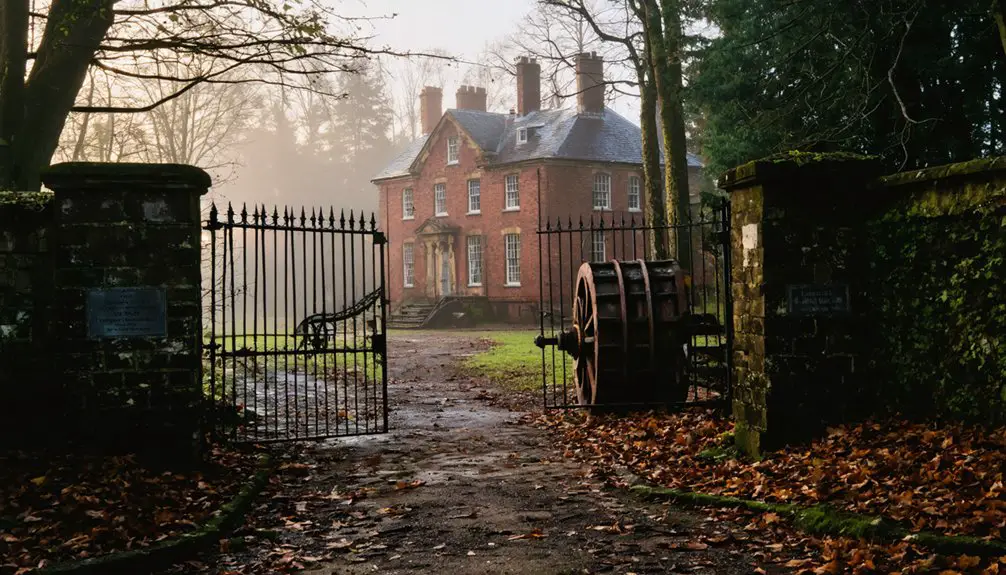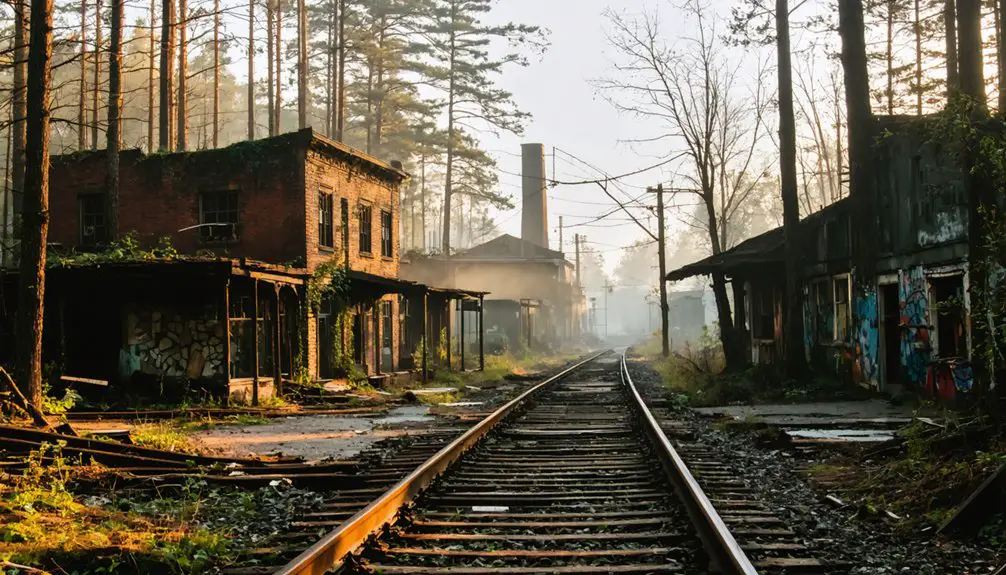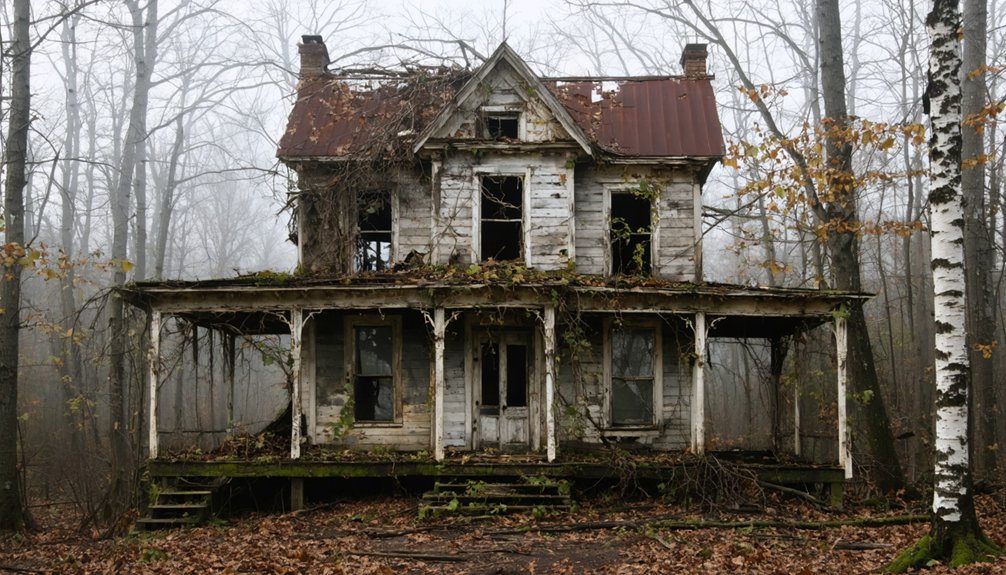
You’ll find New Jersey’s ghost towns where nature reclaims what industry abandoned. Weymouth’s iron furnace foundations disappear beneath moss along Route 559, while Sea Breeze’s coastal structures vanished into the Atlantic by 2010 after fires and erosion destroyed Warner House and its Prohibition-era taverns. Feltville’s strict papermill community collapsed in 1857, leaving preserved workers’ cottages in a county park. These sites reveal how Delaware Bay oyster outposts, charcoal-fueled foundries, and Pine Barrens settlements surrendered to forests and waves, preserving stories of America’s early industrial ambitions beneath advancing wilderness.
Key Takeaways
- Weymouth’s iron furnace foundations and worker housing from 1802-1862 are now moss-covered as nature reclaims the industrial site.
- Atsion’s mansion ruins preserve history of 35 Revolutionary War furnaces after iron production declined and agriculture replaced industry.
- Sea Breeze lost all remaining structures to coastal erosion and seawall failure by 2010 after fires destroyed historic buildings.
- Waterloo Village structures remain preserved but abandoned after Morris Canal commerce collapsed in 1903, ending its transportation hub role.
- Feltville experienced complete abandonment by 1860 following economic collapse, with remnants now preserved within a county park system.
Sea Breeze: A Coastal Resort Swallowed by the Waves
Along the shores of Delaware Bay in Cumberland County, Sea Breeze emerged in the 1800s as a modest outpost serving the region’s thriving oyster industry.
You’ll find this coastal history fascinating—steamboats carried Philadelphia escapees to Warner House‘s forty rooms starting in 1887, where they’d enjoy clambakes and carousel rides along sandy beaches.
During Prohibition, you’d witness Sea Breeze transform into a thriving refuge. Rowboats allegedly smuggled liquor across isolated waters while tourists danced at waterfront establishments.
But nature wouldn’t be tamed. Fire consumed Warner House in 1890. The Seabreeze Hotel burned decades later. Hurricane Gloria destroyed Sea Breeze Tavern in 1985.
When the seawall failed in 2007, relentless waves claimed what remained. Coastal erosion had stripped away significant land over the decades, pushing homes nearing the water’s edge by the 1990s. The cooling sea breeze that once drew summer visitors now swept across empty foundations. By 2010, these lost landmarks vanished completely—demolished after desperate homeowners surrendered to the advancing bay.
Feltville: The Deserted Village of Union County
While Delaware Bay claimed Sea Breeze through relentless erosion, Union County’s ghost town met abandonment through economic collapse rather than natural disaster.
Feltville history began in 1845 when David Felt purchased 760 acres to build a papermill town. His paternalistic rule earned him “King David” as he controlled workers’ lives through mandatory church attendance and education.
David Felt’s iron-fisted governance transformed his papermill settlement into a company town where workers surrendered personal freedom for employment.
The 1857 financial panic destroyed Felt’s investments, forcing abandonment in 1860. He predicted the village would “go to hell” without him—a prophecy fulfilled as six ownership changes brought failed ventures:
- Sarsaparilla production facilities
- Cigar manufacturing operations
- Silk cultivation experiments
The property transformed into Glenside Park resort in the 1860s, attracting New York City visitors seeking a mountain retreat before the Jersey Shore’s popularity caused its eventual decline. The resort closed in 1916, and the site was incorporated into county park in 1921.
Waterloo Village: From Lenape Settlement to Living Museum
You’ll find Waterloo Village’s story begins 12,000 years ago when Lenape ancestors settled along the Musconetcong River’s banks, establishing what they called Winakung—”Place of Sassafras.”
By the mid-1700s, European colonists transformed this landscape into an ironworks that would forge weapons for Washington’s Revolutionary Army, displacing the indigenous communities that had thrived here for millennia.
The arrival of the Morris Canal in the early 1800s reshaped the settlement once more, turning it into a bustling transportation hub for iron ore and coal before its eventual abandonment and modern reconstruction as a living museum.
The Lenape sustained themselves through dugout canoe fishing and farming, with women cultivating corn, squash, and beans while men hunted and crafted tools from the abundant natural resources surrounding their riverside villages.
Today, the New Jersey Department of Environmental Protection operates the site, featuring reconstructed bark wigwams and longhouses that authentically depict Lenape life as it existed in 1630.
Lenape Origins and History
Before European settlers transformed New Jersey’s landscape, the Lenape people thrived along the Musconetcong River for over 10,000 years.
The Lenape migration began when their ancestors crossed from Asia 15,000 years ago, gradually spreading eastward to establish communities throughout the region. Archaeological evidence reveals their continuous presence in the Waterloo area since 8600 BC.
The Lenape lifestyle centered on self-sufficiency and environmental harmony:
- Men hunted abundant wildlife and fished the rivers while women cultivated vegetables and maintained households.
- Handmade dugout canoes served as primary transportation along waterway networks that you’d recognize today as colonial roads.
- Villages featured wigwams and pottery-making, evolving into large agricultural settlements by A.D. 500.
This Algonkian-speaking civilization built a sophisticated culture in fertile glacial valleys before colonial displacement forced westward relocation. Other Algonquin tribes respectfully called the Lenape “grandfathers”, acknowledging their status as original people. The Musconetcong River provided essential resources for fishing and transportation, sustaining Lenape communities for millennia.
Canal Era Transformation
The discovery of bog iron ore along the Musconetcong River in 1761 transformed the former Lenape settlement into Andover Forge, where Revolutionary-era ironworkers established New Jersey’s industrial footprint in what you’d find today as Waterloo Village.
John Smith’s 1831 acquisition consolidated over 2,000 acres, strategically positioning the settlement where Morris Canal, railway, and roads would intersect. The canal’s completion that year revolutionized canal commerce, turning the renamed Waterloo into a thriving transport hub by the 1840s.
Smith’s sons developed village infrastructure—constructing hotels, stores, and the Methodist Church—while waterfront warehouses processed goods for America’s expanding frontier. Mule-pulled canal boats transported up to 70 tons of coal and cargo through Waterloo’s waterways, cementing its role as a commercial powerhouse.
The 1855 railroad arrival fulfilled Smith’s vision, but canal commerce’s 1903 collapse triggered Waterloo’s abandonment, leaving preserved structures that document New Jersey’s canal-era prosperity. The Waterloo Foundation for the Arts was established in the 1960s to manage and promote restoration of the historic village.
Walpack Center: A Farming Community Frozen in Time
Today, you’ll find preserved 19th-century structures that tell stories of independence:
- The one-room schoolhouse where children learned before automobiles connected them to distant towns
- A Methodist church still accessible during warmer months
- Original post office and homes with intact radiators and checkered tiles
Seven residents remain in this protected historic site, surrounded by wilderness reclaiming what was once cultivated farmland.
Batsto Village: The Best Preserved Town of the Pine Barrens
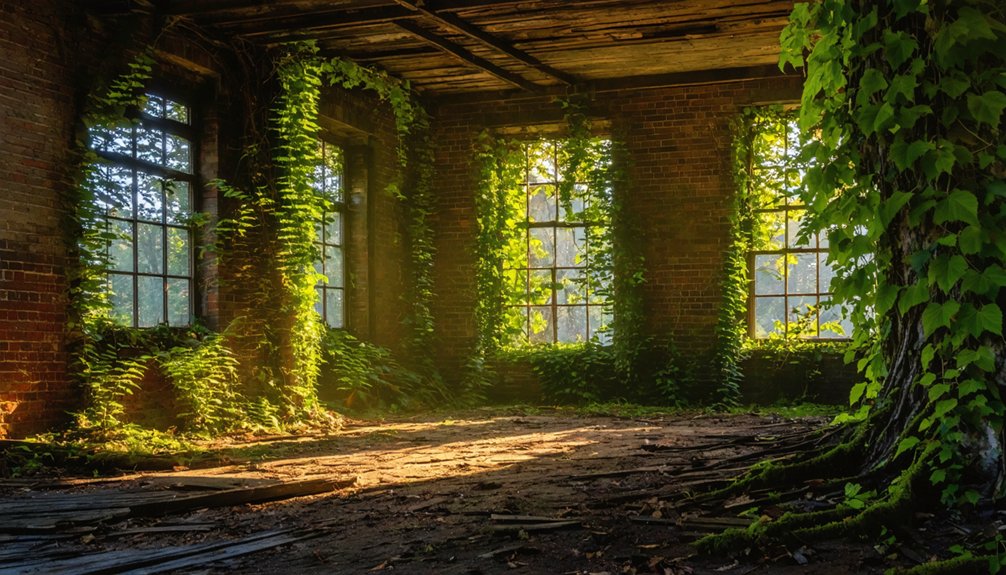
While Walpack Center’s farmhouses stand silent in the Delaware Water Gap, another preserved community tells a different story of early American industry.
You’ll find Batsto Village deep in the Pine Barrens, where Charles Read established his iron works in 1766. The Batsto history reveals how colonists transformed bog ore and forest wood into weapons for Washington’s army during the Revolutionary War.
Iron production thrived here for nearly a century under the Richards family’s ownership from 1784 to 1876.
When iron declined, glassmaking briefly sustained the community before economic collapse.
Joseph Wharton rescued Batsto in 1876, preserving the mansion and village buildings.
New Jersey’s 1950s acquisition saved this industrial settlement from complete abandonment, creating a window into America’s self-reliant past along the Batsto River.
Weymouth: Remnants of the Wharton Industrial Era
Deep within Atlantic County’s pine forests, Weymouth’s stone arches and chimney stack mark where George Ashbridge and Charles Shoemaker transformed bog iron into essential wartime supplies.
From 1802, their charcoal-fueled furnaces shaped local bog ore into cannons for the War of 1812, then pivoted to water pipes and cookware during the 1850s boom.
From bog ore to battlefield cannons, then pivoting to domestic ironwork—Weymouth Furnace armed a young nation before serving its growing households.
The Weymouth ruins reveal three distinct industrial chapters:
- Iron production (1802-1862): Twenty workers’ houses surrounded furnaces converting Pinelands bog ore into ammunition
- Paper mills (1860s-1897): Stone and wooden structures recycled manila rope into paper using river power
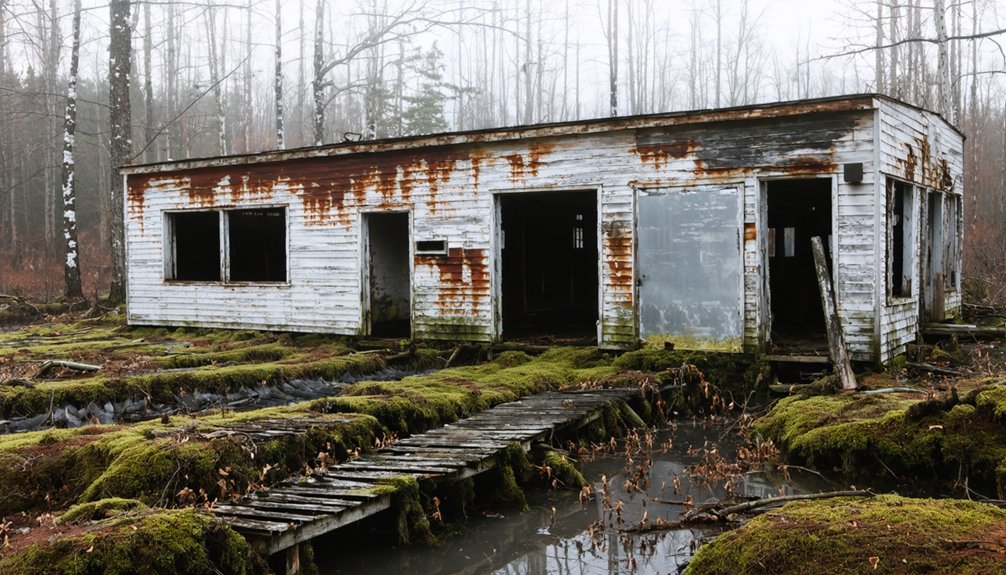
- Natural reclamation (1898-present): Moss-covered foundations where Atlantic County parkland returns to wilderness
You’ll find this industrial legacy accessible via Route 559, where crumbling stonework demonstrates how Pennsylvania’s anthracite coal permanently displaced New Jersey’s charcoal-based independence.
Atsion and Whitesbog: Agricultural Heritage Sites of the Pinelands
Along the sandy trails where charcoal smoke once blackened Pinelands skies, Atsion’s industrial past pivoted from iron to agriculture as bog ore deposits couldn’t compete with Pennsylvania’s anthracite revolution.
You’ll find Atsion history preserved in mansion ruins where 35 furnaces once forged Revolutionary War munitions from bog iron and charcoal.
Nearby, Whitesbog heritage tells a different story. James Fenwick’s 1857 cranberry gamble along Cranberry Run transformed “Skunk’s Misery” into prosperity.
His son-in-law Joseph White expanded operations until Elizabeth White revolutionized American agriculture by domesticating blueberries in 1915.
African-American and Italian-American laborers built satellite communities like Rome and Florence, now razed but remembered through oral histories captured by preservation trusts that maintain these sites as monuments to Pinelands innovation.
Frequently Asked Questions
Are Ghost Town Sites in New Jersey Open to Public Exploration Year-Round?
You’ll find ghost town accessibility varies—most sites welcome exploration dawn to dusk year-round, though seasonal restrictions apply to specific buildings. Remarkably, nature’s reclamation coincides with humanity’s preservation efforts, letting you experience history’s remnants freely across designated trails.
What Safety Precautions Should Visitors Take When Exploring Abandoned New Jersey Towns?
You’ll need sturdy boots and flashlights for traversing abandoned structures, while maintaining awareness of wildlife encounters. Research each site’s history through archival sources, never explore alone, and respect the delicate balance between human curiosity and nature’s reclamation.
Can People Legally Metal Detect or Collect Artifacts From These Ghost Towns?
You can’t legally metal detect or collect artifacts without permission. Metal detecting regulations and artifact preservation laws protect these historically significant sites on public lands, while private properties require owner consent before exploration.
Are There Guided Tours Available for New Jersey’s Ghost Town Locations?
You’ll find guided ghost tours at several locations, including Batsto Village’s mansion tours and Feltville’s haunted hayrides. These experiences reveal the historical significance of abandoned settlements where nature’s gradually reclaiming humanity’s footprints.
How Do Wildlife Refuge Designations Affect Access to Former Town Sites?
You’ll find freedom restricted where it once thrived—wildlife management designations close former settlements through access regulations, requiring entrance fees and seasonal closures. Ironically, protecting nature now limits your exploration of abandoned human communities.
References
- https://thedigestonline.com/new-jersey/the-forgotten-beach-town-of-nj-sea-breeze/
- https://jerseydigs.com/ghost-towns-in-nj/
- https://southjerseytrails.org/2017/03/16/six-pine-barrens-ghost-towns-to-explore/
- https://www.jerseysbest.com/community/take-a-road-trip-through-n-j-s-spooky-ghost-towns-to-see-peculiar-pieces-of-history/
- https://www.youtube.com/watch?v=ZIp3AYb0ulw
- https://www.youtube.com/watch?v=CNzLeOWeG8A
- https://pinelandsalliance.org/learn-about-the-pinelands/pinelands-history-and-culture/ghost-towns-of-the-pine-barrens/
- https://www.youtube.com/watch?v=Qy9ZpNzLS20
- https://en.wikipedia.org/wiki/Sea_Breeze
- https://www.onlyinyourstate.com/experiences/new-jersey/abandoned-beach-town-nj