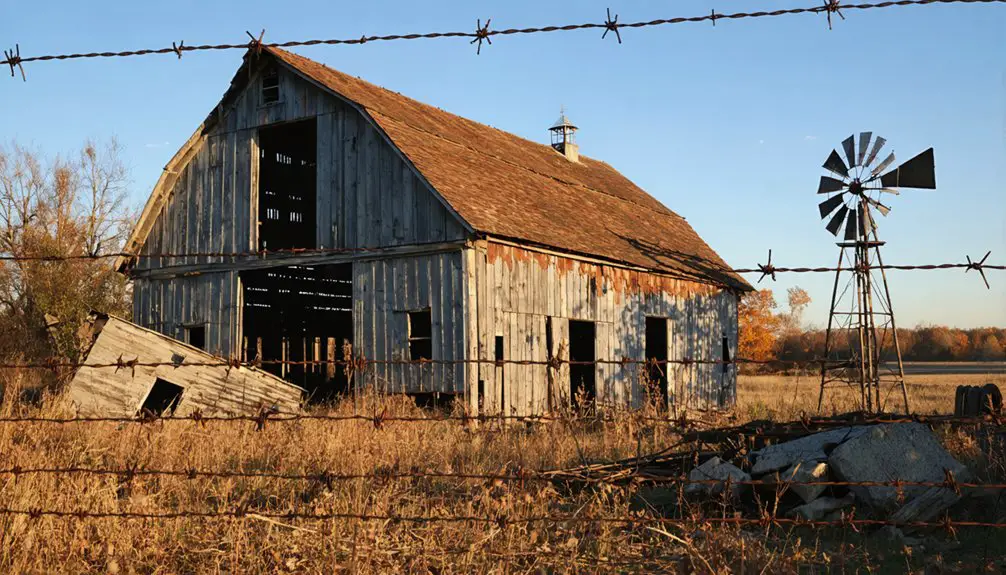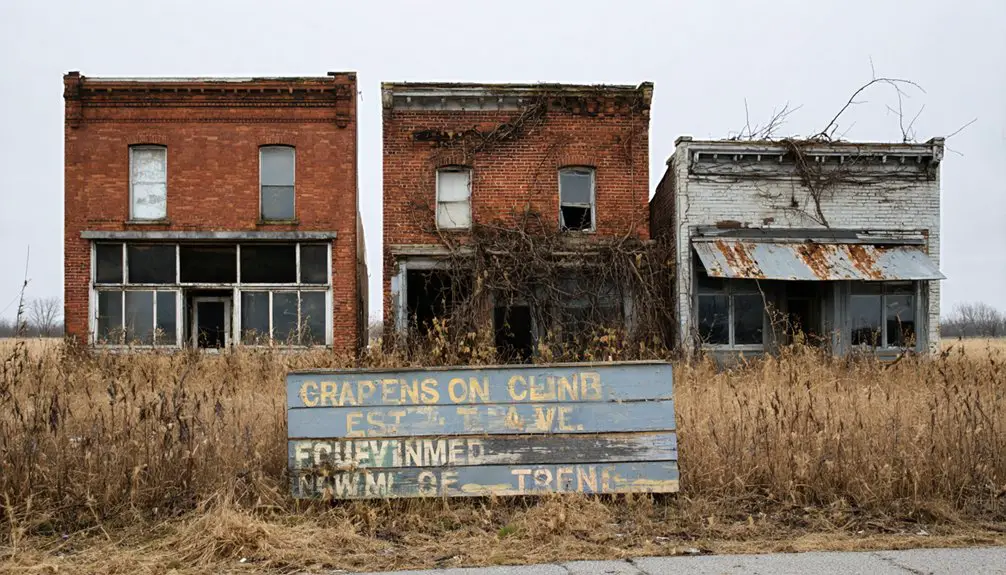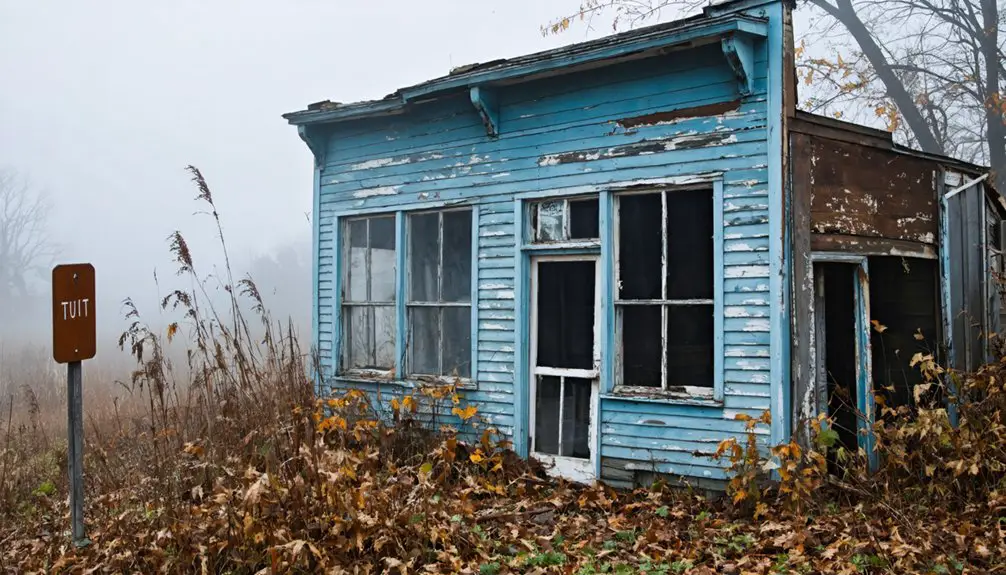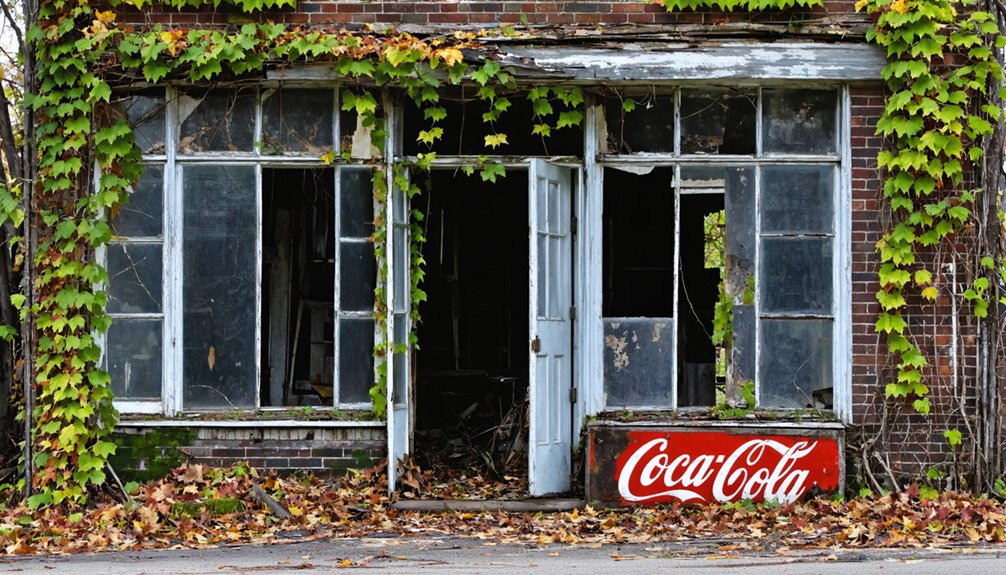
You’ll find Ohio’s ghost towns slowly disappearing beneath forest canopies, where stone foundations and rusted infrastructure tell stories of vanished communities. Moonville’s railroad remnants hide in Vinton County’s woods, while San Toy’s collapsed mine entrances and jailhouse crumble among encroaching vegetation. Orbiston’s furnace ruins and Spruce Vale’s canal locks have become archaeological puzzles as nature reclaims what industry abandoned. These moss-covered relics showcase the ongoing transformation from bustling settlements to weathered stone monuments, revealing how ecological succession systematically erases human enterprise across Ohio’s Appalachian landscape.
Key Takeaways
- Moonville, San Toy, Orbiston, Spruce Vale, and Hartleyville are Ohio ghost towns being reclaimed by forest vegetation and natural overgrowth.
- Vinton Furnace’s moss-covered iron stacks and unique Belgian coke ovens showcase nature’s gradual consumption of industrial monuments since 1883.
- Stone foundations, masonry locks, and building depressions remain hidden beneath vegetation, creating archaeological puzzles in the landscape.
- Vegetation patterns and unnatural topographical features reveal locations of former agricultural activities and vanished settlements throughout Ohio’s forests.
- Forest reclamation transforms human-made structures into weathered stone relics, with careful observation required to interpret these historical sites.
Moonville: Where Railroad Ghosts Haunt the Forest
Deep in the forests of southeastern Ohio, where nature has reclaimed what industry once built, the Moonville Tunnel stands as a monument to a vanished railroad town.
You’ll find this ghost town in Vinton County’s Hocking Hills, where the Cincinnati and Marietta Railroad once hauled coal, clay, and iron ore through dense wilderness.
At its peak around 1856, Moonville housed 100 residents who worked the mines and mills. By 1947, the last family left, and today only the tunnel, cemetery, and foundations remain along a gravel rail trail.
The narrow passage witnessed an estimated 27 deaths, spawning Moonville legends and persistent ghost sightings—phantom lanterns that once stopped real trains until 1981, when automated signals finally ended the supernatural disruptions. The railroad line was abandoned in 1988, with plans for a rail trail in development.
Every October, thousands gather for the Midnight at Moonville Festival, where ghost stories blend with education about Appalachian heritage and the region’s industrial past.
San Toy: Coal Town Consumed by the Wilderness
You’ll find San Toy’s descent into wilderness accelerated by the 1924 labor dispute, when striking miners pushed flaming logs into the mine shaft, destroying the town’s economic foundation and essential infrastructure.
Nature began reclaiming the settlement almost immediately after the 1931 abandonment vote, when 17 of 19 remaining residents officially dissolved their community.
Today’s wooded landscape conceals fragments of San Toy’s violent past—a former jail, stairs ascending to vanished homes, and beneath it all, that 1884 mine fire still burning underground. The town was founded in 1900 and housed Ohio’s only hospital for mine workers, serving the dangerous coal mining industry that defined the settlement.
At its peak, over 2,000 residents called this remote coal town home, drawn by employment opportunities in the mines operated by the New England Coal Company.
Violent Labor Disputes
When the Sunday Creek Coal Company established San Toy in 1900 at the northern edge of Ohio’s Hanging Rock Region, it created what would become one of the state’s most volatile mining communities.
The town’s rough character cultivated deep-seated labor struggles that erupted catastrophically in 1924. Disgruntled workers pushed a cart laden with flaming logs into the mine shaft, triggering destruction that consumed the mine, hospital, and theater. This violent confrontation tested community resilience but ultimately sealed San Toy’s fate.
Though the dispute settled, the coal company withdrew investment by 1927, abandoning the scarred landscape. Between 1927 and 1930, San Toy hemorrhaged more residents than any American town. As the mines became non-productive, desperate residents turned to moonshine production as an alternative source of income. Today, visitors can still explore the old jailhouse and other structural remains that mark where nearly 1,000 residents once lived.
Nature’s Complete Takeover
Today’s forested landscape at San Toy conceals nearly all evidence of the thousand souls who once inhabited this densely packed mining settlement. Nature’s resilience has systematically erased the boomtown’s footprint since its 1931 abandonment, transforming urban decay into wilderness.
You’ll find collapsed mine entrances scattered throughout the wooded terrain, alongside roads that lead nowhere and foundations swallowed by undergrowth. The old jailhouse—a symbol of San Toy’s lawless reputation—stands isolated at the intersection of Santoy Road and Township Highway 452, surrounded by encroaching forest.
Steps ascending to vanished homes mark phantom thresholds where miners once crossed. By 1966, even the mill’s foundation stones had dispersed into Sunday Creek. This complete ecological reclamation demonstrates how quickly southeastern Ohio’s forests consume abandoned human settlements. The town shared its name with a Chinese musical comedy that ran for 768 performances in London during the late 1890s, though any connection between the coal settlement and the theatrical production remains unclear.
Remnants of Community Life
The Sunday Creek Coal Company constructed San Toy in 1900 at the northern edge of Ohio’s Hanging Rock Region, establishing what would become one of southeastern Ohio’s most notorious mining settlements.
Today, you’ll find community memories preserved in scattered remnants: the former jail stands hidden in wooded lots at Santoy Road’s southwest corner, while mysterious steps lead nowhere near crumbling foundations. Nearly 1,000 residents once thrived here, supporting a hospital and theater until labor disputes ignited catastrophic fires in 1924.
When mining ceased in 1927, moonshine revenue sustained holdouts until 1931, when 17 of 19 remaining citizens voted for abandonment. These abandoned structures now share space with newer residences, creating an unsettling landscape where wilderness reclaims human ambition.
Orbiston: Iron Furnace Settlement Lost to Time
Deep within Hocking County’s reclaimed forests, Orbiston emerged in 1877 as an iron furnace settlement anchored by the Ogden Furnace, joining neighboring Hellena Iron Furnace as part of the broader Hanging Rock Iron Region‘s expansion into this corner of Ohio.
You’ll find this ghost settlement once housed over 500 residents by 1883, all supporting iron production that yielded 3,000 tons of pig iron yearly through blast furnace methods fueled by 1,200 bushels of charcoal daily.
The settlement’s collapse came swiftly when charcoal-dependent operations couldn’t compete with coke-fired furnaces elsewhere.
The region’s iron industry had capitalized on ferriferous iron ore discovered atop the Vanport Limestone formation, which stretched from Greenup County, Kentucky, through this area of southern Ohio.
Across southern Ohio, 69 furnaces were constructed during the iron industry’s peak, demonstrating the scale of production before the region’s decline.
Today, you can trace stone foundations and furnace remnants reclaimed by vegetation, while Bethel Ridge Cemetery preserves markers of those who worked these vanished operations—tangible evidence of industry’s temporary dominance over wilderness.
Vinton Furnace: Moss-Covered Stacks in the Woods
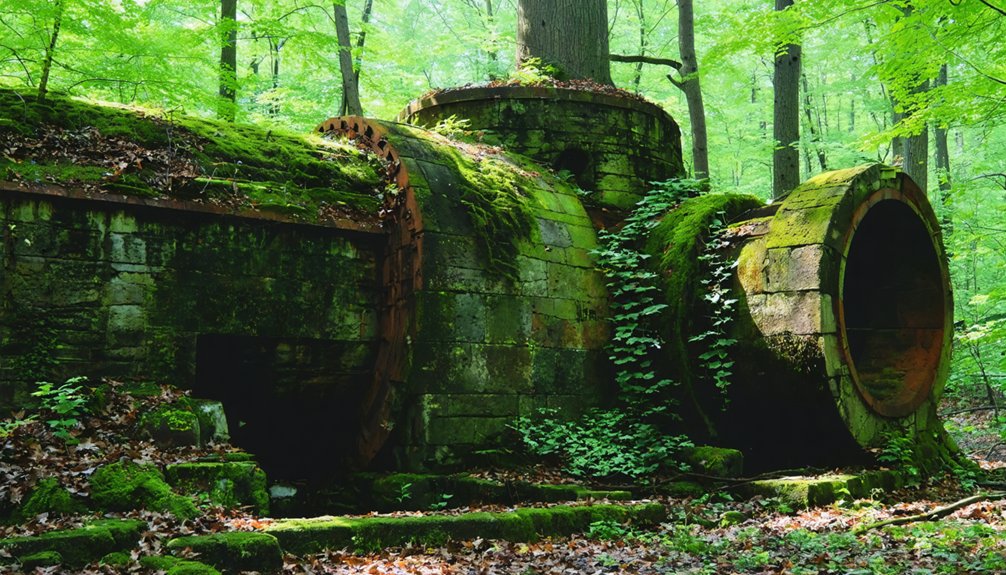
While Orbiston’s ruins remain scattered across Hocking County’s woodlands, Vinton Furnace in neighboring Vinton County presents perhaps the most archaeologically significant industrial remnant in Ohio’s ghost town landscape.
Operating from 1854 to 1883, this facility’s moss-covered stacks stand as monuments to America’s pre-industrial iron age.
These weathered stone relics preserve three decades of industrial heritage, their crumbling facades telling stories of Ohio’s iron-making past.
The site’s historical significance lies in its unique Belgian coke ovens—the last remnants of their kind worldwide:
- Twenty-four ovens constructed with numbered bricks imported from Belgium
- Conversion from charcoal to coke fuel in 1875, representing technological shift
- Visible hot blast house flues and engine house foundations documenting industrial evolution
You’ll find these ruins within Vinton Furnace State Forest, where nature steadily reclaims the stone structures.
The forest has transformed this once-productive ironworks into an outdoor museum of Ohio’s iron industry. At its peak, the modernized coal furnace achieved a rated capacity of 20 tons of metal per day through efficient operations coordinated between indoor machinery operators and outdoor oven workers.
Spruce Vale: Canal Locks Amid Reclaimed Landscape
Established by the Hambleton brothers in 1837, Sprucevale emerged along the Sandy & Beaver Canal as an ambitious commercial settlement that would ultimately succumb to the very infrastructure that birthed it.
You’ll find its remnants within Beaver Creek State Park, where native vegetation has consumed the mills, stores, and lock systems that once defined this waterway community.
The canal history reveals a fatal flaw: insufficient water levels prevented sustainable cargo transport, strangling commerce by 1870.
Today, stone masonry locks lie hidden beneath forest canopy at coordinates 40.708519, -80.576598, accessible via Sprucevale Road.
The site’s abandonment spawned ghost stories, especially Gretchen’s Lock—where legend claims a malaria victim was entombed within the canal’s stonework, attracting paranormal investigators to this reclaimed wilderness.
Hartleyville: Homestead Foundations Swallowed by Forest

Unlike Sprucevale’s stone canal infrastructure that persists beneath the canopy, Hartleyville‘s wooden homesteads dissolved into Athens County’s forest floor with barely a trace. Founded in 1851 along Johnson Run Creek, this agricultural settlement vanished after its post office closed in 1893, leaving freedom-seeking explorers with scattered foundation remnants to discover.
Hartleyville history reveals itself through:
- Archival maps showing vanished roads threading through Trimble Township’s reclaimed farmland
- Crumbling barn foundations emerging from leaf litter like archaeological puzzles
- Johnson Run Creek’s peaceful flow marking the settlement’s original economic lifeline
Homestead exploration here demands detective work—reading forest topography for unnatural depressions, spotting deliberate stone arrangements, interpreting vegetation patterns where cultivation once occurred.
Frequently Asked Questions
Is It Legal to Visit These Abandoned Ghost Towns in Ohio?
Like keys unfastening forgotten doors, ghost town regulations vary—you’ll find abandoned site access legal on public lands and parks, but you must secure written permission for private properties to avoid trespassing charges and fines.
What Safety Precautions Should Visitors Take When Exploring Ghost Towns?
You’ll need essential safety gear including sturdy boots, flashlights, and first-aid supplies while maintaining wildlife awareness for snakes, bears, and bobcats. Always explore in groups, test structural stability, and respect posted boundaries protecting both visitors and historical sites.
Are Guided Tours Available for Any of These Abandoned Sites?
No formal guided excursions exist for these sites—you’ll find freedom through self-directed exploration. Moonville’s tunnel attracts thousands annually, offering historical insights through interpretive trails. State parks like Sprucevale provide managed access to preserved remnants independently.
What Is the Best Time of Year to Visit Ohio Ghost Towns?
Fall’s your ideal window—September through November delivers peak foliage that’ll frame historical ruins beautifully. Weather conditions remain mild, you’ll navigate overgrown sites safely, and seasonal changes showcase nature’s dramatic reclamation of these forgotten settlements most vividly.
Can You Camp Overnight Near These Abandoned Town Locations?
Like wanderers seeking Thoreau’s Walden, you’ll find camping regulations vary by location. Overnight permits aren’t available at Moonville or San Toy’s ruins, but Atwood Lake Park welcomes campers exploring these reclaimed landscapes.
References
- https://hockingvacations.com/blog/exploring-the-ghost-towns-of-ohio-unearthing-forgotten-histories
- https://ohioghosttowns.org/top-10-ghost-towns/
- https://www.youtube.com/watch?v=ONB5GV9T-GI
- https://www.youtube.com/watch?v=QWTtG6njIDs
- https://wrkr.com/ohio-ghost-towns/
- https://en.wikipedia.org/wiki/List_of_ghost_towns_in_Ohio
- https://www.onlyinyourstate.com/state-pride/ohio/abandoned-neighborhood-woodcliff-oh
- https://www.aol.com/articles/abandoned-eerie-former-neighborhood-ohio-040000421.html
- https://www.atlasobscura.com/things-to-do/ohio/abandoned
- https://www.ideastream.org/2023-10-12/how-the-ghosts-of-moonville-are-keeping-the-towns-history-alive