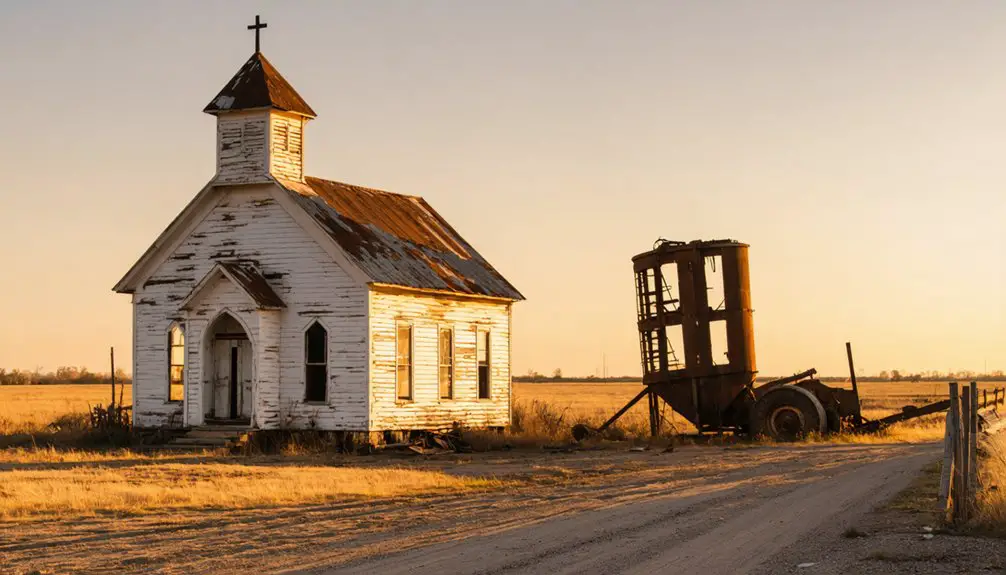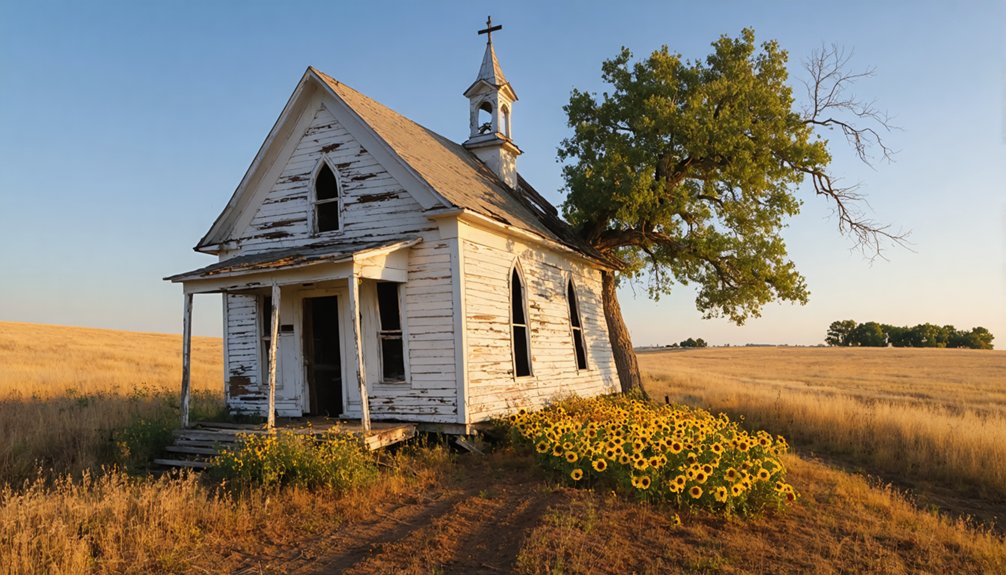
Oklahoma’s ghost towns return to wilderness through three distinct processes: environmental contamination (Picher’s lead-poisoned landscape overtaken by vegetation despite $20 billion in extracted ore), federal dam projects (Lugert, Washunga, and North Fork Town now submerged beneath reservoirs), and economic collapse combined with natural disasters (Glazier’s tornado destruction, McCurtain’s deadly 1912 mine explosion). You’ll find native grasses splitting asphalt, cottonwoods consuming storefronts, and forests concealing settlements like Moral and Skedee—each site revealing how nature patiently erases human infrastructure when communities can’t sustain themselves. The patterns governing these transformations extend far beyond Oklahoma’s borders.
Key Takeaways
- Picher became a ghost town after a 2008 tornado and EPA evacuation due to lead contamination from abandoned zinc and lead mines.
- Vegetation overgrows Picher’s empty buildings while 70 million tons of lead-contaminated chat piles and toxic flooded mine shafts remain.
- Dam projects submerged towns like Lugert, Washunga, North Fork Town, and Woodville under lakes, erasing communities and histories.
- Abandoned settlements like Moral, Skedee, and Ioland have stone foundations and structures consumed by forests and overgrowth.
- Economic collapse and disasters left towns vulnerable to nature, with botanical succession progressively reclaiming isolated ghost town sites.
How Natural Disasters Erased Oklahoma Communities From the Map
When an EF4 tornado tore through Picher, Oklahoma on May 10, 2008, with winds reaching 165 mph, it delivered the final blow to a community already poisoned by decades of lead and zinc mining contamination. The storm claimed six lives and injured 140 residents, prompting the EPA to mandate complete evacuation.
You’ll find similar patterns across Oklahoma’s ghost towns—the tri-state tornado of 1947 obliterated Glazier’s businesses, while fire destruction combined with Depression-era collapse eliminated Brinkman entirely. These weren’t just weather events; they exposed how vulnerable compromised communities become.
Government disaster response through mandatory buyouts sealed Picher’s fate by 2009, with all structures removed by 2010. The tornado overwhelmed emergency services in a town already decimated by the exodus of over 12,000 residents since mining operations ceased in 1967. In McCurtain, a mine explosion in 1912 killed 73 miners and triggered a catastrophic population collapse that forced the town’s merger with neighboring Chant. Community resilience proved impossible when environmental catastrophe met natural destruction, creating conditions where rebuilding simply wasn’t viable.
The Silent Return of Wilderness to Abandoned Mining Towns
Where humanity once extracted $20 billion in lead and zinc ore from Picher’s underground networks, nature now wages a peculiar war of reclamation against an industrial corpse. You’ll find empty buildings succumbing to decay and arson, their structures gradually absorbed by vegetation. Yet this urban reclamation isn’t the ecological healing many would hope for.
Nature’s return to Picher marks not rebirth but a hollow victory—vegetation draping itself over wounds that refuse to heal.
The wilderness that returns carries toxic scars:
- Mountains of chat piles persist amid overgrown streets, their 70 million tons of lead-contaminated tailings unchanged
- Fourteen thousand flooded mine shafts leak acidic metals, turning streams red and poisoning aquifers
- Former residents gather for annual Christmas parades through ghost streets, celebrating memories while traversing a landscape where freedom from industrial legacy remains elusive
Nature reclaims territory, but the contamination endures. The ground itself rebels against occupation, with 86% of buildings standing in zones marked for eventual collapse into the honeycomb of abandoned mines below. The name Picher appears across multiple geographical locations, though this particular town remains Oklahoma’s most notorious example of environmental devastation.
When Rivers and Floods Force Entire Towns to Disappear
Unlike Picher’s slow industrial poisoning, Oklahoma’s drowned towns vanished through deliberate acts of erasure—dam projects that transformed living communities into reservoir beds within months.
You’ll find Lugert’s 1902 foundations beneath Lake Altus-Lugert, exposed only when drought drops water to 9% capacity.
Washunga and original Kaw City disappeared under Kaw Lake‘s 1940s flooding, their neighborhoods bulldozed while residents watched what felt like “a funeral without a casket.”
North Fork Town’s structures vanished beneath damned waters, while Lake Texoma swallowed Woodville’s 360 residents in 1944.
This flood history reveals river dynamics weaponized through federal engineering—communities relocated, cemeteries moved, entire histories submerged.
During severe droughts, these drowned settlements resurface briefly, offering archaeological glimpses before reservoirs reclaim them. The Lake Altus expansion ultimately flooded Lugert after the town had already endured multiple devastating tornadoes that pushed residents toward abandonment.
The reservoirs now provide irrigation and hydroelectric power crucial for Oklahoma’s development, trading lost communities for infrastructure that serves the state’s modern needs.
Forests and Fields Swallowing Oklahoma’s Forgotten Settlements
While submerged towns retain architectural ghosts beneath reservoir waters, Oklahoma’s prairie settlements face erasure through slower botanical conquest—forests and grasslands steadily consuming what stone foundations and wooden frames remain.
You’ll find overgrowth patterns most aggressive where isolation accelerated decline. Moral’s cemetery stands alone in Pottawatomie County’s woods, while Skedee’s tick-infested forest swallows its calaboose. Ingersoll’s 1942 abandonment left structures to weather and vegetation.
The historical significance of these communities fades as nature reclaims:
- Ioland’s 1890s-1920s existence reduced to a cemetery amid fields
- Mineral City’s 80 percent population drop left foundations in grasslands
- Dense tree cover obliterates settlement boundaries entirely
Economic shifts from oil boom prosperity to abandonment left towns like DeNoya and Three Sands vulnerable to nature’s advance. Towns relocated for access to railroads often left their original sites to complete botanical succession. Your freedom to explore these sites decreases annually as botanical succession completes its work.
From Boomtown to Overgrown Ruins: Nature’s Patient Recovery
Picher’s transformation from Oklahoma’s most productive lead and zinc mining center to a federally evacuated wasteland demonstrates nature’s capacity to reclaim industrial landscapes after human abandonment.
You’ll find vegetation consuming structures that once housed 1,640 residents, while 76,800 acre-feet of contaminated water fills the subterranean mines below. The 2008 EF4 tornado accelerated this inevitable shift, killing eight and prompting final evacuations after federal buyout programs.
By 2010, only twenty residents remained—self-proclaimed “Chat Rats” resisting displacement. Today’s urban decay contrasts sharply with historical nostalgia for the mining boom era.
The town produced $20 billion in ore between 1917 and 1947, fueling U.S. military efforts during both World Wars before mining operations ceased. The EPA’s ongoing remediation efforts alongside the Quapaw Nation represent governmental attempts to manage what nature steadily reclaims: contaminated soil, toxic waterways, and collapsed infrastructure from 1967’s mining cessation.
Across Oklahoma’s diverse landscapes, The Nature Conservancy manages 85,553 acres while monitoring how ecosystems recover from various forms of human disturbance through conservation programs.
Frequently Asked Questions
Can You Legally Explore Oklahoma’s Ghost Towns or Is Trespassing Prohibited?
You can’t legally explore most Oklahoma ghost towns without permission, as trespassing laws apply to abandoned private property. You’ll face legal consequences including fines up to $500 and potential jail time, even without posted signs since 2021.
What Valuable Artifacts Have Treasure Hunters Discovered in Abandoned Oklahoma Settlements?
You’ll find treasure hunters haven’t discovered golden artifacts in Oklahoma’s ghost towns, but they’ve unearthed historic relics like mining equipment, arrowheads, pottery sherds, and everyday items from settlements—though trespassing laws complicate your freedom to explore.
Are Any Ghost Towns in Oklahoma Reportedly Haunted by Paranormal Activity?
You’ll find haunted legends throughout Oklahoma’s abandoned settlements. Earlsboro claims the state’s most paranormal sightings, while Ingalls reportedly harbors tortured souls from its outlaw past. Texola’s crumbling Route 66 structures enhance its supernatural mystique through documented ghost encounters.
How Do Property Ownership and Tax Laws Apply to Ghost Towns?
Ghost towns exist in legal limbo where you’ll find property rights frozen in time. Tax implications remain active—unpaid obligations create pathways for acquisition through adverse possession or tax sales, preserving your opportunity for ownership claims.
Which Ghost Towns Offer the Best Preserved Buildings for Photography Enthusiasts?
Texola offers you the best preserved architecture for photography, featuring its National Register-listed Magnolia Service Station and intact commercial structures. You’ll find diverse architectural styles along Route 66, while Picher and Kusa lack standing buildings worth documenting.
References
- http://www.ou.edu/news/articles/2024/may/ou-researcher-unveils-book-of-oklahomas-ghost-towns.html
- https://www.okhistory.org/publications/enc/entry?entry=GH002
- https://en.wikipedia.org/wiki/List_of_ghost_towns_in_Oklahoma
- https://www.youtube.com/watch?v=5d-wHDTIbb0
- https://www.bbcearth.com/news/abandoned-places-reclaimed-by-nature
- https://www.lovemoney.com/gallerylist/86648/americas-empty-ghost-towns-and-why-theyre-abandoned-today
- https://abandonedok.com/city/northern-oklahoma/
- https://www.youtube.com/watch?v=WCoabzqxjpw
- https://www.beaversbendcreativeescape.com/se-oklahoma-ghost-towns/
- https://mix941kmxj.com/25-texas-and-oklahoma-ghost-towns-and-the-legends-they-left/