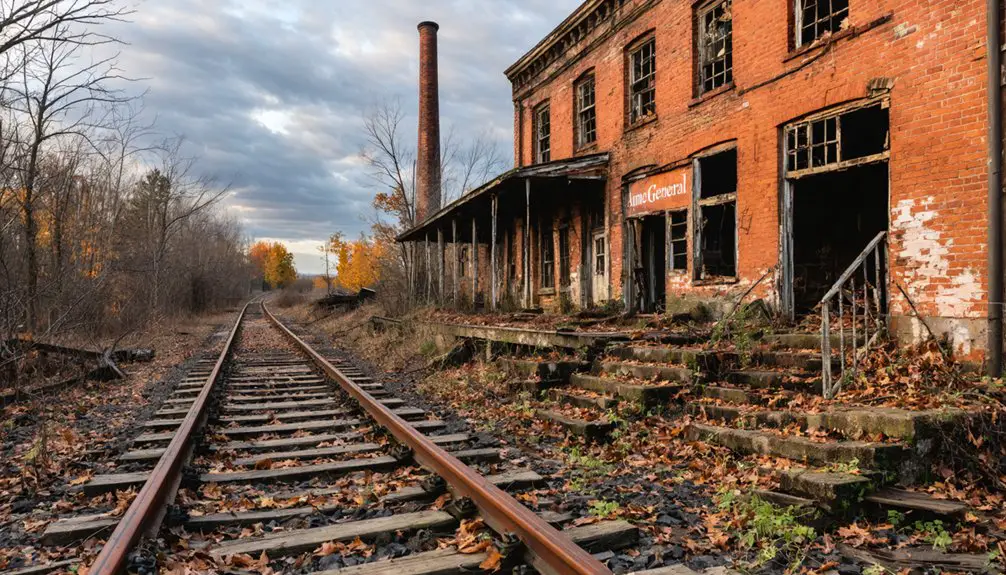
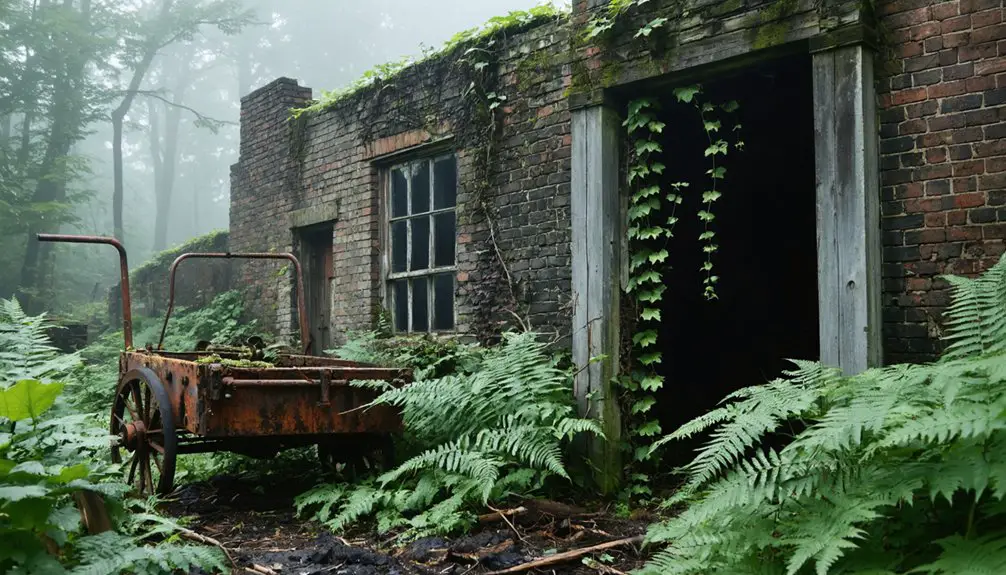
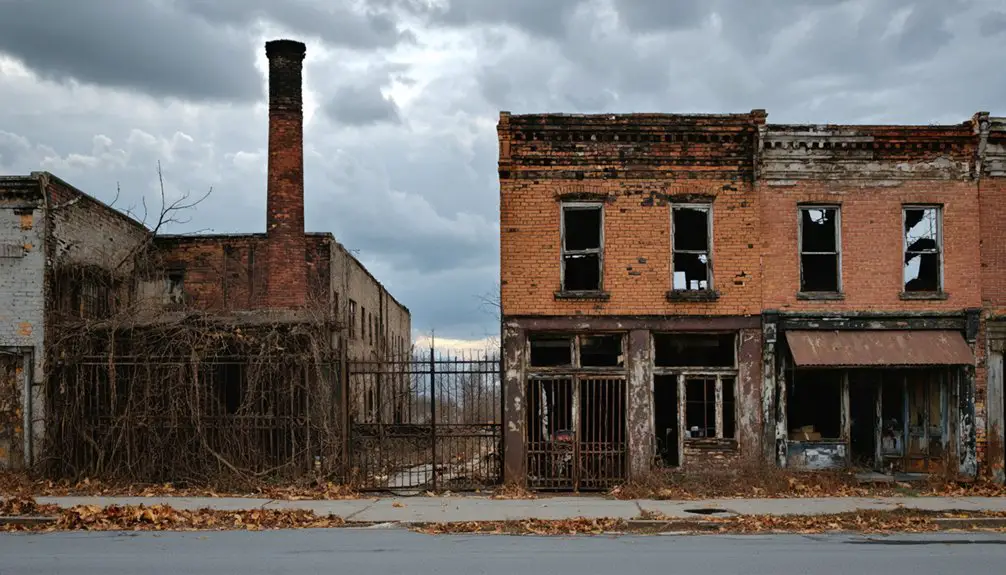
Pennsylvania’s ghost towns tell a story of industrial capitalism‘s boom-bust cycles, where over 11,000 abandoned mine sites across 44 counties now face nature’s patient reclamation. You’ll find vegetation covering 80% of post-1972 mining sites, creating self-sustaining ecosystems where coal extraction once scarred the landscape. From Centralia’s underground fires to collapsed lumber towns like Laquin, these abandoned communities represent $1 billion in environmental debt affecting 1.4 million residents. The transformation from industrial wasteland to regenerating wilderness reveals complex ecological patterns that illuminate both Pennsylvania’s extractive past and its uncertain rural future.
Key Takeaways
- Pennsylvania has over 3,000 abandoned towns from collapsed coal, lumber, and oil industries of the 19th and 20th centuries.
- Centralia became a ghost town after a 1962 underground coal fire forced federal relocation of residents in 1983.
- Abandoned mining sites show vegetation recovery exceeding 80% coverage, with ecosystems now supporting native wildlife populations.
- Approximately 250,000 acres of abandoned mine lands across 44 counties are gradually being reclaimed by natural processes.
- Former lumber camps and mining communities disappear as forests regenerate, reversing environmental devastation from systematic overharvesting.
The Rise and Fall of Pennsylvania’s Coal Mining Communities
When coal first emerged from Pennsylvania’s hills in the mid-18th century, it catalyzed an economic transformation that would define the state’s industrial character for nearly two centuries.
You’ll find that coal town development followed a predictable pattern: discovery led to infrastructure investment, then settlement. By 1810, communities like Coal Town emerged in Lawrence County, while Summit Hill became the anthracite region’s first company town after 1792. Pittsburgh alone consumed over 400 tons daily by 1830.
However, mining community decline proved equally systematic. When Neshannock Township’s coal failed coke production standards in 1871, operators abandoned their ovens by 1886. Railroad competition eliminated toll roads by 1872, severing isolated communities from markets. The plank road constructed in 1853 featured three-inch oak planks that allowed two horses to haul up to four tons of coal, revolutionizing transport efficiency before becoming obsolete within two decades. Economic depression in 1849 closed all coke-fired blast furnaces in Pennsylvania, devastating the communities dependent on these industrial operations.
You’re witnessing how economic forces created and destroyed entire settlements.
Centralia: When Underground Fires Force a Town to Disappear
On May 27, 1962, Centralia’s borough personnel ignited what would become America’s most enduring industrial disaster when they set fire to trash in the municipal dump—a former strip mine pit near Odd Fellows Cemetery—to clean it before Memorial Day.
The flames penetrated an incomplete clay barrier, reaching the Buck Mountain coal seam beneath. Fire control efforts—wet sand, air redirection, vent pits—failed across two decades due to inadequate funding and political paralysis.
The blaze spread through 3,700 acres at 300 feet deep, advancing 75 feet annually along four branches. Carbon monoxide and sulfurous fumes suffocated residents while sinkholes threatened to swallow children whole. In 1981, a 12-year-old nearly fell into an 80-foot sinkhole that opened beneath him.
Community displacement followed inevitably: federal authorities spent $42 million relocating Centralia’s 1,435 residents in 1983, demolishing most structures. In 1992, the government invoked eminent domain to condemn all remaining buildings in the town.
Fewer than six people remain today.
The Staggering Scale of Abandoned Mine Lands Across the State
Centralia’s smoldering nightmare represents merely one visible symptom of Pennsylvania’s coal extraction legacy—a statewide environmental catastrophe whose scale defies easy comprehension.
You’re looking at 250,000 acres of abandoned landscapes, with 11,249 documented mine sites scattered across 44 counties. Nearly 10,000 of these locations pose active environmental or safety threats—from collapsing shafts to acidic drainage poisoning over 5,500 miles of waterways.
Pennsylvania shoulders one-third of America’s entire abandoned mine problem, affecting 1.4 million residents living within a mile of these toxic sites. The estimated $1 billion required for environmental restoration barely scratches the surface of what’s needed to reclaim lands where extraction economics privatized profits while socializing devastating long-term costs your communities still bear today.
This devastation stems from over 15 billion tons of coal extracted from Pennsylvania soil, fueling the nation’s industrial expansion while leaving behind a environmental debt that dwarfs the wealth once created. These abandoned sites have transformed once-thriving communities into desolate landscapes, blocking future development for residential, commercial, or agricultural purposes.
From Lumber Camps to Oil Towns: Pennsylvania’s Diverse Ghost Town Legacy
Pennsylvania’s ghost towns reveal an economic pattern where communities rose and fell with extractive industries that defined 19th and early 20th-century development.
You’ll find lumber camps like Laquin and Norwich housed thousands of workers who cleared vast forests, while sites like Owl’s Nest shifted from logging to oil drilling as entrepreneurs chased new resources.
These settlements weren’t designed for permanence—they existed to exploit timber stands and petroleum deposits, then disappeared when those resources vanished or when railroads redirected their routes to more profitable territories. The coal industry’s decline particularly devastated mining communities, with many towns experiencing population decreases to one-fifth or less of their former size. Across the United States, over 3,000 abandoned towns have been identified as ghost towns, with Pennsylvania contributing its share to this catalogue of communities that once thrived during America’s industrial expansion.
Lumber Boom Towns
While today’s visitors encounter quiet forests along the West Branch Susquehanna River, this landscape once thundered with the activity of America’s most productive timber operation.
Williamsport’s transformation into the “Lumber Capital of the World” wasn’t accidental—the 1846–1851 Susquehanna Boom system revolutionized timber processing. This seven-mile engineering marvel held 300 million board feet, enabling year-round operations that produced 5.5 billion board feet between 1861–1891. The boom required 150 men and boys to sort millions of logs daily, with workers as young as 12 identifying over 1,700 distinct log marks.
You’ll find that Pennsylvania’s lumber heritage created unprecedented wealth; Williamsport boasted the nation’s highest millionaires per capita. Yet this timber legacy collapsed by 1908 through systematic overharvesting, devastating floods, and railroad competition.
The Victorian mansions along “Millionaires Row” now stand as monuments to an extraction economy that consumed itself, leaving second-growth forests where boom cribs once corralled Pennsylvania’s vanished white pine empire. The environmental devastation was so severe that the region earned the nickname “The Pennsylvania Desert,” prompting early conservation efforts led by figures like Dr. Joseph Rothrock and Gifford Pinchot.
Oil Drilling Sites
Just fourteen years after Williamsport’s lumber boom reached full force, Pennsylvania’s extractive economy underwent another radical transformation when Edwin Drake struck oil near Titusville in 1859.
You’ll find Pithole City’s story particularly revealing—500 days from wilderness to 15,000 residents to abandonment. This wasn’t gradual decline but economic collapse compressed into months.
When oil prices crashed from $8.00 to $2.50 per barrel in 1866, your freedom-seeking speculators discovered how quickly fortune turns.
The environmental impact of unregulated oil extraction remained long after fires destroyed those 900 wooden structures.
Today’s preservation efforts can’t restore what burned, but they document how industrial capitalism’s boom-bust cycles leave permanent scars on landscapes and communities alike.
Nature’s Slow Recovery: How Vegetation Reclaims Former Mining Sites

When abandoned mining sites first lie bare and scarred, few observers would predict the dramatic ecological transformations that unfold over subsequent decades.
You’ll witness vegetation recovery accelerating dramatically—herbaceous cover exceeds 80 percent on post-1972 reclaimed sites in Virginia’s coal country.
However, ecosystem restoration follows complex patterns you won’t find in textbooks. White pine shading reduces ground cover on 1980s sites, while red maple creates similar effects on 1970s parcels. Tree basal area climbs fastest where eastern white pine dominates.
Self-sustaining ecosystems now support native wildlife across reclaimed mines, proving nature’s resilience when given opportunity.
Reclamation practices determine recovery rates, demonstrating that strategic intervention accelerates what time alone achieves slowly.
Pennsylvania’s experience mirrors these dynamics across abandoned extraction sites.
The Future of Rural Pennsylvania: Depopulation and Emerging Ghost Towns
Pennsylvania’s rural counties face demographic collapse that transforms them into candidates for twenty-first-century ghost towns.
You’re witnessing population migration trends that stripped 12,200 residents from rural areas between 2020-2024, while deaths outnumbered births by 61,100.
Forest County expects nearly 20% population loss by 2050, and Wayne County faces 15% decline.
The workforce shrinks as baby boomers age without replacement from younger generations.
Despite net migration gains of 46,600 residents, they can’t offset the exodus to urban centers that gained 94,800 people.
Pennsylvania’s Rural Population Revitalization Commission now champions rural revitalization strategies focused on remote work incentives and quality-of-life improvements.
Without intervention, these communities risk following abandoned mining towns into obscurity, their infrastructure slowly surrendering to nature’s patient reclamation.
Frequently Asked Questions
Can You Legally Visit Pennsylvania’s Ghost Towns or Is Trespassing Enforced?
You’ll face Pennsylvania’s trespassing laws even in ghost towns unless you’ve obtained legal permissions from property owners. Many abandoned sites remain privately owned, so research ownership beforehand and respect posted boundaries to maintain your freedom to explore responsibly.
Exploring ghost town attractions in Pennsylvania can reveal fascinating history and unique architecture. However, always keep in mind that safety should be a priority, as some structures may be unstable. Take the time to appreciate the stories behind these locations while ensuring you are following the legal requirements.
Are There Guided Tours Available for Exploring Abandoned Mining Communities?
You’ll find guided exploration at several preserved mining communities like Eckley Miners’ Village and No. 9 Mine, where you can freely experience their historical significance through tours led by knowledgeable guides who understand coal country’s cultural legacy.
What Safety Hazards Exist When Visiting Former Coal Mining Ghost Towns?
You’ll face hidden dangers like toxic contamination from heavy metals, unstable abandoned structures prone to collapse, underground fire risks, and sudden subsidence creating sinkholes. These interconnected hazards demand long-term awareness when you’re exploring independently.
How Do Property Rights Work in Pennsylvania’s Abandoned Ghost Town Areas?
You’ll find that 10-year adverse possession claims can establish ownership of abandoned properties in Pennsylvania’s ghost towns, though legal implications vary. These unclaimed lands present opportunities where nature’s reclamation intersects with evolving property law frameworks.
Which Pennsylvania Ghost Towns Are Most Accessible for Beginner Explorers?
You’ll find the best locations for beginners at Eckley Miners’ Village and Pithole City, offering easy routes with maintained paths, historical context, and legal access that’s evolved from Pennsylvania’s industrial heritage into accessible public spaces.
References
- https://www.cambriaconservationrecreation.com/2020-trail-of-the-year/
- https://patch.com/pennsylvania/across-pa/these-pa-counties-could-have-ghost-towns-2100-new-study
- http://webspace.ship.edu/cajant/documents/white_papers/Littlefield_533_2015.pdf
- https://www.youtube.com/watch?v=2KA2U56jXfQ
- https://en.wikipedia.org/wiki/List_of_ghost_towns_in_Pennsylvania
- https://www.geotab.com/ghost-towns/
- https://www.youtube.com/watch?v=Ywx9DBDDLEM
- https://papers.ssrn.com/sol3/Delivery.cfm/SSRN_ID4071735_code920036.pdf?abstractid=4071735&mirid=1
- https://groups.io/g/ChickBook/topic/article_ghosts_among_us_the/109523916
- https://www.lawrencechs.org/the-road-to-coal-town/