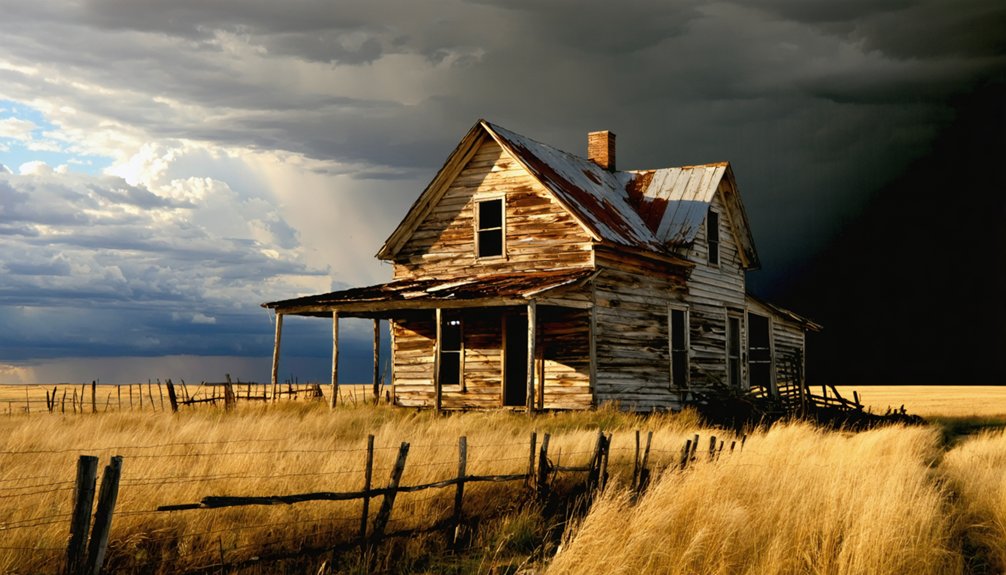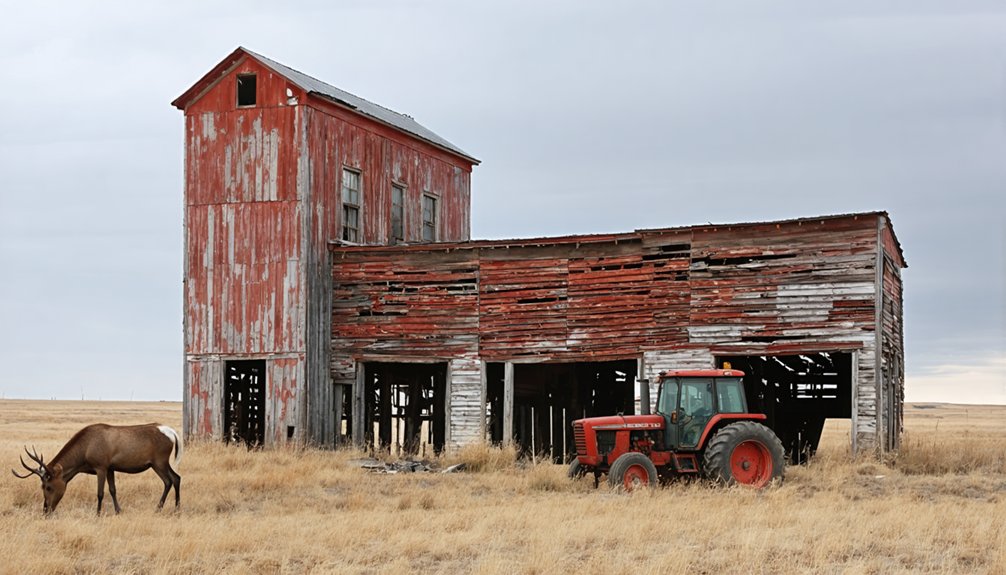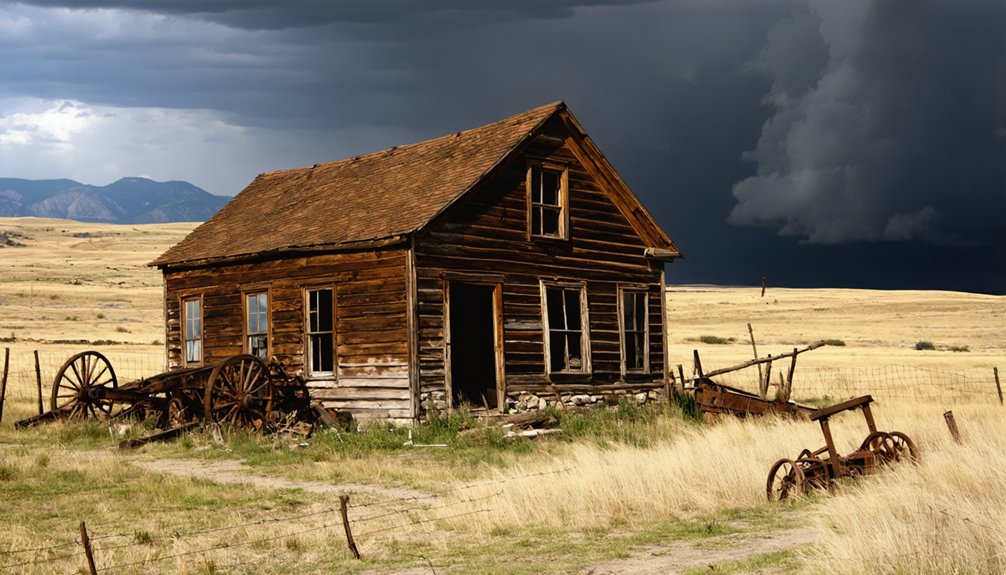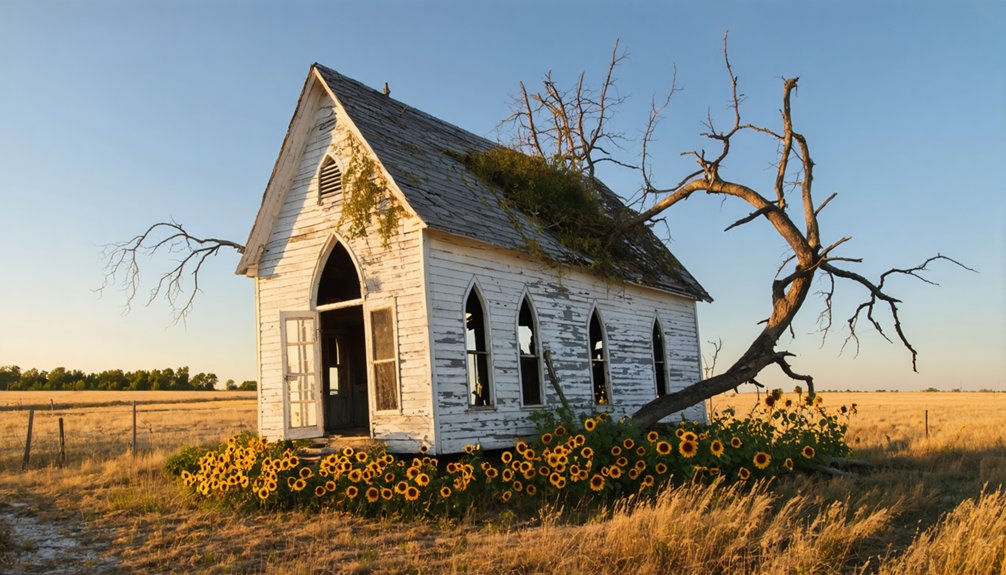
You’ll find nature systematically reclaiming 245 abandoned settlements across South Dakota’s plains and Black Hills, where grass overgrowth obscures foundations and wind strips wooden structures to their frames. Mining towns like Pactola and Rockerville, once bustling with hundreds during the 1870s gold rush, now feature collapsing buildings with deteriorating shingles as prairie vegetation transforms former railroad grades into cattle pathways. These ghost towns represent decades of economic collapse following ore depletion, and their remnants reveal compelling stories about human ambition meeting environmental persistence.
Key Takeaways
- 245 abandoned settlements across South Dakota have experienced significant population loss, with many becoming empty shells between 1950 and 1980.
- Wind and grass have erased hundreds of Black Hills settlements, stripping wooden grain elevators and obscuring foundations with overgrowth.
- Railroad grades from former mining communities have transformed into natural pathways used by grazing cattle across the prairie landscape.
- Lawrence County contains 93 documented ghost towns, the highest concentration in South Dakota, with minimal traces of civilization remaining.
- Nature continues reverting many ghost town sites to pastureland, leaving only memories as proof of their former existence.
Abandoned Settlements Across the South Dakota Landscape
Across South Dakota’s diverse terrain, 93 documented ghost towns in Lawrence County alone mark the highest concentration of abandonment in the state, forming a scattered archaeological record that tells the story of boom-bust cycles tied directly to resource extraction and transportation infrastructure.
You’ll find these settlement patterns distributed across both eastern and western regions, each displaying distinct abandonment characteristics. The Black Hills region hosts numerous mining camps from the gold rush era, while northeastern counties like Roberts, Grant, and Day contain diminishing settlements fighting rural decline.
Many barren sites have completely reverted to pastureland, their exact locations lost to flooding and time. Nature’s reclamation process continues relentlessly—water covers former townscapes, prairie grasses consume foundations, and wilderness erases what civilization temporarily claimed. Some settlements maintain empty buildings with caretakers, preserving structures without sustaining any real population. Allens Camp in Pennington County, established by Mr. Allen in 1875 or 1876, exemplifies these early mining settlements that briefly flourished before abandonment.
Black Hills Mining Towns Left Behind After the Gold Rush
When gold glittered in Deadwood Gulch in November 1875, it set off a chain reaction that would scatter over 93 settlements across Lawrence County alone. Most were destined to collapse within decades as ore bodies depleted and economic realities crushed prospectors’ dreams.
You’ll find mining history written across landscapes where fortune-seekers established communities practically overnight during the 1876 gold rush, only to abandon them when veins ran dry or extraction became impractical.
Today, these gold rush remnants tell stark stories:
- Gaping mine shafts pierce hillsides at Hornblend and Bald Mountain, monuments to extraction’s environmental toll
- Pactola’s entire town sleeps beneath 150 feet of reservoir water, its structures entombed since 1950
- Eroded tailings create badlands at Galena and Blue Lead, permanently scarring once-pristine terrain
- Castleton sits frozen where slate placers buried gold too deep for nineteenth-century freedom-seekers to reach
The Homestake Mine near Lead stood as the exception, operating continuously and producing 10% of the world’s gold supply over its 125-year lifespan before closing in 2001.
While most camps became ghost towns, Deadwood survived three major fires and transformed itself through legalized gambling in 1989, preserving its legendary past while embracing modern tourism.
Architectural Remnants Still Standing Among the Ruins
While most Black Hills ghost towns dissolved into foundation stones and scattered debris, specific structures defied entropy through superior construction or sheer remoteness from salvagers.
You’ll find Cascade Springs’ ornate stone bank standing symbol of unfulfilled spa dreams, while the banker’s Victorian Gothic home resists decay.
Architectural preservation wasn’t intentional—isolation simply prevented demolition crews from reaching sites like Maitland’s shaft houses or Trojan’s massive cyanide vats.
Remoteness, not intent, saved these structures—demolition crews simply couldn’t reach the isolated mining sites to dismantle them for salvage.
At Cottonwood Prairie, original wood shingles still protect collapsing frames, and a stucco church tower separates from its moorings.
The historical significance of these remnants lies in their authenticity: Mystic’s mine manager house, occupied until the 1970s, and South Dakota’s 1876 chapel represent architecture shaped by boom-era optimism, now surrendering to elemental forces. Cottonwood’s buildings display distinctive lighter color bricks above windows and corners, architectural details that mark the town’s early 20th-century construction methods. These ruins serve as reminders of communities that once thrived with purposes now lost to time, their physical presence evoking the spirits of former inhabitants who built with permanence in mind.
How Wind and Grass Have Overtaken Former Communities
Unlike the architectural survivors clinging to their original forms, hundreds of Black Hills settlements surrendered completely to prairie forces that erased nearly all evidence of human occupation.
Wind erosion stripped wooden grain elevators of their roofs while decades of neglect warped remaining structures beyond recognition. Grass overgrowth transformed over 600 town sites into indistinguishable pasture land, obscuring foundations and railroad tracks beneath vegetation that recognizes no property boundaries.
Nature’s complete reclamation reveals itself through:
- Foundation traces disappearing beneath thick prairie grass where families once built their dreams
- Wind-blown vegetation concealing ash heaps and structural remnants across former commercial districts
- Railroad grades converting to natural pathways as cattle graze where communities once thrived
- Old-timers’ memories becoming the only proof certain settlements ever existed
You’ll find minimal civilization traces at most Black Hills ghost town locations today. Towns like Okaton, established in 1906, saw their railroad service end in the 1980s as the infrastructure that once sustained them vanished into the landscape. In Capa, founded in 1904, the Collapsing Church stands as a haunting reminder of a settlement that once housed 300 residents before nature began reclaiming the land.
Economic Collapse and Population Decline That Emptied the Towns
You’ll find that mining operations created explosive growth in South Dakota’s early settlements, drawing hundreds of fortune-seekers to extract gold and other minerals from the Black Hills and surrounding regions.
When ore deposits depleted or market prices collapsed, these resource-dependent communities lost their economic foundation within months. Economic decline transformed these once-thriving settlements into places where the reason for being no longer existed.
The rapid abandonment that followed left entire townscapes to return to prairie and forest, erasing decades of human modification as wind and native grasses reclaimed the disturbed earth. Researchers identified 245 abandoned settlements across South Dakota that met the criteria for ghost town classification, revealing the widespread nature of community abandonment throughout the state’s history.
Mining Operations Fueled Growth
The Black Hills Gold Rush of 1874 set off a frenzy that transformed South Dakota’s wilderness into a landscape of hastily constructed mining camps and boomtowns.
You’ll find remnants of this mining history scattered across valleys where fortune-seekers once carved their destinies from solid rock. Towns like Pactola swelled to over 300 residents during the 1870s, while Rockerville’s 1876 founding marked another wave of independent prospectors.
The Homestake Mine‘s 1877 opening in Lead created the region’s longest-running operation, extracting gold for 125 years.
The economic impact shaped entire communities:
- Spokane peaked at $144,000 profit in 1927
- Mystic Mill attracted $1 million in investment
- Cambria’s anthracite mines operated profitably for four decades
- Railroad whistle stops emerged wherever miners struck ore
Abandonment When Resources Depleted
Prosperity proved fleeting in these remote mountain settlements. When gold and silver ore quality diminished, you’d witness entire economic systems collapse within months.
Without effective resource management, towns that once housed 300-600 residents became empty shells. The Black Hills communities lacked community resilience—they’d built everything around single mines rather than diversified economies.
You’ll find 245 abandoned South Dakota settlements that met this fate between 1950 and 1980, losing over twenty-five percent of their populations. Banks, schools, and post offices shuttered as residents fled.
For hundreds of former townsites, nature’s reclaimed every trace. These weren’t gradual declines but catastrophic failures where entire populations departed, leaving infrastructure to collapse under prairie winds and mountain snows.
Preserving the Historical Legacy of South Dakota’s Ghost Towns
Scattered across South Dakota’s rugged landscape, over 600 ghost towns stand as evidence to the Black Hills Gold Rush that transformed this region in the late 19th century.
You’ll discover that historic preservation efforts balance nature’s reclamation with maintaining cultural significance. Deadwood earned National Historic Landmark status, preserving authentic 19th-century architecture while welcoming modern visitors.
The Homestake Mine’s transformation into a science facility demonstrates adaptive reuse of industrial heritage.
These remnants tell powerful stories of human ambition:
- Weathered headstones at Mystic’s Pioneer Cemetery reveal the hardships settlers endured.
- Pactola’s lone cabin emerges from 150 feet of reservoir water, haunting symbol of displacement.
- Buena Vista’s massive grindstones remain embedded in earth, too heavy for extraction.
- Former Ardmore residents gather at the old fire station, keeping memories alive through reunion gatherings.
Frequently Asked Questions
Are Ghost Town Visits in South Dakota Legally Permitted on Private Property?
No, you can’t legally visit ghost towns on private property without permission. Ghost town regulations and private property rights remain enforceable despite abandonment. Nature’s reclamation doesn’t nullify ownership—you’ll need consent to explore these decaying historical landscapes.
What Safety Hazards Exist When Exploring Abandoned Mining Structures?
You’ll face compromised structural integrity from decades of timber decay and collapsed tunnels, while wildlife encounters include venomous snakes and predators seeking shelter. Toxic gases, unstable explosives, and concealed shafts create additional life-threatening risks requiring extreme caution.
Can Artifacts Be Legally Collected From South Dakota Ghost Town Sites?
You’ll face absolutely devastating legal consequences if you collect artifacts from ghost town sites. Legal regulations strictly prohibit removing items from public lands, while artifact preservation laws protect cultural resources even on many private properties requiring landowner permission.
Which Ghost Towns Are Most Accessible for Families With Children?
Four Mile and Spokane offer the most family friendly locations, with safe walking paths and structured exploration. You’ll find historical significance meets natural reclamation, where your children can freely wander boardwalks and discover authentic pioneer heritage without excessive restrictions.
Do Any Former Ghost Towns Host Annual Events or Gatherings?
Yes, you’ll find ghost town festivals like Galena’s annual walk and Deadwood’s celebrations where historical reenactments connect you to mining heritage. These gatherings blend cultural preservation with nature’s reclamation, offering authentic experiences beyond conventional tourism constraints.
References
- https://www.nature.org/media/southdakota/assessing-untilled-sod-prairie-coteau-report-2014.pdf
- https://openprairie.sdstate.edu/etd/4061/
- https://core.ac.uk/download/pdf/345016075.pdf
- https://www.blm.gov/sites/default/files/uploads/AML_PUB_NewLegacy.pdf
- https://www.onlyinyourstate.com/experiences/south-dakota/capa-ghost-town-sd
- https://en.wikipedia.org/wiki/List_of_ghost_towns_in_South_Dakota
- https://www.sdpb.org/rural-life-and-history/2023-08-21/some-black-hills-ghost-towns-and-their-origins
- https://www.travelsouthdakota.com/trip-ideas/abandoned-beauty-ghost-towns-structures-south-dakota
- https://www.lovemoney.com/gallerylist/86648/americas-empty-ghost-towns-and-why-theyre-abandoned-today
- https://everafterinthewoods.com/deserted-ghost-towns-in-south-dakota-that-history-buffs-still-visit/