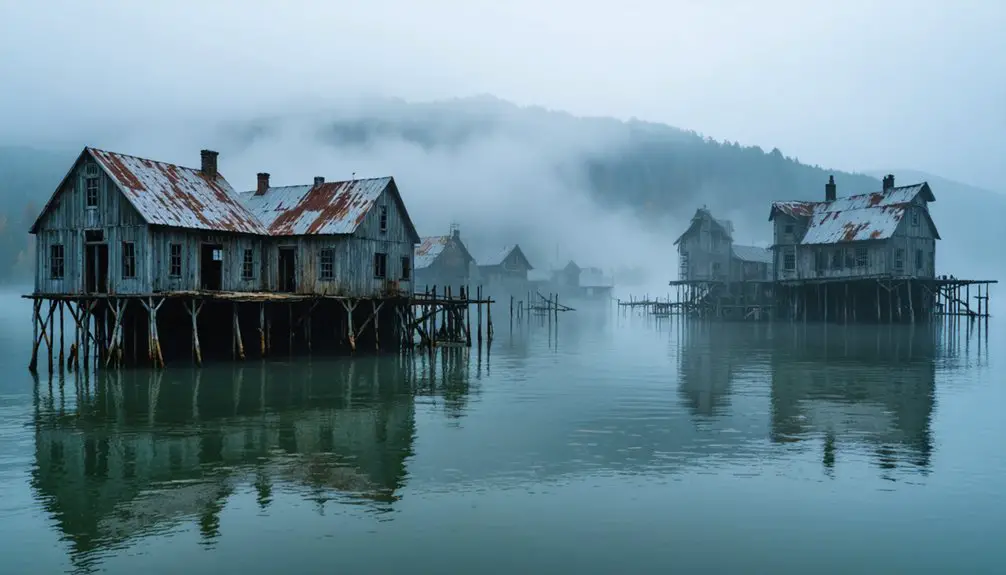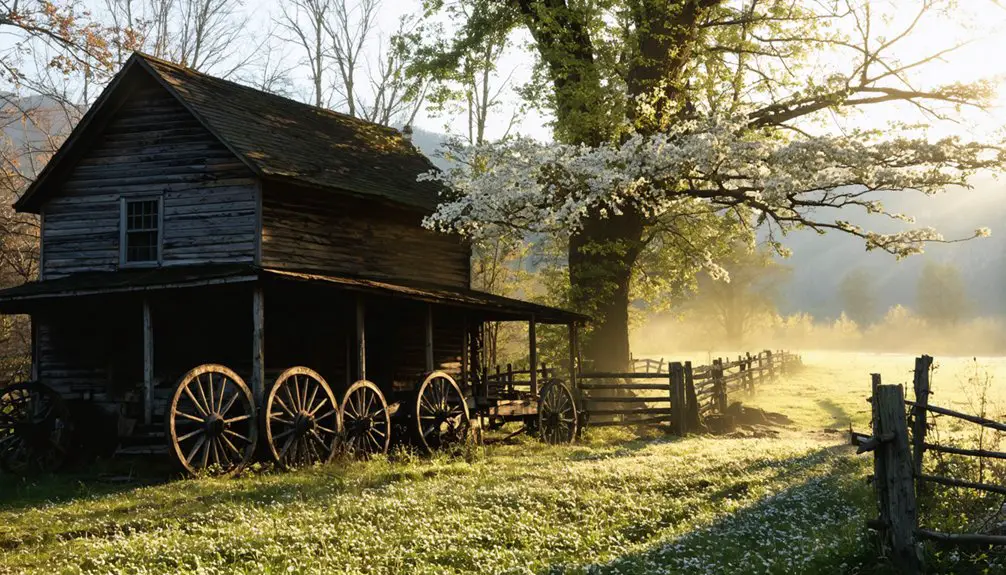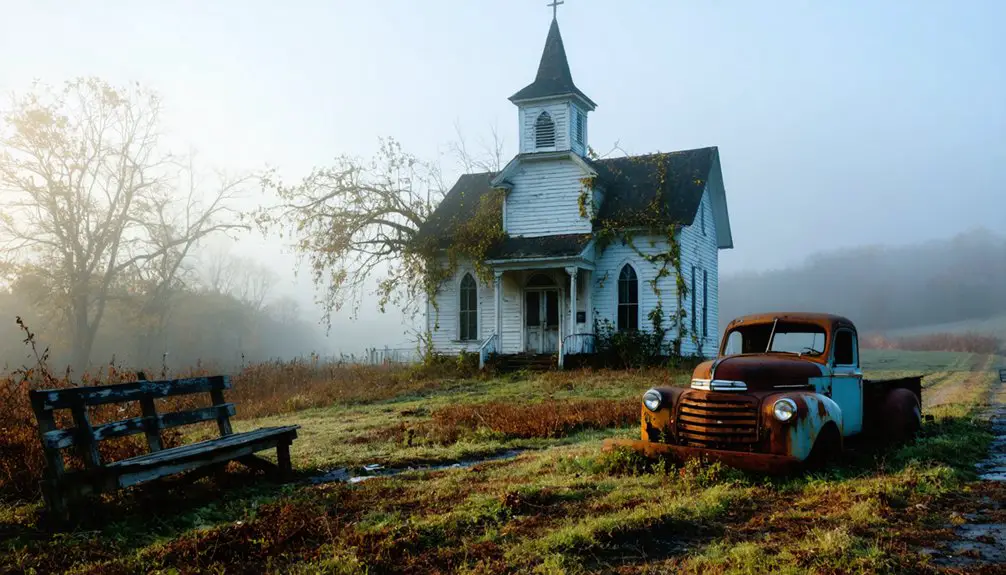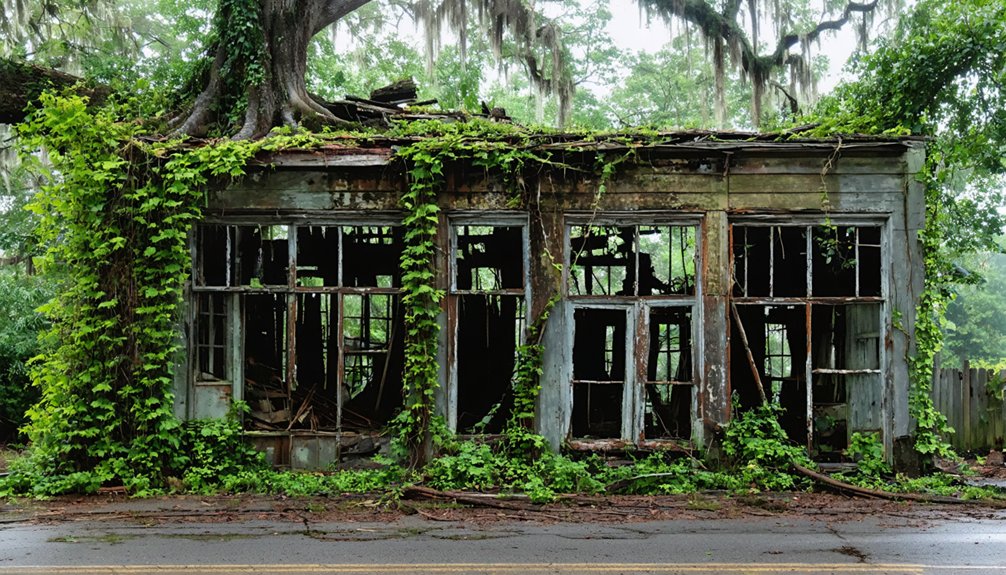
Tennessee’s ghost towns offer you tangible evidence of nature’s persistent reclamation. You’ll find Elkmont’s logging infrastructure disappearing beneath returning hardwoods since its 1925 abandonment, while Big Greenbrier’s 1882 settlement structures slowly collapse into undergrowth. Mousetail Landing’s industrial remnants now anchor a 1,247-acre state park where forest has overtaken what commerce once dominated. Even Wheat, erased by Manhattan Project land seizures in 1942, demonstrates how quickly wilderness reasserts itself when human enterprise withdraws. The physical evidence tells stories that written records often obscure.
Key Takeaways
- Elkmont Ghost Town features 19 restored buildings amid forest regrowth after 1925 railroad dismantlement and industrial logging depletion.
- Big Greenbrier Settlement includes an overgrown one-room schoolhouse and Walker Sisters cabin reclaimed by surrounding wilderness.
- Mousetail Landing State Park preserves 1,247 acres with original pier pilings and blacksmith ruins amid ecological transformation.
- Barney Graham’s grave and mountain cemeteries near coal communities are being reclaimed by forest growth.
- Newsom’s Landing only exists as limestone ruins at Newsom Park after modern commerce and rail service disappeared.
Elkmont Ghost Town: From Logging Hub to Preserved Historic Site
Before the Great Smoky Mountains became a protected wilderness, Elkmont thrived as a bustling logging town that transformed from scattered homesteads into an industrial hub within a single generation.
You’ll find evidence of this logging legacy throughout the site—from the restored 1845 Levi Trentham cabin to the railroad bed that once carried lumber to Knoxville.
The Little River Lumber Company established Elkmont in 1908, swelling its population to over 1,500 residents by 1918.
When forests depleted by 1920, the company secretly dismantled the railroad in 1925, abandoning the town.
Today’s historical preservation efforts maintain the commissary, church, and employee houses as reminders of an era when industrial ambition reshaped these mountains before conservation reclaimed them. The National Park Service plans to preserve 19 buildings by 2025, including all cabins and the lodge from the Appalachian Club that once served as exclusive resorts during Elkmont’s golden age. The site represents one of multiple locations named Elkmont throughout Tennessee and neighboring states.
Big Greenbrier: Pioneer Settlement Surrendered to the Wilderness
While Elkmont’s transformation centered on industrial extraction and commercial leisure, the Little Greenbrier settlement tells a different story—one of subsistence farming and religious devotion carved from wilderness isolation.
Built in 1882 through collective labor, the schoolhouse served as both educational center and Primitive Baptist church until 1936. Little Greenbrier history reveals a community that thrived despite nine-mile daily treks for students.
Faith and learning intertwined in this mountain schoolhouse where children walked miles through wilderness for education and Sunday worship.
When the National Park displaced residents in the 1930s, Walker Sisters resilience became legendary—they refused buyout offers for decades, maintaining their self-sufficient lifestyle while the settlement crumbled around them. Their story gained national attention when featured in the Saturday Evening Post during the 1940s. The nearby Greenbrier Restaurant, originally built to accommodate wealthy hunters and outdoor enthusiasts, continues to attract visitors to the region with its stunning mountain views.
What remains today:
- One-room log schoolhouse with original wooden desks frozen in time
- Walker Sisters cabin featuring springhouse and smokehouse
- Weathered cemetery with 1800s gravestones
- Reports of glowing orbs and disembodied voices
- Overgrown structures reclaimed by Smoky Mountain wilderness
Newsom’s Landing: A Town Twice Built, Forever Lost
Along the Harpeth River’s limestone-studded banks, the Newsom family established what would become a twice-drowned settlement—first by catastrophic flood in 1808, then by economic obsolescence.
William Bryant Newsom’s Virginia-born clan arrived between 1796-1800, transforming Davidson County wilderness into an industrial hub. Their quarries supplied Nashville’s most enduring monuments—the State Capitol, Union Station, Hume-Fogg High School—while Newsom’s Mill ground grain for generations.
Joseph M. Newsom rebuilt the turbine-powered gristmill in 1862 using hand-dressed limestone blocks, creating what seemed permanent. The settlement expanded to include a train depot, post office, and various shops that served locals and visitors alike.
Yet community decline proved inexorable. When rail service disappeared and modern commerce bypassed rural mills, Newsom’s Station faded into Tennessee’s ghost town roster. Like Willow Grove residents who held a farewell picnic before relocation, the families of Newsom’s Landing quietly departed their riverside homes.
Today you’ll find only limestone ruins at Newsom Park—testament to families who twice bet everything on this riverbank, and twice lost.
Mousetail Landing: Industrial Ruins Beneath the Lake
The Tennessee River’s channelization didn’t just alter commerce—it erased entire communities from the map.
Mousetail Landing thrived as Perry County’s post-Civil War lifeline, shipping tanned goods to major river cities until bridges and inland relocation rendered it obsolete.
Archaeological findings reveal the settlement’s unusual name origin: a tannery fire sent masses of rodents fleeing toward the landing, creating an unforgettable exodus.
Today’s 1,247-acre state park preserves what channelization couldn’t claim.
Mousetail history you’ll discover:
- Original pier pilings jutting from shallow waters
- Blacksmith shop ruins hidden along 11 miles of trails
- Parrish Cemetery’s fieldstone-marked graves from the 1800s
- Early tannery foundations reclaimed by Tennessee wilderness
- 1.1-mile Historical Landing Trail connecting forgotten industrial sites
You’re free to explore these remnants without interpretive barriers—raw history awaiting your investigation.
Rangers lead monthly programs featuring animal ambassadors that interpret the park’s ecological transformation since its industrial era.
Anglers casting from deteriorating stone banks still hook crappie, bluegill, and bass where steamboats once loaded cargo.
Wheat: Manhattan Project’s Forgotten Neighbor
When the U.S. government commandeered land for Oak Ridge in 1942, you’ll find scant documentation about what existed before.
Wheat’s history remains largely unwritten in official Manhattan Project archives, though approximately 4,000 people were displaced from surrounding communities to make room for secret atomic facilities.
Without credible sources specifically documenting Wheat as a distinct settlement, its existence as a forgotten neighbor to Oak Ridge can’t be verified through available historical records.
If such a community existed, it’s been erased from collective memory—a casualty of wartime secrecy and government land seizure. The U.S. Army Corps of Engineers purchased 59,000 acres to create what would initially be known as Site X. The site’s population would later peak at 75,000 in May 1945, transforming the rural landscape into a bustling atomic production center.
To uncover this ghost town’s truth, you’d need to consult local Tennessee archives and Manhattan Project National Historical Park resources, where displaced communities’ stories might finally surface beyond official narratives.
Wilder: Cemetery Keeper of Union History
Deep in Fentress County’s Appalachian hollows, Wilder’s remaining cemeteries preserve what official company records deliberately obscured: the human cost of coal extraction in early twentieth-century Tennessee.
When mine guard Jack “Shorty” Green assassinated union president Barney Graham on April 30, 1933, you’ll find no conviction records—only Graham’s grave marking Union struggles against Fentress Coal and Coke Company. His hastily buried body represented workers facing 50% wage cuts since 1929, families starving from pellagra, and systematic violence against organizing efforts.
Graham’s legacy endures where company headquarters cannot: in mountain cemeteries reclaimed by forest.
What remains visible:
- Multiple burial grounds reflecting community size
- Graham’s unmarked grave awaiting promised union monument
- Evidence of 1932-1933 strike violence
- Witness to unsolved labor assassination
- Final record of workers’ resistance
Exploring Tennessee’s Abandoned Communities Safely
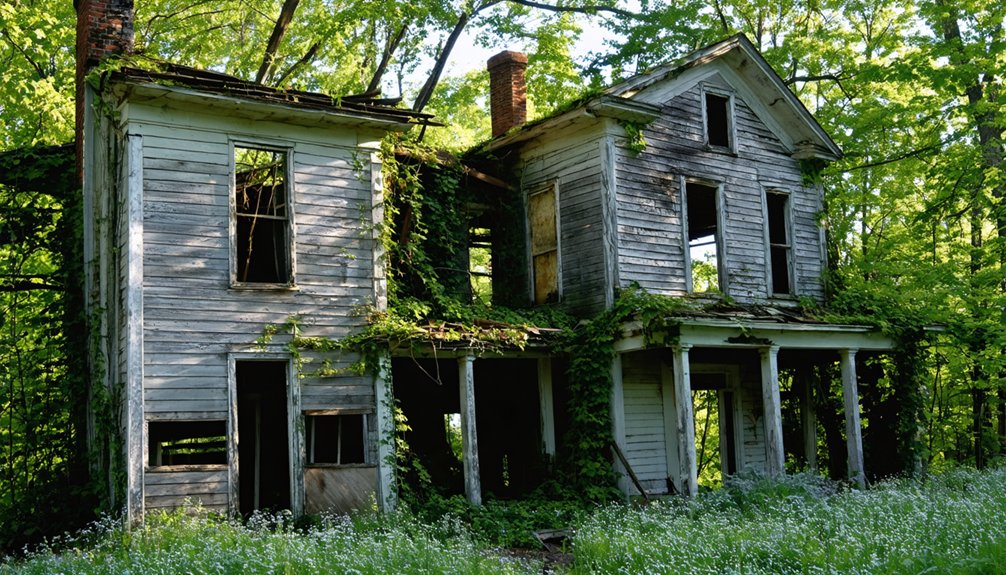
Graham’s grave sits abandoned but accessible—a reminder that visiting Tennessee’s ghost towns requires preparation beyond historical curiosity.
You’ll need proper safety measures before exploring sites like Elkmont or Mousetail Landing. Public land access doesn’t eliminate hazards: collapsing chimneys at Salem-Overall, hidden mine shafts near Wheat, and unstable terrain throughout demand vigilance.
Stick to designated trails where they exist—Great Smoky Mountains pathways prevent both trespassing and structural damage to preserved cabins. You’re free to photograph respectfully, but drones violate park regulations.
Consider your environmental impact: Leave No Trace principles aren’t suggestions but obligations to preserve these temporal artifacts. Wildlife, poison ivy, and flood-prone areas warrant insect repellent, appropriate clothing, and weather awareness.
Group travel enhances safety at remote locations while honoring the autonomy these abandoned communities represent.
Frequently Asked Questions
Are There Any Ghost Towns in Tennessee That Allow Overnight Camping?
You’ll find ghost town camping at Elkmont in Great Smoky Mountains National Park, where Tennessee overnight stays let you explore preserved 1920s structures by day and sleep among 200 campsites where loggers once lived.
Which Tennessee Ghost Town Is Easiest to Access for Mobility-Impaired Visitors?
Elkmont Ghost Town offers you the most accessible routes for mobility-impaired visitors, with paved roads allowing mobility aids to navigate close to historic structures. You’ll find parking within hundreds of feet of viewable cabins throughout Daisy Town’s shaded streets.
Can You Legally Remove Artifacts or Souvenirs From These Abandoned Sites?
Maneuvering artifact removal is treading through legal minefields. You can’t legally take souvenirs from ghost towns due to strict artifact preservation laws and legal regulations governing state, public, and private lands—written permission’s always required.
What Wildlife Hazards Should Visitors Expect When Exploring These Ghost Towns?
You’ll face wildlife encounters including venomous snakes, rabies-carrying mammals, and disease-transmitting insects. Historical records show these hazards intensified as nature reclaimed sites. Take safety precautions: wear boots, use repellent, and maintain awareness of surroundings constantly.
Are Guided Tours Available for Any of Tennessee’s Ghost Town Locations?
While Tennessee offers numerous ghost *tours* focusing on haunted buildings and paranormal activity, you won’t find guided exploration specifically for abandoned ghost *towns*. These reclaimed sites lack the historical significance infrastructure that established tourism operations require for safe, scheduled visits.
References
- https://www.onlyinyourstate.com/experiences/tennessee/tn-ghost-towns
- https://www.tnmagazine.org/19-ghost-towns-in-tennessee-that-are-not-underwater/
- https://gatlinburghaunts.com/elkmont-tennessees-ghost-town/
- https://www.tnvacation.com/trip-inspiration/articles/ghost-towns-tennessee
- https://www.pigeonforge.com/elkmont-ghost-town/
- https://hikinginthesmokymountains.com/blog/elkmont-ghost-town-restoration/
- https://www.youtube.com/watch?v=s9lVc_zwaAU
- https://www.loveproperty.com/gallerylist/91679/tour-the-abandoned-tennessee-ghost-town-where-millionaires-vacationed
- https://roadtrippers.com/magazine/abandoned-ghost-town-smoky-mountains/
- https://en.wikipedia.org/wiki/Elkmont