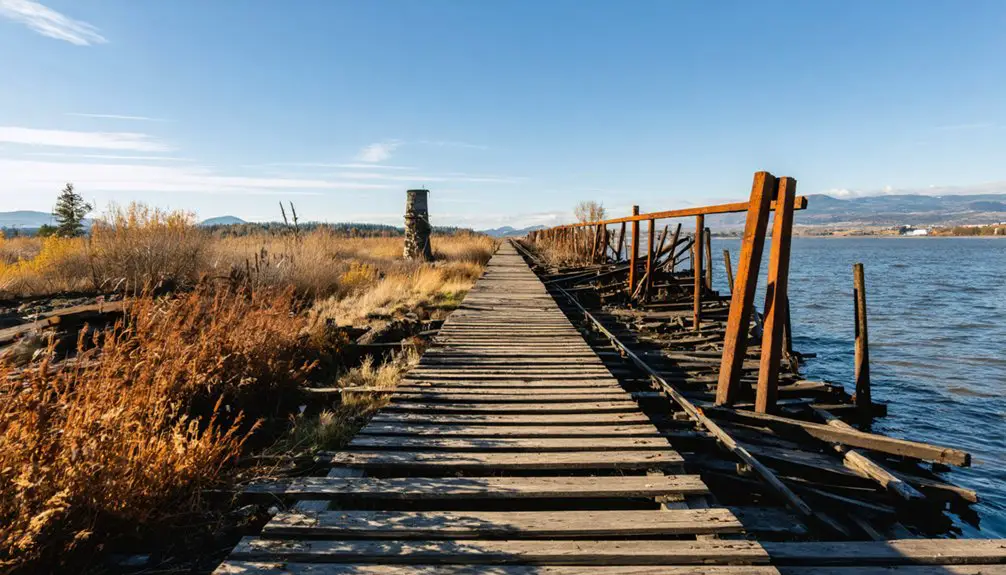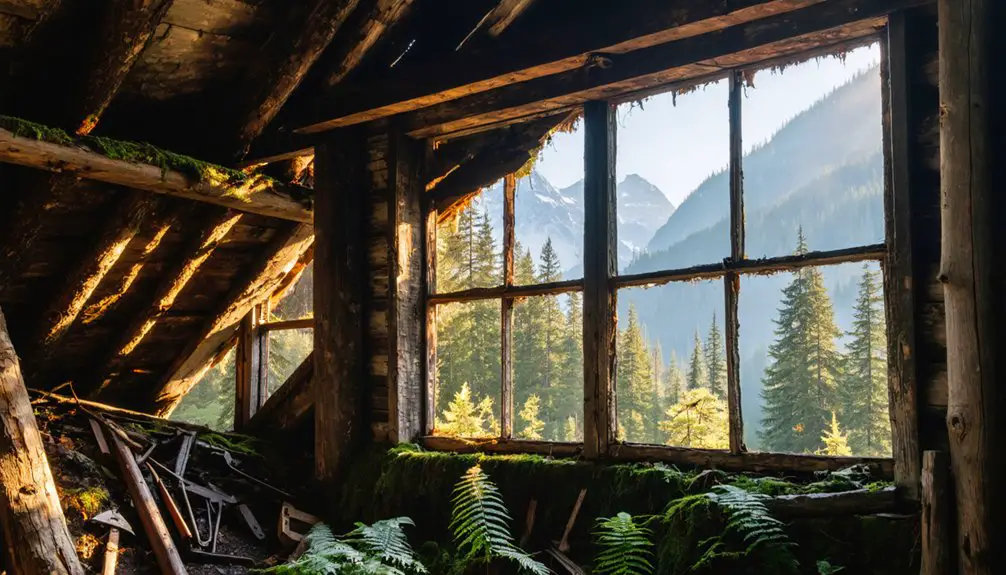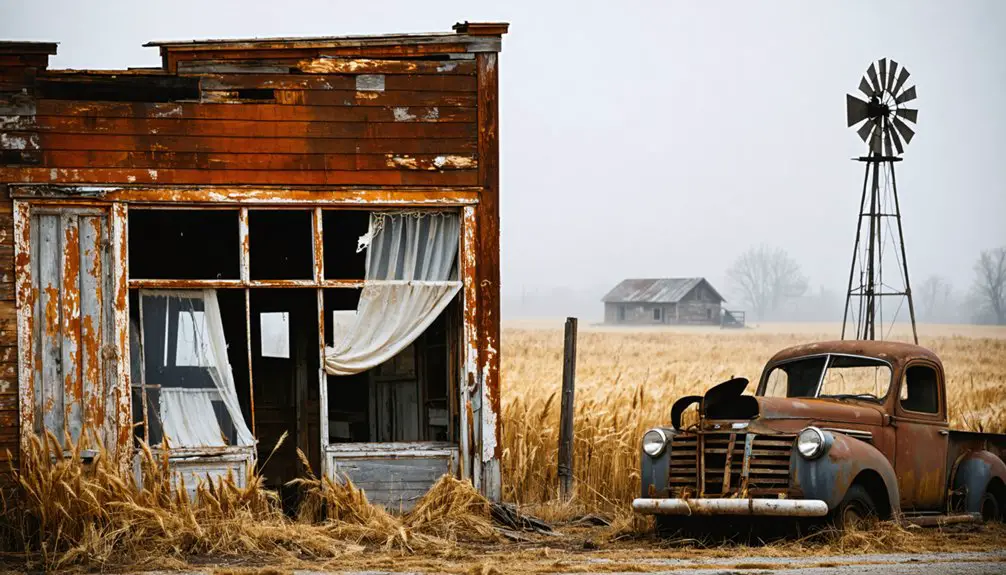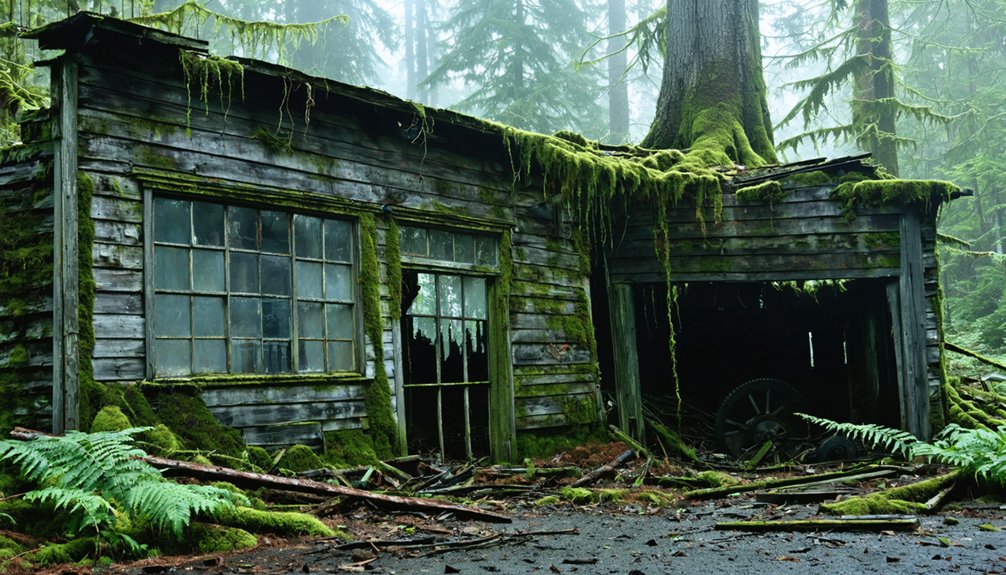
Washington’s ghost towns reveal nature’s relentless reclamation of abandoned settlements across diverse landscapes. You’ll find Monte Cristo’s 15 structures overtaken by the South Fork Sauk River’s headwaters, while Melmont’s mossy retaining walls and dynamite shed crumble along a muddy rail grade. Sherman’s white country church stands on higher prairie ground, and Ruby’s stone foundations mark where 700 residents once called home. Franklin’s coal mining remnants face underground fires, and Nighthawk preserves its 1903 hotel along Prospect Avenue. The following sections explore each site’s accessibility, remaining structures, and historical significance.
Key Takeaways
- Monte Cristo’s last operations ceased in 1907; South Fork Sauk River now carves through the site with over 15 persisting structures.
- Ruby Townsite collapsed after 1893, achieving total abandonment by early 1900s with only stone foundations and markers remaining today.
- Melmont’s wooden structures were consumed by fire in the early 1920s, leaving mossy retaining walls and a dynamite shed.
- Sherman features abandoned structures scattered across open terrain with a white church standing on higher ground near cemetery.
- Nature’s reclamation requires 8-mile treks along washed-out railroad beds to reach former mining towns like Monte Cristo.
Sherman: Wide-Open Terrain and Creepy Remnants
When wheat prices collapsed in the early twentieth century, Sherman’s fate was already sealed by forces larger than any single farming family could withstand.
You’ll find its abandoned structures scattered across wide-open terrain north of Wilbur, accessible via dirt roads cutting through farmland that slopes like a natural gully.
The white country church still stands on higher ground, its steeple intact, while the cemetery beside it marks lives claimed by brutal winters—including the 1889 blizzard that buried homesteads under six feet of snow.
Behind the church, the cemetery holds generations of families who worked this unforgiving land, their simple graves overlooking the rolling farmland they once cultivated.
Located just 15 minutes northeast of Govan off Highway 2, Sherman originated during the homesteading boom that drew settlers to this remote corner of eastern Washington.
These remnants hold historical significance beyond their weathered boards. Each Memorial Day, descendants gather here, refusing to let government promises of land ownership fade completely into eastern Washington’s unforgiving landscape.
Monte Cristo: An 8-Mile Journey to Mining History
You’ll trek 8 miles along a washed-out railroad bed where floods in 2003 and 2006 permanently severed vehicle access, leaving only footprints to reach this remote townsite.
The journey follows Glacier Creek through terrain that once channeled 211 mining claims and a population of 1,000, now reduced to weathered structures monitored by preservationists. Your path traces the old Monte Cristo Railroad grade, a historical corridor that once transported ore from the mines to civilization. The historic route mirrors the same path miners traveled in the 1890s during the region’s lead-silver boom.
What remains tells the story of Rockefeller’s 1891 investment, Frederick Trump’s operations, and the 1920 avalanche that ended extraction after three decades of boom and decline.
Trail Details and Access
Located approximately 30 miles east of Granite Falls on the Mountain Loop Highway, Barlow Pass marks the beginning of your journey into Monte Cristo’s mining past.
You’ll find trail accessibility remarkably straightforward—no permits or fees restrict your exploration. The 4-mile route follows the historic mining road along the South Fork Sauk River, maintaining relatively flat terrain that welcomes both seasoned hikers and families.
Flood damage from 2003 and 2006 has reshaped the path, creating erosion gaps and requiring one log crossing. For hiking safety, you can bypass this obstacle by taking the alternative route half-mile from Barlow Pass, following Mountain Loop Highway to a bridge crossing. The log crossing remains easy to navigate even after rainfall, though muddy sections appear throughout the trail.
Both paths converge at the townsite, where red train station buildings appear first—keep walking to discover the actual ghost town beyond. The surrounding Mount Baker Snoqualmie National Forest provides a stunning backdrop to your historical exploration.
Mining Boom and Bust
Deep in the Northern Cascade Mountains valley, Joseph L. Pearsall discovered silver ore in 1889 that would transform wilderness into civilization.
By 1894, you’d have found over 1,000 inhabitants seeking fortune through evolving mining techniques. The economic impact was staggering—$1,000 invested here matched just $1 at Silver Creek.
Peak Production Facts:
- Eight main mines processed 300 tons of ore daily by 1894
- Railroad connected 40 miles to Everett in 1893, shipping gold, silver, copper, lead, and zinc
- 236 town lots platted in 1893; miners earned $2.50 daily minus board
- 1897 flood destroyed infrastructure, forcing Rockefeller’s bankruptcy decision
Nature reclaimed what economics couldn’t sustain.
The 1920 avalanche sealed Monte Cristo’s fate, ending operations where fortune-seekers once defied mountain wilderness. Frequent avalanches during winter months had disrupted mining activities throughout the town’s existence, making operations increasingly dangerous and unprofitable. By World War I, most of Monte Cristo was abandoned except for the Royal Hotel.
Exploring Abandoned Ruins
When the last commercial operations ceased in 1907, Monte Cristo’s physical footprint began its slow surrender to the Cascade wilderness—yet today, this 8-mile round-trip hike from Barlow Pass remains Washington’s most accessible ghost town experience.
You’ll traverse a flood-damaged road where nature reclaiming its territory becomes evident with each step. Over 15 structures persist along Dumas Street—businesses, a school, church—their abandoned architecture weathering under mountain elements.
The South Fork Sauk River‘s headwaters carve through this isolated eastern Snohomish County site, where avalanches once halted winter mining. Frederick Trump’s former hotel district and railway housing stand as skeletal witnesses to 1,000 former residents.
Two hours from Seattle, you’ll document what floods, fires, and decades haven’t yet erased—a reflection of civilization’s temporary claim on wilderness. The Monte Cristo Preservation Association maintains public access and collaborates with the U.S. Forest Service on cabin maintenance and trail upkeep to preserve this historic mining district.
Melmont: Decaying Relics Along an Abandoned Rail Grade
You’ll follow six miles of muddy rail grade through Pierce County to reach Melmont, where coal miners once extracted 900,000 tons from subterranean depths exceeding 600 feet between 1902 and 1918.
The forest has reclaimed this sunny meadow settlement, leaving behind mossy retaining walls, a dynamite shed, and school basement foundations—architectural fragments that verify the town’s existence before a 1920s fire erased its buildings.
What remains teaches how quickly nature absorbs human enterprise once economic forces shift, as they did when diesel and electric power ended the railroad’s coal demand.
The Northwest Improvement Company established Melmont in 1902, organizing miners into company-owned cottages grouped by nationality.
Trail Access and Features
Across Highway 165 from Carbon Country’s Shady Rest Bed and Breakfast, the Foothills Trail provides immediate access to Melmont’s scattered industrial remains.
You’ll follow an easy 2.5-mile route along the old rail grade, gaining just 100 feet to reach 1,360 feet elevation.
Trail conditions vary dramatically with weather—expect deep mud during rainy seasons from frequent ATV use.
The historical significance reveals itself through deliberate exploration:
- Northern Pacific Railroad’s mossy retaining walls mark your starting point
- Stone dynamite shed with intact walls (safe to enter, no explosives remain)
- Hand-hewn Wilon Quarry blocks support hillside infrastructure
- Blacksmith shop remnants near the townsite foundations
Bring sturdy boots and gaiters.
You’re free to wander without fees or restricted hours, letting curiosity guide your discovery.
Remnants of Settlement History
Fire consumed Melmont’s wooden structures in the early 1920s, erasing most physical evidence of the coal town that once housed hundreds of miners and their families.
Yet traces of town infrastructure persist where nature hasn’t fully reclaimed the landscape. You’ll find the schoolhouse basement foundation embedded in overgrowth, while bridge abutments mark where spanning structures once connected the community across Carbon River.
A mossy retaining wall runs alongside the abandoned rail grade, and a weathered dynamite storage shed stands as a reminder of coal mining operations that penetrated 600 feet underground.
Decaying vehicles rust among scattered building foundations, their metal frames slowly surrendering to forest encroachment. These fragments document lives lived extracting fuel from earth, now returning to wilderness.
Ruby Townsite: From “Babylon of the West” to Stone Foundations
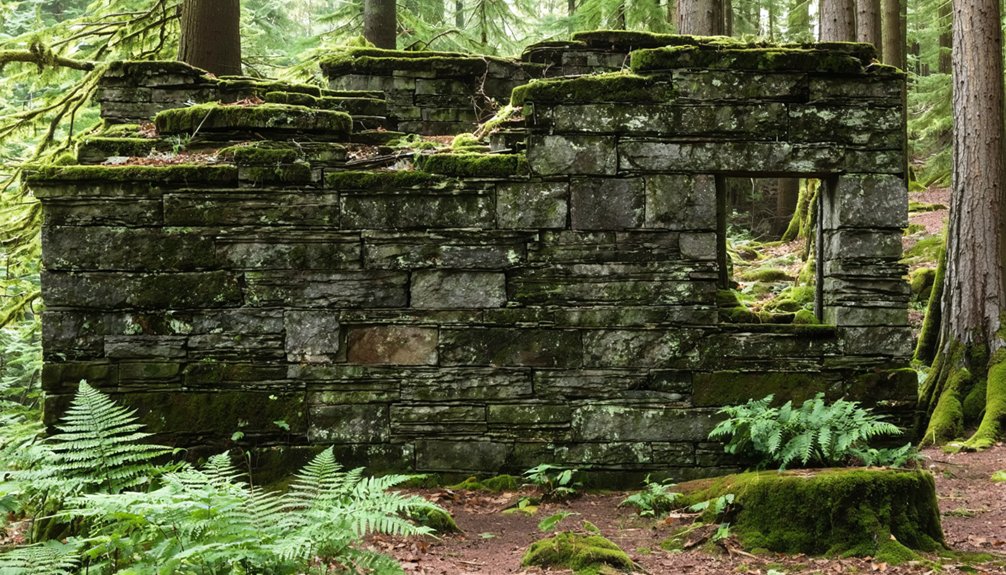
When prospectors discovered silver deposits on Ruby Mountain and Peacock Hill’s slopes in 1886, they couldn’t have anticipated that their claims would spawn one of the Northwest’s most notorious mining camps.
Ruby’s history transformed from wilderness to “Babylon of the West” within months, reaching 700 residents by 1888.
The mining legacy reveals itself through stark contrasts:
- Peak prosperity: Seventy buildings, six general stores, multiple saloons, and brief designation as county seat
- Rapid collapse: 1893 silver price crash shuttered operations overnight
- Total abandonment: Complete desertion by early 1900s after less than a decade
- Present remains: Stone foundations beneath scraggly pines, two historical markers, and Washington State Park Heritage Site designation
You’ll find nature reclaiming what fortune-seekers left behind.
Nighthawk: a Registered Ghost Town With Standing Structures
Abandoned structures still dot the landscape: J.M. Hagerty’s hotel from 1903, rebuilt after a 1910 fire; the 1915 schoolhouse that closed in the 1940s; Doc Andrus’s livery stable.
As metal values dropped and Highway 2 construction rerouted progress, miners departed.
Yet unlike Ruby’s total erasure, Nighthawk refused complete surrender—its buildings standing as defiant monuments along Prospect Avenue, where you’ll walk streets once thundering with ore wagons.
Franklin: Coal Mining Heritage Near Mount Rainier
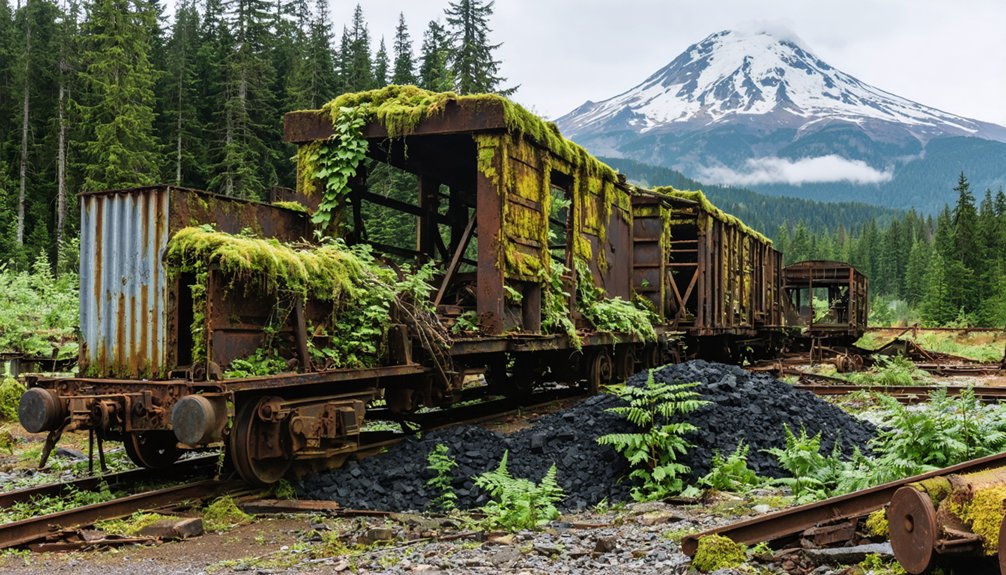
Coal dust settled over Franklin’s wooden boardwalks as early as 1884, when the Oregon Improvement Company transformed Green River Gorge’s forested banks into King County’s industrial engine.
You’ll discover Franklin heritage along trails where 800 miners once extracted 515,000 tons annually from depths reaching 3,000 feet below the surface.
The coal legacy persists through:
- Mine No. 12’s aftermath – A 1970s explosion ignited underground fires still heating groundwater that steams into the Green River
- Cemetery tombstones – Marking 37 men killed in Franklin’s deadliest disaster
- Abandoned coal cart – Rusting equipment bearing the town’s name near a 1,000-foot-deep entrance
- Mount Rainier viewpoints – Where nature reclaims what industry abandoned
The forest absorbs what civilization left behind.
Planning Your Ghost Town Adventure in Washington
Where dirt roads dissolve into forest and weathered foundations pierce through sagebrush, Washington’s ghost towns demand preparation that respects both historical fragility and wilderness isolation. You’ll need topographic maps for sites like Monte Cristo’s 8-mile approach, where seasonal conditions transform trails between spring runoff and autumn snowfall. Safety tips include informing others of your route—cellular coverage vanishes near Govan and Sherman—and carrying sufficient water across arid Eastern Washington terrain.
Photography techniques should capture temporal decay: shoot Northern State’s 1912 structures during golden hour when light penetrates dairy barns and abandoned wards. Document Chesaw’s crumbling hotels with wide-angle lenses that preserve architectural context. Respect cemetery boundaries at all sites, particularly Northern State’s 1,500 interments. Leave artifacts undisturbed; your footprints should remain the only evidence of passage through these vanishing thresholds between civilization and reclamation.
Frequently Asked Questions
Are Ghost Town Visits in Washington Allowed Year-Round or Seasonally Restricted?
You’ll find no formal seasonal access restrictions documented for Washington’s public ghost towns, though winter conditions create practical barriers. Visitor guidelines emphasize respecting private property boundaries and following preservation ethics established by historical organizations year-round.
Do I Need Permits to Explore Ghost Towns on Public Land?
You don’t need permits for basic ghost town exploration on public land, but you must follow exploration etiquette: don’t remove artifacts or enter active buildings. Respect their historical significance while wandering these remnants of human-nature relationships.
Is Camping Allowed Near Washington Ghost Town Sites?
Like pioneers traversing unmarked territories, you’ll find camping regulations permit dispersed stays near ghost town sites on public lands, though these forgotten settlements lack modern ghost town amenities—requiring self-sufficiency within designated forest boundaries.
What Wildlife Hazards Should Visitors Expect at These Abandoned Locations?
You’ll face wildlife encounters including rodent-borne diseases like Hantavirus and potentially large feral animals. Take safety precautions by avoiding rodent nesting areas, wearing gloves when exploring structures, and maintaining awareness of predatory fauna inhabiting these human-free environments.
Can Artifacts Be Legally Collected From Washington Ghost Towns?
No, you can’t legally collect artifacts from Washington ghost towns. National Register protections and artifact preservation laws carry serious legal implications. These historic sites function as open-air museums where you’re welcome to observe, not remove history.
References
- https://stateofwatourism.com/ghost-towns-of-washington-state/
- https://okanogancountry.com/ghost-towns
- https://www.youtube.com/watch?v=FVveO9uJBvc
- https://www.wta.org/go-outside/seasonal-hikes/fall-destinations/hidden-history-ghost-town-hikes
- https://www.ghosttownsofwashington.com
- https://kids.kiddle.co/Sherman
- https://photos4thepeeps.wordpress.com/2009/12/22/eastern-washington-ghost-towns-part-3-shermanwa/
- https://www.co.sherman.or.us/ghost-towns-old-west/
- http://www.ghosttownsusa.com/bttales50.htm
- https://en.wikipedia.org/wiki/Sherman