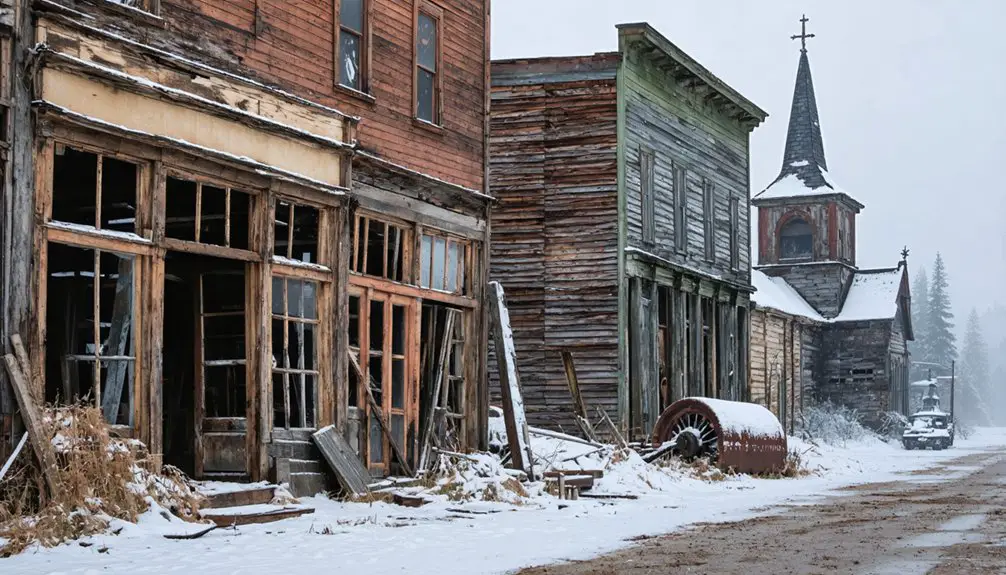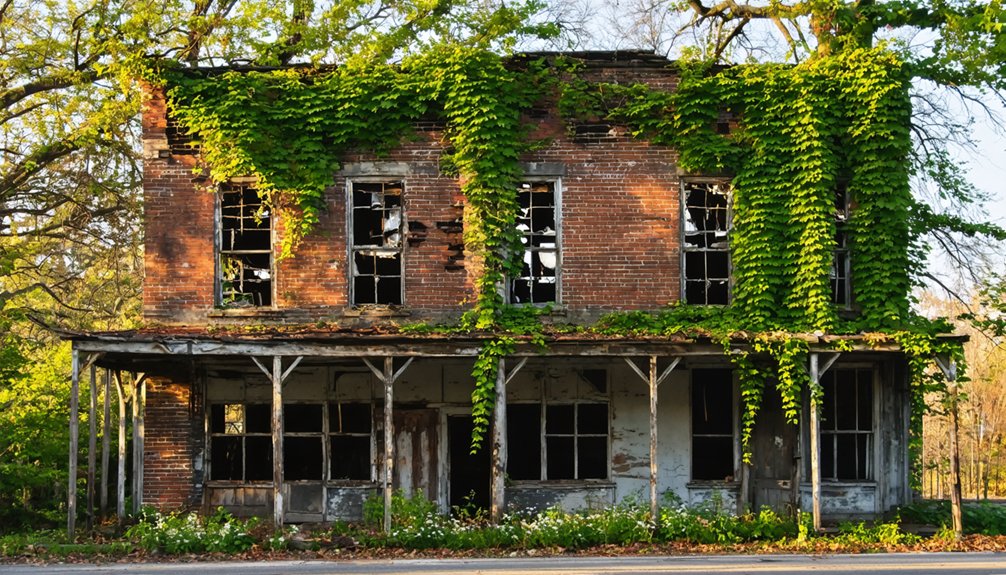
You’ll find West Virginia’s abandoned coal towns undergoing dramatic transformation as nature reclaims former industrial sites. Since the mid-20th century, communities like those 465 company towns from the 1930s have been slowly returning to wilderness, with grasses appearing within months and forests reestablishing in twenty to fifty years. However, beneath this regeneration lies persistent acid mine drainage that continues poisoning waterways with rust-orange toxins. Today’s ghost towns reveal both nature’s resilience and coal mining’s lasting environmental toll, offering insights into how ecosystems recover from industrial exploitation.
Key Takeaways
- 465 company towns emerged by 1930; many abandoned sites now show nature’s recovery through grasses, shrubs, and eventual forest regrowth.
- Nature reclaims industrial wastelands following a predictable timeline: grasses within months, shrubs in five years, forests in twenty to fifty years.
- Wildlife including deer, black bears, wild turkeys, turtles, and fish populations have returned to reclaimed mining corridors and restored waterways.
- Thousands of unreclaimed mining acres remain scarred, though some sites transform into carbon sinks through vegetation regrowth and reforestation efforts.
- Former mining towns face challenges from invasive species and buried hazardous waste, complicating natural regeneration despite visible ecological recovery.
The Rise and Fall of Coal Mining Communities
While John Peter Salley’s 1742 discovery of coal along a Coal River tributary in Boone County marked West Virginia’s first documented encounter with the resource that would define its future, commercial exploitation didn’t begin until Conrad Cotts opened a mine near Wheeling in 1810.
Railroad expansion transformed the industry—the Chesapeake & Ohio reached coalfields in 1873, while the Baltimore & Ohio opened Wheeling to exports in 1853. By 1883, production hit three million tons. The Norfolk & Western Railroad connected the Flat Top-Pocahontas Field in Mercer and McDowell Counties to national markets, establishing these regions as significant coal-producing areas.
Railroad networks unlocked West Virginia’s coal wealth, triggering explosive industrial growth that reshaped the region’s economic landscape within three decades.
This boom spawned 465 company towns by 1930, demonstrating remarkable community resilience despite harsh conditions. These settlements typically lasted 50-75 years before exhausted seams forced abandonment. Peak employment reached 130,457 workers in 1940, reflecting the industry’s massive scale during its height.
The mining legacy remains visible in ghost towns like Widen and Peytona, where workers once challenged corporate control through strikes, demanding the freedom to organize unions and fair compensation.
Environmental Devastation Left Behind
When you examine West Virginia’s abandoned coal towns, you’ll find they didn’t simply disappear—they left permanent scars on the landscape.
The state’s streams still run rust-orange with acid mine drainage decades after the last miners departed, while Richard Mine alone discharges 400 gallons per minute of toxic runoff into Deckers Creek.
These ghost towns bequeathed a legacy of poisoned waterways coating stream beds with iron deposits and thousands of unreclaimed acres where vegetation can’t grow, transforming once-thriving ecosystems into sterile wastelands.
The damage stems from pyrite exposure to oxygen and water, which creates sulfuric acid that dissolves heavy metals and continues indefinitely if left untreated.
Modern energy operations continue this pattern of displacement, with families in Knob Fork abandoning their homes over 50 times in six months due to health concerns from fracking, forcing entire communities to flee properties that have become places of sickness and confusion.
Poisoned Waterways and Streams
Beneath the rusted tipples and collapsed company stores of West Virginia’s ghost towns flows a toxic legacy that persists long after the last miners departed.
You’ll find streams running rust-orange from abandoned mines like Richard Mine, which still discharges 400 gallons per minute of sulfuric acid-laden runoff. This pyrite oxidation process dissolves heavy metals, transforming once-vibrant waterways into polluted habitats devoid of aquatic life.
Over 40 percent of the state’s rivers fail basic safety standards for drinking or recreation. Coal mining operations have also released selenium into waterways, where this essential element becomes toxic at elevated concentrations, causing severe malformations in fish and affecting wildlife populations during their most vulnerable early life stages.
The pollution crisis extends beyond chemistry—less than 25% of streams fully support their designated uses for aquatic life, recreation, and water supply according to state assessments.
Yet there’s hope: Three Fork Creek now teems with fish and salamanders after lime treatments neutralized decades of acidity.
These restoration successes prove you’re not bound to accept permanent contamination—the waterways can heal when communities demand action and implement proven cleanup technologies.
Massive Unreclaimed Land Scars
Across thousands of acres where coal once fueled fortunes, the earth itself bears wounds that outlast any human memory of prosperity.
You’ll find unreclaimed scars stretching across West Virginia’s landscape, where companies transferred permits or declared bankruptcy to dodge land reclamation responsibilities. The state’s taxpayers now shoulder cleanup costs that corporations never intended to pay.
These abandoned industrial wastelands include:
- 6,000-acre mining complexes where subsidence forces families from their homes
- Valley fills holding over one billion gallons of toxic coal sludge
- Continuously discharging mines releasing 400 gallons per minute of contaminated water since the 1950s
- Massive impoundments risking catastrophic failures like Kentucky’s 250-million-gallon collapse
As coal production declined 38 percent between 2008 and 2016, these permanent environmental debts compound. The contamination threatens drinking water for rural communities and damages critical infrastructure throughout the region. The state’s 16 coal-fired power plant sites store massive quantities of toxic coal ash in unlined ponds and landfills, adding to the environmental burden communities face.
How Nature Reclaims Abandoned Industrial Sites
When you examine West Virginia’s abandoned coal and chemical sites, you’ll find nature’s recovery follows a predictable timeline: grasses emerge within months, shrubs colonize by year five, and full forest canopy develops over twenty to fifty years.
This succession transforms industrial wastelands into carbon sinks—similar to Russia’s abandoned farmland, which now sequesters over 40 million tons of carbon annually through vegetation regrowth alone.
Wildlife returns to streams once poisoned by runoff, while deteriorating structures become substrates for pioneer species that accelerate ecological restoration without human intervention. However, invasive species can dominate these landscapes, with abandoned agricultural lands showing up to 75% invasive dominance in some regions, threatening the quality of natural regeneration.
Despite visible natural recovery, hazardous waste may persist at these sites long after facilities close, creating hidden environmental risks beneath the regenerating vegetation.
Vegetation Overtakes Industrial Ruins
After decades of extraction scarred West Virginia’s landscape, nature’s persistence confronts an industrial legacy spanning over 6 million acres of abandoned coal mines across the United States—with West Virginia bearing a disproportionate burden of this devastation.
You’ll witness vegetation succession transforming these wounded lands through deliberate industrial reclamation efforts that challenge compacted soils and eroded terrain.
Restoration strategies include:
- Deep soil ripping 3-4 feet into compacted substrates on 2,500-acre reforestation sites
- Lavender cultivation on former blast zones, creating economic value from destroyed landscapes
- Giant plant species generating missing topsoil while sequestering atmospheric carbon
- Regenerative agriculture rebuilding soil health at sites like Highwall’s former mine
These interventions accelerate what nature accomplishes slowly—reclaiming freedom from industrial bondage through strategic ecological renewal.
Wildlife Returns to Streams
Where timber loading docks once dominated riverbanks, turtles now claim sunlit logs as basking platforms—a transformation documented across West Virginia’s post-industrial waterways since the late 20th century.
You’ll witness wildlife resurgence where fishermen cast lines from platforms that once loaded livestock, their catches proving fish populations rebounded dramatically after industrial abandonment.
Stream restoration occurred naturally along the New River Gorge, where water churns white through boulder fields near forgotten coal sites like Thayer.
Deer, black bears, and wild turkeys now flourish in these corridors, while bats inhabit structures like Silver Run Tunnel.
The gurgling river soundtrack replaces train whistles, creating ecosystems college students study as living classrooms—proving you can’t suppress nature’s reclamation when human industry retreats.
The Battle Against Acid Mine Drainage
Long after the coal miners departed and the boomtowns emptied, their legacy continues poisoning West Virginia’s waterways through acid mine drainage—a relentless chemical process that has transformed thousands of kilometers of streams into lifeless, rust-colored channels.
Abandoned mines continue their silent assault on Appalachian streams, bleeding rust and acid long after the last miners left.
When pyrite oxidizes, it generates acidic runoff that dissolves heavy metals through bacterial metal leaching, creating toxic conditions that persist for decades.
You’ll find treatment systems battling this contamination:
- Active chemical facilities neutralize acids and precipitate metals at sites like Richard Mine
- Passive organic systems use natural sulfate reduction through constructed wetlands
- Vertical flow ponds consume oxygen to reduce iron concentrations
- Rare earth recovery operations extract valuable minerals while cleaning contaminated water
These interventions offer hope for reclaiming poisoned watersheds from industrial ghosts.
Cleanup Projects Restoring Appalachian Waterways
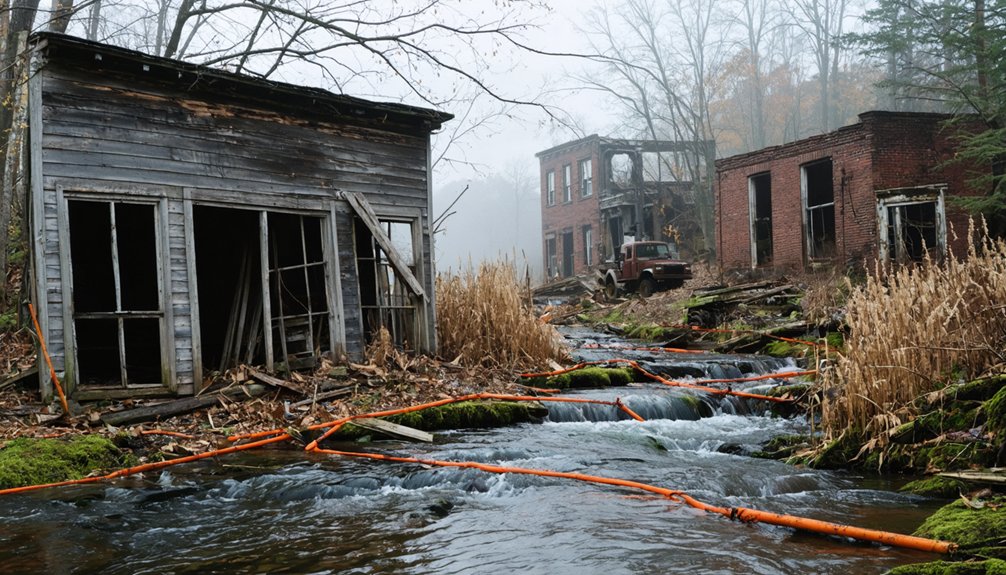
While acid mine drainage remains Appalachia’s most persistent environmental challenge, a coordinated network of restoration initiatives has begun reversing decades of industrial damage across West Virginia’s watersheds.
You’ll find organizations like Appalachian Stream Restoration constructing over 300 miles of rehabilitated waterways, while The Nature Conservancy removes dams reconnecting 800 miles of habitat. These stream restoration projects deliver ecological benefits beyond fish passage—they’re reconstructing the region’s hydrological foundation.
West Virginia secured $1.5 million in Chesapeake Bay grants for pollution reduction, achieving 100% nitrogen and sediment goals.
Trout Unlimited’s $100,000 investment targets riparian buffers reducing agricultural runoff. The Central Appalachia Habitat Stewardship Program funds engineering designs for culvert replacements, opening 195 miles of brook trout habitat.
These aren’t government mandates—they’re voluntary partnerships rebuilding waterways that sustained communities before extraction industries arrived.
Economic Opportunities Through Environmental Restoration
These restoration initiatives now generate measurable economic returns alongside environmental recovery.
You’ll find West Virginia’s abandoned mine sites transforming into dual-purpose facilities where rare earth extraction funds ongoing cleanup operations. The economic revitalization model demonstrates sustainable development through:
- Rare earth recovery generating revenue covering one-third of operating costs from polluted drainage containing valuable heavy elements
- $140 million annually allocated through 2037 for abandoned mine land reclamation under federal infrastructure funding
- Low-tech extraction systems requiring $8.8 million construction costs that scale across multiple sites
- Multipurpose recreational parks emerging at restored waterways enabling fishing, swimming, and water-based transportation
Natural gas company contributions supplement federal grants, creating long-term funding streams that protect your freedom to access restored public lands while addressing century-old environmental damage.
Exploring Ghost Towns as Tourist Destinations
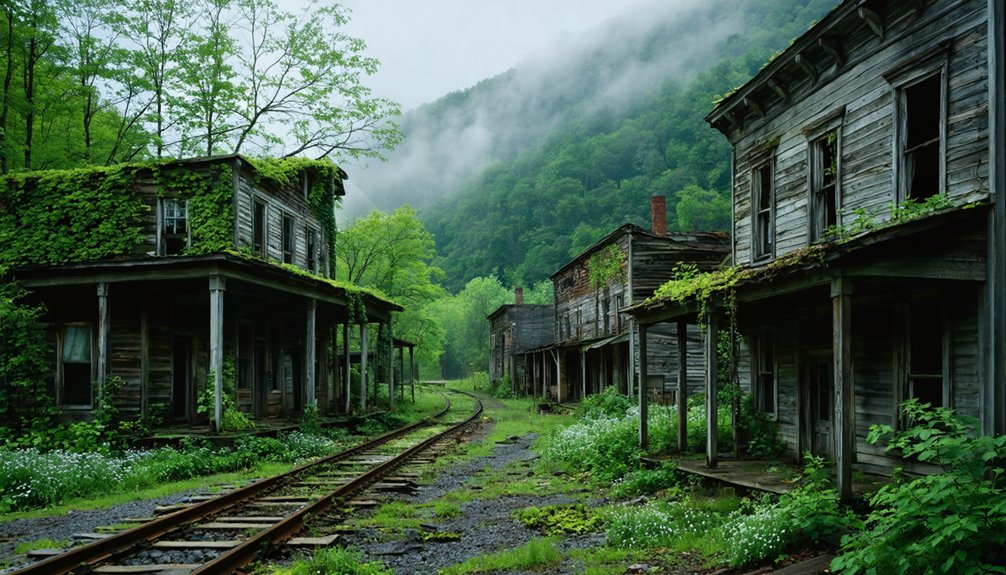
West Virginia’s coal-driven industrial expansion left behind an archaeological landscape that transforms economic decline into cultural capital.
You’ll find over 60 ghost towns concentrated within New River Gorge National Park‘s 12-mile stretch, where coal veins and railroad access once drove prosperity.
Ghost town tourism here offers unmediated encounters with industrial heritage—descend Kaymoor’s 821 stairs to witness rusted equipment reclaimed by forest, or explore Nuttallburg’s complete coal processing infrastructure preserved since the National Park Service acquired it in 1998.
Industrial ruins emerging through Appalachian forest create visceral connections to West Virginia’s vanished coal communities and their abandoned infrastructure.
The historical significance extends beyond mining operations: Winona’s schoolhouse once employed Carter Woodson, while Sewell’s 50 coke ovens from 1874 mark early industrial architecture.
Dun Glen’s cemetery, perched 700 feet above New River, documents communities that vanished after 1935, accessible now through trails connecting past extraction sites with present-day exploration.
Frequently Asked Questions
Are Any Former Mining Ghost Towns Still Inhabited by Residents Today?
Yes, you’ll find Thurmond still breathing with four current residents who guard its historical significance—a living monument where rusted rails whisper coal-era stories through a town that once outpaced Cincinnati’s industrial might.
What Safety Precautions Should Visitors Take When Exploring Abandoned Mine Sites?
You shouldn’t explore abandoned mine sites without professional guidance. Mine site safety requires specialized equipment and training, as visitor precautions include avoiding unstable structures, testing for methane gas, and recognizing asbestos hazards that’ve claimed lives.
How Long Does Natural Reclamation Typically Take at Industrial Sites?
You’ll witness natural processes unfolding across centuries at industrial sites, though official reclamation timelines suggest 6-10 years. Drylands face uncertain ecological recovery, while coal lands require decades before nature truly reclaims degraded landscapes independently.
Can Former Mining Equipment Be Salvaged or Is It Hazardous Waste?
Equipment recycling remains viable if you assess hazardous materials first—acid drainage, asbestos, and lead contamination require testing. Historical precedent shows selective salvage works: Charlie statue proves metal repurposing succeeds when you navigate regulatory frameworks and environmental risks properly.
Which Ghost Towns Are Most Accessible for Families With Children?
Thurmond offers you walkable streets, family-friendly activities, and nature exploration through preserved coal-era structures. You’ll find accessible trails, educational signage, and scenic routes that transform history into hands-on learning experiences for children seeking adventure.
References
- https://wvwri.wvu.edu/news/2025/07/01/how-west-virginia-is-pulling-pollution-and-rare-earths-out-of-its-streams
- https://www.osmre.gov/sites/default/files/inline-files/FY 2016 – FY 2022 Abandoned Mine Land Economic Revitalization Program Report.pdf
- https://appalachianmemories.org/2025/10/16/the-lost-towns-of-appalachia-the-forgotten-mountain-communities/
- https://dep.wv.gov/dlr/aml/Pages/RecognizedProjects.aspx
- https://wvwri.wvu.edu/news/2024/07/11/demand-for-rare-elements-used-in-clean-energy-could-help-clean-up-abandoned-coal-mines-in-appalachia
- https://news.climate.columbia.edu/2020/08/07/coal-rise-decline-west-virginia/
- https://www.osmre.gov/sites/default/files/inline-files/FY-2016-FY-2024-Abandoned-Mine-Land-Economic-Revitalization-Program-Report.pdf
- https://www.usgs.gov/centers/virginia-and-west-virginia-water-science-center/science/effects-abandoned-coal-mine
- https://www.legendsofamerica.com/west-virginia-coal-mining/
- https://researchrepository.wvu.edu/cgi/viewcontent.cgi?article=9016&context=etd