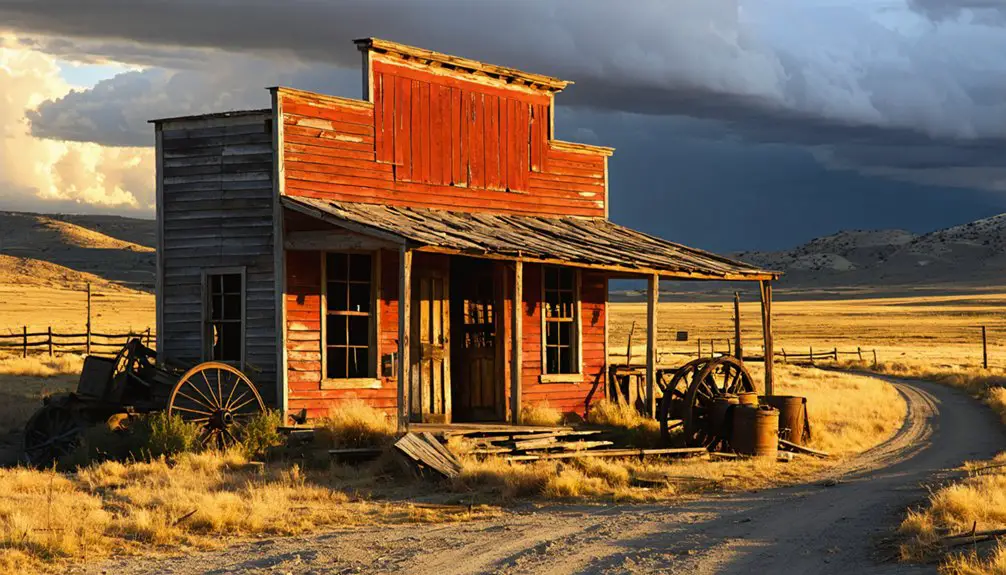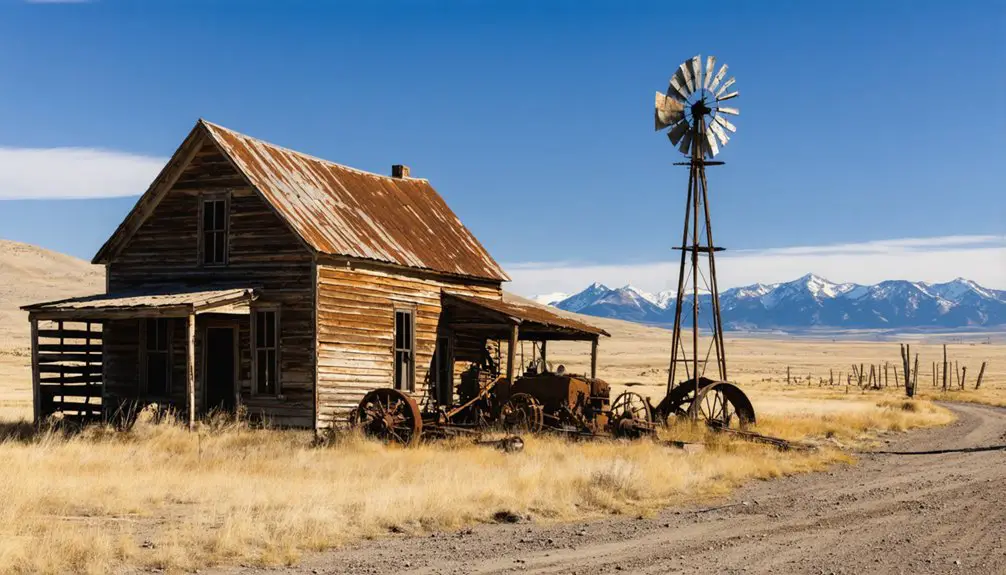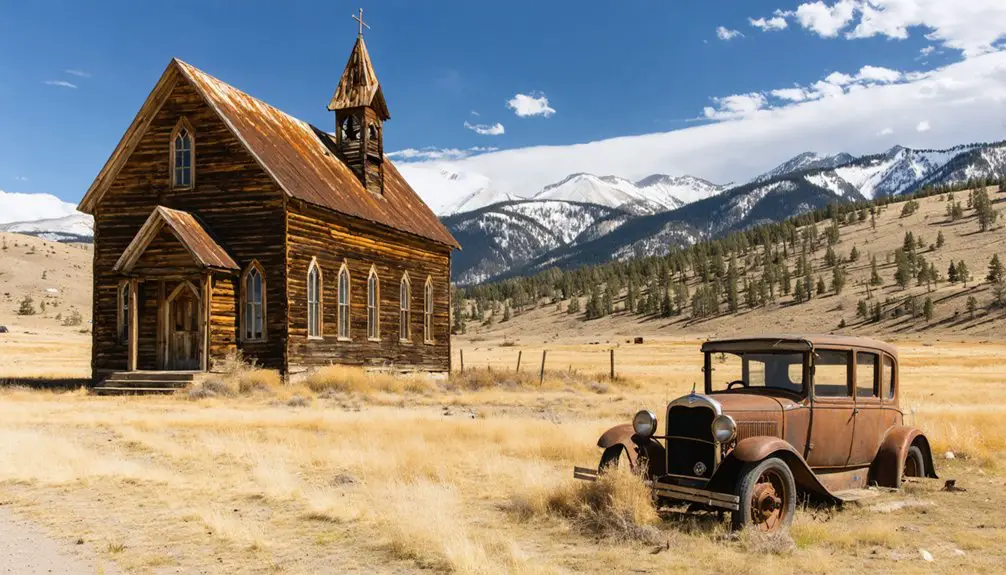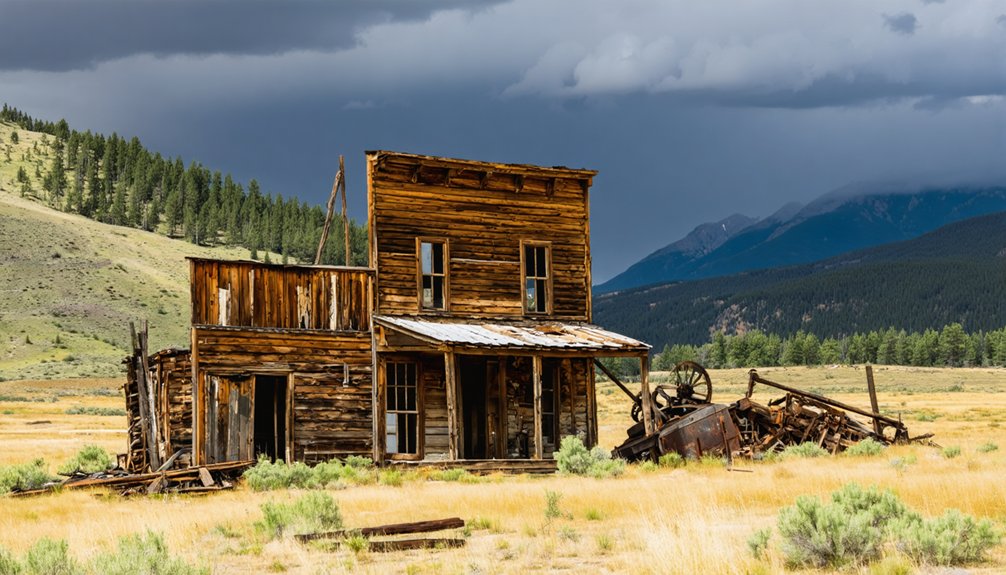
Wyoming’s ghost towns are slowly vanishing beneath sagebrush and native grasses as ecosystems reclaim once-thriving settlements like South Pass City and Carbon. After economic collapse emptied these mining camps—some within months—nature began its century-long recovery process. You’ll find abandoned coal towns where mule deer now outnumber the former residents, and restoration programs have transformed over 50,000 acres into wildlife habitats. The ecological transformation reveals how harsh desert conditions both preserve historic structures and gradually erase human footprints from the landscape.
Key Takeaways
- Wyoming ghost towns emerged from mining booms but emptied rapidly due to resource depletion, railroad shifts, and economic collapse.
- Sagebrush-steppe ecosystem recovery requires centuries, with fire restoration timelines exceeding 100 years in some areas.
- Abandoned mining camps and homesteads now provide habitat for wildlife navigating transformed landscapes across the state.
- Over 50,000 acres of former mining lands have been restored into productive wildlife habitats supporting 279 conservation-priority species.
- Natural reclamation faces challenges from invasive species, drought, and fire, with annual loss of 1.3 million acres regionwide.
Historic Mining and Settlement Sites Across Wyoming
While most western states experienced their mining booms in isolated pockets, Wyoming’s ghost towns stretch across hundreds of miles of high desert and mountain ranges, marking a dispersed pattern of settlement that followed veins of gold, copper, and coal.
You’ll discover South Pass City‘s remnants where 1,000 fortune-seekers once walked half-mile streets lined with saloons and newspapers.
Carbon’s coal operations fueled railroad expansion before fire claimed the town in 1890.
Railroad coal fed westward steel until flames devoured Carbon, leaving only ash where industry once thrived.
Grand Encampment’s world-record 16-mile aerial tramway transported ore to smelters processing 500 tons daily.
Atlantic City emerged after gold discovered in 1868 sparked a rush that brought 300 residents to what remains one of Wyoming’s oldest cities.
Jeffrey City experienced a uranium boom with thousands seeking jobs before the market collapse in the late 1970s caused a 95% population decline by 1986.
Today, historic preservation efforts protect these sites as mining heritage landmarks.
The Carissa Mine and Moses Sturman Stamp Mill stand proof of Wyoming’s unregulated frontier spirit, where independent prospectors carved communities from wilderness without asking permission.
Economic Collapse and the End of Frontier Communities
Wyoming’s ghost towns stand as stark reminders that economic collapse arrived swiftly and mercilessly across the frontier.
When coal seams ran dry, railroads rerouted, or uranium prices crashed, entire communities emptied within months—Rock Springs No. 8 closed in 1962, and by 1965 only 327 miners remained statewide.
You’ll find that nature’s harshness compounded these economic failures, as avalanches, fires, and impossible winters pushed the final residents from mining camps that had thrived just years before.
Company-owned coal camps were dismantled to avoid property taxes, with homes sold cheaply and relocated to larger towns, leaving behind abandoned settlements like Glencoe, Sublet, and Carneyville.
Gebo, once the largest town in Hot Springs County with over 2,000 residents, collapsed entirely when coal production ceased in 1937, its founder Samuel Gebo eventually taking his own life in despair over the mine’s failure.
Resource Depletion Ends Booms
As coal demand shifted to petroleum and diesel fuel in the mid-20th century, Wyoming’s mining towns faced catastrophic economic collapse. Without proper resource management, these settlements lacked economic sustainability when their single commodity vanished.
Carbon’s mines, which once supported 1,000 residents, closed permanently in 1902 after exhausting accessible deposits. Kirwin followed in October 1906, shuttered by supply shortages. The town had reached its peak in 1904 with over 200 residents and 38 buildings, including hotels and general stores, before the mining boom subsided.
The devastation peaked between 1953 and 1958, when Wyoming’s coal production crashed 70 percent to just 1.6 million tons annually. Miners dwindled from 9,192 in 1922 to merely 327 by 1965.
You’ll find these abandoned settlements scattered across the landscape—Carbon reduced to foundations, Kirwin’s buildings crumbling among strewn rocks, Gebo standing in ruins where freedom-seeking prospectors once thrived. Gebo, named after mining entrepreneur Samuel Wilford Gebo, had housed hundreds of families during the early 1900s coal boom before joining the ranks of abandoned communities.
Railroad Shifts Doom Towns
Railroad companies wielded absolute power over frontier settlements, and their routing decisions determined whether communities prospered or perished overnight.
When tracks shifted or stations relocated, entire populations vanished within weeks, leaving only archaeological traces of their existence.
Railroad impacts devastated multiple Wyoming communities through calculated business decisions:
- Cinnabar lost its Yellowstone station status in 1903 when rails extended to Gardiner, prompting residents to physically relocate buildings rather than abandon investment. The town had served as the primary gateway to Yellowstone since 1883 before losing this crucial economic role.
- Carbon emptied after Union Pacific closed coal mines and rerouted lines, forcing the thousand-person population toward Hanna. Founded in 1868 by the Union Pacific Railroad specifically for fuel sourcing, the community was destroyed by fire in 1890.
- Bryan disappeared when river crossing needs changed, leaving only platform depressions visible from WY-374.
These town disappearances demonstrate how corporate logistics superseded human settlement, erasing communities from Wyoming’s landscape without consultation or compensation.
Harsh Conditions Force Abandonment
While corporate decisions about rail routes destroyed some settlements instantly, economic forces ground others down through prolonged collapse that left families no choice but to flee.
Wyoming’s coal production crashed 46 percent in one year, slashing mining jobs by half and triggering abandonment patterns across Sweetwater and Lincoln counties. Towns like Superior, Dines, and Gunn vanished entirely.
Jeffrey City’s uranium collapse proved equally devastating—95 percent of residents departed by 1986 when Western Nuclear shuttered operations, leaving behind an Olympic-sized pool and empty schools.
Rock Springs avoided ghost town status despite coal demand dropping in the 1960s when railroad operators switched to diesel, maintaining a population of around 22,000 residents.
These mining legacies reveal single-industry dependency‘s fatal weakness.
You’ll find machinery worth tens of thousands still rusting in Kirwin, abandoned after the 1907 avalanche that killed three and isolated survivors behind eight miles of snow. Residents fled despite over $300,000 in investments controlling 1,600 acres of mining land, leaving valuable claims untouched as fear and superstition hastened the town’s complete abandonment.
How Sagebrush-Steppe Ecosystems Reclaim Abandoned Lands
When you walk through Wyoming’s ghost towns today, you’ll find sagebrush and native grasses steadily erasing evidence of human occupation, a process documented in land surveys and ecological studies spanning decades.
The natural recovery unfolds slowly—Wyoming big sagebrush requires 50-120 years to fully reestablish on disturbed soils—while wildlife like sage-grouse and pronghorn return only when vegetation reaches sufficient maturity to provide food and shelter.
Yet this reclamation isn’t automatic; contaminated soils from mining operations, invasive cheatgrass colonization, and altered fire regimes can prevent native ecosystems from returning without costly intervention.
Natural Vegetation Recovery Process
Across Wyoming’s abandoned settlements, sagebrush-steppe ecosystems face a protracted battle to reclaim what humanity left behind.
Natural recovery unfolds across centuries, not decades, as these resilient landscapes navigate fire, drought, and invasive pressures. You’ll witness vegetation resilience tested through three critical challenges:
- Fire recovery timelines extending 100 years or more in burned perimeters like House Draw Fire
- Type conversions shifting sagebrush communities permanently to grasslands post-disturbance
- Annual losses of 1.3 million acres across 13 western states accelerating degradation
The Abandoned Mine Lands Native Plants Project grows 40,000 sagebrush seedlings annually, yet natural regeneration struggles.
Without intervention, these once-thriving ecosystems transform into persistent shrublands, their original character vanishing beneath Wyoming’s unforgiving climate.
Wildlife Returns to Sites
As abandoned homesteads and mining camps crumble into Wyoming’s sagebrush-steppe, mule deer and smaller mammals navigate a transformed landscape where human absence has triggered ecological succession.
You’ll find wildlife migration corridors reestablishing through these reclaimed zones, though statewide mule deer numbers have plummeted from 520,000 to 320,000.
Post-fire surveys document returning species utilizing habitat restoration sites where native bunchgrasses now thrive.
Yet this recovery isn’t without cost—vehicle collisions claim 3% of mule deer annually, with 21 big-game strikes occurring daily across rural routes.
Conservation efforts target 279 species of greatest conservation need, though 235 lack sufficient data.
While State Wildlife Grants allocate $860,000 annually for sagebrush habitat protection, these reclaimed ghost towns reveal nature’s persistence against mounting pressures.
Restoration Challenges and Costs
Consider these preservation strategies from Wyoming’s documented efforts:
- South Pass City’s 1966 state acquisition enabled collaborative agency restoration after private management failed.
- Sunrise’s brick structures survived 100+ years with minimal decay, reducing costs.
- Court-ordered reclamation programs address mining legacy impacts through innovative partnerships.
Without running water or electricity, you’re looking at significant investment before achieving habitability.
The $12 million Sunrise offer proves potential value, yet consistent labor and isolation define post-purchase reality.
Large-Scale Restoration Programs Targeting Former Mining Towns
Wyoming’s abandoned mine lands harbor decades of environmental damage that state and federal agencies now tackle through coordinated restoration programs.
You’ll find the AML Division overseeing large-scale restoration of thousands of acres statewide, transforming coal, bentonite, and uranium sites into productive pastures and wildlife habitat.
Mining town reclamation extends beyond environmental cleanup—HistoriCorps volunteers preserve structures like Atlantic City’s Lemley Mill and Miner’s Delight’s historic saloon, dismantling buildings piece-by-piece before reconstructing them on restored foundations.
The Wyoming Reclamation and Restoration Center advances these efforts through university research programs and partnerships with landowners.
These coordinated initiatives don’t just erase mining’s footprint; they’re rebuilding former coal communities while maintaining access to Wyoming’s mining heritage, proving restoration can honor both ecological health and historical integrity.
Environmental and Wildlife Benefits of Natural Reclamation
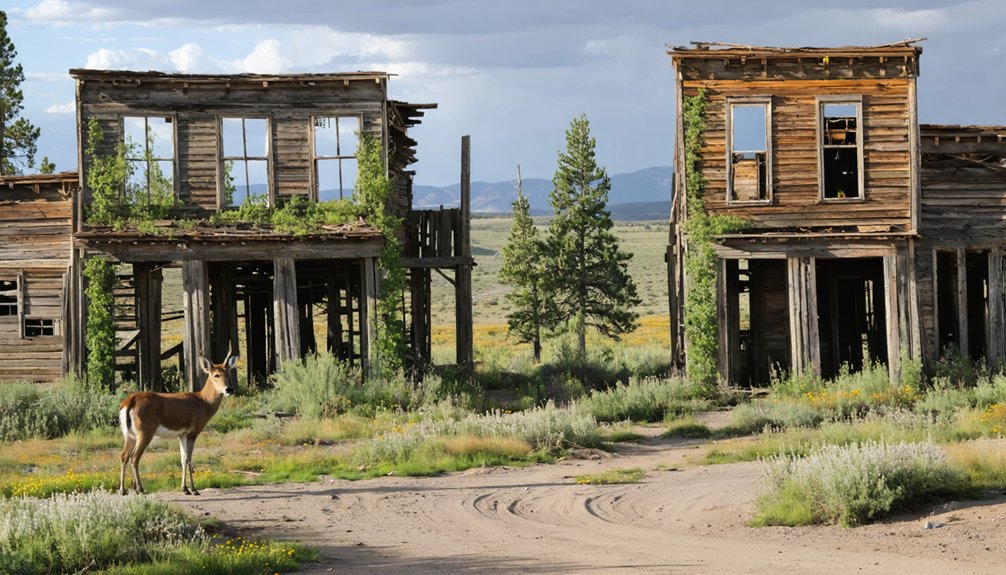
Mining operations once stripped Wyoming’s landscape bare. Thriving ecosystems now demonstrate reclamation’s remarkable ecological payoff.
You’ll find over 50,000 acres transformed into productive wildlife habitats supporting elk, deer, and antelope throughout the Powder River Basin. The Rochelle Hills elk herd winters on what was once barren coal land, while vegetation recovery has created diverse native plant communities.
The ecological transformation delivers measurable benefits:
- 279 Species of Greatest Conservation Need now inhabit reclaimed lands
- Native grasses and shrubs provide abundant foraging beyond pre-mining conditions
- Strategic rock piles create natural shelters for muskrats, foxes, and rabbits
You’re witnessing nature’s resilience amplified by restoration science. Eagles and owls patrol these renewed landscapes daily, proving that thoughtful reclamation returns land to productive use while expanding freedoms for both wildlife and ranchers.
The Cost of Restoring Wyoming’s Ghost Town Landscapes
Modern preservation strategies extend beyond ghost towns.
Wyoming received $25 million from federal infrastructure legislation for abandoned well cleanup, part of $4.7 billion in Department of Interior investments.
Even modest allocations matter: the Buffalo Field Office’s Recreation Fee Program spent $1,535 on trail materials and $15,650 on additional programs, demonstrating how layered funding approaches sustain these landscape restoration efforts statewide.
Frequently Asked Questions
Are Ghost Town Sites in Wyoming Open to Public Exploration?
You’ll find many Wyoming ghost towns offer public access, though exploration guidelines vary by location. Check for private land boundaries, posted restrictions, and BLM cultural protections before venturing onto these historic sites reclaimed by wilderness.
exploring wyoming’s abandoned mining towns can reveal the rich history of the region and the stories of those who once inhabited these places. Many towns were established during the gold and silver rushes, leading to bursts of economic activity before their eventual decline. As you navigate through these fascinating remnants, keep an eye out for unique artifacts and remnants of structures that tell the tale of a bygone era.
What Happened to Residents When Mining Towns Were Abandoned?
When mining impacts devastated local economies, you’d have witnessed entire communities scatter across Wyoming and westward. Town migration occurred rapidly—thousands relocated to Hanna, sought new claims, or abandoned camps entirely, leaving nature to reclaim abandoned settlements.
Can Descendants Reclaim Property in Former Ghost Towns?
You’d face monumental challenges reclaiming abandoned town property. Legal rights depend on proving continuous land ownership through archival records—deeds, tax payments, inheritance documentation. Most ghost town parcels reverted to federal or state control decades ago.
Which Wyoming Ghost Town Is Best Preserved for Tourists?
South Pass City’s your best preserved destination, offering authentic tourist attractions with maintained mining-era structures. You’ll find documented preservation efforts that’ve protected this South Central Wyoming site’s historical integrity, giving you unrestricted access to explore Wyoming’s frontier past.
How Long Does Complete Natural Reclamation Typically Take?
You’ll find natural reclamation’s ecological timeline spans 50-100 years for wooden structures, though Wyoming’s harsh climate accelerates decay. By 1988, Jeffrey City showed nature’s swift takeover—foundations crumbling, sagebrush reclaiming streets within decades.
References
- https://wyofile.com/sagebrush-is-suffering-even-in-wyoming-saving-whats-left-is-complicated/
- https://www.bbcearth.com/news/abandoned-places-reclaimed-by-nature
- https://www.blm.gov/sites/default/files/uploads/AML_PUB_DecadeProgress.pdf
- https://travelwyoming.com/blog/stories/post/wy-hidden-histories-pioneers-ghost-towns/
- https://www.lovemoney.com/gallerylist/86648/americas-empty-ghost-towns-and-why-theyre-abandoned-today
- http://deq.wyoming.gov/aml/projects/
- https://wildlife.onlinelibrary.wiley.com/doi/10.1002/jwmg.22179
- https://wyoshpo.wyo.gov/homestead/pdf/historic_context_study_011311.pdf
- https://www.youtube.com/watch?v=pTO-w4j3-wo
- https://www.rv.com/archive/wyomings-spook-route/