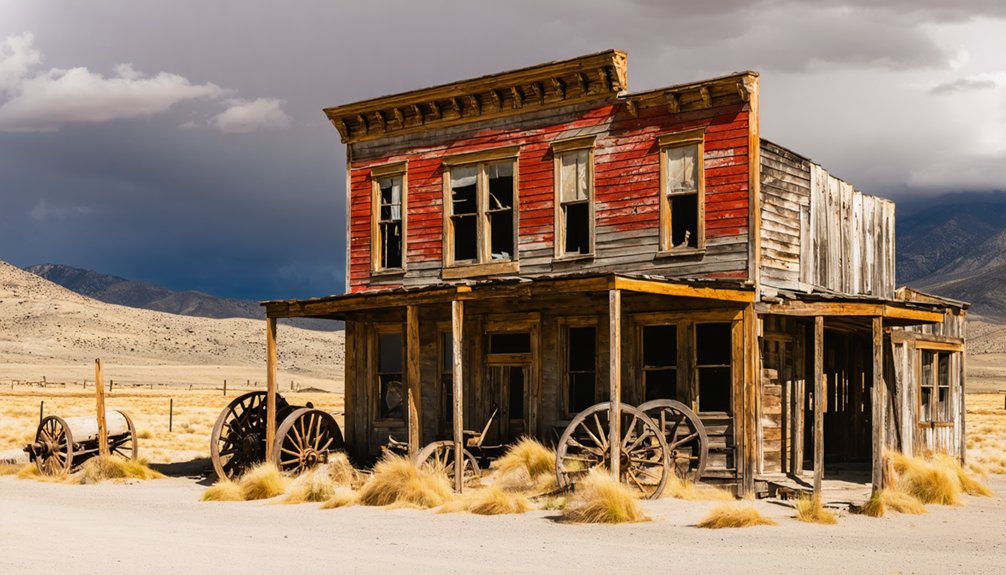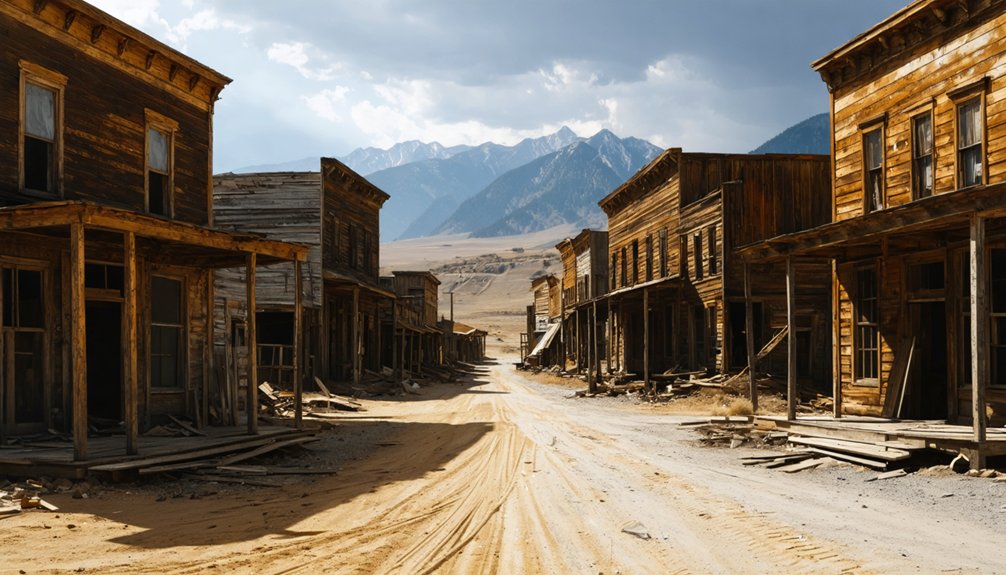
You’ll find over 4,530 ghost towns still standing across the United States, with Texas leading at 511 sites, followed by California’s 346 and Kansas’s 308 abandoned settlements. These preserved communities—from Alaska’s Kennicott copper mines to Montana’s Garnet—remain physically intact yet depopulated, representing economic collapse from resource depletion, the Dust Bowl, and industrial decline. Notable examples include Bodie’s “arrested decay” preservation and Jerome’s adaptive arts transformation, demonstrating how these abandoned landscapes now serve as cultural destinations that reveal deeper patterns of American settlement and economic volatility.
Key Takeaways
- The United States contains over 4,530 ghost towns and abandoned settlements still standing across diverse regions and terrains.
- Texas leads with 511 ghost towns, followed by California with 346 and Kansas with 308 standing abandoned communities.
- Montana’s Garnet, Alaska’s Kennicott copper mines, and Nevada heritage sites remain as preserved examples of historical ghost towns.
- Florida has 257 standing ghost towns, many resulting from failed resort developments in previous decades.
- Eastern Europe contains over 500 ghost towns in Bulgaria alone, with 1,200 villages housing fewer than 50 residents.
America’s Historic Abandoned Settlements
More than 4,530 ghost towns scatter across the American landscape, marking the physical remnants of communities that once thrived during mining booms, military operations, and frontier expansion. You’ll find these settlements from Alaska’s Kennicott copper mines to Florida’s Fort Jefferson fortress, each representing distinct chapters in America’s westward movement and industrial development.
The abandoned infrastructure tells stories of economic collapse—gold deposits exhausted in Montana’s Garnet, copper veins depleted in Alaska by 1938, and silver quality declining throughout Colorado’s mining districts. The Great Plains states experienced widespread abandonment due to the Dust Bowl and economic downturns that forced residents to leave once-prosperous communities.
Historical preservation efforts now protect select sites: Fort Jefferson stands as a National Monument since 1935, while Berlin’s Nevada structures remain intact as mapped heritage sites. These locations offer you tangible connections to America’s entrepreneurial past and settlement patterns. Some ghost towns have transformed into tourist attractions, with Montana’s Bannack drawing visitors to explore its preserved buildings and streets.
Modern Urban Decline in Major Metropolitan Areas
You’re watching America’s major coastal cities hollow out in real time, with Miami posting the steepest year-over-year population drop among major metros as of Q4 2025.
Meanwhile, New York and Los Angeles continue bleeding residents six years after pandemic migration patterns began. These population losses aren’t abstract statistics—they’re creating measurable economic consequences through rising vacancy rates, collapsing construction permits, and tax bases that can’t sustain municipal services.
The cycle accelerates as departing residents and businesses trigger capital flight, transforming once-thriving urban centers into the modern equivalent of ghost towns.
These areas are now characterized by empty storefronts and deteriorating infrastructure. The middle class departure intensifies as property taxes rise while local services, security, and opportunities continue to stagnate, leaving those who remain paying fully without seeing returns. Los Angeles alone has experienced 0.8% annual decline, with residents fleeing primarily to cheaper western hubs seeking more manageable living costs.
Population Loss Trends Accelerating
While ghost towns of the Old West emptied over decades, America’s largest cities hemorrhaged residents at an unprecedented pace during the 2020s. You’re witnessing demographic shifts that dwarf historical patterns—New York alone shed 550,000 residents since 2020, while San Francisco lost 6.30% of its population in a single year.
This urban decay accelerated through domestic migration as families voted with their feet.
Core cities declined 1.25% while suburbs gained 0.25%, revealing stark preferences for autonomy over density. The exodus hit young families hardest: under-5 populations plummeted 18.3% in New York, 15.4% in San Francisco, and 14.6% in Chicago’s Cook County.
Though losses slowed from 0.91% to 0.03% by 2023, major metropolitan centers continue bleeding residents who refuse mandated urban lifestyles. About 70% of core cities experienced population declines in 2021, with 39 out of 56 losing residents. Major metros shifted from losing 138,385 residents in 2020-21 to gaining over 870,471 in 2022-23.
Vacancy Rates Signal Decline
Empty offices and apartments across America’s urban centers reveal a structural crisis that transcends temporary pandemic disruptions. You’re witnessing vacancy impact that signals fundamental urban decay: Austin’s office vacancy surged to 27%, while Dallas-Fort Worth hit 23% and Houston reached 21%.
The national average of 18.4% masks deeper regional divergence—Sunbelt markets that once promised growth now face oversupply and remote work’s permanent shift.
Meanwhile, you’ll find stability in overlooked Northeastern and Midwestern cities. Manhattan’s vacancy dropped to 15.2%, Boston sits at 16%, and Hartford maintains just 5.3% multifamily vacancy.
Atlanta defies this Sunbelt trend, with apartment vacancy forecasted to fall to 5.2% in 2026 as in-migration and slowing construction reverse previous oversupply conditions.
These aren’t temporary fluctuations—they’re structural realignments. The markets bureaucrats championed as unstoppable growth engines now struggle with empty towers, while affordable, stable metros quietly demonstrate resilience without government intervention or artificial stimulus. Emerging powerhouses like Appleton, Wisconsin maintain 2.9% multifamily vacancy while generating consistent rent growth—proof that overlooked markets outperform overhyped Sun Belt cities.
Construction Permits Dramatically Dropping
The cranes have stopped swinging across America’s once-booming metropolises. You’re witnessing a construction slowdown that’s remaking the urban landscape—single-family permits plummeted 7.0% through October 2025, hitting just 787,122 units nationwide.
The permit decline tells a story of regulatory burdens meeting economic reality: Phoenix saw 22% fewer single-family permits, Atlanta dropped 28%, while the Northeast collapsed 15.9% in October alone. Texas, despite leading with 122,293 permits, fell 10.3%. The single-family slump continues, marking the sixth consecutive month of declines.
Even multifamily construction—up 5.7% nationally—couldn’t save the Northeast, where permits crashed 30%. Multifamily units under construction have plunged from their December 2023 peak above 1 million, now sitting at just 790,000 units.
You’re watching government-imposed affordability challenges and mortgage rate manipulation strangle development in real-time. When builders can’t build, your housing options disappear, prices surge, and metropolitan areas transform into stagnant monuments of bureaucratic overreach.
Vacancy Rates and Housing Market Indicators
Across America’s struggling cities, vacancy rates reveal a housing market caught between abandonment and stagnation. You’ll find 1.4 million residential properties sitting empty nationwide—a 1.3% rate that’s remained frozen for 13 consecutive quarters.
But this steady national figure masks severe regional distress where affordable housing initiatives have failed to reverse decline. The long-term vacancy crisis tells you where community revitalization efforts haven’t reached:
- Dayton leads abandonment with 46.2% of vacant homes empty over two years
- Rust Belt dominance appears in Buffalo (40.1%), Scranton (37.9%), and Pittsburgh (34.3%)
- ZIP code extremes show Youngstown’s 44507 area at 23.7% vacancy, Detroit’s 48206 at 18.4%
- Rental markets suffer with Augusta, GA hitting 8.9% vacancy and St. Louis retail spaces 35% above average
State-by-State Distribution of Abandoned Communities
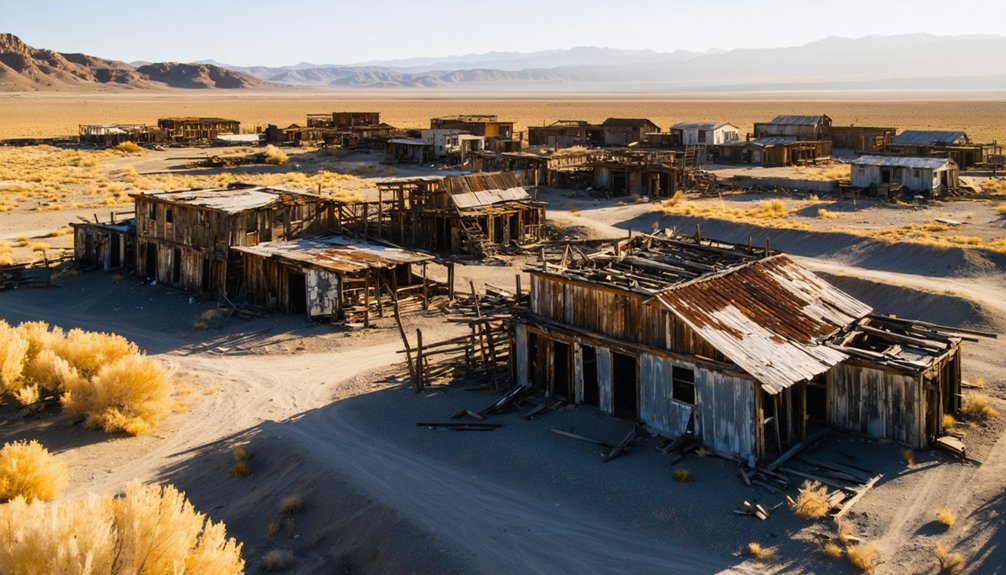
Regional vacancy patterns concentrate into distinct geographic clusters when you map where America’s ghost towns actually exist. Texas dominates with 511 abandoned communities, followed by California’s 346 and Kansas’s 308.
You’ll find the heaviest concentrations across western territories—Oklahoma, Utah, and Arizona collectively harbor 503 deserted settlements where mining booms collapsed and railroad routes shifted.
These hidden histories reveal economic volatility patterns: Florida’s 257 ghost towns reflect failed resort developments, while South Dakota’s 238 mark homesteading failures.
Ghost towns map economic failures: abandoned resorts in Florida, collapsed homesteads in South Dakota—spatial records of capitalism’s volatile frontier experiments.
Preservation challenges intensify in remote locations where Montana and Nevada each count 106 sites facing structural decay without oversight.
The distribution exposes how frontier expansion, resource depletion, and transportation changes created abandonment corridors. You’re witnessing spatial evidence of capitalism’s creative destruction—communities that couldn’t adapt simply vanished from viable existence.
Population Migration Patterns Across U.S. Cities
While ghost towns represent historical abandonment, contemporary American cities face their own exodus crisis—St. Louis lost 21,700 residents from 2020 to 2024, America’s fastest major city decline. You’re witnessing unprecedented urban transformation as families choose freedom over deteriorating services.
Critical Migration Patterns:
- Extreme declines: Paradise, NV plummeted 26.77% over five years; Spring Valley dropped 10.14% in one year
- Regional reversals: Northeast and Midwest hemorrhage residents while Austin (10.9%) and Raleigh (10.2%) surge
- Immigration buffer: International migration slowed losses in New York and San Francisco during 2023-2024
- Suburban escape: Families flee for better schools and parks, challenging neighborhood revitalization efforts
Urban planning strategies can’t overcome residents voting with their feet. When 16% of cities over 100,000 shrink, you’re observing market-driven reallocation of human capital.
International Ghost Towns and Abandoned Regions

Beyond the ghost towns scattered across Africa, Asia, and South America, you’ll find particularly dramatic examples of urban abandonment in Eastern Europe and the Caucasus region.
Azerbaijan’s Agdam district stands as a striking case—once home to 50,000 residents, it was completely abandoned during the Nagorno-Karabakh conflict in 1993 and remains a sprawling ruin of empty Soviet-era apartment blocks.
This pattern of conflict-driven and post-Soviet economic collapse has left numerous settlements across Eastern Europe experiencing severe depopulation.
Some Ukrainian, Bulgarian, and Romanian villages have lost over 70% of their populations since 1989.
Azerbaijan’s Abandoned Urban Centers
The Nagorno-Karabakh conflict transformed multiple Azerbaijani cities into expansive wastelands where systematic destruction erased urban life more thoroughly than most 20th-century wars. Ağdam exemplifies this devastation—once housing 150,000 residents, shelling and deliberate demolition reduced it to rubble serving as a military buffer zone. Azerbaijan’s ruins now attract ghost tourism, though landmines restrict access.
Key Abandoned Urban Centers:
- Ağdam – Concrete skeletons dominate landscapes where vegetation overtakes former neighborhoods. One damaged mosque remains standing.
- Fuzuli – Provincial capital near Iran’s border, fully deserted under military control until 2020.
- Shusha – Cultural capital undergoing restoration after three decades of occupation-induced decay.
- Jabrayil – War-evacuated settlement displaying burnt vehicles and occupied schools as conflict relics.
Post-2020 Azerbaijani control initiates reconstruction, yet extensive mining continues limiting civilian return.
Eastern European Population Collapse
Since communism’s collapse in 1989, Eastern Europe has experienced demographic hemorrhaging that’s converting entire regions into ghost territories through a mechanism more gradual but equally devastating as warfare. Bulgaria’s population plummeted from 9 million to 7 million, with over 500 ghost towns documented and 1,200 villages housing fewer than 50 residents.
Poland faces 3.6 million vacant properties by 2045, while deaths exceed births by 170,000 annually.
Hungary’s settlements like Nagyecsér empty after infrastructure failures. This collapse threatens cultural heritage preservation as churches, folk traditions, and historical architecture disappear with their human custodians.
Environmental reclamation proceeds unplanned—forests reclaim farmland while abandoned buildings decay. Without intervention, Bulgaria’s Academy of Sciences predicts complete village extinction by 2060, marking civilization’s retreat across landscapes once densely populated.
Economic Factors Behind Urban Abandonment
When industrial plants shuttered across America’s Rust Belt, they didn’t just eliminate jobs—they triggered a cascade of economic forces that hollowed out entire cities. You’re witnessing urban decay driven by multiple compounding factors beyond simple manufacturing decline.
Key drivers of economic disinvestment include:
- Suburban competition – Peripheral development flooded markets with newer, cheaper housing while infrastructure costs remained artificially low, distorting true market prices.
- Demographic shifts – Black-majority neighborhoods experienced disproportionate abandonment, compounded by redlining and discriminatory practices that prevented market recovery.
- Fiscal collapse – Population loss eroded tax bases while cities maintained oversized infrastructure, forcing higher rates that accelerated resident flight.
- Cascading externalities – Each abandoned property decreased neighboring values, triggering waves of additional abandonment in already-vulnerable areas.
Reconstruction Efforts and Future Prospects
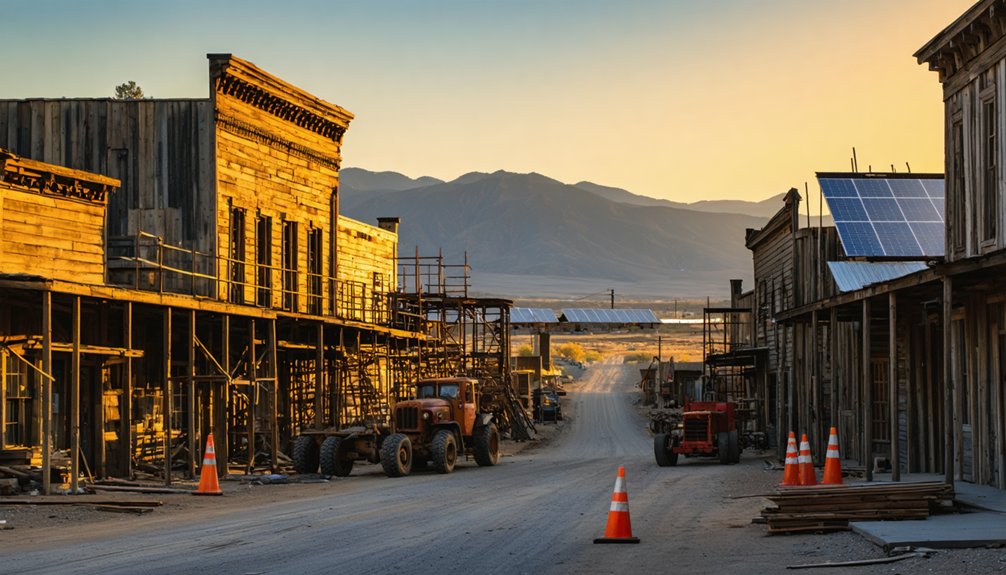
Abandonment doesn’t guarantee permanence—several ghost towns have defied expectations through deliberate reconstruction and adaptive reuse strategies. You’ll find restoration techniques ranging from Cerro Gordo’s volunteer-driven salvage operations, where reclaimed wood accelerates rebuilding, to Bodie’s arrested decay model that freezes structures in time.
Tourism strategies vary notably: Centralia leverages its underground fire as a curiosity draw while maintaining limited residency rights. Jerome transformed mining infrastructure into artist studios and galleries, and Craco capitalized on cinematic appeal after UNESCO designation.
These approaches demonstrate that revival doesn’t require erasing history—it demands creative preservation-entrepreneurship partnerships. Whether through cultural hubs, adventure tourism, or sustainable visitation frameworks, these towns prove you can resurrect communities without surrendering their authentic narratives to commercialization.
Frequently Asked Questions
Can Tourists Legally Visit and Explore Abandoned Ghost Towns?
Want to explore abandoned settlements legally? You can visit public ghost towns under tourism regulations respecting historical preservation, but you’ll need written permission for private sites. Always follow posted rules, take only photographs, and leave artifacts undisturbed.
One fascinating aspect of these locations is the abundance of abandoned towns with historic churches, which often serve as the centerpiece of these ghostly landscapes. Their architecture tells stories of the past, inviting visitors to reflect on the lives once lived there. Capturing the beauty in these structures can lead to a deeper appreciation of the region’s history.
As you journey through the diverse landscapes, consider the intriguing abandoned places along Route 66, where remnants of a bygone era can be explored. Each stop along this historic highway reveals unique stories and the echoes of travelers from decades past. The desolation is a poignant reminder of the American dream and the relentless passage of time.
What Happens to Utilities and Infrastructure in Modern Ghost Towns?
In modern ghost towns, you’ll find utility maintenance ceases immediately after abandonment, accelerating infrastructure decay. Water lines break, electrical grids fail, and roads crumble—leaving physical remnants that demonstrate how quickly civilization’s framework deteriorates without human intervention.
Are There Safety Risks When Visiting Abandoned Buildings and Towns?
You’ll face significant dangers from hazardous structures like unstable floors and collapsing mines, plus health risks including toxic chemicals, lead exposure, and unsafe ground conditions. Abandoned buildings statistically cause serious injuries and deaths requiring extreme caution.
Who Owns the Property in Abandoned Ghost Towns Today?
You’ll find countless ghost towns under private ownership today, bought as real estate investments for restoration or unique projects. Historical preservation laws complicate some properties, while others face divided parcels among multiple owners, creating complex acquisition challenges.
Can People Purchase Homes in Declining Cities at Reduced Prices?
You can purchase homes in declining cities at reduced prices, creating real estate investment opportunities. However, you’ll need proper property legalization and title verification, as markets in Texas, Florida, and Midwest cities show significant price drops up to 10%.
References
- https://themortgagepoint.com/2024/10/25/americas-new-ghost-towns/
- https://www.youtube.com/watch?v=gZhpJaY2mBU
- https://en.wikipedia.org/wiki/List_of_ghost_towns_by_country
- https://www.youtube.com/watch?v=0r1tDpgoAUM
- https://www.loveexploring.com/gallerylist/131658/abandoned-in-the-usa-91-places-left-to-rot
- https://www.geotab.com/ghost-towns/
- https://joybird.com/blog/top-ghost-towns-in-america/
- https://www.youtube.com/watch?v=odbOj8W4V9o
- https://fortune.com/2026/01/27/are-people-still-moving-out-of-new-york-los-angeles-bank-of-america-migration/
- https://blog.batchgeo.com/ghost-towns/