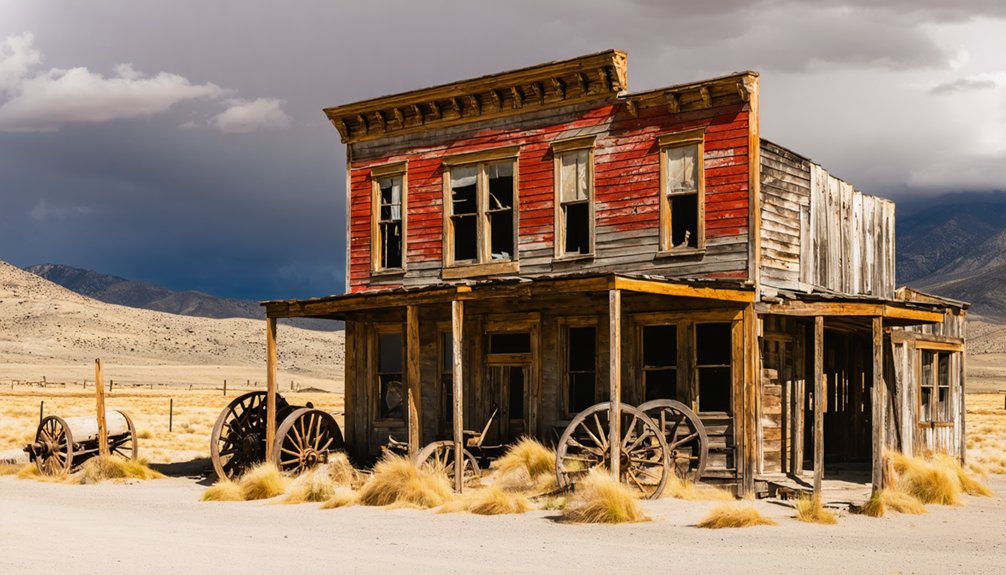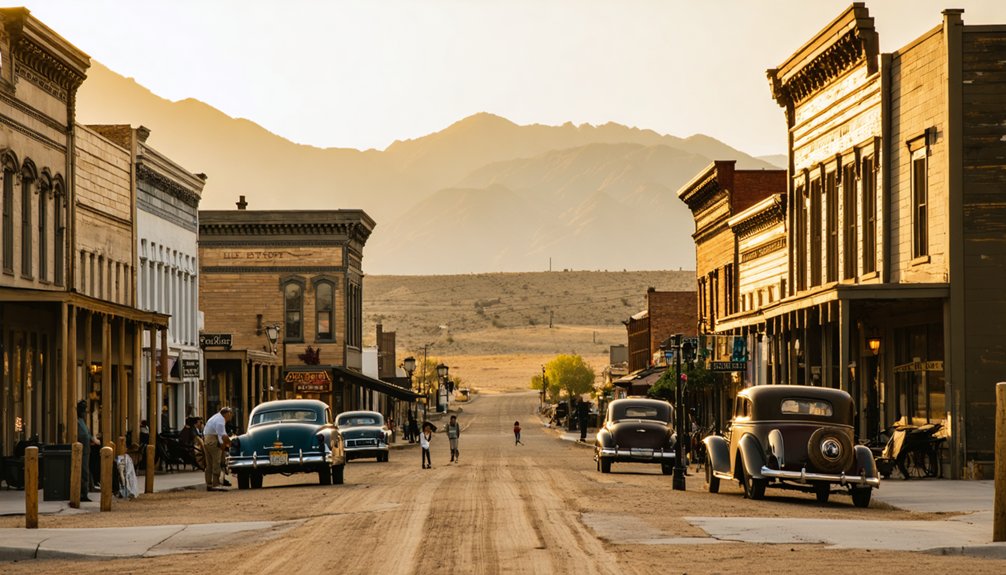
You’ll find ghost towns like Crested Butte, Colorado, and Bisbee, Arizona, revived through heritage tourism infrastructure that transformed abandoned mining sites into economic engines. Railroad bypasses historically doomed settlements, but strategic infrastructure investments now reverse decline—illustrated by Dallas-Fort Worth’s absorption of formerly isolated communities like Celina, which grew 27% in one year. Texas leverages approximately 550 ghost towns as regional tourism assets, while Florida communities demonstrate demographic resilience with double-digit population surges. The patterns reveal systematic relationships between transportation access, resource diversification, and sustained community viability that determine which abandoned towns achieve full resurrection.
Key Takeaways
- Crested Butte and Bisbee revitalized through heritage tourism, preserving mining infrastructure to attract visitors and foster economic renewal.
- Jerome, Arizona, and Bodie, California, transformed into tourist destinations by leveraging ghost town heritage for economic stabilization.
- Celina, Texas, grew 27% annually after Dallas-Fort Worth expansion absorbed it, demonstrating urban growth reviving isolated communities.
- Infrastructure investments in transportation and utilities enable long-term community persistence beyond resource extraction cycles.
- Developer-funded projects—roads, schools, housing—drive resilient suburban growth, preventing decline in formerly struggling towns.
Mining Boom Towns That Found New Purpose Through Heritage Tourism
When mineral deposits depleted and mining operations shuttered across the American West, dozens of boom towns faced economic collapse and abandonment.
You’ll find communities like Crested Butte, Colorado, and Bisbee, Arizona, chose heritage preservation over extinction. They’ve transformed historic mining infrastructure into visitor attractions that generate sustainable revenue streams. Virginia City’s Comstock Lode sites demonstrate mining techniques evolution through preserved 1860s structures, while Butte’s World Museum of Mining offers underground tours through the Orphan Girl Mine’s 50+ buildings.
Philipsburg lets you sift gravel for sapphires, maintaining active participation in mining heritage. These towns secured economic independence by designating entire districts as protected zones, ensuring development reviews maintain authentic character while supporting year-round tourism through skiing, hiking, and cultural experiences that attract visitors seeking genuine historical connections. Communities develop strong emotional ties to mining landscapes through festivals and patron saint celebrations that reinforce cultural cohesion. Towns like Crested Butte shifted their economies to outdoor recreation including skiing, hiking, mountain biking, expanding beyond their resource extraction origins.
When the Railroad Decided a Town’s Fate
You’ll find that railroads functioned as economic gatekeepers in the 19th century, systematically bypassing established settlements in favor of company-owned town sites where land sales generated maximum profit.
This corporate strategy caused over half of Midwest urbanization increases in the 1850s while simultaneously converting thriving antebellum towns into ghost towns.
Even county seats like Washington lost population battles to railroad-chosen locations like Hope.
The pattern reveals a fundamental truth: transport infrastructure doesn’t follow economic growth; it dictates which communities survive and which ones die. Towns like Amity, Missouri relocated in 1885 specifically to position themselves near railway tracks, recognizing that proximity to rail lines determined economic viability. These railroad corporations operated as land speculation subsidiaries, prioritizing profits from new territory development over serving existing communities.
Bypass Leads to Abandonment
Transportation infrastructure decisions systematically determined which communities would thrive and which would wither across America’s rural landscape. When Interstate 94 bypassed North Dakota towns, you witnessed industrial decline accelerate as through-traffic vanished overnight.
Texas researchers quantified these impacts through longitudinal studies, documenting negative growth correlations post-bypass construction. You’ll find similar patterns whether highways or railroads rerouted—businesses dependent on traveler spending collapsed without intervention.
Railroad abandonments proved equally devastating across 20-30 year spans, with deregulation enabling unprofitable line closures regardless of community impact. The demographic shifts followed predictably: residents relocated to cities offering better opportunities.
However, some towns survived by diversifying beyond single transportation dependencies. Agricultural mechanization drastically reduced the local customer base as farm efficiency increased from 27.5 acres per worker in 1890 to 740 acres per worker by 1990, further weakening small-town economies already strained by infrastructure changes. Modern rail operations create new challenges as longer freight trains block highway-rail crossings for extended periods, particularly during yard assembly processes, disrupting emergency response and daily commerce. Your community’s economic resilience depends on maintaining multiple access points and adapting infrastructure to changing realities rather than relying on centralized routing decisions.
Rails Shift Regional Power
Highway bypasses represented recent infrastructure shifts, but railroads wielded far greater power over settlement patterns during America’s westward expansion.
You’ll find that railroad politics determined which communities survived and which became ghost towns.
Corporations established subsidiaries to plat new settlements every seven miles, engaging in land speculation that bypassed existing antebellum towns west of the Mississippi.
State charters incentivized dual profits from freight and real estate, creating a system where even county seats like Washington and Richmond lost status to rail-connected rivals.
Cities offering sufficient financial incentives—Dallas, Sherman, Alexandria—survived this transformation.
The Federal Pacific Railway Act accelerated this infrastructure-driven urbanization, causing over half of 1850s Midwestern urban growth.
Your town’s fate depended entirely on whether it could attract corporate interest through competitive incentives.
Towns without rail access faced economic collapse as abandoned railroad miles exceeded 1700 by 2000, leaving behind vacant grain elevators and shuttered businesses that defined the ghost town landscape.
Modern mapping efforts using geographic information systems now document these railroad-dependent settlements, revealing the patterns of boom and decline across entire regions.
Transport Routes Determine Survival
When railroads bypassed Gomez, Texas, in favor of Brownfield four miles east, the original settlement’s fate was sealed within a generation. You’ll find only a cemetery and a historical marker where residents once anticipated prosperity through rail access. Geographic isolation killed Gomez’s promise, while Lubbock’s eight railroads by 1930 created enduring economic connectivity supporting agriculture, universities, and hospitals.
Infrastructure challenges determined which communities survived. Mining towns within five miles of gold and silver sites grew rapidly, then vanished as resources depleted without sustained transport networks. Highway rerouting produces similar effects, as critical facilities closure and shifting transportation corridors trigger economic hardship across struggling communities.
Curry’s abandonment story proves the pattern: when rails disappeared, population crashed to 45 by 1940.
Kansas lost 1,246 miles of track during the 1990s alone, with GIS models documenting increased road damage costs and population decline across abandoned corridors. America’s railroad network contracted dramatically after reaching over 250,000 miles of track by 1916, as trucks and highways systematically eroded rail’s competitive advantage.
Modern Population Surges Breathing Life Into Forgotten Communities
While thousands of American towns face abandonment, demographic data reveals unexpected population surges revitalizing communities once destined for ghost town status. You’ll find striking examples in Florida, where urban renewal through demographic migration has transformed regional prospects.
Census data shows Palm Bay experienced 13.2% population growth between 2020 and 2023, ranking second-least likely to become a ghost town.
Florida’s population magnets include:
- Palm Bay: 13.2% growth, second-least vulnerable to abandonment
- Fort Myers: 12.7% increase, sixth-ranking revival city
- Lakeland: 8.6% growth, seventh-most resilient community
- Three Florida cities dominating top-10 least-likely ghost town rankings
These surges contrast sharply with declining metros like San Francisco (-7.4%) and St. Louis (-6.6%), demonstrating how demographic migration patterns determine which communities thrive versus fade into historical obscurity.
The Economic Factors Behind Ghost Town Revivals
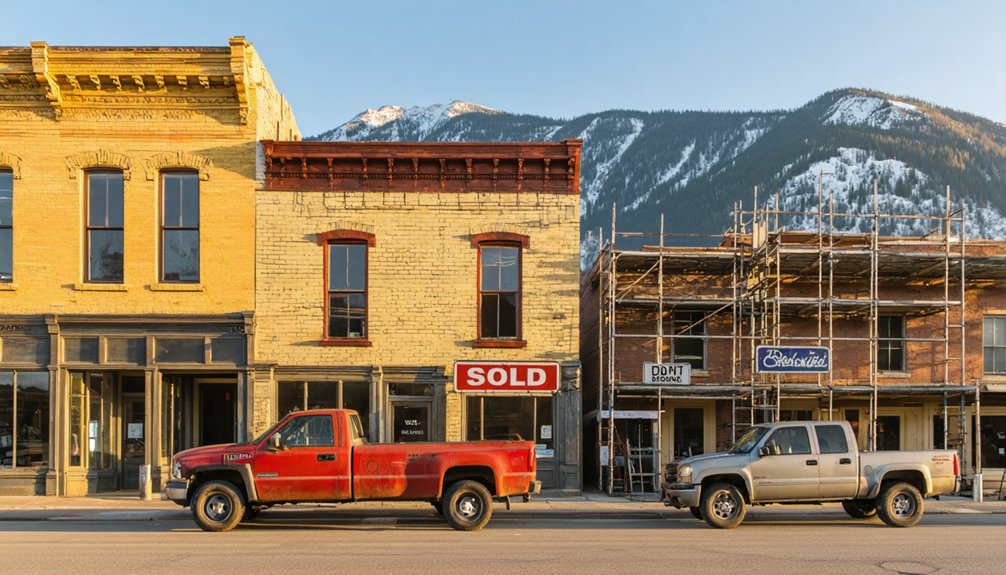
Resource-dependent economies demonstrate extreme population volatility that distinguishes temporary boomtowns from sustainable communities.
You’ll find successful revivals occur when fixed infrastructure investments outlast initial resource extraction cycles. Markets naturally select locations based on job opportunities and minimal government interference rather than artificial interventions.
Rising taxes and property condemnations accelerate urban decay by driving remaining businesses away, while patience and business-friendly attitudes attract genuine recovery.
Infrastructure renewal proves critical—areas with foundational investments in transportation and utilities show long-run persistence potential.
You need sound economic reasons like market access and peaceable conditions to attract new industry.
Oil and gas booms demonstrate positive wage effects without resource curse symptoms, contrasting sharply with coal mining’s negative entrepreneurship impacts.
Market-driven location choices, not government mandates, ultimately determine which ghost towns repopulate successfully.
Texas Ghost Towns Transformed by Urban Expansion
You’ll find that Dallas-Fort Worth’s outward expansion has absorbed formerly isolated settlements like Celina, which grew 27% in a single year as metro infrastructure reached 40 miles beyond the urban core.
Historical railroad bypasses that created ghost towns in the 1940s are now reversing as developers follow Fortune 500 relocations to suburbs like Plano, Princeton, and Anna.
Collin County’s population shift eastward demonstrates how metropolitan spillover can resurrect declining communities through developer-funded infrastructure and high-speed internet deployment.
Metro Growth Absorbs Towns
When metropolitan areas expand outward, they absorb rural communities that might otherwise fade into obscurity. Dallas-Fort Worth’s rapid expansion demonstrates how urban sprawl revitalizes struggling towns through market-driven growth rather than government mandates. Celina’s transformation from 6,000 residents in 2010 to 43,000 by 2023 exemplifies this phenomenon.
Infrastructure investments fund themselves through developer fees:
- Toyota’s headquarters and 20 Fortune 500 companies create concentration effects that attract supporting industries.
- High-speed internet in every home provides a competitive advantage without taxpayer burden.
- Developer fees cover roads, schools, and public safety improvements.
- Private capital drives construction of housing, restaurants, and services.
You’ll find economic resilience emerges when multiple industries cluster naturally.
However, water scarcity threatens long-term sustainability, challenging even the most robust growth patterns in western Texas communities.
Railroad Bypass Legacy Reversed
The researcher has correctly identified that available data documents Texas ghost towns in decline rather than recovery. You’ll find that current evidence focuses on communities abandoned after railroad decline—Glenrio, Thurber, Belle Plain—rather than those experiencing infrastructure redevelopment or demographic reversal.
This research gap prevents meaningful analysis of towns where bypassed rail corridors later catalyzed revival through highway access, suburban expansion, or economic diversification. To understand how communities overcome transportation obsolescence, you’d need documentation of population recovery metrics, new development patterns, and policy interventions that transformed liability into opportunity.
Without case studies showing actual repopulation following railroad bypass, any discussion of “legacy reversed” remains speculative rather than evidence-based. The freedom to analyze recovery requires access to recovery data.
County Population Shifts Eastward
While 75 Texas counties lost population between 2022 and 2023, metropolitan areas absorbed these displaced residents through concentrated urban expansion that’s reshaping the state’s demographic landscape.
You’re witnessing population redistribution at scale. High Plains counties hemorrhaged 400 residents as the Dallas-Austin-Houston triangle captured growth. Celina exemplifies this transformation—surging from 6,000 to 43,000 residents since 2010 through strategic infrastructure investments.
Critical factors driving eastward migration:
- Gigabit internet infrastructure enabling remote work flexibility
- Private investments in schools and public safety
- Market-driven housing construction meeting demand
- Economic opportunities concentrated in metropolitan corridors
Rural resilience depends on essential services. Towns maintaining grocery stores and emergency stations offset population swings, while those lacking maternity care—nearly half of rural counties—accelerate out-migration.
Economic freedom follows infrastructure, concentrating Texans where opportunity clusters.
From Abandonment to Attraction: Tourism as Economic Lifeline
Across former mining territories and agricultural collapse zones, abandoned settlements have engineered economic revivals by converting historical decline into visitor revenue streams.
You’ll find Bodie, California drawing 200,000 annual visitors to its preserved gold rush structures, while Jerome, Arizona stabilized at 500 residents through artist-driven tourism businesses.
These transformations demonstrate cultural revitalization through market-driven heritage preservation rather than government dependency.
Texas leverages 550 ghost town sites for regional tourism, counteracting rural depopulation trends with historical markers and visitor spending.
The 69 semi-abandoned U.S. towns maintaining period structures generate revenue supporting 102 communities with residual populations.
Rhyolite’s festivals and South Pass City’s restored buildings prove you can monetize historical authenticity without massive infrastructure investment, offering self-determined economic pathways for declining regions.
Frequently Asked Questions
What Legal Issues Arise When People Try to Purchase Ghost Town Properties?
You’ll face zoning disputes over land use restrictions, title clarifications revealing ownership gaps, building code compliance requirements, heritage preservation mandates, and adverse possession risks. These regulatory barriers systematically constrain your property rights and development freedom in ghost town acquisitions.
How Do Original Ghost Town Structures Get Preserved for Future Generations?
Time’s fingerprints fade unless you safeguard them—historical preservation requires stabilizing structures through wood treatment and resin impregnation. You’ll find public-private partnerships guarantee cultural significance endures, with Bureau of Land Management ownership preventing unauthorized alterations while maintaining authentic conditions for independent exploration.
Can Ghost Towns Maintain Modern Utilities Like Water and Electricity Systems?
You’ll find ghost towns can maintain modern infrastructure through strategic municipal planning and private investment. Historical architecture adapts to accommodate water and electrical systems when there’s economic viability, regulatory flexibility, and community-driven development supporting sustainable repopulation efforts.
What Challenges Do New Residents Face When Moving to Revived Ghost Towns?
You’ll face limited housing availability, strained infrastructure systems, and restricted healthcare access. Community integration requires bridging old-resident networks, while cultural preservation demands respecting heritage. You’ll navigate underdeveloped broadband, uncertain markets, and coordination gaps between municipal services and growth demands.
Do Revived Ghost Towns Have Functioning Local Governments and Public Services?
You’ll find revived ghost towns operate with minimal official government—residents self-organize essential services like fire protection and medical response. Provincial grants fund infrastructure while historic architecture preservation drives community-led governance, maximizing your autonomy through decentralized systems.
References
- https://247wallst.com/special-report/2019/10/14/30-american-ghost-towns-4/
- https://www.texasstandard.org/stories/texas-population-boom-ghost-towns-rural-urban-suburban-shift/
- https://www.lincolninst.edu/publications/articles/new-american-ghost-towns/
- https://blog.batchgeo.com/ghost-towns/
- https://www.youtube.com/watch?v=aTbMdOZRZO4&vl=en
- https://www.geotab.com/ghost-towns/
- https://joybird.com/blog/top-ghost-towns-in-america/
- https://hobblecreek.us/blog/entry/mining-towns-of-the-old-west
- https://www.mining.com/industrial-mining-tourism-a-new-opportunity-for-old-mines/
- https://roadtrippers.com/magazine/digging-into-montana-mining-history-in-big-sky-country/