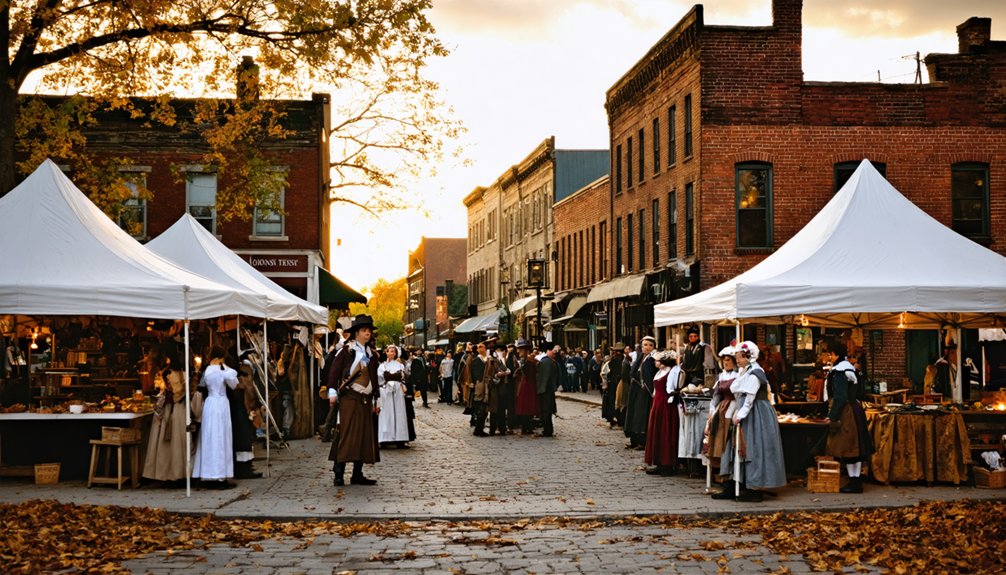
You’ll discover Maryland’s most intriguing historic towns hosting annual events at Sharpsburg, where Civil War reenactments bring Antietam’s battlefields to life each September, and Burkittsville, where Blair Witch tourism peaks during October celebrations. Lonaconing preserves its 1830s iron-smelting heritage through yearly festivals, while St. Mary’s City stages colonial militia musters and archaeological ceremonies. Relay commemorates its 1830 railroad origins with heritage excursions at Patapsco Valley State Park. Each location transforms preservation into living history experiences that connect you directly with Maryland’s layered past.
Key Takeaways
- Lonaconing hosts an annual Heritage Festival celebrating its industrial past, including coal mining, iron manufacturing, and silk mill operations.
- Burkittsville holds October celebrations capitalizing on Blair Witch Project tourism, with peak season events at film-related locations.
- Sharpsburg conducts annual Battle of Antietam commemorations each September with living history encampments, reenactments, and candlelight memorials.
- Burkittsville balances Civil War history preservation with paranormal tourism through cemetery tours and historic building access at GAP Lodge.
- October festivals near Burkittsville include Trail of Jack-O-Lanterns, corn mazes at Gaver and Summers Farm, and Sleepy Hollow Fall Festival.
The Historic Mining Town of Lonaconing and Its Heritage Festival
When Baltimore and London investors purchased 11,000 acres in the Georges Creek watershed in 1837, they transformed a sparsely settled forested region into Maryland’s most prominent mining town. The Georges Creek Coal and Iron Company constructed Lonaconing as an industrial center, achieving America’s first successful iron manufacture from coke in 1839.
You’ll discover a community that grew from 700 residents to a thriving hub supporting diverse industries—coal mines, a silk mill employing 300 workers, and brick manufacturing. The mining workforce included skilled laborers from Scotland, Wales, England, Ireland, and Germany, many of whom were literate and educated. Despite devastating setbacks including an 1881 fire that destroyed 53 buildings and the 1909 Chatham Farmington explosion, Lonaconing’s mining heritage persists. The historic opera house at 5 Jackson Street, existing by 1870, later served as the town hall before standing vacant among other empty buildings along the street.
Today’s annual heritage festival celebrates this industrial legacy, offering you direct access to preserved historical sites where Western European immigrants forged Maryland’s coal country identity.
Sharpsburg’s Living History Events Along Antietam Battlefield
You’ll find Sharpsburg’s commemorative calendar centers on the Battle of Antietam’s anniversary each September, with living history encampments spanning two consecutive weekends.
The 124th New York Infantry volunteers recreate period soldier life through weapons demonstrations and ongoing camp interpretation at the battlefield site.
If you’re planning to attend, you can experience both the battle timeline programs (September 12-13) and aftermath-focused presentations (September 16-17) that chronicle the 163rd anniversary of America’s bloodiest single-day battle. Each December, the battlefield hosts an Annual Memorial Illumination where 23,000 candles light the landscape to honor every soldier killed, wounded, or missing in the battle.
The 2025 Fall Conference explores civilians, casualties, and aftermath through lectures at Shepherd University and guided battlefield excursions examining Sharpsburg residents’ experiences and post-battle medical sites.
Annual Battle Reenactment Schedule
Each September, Sharpsburg’s pastoral landscape transforms into a living monument as reenactors converge on Antietam’s hallowed ground to commemorate America’s bloodiest single day. You’ll witness authentic demonstrations of Civil War tactics as uniformed soldiers recreate the September 17, 1862, engagement that changed history and enabled the Emancipation Proclamation.
While specific 2026 dates aren’t yet confirmed, annual reenactments typically showcase:
- Dawn formations at Dunker Church, where Maryland and Confederate troops first clashed
- Artillery demonstrations echoing across the Cornfield’s preserved acres
- Infantry maneuvers through Bloody Lane’s sunken road
- Bridge assaults recreating Burnside’s costly crossing
You’re free to interact with reenactors, photograph period equipment, and explore battlefield preservation sites. Consider joining ranger-led tours to gain enhanced understanding of battlefield tactics and the soldiers’ experiences during this pivotal engagement. Private tour groups often receive exclusive storytelling sessions that blend essential battle details with unique anecdotes from experienced guides. These living history events ensure future generations understand the sacrifice that secured liberty.
Period Encampments and Demonstrations
Beyond the battlefield’s dramatic reenactments, Sharpsburg’s living history calendar extends throughout the year with period encampments that illuminate Civil War soldiers’ daily existence. You’ll find volunteers portraying the 124th New York Infantry and First Maryland Volunteer Infantry at multiple dates, including October’s Living History Weekend, September’s 163rd Anniversary commemoration, and Memorial Day festivities.
These programs emphasize authentic camp life demonstrations over combat spectacle—watch weapons demonstrations, explore encampments, and engage with interpreters who reveal military tactics and soldier routines from cooking to communication.
Walking tours complement encampment activities, examining civilian impact sites like War Wounds House and battlefield hospitals at Piper and Poffenberger farmsteads. The October 8-9 weekend features dedicated weapons and camp interpretation by Civil War living history volunteers who recreate the experiences of 124th New York Infantry soldiers. Interpreters demonstrate how wet cartridges rendered firearms useless during creek crossings, affecting combat effectiveness throughout the battle.
The National Park Service schedules these preservation-focused events to honor historical accuracy, while Grandparents’ Day programs introduce younger generations to military heritage through marching exercises.
Burkittsville’s Blair Witch Legacy and October Celebrations
You’ll find Burkittsville’s tourism landscape fundamentally altered after 1999’s *Blair Witch Project* transformed this Civil War-era town into an unexpected paranormal destination. The film’s October release created an immediate surge of visitors to Burkittsville, prompting local authorities to decline sequel filming opportunities due to vandalism, cemetery desecration, and damage to the town’s abandoned 1984 church.
Today, October remains the peak season for Blair Witch enthusiasts who travel to documented filming locations, though the town’s authentic historical significance stems from its role as a Confederate hospital facility following the 1862 Battles of South Mountain and Antietam. Visitors also seek out Coffin Rock, a large boulder in the woods dating from 1886 that’s associated with local legends of ritualistic killings and dismembered bodies discovered during a search for a missing child. The town’s population of 151 maintains this delicate balance between preserving Middletown Valley history and accommodating supernatural tourism.
The Blair Witch Connection
The invented legend of Elly Kedward—accused witch banished in 1785—merged with genuine folk tales like Moll Dyer’s 1697 persecution near Leonardtown.
You’ll find the mythology includes:
- Ghostly hands pulling children into Tappy East Creek
- Search parties murdered at Coffin Rock
- Rustin Parr’s 1940-41 basement killings
- October 1994 student disappearances in Black Hills Forest
This blending of archival fact and crafted fiction draws seekers annually to explore Burkittsville’s streets without restriction.
Annual October Festival Events
How does a community transform cinematic notoriety into annual celebration? Burkittsville’s October events blend agricultural heritage with seasonal entertainment throughout Frederick County.
You’ll find haunted attractions at nearby venues like the Trail of Jack-O-Lanterns at Green Meadows Farm, while Gaver and Summers Farm festivals offer corn mazes and pumpkin picking.
The Sleepy Hollow Fall Festival incorporates costume contests alongside food trucks, live music, and petting zoos.
South Mountain Heritage Society preserves Revolutionary-era history through year-round programming at historic sites.
Rose Hill Manor Park’s Fall Fest showcases traditional agricultural exhibits and crafts.
These celebrations honor regional farming traditions while embracing autumn’s theatrical possibilities.
You’re free to explore authentic rural Maryland culture without manufactured commercialization, experiencing genuine community gatherings that predate Hollywood’s interpretation of local folklore.
Tourist Draw and Tourism
Since 1999, Burkittsville’s relationship with cinematic fame has traced an arc from disruption to cautious accommodation. You’ll find this nineteenth-century hamlet transformed pop culture notoriety into measured preservation efforts, balancing tourist curiosity with architectural integrity.
The cemetery’s weathered headstones and abandoned St. Paul’s Lutheran Church—idle since 1984—haven’t succumbed to urban decay despite visitor pressure.
Your exploration reveals distinct tourism phases:
- Initial surge (1999-2001): Stolen welcome signs, graveyard overcrowding
- Revival period (2016): Third film release reigniting interest
- Contemporary shift: Civil War battlefield visitors outnumbering witch-seekers
- October events: Community fundraising at Burkittsville Ruritan Club grounds
The town’s GAP Lodge and Hall buildings, operated as National Park Service museums, anchor authentic historical engagement.
You’re witnessing rural Maryland’s calculated response to unwanted fame—preserving heritage while controlling commercialization.
Vansville’s Agricultural Roots and Seasonal Gatherings
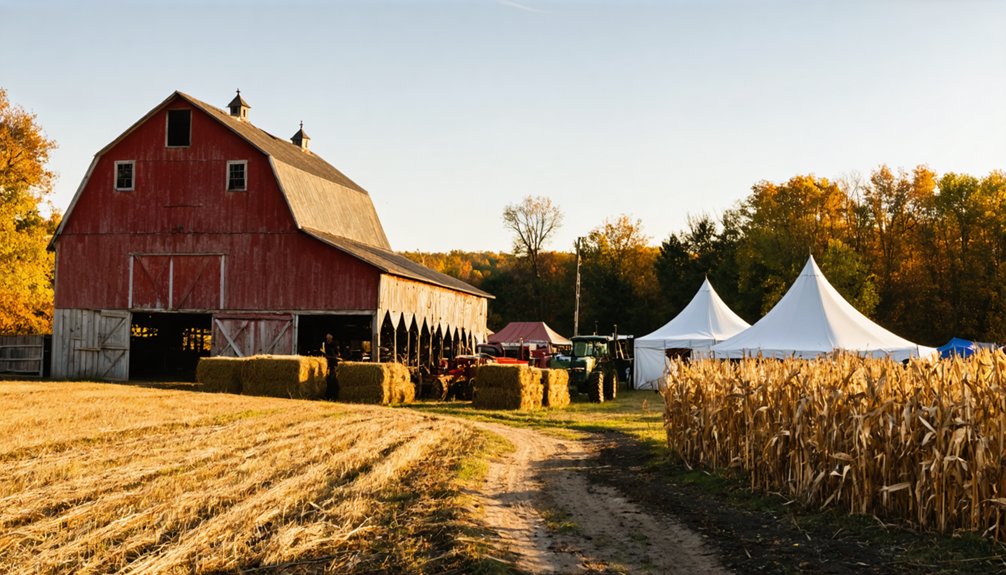
Nestled within Prince George’s County’s colonial framework of hundreds and parishes, Vansville emerged as a community where self-governing religious divisions shaped early settlement patterns and agricultural practices. By 1798, land ownership records document established farms that would anchor Vansville agriculture for generations.
The 1810 cotton mill operations harnessed local water power, creating an economic hub that intertwined textile production with surrounding farmland. While the 1831 B&O railroad arrival shifted industrial focus toward stronger currents elsewhere, the community maintained its agricultural character through seasonal festivals celebrating harvest cycles and parish traditions.
These gatherings reinforced bonds within self-governing parishes that supervised community activities. Though no contemporary annual events continue—the 1968 mill closure and 1972 flood erasure ended such traditions—historical records preserve evidence of celebration woven into Vansville’s agrarian identity.
The Railroad Community of Relay and Its Annual Commemorations
When B&O Railroad officials established Relay in 1830 as America’s first purpose-built railroad town, they created more than a horse relay station—they founded a community whose identity would remain inseparable from rail heritage for nearly two centuries.
Your exploration of Relay’s railroad history reveals pivotal moments worth commemorating:
- Tom Thumb’s legendary 1830 race against horsepower
- World’s first telegraph poles erected in 1844
- Presidents Polk and Taylor’s visits drawing thousands
- Thomas Viaduct’s protection during Union occupation
The town’s Civil War significance transformed it into Camp Relay House, where fortifications safeguarded Washington’s essential connection.
Today’s annual rail excursions to Patapsco Valley State Park honor this legacy, letting you trace routes where freedom-seeking passengers once traveled and Union troops defended democratic infrastructure against Confederate threats.
St. Mary’s City Colonial Reenactments and Yearly Programs
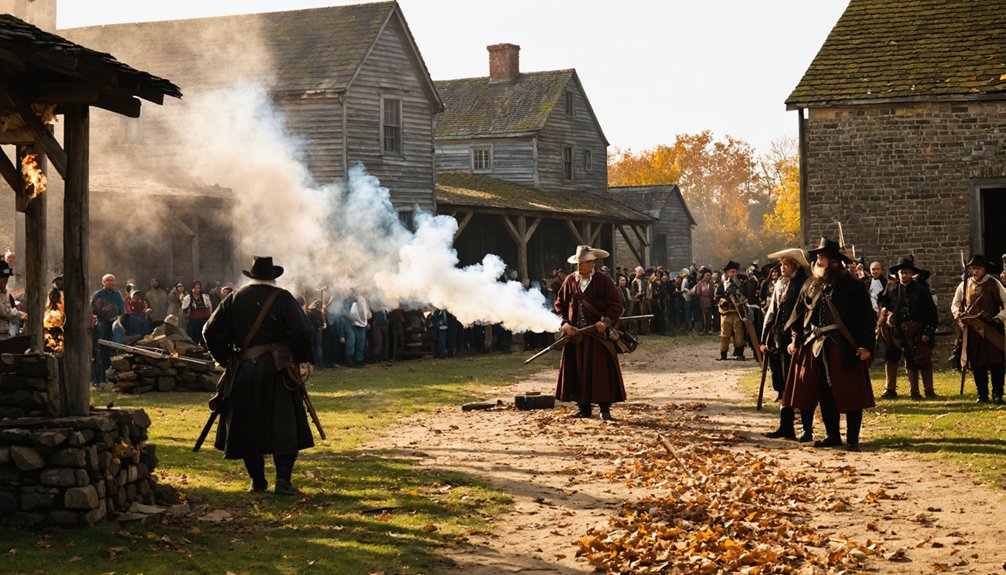
While Relay preserves railroad heritage through annual excursions, Maryland’s colonial past comes alive at St. Mary’s City through archaeological excavations and Colonial reenactments.
You’ll find America’s only complete collection of lead coffins here—all five discovered in North America rest beneath the Brick Chapel, awaiting their September 20, 2025 reinterment ceremony.
The Ceremony of Return features horse-drawn hearses, cannon fire from the reconstructed Maryland Dove, and period-dressed interpreters honoring the colony’s founders.
Visit September 27 for the Militia Muster, where St. Maries Citty Militia demonstrates 17th-century drilling and musket firing.
Daily archaeology tours at the Calvert House dig site reveal ongoing discoveries transforming this former capital into living history.
Open Tuesday through Saturday until November, the site operates without government oversight, funded through admissions and memberships.
Frequently Asked Questions
Are Accommodations Available Near These Maryland Ghost Towns During Annual Events?
I can’t verify accommodations near Maryland’s ghost towns with annual events, as sufficient data wasn’t found. However, you’ll typically discover historical tours and local dining options when visiting preserved regional sites. Research specific locations before planning your independent exploration.
What Transportation Options Exist for Visitors Traveling Between Multiple Ghost Town Events?
You’ll find public transportation limited between rural ghost town sites, making car rentals essential for independence. MARC trains and commuter buses serve some locations, but driving grants you freedom to explore Maryland’s heritage at your own pace.
Do These Annual Events Operate During Inclement Weather or Have Rain Dates?
You’ll find limited event postponements policies posted. Calvert Marine Museum explicitly runs rain-or-shine programs with indoor activities available. Most historic sites don’t publish weather protocols, so you’re advised to contact venues directly before traveling during questionable conditions.
Are the Annual Events in These Ghost Towns Suitable for Young Children?
Most ghost tours aren’t suitable for young children due to frightening content, though you’ll find family-friendly alternatives like historical reenactments and fossil hunting programs at Maryland’s preserved sites, offering age-appropriate exploration of regional heritage without scary elements.
What Fees or Admission Costs Apply to Attend These Ghost Town Events?
You’ll find most ghost town festivals charge $10-25 admission, though historical reenactments often remain free. Antique vendors may require separate booth fees. Children under 12 typically enter free, preserving Maryland’s tradition of accessible heritage education for all families.
References
- https://www.hagerstownmd.org/1129/Ghost-Tour
- https://www.marylandhauntedhouses.com/maryland-paranormal-events.aspx
- https://www.historicalsocietyofmountairymd.org/copy-of-boxes-and-bags-bingo-fundraiser
- https://screams.org
- https://www.legendsofthefog.com
- https://www.visithowardcounty.com/things-to-do/tours/ghost-tours/
- https://www.mainstreetchestertown.org/event/historic-chestertown-ghost-walks-2/
- https://downtownfrederick.org/event/historic-district-ghost-tours/2025-10-23/
- https://www.visitmaryland.org/list/ghost-tours-haunted-attractions
- https://www.markoffshauntedforest.com