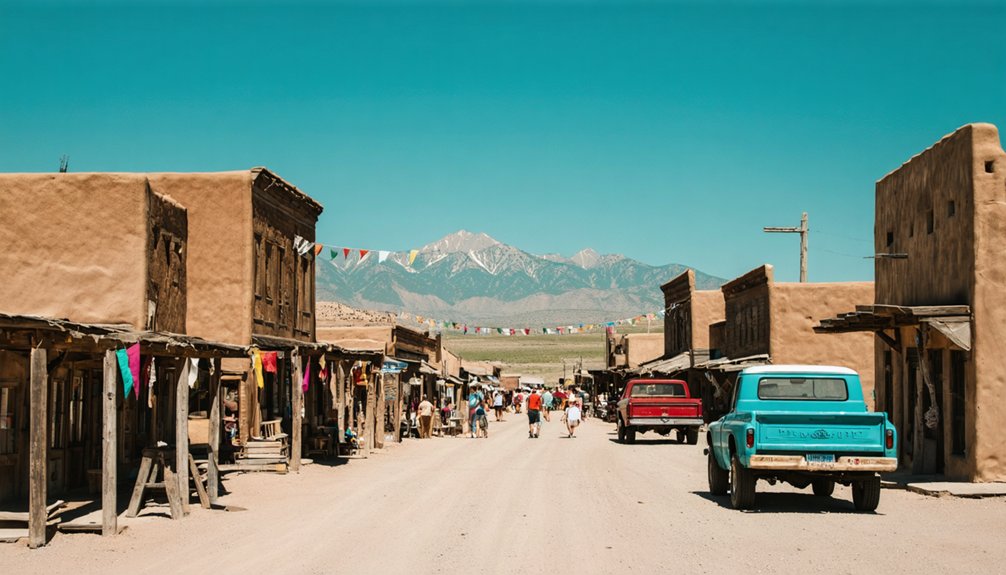
You’ll find New Mexico’s ghost towns come alive during annual festivals that celebrate their rich heritage. Pie Town hosts its famous Pie Festival every second Saturday in September, while Lincoln’s Billy the Kid Festival draws 7,000 visitors each August with authentic reenactments and living history. White Oaks celebrates Miner’s Day commemorating its 1879 gold rush, and Cerrillos honors over 1,000 years of turquoise mining with heritage events along the scenic Turquoise Trail. These preserved communities offer guided tours, live music, and cultural celebrations that connect past traditions with present-day experiences.
Key Takeaways
- Pie Town hosts its annual Pie Festival every second Saturday in September with baking contests, live music, and community celebrations.
- White Oaks celebrates Miner’s Day annually, commemorating its 1879 gold rush with parades, gold panning demonstrations, and chuckwagon cooking.
- Lincoln holds the Billy the Kid Festival each August, featuring gunfight reenactments, living history performances, and educational programs.
- Cerrillos hosts the annual Pack Burro Race celebrating its mining heritage and the Memorial Day weekend Native Treasures Indian Arts Festival.
- Old Lincoln Days draws 7,000 visitors annually with three weekend performances of Billy the Kid’s courthouse escape reenactment.
Pie Town’s September Pie Festival Celebration
Every second Saturday in September, the tiny unincorporated community of Pie Town transforms into a bustling hub as visitors from Oregon, California, Arizona, and beyond converge on this remote Catron County settlement of 186 residents.
The Annual Pie Festival, now in its 42nd year, takes place at Jackson Park along Highway 60, where you’ll find authentic pie traditions dating back to the 1920s when Norman’s Place first served drivers and cowboys.
Festival activities include competitive pie baking contests with category winners, spirited pie eating competitions, and unique horned toad races on the basketball courts.
You can browse the open-air flea market, sample authentic pies, and witness the Pie Queen crowning. Three main pie stands set up throughout the event, alongside vendors offering burritos and Navajo fry bread.
The Pie-O-Neer Cafe, operating since 1995, anchors this celebration of small-town independence and community resilience. The festival also features live music performances alongside games and arts and crafts displays throughout the day.
White Oaks Miner’s Day: A Step Back to the Wild West
When gold nuggets glinted in the Jicarilla Mountains in August 1879, prospectors John Wilson, Jack Winters, and Harry Baxter sparked a migration that’d transform this remote corner of New Mexico into one of the territory’s most prosperous settlements.
By 1880, White Oaks boasted 2,500 residents, 50 businesses, and mines producing $20 million in precious metals.
Within just one year, White Oaks exploded from remote mountain outpost to bustling mining hub worth millions in gold and silver.
You’ll find historical preservation alive at White Oaks Miner’s Day, honoring resident Dave Jackson who spent 61 years in this ghost town before his 1963 death.
These community celebrations feature a 10 AM parade, authentic gold panning demonstrations, chuckwagon cooking, and schoolhouse plays that transport you back to when Billy the Kid roamed these streets.
The town’s growth accelerated through 1880 as over 150 houses were constructed by October, alongside the establishment of a post office in June and the opening of the White Oaks Hotel in November.
White Oaks Avenue showcased the town’s prosperity with Victorian homes, including Hoyle’s Folly, an elaborate mansion built in 1887 for Watt Hoyle’s fiancée who never arrived.
Though White Oaks refused railroad access and declined after 1907’s gold market collapse, its Wild West spirit endures through this annual tribute.
Lincoln’s Billy the Kid Festival and Living History
You’ll find one of New Mexico’s most immersive historical experiences in Lincoln each August, where the town’s preserved 1870s-1880s buildings serve as the authentic backdrop for Billy the Kid Days.
This annual festival transforms the entire historic site into a living museum through gunfight reenactments, lectures, children’s activities, and the renowned “Last Escape of Billy the Kid” folk pageant performed by local volunteers.
The weekend celebration lets you walk the same streets where Billy the Kid and Pat Garrett once roamed, experiencing frontier history where it actually happened. Educational programs are hosted in the San Juan Bautista Church, featuring topics ranging from Billy the Kid’s final days to archaeological discoveries and the courthouse’s darker historical moments. Admission includes a wristband that grants you access to all festival sites and events throughout the historic town.
Annual August Festival Events
Since 1940, the historic village of Lincoln has transformed each August into a living celebration of its Wild West past during Old Lincoln Days. You’ll find the first full weekend packed with authentic experiences: historic reenactments throughout town from 9:00 AM to 5:00 PM, expert lectures at San Juan Bautista Church, and hands-on children’s activities.
The centerpiece remains “Last Escape of Billy the Kid” pageant, performed by local volunteers—many descended from the original cast. You can catch evening performances Friday and Saturday at 8:30 PM, or Sunday’s 1:00 PM matinee.
Admission to Lincoln Historic Site costs $7 for adults (children 16 and under free), while separate pageant tickets run $10 for adults. Families will appreciate that children aged six to twelve pay just $6, while those five and younger enter free. Cash is recommended at the gate, where tickets become available at 10:00 AM. The event is organized by Friends of Historic Lincoln NM, a nonprofit dedicated to preserving the town’s history and buildings.
Billy the Kid Reenactment
At the heart of Old Lincoln Days beats the longest-running folk pageant in the United States—The Last Escape of Billy the Kid. Since 1940, local performers have brought Wild West history to life through this dramatic reenactment, performing three times each August weekend.
You’ll witness Billy’s courthouse escape after killing two deputies on April 28, 1881, concluding a narrative that spans the entire Lincoln County War‘s 19 deaths.
Historical reenactments extend beyond the evening pageant. Throughout the weekend, you’ll encounter gunfight demonstrations, living history interpreters in period costume, and educational lectures from historians. Many volunteer performers maintain multi-generational participation, with families passing down roles through decades of tradition.
Tickets cost just $10 for adults ($6 for children 6-12), available at the gate beginning at 10:00 a.m.
The three-day festival draws approximately 7,000 visitors annually, transforming this ghost town into a vibrant celebration of frontier history. Visitors can also explore several museums during the event, including the Anderson-Freeman Visitor Center and the Murphy-Dolan Store, now known as the Old Lincoln County Courthouse.
Preserved Historic Town Buildings
Beyond the annual festivities, Lincoln stands as New Mexico’s most visited state historic site—a remarkably intact 19th-century settlement where 17 adobe and stone buildings remain frozen in their 1870s-1880s appearance. You’ll find the world’s largest concentration of original Territorial Style adobe architecture here, managed by the New Mexico Department of Cultural Affairs with unwavering commitment to historic preservation.
The Lincoln County Courthouse anchors the collection, meticulously restored to its 1881 appearance through successive rehabilitation projects that prioritize architectural integrity.
You can explore the Tunstall Store’s original 19th-century merchandise, El Torreón’s 1850s defensive tower, and San Juan Mission Church.
The Friends of Lincoln Historic Site, founded in 2013, funds critical preservation work ensuring these structures survive for future generations seeking authentic frontier history.
Cerrillos and the Ancient Turquoise Mining Legacy
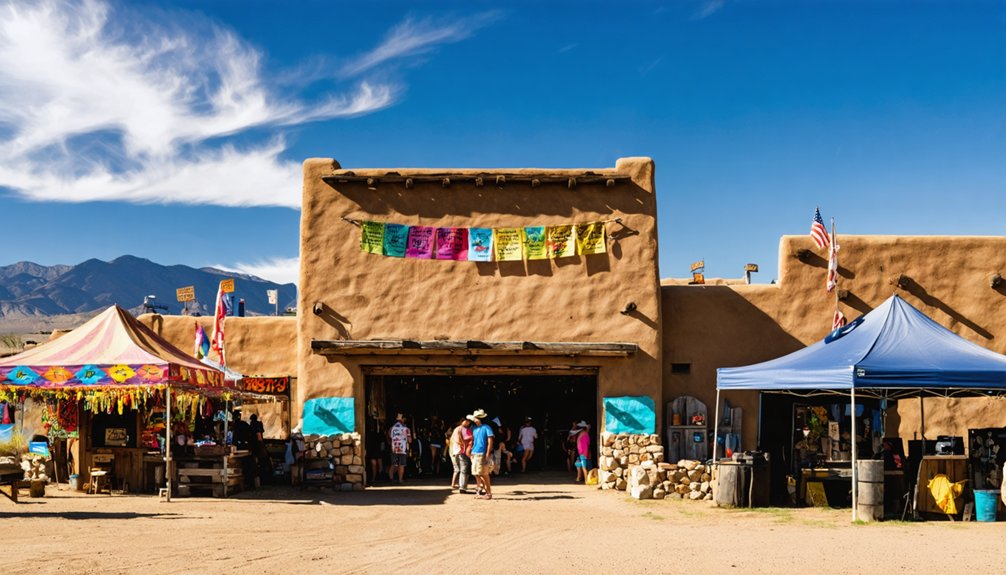
You’ll discover Cerrillos’s remarkable thousand-year mining legacy just south of Santa Fe along the scenic Turquoise Trail National Scenic Byway. Mount Chalchihuitl hosted North America’s largest prehistoric mining operation, where Native Americans extracted turquoise with stone tools as early as 900 A.D.—making this the oldest documented mining district in the American West.
Spanish colonists, Pueblo peoples, and later American prospectors all worked these hills, creating a continuous archaeological record that connects ancient trade networks stretching from Canada to Mexico with modern preservation efforts.
Thousand-Year Mining History
By 1300 A.D., San Marcos Pueblo controlled these deposits, creating Pueblo crafts that spread throughout indigenous trade networks.
When Spanish settlers arrived in the early 1600s seeking silver and lead, they encountered a mining district already flourishing for a millennium. This coexistence lasted fifty years until the Pueblo Revolt of 1680 disrupted shared resource use.
The district’s thousand-year legacy culminated in the 1879 mining boom, when modern prospectors rediscovered what indigenous peoples had known for generations.
Turquoise Trail Gateway Access
Where ancient mining pits meet modern adventure, the Turquoise Trail National Scenic Byway delivers visitors directly to Cerrillos—a village that’s served as gateway to turquoise deposits for over a thousand years.
You’ll find this 200-person community 20 miles south of Santa Fe, where Highway 14‘s 50-mile route connects two major cities through 15,000 square miles of mining heritage.
Access couldn’t be simpler: start at the I-25 and NM-14 junction southwest of Santa Fe, or enter via Tijeras Canyon at I-40 from Albuquerque’s side.
Scenic viewpoints abound throughout your drive, including Sandia Crest’s 10,678-foot elevation via NM-536 spur.
Cerrillos Hills State Park’s 1,100 acres north of the village provide trail access to dozens of pre-1900s mine shafts.
Meanwhile, elevation changes from 5,800 to 6,100 feet reveal sweeping Galisteo Basin vistas.
The Turquoise Trail’s Year-Round Cultural Events
The Turquoise Trail’s cultural calendar extends far beyond its celebrated Studio Tour, weaving together Native American traditions, mining heritage, and contemporary artistry throughout the year. You’ll discover the Native Treasures Indian Arts Festival each Memorial Day weekend, where 150+ Native artists showcase their work.
The Pojoaque River Art Tour celebrates the region’s multicultural Artistic Heritage, featuring Native American, Hispanic, and Anglo creators. Cerrillos hosts the Pack Burro Race annually, honoring New Mexico’s mining past with rugged competition through historic terrain.
Cerrillos Hills State Park offers year-round educational and nature programs that connect you to the landscape. As you explore these Scenic Byways between events, you’ll find studios and galleries open throughout the year, maintaining the living artistic traditions rooted in San Marcos Pueblo and inspired by legends like Georgia O’Keeffe.
Route 66 Ghost Tours: Haunted Heritage Experiences
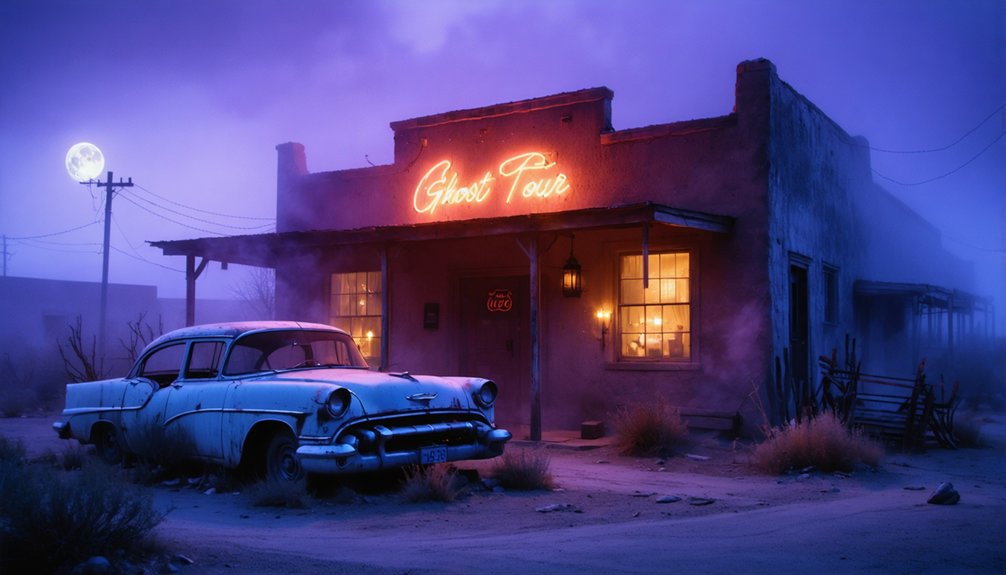
When darkness falls over Old Town Albuquerque, 306 years of haunted history come alive through guided ghost tours that interweave Route 66 heritage with Spanish colonial folklore and Wild West legends.
You’ll explore authentic ghost stories at landmarks like the High Noon restaurant, where “The Dead Files” documented Wild West gunfight spirits causing glasses to slide and names to echo mysteriously.
The chilling La Llorona legend persists through these streets, where a weeping woman in a bloodied white dress still searches for her drowned children.
Tours operate nightly from $35, offering family-friendly and adults-only options through ABQTours‘ 24-year legacy serving 400,000 guests.
You’ll discover how modern architecture now stands where hangings, murders, and wrongful executions occurred, creating portals between Old Town’s haunted past and present-day freedom seekers.
Old Mesilla’s Seasonal Walking Ghost Tours
Just 40 miles south of Las Cruces, Old Mesilla‘s candlelit ghost tours transform the 1850s plaza into an immersive journey through Billy the Kid’s final escape and Colonel Albert Jennings Fountain’s unsolved disappearance.
You’ll explore haunted legends during evening walks past the Basilica of San Albino and the jail where the outlaw made history in 1881.
Preciliana Sandoval leads La Morena tours dressed as Mexican Revolutionary women, sharing ghostly stories passed down through five generations.
Southwest Expeditions offers private 4-hour tours at $48 per person for groups of 4-30 guests.
Peak season runs October 25-November 2, featuring Ghost Stories in the Prison Yard with wine and hors d’oeuvres, culminating in Día de los Muertos celebrations.
Tours operate Wednesday-Sunday, 8:30 a.m.-4:00 p.m.
Book through (575) 647-2639.
Music Events at the No Scum Allowed Saloon
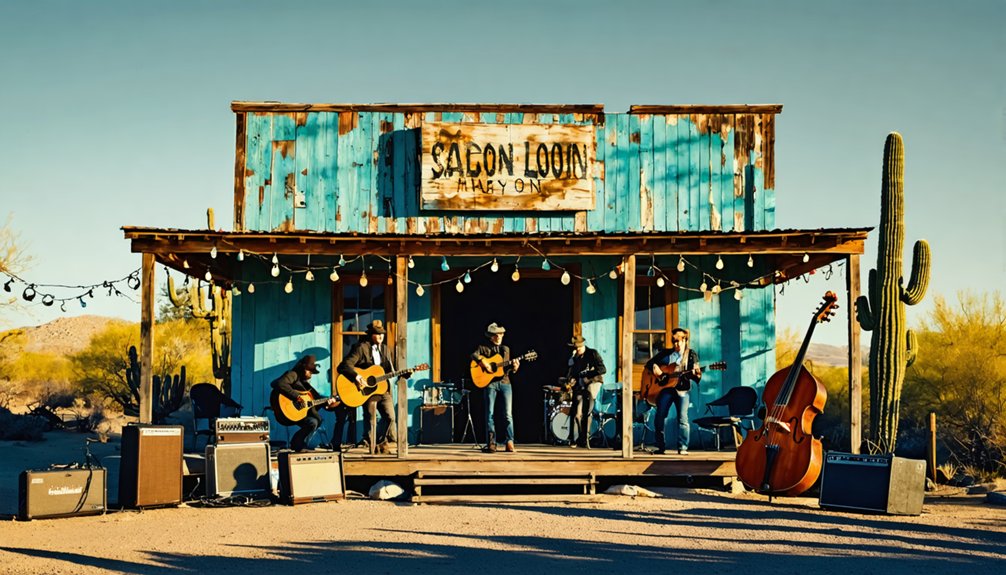
Nestled in the ghost town of White Oaks, the No Scum Allowed Saloon operates from its 1880 building at 933 White Oaks Road, 12 miles north of Carrizozo via Highway 54 and NM 349. Owner Karen Haughness, the saloon’s first woman overseer, maintains this American Cowboy Magazine top 10-ranked establishment where live music magic fills Saturday nights with dancing and celebration.
The historic venue—once an attorney’s office, print shop, and assay office—hosts scheduled music events in authentic cowboy bar ambiance. You’ll find cold beer, the signature Snake Bite drink, food, cornhole, and horseshoes alongside multi-generational patrons.
The saloon welcomes private parties with catering but prohibits minors and closes during holiday weekends. Karen offers local history lessons about Billy the Kid and Pat Garrett’s frequented territory while preserving White Oaks’ gold rush legacy.
Planning Your Visit to New Mexico’s Festival Ghost Towns
Beyond the music and merriment at individual venues, attending festivals in New Mexico’s ghost towns requires careful preparation to maximize your experience in these remote historic locations. You’ll find these communities along Highway 60 and throughout Sierra County, often 80+ miles from major cities. Check specific event dates—White Oaks’ Miner’s Day runs in August, while Pie Town’s festival occurs each September’s second Saturday.
Local culinary traditions shine through pie-baking contests and regional cuisine offerings at various venues. Festival craft workshops provide hands-on experiences, from Día de Los Muertos mask making to spooky tin stamping. Bring cash for vendors and prepare for limited cell service.
You’ll encounter authentic historical settings where preservation efforts maintain cultural integrity while welcoming modern visitors seeking adventure off the beaten path.
Lesser-Known Ghost Town Sites Worth Exploring
While major ghost town festivals draw considerable crowds, several lesser-known sites throughout New Mexico offer equally compelling experiences for visitors seeking authentic historical encounters.
Kingston’s Ghost Town Museum provides dedicated exhibits focused on mining history preservation, showcasing artifacts from the town’s silver boom era. You’ll discover authentic relics and detailed interpretations of frontier life without tourist congestion.
Pie Town, though hosting its annual September festival, remains remarkably uncommercialized year-round. You can explore Ancestral Puebloan ruins and pottery shards that predate the town’s settlement, connecting you with centuries of human history. The area’s ghost town folklore intertwines Native American heritage with pioneer stories.
White Oaks operates similarly—beyond its August Miner’s Day celebration, you’re free to wander historic buildings and mining sites independently, experiencing genuine preservation efforts without scripted tours.
Frequently Asked Questions
Are Accommodations Available in These Ghost Towns or Only Nearby?
You won’t find unique lodging within these ghost towns themselves. Instead, you’ll need to book nearby hotels in communities like Socorro, Santa Fe, or Carrizozo, where modern accommodations support your historic exploration while respecting these preserved sites.
What Accessibility Options Exist for Visitors With Mobility Limitations?
You’ll find wheelchair friendly paths at Old Town Ghost Tours, but most historic sites lack mobility aid accessibility—Shakespeare needs ADA pathways still. With 400+ ghost towns statewide, infrastructure varies widely, so you’ll want confirmation before visiting remote locations.
Do These Events Operate During Bad Weather or Winter Conditions?
Most events run during warm months, avoiding winter conditions entirely. The Ghost Tour operates year-round without event cancellations for seasonal weather. Summer festivals like Pie Town and Lincoln don’t schedule backup plans since they’re timed for reliable conditions.
Are Pets Allowed at Ghost Town Festivals and Historic Sites?
Your four-legged companions occupy a gray zone at these events. You’ll find pet policies vary wildly—festival rules aren’t standardized across ghost town sites. Contact organizers directly beforehand, as some welcome leashed pets while others restrict access to service animals only.
What Are Typical Admission Costs for These Annual Events?
Most ghost town festivals offer free admission, letting you explore historical reenactments and browse souvenir vendors without entry fees. You’ll only pay for food, crafts, or specific activities you choose to enjoy during these heritage celebrations.
References
- https://www.newmexico.org/places-to-visit/ghost-towns/pie-town/
- https://www.newmexicohauntedhouses.com/haunted-attractions/
- https://newmexicotravelguy.com/new-mexico-ghost-towns/
- https://newmexicotravelguy.com/white-oaks/
- https://www.losalamosnm.us/Events-Directory/Ghost-Hunt
- https://www.visitlascruces.com/events/annual-events-festivals/
- https://www.newmexico.org/places-to-visit/ghost-towns/
- https://swexpeditions.com/events-2026
- https://eatingnewmexico.com/2014/09/18/pie-town-festival-pie-town-nm/
- https://en.wikipedia.org/wiki/Pie_Town