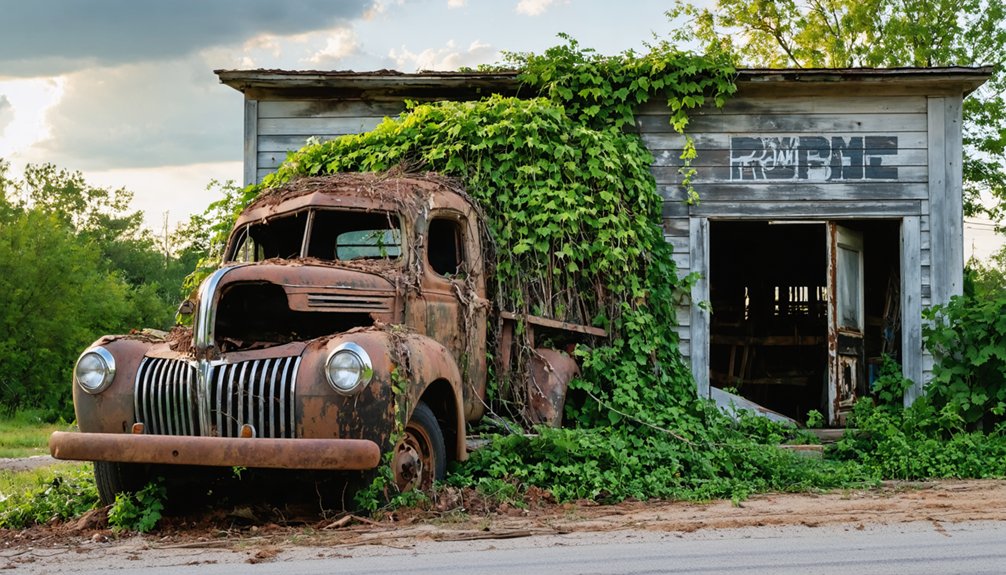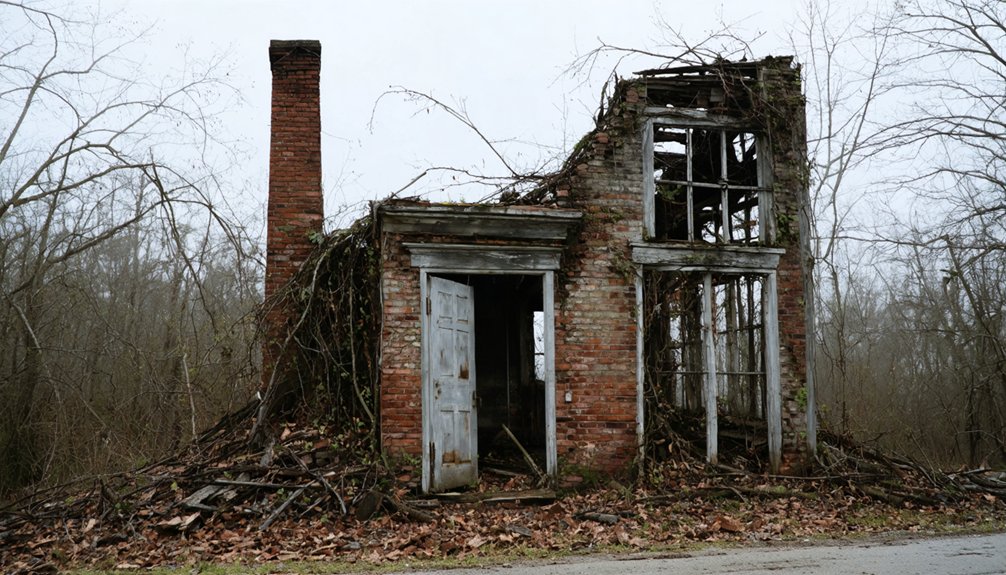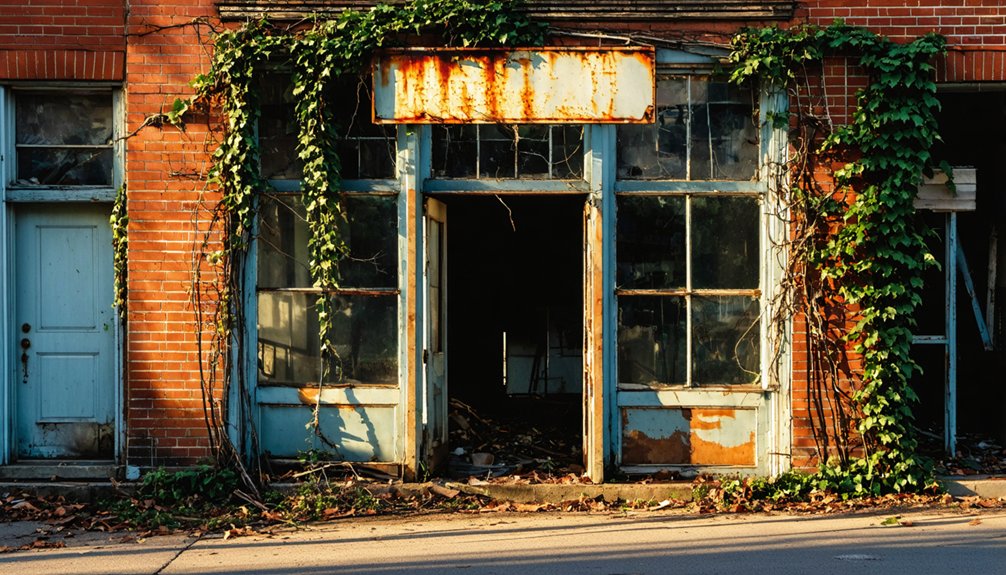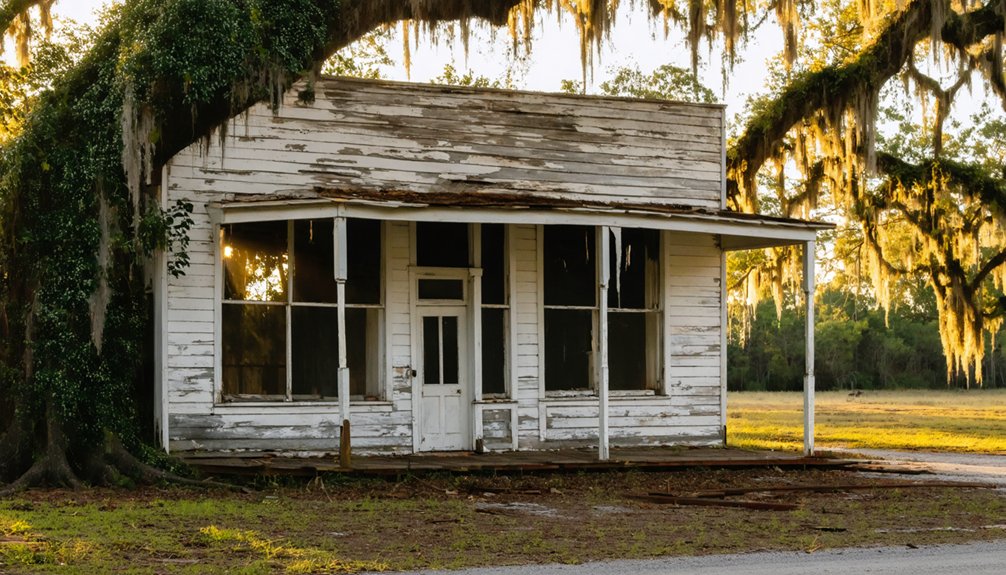
You’ll find Alabama’s most compelling ghost towns scattered across the state’s river valleys and remote ridges. Old Cahawba, the first state capital, features Confederate prison ruins and ancient Native American earthworks at the confluence of two rivers. Bellefonte overlooks the Tennessee River with its 1820s chimney and overgrown cemeteries, while Spectre offers a surreal experience as a preserved film set on Jackson Lake Island. French Bonapartist settlements like Arcola and Aigleville tell stories of exile dreams along the Black Warrior River, and Pikeville preserves its original courthouse from 1821. The complete story behind each haunting location reveals why these communities vanished.
Key Takeaways
- Old Cahawba, Alabama’s first state capital (1820–1825), features Crocheron Columns, historic cemeteries, and an archaeological park with interpretive center.
- Bellefonte declined after refusing railroad development and Civil War destruction; remnants include 1820s chimneys, overgrown cemeteries, and the Old Martin Inn.
- Spectre, built for the 2003 film *Big Fish*, offers free exploration ($5 entry) with weathered houses, a church, and camping on Jackson Lake Island.
- Pikeville, Marion County’s original 1821 judicial seat, preserves the historic courthouse, Judge Terrell’s house, and graveyards on an isolated ridge.
- Arcola and Aigleville were French Bonapartist settlements along the Black Warrior River; most architectural remains vanished by the late 1830s.
Arcola: A French-Named Settlement on the Black Warrior River
While most Alabama ghost towns trace their roots to American pioneers, Arcola stands apart as a rare French settlement along the Black Warrior River in Hale County. Founded in the early 1820s by former Bonapartists from the Vine and Olive Colony, this community bore a name honoring Napoleon’s Italian campaign victory. French influence shaped Arcola’s earliest days, with settler Frederic Ravesies establishing what would become Hatch Plantation.
The settlement served as the colony’s largest outpost, featuring a ferry operated by Colonel Nicholas Raoul, one of Napoleon’s former commanders. River transportation proved essential to Arcola’s function as a landing site.
Bellefonte: Jackson County’s Once-Thriving Hub
You’ll find Bellefonte perched on high ground overlooking the Tennessee River, where a lone chimney from the 1820s Martin Inn still marks what was once the courthouse square of Jackson County’s first seat of government.
The town’s refusal to welcome railroad progress in the 19th century sealed its fate, and by the 1920s, it stood completely abandoned.
The name derives from French, meaning beautiful spring, a reference to the clear water source that originally attracted settlers to this strategic location.
Today, you can explore the historic cemetery—added to Alabama’s register in 2006—and scattered brick remnants just two miles from the mothballed Bellefonte Nuclear Generating Station, creating an eerie parallel of abandoned ambitions.
Visitors often report an eerie feeling when walking through the cemetery, particularly after dark, with some claiming to see apparitions or sense they’re being watched among the weathered headstones.
Historic Buildings and Structures
Standing at the heart of Bellefonte, the Old Martin Inn commanded the courthouse square as the town’s social epicenter during its antebellum heyday. Built by settler Daniel McNair Martin, this structure welcomed travelers and housed the community’s most significant gatherings.
You’ll find the courthouse anchored town operations, while the jailhouse confined those labeled murderers by census records—ironically housing the jailor’s family alongside criminals. The town’s Golden Age in the 1850s featured notable architecture and flourishing social life before war and economic shifts halted its prosperity.
Today, you can explore abandoned buildings reduced to weathered remnants. The inn’s chimney stands as Bellefonte’s primary surviving structure, a solitary sentinel among vanished homes, the post office, and church that once filled these streets. The Old Bellefonte Cemetery preserves the town’s memory with gravestones dating from 1826, offering visitors a tangible connection to the settlement’s earliest inhabitants.
These ruins whisper historical ghost stories of lawyers, doctors, and politicians who animated this thriving hub before its 1868 decline into Alabama’s haunting landscape.
Decline and Modern Access
The Civil War struck Bellefonte with devastating force, reducing much of the town to ashes and destroying the courthouse that had anchored its civic life. Recovery proved impossible as families fled the economic decline, and the county seat relocated to Scottsboro in 1868.
A cholera outbreak accelerated the exodus, and by 1880, Bellefonte vanished from census records entirely.
Today, you’ll find preservation challenges evident throughout the site:
- An overgrown cemetery, added to Alabama’s Historic Cemetery Register in 2006
- A solitary inn chimney standing among scattered bricks
- Dense weeds making navigation difficult across former streets
- The mothballed Bellefonte Nuclear Plant nearby, an ironic monument to failed ambitions
Located two miles southeast of Hollywood, this forgotten settlement remains accessible for those seeking Alabama’s vanished communities. Visitors often report eerie feelings and apparitions after dark, particularly around the cemetery grounds where gravestones date back to 1826.
Old Cahawba: Alabama’s First State Capital
You’ll find Alabama’s most significant ghost town at Old Cahawba, where the state’s first capital rose and fell between 1820 and the early 1900s. This once-prosperous city had over 1,000 residents.
It succumbed to political relocation, devastating floods, and the aftermath of the Civil War. These factors transformed it from a bustling governmental center into an abandoned settlement. The town served as a Confederate prison camp known as “Castle Morgan” during the Civil War, holding over 3,000 Union soldiers by March 1865.
Before European settlement, the site hosted a Mississippian village distinguished by flat-topped mounds and defensive walls dating back to 100–1550 CE. Today, you can explore the archaeological park‘s scattered ruins and walk the same streets where Alabama’s early legislators once shaped the young state’s future.
Alabama’s Lost Capital City
Carved from wilderness at the confluence of the Alabama and Cahaba rivers, Old Cahawba emerged as Alabama’s first state capital through political ambition and strategic maneuvering. Governor William Wyatt Bibb’s advocacy and the Alabama-Cahaba coalition’s influence secured its selection over Tuscaloosa in 1818.
Within two years, you’ll find this hastily-built capital grew to 1,000 residents, surpassing Montgomery’s population. The town hosted distinguished guests including Marquis de Lafayette in 1825, who was celebrated with patriotic ceremonies, barbecue, and a grand ball.
What makes Old Cahawba historically significant:
- Served as Alabama’s permanent capital from 1820-1825 before relocation to Tuscaloosa
- Generated $123,856 from lot auctions to finance the state’s first government buildings
- Thrived as Dallas County seat until 1866 when authorities moved operations to Selma
- Stands atop ancient Mississippian village ruins dating to 100-1550 CE
Today’s preservation efforts protect scattered ruins within Old Cahawba Archaeological Park, showcasing this lost capital’s historical impact on Alabama’s political foundation.
Floods and Civil War
While Old Cahawba‘s political prominence faded after 1825, its strategic river location would thrust it back into historical significance during America’s bloodiest conflict.
In 1863, Confederate authorities transformed a cotton warehouse into Castle Morgan, one of the South’s major Civil War prisons. Though designed for 500 Union captives, over 3,000 prisoners endured severe overcrowding by war’s end.
Captain H.A.M. Henderson’s surprisingly humane administration resulted in remarkably low death rates compared to notorious contemporary facilities.
You’ll discover that February 1865 brought devastating flood damage, inundating the already-stressed town and destroying homes.
When prisoners finally gained freedom through exchange negotiations near Vicksburg, many perished aboard the steamboat Sultana just weeks later.
The flood accelerated Cahawba’s abandonment, with the county seat relocating to Selma in 1866.
Archeological Park Today
Today, Old Cahawba stands as Alabama’s most celebrated ghost town, preserved by the Alabama Historical Commission as an archeological park where nature reclaims what was once the state’s bustling first capital. You’ll discover a landscape rich in archaeological significance, with layers of history spanning centuries.
When you visit, you’ll encounter:
- Crocheron Columns and Castle Morgan ruins – haunting remnants of antebellum grandeur and Civil War imprisonment
- Native American remains from a Mississippian village (100–1550 CE), including mounds and earthworks incorporated into the original town plan
- St. Luke’s Episcopal Church – meticulously restored and returned to its original location
- Two historic cemeteries with hundreds of graves marking the town’s former residents
The interpretive center at 9518 Cahaba Road provides context, while trails let you explore this nature-reclaimed site independently.
Spectre: The Movie Set Turned Ghost Town Attraction
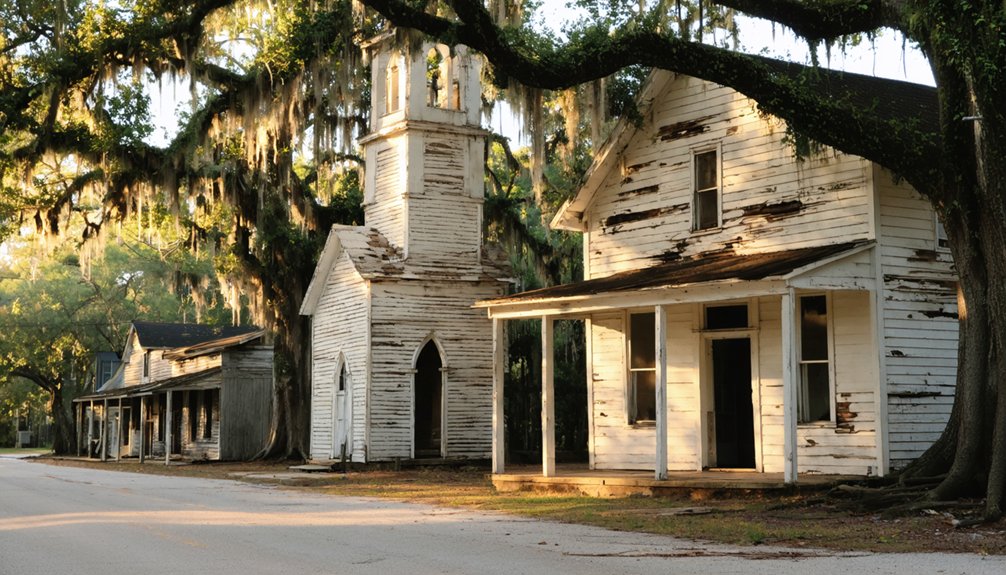
Just twenty minutes from Montgomery, a peculiar ghost town sits on Jackson Lake Island in Millbrook, Alabama—one that never housed actual residents. You’ll discover Spectre, the fictional town built for Tim Burton’s 2003 film *Big Fish*.
When production wrapped, the owners preserved these abandoned structures instead of dismantling them, creating an authentic ghost attraction complete with haunted legends whispered among decaying facades.
You’ll cross under iconic Styrofoam trees and shoes strung between branches before exploring weathered houses, a crumbling church, and remnants of a general store.
Spanish moss drapes the abandoned structures, while goats wander freely.
Though flooding and fire have claimed portions of this movie set, you can still fish, camp, and explore for just $5 per person—cash only at this privately-owned island escape.
Pikeville: Marion County’s Former Seat of Government
Deep in Marion County’s rugged terrain, Pikeville stands as Alabama’s most historically significant ghost town—a former seat of government that couldn’t overcome its geographic curse.
Founded in 1821 and named after War of 1812 hero General Zebulon Pike, this village served as Marion County’s judicial center despite being surrounded by poor farmland on an isolated ridge.
Pikeville became Marion County’s unlikely courthouse town in 1821 despite its remote ridge location and infertile surrounding lands.
When Lamar County formed in 1867-1868, Pikeville’s location became impractical, leading to the county seat’s relocation to Hamilton in 1882.
What you’ll discover at this ghost town:
- The original courthouse building standing defiantly against time
- Judge John Dabney Terrell Jr.’s two-story Antebellum home (1860-1885)
- Ancient graveyards marking forgotten settlers
- Historic store sites scattered throughout
Village preservation efforts maintain the historical significance of Alabama’s quintessential governmental ghost town.
as a result, exploring ghost towns in Alabama provides a unique glimpse into the state’s rich history and cultural heritage. Visitors can witness remnants of the past, from abandoned buildings to artifacts left behind, offering a haunting yet fascinating experience. Each town tells a story of resilience and change, inviting explorers to uncover the secrets buried within.
ghost towns in alabama to explore include impressive sites like Cahaba and Belcher’s Mill, where visitors can imagine life during the height of their communities. These locations highlight the interplay between nature and humanity, with flora reclaiming spaces once bustling with activity. As you roam through these forgotten places, the atmosphere becomes a canvas of nostalgia, allowing for reflection on Alabama’s historical narratives.
Aigleville: An Antebellum River Port Frozen in Time
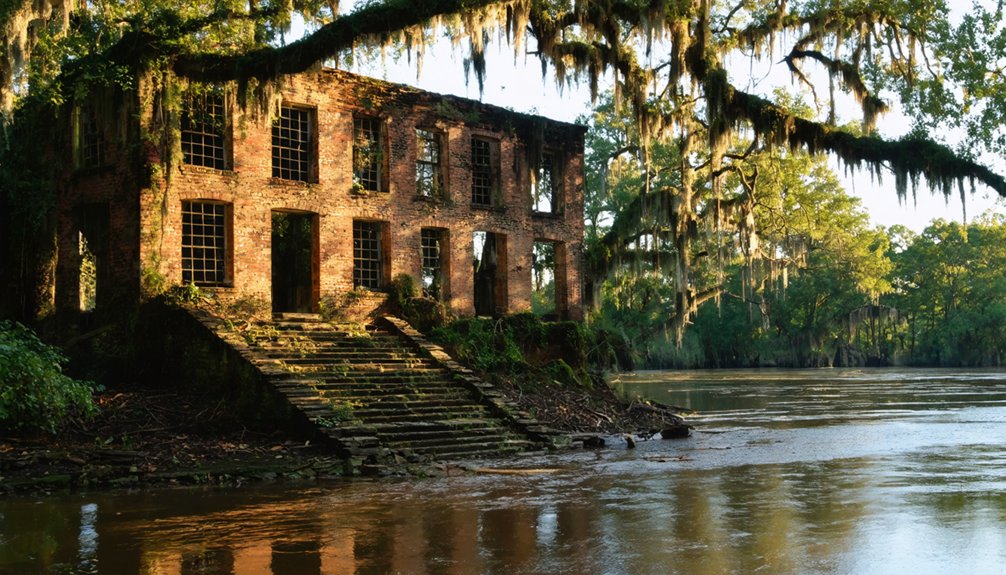
Along the Black Warrior River in Marengo County, Aigleville preserves the remnants of one of America’s most unusual colonial experiments—a settlement founded by French Bonapartists and Saint-Domingue refugees in late 1818. This “Eagle Town” was part of the ambitious Vine and Olive Colony project, where settlers received structured land allotments: town lots, garden plots, and farmland.
You’ll find where historical architecture once lined the riverbanks as this antebellum port thrived on river transportation near the Tombigbee confluence.
By the late 1830s, failed agricultural ambitions forced abandonment. General Lefèbvre-Desnoëttes’ house stood until at least 1842, but forests eventually reclaimed the site.
Today, the land serves industrial purposes, owned by a local cement plant. While no buildings remain, you’re standing where Napoleonic exiles sought freedom—a haunting testament to ambitious dreams meeting Alabama’s frontier reality.
Planning Your Alabama Ghost Town Road Trip
Before you pack your bags, consider the South Alabama loop—a 400-mile circuit that starts and ends in Cahaba and weaves through six compelling ghost towns. You’ll spend roughly eight hours driving, but locating abandoned structures and traversing remote roads requires flexibility.
The South Alabama ghost town loop demands flexibility—eight hours of driving through forgotten places where history hides behind locked gates and overgrown roads.
The Abandoned Travel Alabama Map marks safe destinations with historical markers, though some sites like Prairie Bluff now sit behind gated subdivisions.
Essential preparation tips:
- Contact local historical societies before visiting—even locals can’t always pinpoint cemetery locations or historical markers
- Download interactive maps showing locations near major routes like Beaver Mills by U.S. Route 45
- Scout for abandoned infrastructure including old houses, businesses, and railroad remnants
- Verify current access since gate installations have restricted formerly open sites
This adventure rewards the spontaneous explorer willing to adapt.
Frequently Asked Questions
Are These Ghost Towns Safe to Explore Alone or at Night?
You shouldn’t explore Alabama’s ghost towns alone or at night due to structural hazards, flooding risks, and isolated locations. Follow safety tips: visit during daylight with companions, respect legal restrictions, and remember urban legends often mask real dangers like unstable ruins.
Many visitors are fascinated by abandoned towns in Alabama, drawn to their eerie beauty and rich history. It’s essential to research these locations beforehand to ensure you understand their significance and any potential risks. Engaging with local historians can also enhance your experience, offering insights into the stories behind these forgotten places.
As you plan your adventure to ghost towns to explore in Alabama, consider starting your journey at the well-preserved ruins of the town of Scant City, which offers a glimpse into the past with its intriguing architecture. Additionally, the haunting scenery of the once-thriving community of Hillsboro can provide a perfect backdrop for photography enthusiasts looking to capture the essence of abandonment. Always stay aware of your surroundings and respect the history encapsulated in these wandering locales.
Do I Need Permission to Visit Privately Owned Ghost Town Sites?
While exploring abandoned places feels liberating, you’ll absolutely need permission for privately owned ghost town sites. Private property and land ownership laws protect these locations—trespassing carries legal consequences that’ll quickly end your adventure-seeking freedom.
What Should I Bring When Exploring Abandoned Alabama Ghost Towns?
You’ll need sturdy boots, flashlights, gloves, first-aid supplies, and water for safe exploration. Respect historical preservation by leaving artifacts untouched—preservation laws protect these sites. Bring your phone, ID, and emergency contacts while documenting Alabama’s forgotten landscapes responsibly.
Are There Guided Tours Available for These Ghost Town Locations?
You’ll find guided tours at Old Cahawba Archaeological Park and several historic sites, where knowledgeable guides share local legends and historical preservation efforts. These experiences let you explore freely while learning authentic stories from Alabama’s haunted past.
Can I Take Artifacts or Souvenirs From These Historical Sites?
No, you can’t take artifacts or souvenirs—unauthorized removal breaches state and federal preservation laws. Though tempting to pocket history, these protections ensure future generations experience Alabama’s ghost towns authentically, preserving your freedom to explore intact sites.
References
- https://thebamabuzz.com/5-alabama-ghost-towns-to-put-on-your-bucket-list/
- https://freepages.history.rootsweb.com/~gtusa/usa/al.htm
- https://www.geotab.com/ghost-towns/
- https://www.onlyinyourstate.com/trip-ideas/alabama/ghost-towns-road-trip-al
- https://ghost-towns.close-to-me.com/states/alabama/
- https://www.ezhomesearch.com/blog/11-ghost-towns-in-alabama-that-bridge-the-distance-between-yesterday-and-today/
- https://www.abandonedalabama.com/maps/
- https://kids.kiddle.co/List_of_ghost_towns_in_Alabama
- https://en.wikipedia.org/wiki/Arcola
- https://digitalalabama.com/alabama-ghost-towns/arcola-alabama/2798