You’ll discover Arizona’s most engrossing ghost towns from Swansea’s well-preserved adobe structures maintained by the BLM to Jerome’s cliffside buildings perched at 5,400 feet on Cleopatra Hill. Explore Oatman along Route 66, where wild burros descended from miners’ pack animals roam freely among wooden boardwalks and historic saloons. Visit Gleeson’s copper mining remnants near Tombstone, or Charleston’s lawless silver mill town ruins along the San Pedro River. Each destination offers unique glimpses into Arizona’s boom-and-bust mining heritage, with spring and fall providing ideal conditions for exploration.
Key Takeaways
- Jerome: A preserved copper mining town at 5,400 feet with historic buildings, artist community, and transformation from 15,000 residents to 50.
- Oatman: Route 66 town featuring wild burros, wooden boardwalk, historic saloons, and the famous dollar bill-covered Oatman Hotel.
- Swansea: Remote desert site with preserved adobe structures, worker cottages, railroad depot, and gated mine shafts managed by BLM.
- Charleston: Lawless silver mill town near Tombstone with ruins of six mills, outlaw history, and remnants along San Pedro River.
- Gleeson: Copper mining town near Tombstone featuring preserved 1910 jail museum, mine ruins, and historic cemetery in Dragoon Mountains.
Swansea: A Preserved Desert Relic
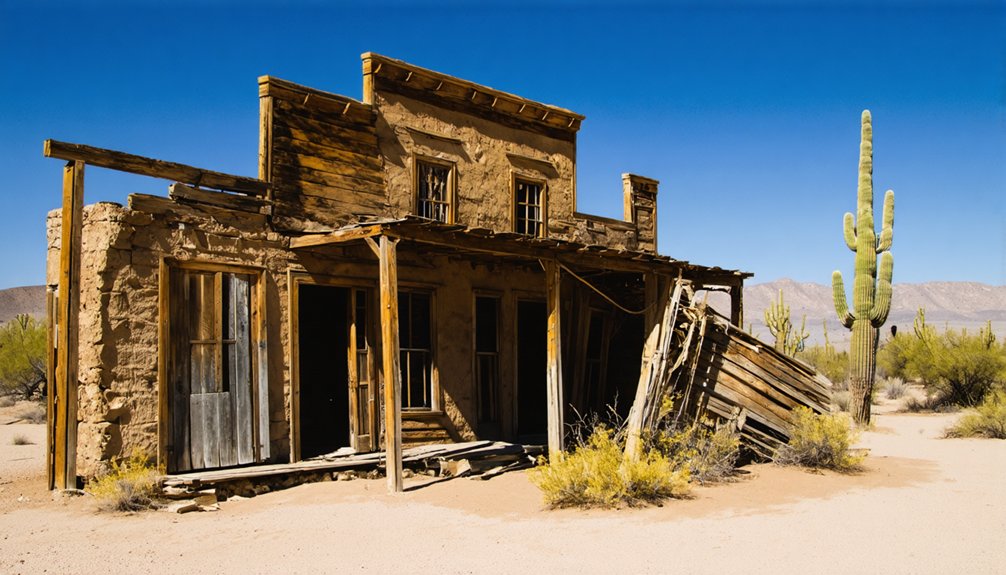
Deep in the Arizona desert, about 30 miles east of Parker, Swansea stands as one of the state’s most remarkably preserved ghost towns. You’ll discover dozens of adobe structures scattered among desert flora, their weathered walls whispering tales of copper mining‘s early 20th-century heyday.
The Bureau of Land Management maintains this remote site, where you’re free to explore worker cottages with restored roofs, a railroad depot, and gated mine shafts. Well-marked historical signs guide your journey through smelter ruins and two windswept cemeteries.
Ancient artifacts remain where miners left them—though you can’t take anything, you’ll witness authentic remnants of 1909’s boom days. The town once supported roughly 300 residents during its peak before copper prices collapsed after World War I. The isolation that once doomed this town now preserves it, offering you unfiltered access to Arizona’s untamed mining heritage. For an immersive experience, consider staying at one of the five designated camping sites where you can spend the night surrounded by history.
Jerome: Arizona’s Mountain Mining Marvel
Perched dramatically at 5,400 feet on Cleopatra Hill’s steep slopes, Jerome clings to mountainside terrain so vertical that entire buildings once slid downhill during its tumultuous mining era.
Jerome’s precarious perch on Cleopatra Hill proved so unstable that buildings literally slid downhill during the town’s volatile mining days.
You’ll discover mining history etched into every weathered facade, from the 1876 copper claims through the billion-dollar output that made this among America’s richest deposits.
The population exploded from 250 to 15,000 before collapsing to just 50 when mines closed in 1953.
Today’s ghost town architecture tells stories of survival through fires, labor strikes, and underground infernos that burned for decades.
The Jerome Historical Society formed in 1956 to halt the demolition of historic structures and preserve the town’s mining legacy.
Artists and craftspeople rescued Jerome from total abandonment in the 1960s, transforming abandoned saloons and company buildings into galleries.
You’re free to explore this “Wickedest Town in the West” where rugged independence still permeates mountain air. The town shares its name with Saint Jerome, the fourth-century scholar who produced the Latin Vulgate Bible translation and lived an ascetic life devoted to biblical scholarship.
Oatman: Where Wild Burros Rule Route 66
You’ll find Oatman perched at 2,710 feet in the Black Mountains, where wild burros—descendants of miners’ pack animals—freely wander the dusty streets of this Route 66 treasure.
The town’s weathered false-front buildings and wooden boardwalks transport you straight into the Old West, their authenticity earned through a century of boom, fire, and near-abandonment.
What began as a $10 million gold strike in 1915 has transformed into something more valuable: a living snapshot of frontier life where tourism has replaced ore as the town’s lifeline.
The town takes its name from Olive Oatman, who was kidnapped by Apache Indians in 1851 and later lived with the Mojave tribe, becoming one of the most famous figures in Old West history.
At the Oatman Hotel, you can still see walls covered with one-dollar bills signed by visitors, a tradition started by miners who left their mark before heading into the mountains.
Historic Mining Town Charm
Along the winding curves of historic Route 66, Oatman clings to the Black Mountains as a proof to Arizona’s wild mining past. You’ll discover weathered buildings that housed thousands during the 1915-1917 boom, when the district’s mines pulled $40 million in gold from shafts plunging nearly 1,000 feet deep.
The 1902 Oatman Hotel stands alongside authentic saloons, the old jail, and Tom Reed mill ruins—all preserved through dedicated preservation efforts. Mining technology from that era remains visible throughout town, telling stories of fortune-seekers who carved tunnels through solid rock. The town gained its name from Olive Oatman, who was captured by the Mojave tribe and bore their distinctive chin tattoo.
Today’s 75 year-round residents maintain this living ghost town‘s authenticity, where eight blocks of paved Route 66 wind through structures that survived countless fires and decades of boom-and-bust cycles. The town’s most charismatic residents are free-range burros descended from historic mining animals, who boldly roam the streets and have become a beloved part of Oatman’s character.
Famous Roaming Wild Burros
Wild burros wander Oatman’s streets with the confidence of longtime residents, their hoofbeats echoing against century-old storefronts as they search for handouts from delighted tourists. You’ll encounter 10-12 of these desert dwellers daily, descendants of miners’ pack animals abandoned when the gold ran out in the 1960s.
Their tame appearance masks genuinely wild natures—don’t let the photo opportunities fool you.
Wild burro behavior ranges from charming to comical, though mating displays occasionally surprise visitors. While they’re federally protected and beloved by tourists, burro population management**** presents serious challenges.
An estimated 2,000 feral burros roam surrounding areas—four times BLM recommendations—crowding native bighorn sheep and causing vehicle accidents along Route 66. These burros contribute significantly to Arizona’s tourism economy, generating hundreds of millions of dollars annually. Young burros wear no carrot stickers to prevent choking hazards, though tourists regularly feed the adults. Recent helicopter roundups captured only 50, barely denting their explosive growth.
Gleeson: Copper Country’s Forgotten Outpost
Nestled fifteen miles from Tombstone on the southern flank of the Dragoon Mountains, Gleeson stands as a proof to copper country’s boom-and-bust cycle. You’ll discover John Gleeson’s 1900 copper strike transformed this frontier outpost from 500 souls into a thriving 6,000-resident hub by 1918.
From 500 hardy pioneers to 6,000 fortune-seekers in less than two decades—copper fever transformed Gleeson’s dusty crossroads into Arizona’s boomtown.
Mining technology evolved here through operations like the Copper Belle and Silver Belle mines, served by Southern Pacific’s spur until 1932.
Today’s ruins offer authentic historic preservation:
- Restored concrete jail museum with original barred windows
- Adobe structures rebuilt after 1912’s devastating fire
- Cemetery marking both ordinary and extraordinary deaths
You’re free to explore foundations, mining remnants, and weathered saloons along Ghost Town Trail.
Unlike sanitized attractions, Gleeson remains raw and unvarnished—a genuine window into Arizona’s untamed mining past.
Charleston: Lawless Mill Town of the Old West
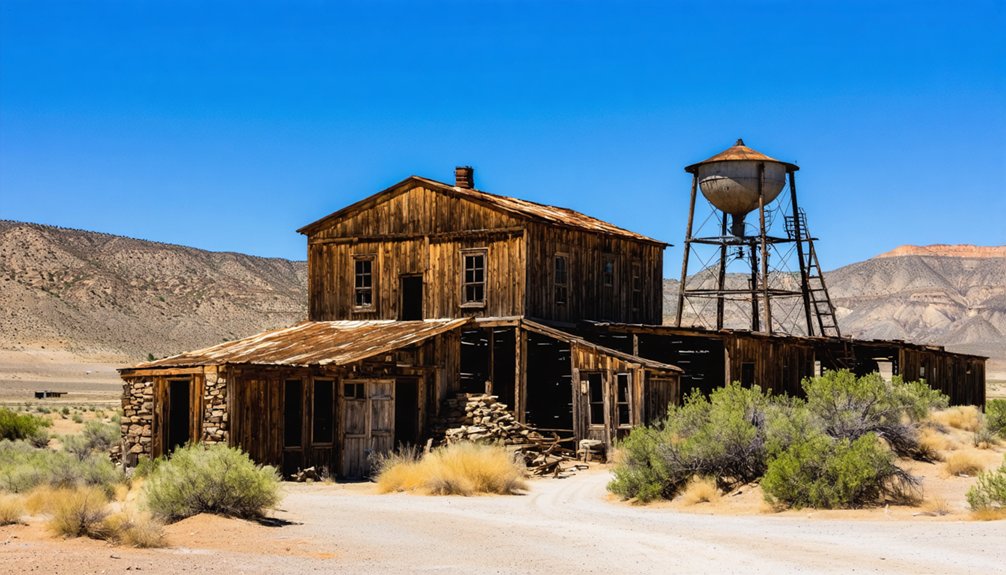
You’ll find Charleston’s story etched in the dust along the San Pedro River, where silver ore once fueled a mill town’s wild prosperity from 1878 to 1889. This wasn’t just another frontier settlement—it earned a reputation for lawlessness that even nearby Tombstone couldn’t match, drawing outlaws and gunmen to its saloons.
While stamp mills thundered across the water in Millville. Today, crumbling adobe foundations and a hidden cemetery mark where earthquake, flood, and time erased a community that processed fortunes in silver yet couldn’t survive the mines’ collapse.
Silver Processing Hub History
While Tombstone grabbed headlines with its legendary gunfights and silver strikes, the real muscle behind its fortune lay nine miles southwest along the San Pedro River.
Charleston’s strategic location wasn’t accidental—it solved Tombstone’s critical water shortage problem. You’ll discover how this processing powerhouse transformed raw ore into wealth through ingenious mining technology and water management systems.
During peak operations in 1881-1882, Charleston’s mills operated with relentless efficiency:
- Six mills ran 24/7 along the river, processing 15-20 tons of ore daily
- Mule teams hauled 40,000-50,000 pounds of ore from Tombstone mines each day
- Annual production reached $1.4 million in silver bullion at its height
The Tombstone Mill and Mining Company’s headquarters stood as southern Arizona’s finest building, commanding operations that turned desert rock into fortune.
Outlaw Haven and Crime
Charleston’s industrial prosperity came with a darker price—the town became southern Arizona’s most notorious outlaw sanctuary. You’ll discover this was the preferred haven for criminal activity’s biggest names: the Clanton family, Johnny Ringo, and Curly Bill Brocius operated freely from nearby ranches.
East Coast newspapers sensationalized the violence, crafting outlaw legends that still echo today.
The town lacked formal law enforcement, letting rustlers and stagecoach robbers move unchecked.
In one infamous incident, Curly Bill and Ike Clanton stormed Charleston’s church, demanding a hellfire sermon at gunpoint—then left the congregation’s largest recorded tithe.
While mill guards prevented successful silver robberies, they couldn’t curb the broader lawlessness that connected Charleston to Tombstone’s OK Corral shootout and cemented its reputation as the Old West’s wildest outpost.
Ruins Near San Pedro
Along the west bank of the San Pedro River, crumbling stone walls mark where Charleston once thrived as Tombstone’s essential industrial partner. Founded in 1878, this mill town processed over $1.4 million in silver bullion before flooding mines and an 1887 earthquake reduced it to ruins.
Today, you’ll discover:
- Scattered foundations where 13 saloons and 400 residents once created a lawless frontier community
- Desert flora reclaiming adobe structures dismantled by Mexican settlers for firewood
- Military training remnants from WWII when the 93rd Infantry Division used these ghost town ruins as “Little Tunisia”
The site offers more than Charleston’s remains—nearby ancient petroglyphs connect you to millennia of human history along this waterway,
while river erosion continues reshaping these atmospheric ruins.
Vulture City: Golden Legacy in the Sonoran Desert
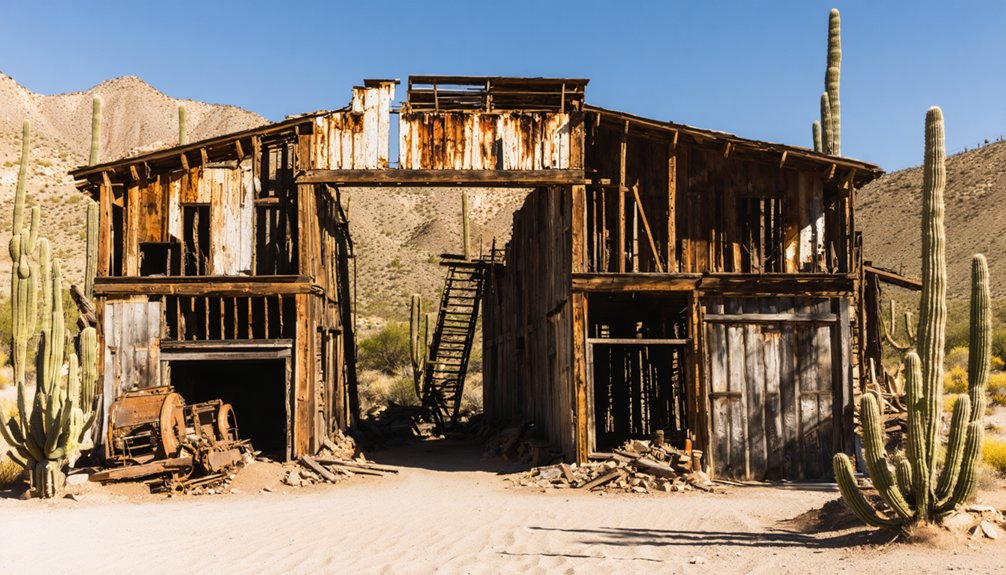
Mining technology like stamping mills once thundered across 5,000 residents’ bustling streets lined with saloons and brothels. When World War II forced closure in 1942, the town emptied overnight.
Today, you can explore 18 restored buildings across 35 preserved acres—a living museum where Arizona’s golden legacy remains tangible and yours to discover.
Planning Your Arizona Ghost Town Adventure
Your journey through Arizona’s ghost towns requires smart preparation to maximize discovery while staying safe. Pack essential supplies—water, sun protection, and sturdy hiking boots—for accessing remote sites like Fort Bowie’s 1.5-mile trail.
Exploring the best ghost towns in Arizona offers a unique glimpse into the state’s rich history and abandoned architecture. Each site tells its own story, revealing the challenges faced by early settlers and miners. Be sure to take your camera; the hauntingly beautiful landscapes provide stunning photo opportunities that capture the essence of these forgotten places.
Carry guidebooks with GPS coordinates to navigate 275+ scattered locations, from Ruby’s preserved ghost town architecture in Coronado National Forest to Castle Dome’s mining museum.
Time your adventures for prime conditions:
- Spring and fall offer ideal temperatures for exploring Ruby’s Montana Mine structures
- October through April provides comfortable hiking weather at Fort Bowie’s elevation
- Winter months suit Yuma County’s desert sites like Castle Dome
Study preservation techniques visible at sites like Gleeson’s 1910 jail, where historical societies maintain these freedom-seeking pioneers’ legacies against Arizona’s harsh elements and time’s relentless advance.
Frequently Asked Questions
Are Arizona Ghost Towns Safe to Visit With Children?
Many Arizona ghost towns aren’t safe for children due to collapsing structures, unstable terrain, and remote locations. However, supervised visits to managed sites like Vulture City offer historic landmarks and photography opportunities while maintaining reasonable safety standards for families.
In addition to Vulture City, there are several other ghost towns to explore in Arizona that provide a glimpse into the state’s storied past. Places like Jerome and Bisbee also welcome visitors, featuring preserved buildings and informative tours that cater to history enthusiasts and families alike. Exploring these sites can ignite curiosity and appreciation for the unique heritage of the American Southwest.
What Is the Best Time of Year to Explore Arizona Ghost Towns?
You’ll find winter (November-February) offers the best weather for exploring, with temperatures between 60-75°F and clear skies. Seasonal changes bring spring wildflowers and fall’s paranormal tourism, though summer’s extreme heat limits comfortable exploration times.
Do I Need a 4-Wheel Drive Vehicle to Reach These Ghost Towns?
Vehicle requirements vary by location—you won’t need 4WD for every off-road adventure. High-clearance 2WD handles most ghost towns successfully, though challenging routes like Tip Top and southern KOFA demand true four-wheel drive capability.
Can I Camp Overnight at Any Arizona Ghost Town Sites?
You can camp overnight at select Arizona ghost towns like Goldfield and BLM’s Fairbank site. You’ll experience wildlife encounters under starlit skies while respecting historic preservation rules. State Trust and National Forest lands near ghost towns offer additional dispersed camping options.
Are There Entrance Fees to Visit Arizona’s Ghost Towns?
Ironically, Arizona’s most remote ghost towns offer free access—nature’s reward for conquering remoteness challenges. However, commercially preserved sites charge $12-$15 for adults, funding historic preservation. You’ll find freedom costs nothing at Swansea, while Vulture City requires payment.
References
- https://www.arizonahighways.com/article/arizona-ghost-towns
- https://en.wikipedia.org/wiki/List_of_ghost_towns_in_Arizona
- https://www.visitarizona.com/like-a-local/4-arizona-ghost-towns-you-may-have-never-heard-of
- https://www.visittucson.org/blog/post/8-ghost-towns-of-southern-arizona/
- https://www.youtube.com/watch?v=Hl0qxYmKPoE
- https://www.ghosttowns.com/states/az/az.html
- https://www.tripadvisor.com/Attractions-g28924-Activities-c47-t14-Arizona.html
- https://goldfieldghosttown.com
- https://www.atlasobscura.com/places/swansea-ghost-town
- https://davenkathy.blogspot.com/2019/01/swansea-ghost-town.html