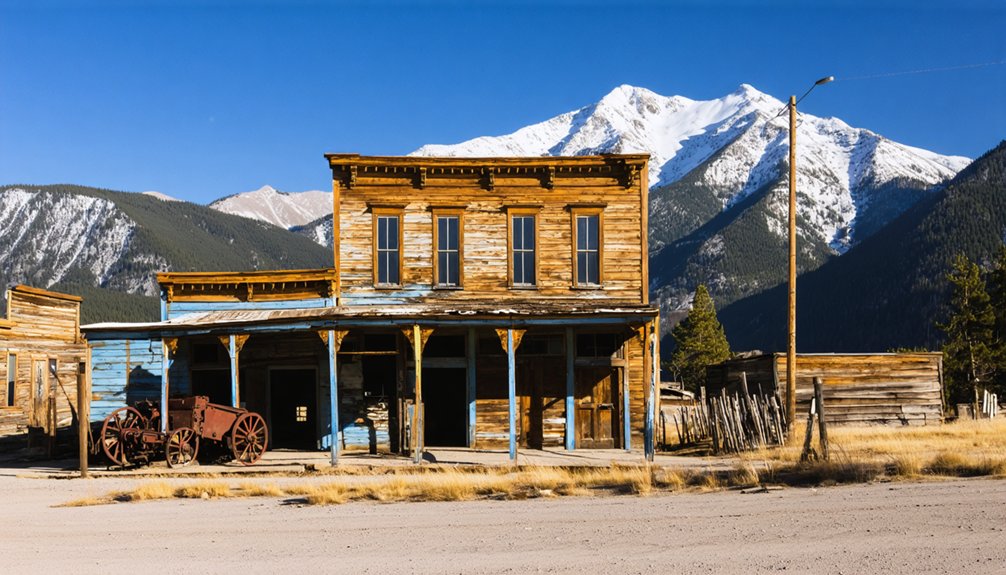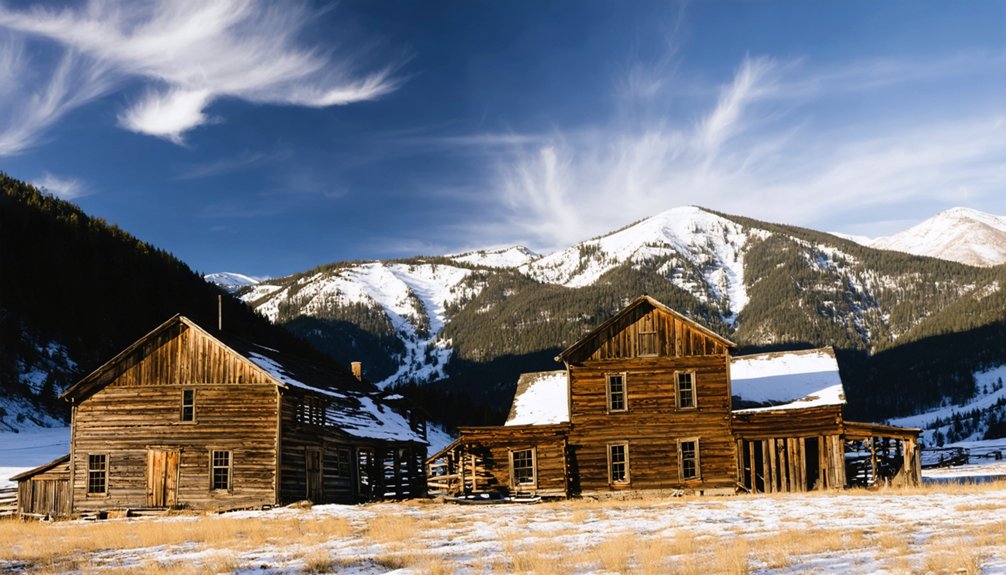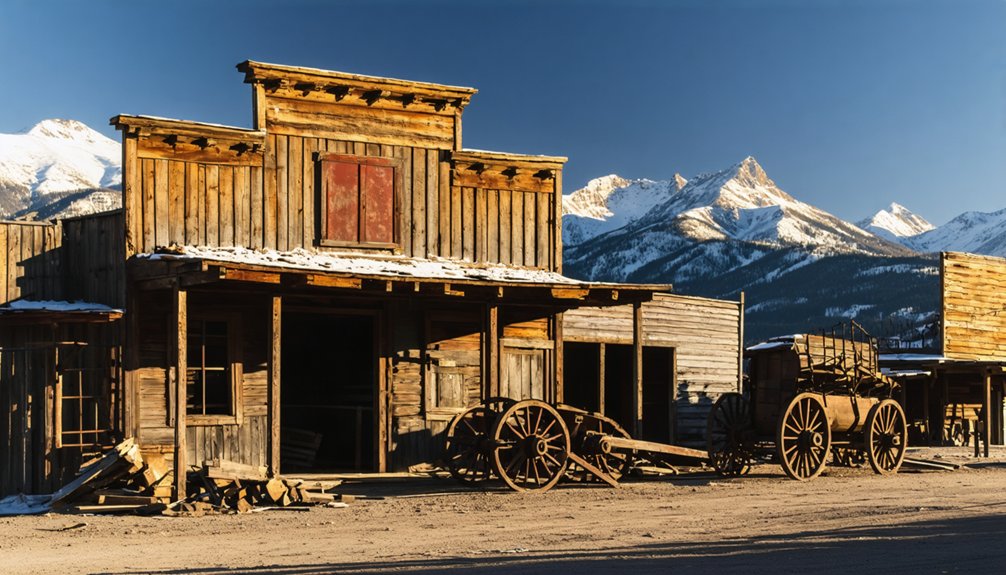
You’ll find Colorado’s most enthralling ghost towns scattered from high alpine passes to eastern plains. St. Elmo stands out as the best-preserved, with 43 original buildings at nearly 10,000 feet. Animas Forks claims the title of highest accessible ghost town at 11,200 feet, while Ashcroft near Aspen showcases restored silver-era structures. Independence commemorates gold rush history, and Dearfield represents Colorado’s largest Black homesteading community. Each site offers unique access to frontier life, though visiting requires proper preparation and understanding of seasonal conditions.
Key Takeaways
- St. Elmo at 9,961 feet features 43 preserved structures including a general store, schoolhouse, and hotel in a National Historic District.
- Animas Forks, Colorado’s highest ghost town at 11,200 feet, requires 4WD vehicles and offers Duncan House and Gold Prince Mill ruins.
- Ashcroft, 11 miles from Aspen, preserves nine restored buildings from its silver mining boom era with 20 saloons and 2,000 residents.
- Independence commemorates July 4, 1879 gold discovery with preserved timber structures at 11,000 feet elevation near Aspen.
- Summer and early fall provide optimal access, wildflowers, and vibrant foliage; pack emergency supplies and 4WD for remote locations.
St. Elmo: Colorado’s Best-Preserved Ghost Town
Where else can you walk through an authentically preserved 1880s mining town with 43 original structures still standing? St. Elmo, perched at 9,961 feet in the Sawatch Range, lets you explore Colorado’s mining heritage without barriers.
Once home to 2,000 residents during its 1890 peak, this remarkably intact ghost town features the original general store, schoolhouse, and American House Hotel.
Preservation efforts transformed St. Elmo into a National Historic District in 1979. The Stark family’s dedication—remaining through decades of abandonment, purchasing properties at tax sales, and ultimately donating buildings—saved this mountain settlement from complete decay.
You’ll discover haunted legends surrounding Annabelle Stark, including tales of phantom encounters at the hotel.
Feed chipmunks, photograph weathered storefronts, and fish Chalk Creek while experiencing authentic frontier atmosphere just twenty miles from Buena Vista.
Animas Forks: The Highest Accessible Ghost Town
At 11,200 feet in the San Juan Mountains, Animas Forks stands as Colorado’s highest accessible ghost town—a windswept settlement where a dozen original structures cling to steep alpine terrain. You’ll reach this remote outpost via the Alpine Loop’s rugged 4WD roads, where 450 pioneers once braved brutal winters pursuing silver and gold.
The 1884 blizzard dumped 25 feet of snow in 23 days, forcing residents to tunnel between buildings.
Advanced mining techniques brought electricity and prosperity until the 1893 silver crash triggered decline. A devastating fire in October 1891 destroyed 14 buildings, severely hampering the town’s ability to recover from economic setbacks.
Today, ghost town preservation efforts protect remnants like the 1879 Duncan House and historic Gold Prince Mill. You’ll discover authentic boarding houses, jail cells, and weathered cabins—tangible proof of human tenacity at impossible elevations, managed by the Bureau of Land Management. Interpretive brochures and maps are available at parking areas to guide your self-guided exploration of the site.
Ashcroft: A Silver Mining Relic Near Aspen
You’ll find Ashcroft tucked eleven miles up Castle Creek Road from Aspen, where preserved cabins and storefronts stand frozen in time against a backdrop of alpine meadows.
This remarkably intact silver mining camp, which once rivaled Aspen with 2,000 residents and 20 saloons, now offers rare access to authentic 1880s mining life through buildings maintained by the Aspen Historical Society.
The scenic mountain drive rewards visitors with interpretive trails, seasonal docents sharing frontier tales, and structures like the Kinney Mercantile Store that survived since the boom-and-bust era. The site’s unique alpine setting also makes it available for ceremony rentals from June through September, combining historical ambiance with natural mountain beauty. The Castle Creek area was originally inhabited by Ute people before settlers arrived during the 1880s silver rush.
Historic Mining Camp Remnants
Nestled in the Castle Creek Valley just ten miles south of Aspen, Ashcroft stands as one of Colorado’s most remarkably preserved silver mining camps from the 1880s boom era.
You’ll discover nine restored buildings maintained by the Aspen Historical Society since 1974, offering an authentic glimpse into frontier life when 3,500 fortune-seekers called this place home. The remaining structures showcase mining techniques from when initial deposits yielded an astounding 14,000 ounces of silver per ton.
Ghost town preservation efforts earned Ashcroft a spot on the National Register of Historic Places in 1975. You can explore several safe-to-enter buildings that reveal how quickly prosperity vanished—from twenty saloons and six hotels in 1883 to complete abandonment by 1885 when shallow ore veins depleted. The arrival of the Denver & Rio Grande Railroad in Aspen in 1887 shifted economic focus away from Ashcroft, accelerating the exodus of remaining residents. The town’s last resident, Jack Leahy, died in 1939, officially marking the end of Ashcroft’s inhabited history.
Scenic Mountain Access Routes
Reaching Ashcroft requires a spectacular 11-mile journey south from Aspen along Castle Creek Road, where you’ll climb from the Roaring Fork Valley into pristine alpine territory. This scenic drive rewards you with constantly changing mountain scenery as you ascend to 9,521 feet elevation, winding through landscapes that once drew silver prospectors to these remote headwaters.
The route features:
- Interpretive signage explaining historical and natural landmarks
- Panoramic views of Castle Creek Valley’s alpine meadows
- Seasonal access through picturesque high-elevation terrain
- Self-guided exploration opportunities upon arrival
Your journey traverses the same path miners traveled over a century ago, though today’s experience emphasizes natural beauty rather than mineral wealth. The paved road remains open year-round, though gates close beyond Ashcroft during winter months. These mountains were home to Ute Indian tradition long before silver miners arrived, with the indigenous peoples considering the Shining Mountains their eternal homeland.
The US Forest Service maintains this access road, ensuring you’ll experience both adventure and preservation of Colorado’s mountain heritage.
Independence: Gold Rush Legacy on Independence Pass
At nearly 11,000 feet elevation, Independence sprang to life when prospectors struck gold on July 4, 1879, at the Independence Gold Lode near the Roaring Fork River. You’ll find this ghost town 16 miles east of Aspen, where 1,500 fortune-seekers once braved brutal winters for precious metal.
The Farwell Mining Company extracted over $190,000 in gold by 1882, but resources depleted rapidly. When Colorado’s worst storm in 1899 trapped residents for months, they dismantled their homes for ski materials and raced to Aspen.
Today, you can explore remarkably preserved timber structures and imagine the gold panning that drew adventurers to this isolated peak. Mining museums throughout the region help contextualize Independence’s brief but intense legacy.
Dearfield: A Historic All-Black Settlement on the Eastern Plains
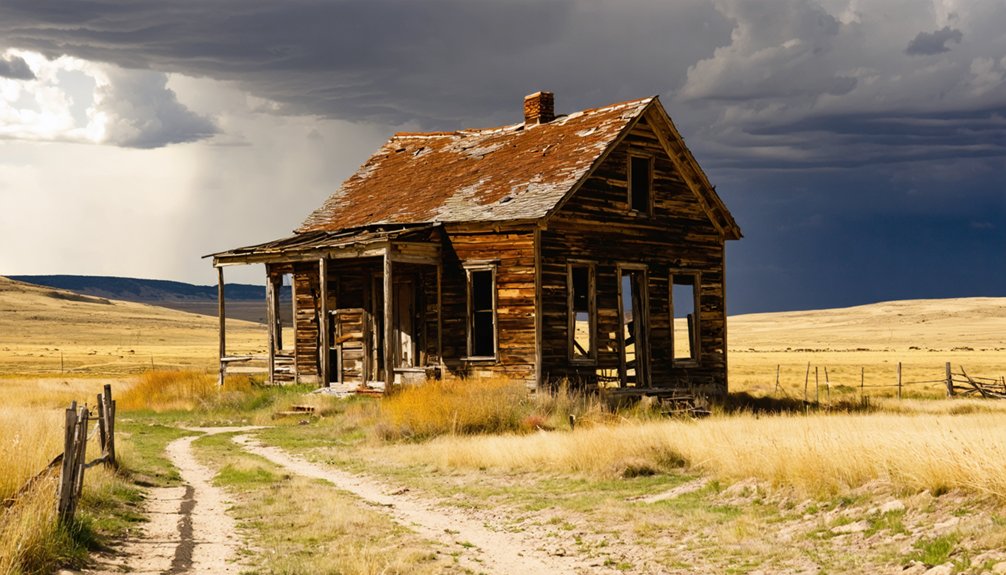
Thirty miles east of Greeley, you’ll discover the windswept remnants of Dearfield, where Oliver Toussaint Jackson‘s extraordinary vision once transformed barren sand hills into Colorado’s largest Black homesteading community.
Between 1910 and the 1940s, this self-sufficient agricultural colony housed up to 700 residents who mastered dry farming techniques and built a thriving cultural hub that drew weekend visitors from across the state.
Today, only three weathered structures—a gas station, diner, and Jackson’s former home—stand as silent witnesses to this pioneering community’s determination and ultimate struggle against drought and economic collapse.
Oliver Jackson’s Vision
What drives a person to build an entire community from scratch on Colorado’s harsh eastern plains? For Oliver Toussaint Jackson, it wasn’t just ambition—it was liberation. Inspired by Booker T. Washington’s *Up From Slavery*, this former state legislator envisioned a place where African Americans could achieve economic independence through land ownership.
Jackson’s bold vision centered on:
- Self-sufficiency through agriculture rather than wage labor dependence
- Community resilience built on collective determination and mutual support
- Agricultural innovation using dry farming techniques on challenging sand hills
- Economic freedom that offered dignity and autonomy to Black homesteaders
After being denied land grants, Jackson filed his homestead claim in 1910 and advertised nationwide for colonists. His dream attracted families seeking escape from discrimination and the chance to build something extraordinary together.
Ruins and Remains Today
Today, the weathered remnants of Dearfield stand as silent sentinels along U.S. Highway 34, approximately 30 miles east of Greeley. You’ll find exceptional surviving structures here—rare among Black colonies—including the O.T. and Minerva Jackson home, originally Dearfield Lodge. These historical landmarks represent what remains of 44 wooden cabins that once housed 700 residents at their peak.
The Black American West Museum owns this Colorado Registered Historic Landmark, preserving National Register lots through strategic land swaps. You can explore the 320-acre townsite’s archaeological insights, where barren fields tell stories of failed dry farming and Dust Bowl devastation.
Sandy soil and absent irrigation rights doomed the settlement by the 1930s. Visible from the highway, these ruins commemorate resilient pioneers who dared forge independent lives on Colorado’s unforgiving plains.
Tin Cup: Where the Wild West Came Alive
Deep in Colorado’s rugged backcountry, Tin Cup stands as one of the state’s most authentic Wild West ghost towns, where legends of gunfights and gold still echo through weathered wooden buildings.
Named after prospector Jim Taylor’s 1859 discovery—he carried his gold back in a tin cup—this settlement earned its notorious reputation through violence and lawless frontier justice.
The town’s mining history reveals a boom-and-bust cycle typical of Colorado’s goldfields:
- Population peaked at nearly 4,000 residents in 1880
- Two marshals were gunned down within two years
- Devastating fires in 1906 and 1913 destroyed most businesses
- Mine exhaustion forced the post office closure in 1918
Today, you’ll find approximately 75 summer residents maintaining restored buildings, a cemetery marking fallen lawmen, and that untamed spirit of independence defining America’s Wild West era.
Planning Your Ghost Town Adventure: What to Bring
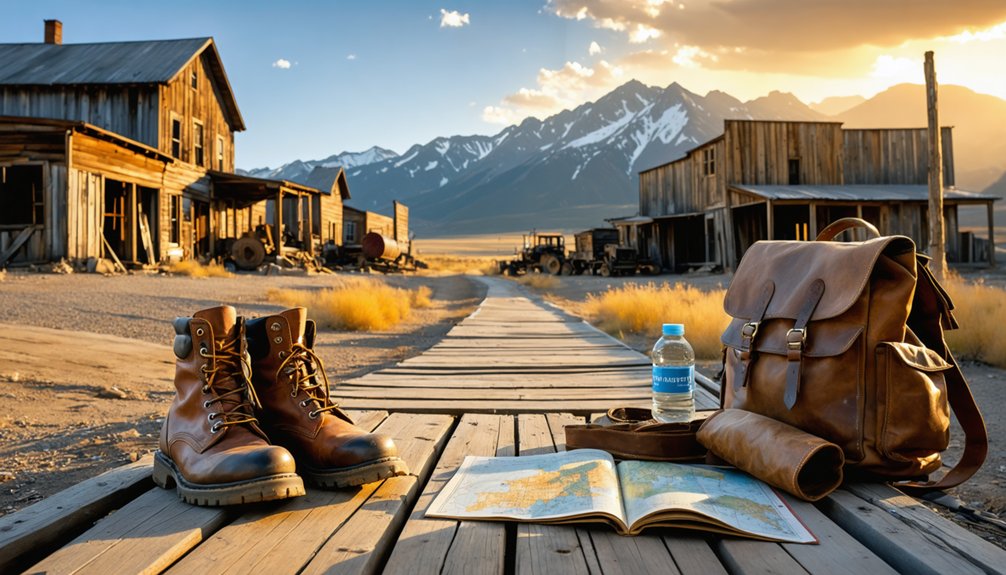
Exploring Colorado’s ghost towns demands thorough preparation, as these remote sites present unique challenges that modern amenities can’t solve. You’ll need a high-clearance vehicle with four-wheel drive for locations like Animas Forks and Red Mountain Town.
Pack three days’ worth of water, food, and emergency supplies—there’s no cell service in these mountains. Bring navigation tools including maps, GPS, and a compass for the rugged San Juan terrain.
Your emergency kit should include outdoor blankets, flashlights, and a satellite communicator. Don’t forget sun protection, sturdy hiking boots, and layered clothing for sudden weather shifts from 98°F to snow.
Before departing, research necessary permits and file a route plan with someone trustworthy. Practice responsible tourism by respecting these fragile historical sites and leaving no trace behind.
Best Times to Visit Colorado’s Ghost Towns
When planning your ghost town expedition, timing can make the difference between a memorable adventure and a frustrating ordeal. Summer offers accessible roads and comfortable exploration, with opportunities for wildlife observation like hummingbirds at St. Elmo’s feeders.
Early fall delivers spectacular seasonal photography with golden aspens and fewer crowds after September. Winter transforms sites into serene, snow-covered landscapes perfect for solitary wanderers, though icy conditions challenge access to higher elevations.
Spring brings variable weather but thawing roads and minimal tourists.
Consider these seasonal highlights:
- Summer: Wildflowers bloom in high-altitude areas; general stores operate
- Early Fall: Vibrant autumn colors around St. Elmo; *ideal* for Cripple Creek ruins
- Winter: Quiet, scenic experiences at Ashcroft and Gold Hill
- Spring: Improving road conditions; hiking trails become viable
Always check conditions before venturing into remote territory.
Preserving History: Respecting These Historic Sites
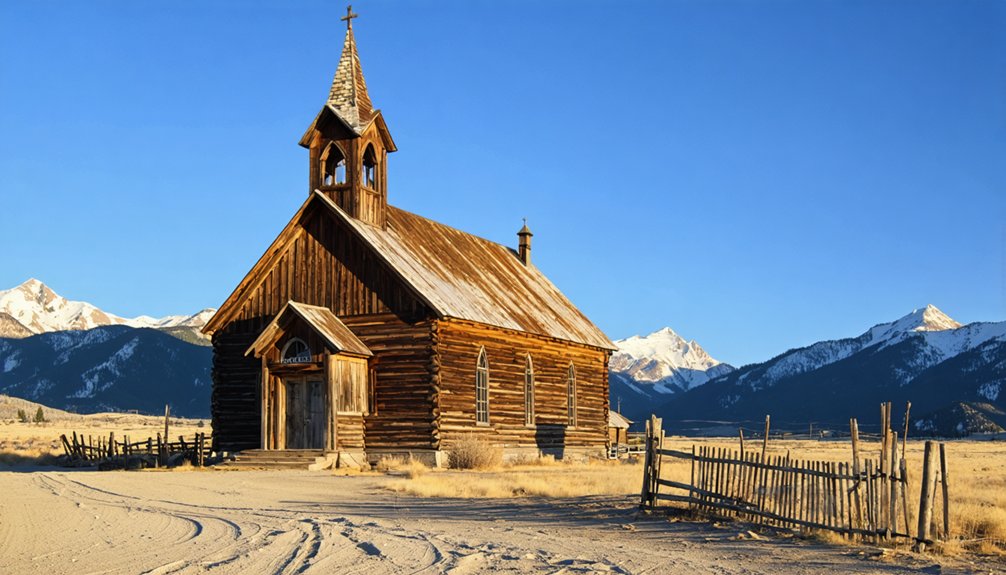
As you wander through Colorado’s ghost towns, you’re walking among irreplaceable pieces of American history that require active protection to survive. Local preservation challenges demand substantial resources—sites like Animas Forks secured $330,000 for stabilization, while Shenandoah-Dives Mill received $1.5 million for ongoing rehabilitation.
Organizations like the Ghost Town Club of Colorado and Silverton Historical Society partner with History Colorado to fight deterioration through dedicated funding and volunteer efforts.
Dedicated partnerships between local preservation groups and History Colorado combine funding and volunteers to battle ongoing deterioration at ghost town sites.
Your visitor etiquette directly impacts these sites’ futures. Respect private property boundaries, especially at St. Elmo where owners request you stay in streets. Signs highlighting preservation work aren’t just informative—they’re deterrents against vandalism.
Consider voluntary donations, like Independence’s suggested $5 contribution, which supports trail maintenance and interpretive programs. You’re exploring these places because others cared enough to protect them.
Frequently Asked Questions
Are Ghost Town Visits in Colorado Suitable for Young Children?
Yes, you’ll find many Colorado ghost towns perfect for young children. They offer family-friendly activities like gold panning, butter churning, and shooting galleries, while historical preservation guarantees safe, educational experiences. Indoor museums provide weather-proof alternatives for worry-free exploration.
Exploring the historic ghost towns in Colorado can ignite a fascination with the past and spark curiosity in children about history and adventure. Families can stroll through well-preserved buildings and imagine life during the gold rush, making it an interactive learning experience. Each town has its own unique story, providing a backdrop for unforgettable family memories and exploration.
Can I Camp Overnight Near These Colorado Ghost Towns?
Yes, you can camp overnight near many Colorado ghost towns on public land. Pack camping essentials, follow dispersed camping rules, and practice wildlife safety. Always verify land ownership and obtain required permits before setting up camp.
Exploring the historic mining towns in Colorado offers a glimpse into the rich history of the Gold Rush era. Many of these towns have well-preserved structures that make for fascinating photo opportunities. As you wander through the remnants of these communities, keep an eye out for local wildlife that may inhabit the area.
Do Any Ghost Towns Charge Admission or Entrance Fees?
Want to explore authentic history? You’ll find several ghost towns charge $3-$8.50 admission for historical preservation efforts. Some operate on private property with honor systems, while others offer free access to their atmospheric ruins and structures.
Are Dogs Allowed When Visiting Colorado’s Ghost Towns?
You’ll find pets allowed at Colorado’s ghost towns like Animas Forks, Saint Elmo, and South Pass City, though dog regulations vary by location. Most welcome your furry companions on trails and through historic structures during operating seasons.
Which Ghost Towns Offer Guided Tours Versus Self-Exploration?
You’ll find guided tour options in Ouray, Silverton, Leadville, and Denver via jeep or walking excursions. For self-exploration tips, head to St. Elmo, Animas Forks, or Vicksburg—accessible by car, ATV, or hiking trails requiring minimal assistance.
References
- https://en.wikipedia.org/wiki/List_of_ghost_towns_in_Colorado
- https://alissapeterson.com/blog/discover-the-spookiest-colorado-ghost-towns
- https://www.colorado.com/articles/colorado-ghost-towns
- https://www.islands.com/2061852/colorado-abandoned-ghost-towns-once-thriving/
- https://303magazine.com/2017/10/colorado-ghost-towns/
- https://www.uncovercolorado.com/ghost-towns/
- https://www.kukucampers.com/blog/9-colorado-ghost-towns-to-visit
- https://www.atlasobscura.com/things-to-do/colorado/ghost-towns
- https://www.tripadvisor.com/Attractions-g28927-Activities-c47-t14-Colorado.html
- https://www.legendsofamerica.com/co-stelmo/