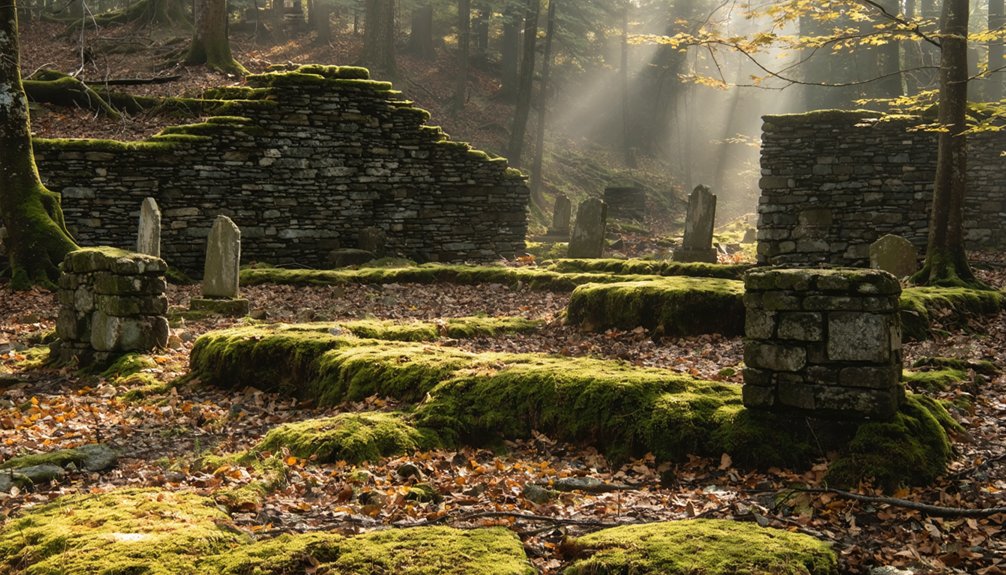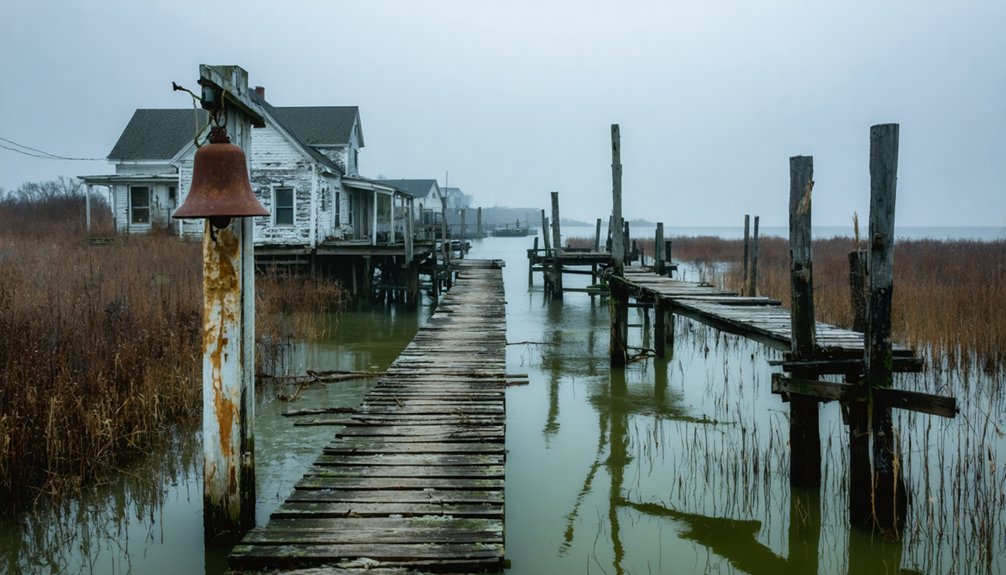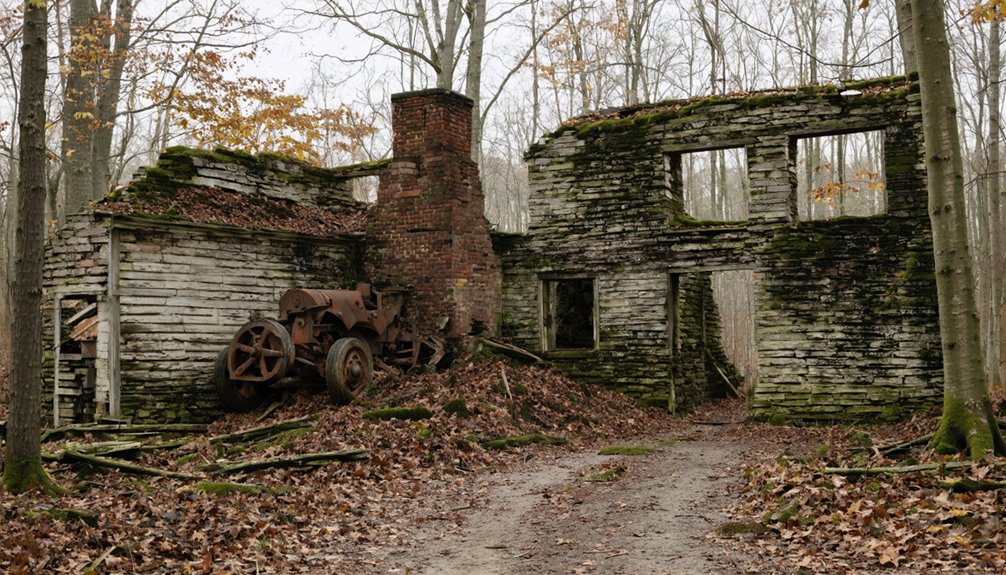
You’ll find Connecticut’s most accessible ghost town at Gay City State Park, where hiking trails wind past stone foundations and chimneys from an 1800s mill village abandoned after fires destroyed its economy. For a more haunting experience, Bara-Hack offers crumbling ruins and a cemetery from its Welsh settlement days, earning the nickname “Village of Voices” for reported paranormal phenomena. Johnsonville Village presents a preserved Victorian-era mill town frozen in time, while restricted Dudley Town carries legendary curse stories. Each site reveals the state’s fascinating industrial decline and supernatural folklore through its weathered remains.
Key Takeaways
- Gay City State Park offers accessible hiking trails, stone foundations, and an early settler cemetery open for public exploration.
- Johnsonville Village provides seasonal tours of its preserved Victorian-style buildings along the Moodus River in East Haddam.
- Bara-Hack requires permission for visits as private property but features foundations, stone walls, and an intact cemetery.
- Pleasure Beach, an abandoned 1892 amusement park, is accessible by water taxi with few remaining structures visible.
- Dudley Town is on private land with strict legal restrictions preventing public access due to preservation efforts.
Gay City State Park: A Forgotten Mill Village in the Woods
Deep in the forested hills of Hebron, Connecticut, stone foundations and crumbling chimneys mark what remains of a once-thriving 18th-century mill village that vanished into legend.
Founded in 1796 by Elijah Andrus and his Methodist congregation, Gay City flourished briefly as Factory Hollow before tragedy struck repeatedly. The wool mill burned in 1830, sparking mass exodus.
Civil War casualties left homes empty. The final paper mill fire in 1879 sealed the town’s fate. Today’s hikers discover haunted archaeology throughout the park—massive stone canals, a towering chimney stack, and cellar holes scattered among the trees. The 1,569-acre park borders the expansive Meshomasic State Forest, creating miles of interconnected wilderness trails. Visitors can reach the main ruins by following the blue trail from the main road to a footbridge near the old mill site.
The small cemetery near the entrance holds early settlers‘ graves, while urban legends persist about unsolved murders and ghostly encounters among these ruins where freedom-seeking pioneers once built their controversial distillery-centered community.
Bara-Hack: The Village of Voices and Stone Ruins
Deep in Pomfret’s Ragged Hills, you’ll find Bara-Hack, a Welsh settlement established before 1780 by Obadiah Higginbotham and Jonathan Randall.
That’s earned the chilling nickname “Village of Voices.” What began as two prosperous farms with a textile mill has dissolved into overgrown stone walls and cellar holes.
Yet visitors have reported hearing phantom children’s laughter, mothers calling, and the rumble of invisible horse-drawn wagons echoing through the abandoned cemetery. Paranormal investigators have also documented bright orbs and streaks of light appearing over the burial grounds.
The site’s transformation from thriving homestead to one of Connecticut’s most haunted locations reveals how quickly wilderness can reclaim human ambition—and how some presences refuse to leave. Writer Odell Shepard helped cement this reputation in his 1927 book, *The Harvest Of A Quiet Eye*, with his poetic description of the abandoned settlement.
Historical Settlement and Decline
Before 1780, two Welsh families carved out a settlement in Connecticut’s rugged Ragged Hills, establishing what would become one of the state’s most enigmatic ghost towns. Obadiah Higginbotham and Jonathan Randall founded Bara-Hack—Welsh for “breaking of bread”—building a thriving linen production community along Nightingale Brook.
Their Higginbotham Linen Wheels company powered flax spinning operations through an ingenious waterwheel system, while occupant stories reveal enslaved workers labored alongside family members on adjacent farms.
The settlement flourished until business decline and family deaths triggered abandonment by 1890.
Archaeological digs have uncovered two house foundations flanking the brook, barn remnants, stone walls, and a well.
Today, you’ll find the Randall-Botham Cemetery still intact, where gravestones mark residents like Dorcas, who lived to 100, preserving their forgotten legacy. The site has earned its reputation as “The Village of Voices”, with visitors reporting unexplained sounds of farm animals, horse-drawn buggies, and human voices echoing through the abandoned settlement. In 1971-72, college students led by Paul F. Eno documented mysterious bluish streaks, suspended faces, and even experienced unseen forces physically restraining investigators during their paranormal research.
Mysterious Voices and Legends
Since Bara-Hack’s abandonment in 1890, visitors have reported an unsettling phenomenon that earned the settlement its enduring nickname: the Village of Voices.
You’ll hear disembodied sounds drifting through the trees—children laughing, mothers calling, wagon wheels rumbling, and livestock lowing. These auditory phenomena persist day and night, echoing the settlement’s former bustle.
The legends of curses trace back to displaced Nipmuc people who allegedly placed a hex on the land after settlers drove them out. Elders chanted through the woods at night, attempting to frighten colonists away.
Beyond phantom sounds, visitors report visual encounters: ghostly figures in elm branches, a bearded apparition near the cemetery, and spectral children among ruins. In 1971, parapsychology students experienced such intense phenomena that one member became physically frozen and unable to move during their investigation.
The site was first settled by Welsh families around 1780, and some humorously speculate the name itself may be Welsh in origin.
Whether supernatural or psychological, Bara-Hack’s eerie reputation remains unchallenged.
Exploring the Ruins Today
Beyond the phantom voices and spectral sightings lies the tangible reality of Bara-Hack‘s physical remains, though reaching them presents significant challenges. You’ll need permission to access this private property—excessive trespassing by ghost hunters forced its closure to casual visitors.
Forest reclamation has transformed the once-thriving settlement, with towering trees now concealing former streets and fields.
What you’ll discover are stone foundations of two houses flanking the brook, barn remnants, and a surprisingly intact cemetery. The mill foundation along Nightingale Brook remains nearly undetectable, though the bridge over the former millpond still stands.
Urban decay meets wilderness here, where worked stone and pillars emerge from undergrowth. Occasionally, guided tours offer legitimate access to this hidden piece of Connecticut’s past.
Johnsonville Village: Victorian Charm Frozen in Time
Nestled along the Moodus River in East Haddam’s quiet countryside, Johnsonville Village stands as Connecticut’s most meticulously preserved ghost town—a peculiar Victorian time capsule that wasn’t actually Victorian at all.
Raymond Schmitt’s 1960s vision transported genuine Victorian architecture from across New England, assembling a stable, chapel, post office, general store, and schoolhouse into an 18th-century aesthetic that never existed here.
The original 1832 Neptune Mill and Emory Johnson’s 1846 homestead provided authentic foundations, but Schmitt’s historic preservation created something uniquely fabricated—a movie-set reality that attracted Billy Joel’s “River of Dreams” video and Hollywood productions.
After operating through 1994, the 62-acre property endured two decades of abandonment before selling for $1.85M in 2017, leaving eight antique buildings frozen between genuine history and theatrical reimagining.
The property’s eerie atmosphere has sparked persistent rumors of paranormal activity, with locals claiming sightings of restless mill workers and even Raymond Schmitt himself wandering the grounds. Following a failed auction in October where the winning bidder couldn’t close the deal, the ghost town returned to market at $2.4 million.
Dudley Town: Cornwall’s Mysterious Cursed Settlement
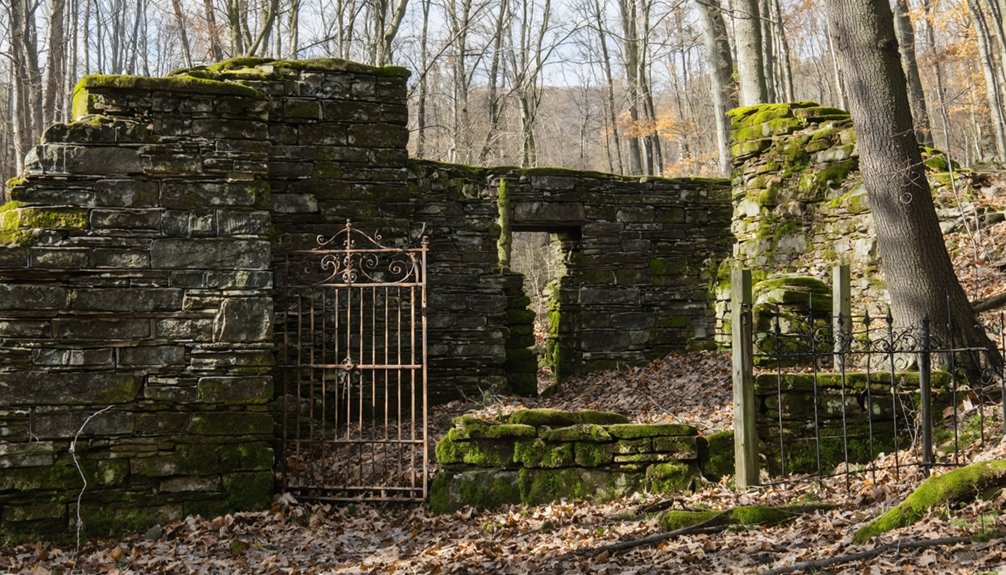
You’ll find Dudley Town shadowed by a dark legend linking its misfortunes to Edmund Dudley, executed for treason in 1509 under Henry VII—a curse his descendants allegedly carried to Cornwall’s steep hillsides.
The settlement’s residents faced relentless hardship: crops withered in unsuitable soil, mental illness plagued families, and violent deaths punctuated the community’s existence until its final abandonment by 1900.
Today, the crumbling cellar holes rest on private property patrolled by the Dark Entry Forest Association, which prosecutes trespassers seeking to explore what remains of Connecticut’s most infamous ghost town.
The Dudley Family Curse
You’ll find tales of William Tanner, who murdered Gershon Hollister in 1792. Then descended into insanity—ranting about demons and wild beasts stalking the settlement.
Locals whispered the land itself was cursed, possibly built upon sacred Mohawk ground.
Private Land Access Restrictions
Despite the enduring fascination with Dudleytown’s haunted reputation, the Dark Entry Forest Association—a private woodland corporation established in the early 20th century—has sealed off the area from public access for decades.
You’ll face serious legal restrictions if you attempt exploration. The association owns 800-900 acres and aggressively prosecutes trespassers through Connecticut State Police. Officers respond immediately to surveillance reports, photographing vehicles and making arrests.
This trespass enforcement intensified during the mid-1990s after ghost hunters vandalized ruins, spray-painted structures, and started fires. The Cornwall Historical Society can’t grant permission—only association members control access.
Property owners monitor the forest constantly, reporting suspicious activity from their cabins. Even local residents rarely receive authorization.
Your curiosity won’t override private property rights here.
Pleasure Beach: Bridgeport’s Abandoned Coastal Amusement Park
The barrier island at the mouth of Bridgeport Harbor has witnessed over a century of transformation—from pirate legend to amusement paradise to Connecticut’s most extensive modern ghost town.
You’ll discover Pleasure Beach’s story mirrors classic urban decay: what began as a thriving 1892 resort featuring Steeplechase rides and New England’s largest ballroom succumbed to economic decline after a 1957 bridge fire severed mainland access.
By the 1960s, bankruptcy consumed the park. Fires gutted the dance pavilion in 1973, while vandalism claimed the carousel and bumper cars before 2009 demolitions.
You can now visit via water taxi since 2014, though little remains of the roller coasters and 5,000-seat coliseum that once drew crowds seeking seaside freedom.
Exploring Connecticut’s Industrial Heritage Through Ghost Towns
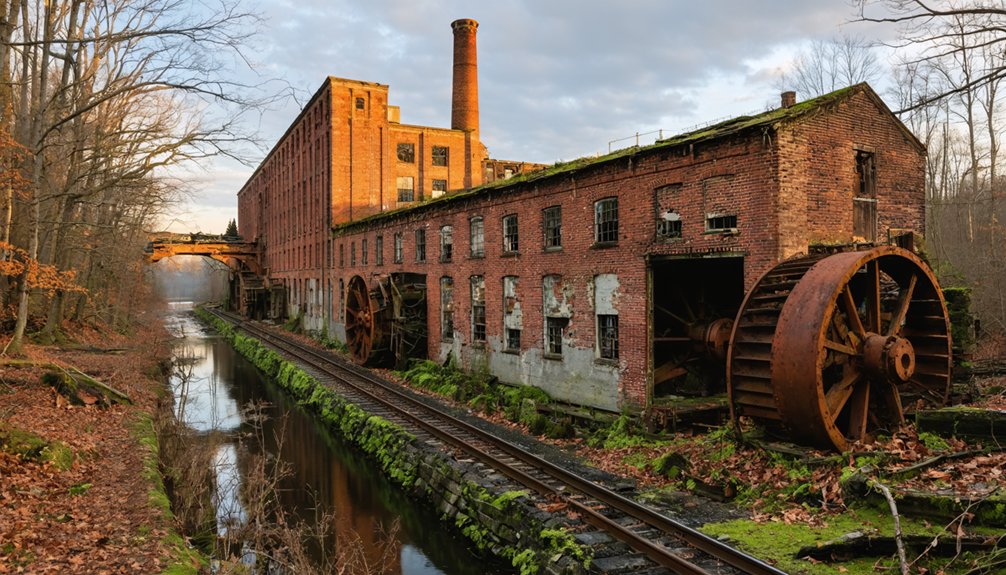
Connecticut’s industrial ghost towns stand as stone-and-mortar testimonies to the state’s transformation from manufacturing powerhouse to post-industrial landscape.
As urban centers evolved, many once-thriving communities faded into obscurity, leaving behind abandoned towns in Connecticut. These remnants tell stories of the past, drawing curiosity from adventurers and historians alike who seek to uncover the secrets of what was once a bustling era. The striking contrasts between the decaying structures and the vibrant natural landscapes create a haunting beauty in the state’s quieter corners.
Exploring abandoned spots in Connecticut’s fall reveals a unique charm as foliage transforms into a kaleidoscope of colors, accentuating the haunting beauty of these relics. Visitors often find that these locations provide a perfect backdrop for photography, where nature reclaims its space amidst the crumbling architecture. Each site, rich with history, invites reflection on the lives once lived and the stories that remain etched in the landscape.
Connecticut’s crumbling factories and abandoned mills chronicle the state’s dramatic shift from industrial dominance to economic reinvention.
You’ll discover Dayville Mills, where 200 years of textile production ended in a 2019 inferno requiring thirteen fire departments. The complex now sits untouched despite public outcry.
Industrial decline appears dramatically at Cedar Hill Rail Yard near Quinnipiac River marshes, where once-booming railroad operations lie abandoned.
Union Pond Mill’s Victorian-era structure deteriorates in modern Manchester, while Milford’s Aerosol Techniques Factory serves as an enormous graffiti gallery.
These sites face severe preservation challenges—Dayville’s roof collapsed in 2010 before fire consumed it completely, yet no cleanup plans exist.
Johnsonville Village, purchased for tourism in the 1960s, lists for $2.4 million, seeking someone willing to preserve this manufacturing heritage.
Planning Your Visit to Connecticut’s Abandoned Settlements
Before you venture into Connecticut’s abandoned settlements, you’ll need to understand that access varies dramatically across sites—from Gay City’s welcoming state park entrance with designated trails and parking areas to Dudleytown’s legally murky hiking routes through Dark Entry Forest.
Your urban exploration journey demands practical preparation: sturdy boots for overgrown paths at Bara-Hack, boat arrangements for Pleasure Beach’s water-only access, and advance booking for Johnsonville’s seasonal tours.
Spring and fall offer ideal conditions, avoiding summer’s dense vegetation and winter closures.
You’ll minimize environmental impact by following leave-no-trace principles and respecting no-trespassing zones.
Pack water, watch for poison ivy and ticks, and expect Gay City’s $15 parking fee.
Check current regulations before departing—these forgotten places require responsible adventurers who understand freedom comes with accountability.
Preservation Efforts and Historical Significance of Ghost Towns
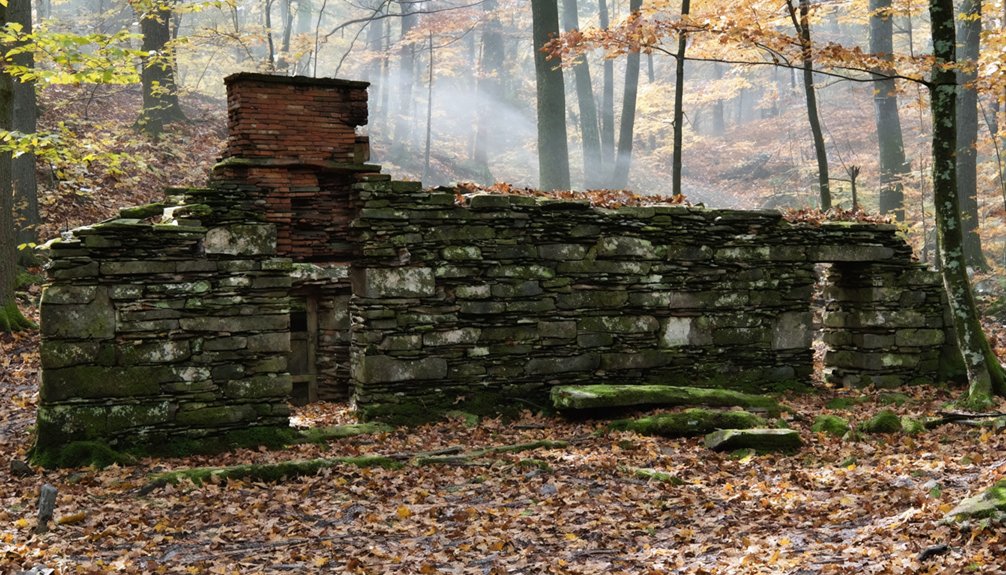
While most ghost towns fade into complete obscurity, Connecticut’s abandoned settlements have sparked an unlikely preservation movement driven by conflicting forces—vandals and protectors locked in a century-long struggle over these haunted landscapes.
The ongoing interest in ghost towns in Connecticut history has led to the discovery of forgotten tales and secrets buried within these eerie locales. As researchers delve into the past, they uncover rich narratives that highlight the lives of those who once called these places home. This renewed curiosity not only honors their memory but also ignites discussions about the impact of urban decay and restoration in modern society.
Additionally, the ghostly legends of Connecticut towns have woven themselves into the tapestry of local folklore, enriching community identity and sparking the imagination of both residents and visitors. Ghost stories often serve as cautionary tales, reminding us of the past while inviting individuals to explore the shadows of history. As these narratives continue to evolve, they play a crucial role in preserving not just the physical remnants of the past, but also the stories that give them meaning.
Connecticut’s ghost towns survive through an improbable alliance: preservationists and trespassers eternally battling over the same crumbling foundations.
Dudleytown exemplifies this tension. After philanthropists acquired the 1,924-acre site through Dark Entry Forest, Incorporated in 1924, they implemented conservation strategies reversing agricultural urban decay through aggressive reforestation.
You’ll find only cellar holes and stone foundations remain—deliberate archaeological preservation requiring constant protection.
The 1999 *Blair Witch Project* transformed everything. Dan Aykroyd’s “most haunted place on earth” declaration already drew thrill-seekers, but the film *unleashed* trespassing waves forcing complete closure.
Connecticut State Police documented escalating vandalism throughout the 1990s, proving public access incompatible with preservation.
Today, legal protections shield these sites, prioritizing archaeological integrity over visitor freedom—a controversial but effective approach ensuring Connecticut’s ghostly heritage survives.
Frequently Asked Questions
Are Connecticut Ghost Towns Safe to Visit With Children?
Your mileage may vary—some Connecticut ghost towns like Gay City State Park welcome families, but urban exploration sites with haunted legends pose structural dangers. You’ll find Johnsonville safer than Dudleytown’s restricted grounds, where trespassing risks overshadow paranormal tales.
One way to appreciate the unique history and eerie charm of these locations is by attending the annual ghost town festival in Connecticut, where local legends come alive through storytelling and guided tours. Visitors can explore vendor stalls featuring spooky crafts and enjoy live music that sets an atmospheric backdrop for the festivities. Events like these not only celebrate the haunted heritage of the state but also promote safe exploration of its ghostly past.
What’s the Best Time of Year to Explore Connecticut’s Abandoned Settlements?
You’ll find October delivers the best experience when seasonal best times align—peak foliage frames ruins beautifully, and weather considerations favor comfortable exploration. Spring’s daffodil blooms offer pleasant alternatives, while summer provides accessible year-round sites without crowds.
Do I Need Special Permits to Photograph at These Ghost Towns?
You’ll likely need permits depending on location. Photography restrictions vary—state properties require film permits and insurance, while municipal permitting requirements differ by town. Contact Connecticut’s Office of Film, Television & Digital Media at filmPermit@ct.gov before exploring.
Are Guided Tours Available for Connecticut’s Abandoned Settlements?
You’ll find guided tour availability limited for true abandoned settlements, as historical preservation efforts focus on maintained sites like Mystic and New Haven. Professional ghost tours emphasize storytelling at accessible historic locations rather than isolated ruins requiring independent exploration.
Can I Bring My Dog to Connecticut’s Ghost Town Sites?
Your four-legged explorer can only roam Gay City State Park’s pet friendly trails on leash—other ghost towns slam the door shut. Follow dog safety tips: respect posted boundaries, as trespassing on private Dudleytown or Bara-Hack lands risks fines.
References
- https://kids.kiddle.co/List_of_ghost_towns_in_Connecticut
- https://waittesinsurance.com/5-of-the-most-haunted-places-in-connecticut/
- https://www.atlasobscura.com/things-to-do/connecticut/ghost-towns
- https://www.hauntedrooms.com/connecticut/haunted-places
- https://www.youtube.com/watch?v=b7wOsjWLQDM
- https://ctvisit.com/articles/ghost-hunting-in-connecticut
- https://ghostofnewengland.com/gay-city-mill-village/
- https://en.wikipedia.org/wiki/Gay_City_State_Park
- https://boltoncthistory.org/gay-city-or-factory-hollow/
- https://www.atlasobscura.com/places/gay-city-state-park