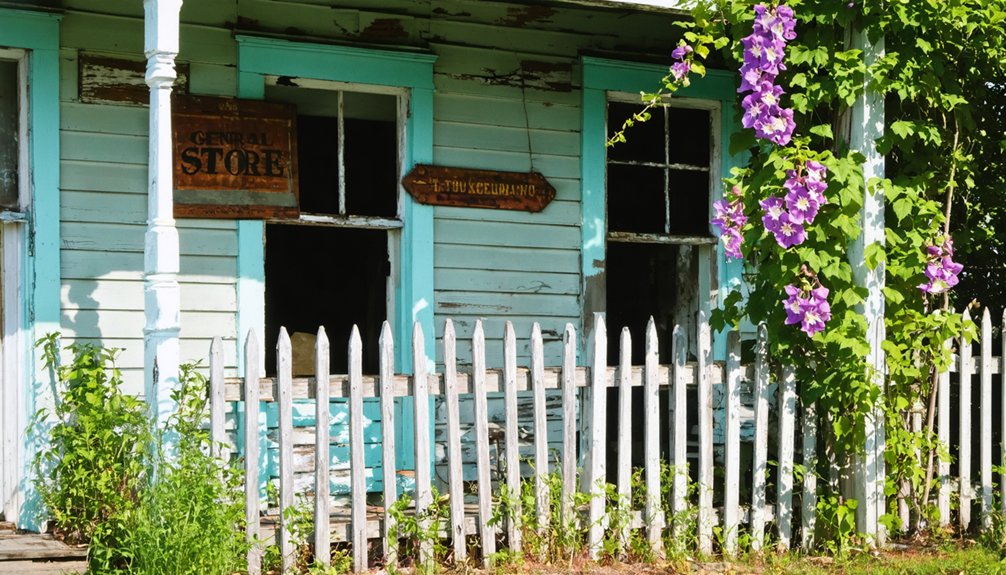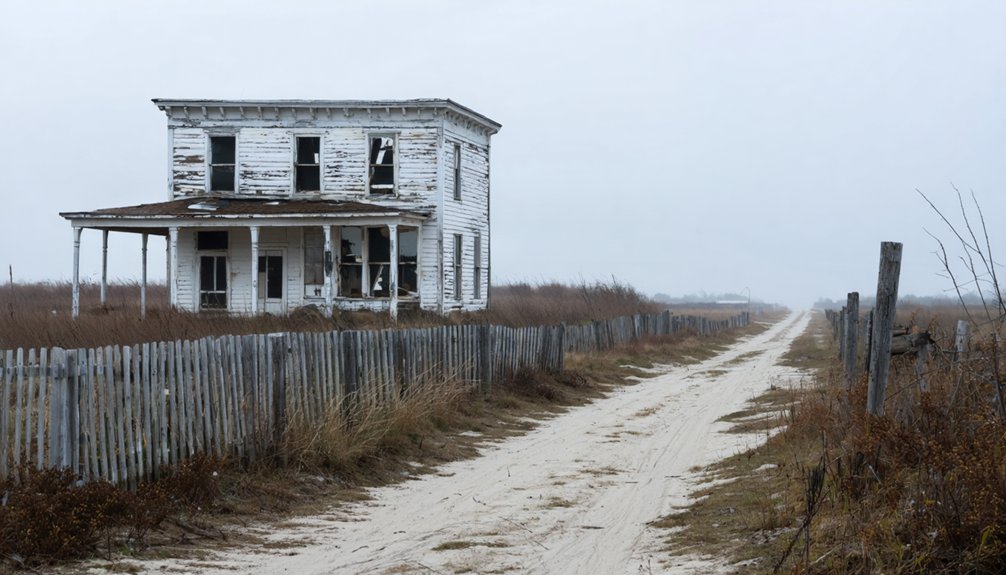
You’ll find Delaware’s ghost towns scattered across marshlands and quiet crossroads, from Fort Delaware‘s haunting Civil War fortress on Pea Patch Island to Glenville, the state’s newest ghost town wiped away by Hurricane Floyd. Owens Station near Greenwood disappeared after railroad removal, while Zwaanendael marks Delaware’s first failed European colony from 1631. Most sites require ferry access or maneuvering private properties, so contact local historical societies before exploring. These vanished communities reveal surprising stories about Delaware’s layered past and the forces that erased them.
Key Takeaways
- Fort Delaware offers ferry access to explore Civil War-era barracks, officer quarters, and haunted prison ruins on an island fortress.
- Zwaanendael Museum in Lewes commemorates Delaware’s first 1631 Dutch settlement destroyed after aboriginal conflict and cultural misunderstandings.
- Owens Station near Ellendale features Delaware’s first public shooting range where a former railroad community once housed 62 residents.
- New Market preserves a historic cemetery at Holly Tree and Reynolds Pond Roads where a vanished crossroads community once thrived.
- Visiting requires contacting historical societies, checking private property boundaries, and planning for flood-prone areas or ferry schedules.
Fort Delaware: A Haunting Military Fortress on Pea Patch Island
Rising from the Delaware River like a sentinel frozen in time, Fort Delaware commands Pea Patch Island with its imposing brick walls and angular bastions. You’ll reach this 1860 fortress via ferry, where eleven years of construction created America’s largest fort of its era.
Fort Delaware rises from the Delaware River as a monumental sentinel, its eleven-year construction creating America’s largest fortress of the 1860s era.
During the Civil War, it transformed from harbor defender to Confederate prison, holding 33,000 captives—though over 2,400 never left. Haunted legends permeate the grounds where desperate prisoners once crawled through privy holes attempting river escapes. The Immortal 600 Confederate officers were transferred to Morris Island in August 1864, marching through the sally-port in a strategic retaliation move that carried both propaganda and psychological significance.
Today’s preservation challenges haven’t dimmed the fort’s eerie atmosphere. You’re free to explore barracks, officer quarters, and those infamous outhouses during hands-on historical experiences. The ferryboat named Delafort transports visitors across the water to begin their journey into this Civil War relic.
The Delaware River breeze carries whispers of the past through this state park, where herons now outnumber ghosts.
Glenville: Delaware’s Modern Ghost Town Born From Natural Disaster
Unlike Fort Delaware’s century-old abandonment, Glenville’s transformation into a ghost town happened within your lifetime—a sobering reminder that disaster can strike even modern communities.
This New Castle County subdivision sat precariously in Red Clay Creek’s floodplain near Stanton, where residents enjoyed affordable housing within commuting distance of Wilmington.
Hurricane Floyd’s 1999 destruction proved just a preview—Tropical Storm Henri devastated the neighborhood in 2003, leaving homes with desperate painted pleas for buyers.
You’ll find nothing there now; local governments orchestrated buyouts and relocated families to safer ground by 2004.
The subsequent demolition erased all traces of urban decay, prioritizing environmental resilience over rebuilding in flood-prone territory.
It’s Delaware’s newest ghost town—one born from nature’s unforgiving power rather than economic collapse. The 2003 flood swallowed this 20th-century housing development, leaving only memories where a thriving community once stood. The community’s story serves as serious discussion material on how natural disasters reshape landscapes and force difficult policy decisions about rebuilding versus relocation.
Owens Station: A Forgotten Relic in Sussex County
If you’re searching for Owens Station between Ellendale and Greenwood, you’ll find nothing but empty fields where a thriving railroad community once stood.
This vanished Sussex County town emerged in the late 19th century as a stop on the Queen Anne Railroad, serving local farmers and traders before disappearing completely when the line shut down.
Unlike ghost towns out West with their weathered saloons and storefronts, Owens Station left no buildings, no cemetery markers, not even a historical plaque—just old postcards and faded records proving it ever existed. About a mile east of Ellendale lies New Market, another lost settlement where only a small cemetery and mobile-home community remain as evidence of the 18th-century community that once supported a church and active congregation. Similar to other abandoned mining towns, these Delaware ghost towns show how economic decline can erase entire communities from the landscape.
History of Owens Station
Tucked away in the rural flatlands of Sussex County, where Beach Highway intersects with Owens Road along Delaware Route 16, you’ll find what remains of Owens—a community that once thrived as Owens Station.
This settlement’s railroad history began as a crucial stop on the Queen Anne’s Railroad, connecting Ellendale and Greenwood. By 1902, maps officially marked it as Owens Station, supporting a modest population of 18 residents in 1900 that grew to 62 by 1925.
However, when the railroad became defunct and tracks were removed, this industrial heritage vanished with them. The land returned to its original owners, and the community faded into obscurity. Today, the area near Greenwood has been repurposed as a 104-acre recreational facility that includes Delaware’s first state-owned public shooting range and sporting clays course.
What started as a promising rail stop transformed into simply “Owens,” embodying Delaware’s forgotten railway era.
Visiting the Abandoned Site
Today, finding Owens Station requires maneuvering to the intersection of Beach Highway and Owens Road along Delaware Route 16, east of Greenwood in Sussex County. You’ll discover scattered houses where a town of 62 once thrived, though most structures vanished after the railroad’s removal.
The urban decay here whispers rather than shouts—subtle traces of hidden histories embedded in the landscape at 38.80556°N, 75.52611°W. These GPS coordinates provide precise location data for navigation and mapping to this forgotten settlement.
Don’t expect dramatic ruins. Instead, you’ll find the Owens Station Shooting Sports and Hunter Education Center at 12613 Hunters Cove Rd, where sporting clays echo across former rail corridors. The venue operates as Owens Station Sporting Clays, offering regular shoots with updates distributed through their mailing list.
It’s an unexpected transformation—a ghost town reborn as recreation space. The preserve’s name honors the vanished community, connecting you to Delaware’s forgotten railroad era while offering genuine freedom to explore.
Saint Johnstown: Echoes of a Vanished Sussex County Settlement
Deep in Sussex County’s rural landscape, Saint Johnstown once thrived as a modest settlement along the Queen Anne’s Railroad, positioned between the stations of Ellendale and Greenwood at an elevation of 52 feet.
Saint Johnstown flourished as a railroad settlement in Sussex County’s countryside, nestled between Ellendale and Greenwood at 52 feet elevation.
Unlike medieval architecture that endures centuries, this railroad community vanished completely when the tracks were pulled and land returned to its owners. Methodist pioneer Francis Asbury established the area’s spiritual foundation in 1779.
But the railroad’s demise proved fatal to settlement survival—similar to how coastal erosion reclaims shorelines. You’ll find no structures standing today, just historical markers commemorating the Methodist site. The present church structure, built in 1872, replaced the original 1780 worship house that had served the community for nearly a century.
The ghost town exists purely in archival records and Delaware’s collective memory, a reminder that communities built on single industries often disappear as thoroughly as morning fog.
New Market: Where a Once-Thriving Community Faded Away
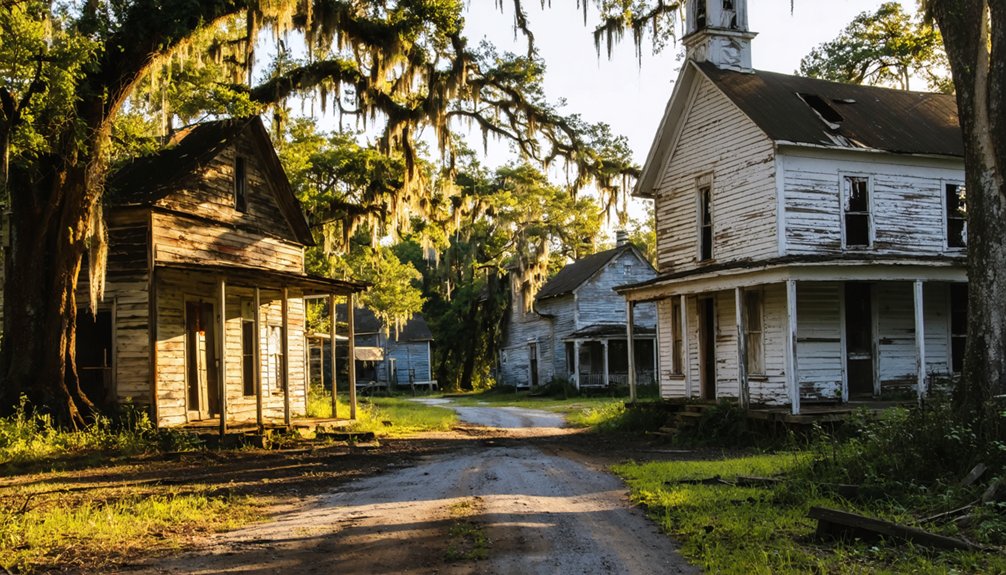
You’ll find New Market nestled at the crossroads of Holly Tree Road and Reynolds Pond Road, where a community once gathered around its church before fading into Delaware’s farmland.
The settlement’s complete disappearance leaves only its cemetery as proof that families lived, worshipped, and built their lives here between Ellendale and Milton.
Today, when you stand among the weathered gravestones—some marking victims of Native American attacks—you’re experiencing the sole physical connection to a town that vanished so thoroughly that even its structures have returned to dust.
New Market’s Early Days
Between the established communities of Ellendale and Milton, New Market took root in Sussex County as a small settlement that would center its entire existence around a single crossroads.
You’ll find that Holly Tree Road and Reynolds Pond Road mark where this community once thrived, built around the New Market Church that defined everything here.
The church’s story reflects the settlers’ determination—starting as a makeshift gathering space in the woods before they constructed a proper building.
By 1872, they’d built a larger structure, proving their commitment to permanence.
These historical landmarks served as more than worship spaces; they anchored the town’s identity and social fabric.
Today, only the cemetery remains as confirmation to this community legacy, preserving stories of residents who carved out their lives at this forgotten crossroads.
Signs of Decline
Yet the Methodist church thrived through the 1880s, expanding twice to accommodate its fervent congregation.
Cemetery additions in 1858 and 1903 marked growth even as economic significance drained away.
This paradox—spiritual life flourishing while commercial existence withered—defined New Market’s peculiar descent into abandonment.
What Remains Today
At the crossroads where Holly Tree Road meets Reynolds Pond Road, you’ll find yourself standing at what once was New Market’s beating heart. Today, there’s barely anything left to explore. The church that anchored this community has vanished, leaving only its cemetery as evidence a town existed here. No historic preservation efforts saved the original structures, and archaeological excavation hasn’t been conducted to uncover what lies beneath.
What you’ll discover at this Sussex County site:
- The churchyard cemetery – gravestones marking generations of residents
- Ranch homes – modern construction replacing historic buildings
- New Market Village – a trailer park quarter-mile east maintaining the town’s name
The landscape’s been completely transformed, offering freedom-seekers little beyond cemetery headstones and rural Delaware countryside.
Zwaanendael: Delaware’s First Failed European Colony
Long before Delaware earned its nickname as “The First State,” a Dutch colony named Zwaanendael—meaning “Valley of the Swans”—stood at the mouth of Lewes Creek for barely a year before vanishing in violence.
You’ll find nothing left of the 1631 settlement where 32 men pursued colonial ambitions of whaling and tobacco farming. Their palisade and buildings burned after aboriginal encounters turned deadly—cultural misunderstandings sparked by leader Gilles Hossitt’s harsh reactions to the Lenape people ignited the massacre.
Today, you can explore the story at Zwaanendael Museum in Lewes, built in 1931 to commemorate this doomed venture. The distinctive building, modeled after Hoorn’s town hall, stands where Dutch settlers briefly claimed territory before their experiment ended in ashes and bloodshed.
What Makes Delaware’s Ghost Towns Unique
Delaware’s ghost towns defy the classic Western imagery of tumbleweeds and sun-bleached saloons. Instead, you’ll discover a haunting blend of colonial tragedy and economic collapse that creates its own distinct atmosphere.
What sets Delaware’s abandoned settlements apart:
- Violent colonial beginnings – Zwaanendael’s complete massacre in 1631 established Delaware’s dark pattern of settlement failure.
- Cultural heritage layered through centuries – From Lenape villages to Dutch colonies to failed canal towns, each era left ghostly imprints.
- Urban decay hidden in plain sight – Scattered foundations along highways and overgrown homesteads blend seamlessly into modern landscapes.
You won’t find dramatic ruins here. Delaware’s ghost towns whisper their stories through preserved 18th-century structures, forgotten canal streets, and lone buildings standing sentinel over what-might-have-been.
It’s abandonment with an East Coast accent.
Planning Your Ghost Town Adventure in Delaware
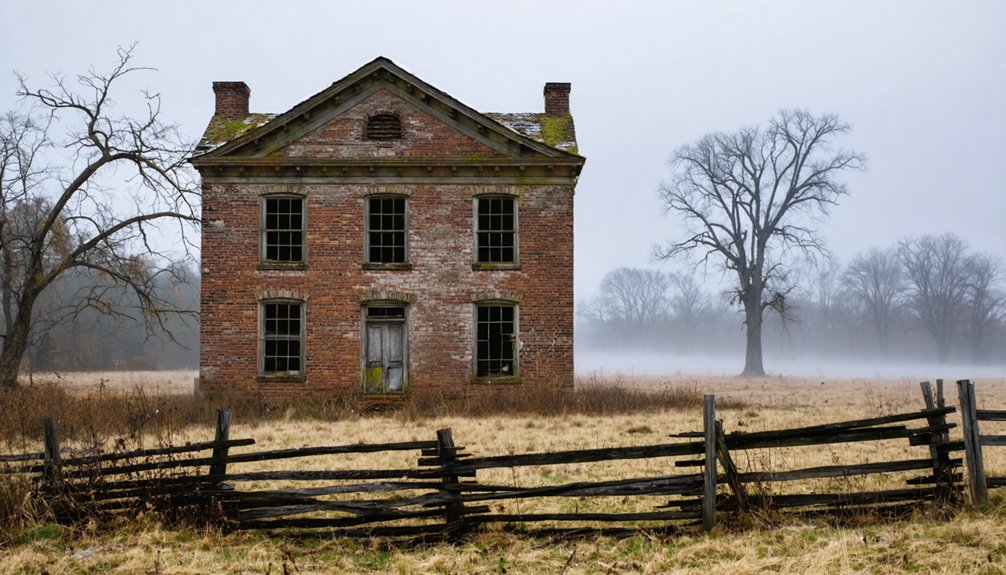
Before you load your camera and lace up your boots, understand that exploring Delaware’s ghost towns demands more preparation than chasing Western ruins. You’ll navigate private property at Nemours, coordinate ferry logistics to Pea Patch Island’s Fort Delaware, and time visits around flood-prone areas like Glenville—Hurricane Floyd’s 1999 devastation still haunts those lowlands.
Contact local historical societies before trekking to scattered sites along SH 227 or Deep Creek’s Old Furnace remnants. Urban legends swirl around these abandoned crossroads, whispered tales locals guard fiercely. Pack binoculars for bird watching along Delaware River approaches—herons stalk the marshes where settlements once thrived.
Study aerial photos, verify National Register sites like Allee House accept visitors, and respect boundary markers. Freedom means responsibility here.
Preservation Efforts and Historical Significance of Delaware’s Abandoned Places
When Abraham Allee laid brick upon brick around 1753 in Kent County, he couldn’t have imagined his two-story plantation house would outlast the settlement that surrounded it.
You’ll find Delaware’s abandoned places now protected through dedicated cultural heritage preservation efforts, with the Allee House restored in 1966 and added to the National Register in 1971.
These sites preserve stories through archeological excavations and careful documentation:
- Fort Delaware transformed from Confederate prison (2,500 deaths) into a state park protecting maritime history
- Zwaanendael’s ruins mark Delaware’s first European settlement destroyed in 1631
- Delaware City’s 19th-century homes maintain generational narratives of frontier life
You’re witnessing living museums where freedom’s price echoes through weathered walls and forgotten foundations.
Frequently Asked Questions
Are Delaware’s Ghost Towns Safe to Explore on Your Own?
You’ll face serious risks exploring Delaware’s ghost towns alone. Trespassing regulations protect most sites, while crumbling structures pose real dangers. Local folklore romanticizes these places, but you’re better off joining guided tours where you’ll safely experience authentic history without legal consequences.
What’s the Best Time of Year to Visit Delaware Ghost Towns?
You’ll find fall’s your sweet spot—crisp October air enhances ghost tours while historical preservation efforts shine through seasonal programs. Cooler temperatures mean comfortable wildlife encounters, fewer crowds grant you freedom to roam, and paranormal events peak during autumn weekends.
Do You Need Permission to Enter Abandoned Buildings in Delaware?
Yes, you’ll need permission before entering Delaware’s abandoned buildings. Trespassing laws apply regardless of abandonment status, with fines reaching $575. Owner consent protects you legally, though some state-managed sites like Fort Miles offer public access without special authorization.
Can You Camp Overnight Near Delaware’s Ghost Town Locations?
You’ll find overnight camping near Delaware’s ghost town locations at several state parks with haunted attractions. Camping regulations permit stays at Fort Delaware, Lums Pond, and Cape Henlopen, where you can explore paranormal sites and abandoned areas firsthand.
Are There Guided Tour Companies Specializing in Delaware Ghost Towns?
While Delaware offers several ghost *tours* featuring haunted locations, you won’t find companies specifically devoted to abandoned ghost *towns*. Historical preservation groups occasionally offer guided exploration of former settlements, but these opportunities remain rare and typically require advance arrangements.
If you’re interested in unique adventures, consider visiting some ghost towns to explore in Delaware. These areas provide a glimpse into the past, showcasing remnants of lives once lived and stories waiting to be uncovered. While exploring, keep an eye out for local wildlife that has begun to reclaim these forgotten places.
References
- http://freepages.rootsweb.com/~gtusa/history/usa/de.htm
- https://kids.kiddle.co/List_of_ghost_towns_in_Delaware
- https://www.youtube.com/watch?v=ex8Hld_imPU
- https://www.geotab.com/ghost-towns/
- https://www.farmweddingde.com/wedding-blog/haunted-history-in-delaware-city-tourism-in-the-first-state
- https://travelswithabandon.com/2018/08/22/adventure-10-cliff-phoenix-delaware-mandan/
- https://www.onlyinyourstate.com/experiences/delaware/abandoned-places-delaware
- https://www.youtube.com/watch?v=0UAkxBOSLhs
- https://delawarestateparks.blog/2020/05/04/history-of-pea-patch-island/
- https://en.wikipedia.org/wiki/Fort_Delaware