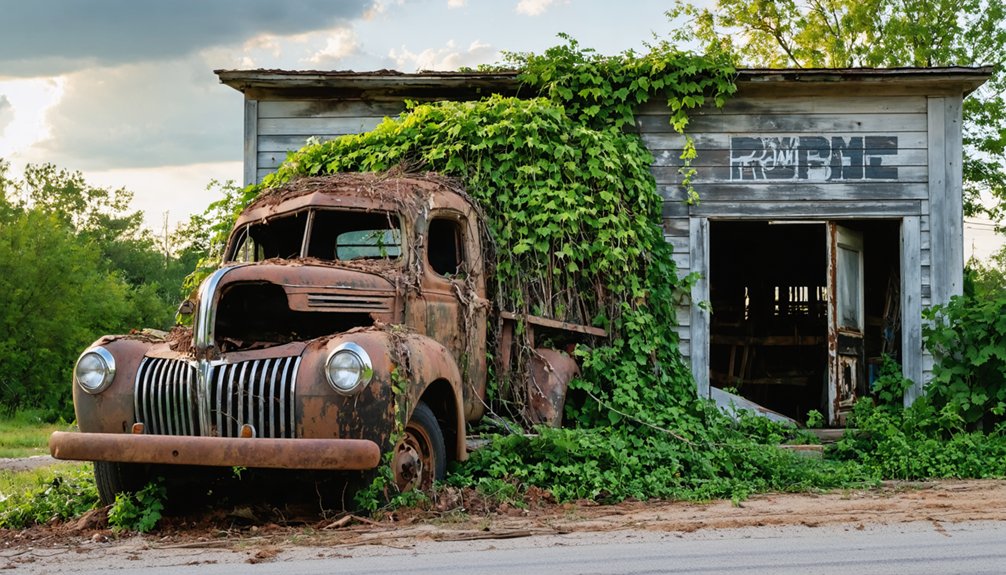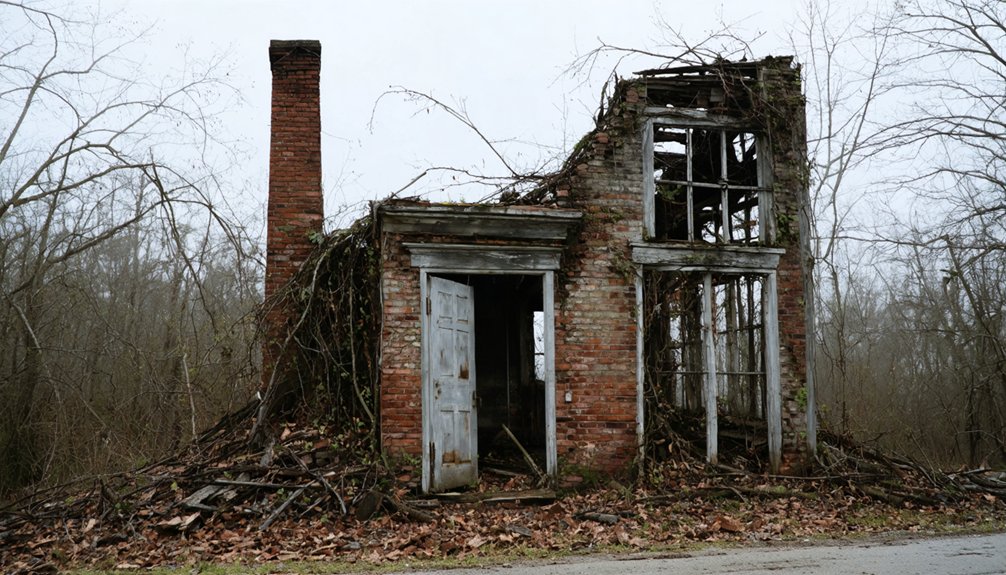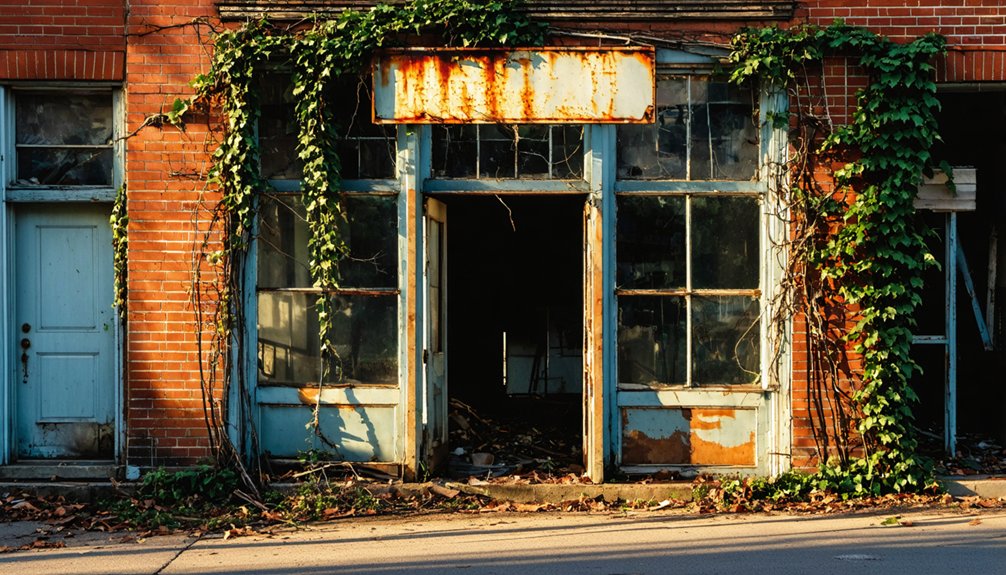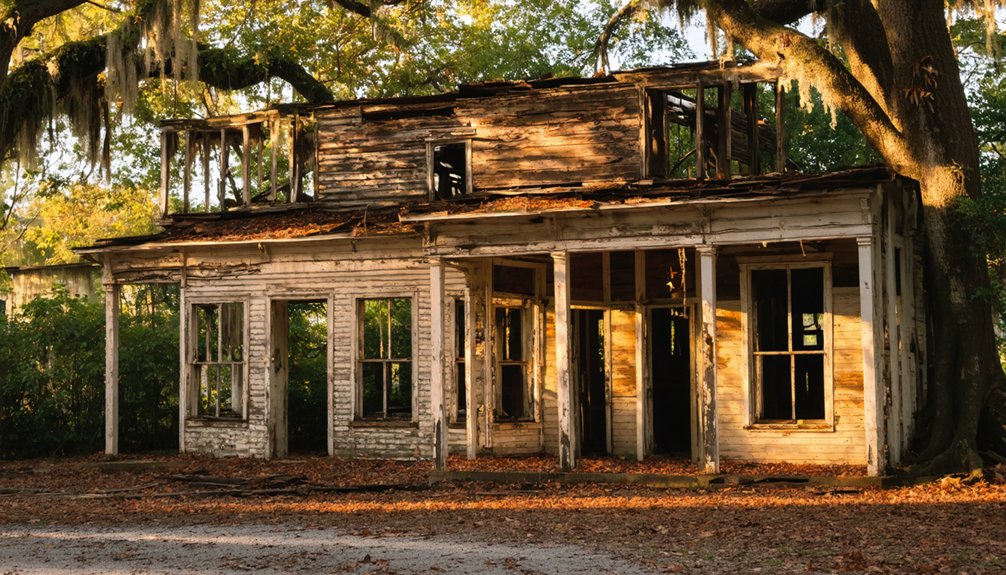
You’ll find Alabama’s most atmospheric ghost towns perfect for fall exploration, from Old Cahawba’s haunting columns where the state’s first capital once thrived, to Blakeley’s well-preserved Civil War earthworks spanning 2,100 acres. The season’s cooler temperatures and dramatic afternoon light enhance visits to Arcola’s French settlement ruins, Battelle’s abandoned mining structures, and Bellefonte’s pioneer cemetery. Fall foliage frames crumbling foundations and overgrown trails, while guided paranormal tours combine historical storytelling with seasonal ambiance, revealing the darker chapters hidden beneath Alabama’s Spanish moss and autumn leaves.
Key Takeaways
- Old Cahawba offers Alabama’s first capital with Crocheron mansion columns, Civil War prison history, and Mississippian archaeological sites.
- Blakeley State Park features preserved Civil War earthworks, Confederate redoubts, and night ghost hunts with paranormal equipment for $20.
- Arcola showcases French Bonapartist settlement ruins including foundation stones, gravestones, and a solitary inn chimney near Demopolis.
- Fall provides optimal lighting, cool weather, and colorful foliage that enhance shadows and atmospheric exploration of ghost towns.
- Battelle reveals DeKalb County’s abandoned mining town with scattered bricks, foundations, and structures accessed through rugged forest trails.
Old Cahawba: Alabama’s First Capital and Most Haunted Location
Nestled at the confluence of the Alabama and Cahaba Rivers, Old Cahawba rises from the mist as Alabama’s most haunted ghost town—a place where the state’s political ambitions first took root in 1818.
Where rivers meet and ambitions once flourished, Alabama’s first capital now stands as a monument to dreams reclaimed by wilderness.
You’ll walk streets where speculators once turned $1.25 acres into $70 fortunes, where 3,000 souls traded cotton before war and floods swept it all away.
Archaeological discoveries reveal you’re treading sacred ground—a Mississippian village that thrived centuries before politicians arrived.
Native American legends whisper of “Maubila,” possibly located here, where defensive walls and ceremonial mounds once stood.
By 1860, the railroad’s arrival transformed Cahawba into a bustling town of 2,000 residents, with grand Greek Revival mansions rising along tree-named streets.
During the Civil War, Castle Morgan prison held thousands of Union soldiers in overcrowded, disease-ridden conditions within a converted cotton warehouse.
Today, Crocheron mansion’s lonely columns mark where Confederate soldiers drew their last breaths.
The freedmen who remained until 1880 knew what you’ll discover: some places refuse to fade completely into history’s shadows.
Bellefonte Cemetery: A Preserved Testament to Pioneer Heritage
Where Jackson County’s first courthouse once dispensed frontier justice, only weathered tombstones now stand guard over Bellefonte’s vanished dreams. This former county seat, incorporated in 1821, thrived until Scottsboro claimed its prosperity in 1868. Today, you’ll discover Alabama’s frontier legacy through cemetery restoration efforts at this Alabama Historic Cemetery Register site.
What awaits your exploration:
- Gravestones dating to 1826 marking pioneer families who carved civilization from wilderness
- Elevated burial ground positioned to lift souls heavenward
- Scattered brick remnants and lone chimney testimony to vanished civilization
- Historic preservation challenges from weathering, vandalism, and encroaching vegetation
- Strategic location near Cherokee removal routes revealing darker historical chapters
While overgrowth complicates navigation and nuclear facility development has altered the landscape, Bellefonte Cemetery remains your gateway to experiencing Alabama’s untamed past. The site contains 155 memorials recorded, with nearly half featuring photographs that document these pioneer graves. The site serves as a hub for multiple historical references bearing the Bellefonte name across different time periods and locations.
Spectre Village: A Charming Film Set Turned Tourist Attraction
Unlike Bellefonte’s authentic pioneer graves, Alabama’s most visited ghost town never housed a single resident—because it sprang to life purely for Hollywood’s cameras.
Alabama’s most famous ghost town exists only because of a movie—no pioneers, no history, just pure Hollywood illusion.
You’ll discover Spectre Village on Jackson Lake Island, where Tim Burton constructed fantasy landscapes for his 2003 film *Big Fish*. The enchanted setting features hollow storefronts, a leaning chapel, and Spanish moss-draped live oaks creating Southern Gothic atmosphere.
Movie magic lingers through visitor-added shoes hanging at the entrance and friendly goats roaming deteriorating structures.
You’ll pay just $3 to explore this cinematic relic during daylight hours, wandering dirt roads past peeling paint and collapsed roofs—exactly the atmospheric decay Burton envisioned. The island itself was formed in the 1970s after construction of the Robert F. Henry Lock & Dam flooded the area upstream of the Alabama River.
Two original styrofoam forest trees still stand after seventeen years, while reports of mysterious footsteps add genuine eeriness to fabricated history. Visitors also describe camera malfunctions and shadowy figures near the deteriorating church structure, particularly when the atmosphere grows heavy beyond the entrance gate.
Arcola: Hidden Ruins Along Alabama’s Historic Routes
Along the quiet banks of the Black Warrior River, you’ll discover Arcola’s crumbling foundations—remnants of a once-thriving French Bonapartist settlement that peaked in the 1830s before vanishing into Alabama’s plantation landscape.
To reach this hidden site, follow historic routes 4.5 miles northeast of Demopolis, where overgrown trails and forgotten river landings mark what was once the largest community in the Vine and Olive Colony.
Though few stone structures remain from its brief existence between the 1820s and 1850s, the site’s atmospheric riverside location offers an evocative glimpse into Alabama’s forgotten colonial past. The town’s name honors the Battle of Arcola, a French military victory that resonated with its early settlers. The Hatch Plantation’s main house, constructed in 1856 by Alfred Parker Hatch on his 3,000-acre property, still stands as a testament to the era when American settlers transformed the French colony into a network of adjoining plantations.
Arcola’s Forgotten Railroad Legacy
Deep in Alabama’s Hale County, the ghost town of Arcola whispers tales of French pioneers and vanished prosperity along the Black Warrior River.
Railroad expansion transformed this 1820s French settlement from a thriving river commerce hub to forgotten ruins. You’ll discover how steel rails strangled waterborne trade, leaving Arcola’s French heritage buried beneath decades of vegetation.
What You’ll Find:
- Deteriorated railroad tracks marking the route that killed river-based prosperity
- French gravestones hidden among overgrown brush
- Artifacts spanning 1920s-1940s scattered throughout abandoned structures
- Trees consuming equipment left behind 30-40+ years ago
- Pottery shards and bottles revealing glimpses of daily life
The irony cuts deep—railroads that promised progress instead delivered abandonment. Cotton trade shifted elsewhere, population dwindled, and Frederic Ravesies’ original settlement vanished into Alabama wilderness. Arcola’s location on the Black Warrior River once made it a vital trading post before the waterways lost importance. The remote setting today creates a chilling atmosphere that emphasizes the town’s haunted past.
Exploring Remaining Stone Structures
When you venture beyond Arcola’s overgrown pathways, remnants of hand-hewn stone structures emerge from the wilderness—silent witnesses to layers of forgotten history. You’ll discover a remote bridge crossing the creek, constructed entirely from local rocks that once controlled water flow for the vanished settlement.
These ancient markers predate the 1820s French colony, possibly connecting to mysterious earthwork embankments discovered in 1817. A solitary chimney from the town’s inn stands defiant against time, while foundation stones lie scattered beneath encroaching trees.
The stone circle patterns suggest deliberate construction, their origins lost between Spanish-French conflicts and Native American occupation. Without modern markers guiding your path, you’re free to trace these hidden ruins along historic routes where bass swim in forgotten waters.
Best Access Routes Today
Your exploration of Arcola’s stone relics leads naturally to the practical challenge of reaching this secluded riverside ghost town. Located along a Black Warrior River bend in Hale County, Arcola demands determination from modern adventurers seeking its atmospheric remnants.
Navigate these access considerations:
- River access via the Black Warrior provides the most authentic historic route, following paths once traveled by French colonists and cotton traders.
- Secondary rural roads branching from Hale County highways lead toward the former Hatch Plantation area.
- Hidden pathways wind through dense overgrowth requiring sturdy boots and careful navigation.
- Dirt tracks mark former plantation routes, now largely reclaimed by Alabama wilderness.
- Proximity to historic Marengo County boundaries helps orient your approach through brush-covered landscape.
- Nine Confederate redoubts connected by miles of earthworks, protected by wide ditches and steep walls
- Three progressive Union siege lines stretching four miles, some positions just 400 yards from enemy fortifications
- Bombproofs where Confederate defenders sheltered from relentless artillery barrages
- The assault route where 16,000 Union troops, including 5,000 U.S. Colored Troops, stormed Confederate positions
- Engineering marvels demonstrating military strategy during the war’s final days
- Three-mile Confederate fortifications with intact redoubts emerging from towering oaks
- Original town cemetery (1815-1818) containing yellow fever mass graves
- Scattered brick foundations marking vanished homes along forest-reclaimed streets
- Union and Confederate breastworks threading through unspoiled wilderness
- Jail ruins where Confederate soldiers allegedly escaped toward the river
- Old Cahawka’s annual Haunted History Tour features paranormal investigations at Barker House’s former slave quarters
- Huntsville Ghost Walks traverse Twickenham’s antebellum homes starting September 2025
- Florence’s flagship downtown tour reveals hidden courtyards after 20 years of operation
- Birmingham tours explore haunted inns like Tutwiler Hotel alongside Native American displacement sites
- Fort Morgan After Dark offers 40-55 minute investigations from $45
- Ghost hunts at Historic Blakeley State Park with EMF meters and dowsing rods exploring the abandoned town ($20, 7-10PM)
- Orrville Haunted History Tours shuttling through the ghost town’s most spiritually active locations
- Pumpkin picking at nearby farms like Gullion Farms and Tate Farms after exploring ruins
- Florence Renaissance Faire at Wilson Park featuring medieval atmosphere
- Haunted History of the Shoals Ghost Walk connecting abandoned sites with chilling local legends
- https://bhamnow.com/2025/10/13/fall-in-alabamas-oldest-city-mobile/
- https://www.visitflorenceal.com/blog/shoals-fall-bucket-list/
- https://alabamabucketlist.com/ghost-towns-in-alabama/
- https://www.alabamahauntedhouses.com/fall-attractions/
- https://www.huntsville.org/events/festivals/fall-annual-events/huntsville-ghost-walks/
- https://www.blackbeltnewsnetwork.com/news/old-cahawba-on-list-of-most-haunted-places-to-visit-in-fall/article_c4e28144-4ab7-5804-9ec5-4eb6aeb019f8.html
- https://www.ezhomesearch.com/blog/11-ghost-towns-in-alabama-that-bridge-the-distance-between-yesterday-and-today/
- https://www.abandonedalabama.com
- https://www.abandonedalabama.com/old-cahawba/
- https://theforgottensouth.com/cahawba-alabama-ghost-town/
Prepare for remote terrain where autumn colors frame forgotten gravestones and crumbling plantation walls.
Blakeley: A Civil War Era Settlement Frozen in Time
You’ll discover Alabama’s most haunting battlefield at Historic Blakeley State Park, where 2,100 acres preserve the site of the Civil War’s final major engagement.
Walk the best-preserved earthworks in the Deep South, where nine Confederate redoubts still scar the landscape exactly as they stood when 16,000 Union soldiers overwhelmed the fort on April 9, 1865.
The ruins whisper stories through crumbling cemetery headstones, jailhouse foundations, and ancient oaks that witnessed both the town’s yellow fever devastation and its violent end as a military stronghold.
Historic Battlefield and Fortifications
While autumn leaves drift through massive earthen fortifications, Blakeley stands as Alabama’s most remarkably preserved Civil War battlefield—a 2,100-acre time capsule where the war’s final major engagement unfolded on April 9, 1865.
You’ll explore authentic Civil War tactics through remarkably intact fortifications:
Thanks to battlefield preservation efforts protecting over 3,800 acres, you’ll walk the same ground where history’s pivot point occurred—the same day Lee surrendered at Appomattox.
Archaeological Remains and Artifacts
Beyond the impressive Civil War fortifications, Blakeley’s archaeological layers reveal 10,000 years of human occupation—from Archaic period hunters to Mississippian villages, colonial homesteads to antebellum streets now traced only by towering oaks.
You’ll discover underground chambers where yellow fever victims found mass burial during the devastating 1822-1828 epidemics. The cemetery’s overgrown graves tell haunting stories of a population that plummeted from 4,000 to mere hundreds.
Woodland and Mississippian artifacts emerge from soil layers beneath colonial remnants, while prehistoric carvings mark ancient territorial boundaries. The jailhouse ruins stand as tangible remnants alongside dismantled building foundations.
Walk these tree-lined street outlines where personal effects abandoned during the 1860s exodus still surface—evidence of lives interrupted by disease, war, and economic collapse that transformed this once-thriving county seat into Alabama’s most archaeologically rich ghost town.
Natural Trails Through Ruins
At Historic Blakeley State Park, 2,100 acres of walking trails transport you through America’s largest National Register Historic Site east of the Mississippi—where nature has woven itself into the fabric of ruins.
These pathways showcase exceptional native plant diversity while trail maintenance techniques preserve both Civil War earthworks and ecological integrity. You’ll discover:
Each trail reveals layers of history—from 4,000 years of Native American occupation to 1865’s final Alabama battle—all preserved through careful stewardship that lets you explore unhindered.
Battelle: Remnants of a Once-Thriving Community
Deep in the forests of DeKalb County, nature has swallowed nearly every trace of Battelle, a once-bustling mining community that thrived at the turn of the 20th century.
Founded by Colonel John Gordon Battelle’s mining company, this settlement contained hundreds of houses, a school, commissary, and sophisticated water systems. When mineral deposits proved insufficient to compete with Birmingham’s mines, the furnace shut down in 1905.
The British government eventually dismantled it during World War I.
Today, wilderness reclamation has transformed these industrial ruins into a hidden adventure.
You’ll find scattered bricks, rotted lumber piles, and two roofless structures among persistent rosebushes and jonquils.
Located five miles north of Valley Head, reaching Battelle requires determination—a bumpy drive followed by hiking through reclaimed forest where freedom-seekers discover Alabama’s forgotten past.
Haunted History Tours Across Alabama’s Cities
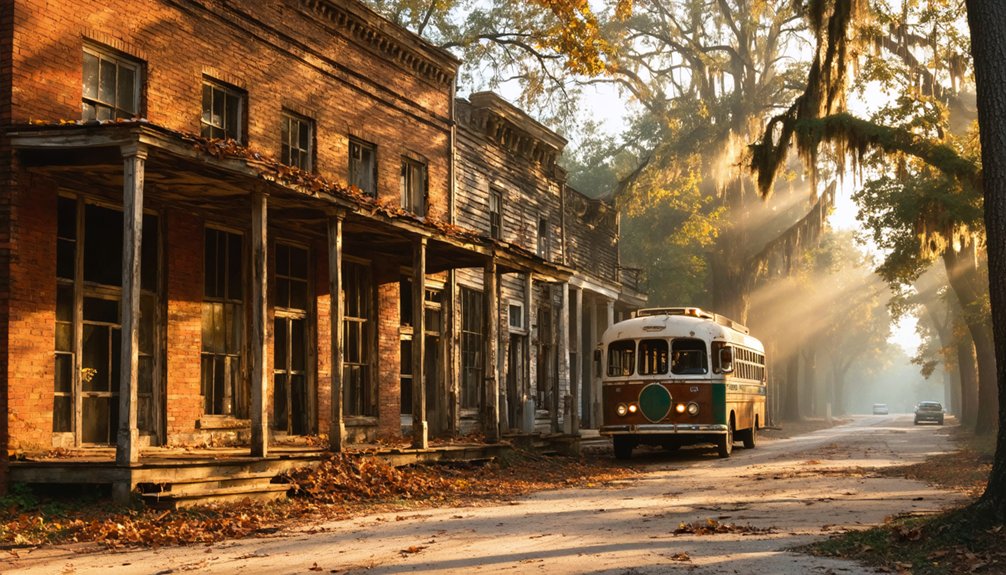
While abandoned ghost towns offer solitary exploration through Alabama’s forgotten past, the state’s living cities preserve equally haunting histories through guided nocturnal tours that bring spectral tales to life.
As you venture into the heart of Alabama, exploring ghost towns in Alabama reveals remnants of a bygone era where echoes of the past still linger. Each decayed structure tells a story, inviting adventurers to uncover the mysteries that shaped these once-thriving communities. Paired with the eerie allure of nightfall, the experience becomes a haunting narrative of history etched into the landscape.
In the crisp air of the season, the haunting beauty of autumn colors in Alabama ghost towns enhances the atmosphere, transforming these forgotten places into a canvas of vibrant hues. As leaves fall and the landscape shifts, each corner of these towns seems to whisper the stories of those who once called them home. This seasonal backdrop not only amplifies the sense of solitude but also invites deeper reflection on the transient nature of life and history.
From Birmingham’s Sloss Furnaces to Mobile’s shadowy streets, you’ll discover urban legends woven through centuries of tragedy and triumph. These experiences connect you with stories that official histories often overlook:
These guided tours illuminate the darker chapters of Alabama’s history that textbooks deliberately omitted or carefully rewrote.
Each journey *reveal* the South’s complex past without sanitization.
Best Time to Visit Alabama’s Ghost Towns
Plan efficient half-day itineraries when the afternoon light casts dramatic shadows across archaeological sites, creating atmospheres that summer’s harsh glare simply can’t match.
Fall Activities Near Alabama’s Abandoned Settlements
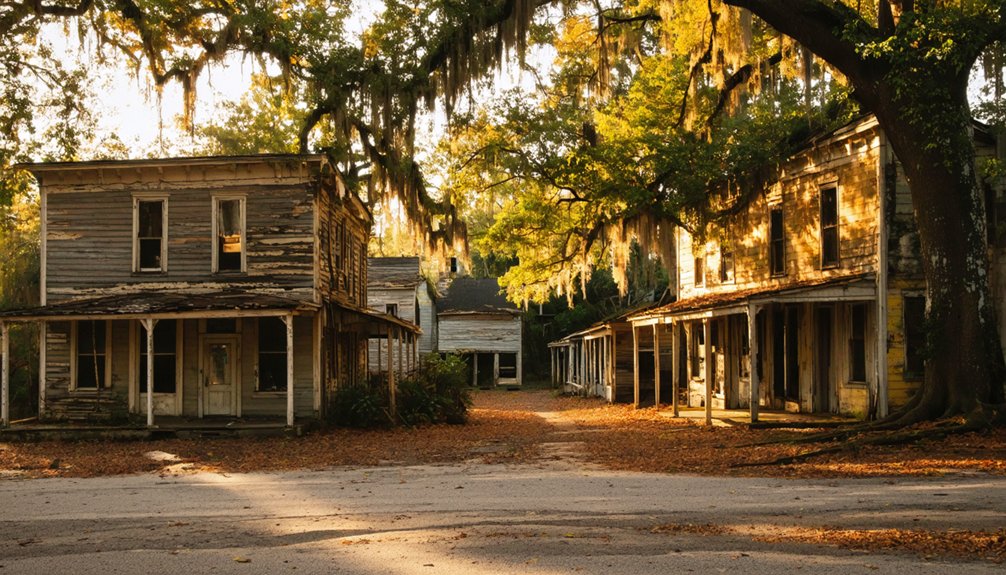
Alabama’s abandoned settlements transform into gateways for authentic fall experiences, where crumbling foundations and weathered structures provide atmospheric backdrops for seasonal adventures.
You’ll discover haunted ghost stories woven through these forgotten places, particularly around Blakeley’s Civil War battlefield where abandoned buildings echo with history.
Immerse yourself in activities near these desolate sites:
Frequently Asked Questions
Are Alabama’s Ghost Towns Safe to Explore With Children?
Yes, Alabama’s ghost towns offer safe family exploration with proper preparation. You’ll discover historical preservation efforts, marked trails, and interpretive signs. While local myths add intrigue, focus on tick prevention, sturdy footwear, and cooler months for ideal children’s adventures.
Do I Need Special Permits to Photograph at These Locations?
You’ll need photography permits for commercial shoots at Alabama’s ghost towns, especially on state or national park land. Legal restrictions vary by location, so research ownership and contact local authorities before your adventure to avoid trespassing issues.
Are the Ghost Towns Wheelchair Accessible?
Old Cahawba offers wheelchair-accessible roads and trails, though restoration projects haven’t reached all ruins. You’ll find the visitor center fully accessible, letting you explore this site’s historical significance despite some rough terrain limiting complete freedom.
Can I Bring Pets When Visiting Alabama’s Abandoned Settlements?
You can bring leashed pets to most Alabama ghost towns like Old Cahawba and St. Stephens. Responsible visitation means keeping six-foot leashes, cleaning waste, and ensuring pet safety with water, tick prevention, and wildlife awareness in these remote locations.
What Should I Pack for a Ghost Town Visit?
Pack layered clothing for shifting fall temperatures, sturdy boots for rugged terrain, and navigation tools like maps and GPS. Packing essentials include bug spray, sunscreen, and water. Follow these clothing tips: prioritize long sleeves and pants for protection while exploring freely.