Arizona’s fall season offers perfect weather for exploring ghost towns like Vulture City, where you’ll walk among 18 restored structures from an 1863 gold rush that yielded $200 million in ore. You can descend into Bisbee’s Copper Queen Mine aboard vintage rail cars, witness gunfight reenactments at Goldfield’s reconstructed 1890s streets, or climb Jerome’s hillside galleries perched 5,000 feet up Mingus Mountain. The cooler temperatures transform these desert relics into atmospheric destinations where weathered saloons, haunted hotels, and abandoned mine shafts reveal the region’s prospecting legacy through guided tours and interactive experiences.
Key Takeaways
- Vulture City offers self-guided tours from October to May, making it ideal for fall visits with cooler desert temperatures.
- Jerome sits at 5,000 feet elevation on Mingus Mountain, providing comfortable fall weather and haunted hotel ghost tours.
- Goldfield Ghost Town features underground mine tours and Wild West reenactments near the scenic Apache Trail and Superstition Mountains.
- Tombstone preserves Wild West history year-round with Boot Hill Cemetery, the Bird Cage Theatre, and famous gunfight sites.
- Chloride hosts Saturday gunfight shows and displays historic murals, offering an authentic continuously-inhabited mining town experience.
Vulture City: A Preserved Portal to the Wild West
The desert sun glints off weathered wood and rusted metal at Vulture City, where Henry Wickenburg’s 1863 gold discovery along the Hassayampa River transformed barren wilderness into a thriving boomtown of nearly 5,000 souls.
You’ll explore over 18 restored structures—from the Assay Office to brothels and Wickenburg’s own cabin—while discovering haunted legends surrounding the infamous Hanging Tree, where 18 men met their end for gold theft.
The mine excavation yielded over 340,000 ounces of gold from a massive quartz outcrop before government shutdown in 1942. The Vulture Mine produced over $200 million worth of gold and silver when adjusted for today’s value, making it one of Arizona’s most profitable mining operations.
Visit October through May to wander authentic buildings, examine period artifacts, and trace the paths of fortune-seekers who built both Wickenburg and Phoenix. Self-guided tours run Thursdays through Sundays from 9 a.m. to 4 p.m., allowing visitors to explore at their own pace.
This living museum delivers genuine Wild West adventure without tourist-trap pretense.
Tombstone: The Legendary Town Too Tough to Die
While Vulture City whispers tales of forgotten fortune, Tombstone practically shouts its legend across the Arizona desert—and for good reason.
Unlike ghost towns that whisper their stories, Tombstone roars its Wild West legacy across the Arizona desert with defiant pride.
You’ll walk streets where Wyatt Earp faced down outlaws during that snowy October gunfight in 1881, exploring a town that survived 105 years of silver mining, devastating fires, and economic collapse.
The fall weather’s perfect for wandering Boot Hill‘s weathered graves, where cemetery legends spring from every headstone marking victims of shootouts and mining disasters. Among the weathered limestone markers and granite monuments, you’ll spot inscriptions revealing the violent stories of Tombstone’s wild past. The Bird Cage Theatre hosted the longest-running poker game in history from 1881 to 1889, drawing notorious gamblers and high-stakes players to its tables.
Downtown, you’ll find the Bird Cage Theatre and Oriental Saloon still standing—living museums where town ghost stories echo through original walls.
With 1,667 residents keeping Western heritage alive, Tombstone earned its nickname through sheer stubbornness, transforming near-death into a thriving tourist destination that refuses to fade.
Jerome: America’s Largest Hillside Ghost Town
Perched 5,000 feet up Mingus Mountain’s slope, Jerome clings to Arizona’s Verde Valley like a copper-stained memory refusing to let go. You’ll discover why newspapers once called it the “Wickedest City in the West”—mining accidents, gunfights, and opium dens earned that reputation during its 1920s boom when 15,000 souls packed these precarious streets.
Today’s 400 residents have transformed former bordellos into art galleries and restaurants, creating something beyond typical tourist traps. The hillside views stretch endlessly across red rock country, while haunted legends lurk in every corner.
“Headless Charlie” still wanders abandoned mine shafts, and Jennie’s spirit allegedly haunts Husband’s Alley where she met her violent end. The Jerome Grand Hotel, originally built as the United Verde Hospital in 1927, now operates as one of Arizona’s most haunted structures after sitting abandoned for 44 years. Ghost tours wind through buildings where catastrophe struck, making Jerome authentically unsettling—no fabricated scares needed. The Douglas Mansion houses large-scale mining equipment and serves as both museum and visitor center within Jerome State Historic Park.
Goldfield Ghost Town: Gateway to the Apache Trail
You’ll find Goldfield Ghost Town perched dramatically on a hilltop between the rugged Goldfield and Superstition Mountains, where Arizona’s legendary Apache Trail begins its winding journey through desert canyons.
Step underground for the 25-minute guided mine tour ($12 adults) that departs every 10 minutes, revealing the authentic tunnels where miners once chased gold veins through solid rock.
Above ground, daily Wild West entertainment brings the 1890s mining camp back to life with gunfight reenactments.
The Mammoth Saloon serves up cold drinks in the same spot where prospectors once gathered after long shifts.
Start your day at the coffee shop, which opens at 9am to 4:30pm, giving you a head start before the merchants unlock their doors at 10am.
Four gold diggers, including brothers Collin Hakes, Orin and Orlando Merrill, along with Riley Morse, discovered the rich deposits here in 1892 that would soon draw a population of 1,500 to this remote desert outpost.
Historic Mine Tours Underground
Deep beneath the reconstructed streets of Goldfield, the Mammoth Gold Mine tunnel opens into darkness that hasn’t changed much since desperate prospectors chased gold veins through volcanic rock in the 1890s.
You’ll descend into authentic stopes and tunnels where guides demonstrate mining techniques that made underground operations far more profitable than surface claims—until three aquifers flooded everything in 1898.
The tour drops you into a miner’s cage replica, surrounding you with century-old equipment hauled from abandoned Southwest operations.
You’ll trace the exact conditions that drew 500 miners here, understanding why they’d risk underground exploration despite Apache raids above.
The 19th-century tower structure still stands, marking where fortunes were made and lost.
Guides point out the historic steel head frame from early 1900s operations, a towering reminder of the engineering required to haul ore from depths reaching a thousand feet underground.
Bob Schoose and Lou Ann rebuilt this ghost town from remnants found in 1984, starting with the mine tunnel construction in 1985.
It’s raw history without the polish—just rock, darkness, and stories of those who refused to quit.
Apache Trail Starting Point
Where Goldfield’s reconstructed Main Street meets Highway 88, you’re standing at the threshold of one of Arizona’s most legendary backcountry routes. The Apache Trail snakes through the Superstition Mountains ahead, following ancient footpaths once used by Apache Indians steeped in Native legends.
Originally constructed as the Tonto Wagon Road between 1903 and 1905, this rugged corridor served as the main traffic artery through Apache Junction before modern highways redirected the crowds.
You’ll wind past towering saguaros and desert flora clinging to volcanic slopes, each curve revealing why this gateway location attracted prospectors chasing the Lost Dutchman Mine.
The 25-minute drive from Mesa’s Superstition Springs feels like crossing into untamed territory—exactly what this historic trail promises beyond Goldfield’s weathered buildings.
Wild West Entertainment Daily
Stepping onto Goldfield’s dusty Main Street feels like walking into a Sergio Leone film, where gunfighters square off daily and the crack of pistol fire echoes between false-fronted buildings. You’re free to wander at your own pace, catching Wild West reenactments by the Goldfield Gunfighters or diving into the paranormal with Spirits of the Bordello‘s ghost tour narratives.
Daily Entertainment Options:
- Mine Tours – Underground expeditions departing every 10 minutes ($12 adults)
- Gunfight Shows – Authentic Wild West shootouts on Main Street
- Ghost Tours – 30-35 minute air-conditioned haunt experiences inside historic buildings
- Gold Panning – Try your luck extracting precious metal from authentic pay dirt
No reservations, no schedules dictating your adventure—just pure frontier freedom under Arizona’s expansive sky.
Bisbee: A Century of Copper Mining History
You’ll descend 1,500 feet into the cool darkness of the Copper Queen Mine aboard a vintage rail car, where your miner-guide reveals the tunnels that once produced 8 billion pounds of copper over nearly a century.
Above ground, stand at the Lavender Pit overlook and peer into the massive terraced crater—900 feet deep and nearly a mile wide—that swallowed entire neighborhoods during Bisbee’s final mining push from the 1950s to 1974.
The Mining and Historical Museum houses steam shovels, mucking machines, and ore samples that trace the town’s evolution from a silver prospect in 1877 to the “Queen of the Copper Camps.”
Copper Queen Mine Tour
Deep beneath Bisbee’s rust-colored hills, the Copper Queen Mine conceals over 2,500 miles of tunnels that once produced 8 billion pounds of copper—making it Arizona’s most productive copper mine during the early 1900s.
When operations ceased in 1975, former miners transformed their workplace into an authentic underground experience, guiding you 1,500 feet into the mountain’s subterranean geology.
You’ll explore this mining heritage aboard vintage rail cars, learning how prospectors extracted ore averaging 23% copper from Tombstone Canyon’s depths.
Your guide—a genuine ex-miner—reveals the reality of working underground.
What You’ll Experience:
- 1,500-foot descent into hand-cleared tunnels
- Former miners sharing firsthand stories
- Authentic equipment and mining techniques
- Subterranean geology spanning multiple ore deposits
Over 50,000 annual visitors discover why this attraction’s employed twelve people daily since 1976.
Lavender Pit Overlook
From the overlook’s weathered viewing platform, you’ll gaze into a 950-acre crater that swallowed entire neighborhoods and produced 600,000 tons of copper before world prices crashed in 1974.
The massive pit forced communities like Jiggerville and Upper Lowell to relocate, erasing whole residential districts in pursuit of low-grade ore.
Mining technology evolution unfolds before you—from 25-ton haul trucks introduced in 1951 to 65-ton behemoths by 1963, all loaded by massive electric shovels.
The community relocation that reshaped Bisbee’s geography remains visible in the ghost town of Lowell below, where the commercial district still stands while residential streets vanished into the earth.
Free informative signage details what extracting 75 million tons of ore cost these copper-dependent towns.
Mining Museum Artifacts
Inside the 1897 Copper Queen headquarters building, original mining artifacts tell the raw story of 8 billion pounds of copper ripped from Arizona’s Mule Mountains. You’ll find the tools that carved underground empires—steam shovels that birthed the Sacramento Pit in 1917, blasting equipment that shattered rock through 95 years of operation.
Historical preservation here isn’t sanitized nostalgia. It’s authentic grit:
- Mining artifacts from underground operations that produced 102 million ounces of silver alongside copper
- Equipment displays showing mechanization innovations that dropped extraction costs
- Company records documenting Phelps Dodge’s 1881 entry through the 1975 closure
- Ore samples representing zinc, lead, manganese, and gold deposits
You’re walking through unvarnished labor history—no corporate spin, just the machinery and minerals that built empires.
Chloride: A Restored Desert Time Capsule
Tucked beneath the Cerbat Mountains in Mohave County, Chloride stands as Arizona’s oldest continuously inhabited mining town, where silver-seeking prospectors first arrived in the 1840s and John Moss’s 1863 silver strike transformed scattered claims into a bustling frontier settlement.
You’ll walk past historic architecture like the Monte Cristo Saloon—Arizona’s oldest continuously operating bar—and the Jim Fritz Museum, preserved exactly as its 95-year-old resident left it.
Desert flora frames weathered structures housing the old jail, post office, and train station.
Beyond town, Roy Purcell’s murals sprawl across rocks depicting Native American culture and frontier life.
Saturday gunfights erupt at Cyanide Springs.
Over 300 residents keep this living monument breathing, while nearby mines still operate around unpaved Tennessee Avenue.
Best Fall Activities at Arizona’s Ghost Towns
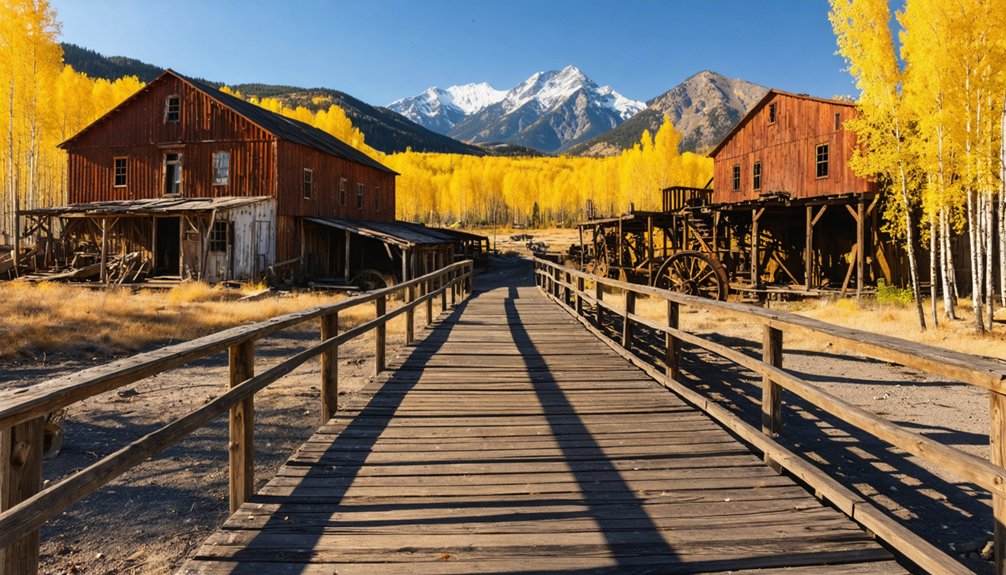
Arizona’s ghost towns transform into atmospheric playgrounds when autumn temperatures drop and October shadows stretch long across weathered boardwalks.
As the landscape shifts, the vibrant fall colors in ghost towns create a stunning contrast against the rustic, abandoned structures. Visitors can wander through the remnants of the past, taking in the breathtaking hues of red and gold that blanket the area. The crisp air is filled with a sense of mystery, inviting exploration and reflection in these hauntingly beautiful settings.
You’ll discover genuine Old West experiences beyond typical tourist traps:
- Nighttime Ghost Tours – Navigate Vulture City’s 12-acre grounds by flashlight while guides share ghostly tales. Alternatively, spend 1 hour 45 minutes exploring Goldfield’s haunted bordello with paranormal investigation equipment.
- Historical Reenactments – Catch Wickenburg Marshals performing comedy gunfights twice monthly at Vulture City. These shows take place where authentic 1800s buildings create the perfect stage.
- Mystery Attractions – Challenge your senses in Goldfield’s Mystery Shack, where 45-degree angles and gravity-defying water defy logic.
- Festival Adventures – Combine ghost town exploration with Mortimer Farms’ Pumpkin Fest. The festival features 40 rides, a 15-acre corn maze, and weekend fire dancers, just 90 minutes north.
Planning Your Arizona Ghost Town Adventure
Before you load your car with camera gear and water bottles, you’ll need to understand that Arizona’s 275+ ghost towns aren’t conveniently clustered along highway exits. They’re scattered across northwest, central, and southeast regions, demanding careful route planning with detailed guidebooks that provide GPS coordinates and driving directions for 50 documented sites.
Arizona’s 275+ ghost towns span three distinct regions, requiring detailed GPS coordinates and strategic route planning beyond typical highway access.
Fall’s cooler temperatures make southern locations like Gleeson (16 miles east of Tombstone) and Ruby (4 miles from Mexico) ideal starting points.
You’ll want to pack hiking essentials for sites like Fort Bowie, where a 1.5-mile trek leads to adobe ruins.
Consult local historical societies about ghost town architecture and ongoing preservation efforts before exploring remote areas.
Download offline maps, bring repair supplies, and always explore during daylight hours to safely navigate these abandoned mining settlements.
Frequently Asked Questions
Are Arizona Ghost Towns Safe to Visit With Young Children?
While Arizona ghost towns offer incredible photography opportunities and historical preservation, you’ll need to supervise children constantly around unstable structures, abandoned mine shafts, and desert hazards. Pack water, stay on marked paths, and embrace cautious exploration for memorable family adventures.
As you venture into exploring abandoned sites in Arizona, keep your camera ready to capture the unique beauty of these forgotten places. The rich history behind each site tells a story that can spark curiosity in both kids and adults alike. Make sure to take breaks and discuss the historical significance to enhance your family’s adventure experience.
What Should I Wear When Exploring Ghost Towns in Arizona’s Fall Weather?
You’ll want appropriate layered clothing—moisture-wicking base layers, fleece, and wind-resistant jackets—for Arizona’s fluctuating fall temperatures. Don’t forget sun protection essentials: wide-brim hats, sunglasses, and sunscreen remain vital despite cooler weather in these remote desert locations.
Can I Bring My Dog to Arizona Ghost Towns?
Your four-legged explorer can join you on dog-friendly trails at most Arizona ghost towns! Keep them leashed, pack plenty of water, and follow pet safety tips like checking paw pads on hot gravel paths.
How Much Time Should I Budget for Visiting Each Ghost Town?
Budget 1-3 hours visitor duration for most Arizona ghost towns. Goldfield and Jerome offer quick sightseeing time, while Vulture City and Ruby reward leisurely exploration. You’ll want flexibility to wander freely and discover hidden stories at your own pace.
Are There Lodging Options Near Arizona’s Ghost Towns for Overnight Stays?
When night falls where the pavement ends, you’ll find nearby accommodations ranging from historic B&Bs to ghost-themed hotels. Camping opportunities abound too, with RV resorts and rustic retreats letting you wake up beside Arizona’s haunting desert landscapes.
References
- https://www.visitarizona.com/like-a-local/arizonas-fall-events-and-festivals
- https://vulturecityghosttown.com
- https://justsimplywander.com/ghost-towns-in-arizona/
- https://www.travelbackland.com/post/jerome-arizona-spend-a-day-in-america-s-largest-ghost-town
- https://goldfieldghosttown.com
- https://www.hipcamp.com/journal/camping/arizona-ghost-towns/
- https://www.youtube.com/watch?v=l_ogVgvyw7Y
- https://www.atlasobscura.com/things-to-do/arizona/ghost-towns
- https://events.thehistorylist.com/organizations/vulture-city-ghost-town
- https://www.legendsofamerica.com/vulture-city-arizona/