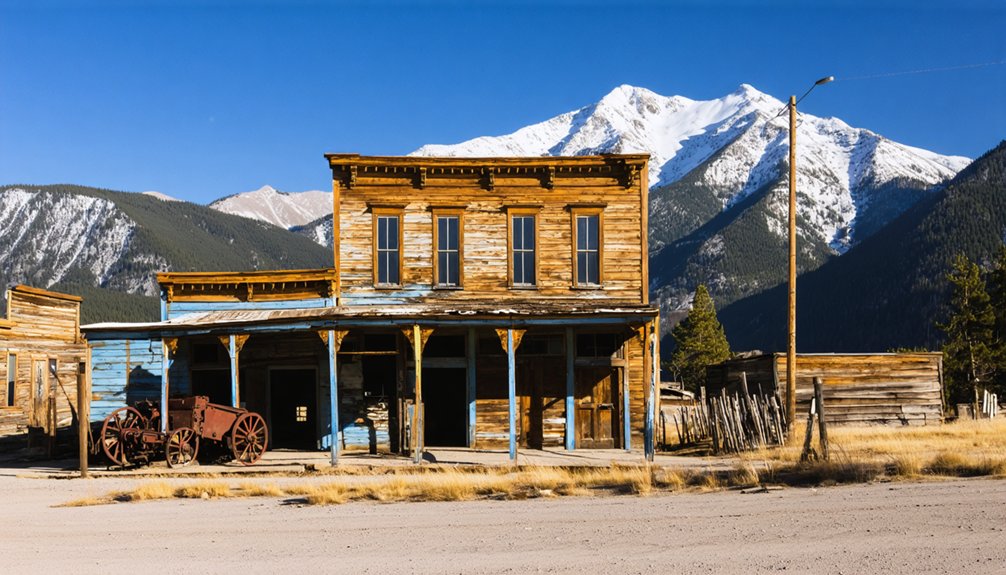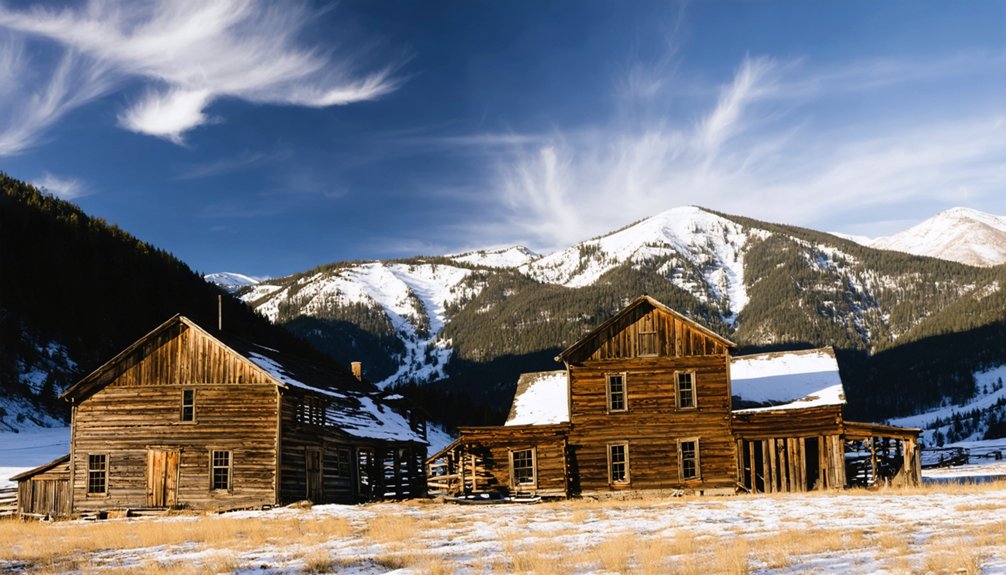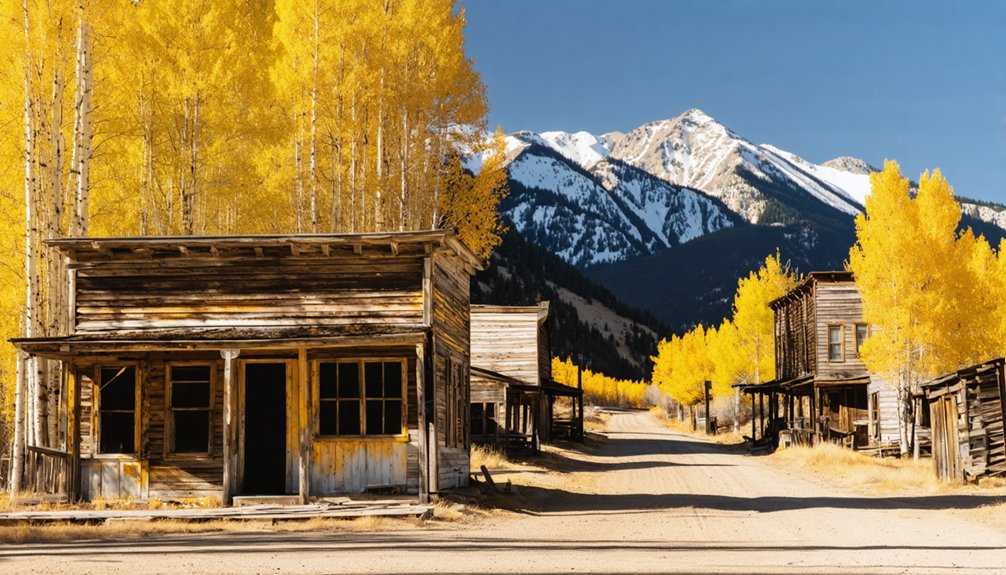
You’ll find Colorado’s best fall ghost town experiences at Ironton, where golden aspens frame century-old mining ruins along the Million Dollar Highway, and Animas Forks, perched at 11,200 feet amid scarlet scrub oak and jagged peaks. St. Elmo’s weathered boardwalks and authentic storefronts offer easy exploration, while remote Alta showcases the world’s first AC-powered mining operation beneath Wilson Peak. Peak colors blaze between late September and early October, when sub-freezing nights ignite the most vibrant displays across these historic sites.
Key Takeaways
- Animas Forks at 11,200 ft offers spectacular fall colors with golden aspens and crimson scrub oak surrounding 1870s mining structures.
- Ironton features easier flat-terrain exploration at 9,800 ft, with weathered mining ruins set amid vibrant golden aspens in autumn.
- St. Elmo provides authentic decay with walkable boardwalks, a historic general store, and well-preserved buildings from its 2,000-miner heyday.
- Peak fall colors occur October 6-10 across Colorado’s San Juan Mountains, with sub-freezing nights creating the most vibrant foliage displays.
- Ashcroft near Aspen combines mountain scenery with ghost town exploration; accessible May-October at 9,521 ft elevation with self-guided trails.
Ironton: Historic Mining Buildings Among Golden Aspens
Perched at 9,800 feet along Colorado’s legendary Million Dollar Highway, Ironton transforms into a photographer’s dream each fall when golden aspens frame its weathered mining structures.
At 9,800 feet, Ironton’s weathered ruins and golden aspens create an unforgettable autumn spectacle along the Million Dollar Highway.
You’ll find this ghost town seven miles south of Ouray, where mining history whispers through remnants of the Yankee Girl and Robinson mines that once fueled Colorado’s second-largest silver district.
Wander freely through aspen groves to discover over a century of stories etched in decaying buildings.
The town’s flatter terrain makes exploration easier than neighboring sites, letting you connect with 1880s boom-town energy without permits or restrictions.
Thanks to ghost town preservation efforts by Ouray County Historical Society, you’re witnessing authentic Colorado heritage.
Among the most photographed structures stands the circa 1891 “White House,” a testament to the town’s peak prosperity when Otto Mears’ railroad brought daily trains through the Red Mountain district.
Originally known as Copper Glen, the settlement was renamed Ironton in 1893 as it rapidly expanded into a bustling transportation hub.
Pull off Highway 550 at the interpretive sign—this accessible adventure requires nothing but curiosity and sturdy boots.
Animas Forks: High-Altitude Remnants in the San Juan Mountains
You’ll find Animas Forks perched at a breathtaking 11,200 feet in the San Juan Mountains.
Nearly a dozen original structures from the 1870s mining boom still stand against impossible odds.
The crisp fall air at this elevation transforms the surrounding peaks into a painter’s palette of gold aspens and crimson scrub oak, creating arguably the most photogenic ghost town backdrop in Colorado.
Be warned—you’ll need a high-clearance 4WD vehicle to navigate the rugged Alpine Loop from Silverton, especially as autumn weather can turn the narrow mountain road treacherous without notice.
The town thrived with over 450 summer residents during its 1880s peak, supported by essential amenities including a hotel, saloons, and even a jail.
Plan your visit for early fall before the unpaved Alpine Loop closes, as this 65-mile scenic route connecting Silverton, Lake City, and Ouray attracts over 100,000 visitors annually seeking Colorado’s mining heritage.
Elevation and Historic Structures
Towering at 11,200 feet above sea level in Colorado’s San Juan Mountains, Animas Forks holds the distinction of being one of the highest mining camps ever established in North America.
You’ll discover several original buildings standing defiant against the local climate’s brutal winters—including one legendary 1884 blizzard that dropped 25 feet of snow in 23 days, forcing miners to tunnel between structures.
What You’ll Experience:
- Weathered cabins with sagging rooflines silhouetted against jagged peaks reaching 13,711 feet
- The abandoned newspaper office where the world’s highest publication once operated
- Hand-hewn timber frames exposing construction techniques from the 1870s boom
Thanks to preservation efforts, you can freely explore these structures without restrictive barriers.
The rocky, unimproved road demands high-clearance 4WD, rewarding your adventurous spirit with unmediated access to authentic Western history. Nine remaining buildings stand at the site today, with ongoing restoration work maintaining their historical integrity while allowing unrestricted entry for visitors. Located on the Alpine Loop, this 65-mile unpaved road system connects the historic mining towns of Lake City, Ouray, and Silverton, drawing over 100,000 visitors annually to experience Colorado’s high-country heritage.
Fall Colors and Scenery
When autumn sweeps across the San Juan Mountains in late September, Animas Forks transforms into a photographer’s dream where golden aspen groves cascade down mountainsides to meet weathered gray cabins at 11,200 feet.
You’ll find the Alpine Loop’s rugged 4X4 roads threading through color-changing stands that peak between October 6-10, when consecutive sub-freezing nights ignite yellow, orange, and red hues without stripping leaves.
Position yourself at river viewpoints along the Animas Valley where backlit aspens glow against evergreen backgrounds and crumbling mine structures.
Fresh snowfall intensifies the color magic—what wildflower displays accomplished in summer, autumn aspen does spectacularly.
Time your visit during the elk rut when bulls bugle through golden meadows.
The high-altitude timing means you’ll catch colors later than lower elevations, extending your exploration window into early October.
Come prepared with snacks, water, and patience for these remote excursions where cell service fades and nature takes center stage.
For a different perspective of the San Juan Mountains’ fall splendor, the Colorado Trail at Molas Pass offers panoramic views of vibrant foliage across accessible hiking terrain.
Access and Road Conditions
Reaching Animas Forks demands commitment—this isn’t a casual Sunday drive but a genuine backcountry adventure requiring a high-clearance 4WD vehicle and steady nerves.
The 12.3-mile journey from Silverton follows unpaved County Road 2 along the Alpine Loop, where road maintenance takes a backseat to raw wilderness. You’ll steer through bumpy terrain, ford creek crossings, and skirt embankments with breathtaking drops.
The initial 2 miles are paved, followed by roughly 7.5 miles of gravel road before the terrain transitions to the challenging rocky sections that define the final approach.
Vehicle requirements aren’t negotiable at this elevation:
- Your Jeep or 4×4 must handle rocky passages studded with mining relics
- Ground clearance becomes critical when crossing streams and maneuvering washboard surfaces
- Snow closes these unimproved routes completely in winter
If you’re uncomfortable tackling this moderate-rated trail solo, guided 4WD tours from Silverton offer hassle-free access while you focus on absorbing the scenery rather than steering through obstacles.
Alta: Remote Alpine Ghost Town With Mountain Vistas
Perched at 11,800 feet in the San Miguel Mountains, Alta clings to a steep slope between Telluride and Rico.
Jagged peaks frame what remains of Colorado’s most electrifying ghost town—literally. In 1891, this remote camp became the world’s first mining operation powered by alternating current, thanks to Nikola Tesla’s breakthrough technology transmitted from the Ames power plant miles below.
You’ll find alpine solitude among weathered cabins and a reconstructed boarding house. All of this is set against Wilson Peak’s dramatic backdrop.
The mining history here spans from 1877 to 1948, when a devastating mill fire ended operations for good.
Access Alta via Highway 145, six miles south of Telluride. The townsite is accessible by 2WD vehicles from May through October.
However, exploring requires respecting private property boundaries established around 2012.
St. Elmo: Colorado’s Best-Preserved Mining Town
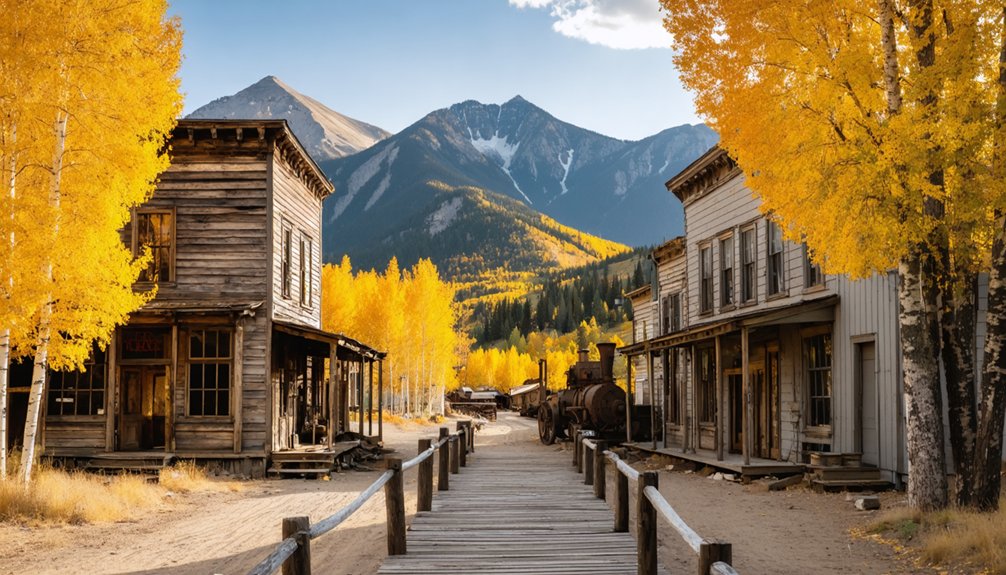
Walk the boardwalks where 2,000 miners once lived, and you’ll find:
- The general store’s shelves still stocked with century-old goods
- Saloon doors creaking in the autumn wind
- The schoolhouse with lesson plans fading on chalkboards
The Mary Murphy Mine produced $4.4 million in gold before closing in 1925, ending an empire built on 150 patented claims.
Unlike commercialized ghost towns, St. Elmo offers raw authenticity—no gift shops masking its gritty past, just honest decay and remarkable resilience.
Ashcroft: Picturesque Cabins Near Aspen
Just eleven miles from Aspen’s glitz, Ashcroft tells a starker story—one of spectacular failure dressed in autumn gold. This ghost town architecture stands frozen at 9,521 feet, where weathered cabins catch September’s light like postcards from 1883.
A ghost town suspended in time, where weathered wood and mountain light tell stories of silver dreams turned to dust.
You’ll find the Blue Mirror Saloon and original post office restored by the Aspen Historical Society. Walk the self-guided trails through structures that once housed 2,000 silver-hungry souls.
By 1885, the boom collapsed—residents literally moved their cabins downvalley. Visit June through October when docents share tales of Jack Leahy, the last holdout who died in 1939.
The cultural heritage here isn’t sanitized; it’s raw mountain capitalism exposed. Park free, explore independently, then push further to Maroon Bells before the aspens lose their leaves.
Vicksburg: Mining Camp With Autumn Poplars
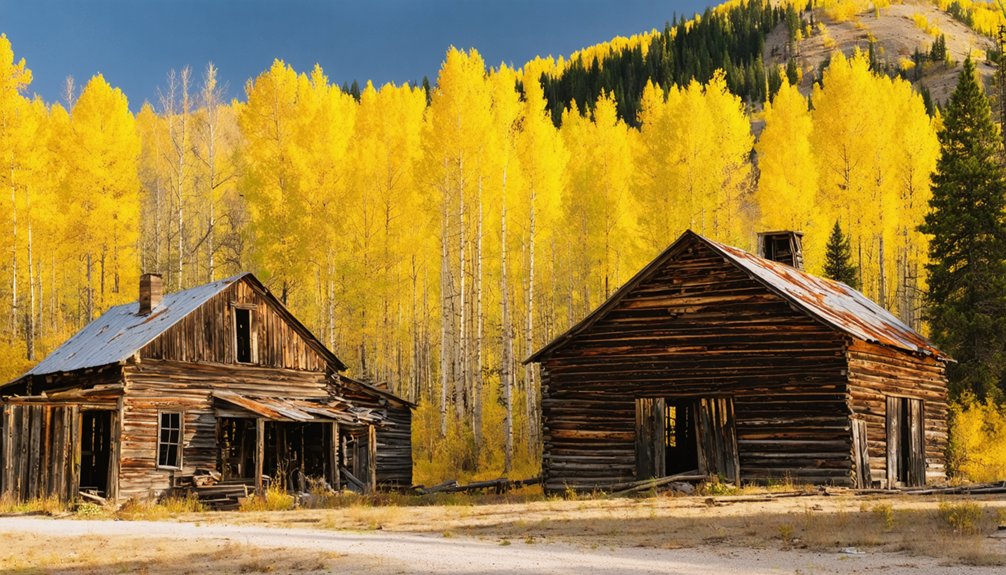
You’ll find Vicksburg nestled in Clear Creek Canyon, where miners packed in balsam poplar saplings on burros over a century ago—and those same trees now blaze golden along the main street each autumn.
The Chaffee County Historical Society runs a weekend museum here, with the restored Shepard Tavern showing exactly how an 1880s miner lived, surrounded by original wagons and mining equipment.
Time your visit for late September when those historic poplars peak, their leaves shimmering against weathered log cabins that once housed 700 fortune-seekers.
Historic Mining Camp Origins
When prospectors from Leadville pitched camp in Clear Creek Canyon back in 1867, they couldn’t have predicted their wandering burros would stumble upon the region’s fortune. Those lost pack animals found gold glittering in the creek bed, sparking Vicksburg’s birth as a mining camp named after storekeeper Vick Keller.
You’ll find remarkable preservation techniques evident throughout this site, where urban archaeology reveals a community that swelled to 700 residents.
Picture the camp’s heyday:
- Balm of Gilead poplars lining the main street, packed in on burro backs
- Hand-dug ditches channeling Vicksburg Creek for fire protection and cooling boxes
- Two hotels, multiple saloons, and a bustling assay office processing silver and lead
The National Register recognized this authentic piece of mining history in 1977, preserving freedom-seeking miners’ legacy.
Weekend Museum and Tours
The Chaffee County Historical Society opens the cabin closest to the road on select summer weekends, transforming Vicksburg’s weathered structures into portals back to the 1880s.
You’ll find the Shepherd tavern cabin arranged as a typical miner’s home, where museum preservation efforts showcase authentic tools, photographs, and daily-life artifacts. The artifact restoration work reveals how miners actually lived—not romanticized versions.
Pack your lunch and water before heading fifteen miles northwest of Buena Vista on Forest Service Route 390. The graded dirt road handles passenger cars, though it’s bumpy.
Seven cabins survived abandonment, with two privately owned as hunting camps. Outside, examine the wooden boxes settlers placed in creek ditches for refrigeration and fire suppression—practical ingenuity you’ll appreciate while exploring mining equipment scattered throughout Clear Creek Canyon.
Balsam Poplar Fall Colors
Vicksburg’s most striking feature arrives with September’s first frost, when the balsam poplars lining the old main street explode into brilliant gold. Those nineteenth-century miners who hauled saplings on burro backs created an unintentional legacy—a natural cathedral of autumn color framing vintage architecture and mining remnants.
You’ll find the season’s peak typically hits late September through early October:
- Golden canopy overhead: Massive poplar crowns create filtered sunlight across weathered cabins.
- Creek-side contrast: Yellowed leaves mirror in Clear Creek’s water where prospectors once tried gold panning.
- Mountain backdrop: Brilliant foliage against snow-dusted peaks and rust-colored tailings.
The original irrigation ditches still flow alongside these survivors, keeping roots fed after 150 years.
Time your visit right, and you’ll witness what early residents saw—wilderness transformed by determination.
Frequently Asked Questions
What Camping or Lodging Options Are Available Near Colorado Ghost Towns?
You’ll find endless camping options near Colorado ghost towns, from RV hookups at Priest Gulch to luxe Airstreams at CampV. Join local ghost town tours, explore historical preservation sites, and camp among aspens where miners once roamed freely.
The allure of abandoned sites in Colorado provides an exciting backdrop for outdoor adventures. You can hike to these remnants of the past, discovering fascinating stories etched in the walls of old buildings. Additionally, many of these locations offer stunning views and an opportunity to appreciate the natural beauty surrounding the historic landscapes.
As you explore ghost towns in Colorado’s autumn colors, the vibrant hues of the leaves create a picturesque canvas that enhances the eerie charm of these deserted places. Photographers and nature lovers alike are drawn to capture the vivid contrasts of the orange and gold foliage against the backdrop of crumbling structures. Each visit during the fall reveals a unique perspective, inviting you to experience both the haunting history and the breathtaking seasonal beauty.
Are These Ghost Towns Safe to Visit With Children?
Yes, many ghost towns are family-safe with proper supervision. You’ll discover historical significance at accessible sites like St. Elmo and Tin Cup. Avoid unstable buildings and mine shafts, supervise kids closely, and consider guided tours for safer exploration.
What Photography Equipment Is Recommended for Capturing Fall Ghost Town Scenes?
Want to capture Colorado’s haunting autumn beauty? You’ll need thoughtful lens selection—wide-angles for sweeping vistas, telephoto for architectural details. Drone photography reveals stunning aerial perspectives of abandoned settlements. Don’t forget your tripod for those golden-hour shots!
Do These Ghost Towns Charge Entrance or Parking Fees?
Yes, you’ll pay entrance fees ranging from $5-8.50 depending on the ghost town. Most support historical preservation through honor-system payments. Ghost Town Museum offers the best visitor amenities but costs more than self-guided sites.
What Wildlife Might Visitors Encounter at High-Altitude Ghost Towns?
You’ll encounter an incredible wildlife diversity that’ll blow your mind—from ptarmigan and marmots to bighorn sheep and golden eagles. These high-altitude ruins offer unmatched bird watching opportunities where nature reclaims abandoned human spaces with wild freedom.
References
- https://www.lerrophotography.com/colorado-fall-colors-and-ghost-towns/
- https://www.colorado.com/articles/find-your-perfect-fall-adventure-colorado
- https://www.visitouray.com/ghost-towns
- https://alissapeterson.com/blog/discover-the-spookiest-colorado-ghost-towns
- https://www.tripadvisor.com/Attractions-g28927-Activities-c47-t14-Colorado.html
- https://leadville.com/the-ghost-towns-of-leadville-and-beyond/
- https://creeksidechalets.com/ghost-towns-near-salida/
- https://www.americansky.co.uk/colorado-holidays/exploring-colorados-ghost-towns
- https://www.historynet.com/ghost-town-ironton-colorado/
- https://www.uncovercolorado.com/ghost-towns/ironton/