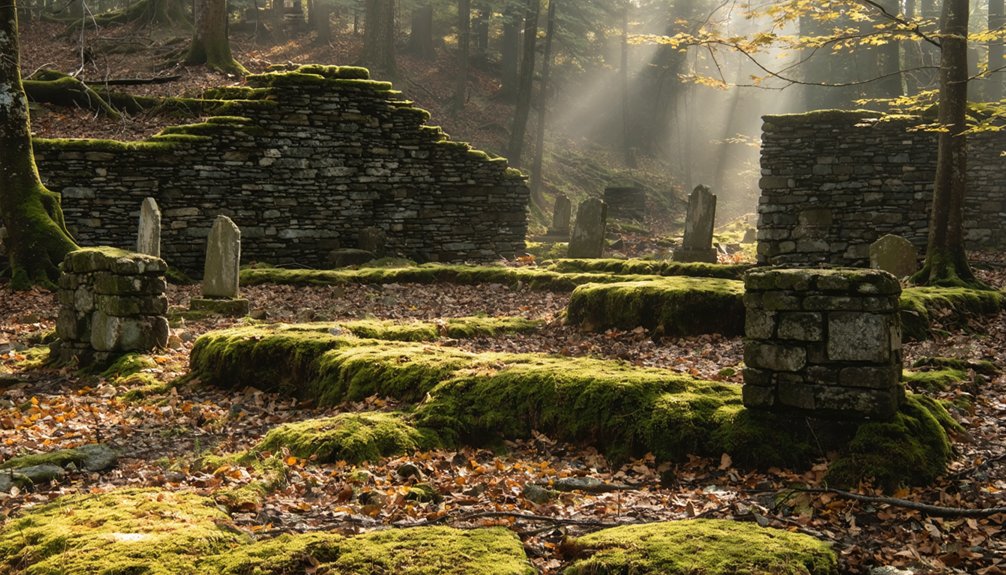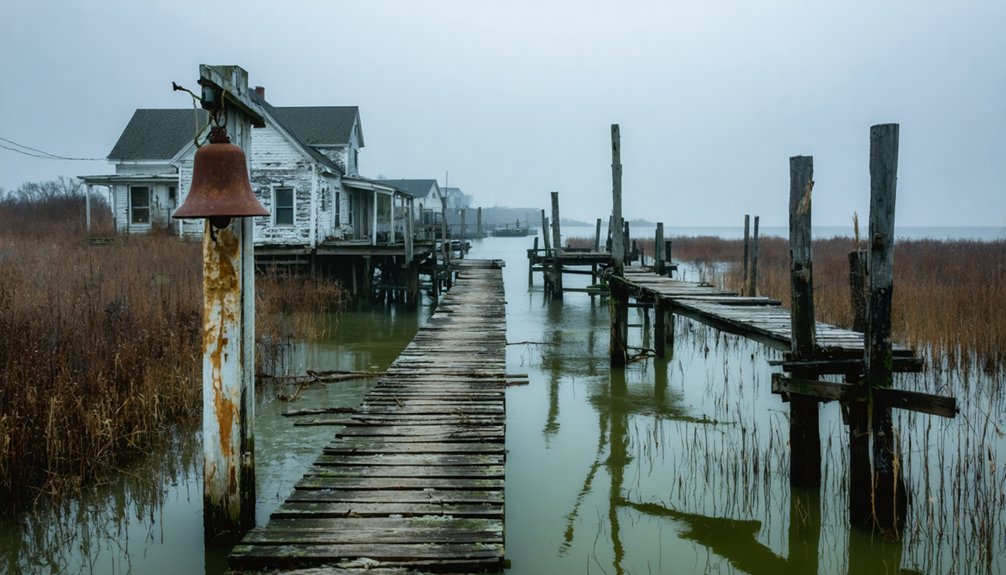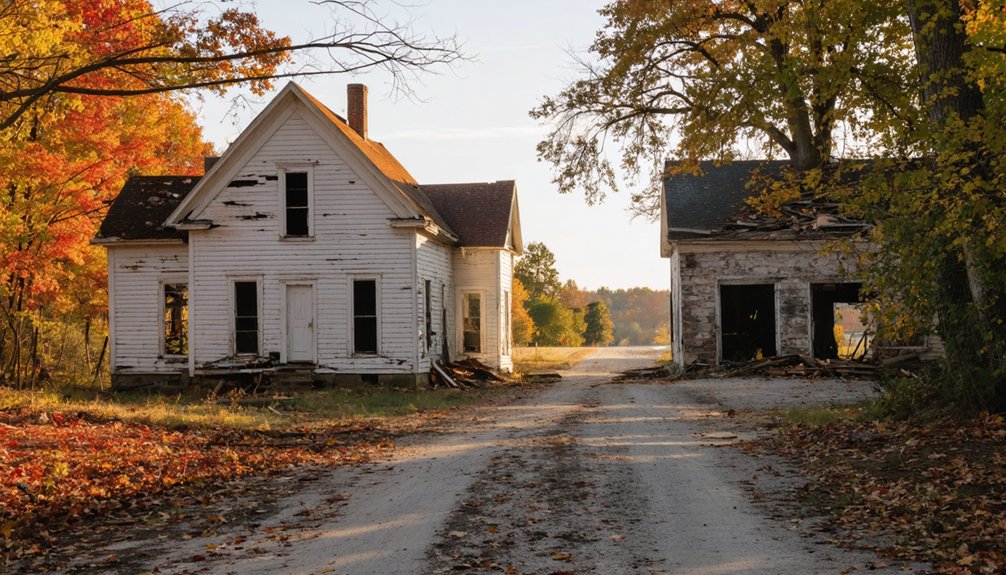
You’ll find Connecticut’s most atmospheric ghost towns come alive during October’s foliage season. Gay City State Park offers accessible ruins with crumbling stone foundations framed by crimson maples along the Blue Trail. Johnsonville Village‘s preserved Victorian mill town spans 62 acres of haunting architecture, though access is restricted. Bara-Hack‘s mysterious stone foundations hide in Pomfret’s woods, while Holy Land USA‘s 200 weathered biblical structures crown Waterbury’s Pine Hill. Each site weaves together autumn beauty with tangible remnants of Connecticut’s industrial past, and understanding their stories, legends, and legal access points will transform your exploration into something deeper.
Key Takeaways
- Gay City State Park offers accessible hiking trails past cellar holes and mill ruins from an 1800s settlement abandoned after fires and violence.
- Dudleytown has extremely limited October access via the blue-blazed Mohawk Trail, with most entry restricted by Dark Entry Forest Association.
- Bara-Hack, founded in 1778, features mysterious ruins and is known as the “Village of Voices” for reported ghostly sounds.
- Holy Land USA in Waterbury displays over 200 crumbling biblical structures atop Pine Hill with recent preservation revival efforts underway.
- Johnsonville Village spans 62 acres with preserved Victorian buildings but remains closed to public access due to private ownership and trespassing risks.
Johnsonville Village: A Victorian Mill Town Frozen in Time
Tucked away in the rolling hills of East Haddam, Johnsonville Village stands as Connecticut’s most hauntingly preserved mill town—a 62-acre monument to America’s industrial past that time simply forgot.
You’ll wander past Victorian architecture that once housed thriving businesses: a chapel where mill workers prayed, a general store that served the community, and a schoolhouse echoing with phantom lessons.
The mill relics tell stories of when twelve mills dotted these riversides, producing twine for fishing nets shipped across America.
Raymond Schmitt’s dream of creating a Victorian tourist attraction lives on through transplanted 19th-century structures, though zoning disputes shuttered the gates in 1994. The town’s demise accelerated after Neptune Mill burned in 1972, struck by lightning and never rebuilt. After remaining vacant for decades, the entire village sold for $1.85 million in July 2017, leaving its future uncertain.
Now it’s yours to explore—if you’re bold enough to trespass where mill workers’ spirits reportedly still roam.
Gay City State Park: Exploring the Ruins of a Failed Utopian Dream
You’ll find Connecticut’s darkest ghost town hidden within 1,500 acres of woodland, where Methodist settlers fled Hartford in 1796 to build their alcohol-fueled “utopia.” Only to abandon it after murders, mill fires, and whispered tales of strange religious rites.
Exploring these abandoned places in Connecticut can reveal haunting histories and eerie landscapes that captivate those with a taste for adventure. Each site tells a story of a once-thriving community, now silent and forgotten, inviting curiosity and exploration. From crumbling factories to derelict houses, these remnants of the past provide a glimpse into the lives that once flourished in the shadows of modernity.
As you wander through these eerie remnants, you might also find the experience enhanced by exploring fall foliage in Connecticut, where vibrant reds and golds contrast starkly with the decay of abandoned structures. The natural beauty of the changing leaves adds an unexpected charm to the journey through history, making each site feel alive in its own unique way. Embracing the season’s transformation can deepen your connection to these forgotten places, inviting reflection on both nature and time.
The blue trail leads you past crumbling stone foundations and chimney stacks emerging from carpets of crimson and gold leaves, each ruin marking where blacksmiths, merchants, and mill workers once lived before tragedy emptied Factory Hollow.
October’s slanting light transforms the cemetery and Still Pond into an eerie photographer’s paradise, where weathered gravestones tell stories of decapitated apprentices and a jewelry peddler whose skeleton was discovered in a charcoal-burner’s pit. Visitors sometimes leave flowers or teddy bears at the burial sites, perhaps hoping to appease whatever spirits still linger among the ruins. The thrice-burned mill stands as the most prominent ruin, its stone remnants visible from the main trail before the forest fully reclaimed the settlement.
Haunted Settlement History
Deep in the Connecticut woods, stone foundations emerge from the forest floor like broken teeth, marking where Factory Hollow once thrived along the Blackledge River.
You’ll wander past crumbling cellars where Methodist settlers distilled spirits and practiced their faith away from Hartford’s judgment. The urban legends here aren’t manufactured—they’re rooted in documented violence.
A blacksmith actually decapitated his tardy apprentice. A jewelry peddler’s bones were discovered in a charcoal pit, his killer never caught.
Emma Foster’s 1943 land donation created preservation challenges that protected these ruins from demolition. Now you’ll find teddy bears adorning weathered gravestones, offerings from hikers who’ve felt something watching from the shadows.
The massive chimney stack stands sentinel over what remains of this failed utopian experiment turned ghost town. The settlement’s woolen mill produced fabric until devastating fires in 1830 destroyed the operation, followed by a paper mill that met the same fate in 1879. Following the blue trail from the main road leads to a footbridge where the most substantial mill remnants await exploration.
Stone Ruins Trail Guide
Starting from the Hebron Avenue parking lot, the stone ruins reveal themselves gradually as you follow the light blue blazes into the forest.
At 0.23 miles, fork left where trail mapping becomes essential—multiple paths crisscross these 1,569 acres of forgotten dreams.
The thrice-burned mill ruins appear after ten minutes, their crumbling walls emerging through autumn foliage.
Cross the wooden bridge at 2.6 miles onto yellow-blazed trail, then immediately left onto white. Here, the woolen mill’s raceway cuts through rock, showcasing impressive ruin preservation efforts.
Stone fences form ghostly rectangles throughout the woods—boundaries of vanished farms.
Cellar holes hide off-trail, waiting for waterproof boots and adventurous souls.
The cemetery rests near the entrance road, moss-covered stones marking settlers who believed this would become paradise. Glacial erratics—massive boulders deposited by ancient ice sheets—dot the landscape between trail sections, adding geological drama to the historical narrative. Beyond the ruins, Gay City Pond spans over 50 acres, offering a stark contrast between the failed settlement and nature’s reclamation.
Fall Foliage Photography Spots
When October’s crimson maples frame the crumbling stone walls of Gay City’s woolen mill, you’re witnessing Connecticut’s most photogenic collision of nature and abandonment.
Position yourself near the mill ruins where golden birches contrast against weathered foundation stones—autumn foliage transforms these forgotten structures into something almost sacred. The abandoned chimneys accessible from the trail become dramatic focal points when backlit by afternoon sun filtering through scarlet canopy.
You’ll find scenic vistas along the blue trail where stone farm fences disappear into rust-colored understory, creating natural leading lines. The small burial ground near the park entrance contains members of the Gay and Sumner families, their stones facing each other in a silent testament to old animosities.
Early morning fog adds ethereal atmosphere to cellar holes, while the cemetery near the entrance offers poignant compositions of moss-covered gravestones beneath blazing sugar maples.
Bring your widest lens—these ruins demand context.
Bara-Hack Village: The Mysterious “Village of Voices”
Hidden within Pomfret’s dense woodlands, Bara-Hack Village stands as Connecticut’s most enigmatic ghost town—a place where stone foundations peek through tangled undergrowth and centuries-old gravestones mark the final resting places of families who carved out an existence in these rugged hills.
Where moss-covered stones whisper forgotten names and woodland shadows guard the secrets of families who vanished into Connecticut’s haunted hills.
Founded in 1778 by Rhode Island refugees fleeing British forces, this settlement earned its haunting nickname “Village of Voices” through ancient legends and folklore tales of disembodied sounds echoing through the trees.
You’ll discover why visitors report hearing children’s laughter, livestock bells, and wagon wheels creaking along phantom roads.
What Makes Bara-Hack Unforgettable:
- Stone foundations emerging from autumn leaves tell stories of vanished homesteads
- Original cemetery preserves weathered markers of Randall and Higinbotham families
- Forest reclaimed pastoral fields where sheep once grazed
- Nightengale Brook still flows past the mill’s forgotten ruins
The community was abandoned by 1890, as residents gradually departed following the Civil War, leaving behind only memories etched in stone and whispered in the wind.
Dudleytown Ruins: Cornwall’s Most Infamous Haunted Settlement
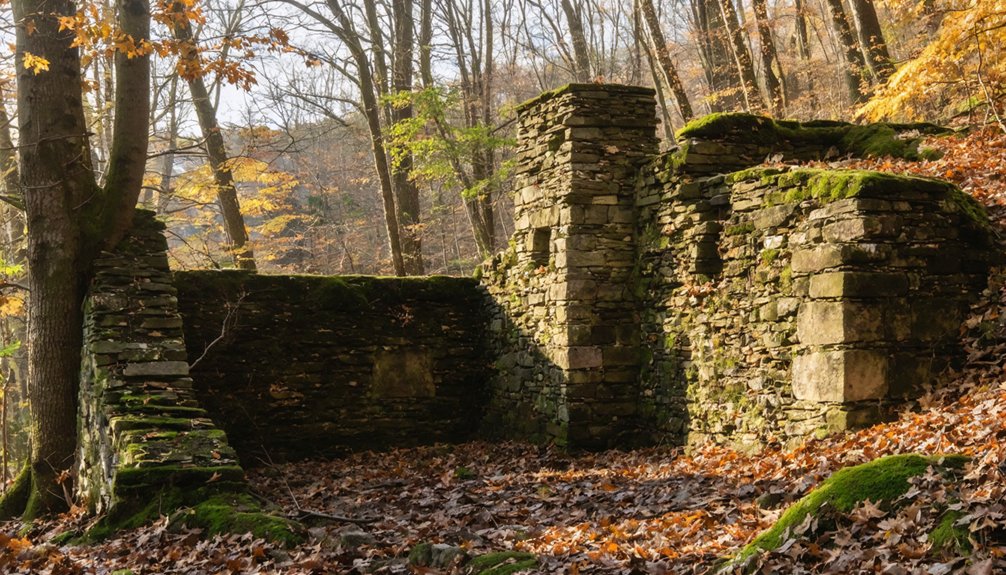
You’ll find Dudleytown cloaked in perpetual shadow, where three surrounding hills block the sun and create an eerie twilight even at midday.
The settlement’s sinister reputation stems from a supposed curse tracing back to a beheaded English nobleman—though historians confirm no genealogical connection exists between Cornwall’s Dudley families and their infamous namesake.
Today, the site remains strictly off-limits as protected private property, though the legends of madness, suicide, and violent death continue to draw curious trespassers into these forbidden woods.
Dark History and Curses
The real story reveals mundane tragedy:
- Poor soil and steep terrain made farming nearly impossible.
- Economic collapse followed when iron furnaces relocated to railroad towns.
- No schools, churches, or shops ever existed here.
- Edward C. Starr’s 1926 fictional account created most curse mythology.
You’ll find reality more compelling than fiction.
Accessing the Forbidden Forest
Deep in Cornwall’s wooded hills, where three peaks cast permanent shadows over a forgotten valley, Dudleytown’s remains lie scattered across 800 acres of fiercely protected private land.
The Dark Entry Forest Association patrols aggressively—state police don’t hesitate to arrest urban exploration enthusiasts who breach the perimeter. You’ll find only cellar holes and crumbling stone foundations now, accessible through forbidden access points along Dark Entry Road.
There’s a legal alternative: the blue-blazed Mohawk Trail grants limited October passage through portions of the site.
Fall transforms the landscape into blazing color, but you’re hiking against time and authority. Most visitors still come at night, parking strategically away from residential streets.
The preserve’s official entrance sits at Bald Mountain Road’s terminus—though “official” means little when trespassing charges await the curious.
Holy Land USA: Waterbury’s Abandoned Biblical Theme Park
Perched atop Pine Hill in Waterbury, a 57-foot illuminated cross glows against the Connecticut sky, beckoning travelers along Interstate 84 toward what remains of one man’s extraordinary vision.
A towering illuminated cross stands sentinel over Interstate 84, marking the entrance to an abandoned pilgrimage site of faith and decay.
Attorney John Baptist Greco built this pilgrimage site in the 1950s, transforming 18 acres into Jerusalem and Bethlehem through plywood and devotion.
You’ll discover over 200 structures—now weathered and crumbling—where Biblical symbolism meets decay.
What awaits your exploration:
- Navigate steep streets to metal gates guarding this hillside sanctuary
- Wander among knocked-over villages and catacombs extending 200 feet underground
- Witness the LED cross shifting colors for liturgical seasons
- Photograph eerie dioramas where plastic mannequins portray sacred scenes
Though vandalized and abandoned since 1984, recent revival efforts preserve Greco’s testament to faith and freedom of expression.
Stamford Miniature Ghost Town: An Urban Oddity Beneath the Roads

Beneath the thundering traffic of Interstate 95, a forgotten neighborhood clings to Manhattan Street like a photograph left too long in the sun. You’ll find urban decay frozen mid-collapse—a furniture store’s windows gaping like empty eye sockets, restaurant walls bearing graffiti epitaphs, and a church standing sentinel over ruins.
These highway relics tell stories of families who watched their community disappear beneath concrete and exhaust fumes.
Rusted fences embrace buildings swallowed by creeping vines, their boarded entrances marking thresholds you can’t cross. The site’s permanently closed now, but you’ll glimpse this miniature ghost town from the highway—a street-level time capsule where Stamford’s past refuses to vanish completely.
It’s proof that progress doesn’t erase everything, just pushes the inconvenient aside.
Best Times to Visit Connecticut’s Abandoned Towns in Autumn
When October transforms Connecticut into a canvas of crimson and gold, you’ll discover that timing your ghost town explorations means chasing a wave of color that sweeps from north to south across six transformative weeks.
Fall weather and foliage timing strategies for your abandoned settlement adventures:
- Early October: Target Litchfield Hills’ northern ghost towns when peak color ignites the landscape.
- Mid-to-late October: Explore Gay City State Park and central Connecticut’s forgotten villages during their prime foliage window.
- Late October through early November: Visit coastal abandoned settlements as autumn’s finale unfolds.
- Multi-region approach: Plan a 2-3 week itinerary following Connecticut’s elevation-driven color progression.
You’re not bound to a single weekend. The state’s topography creates staggered opportunities, letting you experience multiple ghost towns at their most atmospheric moments.
Photography Tips for Capturing Fall Ghost Town Atmosphere
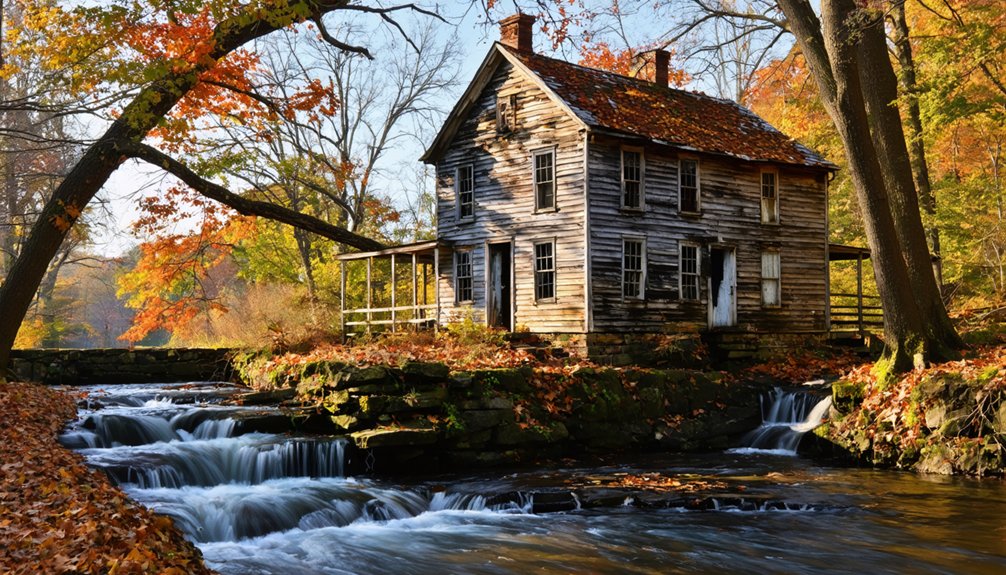
While Connecticut’s ghost towns hold their mysteries year-round, autumn transforms them into a photographer’s dream where decay and vibrancy collide in perfect tension. You’ll want to arrive at golden hour when low light ignites the foliage surrounding Victorian ruins at Johnsonville Village.
Frame crumbling foundations through colorful canopies using the rule of thirds, letting overgrown paths lead viewers deeper into abandonment. Urban exploration demands technical precision—shoot in RAW format and bracket your exposures to balance shadowed interiors against brilliant exteriors.
Focus on intimate details: rusted metal draped in crimson vines, broken windows layered with golden leaves. These sites aren’t just historical preservation opportunities; they’re canvases where nature reclaims human ambition, and your lens captures that raw, unrestricted transformation mid-stride.
Safety Considerations When Exploring Abandoned Sites
The camera captures autumn’s beauty among the ruins, but your boots navigate a landscape designed to fail. Decaying floors at Union Pond Mill won’t announce their collapse, and fire-damaged beams at Derelict Cotton Mill hide their breaking points beneath autumn leaves.
Artificial hazards multiply where vandals stack rocks along Castle Craig’s trails and foragers block paths through Holy Land USA. Wildlife encounters become likelier as dusk approaches—reclaimed spaces like Seaside Sanatorium belong to creatures now, not visitors.
Essential safety protocols for exploring Connecticut’s abandoned sites:
- Check ownership status before entry—Johnsonville’s $1.9M listing means enforceable trespassing charges
- Avoid underground tunnels at hospital ruins where entrapment risks escalate
- Navigate marshy terrain cautiously near Cedar Hill Rail Yard’s Quinnipiac approaches
- Never explore solo—remote locations delay emergency response considerably
Respecting Historical Preservation and Access Restrictions
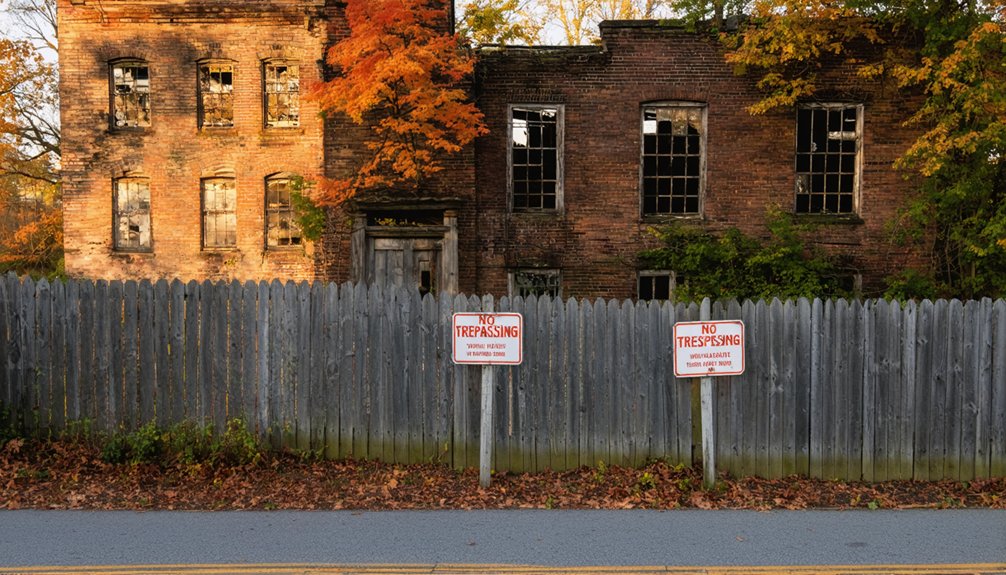
Beyond the thrill of discovery lies a network of laws designed to protect Connecticut’s crumbling heritage from well-meaning damage. When you’re drawn to that weathered historic landmark, know that fewer than 25% of Connecticut’s historic districts operate under local preservation regulations. These aren’t arbitrary barriers—they’re safeguards against irreversible loss.
Before you explore, check if your destination falls under the Community Investment Act’s protection or requires archaeological permits under CGS 10-386.
Many ghost towns sit on state preserves where unauthorized access violates preservation laws. Hartford’s municipal ordinance, adopted in 2006, has processed over 5,000 applications for alterations—proof these places still matter.
Your fascination fuels their survival. Respect the boundaries, document responsibly, and understand that true freedom includes preserving what remains for others.
Frequently Asked Questions
Are Any Connecticut Ghost Towns Wheelchair Accessible for Visitors With Mobility Limitations?
You’ll find limited wheelchair accessibility at Connecticut’s ghost towns. Mystic Seaport Museum offers accessible pathways and mobility aid rentals, letting you explore historic grounds freely. However, remote locations like Dudleytown lack proper accommodations, restricting your independent adventure.
Can I Bring My Dog When Exploring Abandoned Settlements in Connecticut?
You’ll find limited opportunities due to private property restrictions, but state parks like Gay City welcome leashed dogs. Prioritize dog safety amid crumbling structures and follow leash regulations—though trespassing risks your freedom to explore future sites.
Do I Need Special Permits to Visit These Ghost Town Locations?
Revealing history’s doors requires no special permits for public state parks like Gay City, where you’ll roam freely. However, private ghost towns demand permission—consider volunteer opportunities supporting historical preservation to gain authentic access to these forbidden landscapes.
Are Guided Tours Available for Any of Connecticut’s Abandoned Towns?
No guided tours operate at Connecticut’s ghost towns, but you’ll find freedom to explore Gay City State Park’s ruins independently. Historical preservation efforts maintain accessible trails, offering exceptional photography opportunities as you wander crumbling foundations beneath autumn’s golden canopy.
What Cell Phone Coverage Can I Expect at Remote Ghost Town Sites?
You’ll find yourself completely disconnected from civilization—zero bars, pure radio silence. These remote historical preservation sites deep in Connecticut’s wilderness lack any cell infrastructure, letting you experience their environmental impact and eerie isolation exactly as nature intended.
References
- https://newenglandwanderlust.com/fall-in-connecticut/
- https://www.forsakenlandshaunt.com
- https://earlybirdonthetrail.com/haunted-hikes-in-connecticut/
- https://www.cthauntedhouses.com
- https://www.atlasobscura.com/things-to-do/connecticut/ghost-towns
- https://ctvisit.com/articles/ghost-hunting-in-connecticut
- https://i95rock.com/the-abandoned-ghost-town-of-johnsonville-ct-then-now/
- https://www.atlasobscura.com/places/johnsonville-village
- https://johnsonville.omeka.net/exhibits/show/tour/johnsonvilleroad/mill
- https://www.williampitt.com/johnsonville-connecticuts-hauntingly-beautiful-ghost-town/