You’ll find Georgia’s most mesmerizing ghost towns draped in autumn gold, from Auraria’s gold rush ruins in the North Georgia Mountains to Scull Shoals’ flooded paper mill foundations along the Oconee River. Wrightsboro preserves Quaker heritage with its 1810 church and Revolutionary War cemetery, while Ebenezer’s colonial Lutheran church stands since 1769. Don’t miss Godfrey’s weathered 1918 general store or Apalachee’s overgrown railroad remnants emerging from fall foliage. Each site offers haunting glimpses into Georgia’s forgotten communities, and there’s much more to discover about their remarkable stories.
Key Takeaways
- Auraria in North Georgia features Gold Rush ruins including Graham Hotel and Woody’s General Store along historic Gold Diggers’ Road.
- Scull Shoals on the Oconee River showcases Georgia’s first paper mill ruins with foundations and chimneys amid scenic fall foliage.
- Wrightsboro offers one of Georgia’s oldest churches and a Revolutionary War cemetery representing early Quaker settlement history.
- Godfrey preserves a weathered 1918 general store and remnants of a once-thriving cotton economy town now reclaimed by nature.
- Apalachee displays a former railroad hub with an 1857 Baptist church, pioneer cemetery, and overgrown storefronts enhanced by autumn scenery.
Auraria: Golden Remnants in the North Georgia Mountains
The crisp autumn air carries whispers of a forgotten fortune through the North Georgia Mountains, where Auraria slumbers as a memorial to America’s first gold rush. You’ll discover crumbling buildings along Gold Diggers’ Road, remnants of a boom town that housed 10,000 souls chasing dreams in 1833.
Where 10,000 dreamers once chased fortune in 1833, only whispers and crumbling walls remain along Gold Diggers’ Road.
Historic preservation here means wandering freely among ruins like Graham Hotel and Woody’s General Store, where $20 million in gold once flowed through enthusiastic hands.
Gold mining transformed this perfect placer site into Georgia’s first ghost town after California’s 1848 discovery lured fortune-seekers westward. Today, 350 residents share space with history itself.
You’re standing where Grandma Agnes Paschal ran her liquor-free tavern, where miners sparked Colorado’s expansion, and where America’s restless spirit first caught gold fever. The town’s origins trace back to Benjamin Parks’ discovery of a gold nugget in his boot while following deer tracks, igniting the rush that would reshape this landscape forever. The Athens Stage Line once connected this bustling mining hub to Augusta and other towns, carrying prospectors and provisions along scheduled routes that kept the frontier community thriving.
Scull Shoals: Paper Mill Ruins Along the Oconee River
When you explore Scull Shoals in fall, you’ll walk among the crumbling brick walls of Georgia’s first paper mill, established in 1811 along the Oconee River‘s once-powerful rapids.
The riverside trail winds past four-story ruins half-buried in sediment—a monument to how decades of cotton farming sent erosion downstream, raising the riverbed fourteen feet and drowning the water-powered mills that once sustained 600 residents. Fort Clark, built in 1793 by Michael Cupp, originally protected these early settlers from Creek Indians across the river before the community transformed into an industrial center.
Autumn’s cooler temperatures and golden foliage make this the ideal season to trace the foundations of warehouses, textile mills, and grist operations while the Oconee flows quietly past the industrial ghost town it destroyed. The two-mile Scull Shoals Trail leads hikers through the ruins and along scenic riverbanks, though some sections may be overgrown and challenging to follow.
Georgia’s First Paper Mill
Deep within the Oconee National Forest, crumbling brick walls and weathered foundations mark where Georgia’s paper manufacturing industry first took root in 1811. Zachariah Sims and George Paschal constructed this pioneering mill at Scull Shoals, harnessing the Oconee River’s power to transform rags into paper. War of 1812 embargoes fueled demand, making this industrial revolution outpost profitable until 1815. The settlement’s name derives from boats’ sculls, the short oars used to navigate vessels through the challenging rapids.
What made Scull Shoals significant:
- $3,000 state funding launched Georgia’s first paper mill alongside existing grist operations
- Historical architecture evolved from wooden structures to imposing four-story brick buildings after an 1845 fire
- 600+ workers eventually operated 2,000 spindles processing $200,000 worth of cotton annually
- Visible ruins including foundations, chimneys, and an arched bridge remain accessible for exploration
You’ll discover remnants of America’s manufacturing ambitions scattered throughout this forgotten company town. The site attracted settlers for 10,000 years, with Native American hunter-gatherers drawn to the area’s fertile shoals long before industrial development began.
Oconee River Flood History
The flood impact proved catastrophic by mid-1880s, when repeated deluges made mill operations impossible.
The final blow struck in 1887, when historic flooding submerged the entire town for days, destroying most remaining structures.
Even the sturdy 1846 warehouse that survived earlier floods and Civil War troop movements couldn’t withstand abandonment’s neglect.
The site’s water rapids had once powered thriving grist, cotton, and sawmills since 1809, but the same force eventually doomed the settlement.
At its peak, mill operations employed over 600 people across Georgia’s first paper mill and a four-story textile mill.
Today, you’re witnessing nature’s reclamation—skeletal ruins buried beneath the very silt that strangled this once-prosperous settlement’s lifeblood.
Autumn Trail Exploration
From destruction’s aftermath emerges opportunity—fall’s canvas transforms Scull Shoals into Georgia’s most atmospheric ghost town hike. You’ll discover seasonal foliage framing 19th-century brick ruins along the Oconee River’s banks, where trail photography captures autumn’s golden light filtering through centuries-old industrial remnants.
Your exploration reveals:
- Four-story brick warehouse walls standing sentinel since 1846, fire-forged and battle-tested
- Water-powered mill foundations emerging from riverbank silt, testament to pioneer ingenuity
- Textile era structures scattered through forest trails, where 500 souls once thrived
- Native American heritage sites spanning 10,000 years beneath your boots
The gentle trail winds through Chattahoochee-Oconee National Forest, offering unfiltered access to Georgia’s agri-industrial past. Georgia’s first paper mill operated here shortly after 1810, establishing the site’s pioneering role in the state’s industrial heritage. DeSoto’s exploration in the 1540s marked early European contact in this region, centuries before industrial development transformed the landscape.
You’ll walk where papermakers, millers, and frontier settlers carved independence from wilderness—their stone and brick legacy demanding no permission to inspire.
Wrightsboro: Quaker Heritage in McDuffie County
You’ll find one of Georgia’s oldest churches standing watch over Wrightsboro’s Revolutionary War cemetery.
A Methodist sanctuary built between 1810-1812 replaced the original Quaker meetinghouse.
The weathered gravestones tell stories of the thirty-five murders that plagued this pacifist community between 1780-1781, when Patriot raiders targeted families who refused to bear arms.
These preserved grounds mark where Joseph Maddock and his fellow Quakers established the southernmost settlement of their faith in 1768, only to become casualties of their own neutrality.
Revolutionary War Cemetery Remains
Hidden among the rolling hills of McDuffie County, Wrightsboro’s Revolutionary War cemetery stands as a somber testimony to Georgia’s southernmost Quaker settlement and the brutal toll of choosing neutrality during America’s fight for independence.
You’ll discover two distinct Quaker burials grounds where pacifist settlers who refused to bear arms paid the ultimate price. Between 1780-1781, patriot raiders burned their homes and killed dozens, including founder Joseph Mattock, targeting those who wouldn’t choose sides.
What Makes This Cemetery Significant:
- Revolutionary veterans rest alongside persecuted Quakers who died defending their convictions.
- Civil War soldiers from Gettysburg, Shiloh, and Fredericksburg found their final peace here.
- Original 1774 meeting-house once stood within the burial ground’s cedar palings.
- Historical records survived war and raids, now preserved at Guilford College.
Their sacrifice reminds you that freedom includes choosing one’s own path.
Preserved 1810 Methodist Church
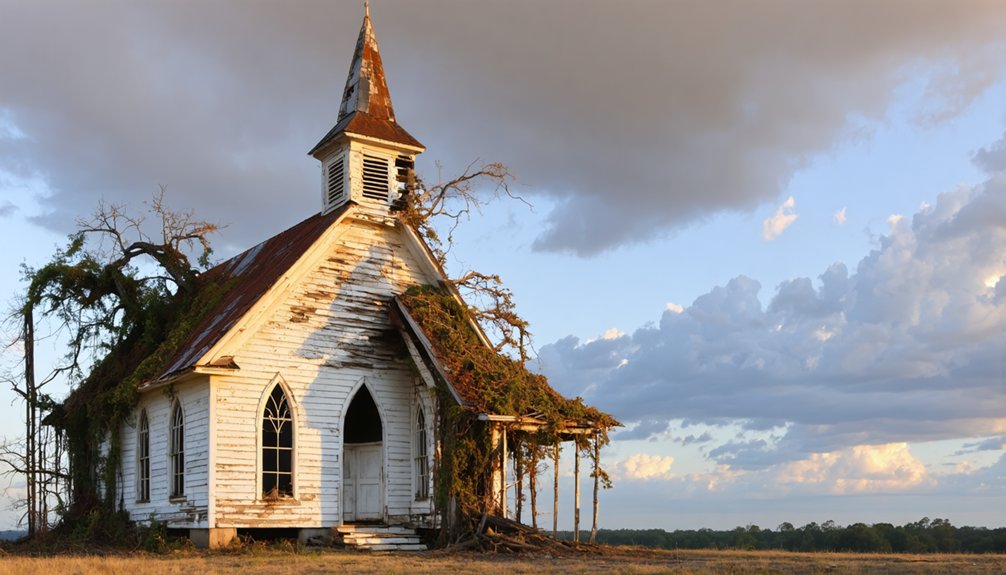
Just beyond the cemetery gates, a white clapboard church rises from a gentle hill, its weathered walls bearing witness to two centuries of faith, conflict, and compromise. Built between 1810 and 1812, this structure embodies an extraordinary principle: it was constructed as Georgia’s first truly non-denominational house of worship, where “all denominations of Christians” could gather freely.
The historic architecture reflects Quaker traditions of simplicity and equality, though Methodists eventually claimed it in 1877 after maintaining the building for decades.
When their congregation disbanded in 1964, McDuffie County inherited this remarkable survivor. Today, you’ll find one of Georgia’s oldest churches standing sentinel over an abandoned town, its enduring presence a demonstration to religious liberty and communal cooperation.
Ebenezer: Colonial Church and Creek-Side Memories
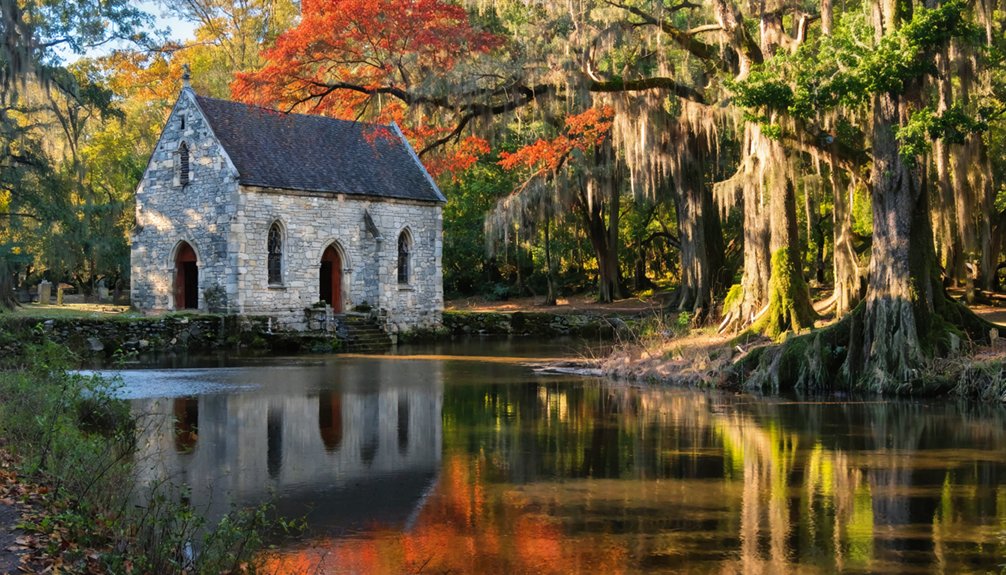
When 150 Salzburger Protestant refugees first stepped ashore along Ebenezer Creek in 1734, they carried more than their meager belongings—they brought a vision of religious freedom that would create one of colonial Georgia’s most distinctive settlements. Today, you’ll find Jerusalem Evangelical Lutheran Church standing as Georgia’s oldest public building, its handmade clay bricks still bearing the fingerprints of those determined colonists.
What Makes Ebenezer Compelling:
- Historic preservation success: The 1769 church remains actively used, hosting Sunday services at 11:00 a.m.
- Colonial architecture showcasing local craftsmanship and resourcefulness.
- Creek-side location offering spectacular fall scenery for contemplative exploration.
- Archaeological evidence revealing how these settlers chose principle over profit, opposing slavery until economics forced their community’s decline.
The belfry’s bullet-scarred swan watches over this testament to idealism.
Godfrey: Rustic Remains in Greene County Countryside
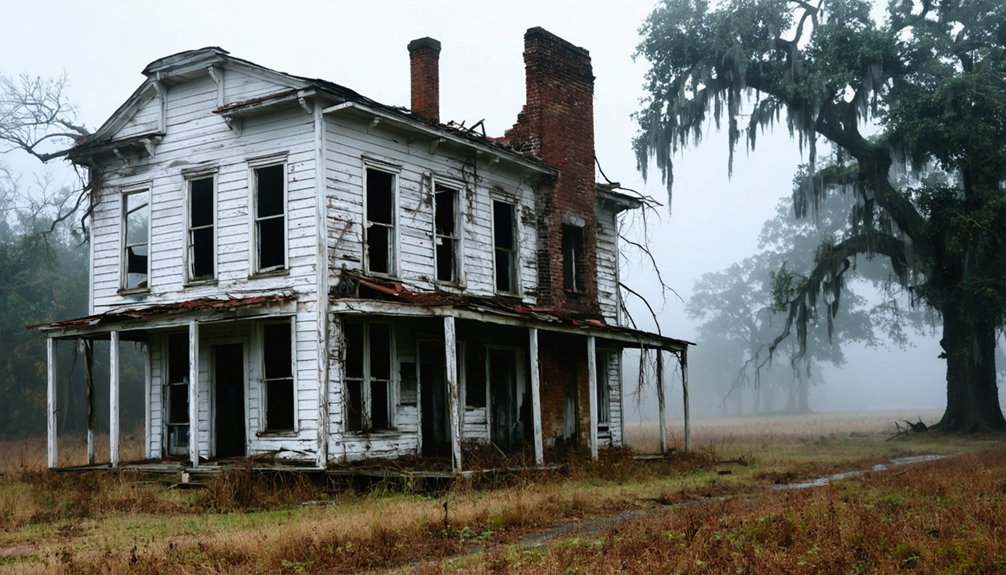
Where cornfields once fed a thriving cotton economy, Godfrey now drowses beneath Greene County’s autumn canopy. Its weathered general store is the last monument to a town that cycled through four names before settling into obscurity. You’ll find handmade brick walls standing sentinel where eight stores, a bank, and cotton gin once hummed with railroad commerce.
A town that wore four names now wears only silence, its brick sentinels guarding memories of commerce long departed.
The circa 1918 general store—roof collapsed since 2019—anchors these rustic remains alongside a cemetery holding stories the living have forgotten.
Dr. James Ervine Godfrey’s former Confederate service and the Walton plantation’s legacy permeate this landscape, though no haunted legends officially cling to the abandoned buildings. October’s golden light filters through empty doorways where customers once bartered.
You’re witnessing Georgia’s forgotten backbone—communities that mirrored national retail’s decline, leaving only whispers in the countryside.
Apalachee: Hidden History Among Fall Foliage
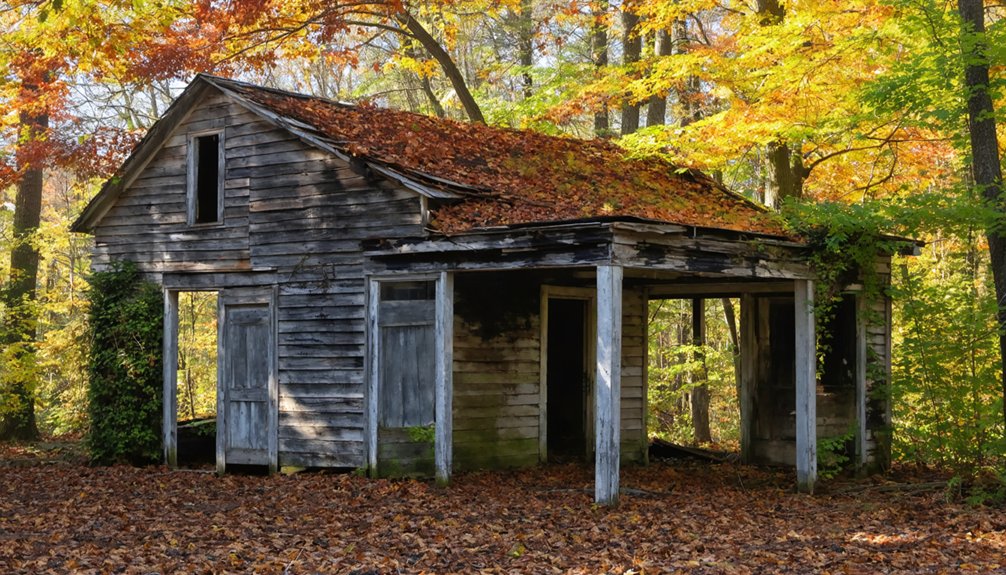
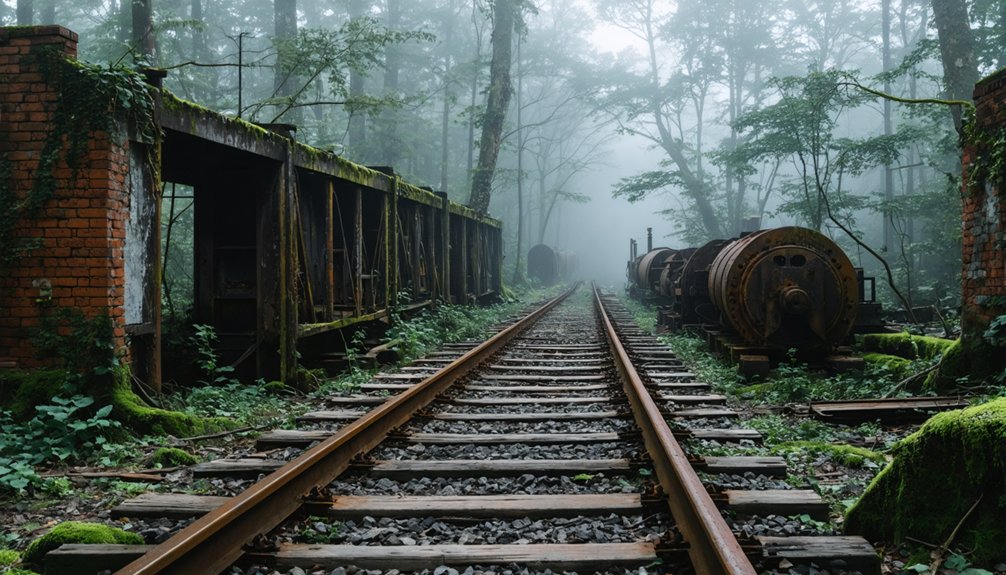
North of Madison along US Highway 441, Apalachee emerges from Morgan County’s fall foliage like a sepia photograph slowly developing. This settlement, named for its Native American heritage from the Creek Confederation, transformed from Dogsborough into a thriving railroad hub after 1888. You’ll discover remnants of its prosperity wandering between parallel roads where overgrown tracks still mark its railroad history.
Essential stops for your exploration:
- Apalachee Baptist Church (1857) – Active congregation maintaining 166 years of community faith
- Original schoolhouse – Preserved early 1900s structure with intricate fireplace details
- Apalachee-Prior Cemetery – Weathered gravestones telling pioneer stories
- Boarded storefronts downtown – Cotton-era commercial district frozen in time
The 2007 Morgan County Bicentennial Marker guides you through decades when cotton, railroads, and determination built something substantial from wilderness.
Planning Your Ghost Town Road Trip This Season
As October’s amber light transforms Georgia’s landscape, your ghost town adventure demands strategic planning to capture both historical atmosphere and autumn’s fleeting brilliance.
Base yourself in Helen for North Georgia’s mountain routes, where mid-October delivers peak fall foliage along twisty two-lane highways connecting Vogel and Tallulah Gorge.
Alternatively, trace the classic corridor from Atlanta through Covington and Madison to Milledgeville’s Central State Hospital ruins, then south to Savannah’s haunted legends.
Budget $15-28 for guided ghost tours, or explore Oakland Cemetery and Memory Hill free during daylight hours.
For coastal history, Cumberland Island‘s Dungeness Ruins offers Carnegie-era atmosphere.
Schedule autumn leaf train rides near Dahlonega, or catch Villa Rica’s ghost train through October 31st.
Reserve accommodations early—Halloween weekends fill quickly.
Photography Tips for Capturing Autumn Ruins
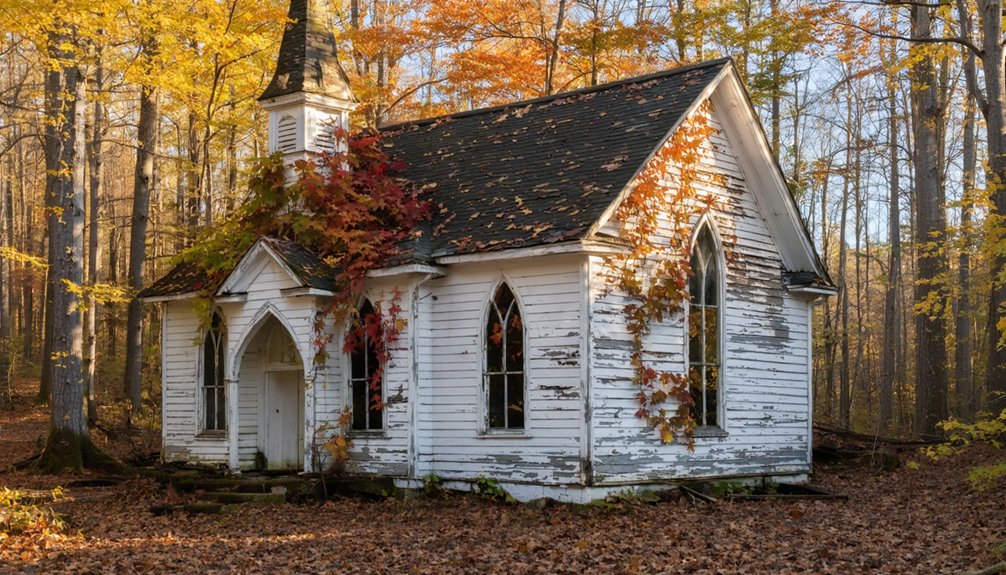
Your camera becomes a time machine when pointed at Georgia’s crumbling structures framed by October’s crimson and gold. These abandoned places demand different approaches than standard landscape work, where weathered textures meet seasonal brilliance.
Master these essential techniques:
- Golden hour transforms decay – Shoot during the first and last light when shadows emphasize architectural details and warm tones complement autumn foliage surrounding ruins.
- Layer your compositions – Position colorful leaves in foreground, decaying structure in middle ground, and sky as backdrop for dimensional storytelling.
- Embrace natural frames – Use doorways, broken windows, and vine-covered openings to draw eyes toward focal points.
- Bracket your exposures – Preserve detail in both bright fall foliage and shadowed interiors where lighting techniques matter most.
These composition strategies honor both structure and season.
Preservation Efforts and Respecting Historic Sites
While autumn draws photographers to Georgia’s ghost towns, these fragile sites survive only through dedicated preservation efforts and visitor responsibility. The Georgia Trust for Historic Preservation, founded in 1973, operates a Revolving Fund to rescue endangered properties and partners with the 1772 Foundation on grants. The state’s Historic Preservation Division identifies sites like Auraria and Scull Shoals while distributing federal funding to local communities.
Community engagement proves essential—Cuthbert residents saved their historic water tower, while New Ebenezer maintains its original church. Yet challenges persist: Historic Rock House faces vandalism, and Butler Island’s Huston House burned in 2024.
Preservation funding remains critical, from HUD’s $40 million Atlanta Westside grant to local initiatives. You’re part of this legacy—respect these spaces by avoiding damage, staying on designated paths, and supporting conservation efforts.
Frequently Asked Questions
Are These Ghost Towns Safe to Visit With Children During Fall?
Most Georgia ghost towns are safe for children, thanks to historical preservation and restoration efforts that maintain stable structures. You’ll find guided tours minimize risks at sites like Dungeness Ruins, though you should supervise kids near unstable areas.
Do Any Ghost Towns Charge Admission Fees or Require Permits?
You’ll find most Georgia ghost towns are free to explore, though historical preservation efforts may require permits for certain areas. Always check local restrictions beforehand—some sites limit access to protect fragile structures while respecting your adventurous spirit.
Among the fascinating sites, you can uncover historic ghost towns in Georgia that tell stories of the state’s rich past. Each town offers a glimpse into a bygone era, with remnants of buildings and local lore that ignite curiosity. As you wander through the remnants of these towns, you’ll experience the unique blend of history and mystery that makes exploring them an unforgettable adventure.
If you’re seeking an eerie experience, consider visiting haunted ghost towns in Georgia, where tales of restless spirits and lost souls linger among the crumbling structures. Each haunt reveals its own chilling story, captivating visitors with whispers of the past. Prepare for a spine-tingling journey through these shadowy remnants, where each step might echo with the footsteps of those who once called these towns home.
What Wildlife Might I Encounter While Exploring Abandoned Georgia Towns?
You’ll encounter bobcats, foxes, alligators, and diverse bird species while exploring abandoned settlements. Beyond haunted legends and local folklore, these ghost towns host 32 endangered species, thriving small mammals, and reptiles reclaiming human spaces in Georgia’s wild terrain.
Can I Camp Overnight Near These Ghost Town Locations?
You’ll find camping opportunities dancing through Georgia’s forests near ghost towns, though you’ll need permits for designated areas. Historical preservation sites often restrict overnight stays, but nearby state parks offer perfect basecamp spots for dawn photography opportunities and exploration freedom.
Are Guided Tours Available for Any of These Sites?
Yes, you’ll find guided tours at Milledgeville and Eatonton that weave ghost town history into haunting narratives. High Falls and Banning Mills lack formal tours but offer self-guided exploration of their preservation efforts and atmospheric ruins.
References
- https://roughdraftatlanta.com/2021/05/23/travels-with-charlie-georgias-ghost-towns-slideshow/
- https://flagpole.com/news/news-features/2013/10/23/exploring-georgias-ghost-towns/
- https://www.ghosttowns.com/states/ga/ga.html
- https://www.ezhomesearch.com/blog/ghost-towns-in-georgia/
- https://vanishinggeorgia.com/tag/georgia-ghost-towns/
- https://www.freakyfoottours.com/us/georgia/
- https://www.youtube.com/watch?v=OfhPAHTOkJE
- https://lisamrussell.substack.com/p/auraria-georgias-golden-ghost-town
- https://www.hhhistory.com/2025/10/auraria-georgias-gold-rush-ghost-town.html
- https://sites.rootsweb.com/~galumpki/history/Auraria_byAB.htm