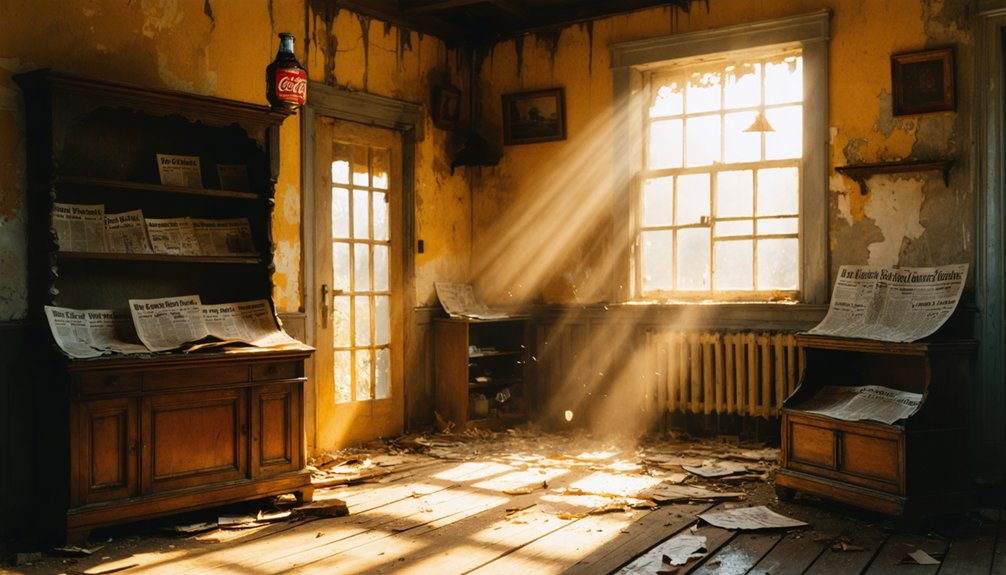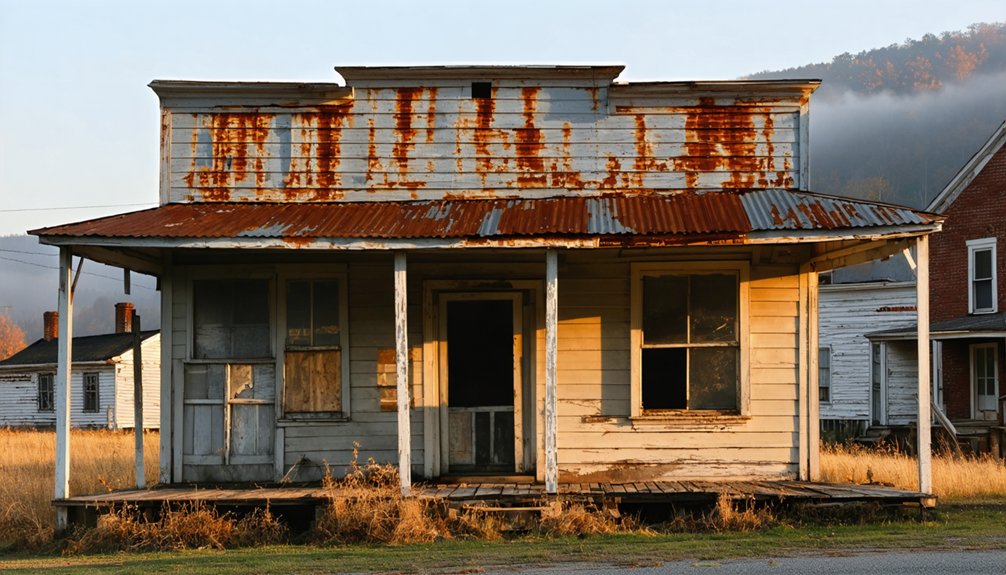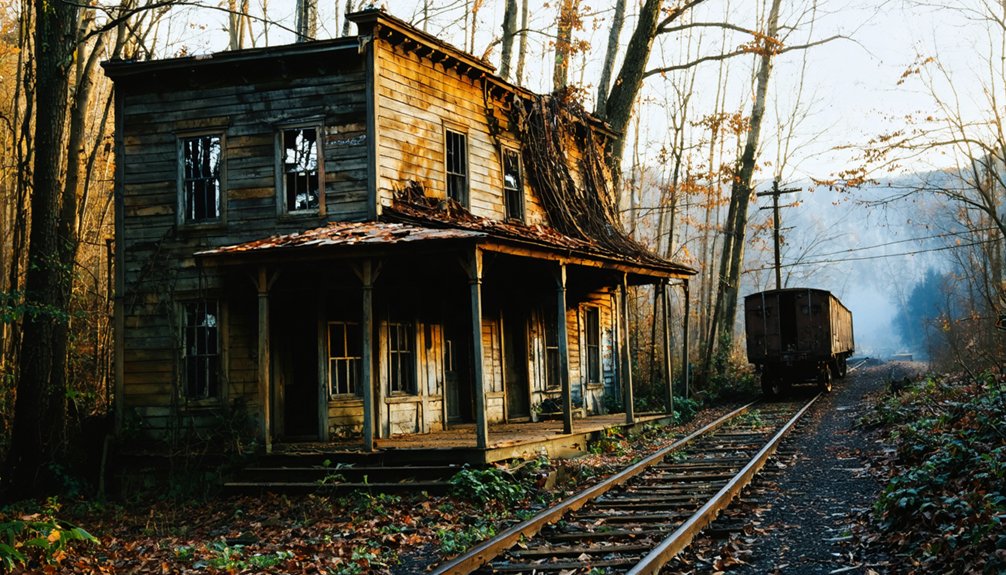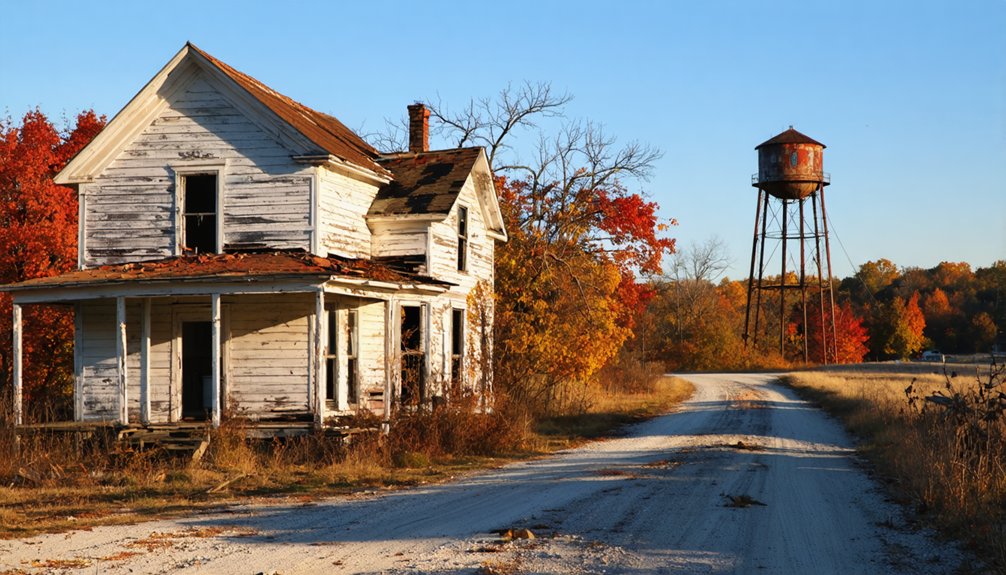
You’ll find Kentucky’s most atmospheric ghost towns come alive during fall when crimson leaves frame the 120-ton coal tipple at Blue Heron Mining Community and golden foliage surrounds Penn’s Store, operating since 1850. September through October offers perfect conditions to explore Rocky Hill’s abandoned railroad remnants, Creelsboro’s riverside ruins along the Cumberland River, and the eerie movie-set facades of Six Gun City theme park. The cool autumn air and seasonal festivals like Blue Heron Ghost Train enhance these haunting landscapes, and there’s much more to discover about planning your exploration adventure.
Key Takeaways
- Blue Heron Mining Community offers outdoor museum with coal mining relics amid Daniel Boone National Forest’s vibrant fall foliage.
- Creelsboro features historic riverport ruins, Native American artifacts, and seventh-largest limestone arch accessible by hiking or kayaking.
- Six Gun City presents abandoned Wild West amusement park with weathered saloon facades near Cumberland Falls State Park.
- Gravel Switch preserves Penn’s Store since 1845, Gothic houses from 1860s–1870s, and historic railroad depot with weathered streets.
- September through October provides peak autumn colors and festivals like Blue Heron Ghost Train enhancing eerie ghost town atmosphere.
Blue Heron Mining Community: A Haunting Journey Through Coal Mining History
Deep in the Daniel Boone National Forest, where the Big South Fork River carves through McCreary County’s rugged terrain, metal skeletons rise from the earth like monuments to a vanished world. You’ll discover Blue Heron’s “ghost structures”—open frameworks marking where miners once lived and worked from 1937 to 1962.
Press buttons along the self-guided trail, and you’ll hear voices describing conditions “dark as a dungeon, damp as the dew.” Mining relics surround you: the 120-ton coal tipple, original rail cars, and electric trams frozen at the mine entrance. Walk across the old coal train bridge to access hiking trails on the river’s opposite side, where scenic overlooks reveal the full scope of this abandoned company town.
The National Park Service recreated this outdoor museum in the 1980s, preserving ghost stories without sanitizing them. The site shares its name with related topics found throughout various regions and contexts. Fall’s vibrant foliage frames these industrial phantoms, offering you unfiltered history amid nature’s reclamation.
Rocky Hill: Where 19th-Century Railroad Heritage Meets Abandoned Streets
The railroad remnants still cut through the landscape, silent witnesses to a vanished era. Today’s hundred residents maintain a volunteer fire department, general store, and post office—ghosts of former prosperity.
Rocky Hill experienced its heyday in the 1920s when it served as a bustling Louisville Nashville Railroad stop with active businesses throughout the town. A devastating fire in 1930 destroyed much of the community, marking the beginning of its long decline.
Visit during Rocky Hill Days to experience this accessible 2WD destination that’s just fifteen minutes from Mammoth Cave National Park.
Creelsboro: A Hidden River Settlement Lost to Time
You’ll find Creelsboro tucked along the Cumberland River‘s north bank in Russell County, where the Creel brothers’ 1800s tavern once anchored Kentucky’s busiest river port between Nashville and Burnside. Getting there requires traversing rural backroads that wind toward the water, but the reward is stumbling upon Campbell’s 1876 country store still standing among scattered houses and memories of steamboat days.
Just a short walk from town, the ancient Creelsboro Natural Arch—locals call it the Rockhouse—rises from limestone formed 300 million years ago, its cathedral-like shelter once protecting Native Americans, long hunters, and yes, even moonshiners from mountain storms. Unlike most natural bridges carved from sandstone, this dolomite formation ranks as the seventh largest in the United States. The settlement once thrived with multiple establishments, including a drug store, tavern, and blacksmith shop that served the riverine community.
Cumberland River Settlement History
Long before Russell County officially formed in 1825, Creelsboro thrived as a bustling river port where flatboats laden with tobacco and produce jostled for position along the Cumberland’s banks.
You’ll discover ancient artifacts here dating back 10,000 years, uncovered when Wolf Creek Dam construction threatened this settlement founded in 1809.
The Creels established river customs that defined commerce—steamboats hauling supplies upstream, flatboats carrying goods to Nashville.
Adair County farmers traveled 28 miles just to ship their harvests from these docks.
You can explore the original bank, stores, and lodging facilities that once served passengers and traders.
The Rockhouse Natural Bridge, documented since the late 1700s, still stands as a *proof* to the long hunters who blazed these trails before civilization arrived.
The Reeder family settled in Rock House Bottom after the Civil War, seeking refuge from guerrilla warfare that plagued their Tennessee homeland.
At its peak, Creelsboro was the busiest river port between Nashville and Burnside, commanding the Cumberland River trade routes that connected Kentucky’s interior to regional markets.
Reaching Creelsboro requires deliberate intent—this isn’t a destination you’ll stumble upon while cruising Kentucky’s modern highways. You’ll navigate Russell County’s back roads, where local folklore whispers through the trees and ghost stories echo from abandoned structures. The Cumberland River serves as your landmark, guiding you to this settlement that time forgot.
Once there, you can:
- Access the river for exceptional trout fishing beneath autumn’s golden canopy
- Hike five miles downstream to witness Rockhouse’s natural arch carved into limestone cliffs
- Explore the preserved Creelsboro Country Store, recently saved from demolition
Fall transforms these chilled hills into a painter’s palette. The scenic route to Rockhouse Bottom showcases countryside dotted with older homes and rural scenery characteristic of the region.
The Kentucky Archaeological Survey offers documentary resources before you venture out, ensuring you’ll maximize your exploration of this vanished river port. The town thrived during the steamboat era, establishing itself as a vital hub on the Cumberland River in the early 1800s.
Nearby Natural Bridge Wonder
The crown jewel of your Creelsboro expedition awaits five miles downstream—a 106-foot natural limestone arch that’s outlasted every building, road, and riverboat that once defined this settlement. Known as Rockhouse, this seventh-largest natural arch in America has witnessed 300-400 million years of history, from Native Americans who sheltered beneath its span to moonshiners who vanished into its shadows.
You’ll spot flood marks on the ceiling from 1943, when rising water let riverboats pass directly through. The Cumberland River still flows beneath this limestone cathedral, where ancient burial grounds remind you that freedom-seekers have always been drawn to Kentucky’s hidden corners.
Pack your hiking boots or kayak—this geological marvel nearly disappeared under Wolf Creek Dam’s floodwaters, making your visit all the more precious.
Gravel Switch: Preserved Structures in an Unincorporated Community
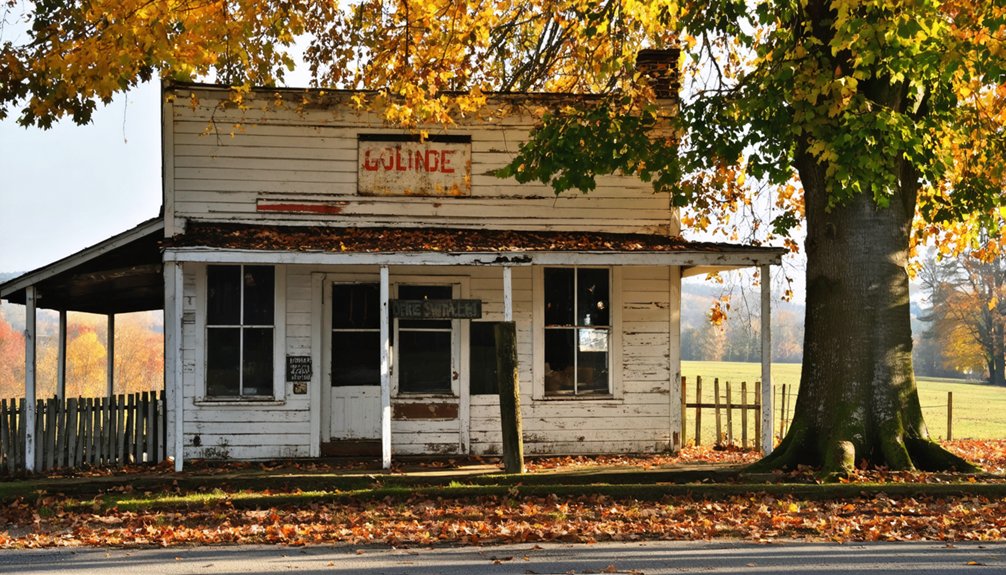
You’ll find Gravel Switch’s peculiar name etched on weathered buildings that have stood since the 1870s, when railroad workers diverted gravel cars at this junction to load prized cementing material from a nearby creek.
The Penn family structures—a log house, rock walkways, and former storage buildings—cluster around Penn’s Store, which has operated continuously since the 1840s and once doubled as the town’s first post office.
Walking these quiet streets in fall, you’ll trace the remnants of a whiskey barrel shipping hub that served distilleries like Maker’s Mark, its industrial past preserved in limestone and aged wood.
Historic Buildings Still Stand
While many Kentucky ghost towns have crumbled into memory, Gravel Switch preserves its past through a remarkable collection of standing structures that span over 150 years. You’ll discover authentic nineteenth-century architecture along abandoned railroads that once brought prosperity here.
Three structures demand your attention:
- Penn’s Store (1845) – Still heated by a Warm Morning stove, this National Register property survived floodwaters reaching its porch roof.
- Gothic balloon-frame houses (1860s-1870s) – Vertical plank construction showcasing pioneer craftsmanship.
- 1857 Railroad depot – A weathered sentinel from the community’s commercial heyday.
Beyond these landmarks, you’ll find the late nineteenth-century frame houses and mid-century structures that tell stories of families who chose permanence over abandonment.
There’s no ghost town cafe here—just authentic preservation.
Distinctive Name and Charm
Among Kentucky’s vanishing settlements, Gravel Switch earned its peculiar name from something far more practical than folklore—a valuable deposit that turned railroad engineers’ heads in the 1870s.
You’ll find this Marion County community clinging to Kentucky Route 243, where abandoned structures whisper their railroad heritage along the defunct Louisville and Nashville line.
Penn’s Store anchors the town’s charm—Kentucky’s oldest general store, operating since 1850. You can wander through the log house, rock walk, and former spirits shop where ghost stories echo through weathered walls.
The post office that once hummed inside closed around 1910, leaving behind that tight-knit rural atmosphere locals still protect.
Don’t expect municipal boundaries here. This unincorporated settlement lives by its own rules, celebrating freedom with annual outhouse races since 1992.
Six Gun City: Kentucky’s Forgotten Wild West Amusement Park
Hidden along Kentucky Route 90 near Cumberland Falls, Six Gun City stands frozen in time—a would-be Wild West attraction that barely got its boots on before riding into the sunset.
Six Gun City: a frontier fantasy that collapsed faster than a tumbleweed town, leaving only weathered dreams behind.
This abandoned park opened in 1998, promising gunfights and frontier thrills as successor to the fire-ravaged Tombstone Junction. You’ll discover weathered buildings that never saw their second season:
- Red Garter Saloon – once hosting magic shows, now hosting only silence
- Boot Hill – a fake graveyard that became genuinely forgotten
- Pa’s Cabin – a fun house with slanted floors tilting toward oblivion
The park hired 70 workers but closed within a year. Today, you’re free to explore this movie-set ghost town where wooden facades and empty storefronts capture the Wild West dreams that died young.
Penn’s Store: More Than Just a Historic Landmark
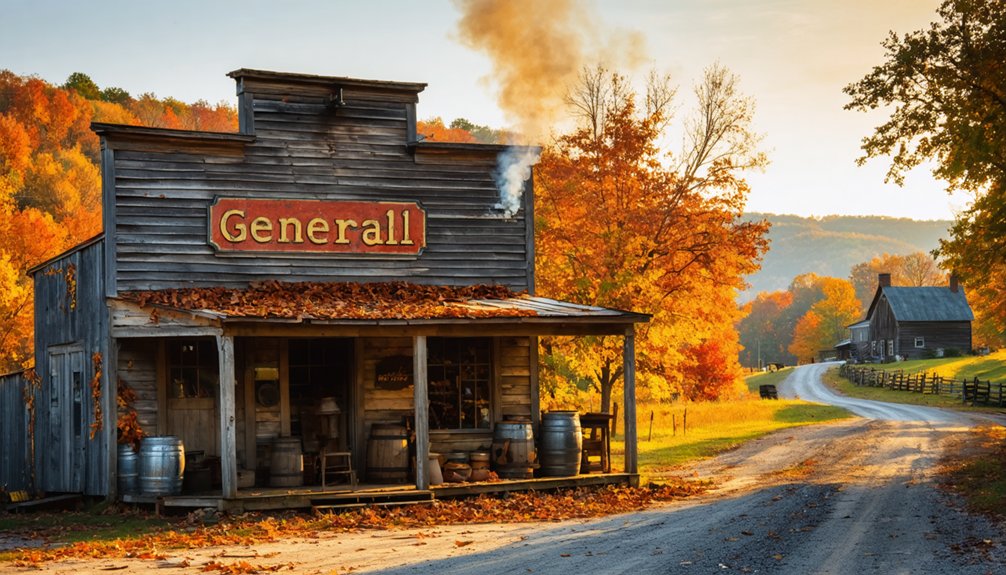
Since 1850, Penn’s Store has anchored the rural crossroads of Gravel Switch, Kentucky—not as a ghost town, but as something rarer: a survivor. You’ll find salt-cured hams still hanging from ceiling spikes, just as they did when Gabriel Jackson Penn first opened its doors.
Historic preservation here isn’t museum-work—it’s Dawn Osborn serving customers like her great-great-grandfather did, extending credit until harvest comes in.
The community stories live in every weathered floorboard. Farmers once traded chickens for dry goods at the back coop.
In 1992, Chet Atkins christened “Penn’s Privy,” Kentucky’s most celebrated outhouse.
Even after the 2010 flood threatened to end 160 years of continuous operation, the Penn family rebuilt.
Visit during April’s Kentucky Writer’s Day, and you’ll understand why some places refuse to become ghosts.
Best Times to Visit Kentucky’s Ghost Towns During Fall Season
When the first September chill settles over Kentucky’s abandoned places, you’ll find the state’s ghost towns transformed by nature’s slow-burning farewell. Seasonal foliage ignites the hillsides surrounding forgotten mining camps and historical sites, while ghost town festivals breathe temporary life into these silent settlements.
As you explore ghost towns in Kentucky’s fall colors, you might stumble upon remnants of life from another era, with vibrant leaves carpeting the ground and framing the crumbling structures. Each town tells a story, from the bustling activity of its peak to the quiet solitude that envelops it now. The contrast between the bright foliage and the deserted streets creates a haunting beauty that captivates all who venture into these historical landscapes.
Plan your escape around these prime windows:
Time your visit strategically to capture Kentucky’s ghost towns at their most atmospheric, when autumn’s colors and festivals collide with abandonment.
- Early-to-mid September: Catch Cynthiana’s gold and crimson transformation before crowds arrive.
- Mid-September through October: Peak foliage across Harrison County’s rolling hills and Daniel Boone National Forest.
- October weekends: Ghost town festivals, including Blue Heron Ghost Train on October 18th and Cynthiana’s atmospheric weekend ghost walks.
The abandoned railroad corridors and creaky mining structures gain paranormal edge when autumn winds whistle through weathered boards.
You’ll experience these haunted landscapes best when fall’s palette frames crumbling foundations against brilliant orange maples.
What to Bring for Your Ghost Town Exploration Adventure

Your backpack’s weight tells the story of preparedness before you even set foot on the overgrown path leading to Kentucky’s abandoned coal camps. Pack long-sleeved layers and weatherproof jackets against October’s unpredictable mountain weather.
Sturdy hiking boots grip uneven terrain where foundations crumble beneath kudzu vines. Your flashlight illuminates darkened structures where urban legends whisper through broken windowpanes—essential when exploring reportedly haunted locations like Rohs Opera House.
Don’t forget wayfinding tools and cameras to document steel frame markers and historical replicas. Water bottles and high-energy snacks sustain multi-hour explorations across Big South Fork’s 125,000 acres.
Printed historical guides provide context about coal operations, while portable chargers keep devices alive for capturing haunted legends. A first aid kit handles minor scrapes from steering through vine-covered rail beds where freedom-seekers once carved their fortunes.
Planning Your Kentucky Ghost Town Road Trip Route
The best Kentucky ghost town routes follow geographic clusters rather than forcing yourself into exhausting zigzags across the Bluegrass State. McCreary County delivers immediate rewards—start at Barthell’s preserved coal town structures, then head to Blue Heron along the Big South Fork River where preservation efforts maintain authentic mining camp buildings.
Consider these strategic clusters:
Strategic clustering of ghost town visits maximizes exploration time while minimizing backtracking across Kentucky’s diverse terrain.
- Eastern Circuit: Combine Estill Springs on SH 89 with Elliott County’s Lawton, though verify access since it’s on private land.
- Western Loop: Henderson County’s Scuffletown near the Ohio River pairs well with Grayson County’s Kyrock, twelve miles west-northwest of Leitchfield on SH 54.
- Henderson Base: Stay where modern amenities exist, then explore remote sites during daylight.
Contact local historical societies beforehand—they’ll share unmarked locations and current conditions.
Frequently Asked Questions
Are Pets Allowed at Kentucky Ghost Town Sites?
Pet policies vary widely at Kentucky’s ghost towns. You’ll find animal restrictions minimal at sites like Dinosaur World and Mammoth Cave, but abandoned places on private property lack official guidelines—you’re exploring at your own risk with your furry companion.
Do Any Ghost Towns Require Entrance Fees or Permits?
Most Kentucky ghost towns don’t require entrance fees or permits, letting you explore freely. However, sites with historical preservation efforts or visitor safety concerns, like Blue Heron Ghost Mine, may charge fees or need National Park passes.
Are Guided Tours Available at These Locations?
Like breadcrumbs leading you through forgotten forests, local guided tours illuminate Kentucky’s ghost towns. You’ll find historical preservation tours at Blue Heron Mining Community, while Louisville, Lawrenceburg, Covington, and Newport offer evening walks celebrating haunted heritage independently.
As you venture deeper into this cultural tapestry, you may stumble upon numerous abandoned sites in Kentucky that tell stories of a bygone era. Each location, filled with remnants of the past, beckons the adventurous spirit and provides a unique glimpse into the state’s history. Exploring these eerie yet fascinating places invites a sense of wonder and reflection on the lives that once flourished there.
Is Cell Phone Reception Available at Remote Ghost Town Locations?
Cell phone coverage varies wildly—you’ll find decent signal strength near Cave City’s tourist zones, but Elsewhere and Six Gun Territory leave you truly disconnected. Pack offline maps and embrace the freedom from constant connectivity in these forgotten places.
Are Overnight Camping Options Available Near These Ghost Towns?
You’ll find camping isn’t directly at ghost town sites—Forest Service regulations keep the historical preservation intact. However, you can pitch your tent nearby in designated state park campgrounds or dispersed forest areas, where local legends echo through moonlit nights.
References
- https://www.hannaheliseschultz.com/blog/waterfalls-amp-ghost-towns-eagle-falls-trail-in-cumberland-falls-state-park-corbin-ky
- https://www.kentuckytourism.com/detail/articles/2023/07/25/autumn-fun-in-kentucky
- https://www.cynthianatourism.com/fall-destination
- https://www.youtube.com/watch?v=ua6VZ_nsero
- https://wkdq.com/abandoned-kentucky-ghost-town-looks-like-something-out-of-a-movie/
- https://ronnysalerno.com/queencitydiscovery/six-gun-city
- https://www.freakyfoottours.com/us/kentucky/
- https://backyardknoxville.com/blue-heron-kentucky-mining-camp/
- https://en.wikipedia.org/wiki/Blue_Heron
- https://npshistory.com/publications/biso/brochures/blue-heron-community-2.pdf