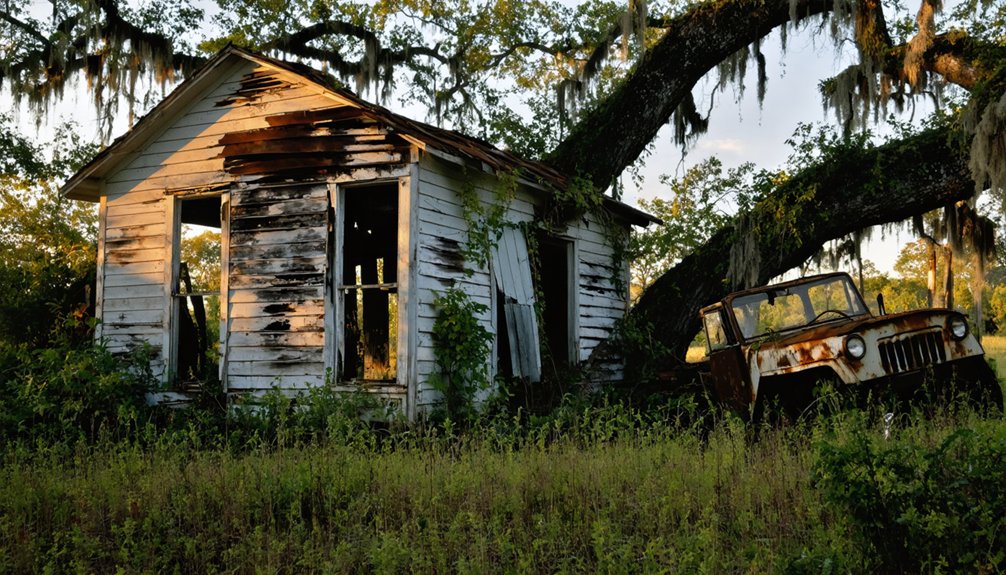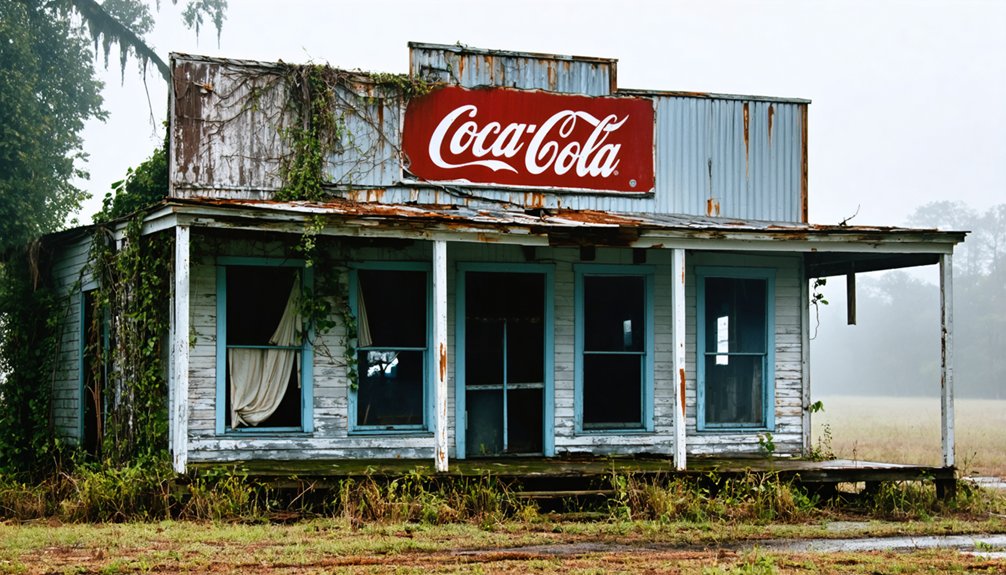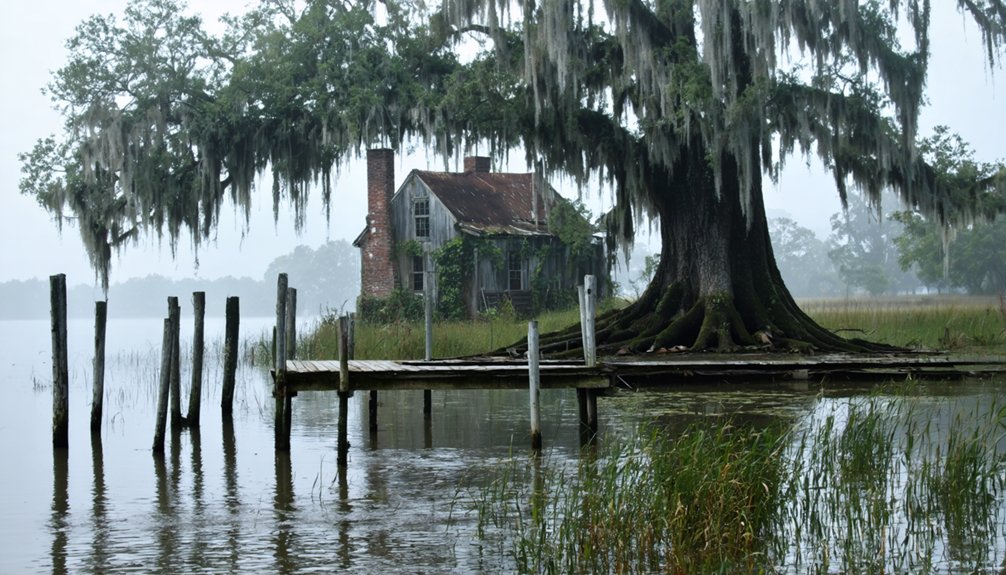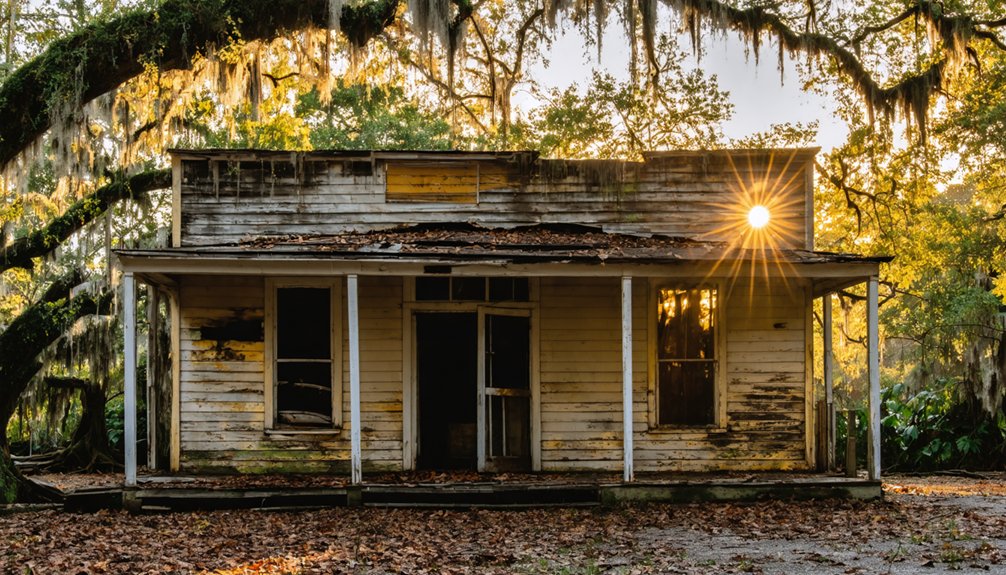
You’ll find Louisiana’s most haunting ghost towns emerging from swamps and coastlines each fall, when cooler temperatures make exploration bearable. Ruddock and Frenier lie submerged in Manchac Swamp, accessible only by airboat through cypress groves where Julia Brown’s curse still lingers. Cheniere Caminada’s crumbling cemetery fights coastal erosion near Grand Isle, while Bayou Chene‘s concrete foundations hide deep in the Atchafalaya Basin. These abandoned settlements—destroyed by hurricanes, flooding, and time itself—reveal Louisiana’s darker histories through moss-draped ruins, forgotten graves, and the resilient spirits of communities that vanished beneath rising waters and devastating storms.
Key Takeaways
- Ruddock/Frenier in Manchac Swamp offers airboat tours through hurricane-destroyed ruins, exploring legends like Julia Brown’s curse and the Rougarou.
- Cheniere Caminada near Grand Isle features a historic cemetery with crumbling graves, memorializing 779 victims of the devastating 1893 hurricane.
- Bayou Chene in Atchafalaya Basin showcases scattered foundations and towering cypress trees from a 1830s logging town submerged by flooding.
- Dark Woods Ghost Town near Natchitoches combines authentic wilderness atmosphere with haunted attractions, including guided swamp tours and ghost stories.
- Isle de Jean Charles displays climate-driven displacement, with remaining stilt homes marking a vanishing indigenous community established in the 1830s.
Ruddock/Frenier: Haunted Manchac Swamp Adventure
Deep in the Manchac Swamp, where cypress trees rise from black water and Spanish moss hangs like tattered curtains, the ghost town of Ruddock clings to Louisiana’s collective memory. This 1890s lumber boomtown met its apocalyptic end during the 1915 hurricane—145 mph winds and 15-foot storm surges obliterated everything, killing 58 residents.
You’ll find the site ten miles north of LaPlace, though nature’s reclaimed what’s left. Haunted legends swirl through these waters: Julia Brown’s alleged curse, the Rougarou prowling moss-draped shores.
Book an airboat tour through the narrow isthmus where 700 souls once lived on stilts above the swamp. The Louisiana Treasures Museum in Ponchatoula displays bottles, tools, and equipment recovered from the ruins by local historian Wayne Norwood. Before the 1915 disaster, the Ruddock Cypress Company established the settlement as a sawmill and company town. Visit the abandoned cemetery‘s ruined headstones—visceral proof of community legends that refuse to sink beneath Louisiana’s dark waters.
Cheniere Caminada: Coastal Ruins Before They Vanish
Louisiana’s coast claims ghost towns differently than the swamps do—not through slow decay and creeping vegetation, but through catastrophic erasure that leaves almost nothing behind.
The narrative of abandoned towns in Louisiana is intertwined with the stories of those who once called them home. Often, these places serve as haunting reminders of the impermanence of communities and the relentless force of nature. Each dilapidated structure stands as a testament to a vibrant past, now lost to time and the elements.
As the seasons change, fall foliage in abandoned towns paints a vivid contrast against the crumbling facades. The fiery reds and oranges embody a beauty that belies the desolation, drawing visitors eager to capture a glimpse of what once thrived. These towns, now wrapped in colorful leaves, remind us of nature’s ability to reclaim and transform, even amidst ruins.
Cheniere Caminada vanished in October 1893 when an 18-foot storm surge killed 779 of 1,471 residents. What was once a thriving resort with French-imported servants and steamers from New Orleans became Louisiana’s deadliest hurricane site.
You’ll find precious little now—a small cemetery along Highway 1 near Grand Isle holds crumbling brick graves beneath dead oaks, their inscriptions fading into sinking ground. The 130th anniversary memorial scheduled for October 1, 2023, includes prayer services and cemetery rededications honoring those lost.
Coastal erosion continues consuming what the hurricane spared. The unnamed hurricane demonstrated how devastating tropical storms could be even before modern tracking systems existed. Visit these ruins before they disappear completely, joining the gold-and-silver church bell and 180 buildings already swallowed by time.
Historical preservation here means witnessing vanishing itself.
Isle De Jean Charles: a Disappearing Island Community
You’ll reach Isle de Jean Charles along a narrow ridge where Gulf waters lap at stilted homes and dead cypress trees mark the ghosts of vanished forests. This Biloxi-Chitimacha-Choctaw community has witnessed 98% of its ancestral land disappear beneath rising tides since 1955—transforming 22,000 acres of marshland into a quarter-mile strip that floods with each storm surge.
The island remained accessible only by boat until 1953, when a mainland road finally connected this isolated settlement to Terrebonne Parish. Oil discovery in 1929 brought offshore drilling operations that carved canals through the wetlands, accelerating the erosion that now defines the landscape. Come before the island completes its retreat into memory, as the few remaining families prepare for America’s first climate-driven resettlement, leaving behind the oyster shacks and rice fields their ancestors claimed in the 1830s.
Indigenous Community and Displacement
For over 170 years, the Biloxi-Chitimacha-Choctaw people have called Isle de Jean Charles home—a sliver of earth that’s now vanishing beneath the Gulf’s relentless waters. You’ll find a community shaped by indigenous resilience, descendants of ancestors who fled westward in the 1830s to escape forced removal.
Chief Albert Naquin has led the fight for cultural preservation since the early 2000s, steering his people through impossible choices as 98% of their ancestral land disappeared. The island endured 15 hurricanes and 2 major floods between 1992 and 2021, with federal data documenting the relentless disasters that accelerated its decline. Access to the island depends on a single-lane “Island Road” that becomes impassable during high water, isolating residents from the mainland.
Today, only a dozen homes remain habitable on what was once 22,000 acres. After Hurricane Ida in 2021, the island emptied—America’s first climate refugees seeking higher ground. Their displacement marks the end of generations sustained by fishing, trapping, and ceremonies rooted in sacred burial grounds now swallowed by rising seas.
Visit Before It Vanishes
The clock is ticking on Isle de Jean Charles—what remains of this ancestral homeland won’t survive another decade of rising tides.
You’ll witness Environmental Impact firsthand: 98% of land devoured since 1955, reducing 22,000 acres to just 320.
Drive the single-lane Island Road while you can—high winds and storm surge frequently render it impassable.
Around a dozen weathered homes still stand on stilts, defiant against the encroaching Gulf.
Cultural Preservation efforts now focus on memory rather than place, as Hurricane Ida left the island virtually deserted.
You’re watching America’s first climate refugees abandon their ancestral fishing grounds in real-time.
What was once five miles wide has shrunk to a quarter-mile sliver—Manhattan’s worth of Louisiana coast vanishes annually.
Bayou Chene: Swamp Settlement Frozen in Time
Deep in the Atchafalaya Basin, where cypress knees pierce black water and Spanish moss drapes like funeral veils, Bayou Chene rests beneath twelve feet of silt—a lost logging town swallowed by the swamp it once conquered.
You’ll find only scattered concrete foundations and the occasional artifact emerging from brambles, remnants of a community that thrived on old-growth cypress extraction and survived entirely by boat until catastrophic floods erased it from maps. Established in the 1830s, the settlement once supported a post office, church, and general store during its prosperous decades before the water reclaimed everything. The 1927 flood ultimately submerged the community, triggering spillway construction that sealed Bayou Chene’s fate and forced residents to dismantle their homes piece by piece.
Reaching these haunting ruins requires traversing narrow channels through dense cottonwood forests, where the autumn air carries both the decay of the wetlands and whispers of the 500 souls who called this watery wilderness home.
Logging and Fishing Heritage
Standing cypress trees over ten feet across their gnarled bases towered above Bayou Chene’s dark waters when lumberjacks first arrived in the 1870s. Their hand saws were inadequate against the ancient red cypress that had watched centuries pass in the Atchafalaya’s stillness.
You’ll discover how the timber industry transformed this waterborne community, with swampers perching on elevated planks driven into trunk slits, spending days felling single giants before steam engines dragged them to sawmills.
The fishing heritage ran equally deep—by the 1930s, nearly 1,000 full-time fishermen worked these waters, generating $250,000 annually.
Boat operators from Morgan City navigated narrow bayous twice weekly, trading fresh fish for groceries.
This dual economy sustained robust community infrastructure: churches, saloons, stores, and a school serving 100 students through the Depression’s darkest years.
Swamp-Surrounded Abandoned Structures
Beneath twelve feet of silt and strangling cottonwood roots, Bayou Chene’s foundations rest where approximately 500 souls once built their lives on narrow strips of forested riverbank, accessible only by pirogue through the Atchafalaya’s labyrinthine waterways. You’ll find community resilience etched in every adaptation these swampers made—raising house floors, constructing cattle rafts, building levees against relentless floods.
The 1927 deluge ultimately proved unstoppable, yet families persisted until the 1950s:
- Wavy floors from silt deposits warned residents of rising water
- Entire structures relocated by barge to higher ground
- A cracked china Virgin Mary statue still haunts the brambles
Their flood adaptation strategies bought decades, but the swamp reclaimed what was always borrowed, leaving only skeletal oak branches protruding through mud.
Accessing the Remote Ruins
Where Bayou Chene once thrived, you’ll need more than determination—accessing this ghost settlement demands specialized watercraft capable of traversing the Atchafalaya’s most treacherous backwaters. Boat navigation here isn’t recreational; airboats push through willow thickets where channels once carried mail-laden vessels.
The flood impact since 1927 transformed familiar waterways into silt-choked mazes buried under twelve feet of sediment. Basin Landing offers guided swamp tours for those unwilling to tackle dense cottonwood forests and twilight-dark conditions alone.
You’ll encounter cement foundations emerging from brambles, cracked china scattered among invasive undergrowth—all that remains visible. Protective gear proves essential against insect swarms that’ve traumatized previous visitors.
This journey demands respect for the basin’s unforgiving terrain, where independence meets Louisiana’s wildest, most authentically preserved abandonment.
Dark Woods Ghost Town: Haunted Attraction Near Natchitoches
Deep in the Louisiana woods off University Parkway in Natchitoches, Dark Woods Ghost Town transforms 4343 University Parkway into a pulse-pounding haunted attraction that’s redefined fall terror since 2014.
Since 2014, this haunted attraction has been pushing the boundaries of fall terror deep in the Louisiana wilderness.
You’ll encounter urban legends come alive through the John Murrell treasure lore and ghost stories woven into pitch-black trails where sinister spirits lurk.
This isn’t your typical jump-scare fest. Experience:
- Dead Fall Trail: Navigate wooded darkness with roaming monsters
- Dark Carnival: Louisiana’s only 3D black-light haunt featuring Boogey the Clown
- Lost Treasure Mining Co.: Dig for gems amid outlaw mythology
Blood-dripping signs, thunder effects, and psychological terror create heart-racing immersion.
Whether you’re driving from Dallas or Shreveport, this nightmare lumber town setting delivers the freedom to scream without judgment—no age restrictions, just pure adrenaline.
St. Louis Cemetery No. 1: Marie Laveau’s Eternal Domain
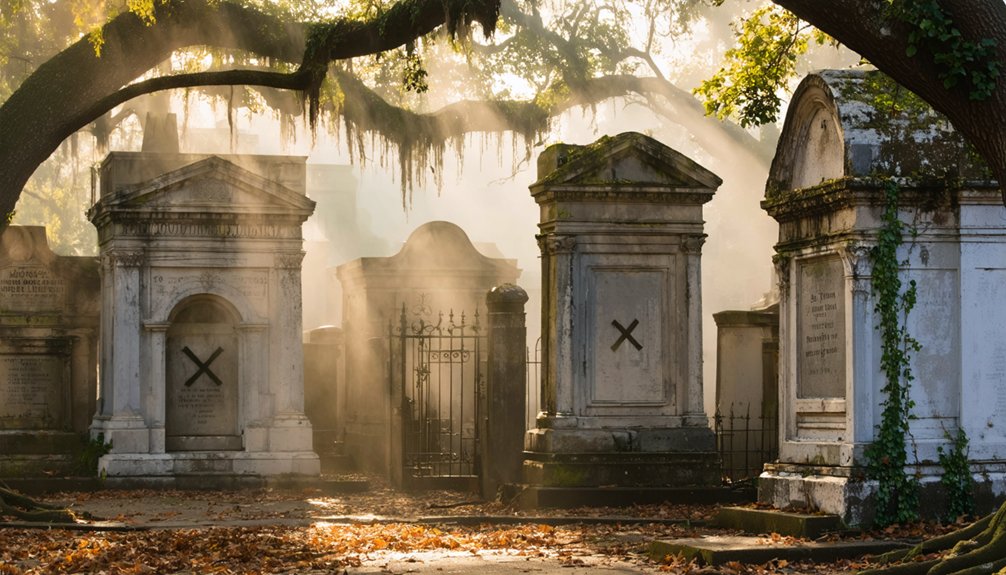
Since 1789, St. Louis Cemetery No. 1 has stood as New Orleans’ most atmospheric burial ground, where elaborate above-ground tombs rise like miniature cities of the dead. You’ll navigate maze-like pathways between crumbling vaults that showcase French, Spanish, Creole, and African American burial customs—each reflecting the cultural tapestry that defines this city.
The cemetery architecture features distinctive oven vaults stacked like filing cabinets, necessitated by the treacherous water table below.
Marie Laveau’s tomb remains the crown jewel, drawing seekers who leave offerings to the legendary Voodoo Queen. Though you’ll need a licensed guide to enter since 2015, the experience transcends typical tourism.
Here, among chess genius Paul Morphy and civil rights pioneer Homer Plessy, you’ll discover authentic New Orleans—haunting, beautiful, and defiantly unconventional.
Oak Alley Plantation: Where Shadows Come Alive
Twenty-eight majestic live oaks stretch their gnarled limbs skyward along an 800-foot corridor that predates the Greek Revival mansion it frames—a natural cathedral planted in the early 18th century by French settlers who never imagined the grandeur to come.
These ancient oaks witnessed centuries of contradictions—natural beauty shadowing human bondage beneath their sprawling canopy.
You’ll discover layers of untold stories beneath this National Historic Landmark’s antebellum facade. The historical architecture conceals profound truths about the 110-120 enslaved people who built this empire.
What plantation conservation reveals:
- Antoine’s paper-shell pecan innovation won the 1876 Philadelphia Centennial Exposition
- Enslaved workers endured 18-hour shifts during harvest “grinding” season
- The People of Oak Alley exhibit chronicles post-emancipation transitions through 1924
Walk the grounds where economic ambition met human suffering. This isn’t romanticized Southern heritage—it’s confronting history’s uncomfortable realities along the Mississippi’s banks.
Myrtles Plantation: Meet the Ghost of Chloe
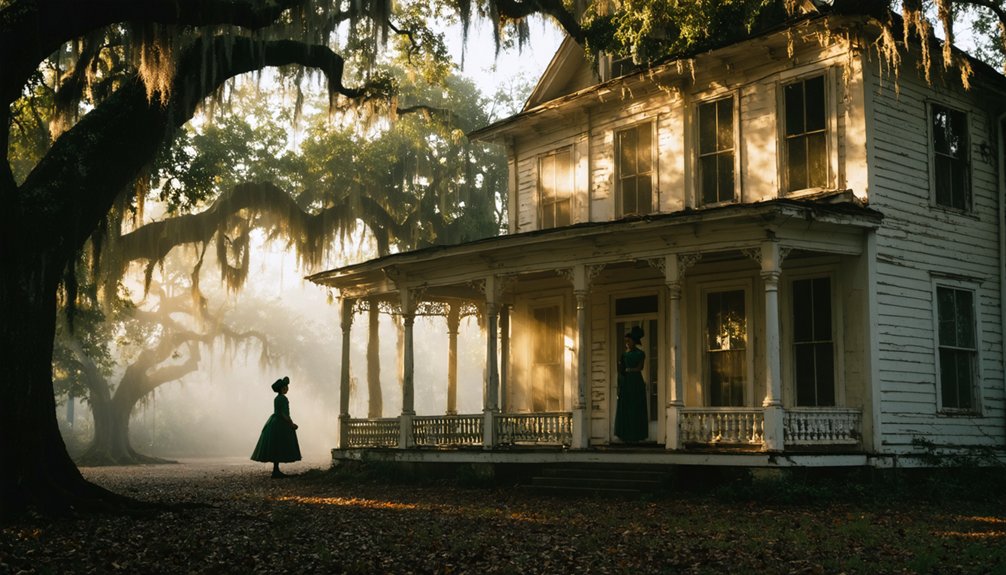
Between moss-draped oaks and white columns of St. Francisville stands Myrtles Plantation, where you’ll encounter Louisiana’s most documented spirit sightings.
The haunted legends center on Chloe, an enslaved woman who wore a green turban to hide her mutilated ear—punishment from Judge Woodruff for eavesdropping. Her desperate attempt to prove her worth through poisoning a birthday cake with oleander leaves backfired fatally, killing Sarah Woodruff and two children.
Fellow enslaved workers revealed her hiding spot, and she was hanged from an oak tree, her weighted body cast into the Mississippi River.
You’ll find Chloe’s turbaned figure wandering nighttime grounds, peering beside beds, her presence accompanied by children’s cries. That famous photograph between buildings? It’s sold as postcards, cementing her as America’s most recognized plantation ghost.
The Mortuary: Year-Round Haunted Experience
While plantation spirits haunt rural Louisiana byways, New Orleans’ most documented paranormal activity thrives year-round at The Mortuary, a Grand Victorian mansion that’s processed over 20,000 funerals since 1872.
Since 1872, this Grand Victorian mansion has conducted over 20,000 funerals, making it New Orleans’ most paranormally active documented location.
You’ll find founder PJ McMahon’s ghost arranging invisible flowers in his Victorian attire, while poltergeist activity has forced permanent closures of certain areas after investigators required medical attention.
This 14,000-square-foot venue near the French Quarter offers authentic encounters beyond typical tourist traps:
- Paranormal investigations by Ghost Lab and Ghost Hunters documented nine resident spirits
- Basement catacombs reveal yellow fever-era embalming rooms with original drain systems
- Haunted artifacts and voodoo masks fill period-appropriate rooms dating to the 1800s
You’re exploring genuine documented hauntings—not manufactured entertainment—surrounded by a million graves within one square mile.
Frequently Asked Questions
What Should I Wear When Visiting Louisiana Ghost Towns in Fall?
Wear autumn attire with moisture-wicking layers—long sleeves shield against thick brush and mosquitoes. You’ll need waterproof hiking boots for muddy, unstable terrain. Pack a wide-brim hat and lightweight jacket for Louisiana’s unpredictable fall weather while exploring freely.
Are Louisiana Ghost Towns Safe to Visit With Children?
Safety varies dramatically—structured tours at preserved sites offer family-friendly historical preservation experiences, while unsupervised urban exploration of abandoned buildings poses serious dangers. You’ll find kid-appropriate guided adventures in New Orleans, but avoid deteriorating structures without professional oversight.
Do I Need Permits to Explore Abandoned Ghost Towns in Louisiana?
“Look before you leap”—you’ll need permits depending on location. Private property requires owner permission. State lands demand coastal zone or archaeological permits for historical preservation. Legal considerations include trespassing laws. Always research ownership and secure proper authorization before exploring Louisiana’s haunting remnants.
What Is the Best Time of Day to Photograph Ghost Towns?
You’ll capture Louisiana’s ghost towns best during golden hour photography—early morning around 8-9 AM or evening sessions. Sunlight timing matters: soft light reveals weathered textures, while avoiding midday’s harsh overhead sun lets you explore freely with stunning results.
Can I Camp Overnight Near Louisiana Ghost Town Sites?
You can camp overnight near ghost towns using dispersed camping in Kisatchie National Forest or state park facilities. You’ll discover historical preservation efforts while enjoying birdwatching opportunities at dawn, experiencing Louisiana’s haunting landscapes with complete freedom.
References
- https://www.louisianabandb.com/blog/halloween-in-louisiana
- https://www.explorelouisiana.com/articles/things-do-haunted-places-louisiana
- https://www.wildlouisianatours.com/activities/special-events/
- https://www.ezhomesearch.com/blog/ghost-towns-in-louisiana/
- https://www.worldatlas.com/cities/6-quirky-little-towns-in-louisiana.html
- https://www.getyourguide.com/louisiana-l583/ghost-vampire-tours-tc23/
- https://darktourists.com/ruddock-louisiana-entire-town-destroyed-by-hurricane/
- https://hnoc.org/publishing/first-draft/julia-brown-curse-hoodoo-hurricanes-and-storm-swamped-ruddock
- https://kids.kiddle.co/Ruddock
- https://lobservateur.com/2015/09/30/ruddock-washed-away-100-years-ago/