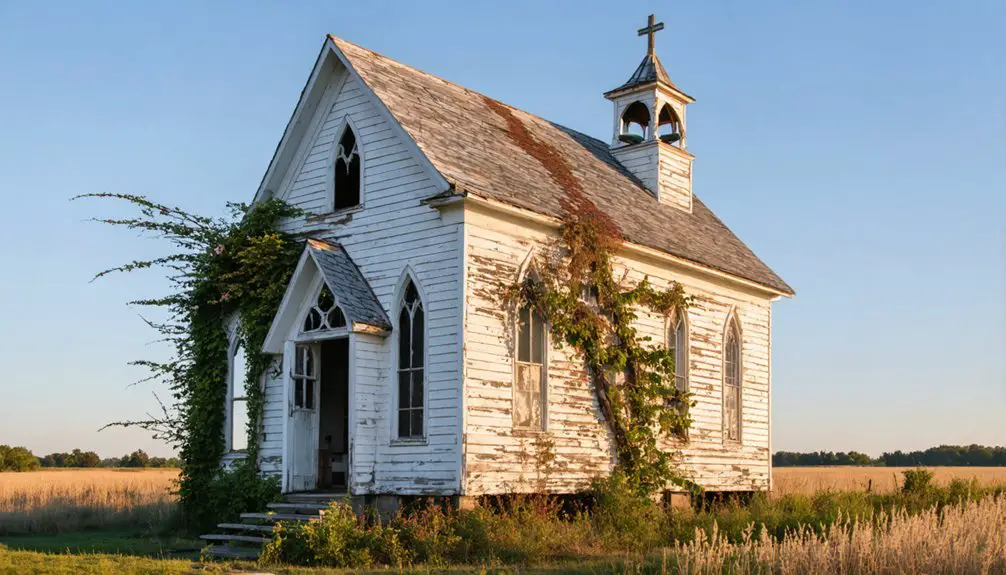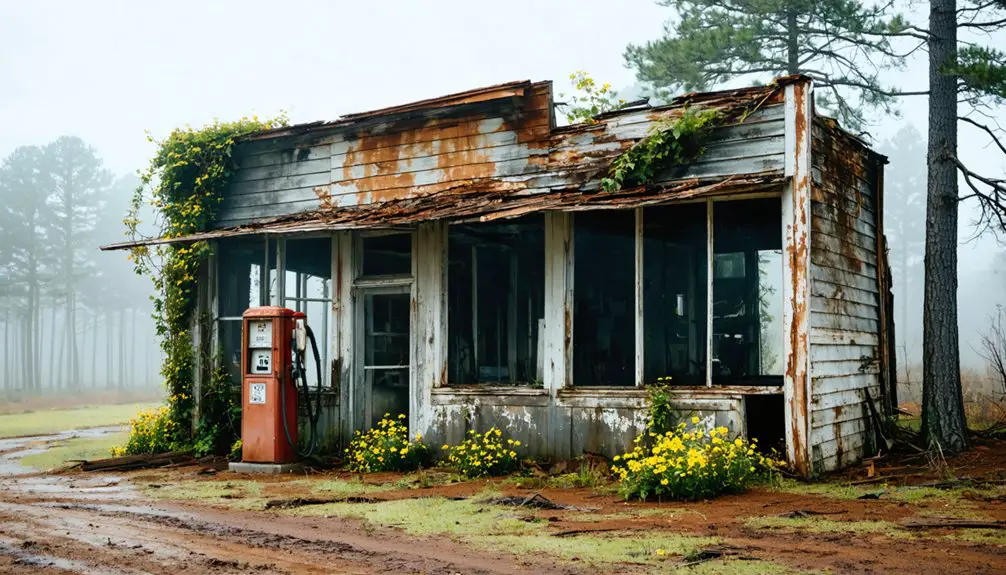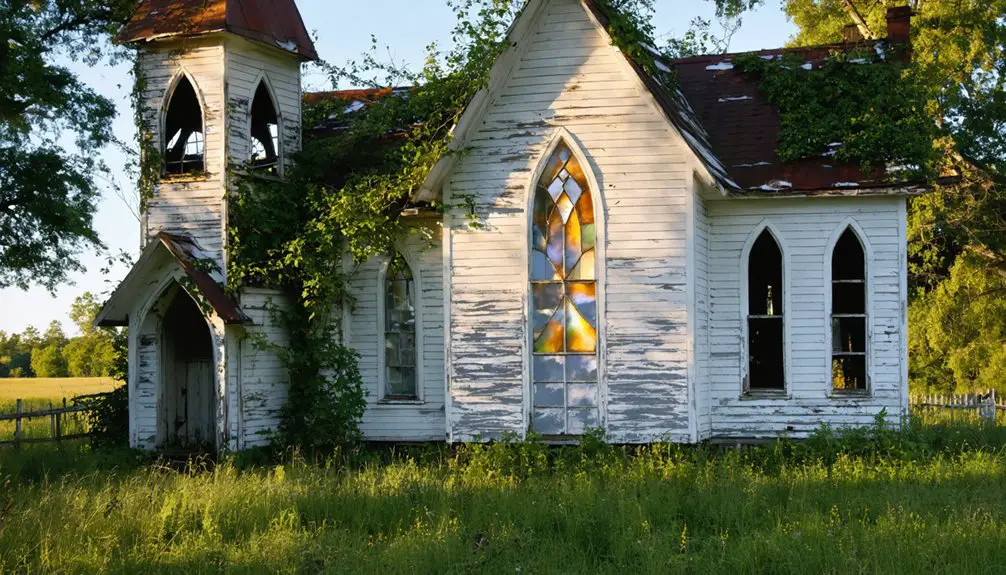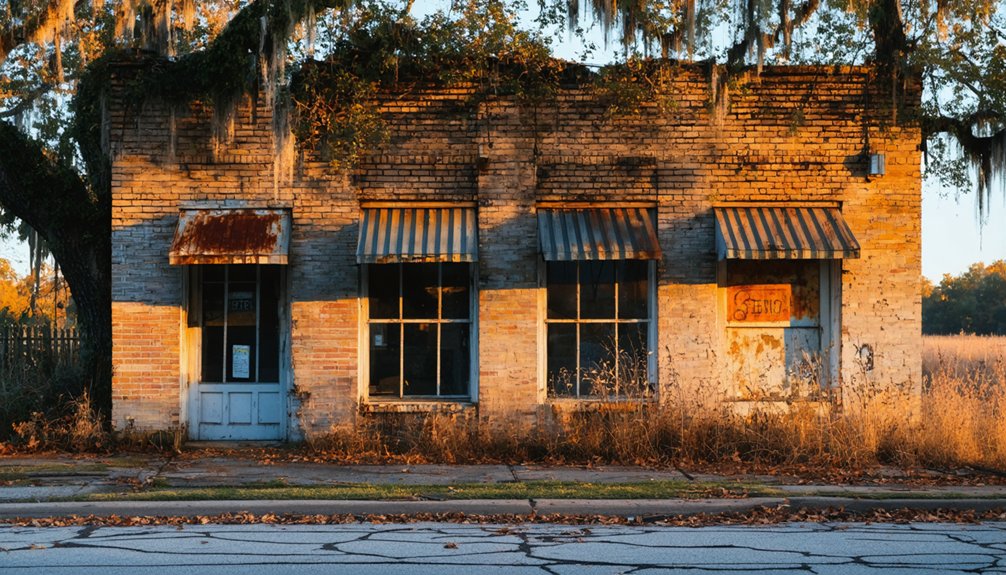
You’ll discover Mississippi’s most mesmerizing ghost towns during autumn when vibrant foliage frames historic ruins. Visit Rodney’s 1828 Presbyterian Church with its silver-dollar bell, explore Rocky Springs’ 1837 Methodist sanctuary where Grant once headquartered, or wander Grand Gulf’s 450-acre military park overlooking the river. Mid-October offers peak scarlet maples and golden hickories against crumbling foundations and weathered gravestones. The cooler 60-75°F temperatures make exploration comfortable as you walk among abandoned storefronts and Civil War earthworks, where each site reveals fascinating stories about Mississippi’s vanished river ports and frontier settlements.
Key Takeaways
- Rodney features the historic 1828 Presbyterian Church and was Mississippi’s most famous port town with only thirteen residents today.
- Rocky Springs offers an 1837 Methodist church, cemetery with graves from 1796, and ruins accessible via National Park Service trails.
- Grand Gulf Military Park spans 450 acres with Civil War fortifications, observation tower, museum, and daily access from 9 AM to 5 PM.
- Mid-October provides peak fall foliage with temperatures between 60-75°F, crisp mornings, and colorful maples, hickories, and dogwoods throughout ruins.
- Autumn’s drier weather and fewer visitors create ideal conditions for exploring abandoned structures, historic markers, and scenic river overlooks comfortably.
Rodney: Mississippi’s Most Famous Ghost Town
When autumn mist rolls off the Mississippi River, it shrouds the skeletal remains of what was once a thriving port town that hosted presidents and cotton barons.
Autumn fog drifts across Mississippi’s waters, veiling the ghostly remnants of a once-prosperous port where history still whispers.
You’ll discover Rodney’s haunting beauty through its 1828 Presbyterian Church, where a bell cast with 1,000 silver dollars still hangs silent.
Ghost stories echo through these ruins—tales of the 1843 yellow fever epidemic that nearly depopulated the town, Union soldiers’ 1864 plunder, and devastating fires that consumed entire blocks.
Only thirteen residents remain among the crumbling facades of what once boasted 35 stores, two banks, and Mississippi’s first opera house.
The town nearly became Mississippi’s first capital in 1817, a distinction that would have changed its fate entirely.
On September 13, 1863, Confederate cavalry surrounded the church during services, demanding Union soldiers’ surrender in a dramatic gunfight that left the building shelled.
Preservation challenges mount as flooding continues eroding this historic site, making each fall visit potentially your last glimpse of authentic frontier grandeur.
Rocky Springs: A Vanished Community in Claiborne County
As you step through the weathered gates of Rocky Springs Cemetery, autumn leaves drift past leaning tombstones that mark the graves of settlers who arrived in 1796. Their names are slowly fading like the town itself.
The white clapboard Methodist church from 1837 stands alone among the ruins—its doors still open to visitors. The congregation that once filled its pews has long since vanished. In May 1863, Ulysses S. Grant’s headquarters occupied this very church as his troops swept through on their campaign, living off the land and hastening the town’s eventual decline.
Walking the short trail through October’s golden light, you’ll trace the skeleton of a community that swelled to 2,600 souls before yellow fever, failed cotton crops, and a dried-up spring erased it from the map by 1940. Among the scattered foundations, you can still find the blacksmith shop remains where craftsmen once forged horse shoes and repaired metal tools for surrounding farmsteads and plantations.
Cemetery and Historical Markers
Perched on a gentle hill overlooking what was once a bustling community of 2,600 souls, Rocky Springs’ small graveyard holds the weathered stones of settlers who arrived in the late 1700s with dreams of prosperity along the Natchez Trace.
You’ll find cemetery preservation efforts by the National Park Service have kept this sacred ground accessible via a short loop trail during daylight hours, adjacent to the 1837 Methodist Church—the town’s only standing structure. The church’s belfry was removed in 1901 due to safety concerns, altering the building’s original silhouette.
As you walk the trail, interpretive signage reveals the town’s dramatic arc: its peak prosperity, the devastation wrought by 50,000 Union troops foraging in 1863, and the final blows of yellow fever, boll weevils, and a dried spring. General Ulysses S. Grant commandeered the church as camp headquarters, removing pews to position his desk where the pulpit once stood.
Rusted safes and cisterns punctuate your journey through this vanished world.
Fall Foliage and Ruins
Beyond the weathered headstones and silent Methodist church, Rocky Springs’ autumn landscape transforms into a haunting canvas where amber-leaved hickories and scarlet sweetgums frame the skeletal remains of a once-thriving cotton town.
You’ll discover rusted safes emerging from carpets of fallen leaves, their iron bodies surrendering to native plant roots that crack through forgotten foundations. The seasonal weather brings crisp mornings perfect for exploring the short loop trail, where fog clings to abandoned cisterns like spectral residents refusing to leave.
October’s palette intensifies the site’s melancholy beauty—golden hickories arch over crumbling walls while dogwoods blaze crimson against weathered placards. The Methodist church structure still stands open to visitors, maintaining monthly services that echo through its preserved sanctuary.
Nature’s reclamation feels complete here, yet you’re free to wander these wooded ruins without barriers, touching history while surrounded by Mississippi’s unrestrained autumn glory.
Economic Decline and Abandonment
How does a town of 2,600 souls simply vanish from the earth? Rocky Springs‘ economic impact tells a brutal story of cascading failures. The Civil War stripped the community bare—slaves freed, livestock seized, crops torched. You’ll sense the desperation in an 1863 letter describing torn fences and devastated fields.
Yellow fever struck twice, claiming 43 lives in 1878 alone, then returning in 1888 to finish what war started. The 1905 boll weevil epidemic destroyed cotton crops, collapsing the agricultural backbone. Poor farming practices eroded the soil until even the natural spring dried up.
Community decline accelerated—the last store closed in 1930, the post office shuttered in 1932. By 1940, every resident had fled this once-thriving settlement.
Grand Gulf: Exploring a Former River Port
You’ll discover Grand Gulf’s haunting beauty intensifies each autumn, when fallen leaves blanket the Spanish House’s weathered timbers and crimson vines climb the Sacred Heart Church’s relocated walls.
This once-thriving port—Mississippi’s third-largest city before yellow fever, explosions, and a vengeful river consumed fifty city blocks—now whispers its stories through crumbling fortifications and empty streets.
As you walk where steamboats once docked and Confederate cannons thundered, the crisp fall air carries echoes of a prosperity the Mississippi River refused to let survive. The 400-acre military park, established in 1962, preserves Fort Wade and Fort Cobun alongside hiking trails and an observation tower offering panoramic views of this haunted landscape. The town’s resilient inhabitants continue rebuilding on stilts above floodwaters, their mobile homes standing as testaments to a community that refuses to fade despite nature’s repeated attempts to erase it.
Historical Significance and Decline
Standing at the Grand Gulf overlook today, you’ll struggle to imagine this quiet bend once thrummed with the chaos of Mississippi’s third-largest town.
By the late 1830s, this cotton port boasted 1,000 residents, over 20 weekly steamboat arrivals, and the urban development that rivaled established cities.
The cultural heritage here runs deep—from Native American settlements through Spanish land grants to its explosive 1830s heyday when 37,770 cotton bales shipped in a single season.
Among the merchants who built their businesses here were Jewish peddlers and traders, including the Levy family who established operations by 1838.
Nature conspired against permanence. Yellow fever struck repeatedly after 1843.
A steamboat explosion obliterated the docks in 1852, followed by a devastating tornado.
Then the Mississippi itself turned traitor, shifting course and swallowing fifty city blocks.
Autumn Landscape and Atmosphere
When autumn settles over Grand Gulf’s 450 acres, the transformed landscape reveals why fall ranks among the finest seasons to explore this Mississippi River ghost.
You’ll discover silent ruins emerging through golden foliage, where Fort Cobun’s earthworks cast long shadows across crimson-tinged bluffs.
The 75-foot observation tower frames autumn reflections dancing on the river below, while hiking trails wind through oak groves ablaze with seasonal color.
Three sensory encounters define your fall visit:
- Cemetery monuments standing sentinel among fallen leaves, their weathered inscriptions catching slanted October light
- Mississippi River mists rolling across bottomlands at dawn, shrouding steamboat-era remnants
- Wind stirring through the Spanish House’s timbers, carrying whispers of vanished port commerce
This crowd-free sanctuary offers unscripted exploration—just you, history’s echoes, and nature’s transformation.
Accessing the Preserved Site
Eight miles northwest of Port Gibson off Highway 61, Grand Gulf Military Park awaits your arrival with 450 acres of preserved history spread beneath Mississippi’s changing skies. You’ll find the gates open daily from 9 AM to 5 PM, welcoming you to wander at your own pace through this riverside ghost town.
The park’s preservation techniques have rescued structures from oblivion—the Spanish House stands defiant since the 1790s, while Sacred Heart Catholic Church arrived from dying Rodney to find sanctuary here.
Visitor facilities blend seamlessly into the landscape: hiking trails wind past Fort Wade’s earthworks, an observation tower offers commanding views, and camping grounds let you linger beneath autumn stars. The museum houses Civil War relics, while picnic areas invite contemplation among the ruins of Mississippi’s third-largest city.
Logtown: Hancock County’s Forgotten Settlement
Nestled where the Pearl River meets the Gulf, Logtown once thrummed with the rhythmic pulse of sawmills and the dreams of over 3,000 souls who called this bustling lumber town home. Founded in 1815, this vanished settlement reached its zenith when H. Weston Lumber Company employed 1,200 men across sprawling operations.
You’ll discover community legends whispered among descendants who remember:
- Saturday nights at the silent movie theater where lumberjacks courted local girls
- The Parkview Hotel’s dining hall serving hearty local cuisine to weary millworkers
- Summer evenings at the swimming pool beneath ancient moss-draped oaks
When NASA claimed the land in 1961, 250 families watched their heritage bulldozed into memory.
Today, only the cemetery stands sentinel—a defiant reminder that freedom-loving pioneers once carved empire from wilderness.
Fort Adams: A Frontier Post Frozen in Time
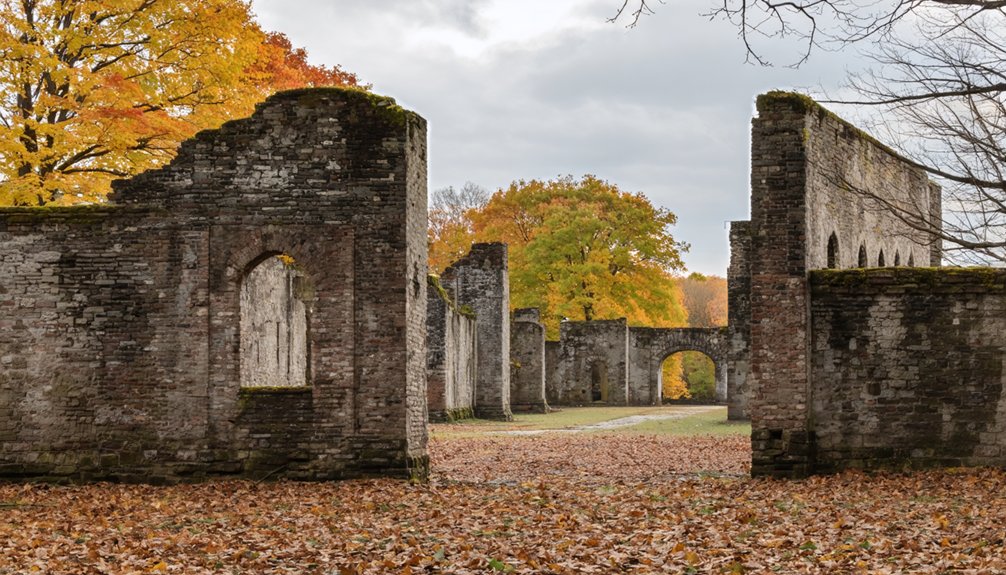
Long before Louisiana belonged to America, a limestone bluff commanded the Mississippi’s eastern bank where Spanish territory ended and the young republic’s ambitions began. You’ll find Fort Adams where 500 troops once guarded the nation’s southwestern frontier, collecting duties from riverboats steering between sovereign lands.
Where empires met on Mississippi’s bluff, soldiers collected tribute from vessels navigating the boundary between Spanish dominion and American aspiration.
The 1801 Choctaw Treaty signed here opened territories your ancestors would claim as their own.
Walk through this riverport history where Meriwether Lewis paused before his legendary expedition. The Mississippi betrayed this settlement during the Civil War, shifting its channel a mile away.
Now floodwaters reclaim what the river abandoned, leaving structures marked by decay and defiance. Those who remain live above the waterline, watching their town dissolve into the delta’s patient grip—a reminder that nature recognizes no treaties.
Bruinsburg: Where History Meets Autumn Beauty
Where Bayou Pierre whispers into the Mississippi, you’ll discover a vanished world that Irish immigrant Peter Bryan Bruin carved from wilderness in 1788. Though nothing remains of this once-thriving river port, autumn transforms the private grounds into a cathedral of gold and crimson where local legends still echo.
Stand where Grant’s troops landed in 1863, where Aaron Burr fled treason charges, and where Jackson built his trading empire:
- The ghost of commerce haunts these quiet banks where steamboats once crowded the landing.
- Cultural festivals in nearby Port Gibson honor the vanished settlement each fall.
- Ancient mounds beneath your feet whisper of civilizations predating Bruin himself.
You’ll access this phantom town through Port Gibson’s commemorative plaque, following freedom-seekers’ paths toward the magnificent Windsor Ruins standing sentinel ten miles southwest.
Best Times to Visit Mississippi Ghost Towns in Fall
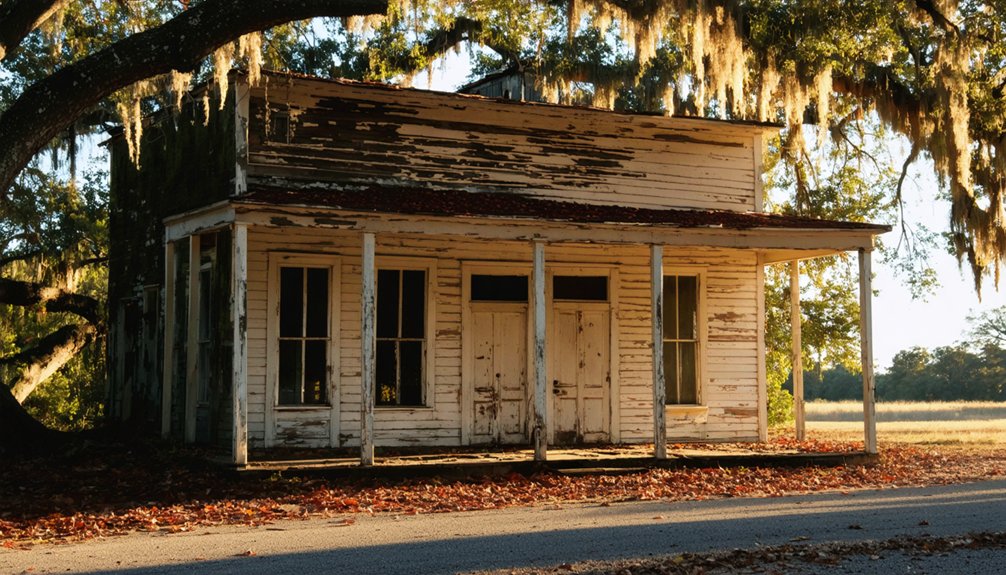
You’ll find Mississippi’s ghost towns most enchanting when October’s crisp air settles around abandoned storefronts and crumbling chimneys, with daytime temperatures hovering between 60-75°F.
The golden weeks from late September through early November transform these forgotten places into living canvases, where rust-colored leaves frame Windsor Ruins’ towering columns and amber light filters through Rodney’s skeletal church windows.
Time your visit for mid-October, when the Natchez Trace Parkway blazes with fall color and morning mist clings to weathered facades, creating the perfect backdrop for your exploration of Mississippi’s haunted past.
Optimal Weather Conditions
When autumn settles over Mississippi’s abandoned settlements, the oppressive blanket of summer heat finally lifts, transforming these forsaken places into havens of exploration. You’ll find temperatures dropping from stifling 90s to comfortable 70s, while mornings greet you with crisp 50-degree air perfect for unrestricted wandering.
The fall conditions create ideal circumstances for your untethered adventures:
- Minimal rainfall (3-4 inches monthly) keeps crumbling structures accessible and paths navigable.
- Reduced humidity eliminates the suffocating moisture that plagued summer expeditions.
- Receded floodwaters from the Mississippi River expose previously submerged foundations.
You’ll encounter seasonal wildlife emerging in cooler temperatures, while nearby autumn festivals contrast sharply with the silence of these forgotten streets.
Extended daylight hours—11 to 12 per day—grant you freedom to explore without rushing, capturing weathered remnants before winter’s arrival.
Foliage Peak Timing
The sweetgums flanking Mississippi’s forgotten settlements ignite into crimson torches between October 19th and November 4th, their transformation marking nature’s reclamation of what humans abandoned.
You’ll witness the state’s most dramatic seasonal foliage when maples blaze scarlet against weathered timber frames and hickories cast golden light through empty window frames.
Weather considerations matter—recent rainfall amplifies the vibrancy, while drought dulls the spectacle to mere brown whispers.
Northern districts along the Tennessee border shift first, their oaks turning russet by mid-October.
Central ghost towns hit peak glory after those critical cool nights arrive.
What to Bring on Your Ghost Town Adventure
As Mississippi’s fall air carries whispers of forgotten settlements through rustling sweetgum leaves, proper preparation transforms your ghost town expedition from potentially hazardous to genuinely rewarding. You’ll need sturdy boots for traversing crumbling foundations, layered clothing for unpredictable temperatures, and snake gaiters—because these abandoned places belong to nature now.
Tracking the vibrant fall foliage in Mississippi ghost towns can lead to stunning photo opportunities, as the brilliant hues contrast with the decaying architecture. Each deserted structure tells a story, inviting exploration while wrapped in the colors of autumn. Embrace the serene beauty and haunting silence, and you may uncover hidden gems amidst the wilderness reclaiming its territory.
Essential gear for your liberation into history:
- Navigation tools: GPS devices and printed maps guide you through vanished communities where local legends still echo
- Protection essentials: First aid kits and insect repellent defend against wilderness reclaiming Windsor Ruins
- Documentation supplies: Notebooks capture stories older than any campfire recipes your grandmother knew
Pack water, high-energy snacks, and a headlamp for exploring shadowed structures. Your independence demands respect for these sites—bring trash bags and leave only footprints.
Photography Tips for Capturing Abandoned Sites
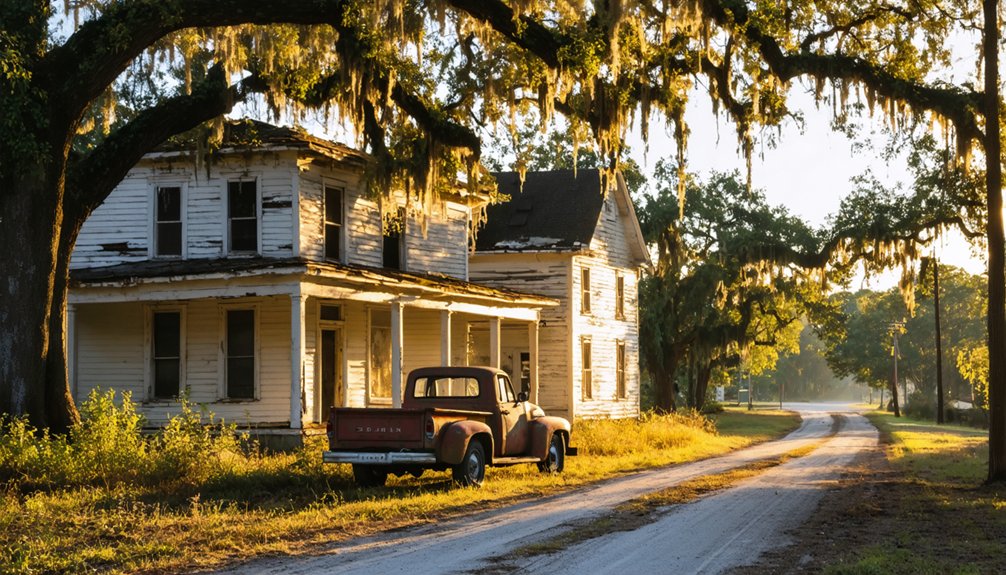
Capturing Mississippi’s ghost towns through your lens demands more than pointing and shooting—it requires understanding how light transforms decay into art. Chase natural light streaming through shattered windows on sunny days, or embrace long exposures at dusk when abandoned structures take on ghostly character.
Your photography gear should include a sturdy tripod for low-light shots and a wide-angle lens to emphasize the vast emptiness of forsaken spaces.
Position yourself low to the ground for dramatic perspectives that amplify the haunting scale of urban decay. Seek symmetry down collapsing hallways, then break it deliberately by framing crumbling doorways and overgrown staircases. Focus on weathered details—rusting meters, peeling wallpaper, nature reclaiming forgotten rooms.
These elements tell stories of lives once lived, now surrendered to time’s relentless march.
Staying Safe While Exploring Historical Ruins
Before you step through that doorway where hinges hang like broken promises, understand that Mississippi’s ghost towns protect their secrets with rusty nails and rotted timber.
Wildlife safety demands respect—snakes coil beneath fallen beams, and ticks wait in forgotten gardens. Permission guidelines aren’t bureaucratic hurdles; they’re your shield against trespassing charges that’ll end your adventure.
Your survival checklist:
- Test every surface before trusting your weight to century-old floorboards
- Wear boots and long pants as armor against fanged encounters in summer grass
- Stay visible near Stennis Space Center’s buffer zones where restricted areas blur into history
Watch for ground instability where mining operations left hollow earth beneath your boots. These ruins won’t coddle you—they’ll swallow the unprepared whole.
Frequently Asked Questions
Are Any Mississippi Ghost Towns Privately Owned or Off-Limits to Visitors?
Yes, you’ll find private ownership severely limits your exploration. Rodney’s crumbling buildings remain off-limits without permission, while Logtown sits locked within NASA’s buffer zone. Access restrictions mean you’re confined to roadside glimpses of these haunting remnants.
Can I Camp Overnight Near These Ghost Town Locations?
Like nomads respecting sacred ground, you’ll find overnight camping isn’t permitted at most ghost towns due to preservation efforts. Grand Gulf Military Park offers your safest bet—legitimate campgrounds nearby balance camping safety with your adventurous spirit.
Are Guided Tours Available for Mississippi Ghost Towns?
Yes, you’ll find guided tours throughout Mississippi’s haunted locations, offering historical preservation insights and exceptional photography opportunities. You’re free to explore spine-tingling cemeteries, eerie swamps, and storied streets while capturing haunting images and experiencing paranormal encounters firsthand.
Additionally, there are many ghost towns in Mississippi to explore, where the remnants of once-thriving communities tell tales of their past. Each abandoned building and faded sign creates an atmosphere rich with history and intrigue. As you wander through these forgotten places, you’ll uncover the secrets they hold, making for an unforgettable adventure.
Do Cell Phones Work in These Remote Ghost Town Areas?
Cell coverage vanishes like morning mist in Mississippi’s ghost towns. You’ll find signal strength fading along those winding dirt roads, especially around remote Rodney. Pack offline maps and embrace the disconnected adventure—these abandoned places exist beyond civilization’s reach.
Are There Entrance Fees to Visit These Abandoned Sites?
You’ll find no entrance fees at Mississippi’s ghost towns—they’re yours to explore freely. For historical preservation awareness and photography tips, golden hour lighting captures crumbling facades beautifully while you wander these hauntingly atmospheric ruins untethered.
References
- https://en.wikipedia.org/wiki/List_of_ghost_towns_in_Mississippi
- https://kids.kiddle.co/List_of_ghost_towns_in_Mississippi
- http://sites.rootsweb.com/~mstttp/ghosttowns.htm
- https://freepages.rootsweb.com/~gtusa/history/usa/ms.htm
- https://mississippifolklife.org/articles/haunted-by-a-ghost-town-the-lure-of-rodney-mississippi
- https://www.tripadvisor.com/Attraction_Review-g28945-d10045204-Reviews-Rodney_Ghost_Town-Mississippi.html
- https://www.geotab.com/ghost-towns/
- https://www.youtube.com/watch?v=R8iRBp335Lc
- https://www.legendsofamerica.com/ms-rodney/
- https://sethparker.net/rodney-mississippi-the-ghost-town-youve-probably-never-heard-of/