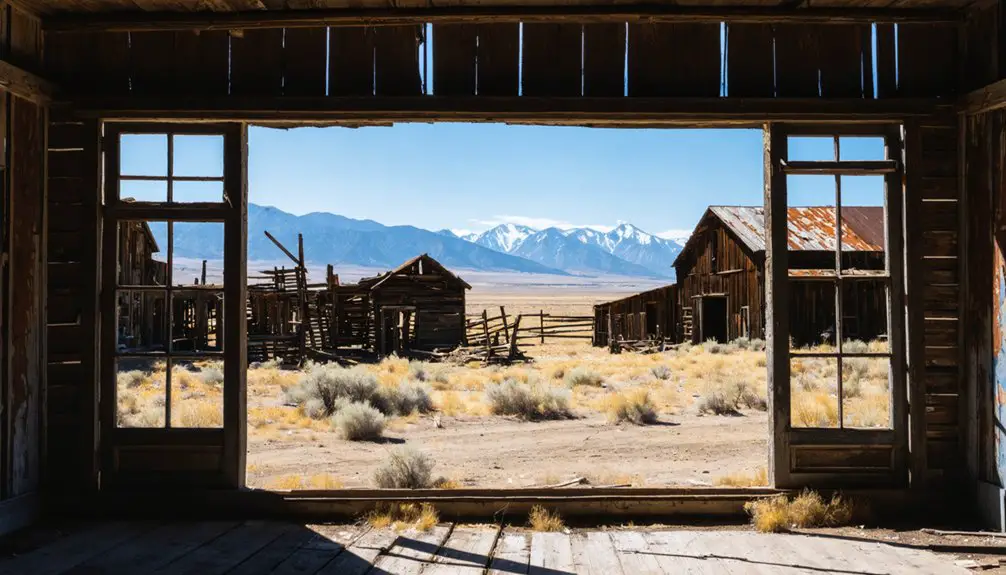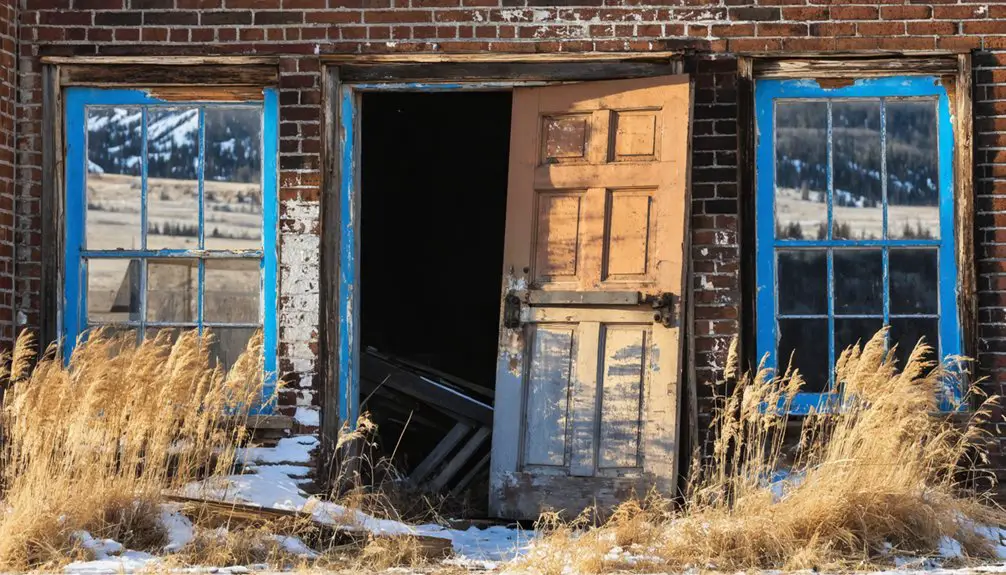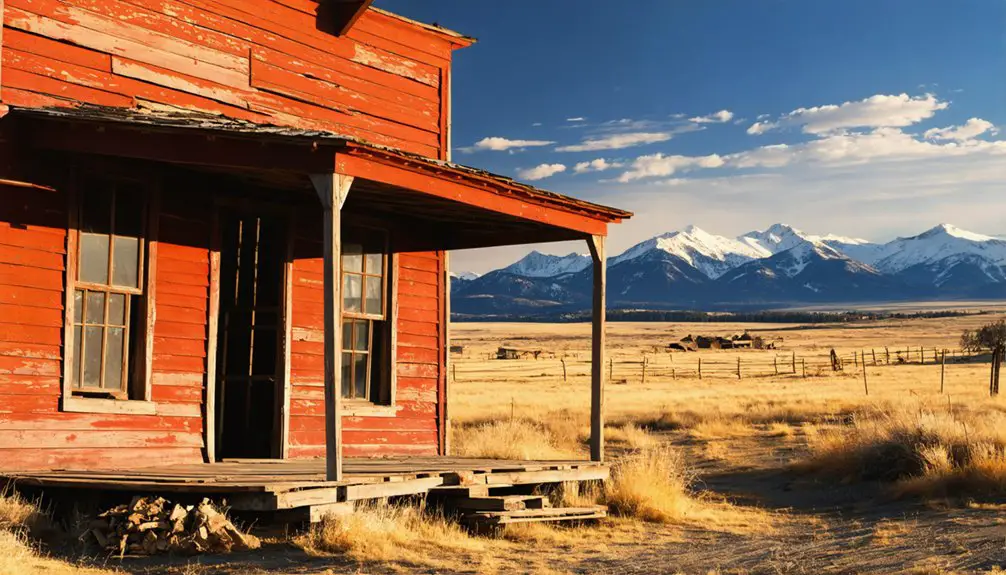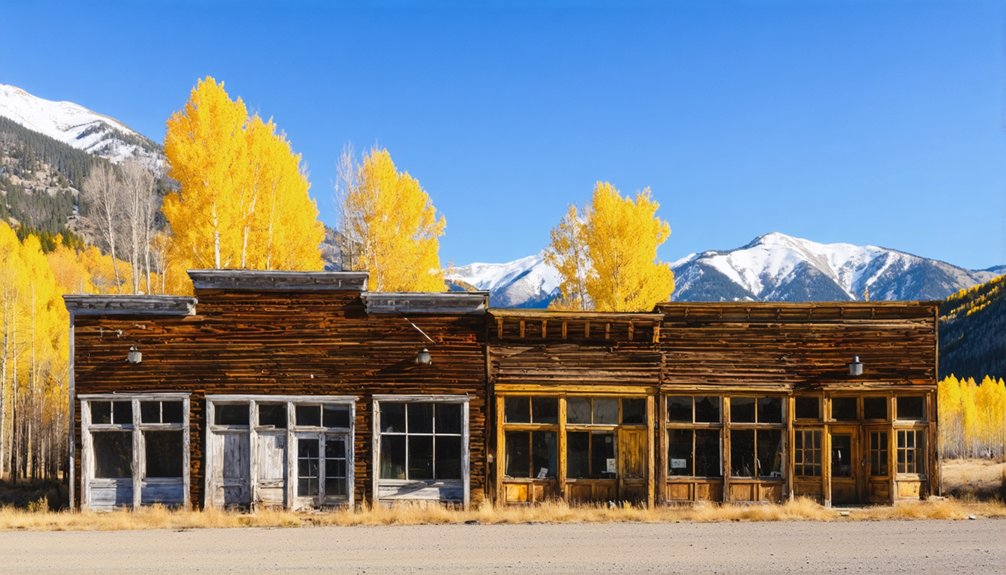
You’ll find Montana’s most spectacular ghost towns ablaze with fall colors from September through October, when golden aspens frame weathered buildings at historic sites like Bannack State Park, Virginia City, and Garnet Ghost Town. These elevated destinations—perched between 5,800 and 6,500 feet—offer over 250 preserved structures, living history demonstrations, and autumn landscapes that transform mining relics into photographer’s dreams. Pack layers for unpredictable mountain weather and prepare for backcountry roads leading to billion-dollar legacies frozen in time, where each location reveals distinct stories of boom-era prosperity and eventual abandonment.
Key Takeaways
- Bannack State Park features over 50 original 1862 buildings and hosts an October Ghost Walk highlighting vigilante legends and hauntings.
- Virginia City contains over 100 preserved buildings and 1.2 million artifacts with weekend living history demonstrations throughout fall.
- Garnet Ghost Town sits at 6,000 feet with 80 weathered structures including saloons and hotels from its 1898 gold rush peak.
- Elkhorn State Park preserves Montana’s most photographed ghost town buildings within a scenic 0.3-mile interpretive loop at 6,500 feet elevation.
- Visit in September for peak autumn colors; pack layers, sturdy boots, and check road conditions via Montana’s 511 service.
Bannack State Park: Montana’s Best-Preserved Ghost Town
Wooden boardwalks creak beneath your feet as you step onto Bannack’s Main Street, where over 50 original buildings stand frozen in time since Montana’s raucous gold rush era.
Step back into 1862 as weathered boardwalks guide you past 50 authentic gold rush buildings preserved in their original glory.
This abandoned mining settlement, where prospectors struck gold in 1862, once thrived with 5,000 fortune-seekers before the railroad passed it by.
You’ll explore the Methodist church, Governor’s Mansion, and brick courthouse where Sheriff Henry Plummer and his alleged gang of over 100 road agents met their end through vigilante justice in 1864.
Haunting legends whisper through empty saloons and hotels, especially during October’s Ghost Walk.
Montana designated this remarkably preserved site as a state park in 1954, ensuring its wild authenticity remains intact.
The town originally took its name from the Bannock Indians who inhabited the region.
The park spans 1,154 acres at an elevation of 5,800 feet, offering campgrounds with 28 sites complete with modern amenities for overnight visitors.
You’re free to wander these dusty streets where the Old West lives on.
Virginia City: A Living History Museum Experience
You’ll discover 1.2 million artifacts spread across Virginia City and Nevada City, forming the second-largest Old West collection outside the Smithsonian.
On summer weekends between Memorial Day and Labor Day, living history interpreters in period dress bring the 1860s mining frontier to life through hands-on demonstrations like tin smithing and authentic Gold Rush games.
Even in fall’s cooler months, you can explore over 100 preserved buildings dating from 1863 to the early 1900s, each one offering a sensory journey into Montana’s territorial past. Watch skilled artisans demonstrate traditional cobbler and leatherwork techniques that were essential to frontier survival. The museum operates from late May through early September, with last entry at 5 PM daily, giving you ample time to explore historic sites like the Music Hall, Criterion Hall, and Sedman House.
Gold Rush History Preserved
While most ghost towns slumber in decay, Virginia City pulses with carefully preserved authenticity—housing the second-largest collection of Old West artifacts in the nation, surpassed only by the Smithsonian. You’ll explore 1.2 million artifacts spanning three historic sites, where mineral deposits once sparked Montana’s transformation from wilderness to civilization.
Historic preservation reaches extraordinary heights here, with one hundred buildings from 1863-1900s forming authentic frontier streetscapes.
On weekends between Memorial Day and Labor Day, living history interpreters demonstrate frontier trades, letting you experience the 1860s gold rush firsthand.
- Tin smiths hammer metal in century-old workshops
- Period-dressed guides demonstrate frontier survival skills
- Historic music machines echo melodies from Montana’s mining heyday
You’ll wander through this “building zoo,” where structures rescued from across Montana create an immersive journey into authentic frontier life. The town’s gold legacy runs deep, with nearly $90 million in gold extracted during its mining heyday—worth approximately $1.95 billion today. A dedicated volunteer community spanning four states and eleven Montana communities brings this history to life, with participants ranging from age 4 to 78 demonstrating traditional crafts like basket weaving and cooking on wood stoves.
Seasonal Events and Activities
Every Saturday and Sunday between Memorial Day and Labor Day, Virginia City transforms into a vibrant 1860s settlement where costumed interpreters breathe life into frontier trades. You’ll witness blacksmiths hammer glowing iron, learn faro at the saloon, and watch wheelwrights craft wooden spokes among abandoned structures that once housed real pioneers.
Themed weekends throughout summer immerse you deeper—Independence Day brings parades and pie-eating contests, while Circle of Life programming explores Victorian customs from birth to death. The museum’s collection rivals the Smithsonian’s, with authentic artifacts you can touch and experience firsthand.
Admission runs $10-$12 for these living history weekends, where ghost town legends become tangible reality through demonstrations of leathercraft, tinsmithing, and cobbler work that defined frontier survival. As September arrives, Preparing for Winter events showcase how townspeople stockpiled supplies and weathered the harsh mountain season. Just down the road, Nevada City Museum showcases over 100 authentic buildings from Montana’s late 1800s frontier, arranged as a complete period town with original artifacts filling each structure.
Garnet Ghost Town: Remote Mountain Mining Camp
Perched at 6,000 feet in Montana’s Garnet Mountains, this remarkably preserved mining camp tells the story of gold fever and frontier ambition through over 80 weathered buildings that still stand where miners left them.
You’ll navigate dirt roads for remote access to this authentic 1890s boomtown where nearly 1,000 souls once extracted millions in gold from surrounding hills.
Walk freely through buildings frozen in time:
- Kelly’s Bar and Dahl’s Saloon, where miners once gambled their fortunes
- F.A. Davey’s Store, still stocked with Depression-era goods on dusty shelves
- J.R. Wells Hotel, its rooms furnished as if guests might return tomorrow
The Bureau of Land Management and preservation volunteers battle Montana’s harsh elements to maintain these structures against preservation challenges, letting you experience frontier independence without modern commercialization constraining your exploration.
The town’s prosperity exploded in 1898 when the Nancy Hanks Mine discovered gold, transforming Garnet into a thriving boomtown that would produce nearly $9.5 million in minerals over the next two decades. A devastating fire in 1912 destroyed many of the town’s commercial buildings, accelerating the exodus of residents who left to pursue war-related employment opportunities.
Elkhorn State Park: Photographer’s Paradise
Just 18 miles from Boulder, Elkhorn State Park preserves Montana’s most photographed ghost town buildings within the state’s smallest park—less than one acre protecting two spectacular 19th-century structures.
You’ll discover Fraternity Hall and Gilliam Hall standing sentinel at 6,500 feet, their weathered facades telling stories of the 1893 silver crash that emptied this once-thriving camp.
The 0.3-mile interpretive loop reveals architectural details photographers chase year-round, while fall foliage adds golden contrast to silvered wood and mountain stone.
Beyond the park, gravel roads wind through mining ruins toward Elkhorn Cemetery, where 1880s headstones emerge from high-country brush. Night photography captures star-trails above ghost-town silhouettes.
Pack your wide-angle lens and explore backcountry routes where elk bugle through autumn twilight—this is Montana’s frontier, preserved and accessible.
Marysville Ghost Town: Helena’s Historic Neighbor
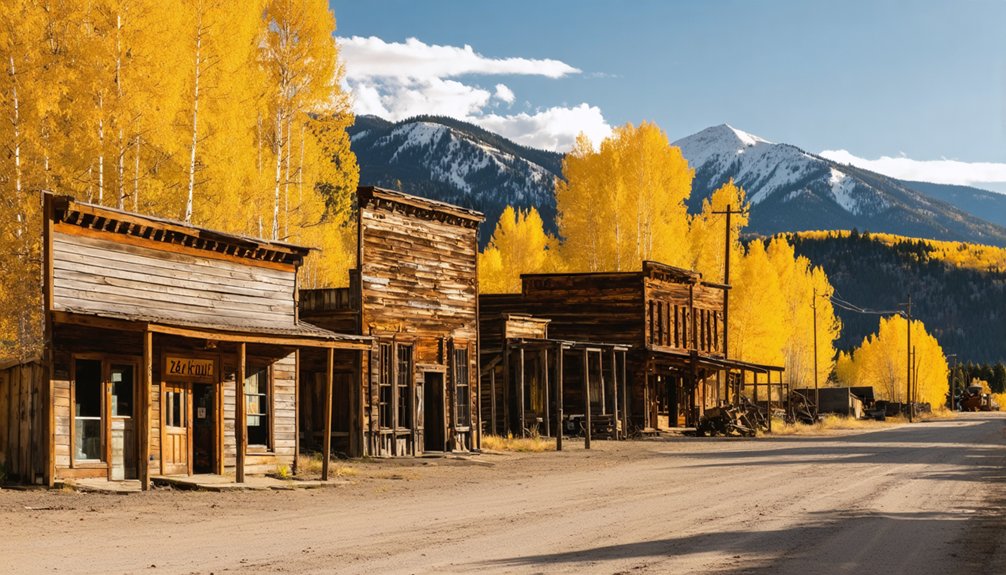
Twenty-five miles northwest of Montana’s capital, Marysville clings to the eastern slopes of the Rockies at 6,000 feet—where Thomas Cruse discovered fortune in 1876 and built an empire honoring Mary Ralston, the district’s first woman settler.
At 6,000 feet where fortune met wilderness, Thomas Cruse honored Montana’s first woman settler with an empire carved from gold.
You’ll wander through a town that once roared with 5,000 souls and 27 saloons, where $60 million in gold transformed wilderness into Montana’s richest strike.
Today’s 80 residents guard what remains:
- The 1886 Methodist Episcopal Church standing sentinel over weathered headstones
- Historical architecture including Shaffer’s 1895 mercantile and hillside miners’ cabins
- Mining relics scattered across Silver Creek’s canyon
Fall light penetrates abandoned windows and illuminates rust-stained machinery.
The Drumlummon Mine‘s shaft still pierces earth that yielded $25 million—a testament to ambition unfettered by convention.
Rimini Ghost Town: Silver Mining Legacy
You’ll find Rimini nestled in the Ten Mile Creek Valley, where over 100 mines once produced $7 million in silver, gold, and lead during Montana’s frontier era.
As fall transforms the Helena-Lewis and Clark National Forest surrounding this ghost town, you can explore preserved structures including the original schoolhouse and restored cabins that hint at the 300 residents who thrived here in 1890.
The crisp autumn air and golden aspens create perfect conditions for hiking among crumbling buildings and interpretive signs that tell stories of boom, bust, and resilience.
Mining Boom Era History
In 1864, prospector John Caplice struck silver on Lee Mountain, setting off a rush that would transform a remote gulch near Red Mountain into one of Montana’s most productive mining districts.
By 1885, the Northern Pacific’s spur line opened the floodgates. Rimini shipped 400 tons of ore weekly, its mining techniques evolving as operations expanded.
The town swelled to 300 souls by 1890, with ore processing facilities working round-the-clock.
Picture Rimini at its zenith:
- Ore carts rattling down mountain slopes toward the railroad depot
- Smoke billowing from the East Helena smelter, processing Rimini’s polymetallic riches
- Miners emerging from the East Pacific and Lady Washington shafts, pockets heavy with promise
The district would ultimately yield up to $700 million in silver, gold, lead, zinc, and copper before exhaustion claimed it.
Accessing Rimini in Fall
From Helena, the journey to Rimini unfolds across 25 miles of changing terrain that’ll carry you from Montana’s capital into the hushed reaches of Ten Mile Creek Valley. You’ll navigate US-12 West before veering south onto Rimini Road.
Along this route, autumn foliage transforms the Helena-Lewis and Clark National Forest into cascading gold and crimson.
Rural road conditions demand attention during fall’s unpredictable shifts. Early snowfall can render passages impassable without warning, particularly along the seven-mile stretch to town.
Check Montana’s 511 service before departing—it’s your lifeline for real-time updates.
The reward? An open-air ghost town requiring no permits, no schedules, no restrictions. You’re free to wander past Rose Wilson’s store and the 1904 schoolhouse whenever wanderlust strikes.
Explore at your own pace beneath October’s endless sky.
Preserved Buildings and Structures
Weathered logs and false-front facades emerge from the hillside as you round the final bend into Rimini, their skeletal frames still defiant against Montana’s relentless seasons. Unlike urban decay in forgotten cities, these structures wear their age with mountain dignity.
The original schoolhouse stands as Rimini’s crown jewel, while miners’ cabins transformed into year-round homes demonstrate practical preservation techniques that honor heritage without sanitizing it.
You’ll discover:
- Log buildings with frame fronts clinging to late 19th-century architecture
- Crumbling mining structures surrendering to gravity beside restored cabins
- A century-old Forest Service building that later trained WWII search-and-rescue dogs
Interpretive signs guide your exploration through this open-air museum, where abundant tailings and weathered timbers chronicle $7 million in extracted treasure without demanding entry fees or scheduled tours.
Planning Your Fall Ghost Town Adventure
Fall transforms Montana’s ghost towns into atmospheric portals where russet leaves drift past weathered storefronts and crisp mountain air carries whispers of frontier dreams. You’ll want to hit Bannack mid-September when autumn ignites the wooden sidewalks, though prime color fades fast. Pack layers—mountain weather shifts quickly on those wind-swept ridges above Philipsburg and Elkhorn.
As you wander through the stunning fall foliage in ghost towns, each step brings with it a sense of history and nostalgia. The vibrant hues of orange and gold create a striking contrast against the rustic buildings, inviting exploration and reflection. Make sure to capture the beauty of these forgotten places before the season changes and blankets them in winter’s embrace.
Base yourself in Missoula or nearby towns to chain multiple sites together. Grab that $2 self-guided pamphlet at Bannack’s Visitor Center, or time your visit for October weekends when they extend hours.
Virginia City’s living history experience pairs perfectly with seasonal food and local art discoveries in surrounding communities. Book primitive Garnet cabins early for snowmobile access, or reserve Bannack’s campground for overnight stays beneath impossibly starry skies.
What to Bring for Your Ghost Town Exploration
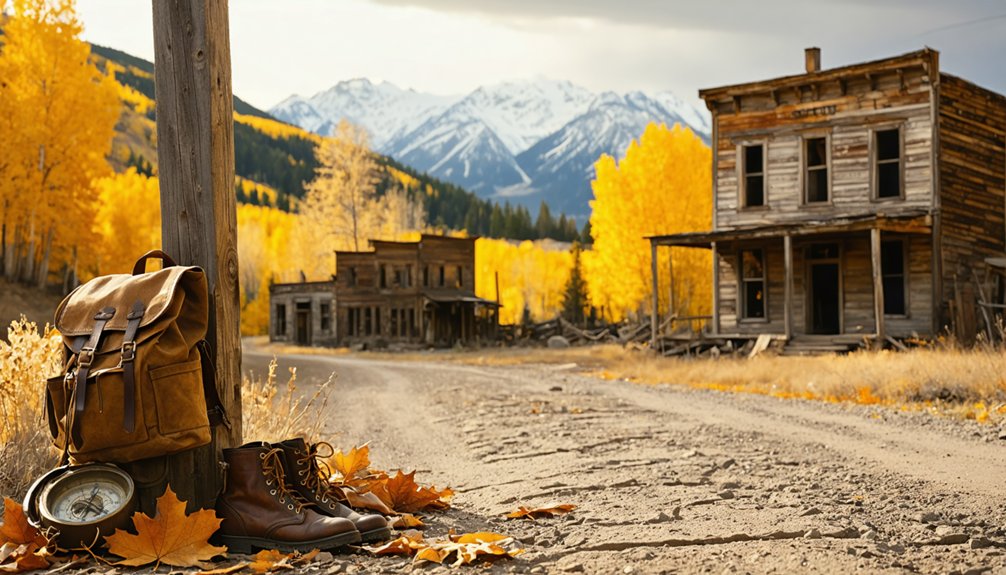
Before you venture down those washboard roads where civilization surrenders to sagebrush, you’ll need gear that matches Montana’s unforgiving beauty.
Essential gear includes sturdy waterproof boots for crumbling floorboards, layered clothing for 6,000-foot elevations where temperatures plummet without warning, and a high-clearance vehicle that laughs at washouts.
Safety precautions demand respect in these remote outposts:
- Bear spray tucked within reach as you’re hiking backcountry territory
- First-aid kit and emergency supplies for when cell towers fade to memory
- Flashlight illuminating dark doorways where miners once walked
Pack binoculars for distant hillside structures, your camera for capturing peeling wallpaper’s ghostly patterns, and rain gear—because Montana weather respects no forecast.
Bring offline maps, a thermos of coffee, and trash bags.
Leave nothing but bootprints in the dust.
Frequently Asked Questions
Are Montana Ghost Towns Safe to Visit With Children?
Yes, Montana ghost towns like Bannack offer safe family exploration through historical preservation efforts. You’ll discover sturdy structures, supervised tours, and local folklore that’ll captivate kids while ensuring their safety amid authentic frontier buildings and educational exhibits.
Do Any Ghost Towns Offer Overnight Accommodations or Camping?
Three Montana ghost towns offer you authentic overnight stays. You’ll find historical lodging at Garnet’s winter cabins and Nevada City’s preserved buildings, plus camping opportunities at Gunslinger Gulch, where you can sleep beneath vast Western skies.
Which Ghost Towns Are Wheelchair Accessible?
Garnet Ghost Town welcomes you with wheelchair-accessible historical landmarks along its main street, though accessibility challenges remain on hillside slopes. You’ll find resting benches, bathrooms at both elevations, and BLM rangers offering guided exploration of Montana’s preserved frontier.
Are Pets Allowed at Montana Ghost Towns?
Yes, you can bring pets to Montana’s ghost towns like Garnet and Bannack. Pet policies require leashes at historic sites, with leash regulations enforced throughout. You’ll maintain freedom to explore together while respecting preservation standards and cleanup responsibilities.
What Are Typical Admission Fees for Ghost Town Sites?
You’ll find entry fees ranging from free to $10 per person at Montana’s ghost towns. Tour costs vary—some charge $3-$8 for day use, while others offer complimentary exploration where you’ll wander weathered streets unrestricted.
As you venture through the ghost towns in Montana to explore, you’ll encounter remnants of history that tell unique stories of the past. Many towns feature preserved buildings where you can imagine life during their bustling days, and some even host seasonal events that delve into their rich heritage. Don’t forget to bring your camera to capture the hauntingly beautiful landscapes that surround these once-thriving communities.
References
- https://www.roamingnearandfar.com/montana-ghost-towns-near-helena/
- https://www.mountain-home.com/blog/vacation-planning/guide-montana’s-ghost-towns
- https://glaciermt.com/ghost-towns
- https://visitmt.com/things-to-do/ghost-towns
- https://www.garnetghosttown.org
- https://southwestmt.com/blog/haunted-encounters/
- https://fwp.mt.gov/stateparks/granite-ghost-town
- https://www.distinctlymontana.com/curious-afterlife-montanas-ghost-towns
- https://www.legendsofamerica.com/mt-bannack/
- https://southwestmt.com/blog/bannack-haunting-montana/