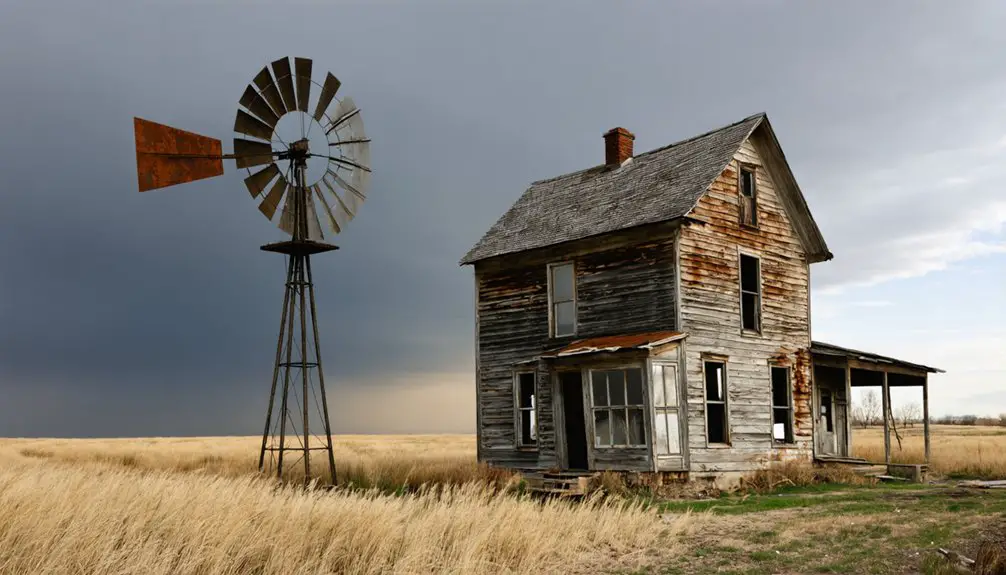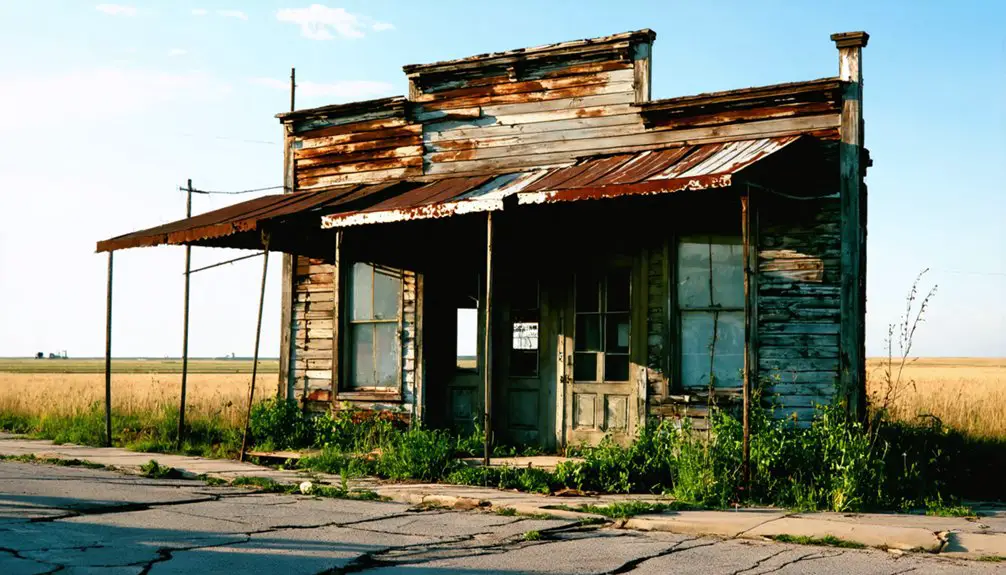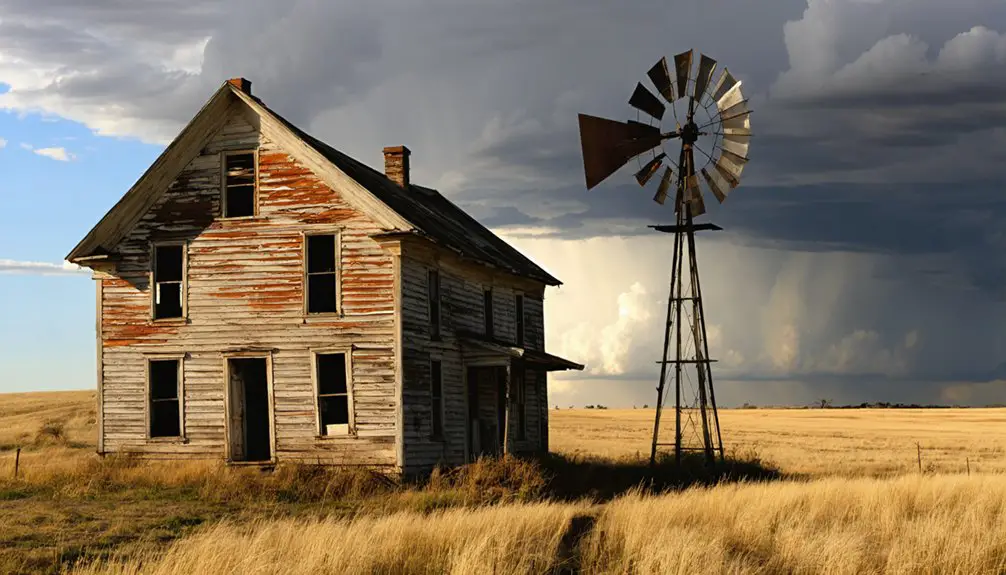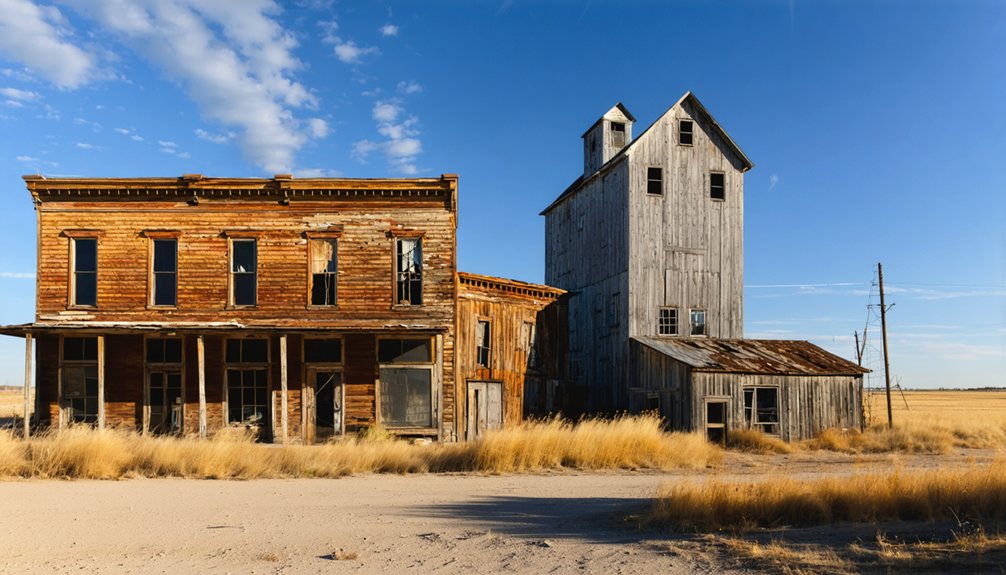
You’ll find Nebraska’s most mesmerizing ghost towns bathed in autumn gold, from Belvidere’s preserved railway depot where whistles still echo to Rock Bluff’s 1870 schoolhouse overlooking the Missouri River. Wander through Brocksburg’s leaning structures along the Outlaw Scenic Byway, explore St. Deroin’s 1,500-year-old petroglyphs at Indian Cave State Park, or trace DeWitty’s remarkable African American homesteading heritage in the Sandhills. Each abandoned settlement reveals pioneer stories against a backdrop of rust-colored prairie grasses and crystalline fall skies that make the season perfect for discovery.
Key Takeaways
- Belvidere features preserved grain elevators, wooden depot, and boxcar with a whistle sounding every ten minutes along Big Sandy Creek.
- Brocksburg along Outlaw Scenic Byway offers golden hills and vibrant fall foliage with leaning structures accessible by high-clearance vehicles.
- Roscoe on Lincoln Highway provides original stone hotel and abandoned garages surrounded by scenic American wanderlust symbolism in fall.
- Rock Bluff showcases Nebraska’s oldest schoolhouse, hillside cemetery, and limestone foundations overlooking the Missouri River with autumn views.
- Steele City displays 1870s railroad remnants, sandstone church, and Victorian architecture amid authentic decay in a wooded valley setting.
Belvidere: Railroad Stop Turned Time Capsule
The whistle cuts through the prairie silence every ten minutes, a haunting reminder that Belvidere refuses to fade completely into memory. You’ll find yourself standing where pioneers built their dreams along Big Sandy Creek in the 1870s, watching hundred-car coal trains thunder past abandoned storefronts and grain elevators.
Railroad history pulses through this place—Union Pacific crowned it “Train Town USA” in 2013, recognizing ghost town preservation efforts that saved Thayer County’s last wooden depot and boxcar. The town once thrived with about 500 residents before dwindling to its current population of approximately fifty. Like North Omaha’s Briggs Station, which served as a railroad layover between Florence and Calhoun, Belvidere reveals how communities evolved around rail infrastructure in Nebraska’s settlement era.
Union Pacific’s 2013 “Train Town USA” designation honored Belvidere’s preservation of Thayer County’s last wooden depot and boxcar.
Walk freely among weathered buildings that once housed blacksmiths and doctors, explore the stage area, then settle in the memorial garden.
With trains roaring through every quarter-hour, you’re witnessing something rare: a town that’s simultaneously dying and refusing to disappear.
Rock Bluff: Home to the Historic Naomi Institute
You’ll find Nebraska’s oldest schoolhouse standing alone in Rock Bluff, a brick sentinel marking where the Missouri River once drew steamboats and settlers to this thriving crossing.
The Naomi Institute opened here in 1870 as Cass County’s first college. Its two-story halls briefly echo with academic ambition before debt shuttered the dream just three years later.
Rock Bluff once bustled with a post office, mayor, and county fair, along with stores, blacksmith shops, and a racetrack near the steamboat landing. The town’s decline accelerated when railroad tracks were built ten miles west, draining away its commerce and accessibility.
Now, this building is maintained as a museum by the Cass County Historical Society. This solitary structure invites you to walk through the sole surviving building of a town that vanished when the railroad chose a different path.
Historic Naomi Institute Background
Perched on the south slope of the Missouri River bluffs where Rock and Squaw Creeks converge, the Naomi Institute rises from Nebraska’s educational frontier as a tribute to pioneering ambition.
Professor J.D. Patterson founded this groundbreaking college in 1870, establishing Cass County’s first higher education institution when Nebraska itself was barely formed.
You’ll find historical architecture that tells stories of frontier determination—what began as a two-story structure now stands as a weathered one-story brick schoolhouse, its educational legacy echoing through 150 years.
The institute opened with promise but financial reality struck hard. By 1872, mounting debt forced Patterson to surrender his dream.
Yet the building refused to fade, transforming into Rock Bluff School and serving generations of local students before eventually becoming a museum preserving pioneer education‘s bold spirit.
The schoolhouse earned recognition through its National Register listing in 1977, cementing its place in Nebraska’s historical preservation efforts.
A monument at Rock Bluff School stands today south of Plattsmouth in rural Cass County, marking the site’s enduring educational heritage.
Visiting Rock Bluff Today
Where does a thriving river town vanish to, leaving only whispers in brick and stone? You’ll find answers at Rock Bluff, three miles east of Murray, where the Cass County Historical Society champions historical preservation through the restored Naomi Institute. This 1870 schoolhouse stands defiant against abandonment, its soft red brick walls rising from limestone foundations.
What awaits your exploration:
- A period classroom where community stories echo through authentic vintage furnishings
- The hillside cemetery overlooking the Missouri River, holding unmarked graves of vanished settlers
- Weathered limestone foundations marking where 200 residents once built their dreams
- Grain elevators near the river—modern sentinels guarding forgotten crossings
You’ll walk paths where German pioneer Benedict Spires launched Nebraska’s statehood journey in 1866, feeling autumn winds carry tales of a town that refused complete erasure. The town once bustled with three general stores, two blacksmith shops, two saloons, and a billiard hall that served the community at its peak.
Mud Springs: Watering Hole Along Pioneer Trails
Between the Lodgepole Creek and North Platte River valleys, an indispensable oasis once drew desperate travelers across Nebraska’s parched high tablelands.
You’ll find Mud Springs six miles north of Dalton, where buffalo-trampled seeps created this critical water source.
History that sustained life for centuries.
Native American occupation left archaeological traces long before Pony Express riders galloped through in 1860.
Stand where nine soldiers held off Sioux and Cheyenne warriors in 1865—you can still spot their rifle pits.
The stagecoach station that Richard Burton described as a humble sod hut witnessed Texas cattle drives and gold rush fever.
The site evolved from a Pony Express home station built of log and sod in 1860-61 to include telegraph operations by August 1861.
The original sod structures featured roofs of poles, brush, and earth topped with coarse gravel to prevent wind erosion.
Now protected by the Nebraska State Historical Society, this National Register site lets you walk freely among whispers of frontier desperation and survival.
St. Deroin: Ferry Trading Post at Indian Cave State Park
Along the Missouri River’s wooded bluffs, St. Deroin beckons you into Nebraska’s forgotten frontier. Founded in 1853 by Joseph Deroin—born of French-Canadian and Otoe Native heritage—this ghost town once thrived as a bustling ferry crossing and trading post serving 300 souls.
Where frontier commerce meets forgotten heritage—a ghost town born of two worlds now whispers through Nebraska’s bluffs.
Explore what remains:
- The 1910 brick schoolhouse, relocated to escape flooding’s grasp
- Wind-swept cemetery where river legends whisper of A.J. Ritter searching for his lost arm
- Ancient petroglyphs in the sandstone cave, carved over 1,500 years ago
- 30 miles of trails threading through 3,052 acres of untamed beauty
The Missouri’s temperament ultimately sealed St. Deroin’s fate—flooding erased buildings, shifting channels killed the ferry business. Lewis and Clark camped nearby in July 1804, marking this location as part of their westward exploration route.
Now you’ll wander paths where steamboats once docked, feeling autumn’s chill where commerce once roared.
Brocksburg: Scenic Byway Ghost Town in the Hills
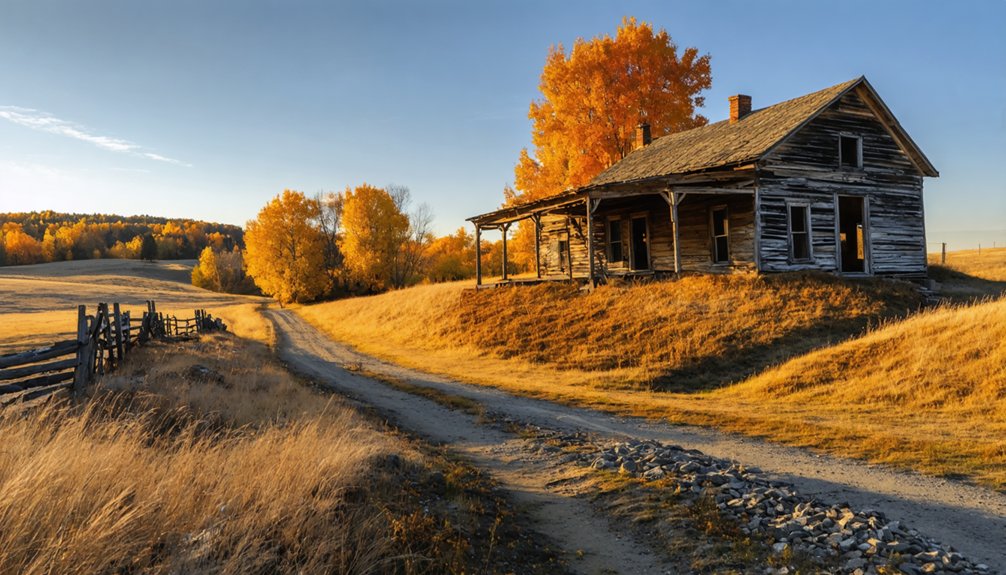
From Missouri River bottoms, your journey climbs north into Nebraska’s rugged hill country, where Brocksburg clings to existence along the Outlaw Scenic Byway.
Henry Brockman’s 1899 settlement served scattered ranching families until Highway 12 rerouted traffic in the 1920s, draining life from this remote outpost. The post office shuttered in 1957, sealing Brocksburg’s fate.
You’ll need a high-clearance vehicle to navigate deteriorating roads through Keya Paha County’s backcountry. GPS fails here—trust your instincts and old-fashioned maps.
Brocksburg scenery rewards your commitment: leaning structures battle relentless wind, a tornado shelter yawns darkly, and autumn landscapes paint golden hills surrounding barely-recognizable foundations.
This genuine ghost town demands dedication, but fall’s crisp air and blazing colors transform your exploration into pure adventure, where isolation becomes freedom.
Steele City: Historical Buildings in a Nearly Empty Town
You’ll find Steele City nestled in a wooded valley along the Little Blue River, where time has stripped away most of its residents but left the bones of its 1870s railroad heritage standing. The rough-cut sandstone walls of Abner Baker’s 1880s bank building still anchor the main street, their Richardsonian Romanesque style speaking to an era when this alphabetically-named depot town thrived with commerce.
Walk among the restored native stone church, the blacksmith shop, and the three-story high school, and you’re threading through a living architectural museum where fewer than 50 people now call home.
Architectural Remnants Still Standing
Walking through Steele City feels like stepping onto a movie set where the actors have long departed but their stage remains hauntingly intact. You’ll discover architectural survivors that refuse to fade into prairie grass:
- Baptist Church (1882) – Medieval architecture meets Nebraska plains in this limestone replica of an English church, built entirely from local stone quarried south of town.
- Bank Building (1880-1890) – Richardsonian Romanesque sandstone walls guard turn-of-century banking displays upstairs, while the basement preserves textile collections.
- Blacksmith Shop (1900-1902) – Brick-spanned archways frame this sandstone workshop, now restored as a functioning museum accessible by appointment.
- Zoellin House (1890) – Victorian elegance meets urban architectural styles in this elaborate two-story frame dwelling showcasing Italianate flourishes.
Each structure stands as testimony to communities that built monuments expecting permanence.
Exploring Steele City Today
With fewer than 50 souls calling it home, Steele City exists in a peculiar limbo between abandonment and survival. You’ll find streets where demographic changes have stripped away 87% of the population since 1880, leaving behind weathered storefronts and empty lots that urban renewal forgot decades ago.
The median age of 56.3 tells you this village isn’t attracting young dreamers—it’s holding onto the last generation who remember better times.
Walk these quiet blocks in autumn, and you’re witnessing Nebraska’s rural exodus in real-time. Houses sell for $24,600, practically giving away pieces of history. Your boots crunch through fallen leaves on sidewalks where few footsteps echo anymore.
This isn’t packaged nostalgia—it’s authentic decay, freedom from crowds, and the raw beauty of impermanence.
Venus: Rural Post Office Community Frozen in Time
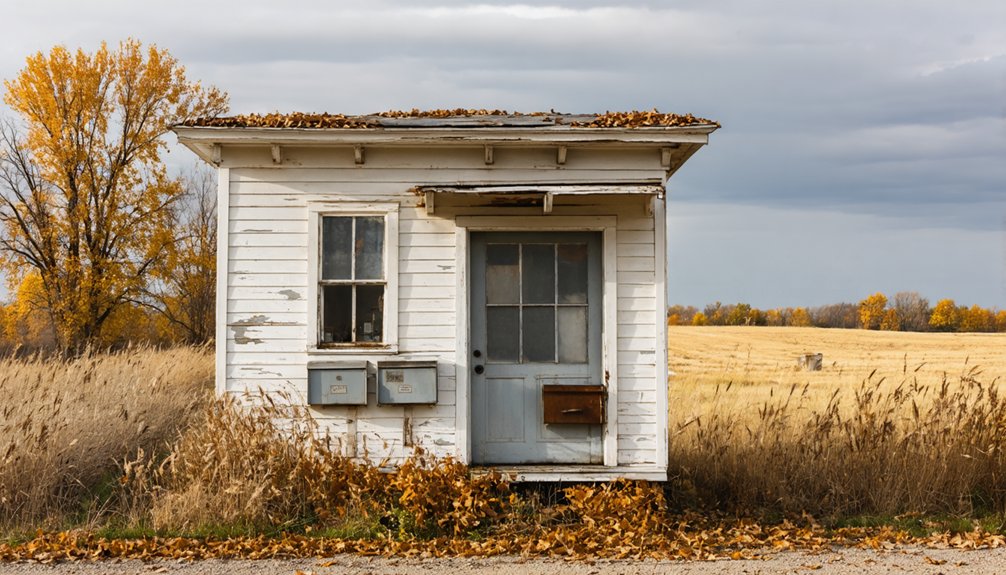
Nestled in Knox County’s windswept plains, Venus stands as a proof of the brief, bright era when a simple post office could anchor an entire community’s hopes. From 1880 to 1959, this unincorporated settlement thrived around its postal hub, where farmers once rode hours just to collect letters and catalogs that connected them to the wider world.
Traces of Venus’s Rural Heritage You’ll Discover:
- Crumbled building foundations scattered across the prairie landscape
- Original railroad corridor routes where Union Pacific trains once thundered through
- Rural Free Delivery milestones marking the 1904 transformation that ironically sealed the town’s fate
- Weathered structures standing sentinel against Nebraska’s relentless winds
You’ll find authentic decay here—no tourist reconstructions, just honest remnants of frontier ambition meeting twentieth-century obsolescence.
Dobytown: Fort Kearny’s Forgotten Neighbor
Where Fort Kearny’s soldiers once sought whiskey and cards, only prairie grass and a roadside marker remain.
You’ll find Dobytown’s ghost three miles west of the old fort, where twelve earthen structures once housed Nebraska’s wildest frontier outpost. From 1860 to 1866, this sod-and-log settlement served “tanglefoot” whiskey and ran poker games that’d empty a soldier’s pockets faster than any Sioux raid.
The Union Pacific’s completion in 1869 killed Dobytown overnight. Urban legends persist about buried gold and midnight revelry, but preservation challenges have erased nearly every trace.
Standing at Highway 50A’s historical marker, you’re free to imagine the gambling hell that thrived here—where desperate men chased fortune and forgot orders, where civilization’s rules dissolved into prairie dust.
Roscoe: Architectural Gems Along the Lincoln Highway
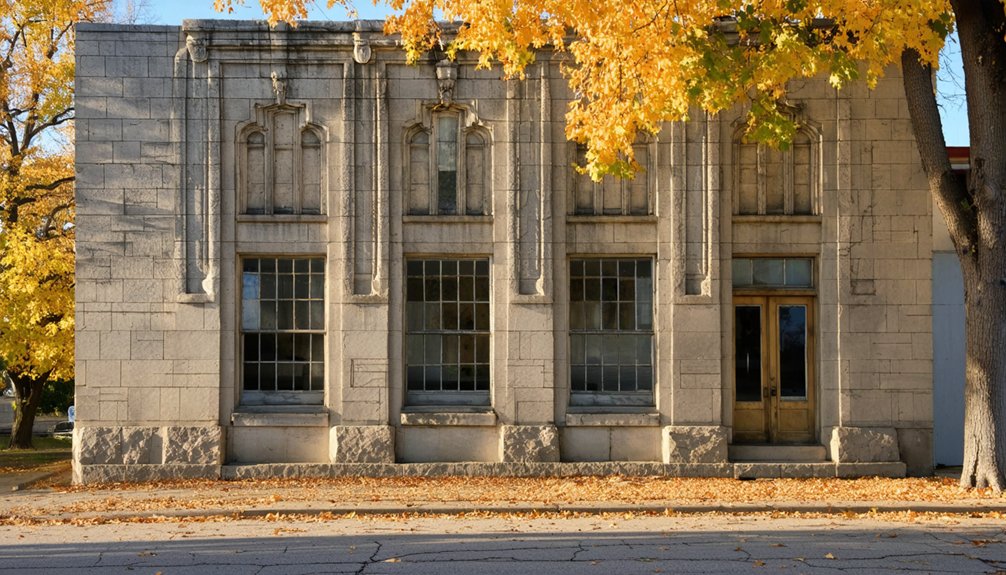
The Lincoln Highway‘s establishment in 1913 birthed settlements like Roscoe along its path. You’re walking where Boy Scouts planted concrete markers in 1928, where travelers first experienced transcontinental auto freedom.
Essential Roscoe Features:
- Original Lincoln Highway alignments—both gravel and paved sections remain drivable.
- 1911-era stone hotel architecture echoing Lodgepole’s preserved structures.
- Abandoned garages displaying early automotive-age design.
- Proximity to Union Pacific tracks revealing transportation evolution.
Visit during fall when golden light transforms these relics into haunting monuments of American wanderlust.
DeWitty: African American Homesteader Settlement
Far from the Lincoln Highway’s well-traveled routes, another story of American determination played out in Cherry County’s remote Sandhills. You’ll discover DeWitty’s profound legacy near Brownlee, where African American heritage took root along the North Loup River in 1907.
Former slaves who’d fled to Canada and their descendants claimed their 640 acres under the Kinkaid Act, building sod houses and cultivating an extraordinary community of 150 souls.
They established churches, schools, and the North Loup Sluggers baseball team, celebrating Independence Day alongside white neighbors during America’s bloodiest race riots.
Though harsh weather and collapsed crop prices emptied DeWitty by 1936, historic land claims here represent Nebraska’s most successful Black settlement. You’re standing where courage met opportunity, where people manifested their own destiny against impossible odds.
Frequently Asked Questions
What Is the Best Time to Visit Nebraska Ghost Towns in Fall?
Mid-to-late October offers you the finest ghost town exploration, when golden foliage frames weathered structures for stunning photography opportunities. You’ll discover historical preservation amid nature’s transformation, with comfortable temperatures and fewer crowds enhancing your autonomous adventure through Nebraska’s forgotten landscapes.
Are Nebraska Ghost Towns Safe to Explore Without a Guided Tour?
Most Nebraska ghost towns lack maintenance oversight, making independent exploration risky. You’ll need proper safety precautions when entering abandoned buildings—watch for unstable floors, exposed nails, and wildlife. Your freedom to explore comes with personal responsibility for potential hazards.
The allure of abandoned towns in Nebraska to explore attracts adventurers and history enthusiasts alike. Each decaying structure tells a story of the past, holding secrets of those who once lived there. As you navigate through the remnants, take the time to appreciate the unique architecture and the haunting beauty of nature reclaiming these spaces.
The experience of exploring ghost towns in Nebraska with foliage offers a unique blend of history and nature. Vivid greens and vibrant autumn hues envelop the forgotten structures, creating a stunning visual contrast against the weathered wood and crumbling bricks. As you walk among the remnants, you’ll find that each town serves as a poignant reminder of the passage of time and the resilience of nature.
Can You Camp Overnight Near These Ghost Town Locations?
You’ll find developed camping at Indian Cave State Park near St. Deroin, with electrical hookups and amenities. Other ghost towns offer primitive dispersed camping, letting you chase dawn’s golden light for unmatched photography opportunities while supporting historical preservation through respectful visitation.
Do Any Ghost Towns Charge Admission or Entrance Fees?
You’ll find most ghost towns accessible like forgotten treasures—completely free to explore. However, historical preservation demands admission policies at state parks: Fort Kearny charges $60-$80 daily, while Rock Creek Station requires $80, plus standard $7 park permits.
What Should Visitors Bring When Exploring Nebraska’s Ghost Towns?
You’ll need sturdy boots, water, and cameras for capturing history preservation moments. Follow photography tips: shoot during golden hour when autumn light transforms weathered buildings into haunting silhouettes, revealing stories etched in every crumbling wall and forgotten doorway.
References
- https://www.ghosttowns.com/states/ne/ne.html
- https://history.nebraska.gov/wp-content/uploads/2017/12/doc_publications_NH1937GhostTowns.pdf
- https://www.youtube.com/watch?v=l3s2qhSxis8
- https://kids.kiddle.co/List_of_ghost_towns_in_Nebraska
- https://www.onlyinyourstate.com/trip-ideas/nebraska/ne-ghost-towns-road-trip
- https://freepages.rootsweb.com/~gtusa/history/usa/ne.htm
- https://visitnebraska.com/trip-idea/explore-7-authentic-ghost-towns-nebraska
- https://history.nebraska.gov/finding-nebraskas-ghost-towns/
- https://northomahahistory.com/2017/03/30/the-lost-towns-in-north-omaha/
- https://www.youtube.com/watch?v=fP8NFNqvAfs