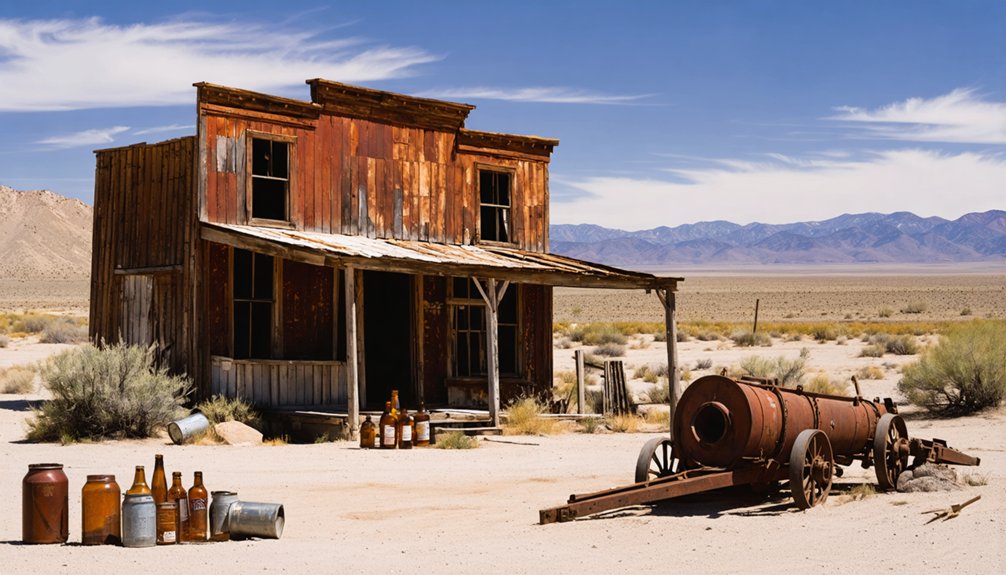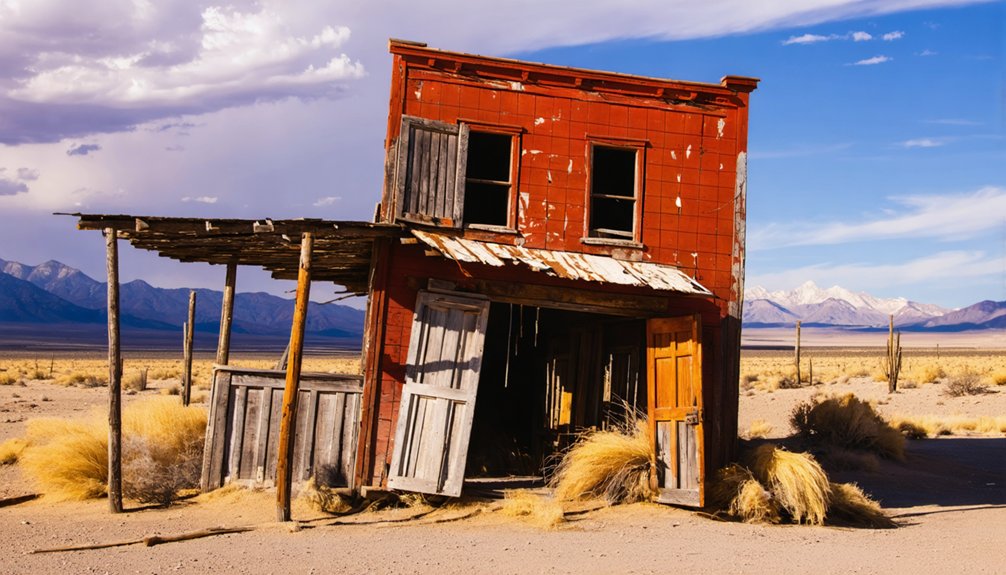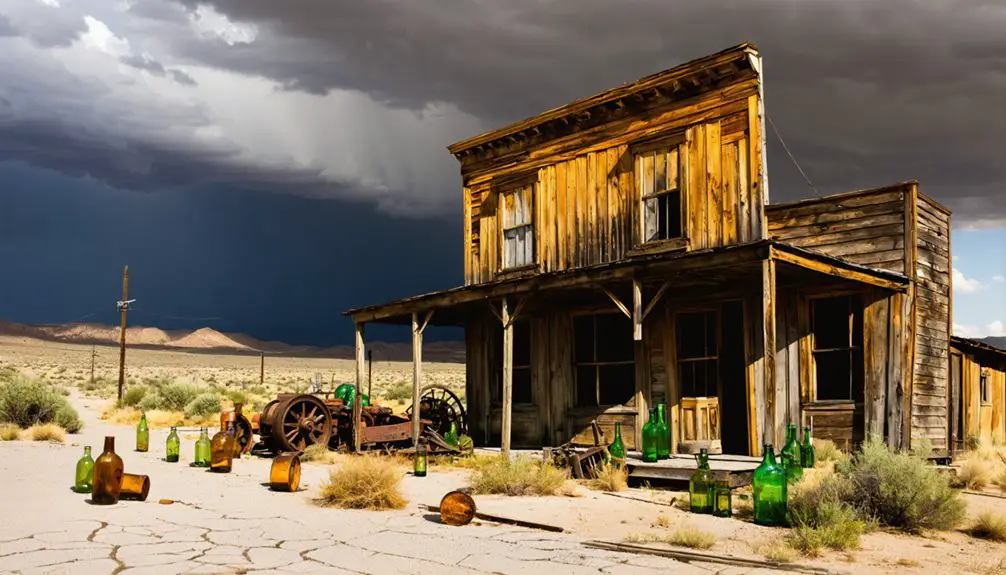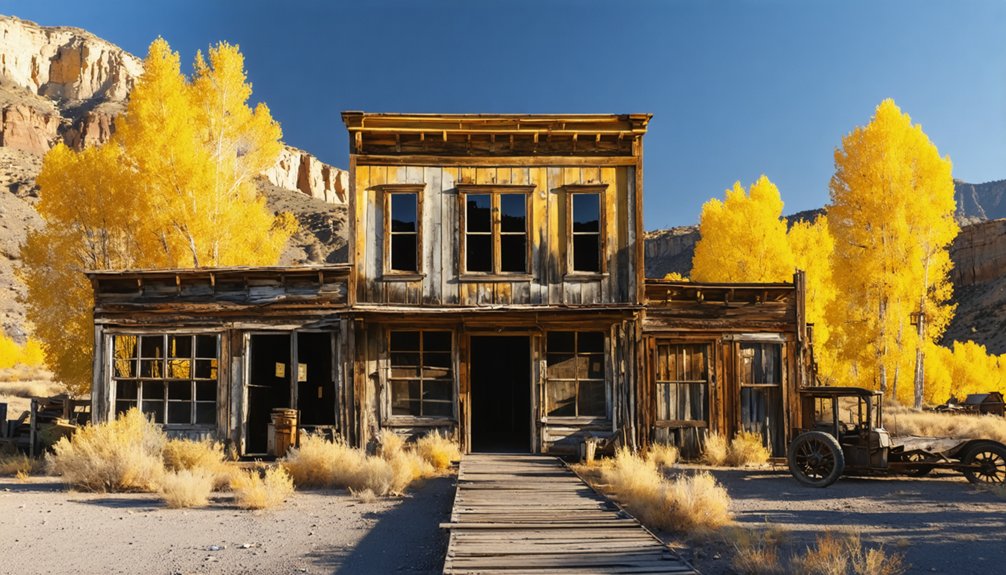
You’ll find Nevada’s ghost towns at their eerie best during fall, when comfortable temperatures let you wander through Rhyolite’s whiskey-bottle houses and sun-bleached ruins without summer’s punishing heat. Virginia City’s shadowy Victorian streets grow genuinely atmospheric as daylight fades earlier, while Belmont’s crumbling brick mills and Goldfield’s haunted hotel corridors reveal their secrets in crisp autumn air. The cooler months transform these desert relics from harsh destinations into hauntingly beautiful time capsules where you’ll discover each town’s unique story—from Pioche’s violent mining disputes to Jarbidge’s wilderness-surrounded remnants.
Key Takeaways
- Rhyolite features Nevada’s most photographed ruins, including the unique Bottle House and the Goldwell Open Air Museum with modern sculptures.
- Goldfield offers paranormal tours of the haunted hotel, operational courthouse with Tiffany lamps, and restored 1908 high school building.
- Virginia City, at 6,200 feet elevation, showcases Victorian architecture, Boot Hill Cemetery with 5,000 burials, and numerous haunted saloons.
- Belmont provides unrestricted access to authentic 1876 courthouse, four-story mill ruins, and original ore carts in Nevada’s dry climate.
- Pioche displays the Million-Dollar Courthouse, original jail with 16-inch walls, and Boothill Cemetery commemorating its violent mining history.
Rhyolite: Nevada’s Most Photogenic Ghost Town
When prospectors Frank “Shorty” Harris and Ernest “Ed” Cross struck high-grade gold in the Bullfrog Hills in 1904, they couldn’t have imagined the architectural marvel that would rise—and fall—in just over a decade.
You’ll find Rhyolite’s skeletal remains near Death Valley, where abandoned buildings tell stories of Nevada’s wildest boom. The town exploded to 5,000 residents by 1907, complete with an opera house, 50 saloons, and the iconic three-story John S. Cook Bank—now Nevada’s most photographed ghost town ruin.
Wander freely through stone and concrete shells built to withstand the desert’s extremes. The quirky Bottle House, constructed from 50,000 whiskey and beer bottles, stands as one of the most unusual surviving structures. Historic photographs show what thrived here: electric lines, a $130,000 depot, even a school for 250 children. Just below the ruins, you’ll discover the Goldwell Open Air Museum, where contemporary sculptures like Albert Szukalski’s “The Last Supper” blend modern art with frontier history.
Goldfield: Where History Meets the Paranormal
Step inside the Goldfield Hotel’s dust-choked corridors where your flashlight beam might catch more than peeling wallpaper—ghost hunters claim Elizabeth still wanders room 109.
I’ve watched seasoned investigators leave white-faced after hearing unexplained footsteps on the granite floors.
Outside, the desert air has mummified mining headframes and weathered cabins so perfectly you’ll half-expect a miner to emerge for his shift.
Book a paranormal investigation tour through the hotel’s locked doors, then spend golden hour photographing the preserved structures that tell Goldfield’s story better than any history book.
The Esmeralda County Courthouse across the street still operates with its original Tiffany lamps glowing in the windows, a functioning reminder of when Goldfield reigned as Nevada’s largest city.
Down the street, the Goldfield High School stands as a testament to the town’s educational legacy, its 1908 structure currently undergoing restoration thanks to community donations and preservation campaigns.
Historic Hotel Ghost Hunts
Rising from the dusty streets of Goldfield like a gilded relic of Nevada’s wildest boom days, the Goldfield Hotel commands attention with its four stories of Edwardian grandeur—now crumbling, always watching.
Built during the 1900s gold rush, this spectacular venue once boasted crystal chandeliers and gold-leaf ceilings. Today, it’s infamous among haunted hotels for Elizabeth’s tormented spirit in room 109, where visitors report bone-chilling cold and inexplicable tears.
You’ll find ghost stories everywhere—from George Wingfield’s lingering cigar smoke to three mischievous children who tap shoulders in the lobby.
Book guided tours through Heather Ingalls at (775) 277-0484 for $20. Bring flashlights—there’s no electricity. Serious paranormal investigations require insurance and waivers.
If it’s closed, admiring from outside still delivers spine-tingling authenticity. The hotel remains a historic landmark in Goldfield’s National Historic District, preserving an essential piece of Nevada’s Wild West heritage. Unfortunately, vandalism and urban exploration have complicated ongoing restoration efforts to return the building to its former glory.
Desert-Preserved Mining Structures
Beyond the haunted hotel’s shadow, Goldfield’s skeletal mining structures rise from the desert floor like monuments to fortune and folly—each rusted headframe and crumbling mill wall preserving stories that daylight can’t entirely dispel.
You’ll find Nevada’s arid climate has mummified these mining relics better than any museum could. The 1908 fire station’s ashlar stone still stands defiant, while brownstone cave fronts from Malpai Mesa cling to Coyote Wash hillsides.
Essential Desert Architecture to Explore:
- Florence Mine’s 40-stamp mill (1909)—160 tons processed daily
- Consolidated Mines Building—communications hub until 1963
- Volunteer fire station—locally quarried stone craftsmanship
- Mohawk Mine headframes piercing open sky
- Post-1923 fire survivors revealing brick-and-mortar resilience
Visit early morning when long shadows animate these structures, transforming $90 million worth of history into something transcendent. The town’s original mining stock exchange building stands among the survivors, a testament to when Goldfield operated five banks and established itself as Nevada’s financial epicenter. Three railroads once converged here during the city’s 1907-1908 peak, when over 20,000 fortune-seekers called this desert metropolis home.
Pioche: Silver Boom Town With a Violent Past
When silver ore from an unnamed Nevada canyon arrived in Salt Lake City in 1863, few could have predicted it would spawn one of the West’s most notorious boomtowns.
You’ll discover Pioche’s mining history through its Million-Dollar Courthouse—finally paid off in 1938—and the original jail with 16-inch walls that barely contained the chaos.
This town’s lawless legacy is staggering: the first 72 deaths were all murders, and shootouts erupted constantly as rival mining companies battled over claims. The Pioche Record newspaper, established in 1870, chronicled the violence and civic life throughout the town’s turbulent early years.
Walk through the Boothill Cemetery where about 72 men lie buried with their boots on, most killed by gunshot wounds during mining disputes.
Jarbidge: A Living Ghost Town in Nevada’s Wilderness
While Pioche’s violence-scarred streets tell tales of silver-fueled chaos, Nevada’s most remote ghost town offers a different kind of dramatic story—one written in gold, isolation, and the sheer audacity of building a community where logic said none should exist.
You’ll find Jarbidge nestled deep in canyon geological formations where David Bourne’s 1909 discovery sparked the West’s final major gold rush.
This living ghost town produced $10 million in gold before 1932, weathered devastating fires, and witnessed the region’s last stagecoach robbery.
Today’s Jarbidge offers authentic frontier experience:
- Operating hotel and cafe serving year-round visitors
- Restored historic buildings and cemetery
- Surrounding wildlife habitat for backcountry exploration
- Access to pristine wilderness trails
- Real community atmosphere without tourist traps
Experience genuine Western isolation where freedom still means something.
Belmont: Desert-Preserved Ruins Over 150 Years Old
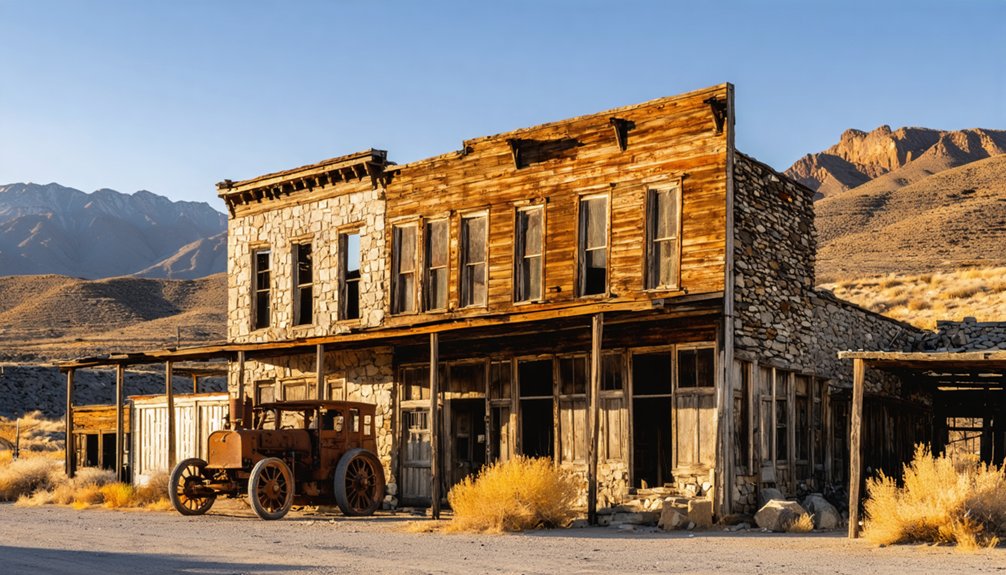
You’ll find Belmont’s 1876 courthouse standing remarkably intact, its two-story brick walls enduring 150 years of high-desert sun and wind among scattered pinions. Walk through the roofless Combination Mill, where forty stamp batteries once thundered, and you’ll spot the original ore cart still suspended on its tramline overhead—frozen mid-journey since operations ceased.
The arid climate has acted as a natural curator here, preserving everything from the Bank Building’s basement jail (where vigilantes once hanged two men) to the four-story mill’s brick skeleton rising against Nevada’s autumn sky.
Courthouse and Mill Ruins
Standing amid the sagebrush of central Nevada, Belmont’s brick courthouse rises from the desert floor like a monument to silver-fueled ambition. Built in 1876 for $3,400, this J.K. Winchell-designed structure governed Nye County until 1905.
You’ll find restoration techniques preserving its original character, though preservation challenges required replacing the 150-year-old roof.
Beyond the courthouse, mill ruins dot the landscape:
- Monitor-Belmont Mill’s lone brick chimney piercing the southern horizon
- Combination Mill’s smokestack (scarred by Air Force target practice)
- Cameron Mill’s salvaged brickwork
- Forty-stamp battery mill’s magnificent rock walls
- WWI-era revival remnants
These structures extracted $15 million in silver over two decades.
You’re free to explore self-guided, wandering between restored jail cells and crumbling walls.
Fall’s crisp air makes the remote journey worthwhile—just pack water and respect the ruins.
Arrested Decay Architecture
The desert’s arid climate has turned Belmont into an accidental preservation chamber, where brick structures from the 1860s stand frozen in time rather than crumbling to dust.
You’ll witness remarkable industrial preservation at the Flotation Mill ruins, where salvaged bricks from the 1873 Combination Mill were repurposed in 1915—creating layers of architectural decay spanning decades.
The courthouse’s single-storey walls still stand after timber roofs were stripped for reuse in the 1890s, leaving exposed brick shells that reveal construction methods from Nevada’s mining boom.
Walk through these skeletal remains freely; there’s no admission gate restricting your exploration.
The dry air prevents moisture damage that destroys structures elsewhere, giving you authentic access to 150-year-old buildings without glass barriers or roped-off sections.
Virginia City: Nevada’s Haunted Ghost Town Capital
Perched at 6,200 feet on Mount Davidson’s windswept slopes, Virginia City earned its reputation as Nevada’s most haunted ghost town through decades of mining tragedies, violent deaths, and restless spirits that still inhabit its Victorian-era buildings.
You’ll discover mining legends and haunted stories around every corner of this National Historic Landmark.
The town’s paranormal activity centers on these authentic sites:
- Boot Hill Cemetery, where vigilante-executed road agents rest among 5,000 burials
- The historic opera house, hosting paranormal investigations between live performances
- Victorian homes along creaking boardwalks, some with windows permanently sealed
- Remaining cemeteries featuring ornate Italian marble headstones behind iron fences
- Preserved saloons and churches where 25,000 souls once walked
Walk these shadowy streets during fall‘s cooler temperatures, when the veil between past and present feels thinnest.
Frequently Asked Questions
What Permits or Fees Are Required to Visit Nevada Ghost Towns?
You’ll dodge most fees exploring ghost towns—BLM land’s generally free unless you’re commercializing your adventure. State parks like Berlin-Ichthyosaur charge $5-10 entry. Historical preservation laws prohibit artifact-hunting, but permit regulations won’t stop your wandering spirit.
Are Nevada Ghost Towns Safe to Explore With Children in Fall?
Nevada ghost towns aren’t safe for children—open mine shafts, unstable structures, and environmental hazards pose serious risks. You’ll capture better photography from maintained viewpoints while respecting historical preservation. Choose guided tours at developed sites for family adventures instead.
explore virginia city’s historic charm by visiting the well-preserved buildings that tell the story of the Gold Rush era. As you wander through the town, you’ll find museums and shops that reflect its rich heritage. Don’t miss the chance to enjoy local cuisine at quaint eateries, which contribute to the town’s unique atmosphere.
Exploring the ghost towns of northern Nevada can lead to fascinating discoveries, from vintage automobiles left to rust to remnants of mining equipment that tell tales of past lives. Each site offers a glimpse into the challenges faced by those who once thrived in these now-desolate places. The eerie beauty of the landscape serves as a reminder of both the triumphs and trials that shaped this region’s history.
What Should I Pack for a Day Trip to Nevada Ghost Towns?
Ready for adventure? Pack layered clothing for shifting desert temperatures, sturdy boots for rocky trails, sunscreen, and two liters of water. These packing essentials and clothing tips guarantee you’ll explore freely while staying safe in Nevada’s rugged ghost towns.
Can I Camp Overnight Near These Ghost Towns During Fall?
You can camp near most Nevada ghost towns on BLM land with 14-day limits, but pack cold-weather camping gear for fall weather. Rhyolite prohibits overnight stays. Always choose durable surfaces and follow Leave No Trace principles for maximum freedom.
Which Ghost Towns Are Wheelchair Accessible or Senior-Friendly?
You’ll find Berlin and Churchill State Parks most senior-friendly, with maintained paths and facilities. Rhyolite offers managed grounds too. However, accessibility challenges persist elsewhere—most ghost towns prioritize authentic preservation over wheelchair accommodations, limiting your exploration freedom.
References
- https://nvtami.com/2022/10/18/top-10-ghost-towns-to-visit-this-fall/
- https://roadtrippers.com/magazine/dark-skies-and-ghost-towns-stops-on-a-spooky-nevada-road-trip/
- https://www.visittheusa.com/experience/6-nevada-ghost-towns-explore-if-you-dare
- https://www.atlasobscura.com/things-to-do/nevada/ghost-towns
- https://travelnevada.com/ghost-town/
- https://nvtami.com
- https://www.getyourguide.com/nevada-l1543/ghost-vampire-tours-tc23/
- https://ladailypost.com/posts-from-the-road-rhyolite-ghost-town-in-nevada/
- https://vegasghosts.com/rhyolite-nevada-ghost-town/
- https://travelnevada.com/ghost-town/rhyolite-ghost-town/