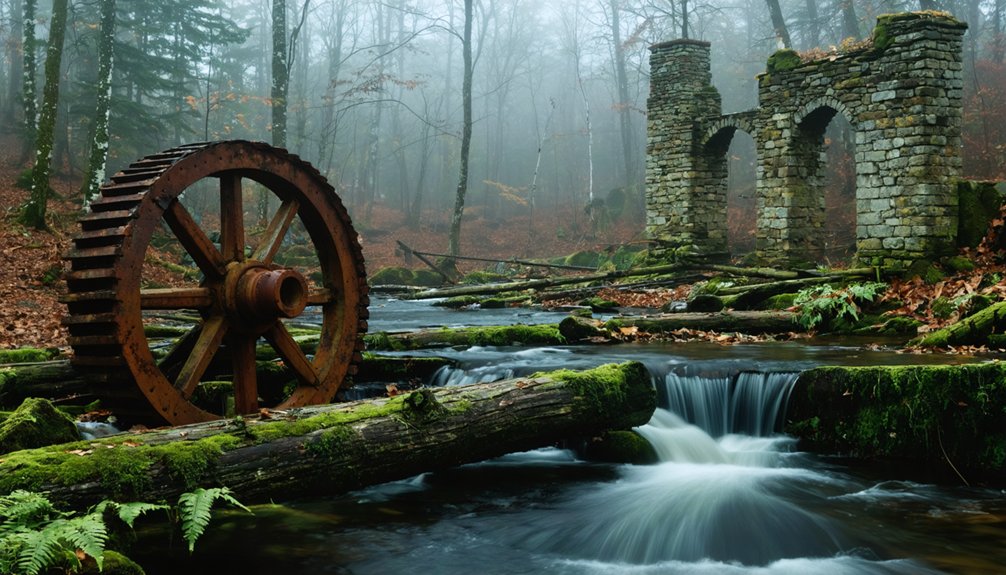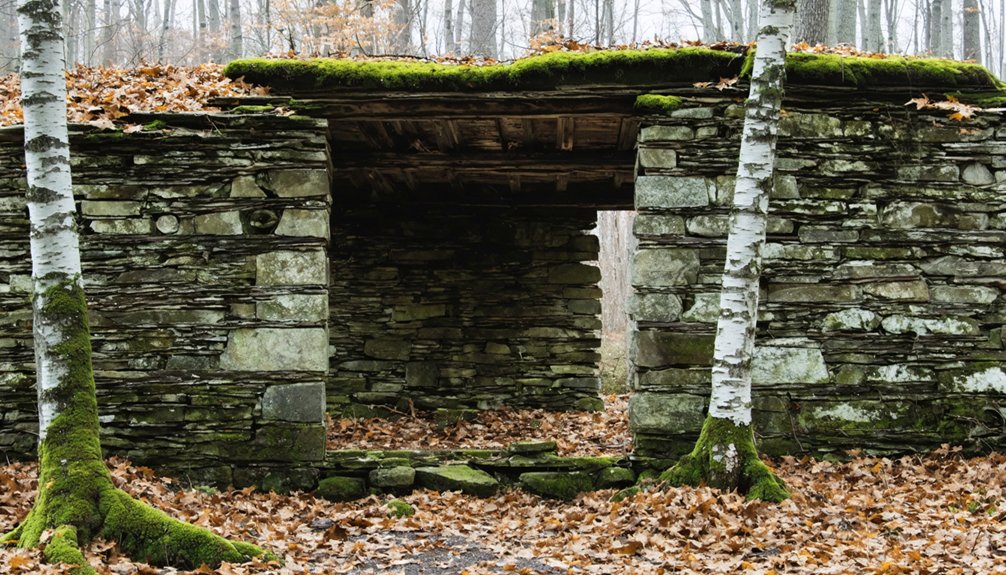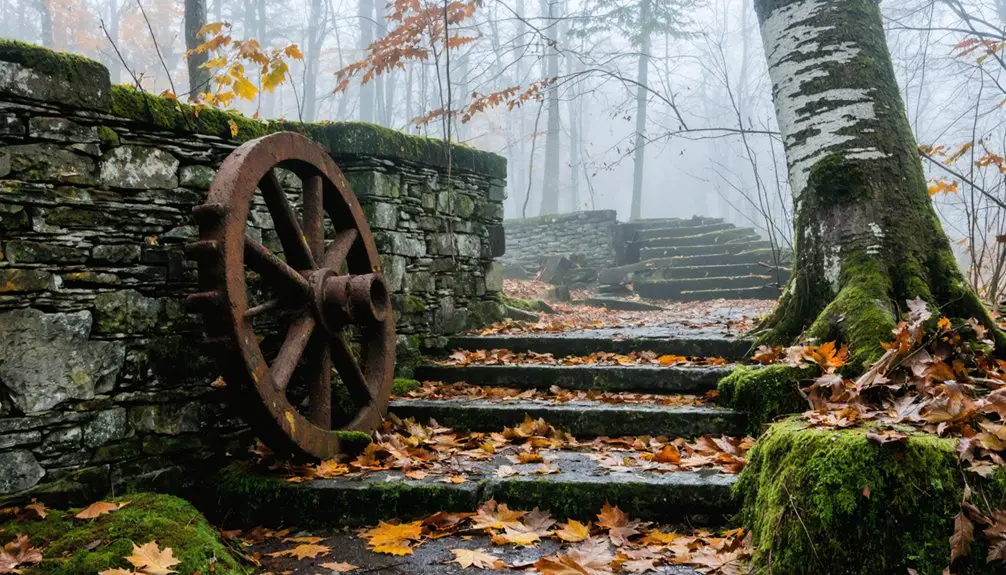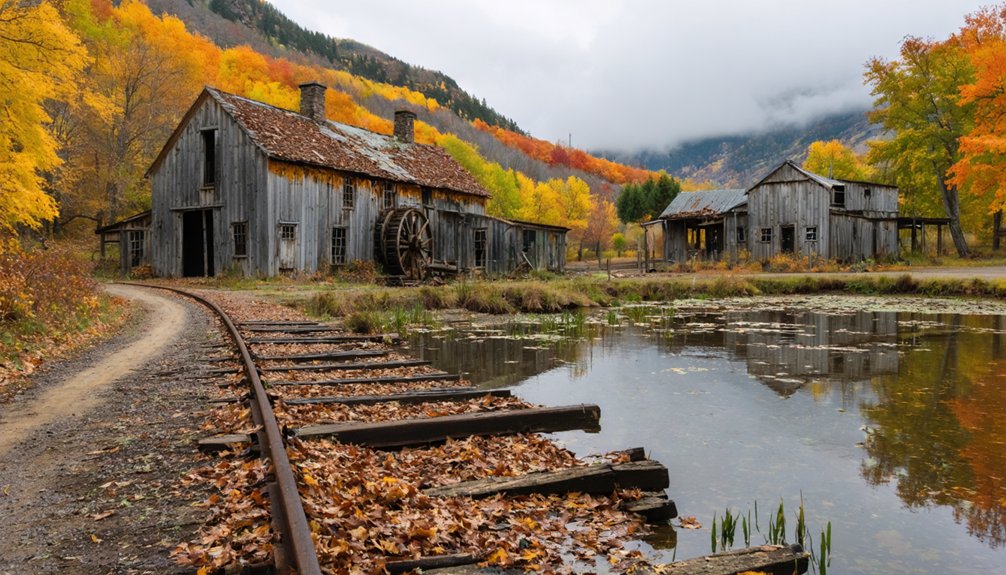
You’ll find New Hampshire’s most haunting ghost towns wrapped in fall’s crimson and gold embrace. Thornton Gore’s 600 cellar holes hide among White Mountain trails, while Hill Village’s foundations sleep beneath Franklin Falls Reservoir. Madame Sherri’s dramatic stone staircase still climbs toward nothing but October sky, and Nancy’s Brook marks where a heartbroken woman met her frozen end in 1778. The Willey House site in Crawford Notch remembers an entire family lost to an 1826 landslide. Each location offers more than crumbling stones—they’re gateways to stories that refuse to stay buried.
Key Takeaways
- Thornton Gore features 600+ cellar holes and stone walls accessible via Tripoli Road, with fall foliage enhancing abandoned farm structures.
- Hill Village, drowned in 1937, offers remnants of foundations and streets with vibrant autumn colors marking its original layout.
- Monson Village provides 200 acres of protected ruins including the 1756 Gould House, surrounded by fall forest and local legends.
- Madame Sherri’s Castle ruins feature a dramatic staircase and haunted reputation, framed perfectly by fall foliage in Chesterfield.
- Nancy’s Brook memorial and Willey House site combine tragic history with October ghost stories amid stunning fall scenery.
Thornton Gore: A Forgotten Settlement Among Fall Foliage
Deep in New Hampshire’s White Mountain National Forest, where golden birches and crimson maples now blanket the hillsides each October, lie the scattered remains of Thornton Gore—a farming settlement that flickered to life in 1804 and vanished before the twentieth century arrived.
You’ll find over 600 crumbling cellar holes hidden beneath the fall foliage, weathered stone walls snaking through brilliant yellow leaves, and rusting iron fixtures half-buried in moss.
The grist mill built in 1823 and sawmill from 1860 are now mere whispers of industry.
Drive Tripoli Road for scenic access, then hike into these abandoned structures where farms once thrived.
The Wildcat Cemetery‘s crooked headstones lean among the autumn bower—eerie reminders that 22 families called this wilderness home before logging companies reclaimed their dreams.
The population began its decline after the Civil War when men departed for battle and women sought work in distant textile mills.
The crisp mountain air carries the scent of pine needles and fallen leaves as you explore overgrown paths that once connected the settlement’s homesteads.
Hill Village: Where History Meets the Pemigewasset River
Unlike most New Hampshire ghost towns that simply faded away, Hill Village drowned by government decree. In 1937, the Army Corps of Engineers condemned this Pemigewasset River settlement for the Franklin Falls Dam project. Their floodplain analysis cited devastating floods—thirty feet above normal in 1875 alone—that justified sacrificing one community to protect downstream cities.
You’ll find what bureaucrats couldn’t erase: fourteen relocated buildings, foundations of water-powered mills, and walkable streets marking where freedom-loving settlers defied authorities by moving their entire town instead of scattering. The town’s relocation in 1941 used railroad winches and horses to move structures to higher ground.
Historical preservation efforts placed plaques throughout Old Hill Village, accessible above the reservoir’s waterline. Statuesque trees still line the main street, standing as silent witnesses since the village’s original days.
Visit the 1799 church standing defiantly at the original “Center”—proof that some foundations run deeper than government plans. Autumn foliage frames this testament to community resilience.
Monson Village: A Haunted Walk Through 18th Century Ruins
When six Massachusetts settlers purchased 17,000 acres of wilderness in 1735, they couldn’t have imagined their thriving community would vanish so completely that archaeologists would one day rank its ruins among New England’s most significant historical sites.
You’ll discover Monson Center’s eerie remains scattered across 200 acres of protected forest, where haunted legends and folklore tales echo through crumbling stone foundations.
What You’ll Explore:
- Gould House (1756) – The sole surviving structure, now housing historical exhibits
- Six original cellar holes – Stone-lined basements marking family homesteads with genealogy signage
- Original settlement roads – Now hiking trails winding through autumn forests
- Ancient stone walls – Boundary markers preserved since the 1760s
Political discord ultimately destroyed what harsh conditions couldn’t—settlers disbanded their own charter in 1770, abandoning everything they’d built. The town’s decline was hastened by the fact that no meeting house or school was ever constructed, leaving Monson without the communal institutions that sustained other frontier settlements. Today, Hollis and Milford incorporated the land from Monson’s original boundaries as they developed into modern New Hampshire towns.
Madame Sherri’s Castle: The Stairway to Heaven
A stone staircase rises through the New Hampshire forest like a theatrical stage prop abandoned mid-performance—which isn’t far from the truth.
French costume designer Madame Sherri built this castle without blueprints in 1929, poking stakes in the ground to mark where her lavish party venue would stand. She’d roar up in her cream Packard with a monkey on her shoulder, hosting Prohibition-era bashes for Broadway friends.
The mansion burned down in 1962, leaving behind stone ruins that tell the story of her legendary parties. Today’s ruin preservation efforts maintain trails around the foundation, though the iconic “Stairway to Heaven” partially collapsed in 2021.
The castle architecture that remains—including the dramatic exterior staircase—draws photographers and ghost hunters alike. Visitors report hearing sounds of laughter and music echoing through the ruins, with some claiming to see Madame Sherri’s apparition at the top of the staircase.
You’ll find it in Madame Sherri Forest off Gulf Road in Chesterfield, where fall foliage frames this eccentric monument to theatrical excess.
Willey House Site: Crawford Notch’s Tragic Tale
Deep in Crawford Notch, where autumn maples blaze against granite cliffs, you’ll find an interpretive center marking one of the White Mountains‘ most haunting ironies.
Where tragedy and preservation collide beneath New Hampshire’s peaks, nature’s cruel mercy left a home standing while claiming its fleeing inhabitants.
On August 28, 1826, the Willey family fled their home during a violent landslide—only to perish in the debris while their house remained perfectly intact beneath a protective ledge.
What draws visitors today:
- Spiritual legends surrounding the family’s tragic decision and the phrase “gives me the willies”
- Paranormal investigations reported near the preserved site and surrounding trails
- Stunning hiking access to the original slide path on Mt. Willey
- Dry River Campground for overnight exploration
The property’s transformed from inn to interpretive center, letting you trace this mountain legend that captivated even Nathaniel Hawthorne. The disaster followed a severe drought and storm that destroyed 21 miles of turnpike and dramatically altered the mountain landscape. The original inn operated at this location until destroyed by fire in 1898, after which the state acquired and preserved the historic site.
Nancy’s Brook: A Ghostly Grave in the Wilderness
You’ll find Nancy Barton’s grave marked by a simple cairn beside the brook that bears her name, where she froze to death in 1778 after chasing her faithless lover through Crawford Notch’s winter wilderness.
The rocks stacked near the water commemorate the young servant woman who collapsed from hypothermia on this very spot, her body discovered by searchers from Jefferson curled against the cold.
On October nights, hikers still report hearing desperate cries and eerie laughter echoing through the pines—sounds locals attribute to Nancy’s restless spirit, forever wandering these woods in search of the man who betrayed her.
Nancy’s Tragic Wilderness Death
Sometimes love drives us to reckless decisions that echo through centuries. Nancy Barton’s 1778 pursuit of her faithless lover through Crawford Notch became New Hampshire’s most haunting wilderness exploration tale.
After farmhand Jim Swindell fled with her savings, she chased him unprepared into winter’s fury.
Her desperate journey revealed tragic determination:
- 20-30 miles traversed through snow-covered peaks without provisions
- Soaked dress from crossing icy Nancy Brook
- Death by hypothermia while resting on a riverside boulder
- Immediate regret drove Swindell mad upon hearing the news
You’ll find her burial cairn near the brook that bears her name. The ghost lore persists—hikers still report phantom cries echoing through these woods, where love’s obsession met winter’s indifference.
Riverside Cairn Memorial Site
Nancy’s final resting place lies tucked among towering spruce and fir trees on a quiet riverbank north of Nancy Brook, where the forest floor carpets itself with moss and autumn leaves.
You’ll find a simple jumble of stones marking her presumed grave—no elaborate headstone, just a cairn that feels right for someone who died pursuing freedom through these mountains.
Access the site from Notchland Drive off Route 302, but call the Inn first for permission and directions.
The quarter-mile walk through moderate terrain rewards you with one of New Hampshire’s most haunting wilderness memorials.
The 1,385-acre Nancy Brook Scenic Area now protects these forest preserves, encompassing virgin spruce-fir stands and the cascades where she crossed.
Don’t trek alone—locals report strange phenomena near the cairn.
Haunting Sounds and Echoes
When October winds sweep through Crawford Notch, hikers traversing the Nancy Brook trail often pause mid-step, uncertain whether they’ve heard distant sobbing or merely water tumbling over rocks. These folklore stories have persisted since 1778, when Nancy Barton’s frozen body was discovered beside the brook.
The urban legends describe specific phenomena:
- Desperate cries echoing through the valley during autumn evenings
- Gibbering laughter heard by travelers on cold October nights
- Unexplained shrieks that cause experienced hikers to quicken their pace
- Disembodied sobbing near the memorial marker where Nancy collapsed
You’ll find the memorial about twenty miles into the trail—a sobering reminder that these mountains hold stories darker than any ghost town‘s abandoned buildings ever could.
Frequently Asked Questions
What Should I Bring When Visiting These Abandoned Ghost Towns in Fall?
You’ll want sturdy boots, layered clothing, and a camera for autumn photography. Bring water, snacks, and a trail map for historical exploration. Don’t forget your sense of adventure—these forgotten places reward those who wander freely off the beaten path.
Are These New Hampshire Ghost Town Sites Wheelchair or Stroller Accessible?
Most New Hampshire ghost towns aren’t wheelchair or stroller accessible—you’ll face rough forest terrain without urban infrastructure or accessibility features. Only Monson appears in disability-friendly guides, though specific accommodations remain unclear. You’ll need sturdy mobility for these remote adventures.
If you’re up for the challenge, there are ghost towns to explore in New Hampshire that offer a glimpse into the state’s rich history. From abandoned homes to forgotten roads, each site tells a unique story of life in a different era. Make sure to research the areas you plan to visit and be prepared for an off-the-beaten-path experience.
Can I Camp Overnight Near Any of These Ghost Town Locations?
You can’t camp directly at these ghost towns, but dispersed camping’s allowed in surrounding White Mountain National Forest with permits. Scout perfect spots for capturing haunted legends through dawn photography—I’ve found early light reveals the most atmospheric shots of ruins.
Do I Need Special Permits to Explore These Abandoned Settlements?
You won’t need permits for Thornton Gore, Monson Center, or Livermore—they’re open for exploration without legal restrictions. However, Nancy’s Gravesite requires calling Notchland Inn beforehand for permission since it’s on private property.
Are Dogs Allowed on the Trails at These Historic Sites?
Trail regulations don’t explicitly mention pet restrictions at Thornton Gore, Monson Village, or Hill Village, so you’ll likely find freedom exploring with your dog. Always prioritize pet safety on overgrown paths and near crumbling ruins.
References
- https://www.explore.com/1951502/thornton-gore-new-hampshire-ghost-town-white-mountains-fall-foliage/
- https://outdoorodyssey.net/2024/11/04/the-old-ghost-town-of-hill-new-hampshire/
- https://www.newhampshirehauntedhouses.com/fall-attractions/
- https://www.visitnh.gov/blog/haunted-adventures
- https://nothingbutnewengland.com/new-hampshires-haunted-hikes/
- https://www.visitwhitemountains.com/blog/post/spooky-stories-ghost-towns-and-historic-haunted-spots/
- https://adventuresinnewengland.com/fall-in-new-hampshire/
- https://www.youtube.com/watch?v=EyeXIme2ppc
- https://www.youtube.com/watch?v=rzJN7i0WYOY
- https://www.visitwhitemountains.com/blog/post/scary-tales-of-the-white-mountains/