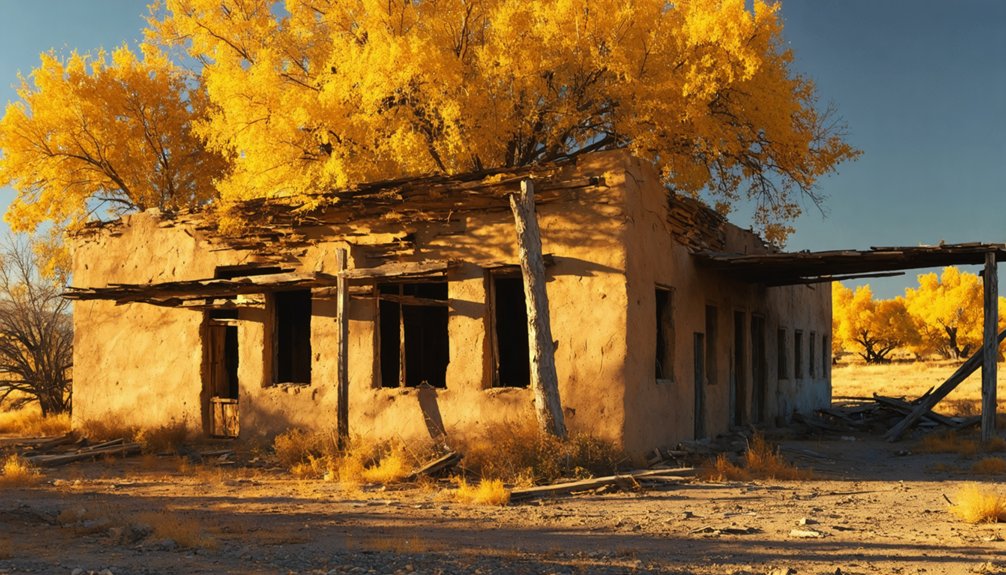
You’ll find New Mexico’s best fall ghost town experiences along the Turquoise Trail, where Madrid’s artist galleries showcase turquoise jewelry amid autumn colors, and in the remote Black Range Mountains at Chloride, where 27 original buildings stand near golden aspens. Shakespeare near Lordsburg offers living history tours through its lawless past, while Lake Valley‘s BLM-managed ruins provide solitary desert exploration. Mogollon sits at 7,000 feet with nearly 100 structures framed by peak foliage from late September through early October, and the guide below reveals how to navigate these historic sites for unforgettable autumn photography.
Key Takeaways
- Madrid offers art galleries, mining museums, and colorful autumn landscapes along the scenic Turquoise Trail between Albuquerque and Santa Fe.
- Mogollon sits at 7,000 feet with nearly 100 preserved structures amid fall foliage in the Mogollon Mountains.
- Lake Valley provides solitary exploration of silver mining ruins managed by BLM, with tours starting at the old schoolhouse.
- Chloride features twenty-seven original buildings and proximity to Gila National Forest’s autumn wildlife and natural beauty.
- Hillsboro’s preserved courthouse and mining relics are enhanced by fall’s golden light, showcasing frontier adaptability and resilience.
Madrid: A Colorful Artists’ Haven Along the Turquoise Trail
Tucked into the high desert hills along New Mexico’s Turquoise Trail, Madrid rises from the landscape like a phoenix painted in turquoise and terracotta. This former coal mining town, abandoned in the 1954, now thrives as an artists’ colony where creativity flows through every converted miners’ cabin.
You’ll discover galleries showcasing nationally known painters and sculptors, including Trading Bird Gallery with its owner-mined Cerrillos turquoise and Santo Domingo jewelry. At Madrid’s south end, Gypsy Plaza’s courtyard brings together local artisans offering jewelry, paintings, photography, and handcrafted stone creations. The historical architecture along Main Street—Territorial adobes and weathered Western façades—creates an authentic backdrop for your exploration.
Don’t miss the Mine Shaft Tavern‘s legendary bar, claimed as New Mexico’s longest. The town also features a Coal Mining Museum preserving its industrial heritage alongside restored historic sites. As autumn paints the surrounding hills gold, you’ll find Madrid’s bohemian spirit perfectly frames the season’s mystic landscapes.
Chloride: Silver Mining History in the Black Range Mountains
While Madrid’s colorful galleries celebrate artistic rebirth, the weathered buildings of Chloride whisper tales of a more volatile resurrection—one born from silver strikes and Apache conflicts in the rugged Black Range Mountains.
Harry Pye’s 1879 discovery of high-grade silver deposits transformed this remote canyon into a boomtown of 3,000 fortune-seekers by 1883. You’ll find twenty-seven original structures still standing, including the Pioneer Store museum and Monte Cristo Saloon.
Within four years, a single silver strike multiplied one canyon’s population to 3,000 souls chasing fortune.
Picture Chloride’s dramatic history:
- Ox-drawn freight wagons hauling ore across forty miles of untamed wilderness
- Eight saloons echoing with miners’ celebrations along dusty Main Street
- Apache history etched into every canyon wall surrounding the settlement
The 1893 Silver Panic collapsed prices from $1.81 to eighteen cents per ounce, ending the dream.
Today, you’re free to explore authentic false-front buildings where independence-minded prospectors once defied both economics and danger. The town’s position near Gila National Forest offers natural beauty alongside its preserved mining heritage, with deer regularly wandering through the historic streets even during daylight hours. The active mining district ultimately produced about $500,000 in silver and ore before operations wound down.
Shakespeare: Where Outlaws Once Roamed
Just two miles south of Lordsburg, the ghost town of Shakespeare stands as one of the Southwest’s most authentically preserved relics of frontier justice—or rather, its conspicuous absence. You’ll discover a Wild West settlement where no lawmen ever patrolled, where vigilantes maintained order through one brutal rule: killers dig their own victims’ graves.
This deterrent kept indiscriminate shootings in check while Texas “hired fighting men” guarded silver claims from claim-jumpers.
Founded during the Civil War era, Shakespeare survived boom-and-bust cycles, the infamous Diamond Swindle, and Apache conflicts. The town’s origins trace back to Mexican Spring, a reliable water source that served as an Army relay station in 1856. Since 1935, three generations have preserved its buildings intact. Emma Marble Muir, who moved to Shakespeare in 1882, documented the town’s history through articles in New Mexico Magazine including “The Stage to Shakespeare” and “Bonanza Days at Shakespeare.”
You can tour this National Historic Site daily and experience living history re-enactments where ghost stories of Shakespeare’s lawless past echo through authentic structures.
Lake Valley: Remnants of a Silver Boom Treasure
Deep in Sierra County’s high desert, Lake Valley guards the legend of North America’s richest silver discovery. You’ll walk where miners once carved the legendary Bridal Chamber with handsaws—a crystalline cavern yielding ore worth $15,000 per ton.
The 1881 strike transformed primitive mining techniques into fortune-hunting frenzy, with the Sierra Grande Mining Company extracting over $1 million in months.
- Picture the 200-foot cavern lined with horn silver crystals, where “Jackson’s Baby” weighed over five tons
- Imagine Main Street ablaze in 1895, ending the boom forever
- Explore weathered buildings and mining relics along the dirt road
Today’s ghost town preservation by BLM lets you discover original structures at your own pace. Tours originate at the old schoolhouse, where caretakers welcome visitors Thursday through Monday. The town’s remote location off main tourism routes means you might find yourself exploring the weathered structures in complete solitude, with only the desert wind as your companion.
Even Walt Whitman owned shares in this desert gamble, though silver’s demonetization ultimately sealed Lake Valley’s fate.
Mogollon: High-Altitude Mining Town in the Gila Wilderness
Perched at 7,000 feet in the Mogollon Mountains, this former mining camp claimed its reputation as one of the West’s most lawless outposts—and for good reason.
You’ll navigate nine miles of narrow, winding road to reach this isolated settlement where 6,000 fortune-seekers once extracted $1.5 million in gold annually.
The town’s historical architecture tells stories of survival: five catastrophic fires and five floods destroyed wooden structures, forcing residents to rebuild with brick and adobe.
Today, nearly 100 buildings stand in various states of decay, earning the site National Register status in 1987.
Preservation challenges mount as nature reclaims what miners built, yet the town’s defiant spirit remains palpable among the weathered storefronts and crumbling foundations. The settlement takes its name from a Spanish governor who ruled New Mexico during the 1700s. The Mogollon Cemetery, located a mile north of town, contains graves of many who perished during the 1918 Spanish Flu epidemic.
Hillsboro: Gateway to Gold and Silver Rush Heritage
You’ll discover Hillsboro nestled in the Mimbres Valley foothills, where over 9,900 mines once extracted six million dollars in precious metals during the 1877-1898 gold and silver rush.
The town’s remarkable survival—unlike its vanished neighbors—stems from its strategic pivot to gold mining when the 1893 silver crash devastated the Black Range.
Fall’s crisp mountain air and golden aspens create ideal conditions for exploring the 1892 brick courthouse and Union Church, then venturing along scenic Geronimo Trail Ranch routes into the surrounding mineral-rich canyons.
Historic Mining Town Remnants
Nestled at 5,253 feet along New Mexico’s Highway 152, Hillsboro stands as a proof to the Southwest’s tumultuous gold and silver era. You’ll discover authentic remnants of historic preservation efforts scattered throughout this survivor of boom and bust cycles.
The ruins tell stories of mining techniques that once extracted over $6 million from surrounding mountains.
- The 1896 jail’s weathered stone walls still whisper tales of frontier justice and the famous Oliver Lee murder trial.
- Crumbling courthouse foundations mark where Sierra County’s seat stood from 1884 to 1936.
- The converted power station, now a private residence, showcases adaptive reuse of industrial heritage.
These tangible connections to 10,000 souls who once called this place home offer you an unfiltered glimpse into New Mexico’s untamed past.
Geronimo Trail Ranch Access
Beyond Hillsboro’s weathered mining relics, Highway 152 transforms into the Geronimo Trail National Scenic Byway, climbing through 50 miles of ranch country toward one of New Mexico’s most secluded heritage experiences. The route ascends to Emory Pass at over 8,000 feet before descending through scrub slopes toward Winston, where Geronimo Trail access leads to authentic off-grid adventures.
You’ll need reservations mid-March through early November—this isn’t terrain for spontaneous visits. The Geronimo Trail Guest Ranch sits tucked within the 3.3-million-acre Gila National Forest, where cellphone service vanishes and horseback trails wind past 1,000-year-old Mimbres pit houses, cliff dwellings, and Apache history.
Four rustic cabins accommodate 12-16 guests seeking unlimited riding through Ponderosa forests and spring-fed canyons where Hillsboro’s prospectors once searched for fortune.
Fall Exploration Opportunities
How does a town survive when 8,000 residents vanish within a decade? You’ll discover the answer in Hillsboro, where gold-based resilience saved the settlement after silver’s 1893 collapse devastated neighboring camps.
While Kingston and Lake Valley became ghost towns, Hillsboro’s miners kept extracting precious metal from over 9,900 operations that produced six million dollars combined.
Fall’s golden light illuminates genuine ghost town preservation efforts:
- The 1892 brick courthouse stands proud, sharing architectural DNA with Tombstone’s territorial justice center
- Union Church’s red brick walls echo with memories of 10,000 boom-era souls
- Abandoned mining techniques scatter across hillsides—rusted equipment marking Ready Pay Gulch and Grayback Arroyo claims
You’re free to wander authentic Black Range history where ranching replaced silver fortunes, creating today’s living monument to frontier adaptability.
Planning Your Fall Ghost Town Adventure in New Mexico
Fall transforms New Mexico’s ghost towns into crisp-aired destinations where golden aspens frame weathered adobe and autumn light paints rust-colored ruins.
You’ll need offline maps, sturdy boots, and ample water for remote sites like Mogollon at 7,000 feet, where cell service vanishes and mountain roads twist through changing foliage.
Late September offers ideal conditions—clear skies dodge summer heat while daylight hours remain generous for photographing preserved buildings along the Turquoise Trail or hiking through the Organ Mountains to Dripping Springs.
Best Times to Visit
When planning your ghost town adventure in New Mexico, timing transforms a good trip into an unforgettable one. September 28 through October 5 delivers peak seasonal foliage as aspens blaze yellow across Sangre de Cristo mountainsides.
Exploring ghost towns near Santa Fe allows you to step back in time, immersing yourself in the history and solitude of these once-thriving communities. As you wander through the remnants of old structures, the vibrant fall colors enhance the haunting beauty of the landscape. Make sure to capture the striking contrast between the warm hues of the foliage and the cool, weathered stones of the ghost towns.
The colorful fall foliage in New Mexico creates a breathtaking backdrop for your exploration. As you engage with the rich stories of the past, the leaves dancing in hues of red, orange, and gold illuminate the path, making every moment feel even more magical. Don’t forget to take a moment to appreciate how the natural beauty complements the remnants of history surrounding you.
Weather considerations favor this window—warm days and cool nights intensify colors without frost damage. Moist springs followed by dry autumns create the most brilliant displays.
Your fall exploration unfolds with:
- Mogollon’s elevated trails at 7,000 feet, where preserved mining ruins stand against autumn mountain air and weekend galleries welcome wanderers
- Cuervo’s abandoned stone-stucco houses offering cool interiors as oppressive summer heat finally breaks along Highway corridors
- Remote adobe structures near Mora River, accessible via footbridges under mild skies that spare you winter snow and summer scorching
Check road conditions before venturing into backcountry locations where freedom awaits.
Essential Gear and Supplies
Before stepping into New Mexico’s windswept ruins and mountain ghost towns, you’ll need gear that matches the terrain’s demands. Pack layered clothing for altitude swings—warm days shift to cool nights fast at 7,000 feet.
Sturdy boots grip rugged trails through Gila Wilderness and Organ Mountains. Zero cell service means offline maps and GPS devices aren’t optional.
Bring water for desert crossings, first aid for exploring decaying structures, and flashlights for peering into preserved buildings at dusk.
For ghost town photography capturing golden cottonwoods and autumn foliage against volcanic cliffs, pack a tripod for low-light shots and polarizing filters to intensify aspens’ vibrant yellows.
Extra batteries matter when you’re hours from civilization, documenting weathered shacks beneath Sangre de Cristo mountainsides.
Route Planning and Logistics
Your loaded backpack won’t matter if your route dead-ends at an impassable wash or leads you three hours down a dirt road to nowhere. Unlike urban development with predictable grids, New Mexico’s ghost towns demand strategic planning.
Transportation infrastructure here means understanding where Interstate 40 diverges from historic Route 66, where the Turquoise Trail‘s 65 winding miles require daylight navigation, and which backcountry byways test your vehicle’s limits.
Consider these routing essentials:
- The Turquoise Trail snakes through juniper-piñon hills between Albuquerque and Santa Fe, connecting Golden’s 1830 church with artist-colony ghost towns
- Cuervo’s weathered Catholic church stands 126 miles from Santa Fe along abandoned Route 66 pavement
- Lake Valley’s 48-mile backcountry loop demands reliable transportation through BLM territory
Mountain passes exceed 7,500 feet—plan accordingly.
Frequently Asked Questions
Are Pets Allowed When Visiting New Mexico Ghost Towns in the Fall?
Yes, you’ll find pet-friendly policies at New Mexico’s ghost towns. Keep your dog leashed on trails and day-use areas, ensuring pet safety while exploring. Remember, self-contained RVs accommodate overnight stays with your furry companion.
What Photography Equipment Works Best for Capturing Ghost Town Autumn Scenery?
Weathered wood glows golden through your viewfinder. You’ll need wide-angle lenses (14-35mm) for expansive landscapes, polarizing filters for autumn colors, and sturdy tripods for sharp architectural shots. These photographic techniques support historical preservation while capturing New Mexico’s abandoned beauty.
Can You Camp Overnight Near These Ghost Towns During Fall Months?
You’ll find overnight options vary—Madrid offers on-site parking through their Harvest Host program, while Chloride and Glenrio require nearby boondocking. Campground amenities are limited, but you’ll gain excellent fall foliage access for sunrise photography sessions.
Do Any Ghost Towns Offer Guided Tours Specifically During Fall Season?
While you won’t find fall-specific tours carved in stone, Old Town Albuquerque’s autumn-promoted Legends & Lore bicycle tour delivers local legends and historical preservation through paranormal storytelling. Most ghost town guided tours operate year-round, welcoming your spontaneous exploration.
What Wildlife Might Visitors Encounter at These Ghost Town Locations in Fall?
You’ll encounter native fauna like mule deer, elk, and coyotes roaming freely across these wild landscapes. Migratory birds pass through seasonally, while elusive big cats and pronghorn antelope traverse the untamed terrain surrounding these abandoned settlements.
References
- https://newmexicotravelguy.com/new-mexico-ghost-towns/
- https://geronimoranch.com/blog/ghost-towns-in-nm/
- https://www.tripadvisor.com/Attractions-g28952-Activities-c47-t14-New_Mexico.html
- https://www.atlasobscura.com/things-to-do/new-mexico/ghost-towns
- https://www.newmexico.org/places-to-visit/ghost-towns/
- https://www.youtube.com/watch?v=FxQkk4utppg
- https://www.newmexicomagazine.org/blog/post/abandoned-ghost-towns-new-mexico/
- https://www.treasurenet.com/threads/obscure-new-mexico-ghost-towns.84979/
- https://www.blm.gov/visit/lake-valley-historic-townsite
- https://www.nmexperiences.com/post/turquoise-trail-madrid-new-mexico