You’ll discover New York’s most mesmerizing ghost towns when fall foliage frames abandoned ruins. Explore Doodletown’s crumbling staircases in Bear Mountain State Park, Tahawus’s preserved 1854 blast furnace in the Adirondacks, or New Ireland’s stone foundations hidden in Allegany State Park. Each site offers crimson maples surrounding forgotten cemeteries, weathered foundations, and haunting remnants of communities lost to economic collapse, environmental disasters, and forced evacuations. Late September through October provides the perfect backdrop for these atmospheric explorations, where Gothic scenery meets documented history and local legends whispered through the ruins await your visit.
Key Takeaways
- Doodletown in Bear Mountain State Park features crumbling foundations, historic cemeteries, and a 200-year-old oak surrounded by five mountains.
- Tahawus offers 16 historical structures, including an 1854 blast furnace, interpretive trails, and guided tours from 10 AM–3:30 PM daily.
- New Ireland in Allegany State Park displays Irish settlers’ stone foundations along Ward Cabin Trail, best viewed during autumn foliage.
- Love Canal presents fenced-off abandoned streets and the empty 93rd Street School as haunting monuments to environmental disaster history.
- Fall exploration from September to October showcases crimson maples among ruins, enhancing Gothic atmosphere and urban legend experiences.
Doodletown: A Forgotten Settlement in Bear Mountain State Park
Tucked deep within Bear Mountain State Park lies Doodletown, a settlement that once buzzed with the sounds of miners’ pickaxes and loggers’ saws before vanishing into the forest. You’ll find crumbling staircases and weathered foundations where 70 homes once stood—remnants of urban decay reclaiming what civilization briefly conquered.
The Dutch name means “dead valley,” a darkly fitting descriptor for this ghost town where 300 residents thrived until eminent domain forced the last families out in 1965. During its heyday in the 1920s, the community supported a school and small businesses that served the growing population.
Today, you can hike unmarked trails past two historic cemeteries and a 200-year-old oak, though historical preservation efforts remain minimal. The settlement’s location, surrounded by five mountains including Dunderberg, Bald, Timp, West, and Bear Mountain, created the isolated valley that gave this community its distinctive character. Watch for timber rattlesnakes as you explore the bridle paths built during the Depression.
It’s raw, unfiltered history—freedom seekers will appreciate the unvarnished authenticity of these forgotten ruins.
Tahawus: The Adirondacks’ Best-Preserved Mining Village
You’ll find Tahawus standing as the Adirondacks’ most intact mining ghost town, where a massive 1854 stone blast furnace and the historic MacNaughton Cottage rise from the wilderness like monuments to iron and titanium extraction.
The site opened to public access in 2003, transforming these ruins into an accessible hiking destination where interpretive signs guide you through the settlement’s dramatic 140-year timeline— from its 1820s founding as Adirondack Iron Works through its 1989 abandonment.
Walk among preserved structures where 16 families once lived, then explore the Upper Works historic district as forest reclaims what industry left behind. Before its modern recreational use, the area served as headquarters for the Preston Ponds Club, a hunting and fishing club that leased the entire tract in 1876 and transformed the abandoned mining village into a private retreat. The location gained unexpected historical significance when Theodore Roosevelt learned of McKinley’s death here during his 1901 Mount Marcy hiking trip, marking the moment before his presidency began.
Preserved Buildings and History
Deep in the Adirondack wilderness, Tahawus stands as one of New York’s most architecturally intact ghost towns. Weathered buildings narrate a century of boom-and-bust cycles.
You’ll discover remarkable examples of industrial archaeology scattered throughout the site:
- McIntyre Furnace (1854): This impressive stone blast furnace represents a $43,000 investment that ultimately couldn’t overcome titanium dioxide processing limitations.
- McNaughton Cottage: Theodore Roosevelt’s 1901 midnight ride to presidency began here, preserved as attestation to unexpected presidential history.
- 1940s Village Structures: 84 buildings once housed mining families with modern amenities—movie theaters, bowling alleys, barbershops.
The Open Space Institute’s 2003 acquisition ensures these preservation challenges receive proper attention. The organization retained land along the road, including existing structures, while selling most of the property to the state for addition to the Forest Preserve. Accessing the site requires a seven-mile journey along a desolate asphalt road through dense wilderness that ends abruptly in the town center.
You can freely explore remnants of dwellings, industrial equipment, and community infrastructure that survived two abandonments, offering unfiltered glimpses into Adirondack mining heritage.
Hiking and Recreation Access
Beyond the weathered buildings themselves, Tahawus offers something most ghost towns can’t—direct access to world-class wilderness trails. You’ll find High Peaks trailheads right from the Upper Works parking area, cutting seven miles off your approach to Mt. Marcy’s base.
The interpretive trails wind through mining ruins with educational panels, while more ambitious routes lead to Mt. Adams Fire Tower and Calamity Brook’s backcountry campsites.
Wildlife observation opportunities abound along Lake Henderson’s shores, where you can paddle between historical exploration and remote waterways.
The winding Upper Works Road itself becomes an adventure, especially during peak foliage season. For history enthusiasts, a 10-mile round-trip to the nearby Santanoni Great Camp offers an extended day trip via hiking, biking, or skiing.
Trail safety matters here—these paths traverse uneven terrain through genuine wilderness. The property is currently stewarded by the Open Space Institute, ensuring preservation and public access.
Guided tours run 10 AM to 3:30 PM, though you’re free to explore independently year-round.
North Brother Island: Nature Reclaims a Quarantine Hospital
Imagine a forsaken island in the East River where crumbling hospital pavilions slowly surrender to strangling vines and towering ailanthus trees—a place where nature has spent six decades erasing all traces of human suffering. North Brother Island’s abandoned Riverside Hospital once quarantined “Typhoid Mary” and countless disease victims before closing in 1963.
Though urban exploration enthusiasts yearn to witness this ecological restoration firsthand, you can’t legally access it—the island’s now a protected bird sanctuary.
Dark History Highlights:
- Quarantine hospital from 1885-1963 treating smallpox, typhoid, tuberculosis, and other contagious diseases
- Mary Mallon’s forced confinement from 1915 until her death in 1938
- General Slocum disaster site (1904), claiming 1,021 lives
- Failed drug rehabilitation center (1952-1964) with questionable confinement practices
The island’s location near Hell Gate, a treacherous whirlpool notorious for wrecking ships, once deposited maritime wreckage along its shores. The 20-acre island once featured self-sufficient community amenities including a morgue, public school, and tennis courts. You’ll glimpse decaying structures from passing boats.
Love Canal: A Toxic Legacy in Niagara Falls
You’ll find Love Canal in Niagara Falls, where a failed 1890s hydroelectric dream became America’s most infamous toxic waste disaster.
Between 1942 and 1952, Hooker Chemical buried over 21,000 tons of carcinogens in the abandoned canal before selling it for $1—then homes and a school rose directly atop the poison.
Today, you can drive through the eerily quiet streets where 900 families once lived before President Carter’s emergency evacuation.
Now renamed Black Creek Village, some resettled homes stand as unsettling monuments to environmental catastrophe.
The Chemical Disaster History
Beneath the streets of a quiet Niagara Falls neighborhood lies one of America’s most notorious environmental disasters. From 1942 to 1953, Hooker Chemical Company dumped 22,000 tons of toxic waste into an abandoned canal, creating a contaminated time bomb beneath what would become homes and schools.
The industrial contamination included:
– 248 separate chemicals, including 12 known carcinogens like dioxin, PCBs, and benzene
Chemical burns on children playing in yards were reported as early as 1958.
Toxic sludge seeping into basements during wet winters of the late 1970s.
Widespread health problems: miscarriages, birth defects, cancers, and respiratory diseases.
Visiting the Abandoned Streets
Today, the former Love Canal neighborhood stands eerily silent behind chain-link fences, its abandoned streets frozen in time since the mass evacuation of the 1980s. You’ll find boarded-up homes where 900 families once lived, their empty windows staring blankly at overgrown lawns.
Warning signs mark the perimeter of this toxic wasteland, where 21,000 tons of chemical waste still lie beneath your feet. The urban decay tells a haunting story—93rd Street School sits abandoned, its playgrounds empty since children suffered chemical burns in the late 1950s.
Walking these desolate blocks, you’ll witness abandoned structures that serve as monuments to governmental negligence and corporate irresponsibility. While portions were renamed Black Creek in 1990, the fenced-off area remains a stark reminder of America’s worst environmental disaster.
Pottersville: Tragedy and Floods in Warren County
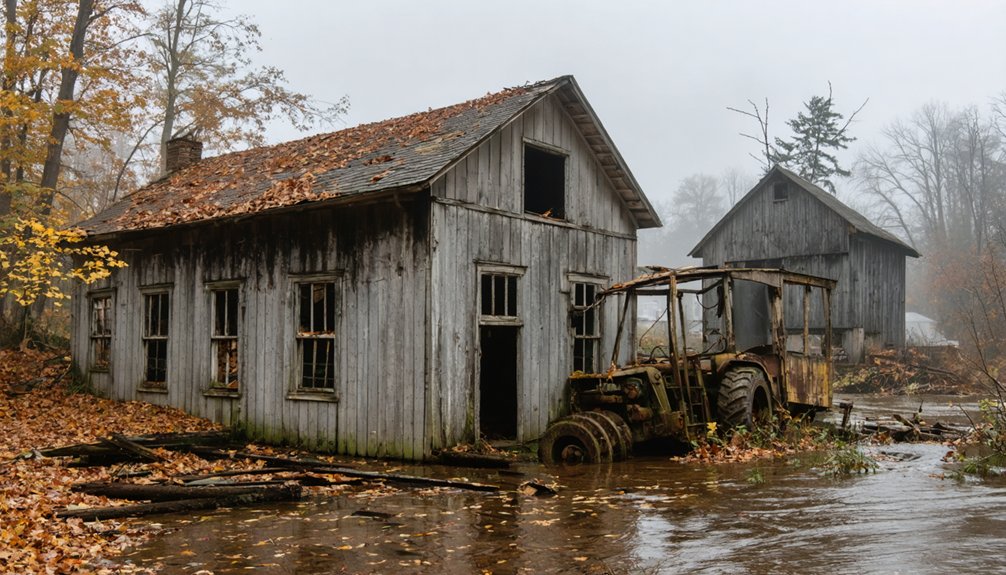
When spring rains released their fury in 1913, Warren County witnessed devastation on a scale that defied living memory. The Conewango Creek and Brokenstraw River surged simultaneously, transforming Warren into an unprecedented lake.
Two rivers converged in catastrophic fury, drowning Warren County beneath waters that shattered every recorded precedent from generations past.
You’ll find Pottersville’s story particularly haunting—a community repeatedly battered by nature’s wrath.
Today’s flood damage echoes through 44 at-risk properties, comprising 15.1% of this hamlet.
Historical preservation efforts document these recurring disasters, from 1913’s cottage-sweeping torrents to 1949’s New Year deluge.
As you explore Pottersville’s abandoned streets, consider:
- Families frantically hauling belongings from first to second floors
- The Eddy Street levee threatening Warren’s West End
- Cellars submerged to their tops across entire neighborhoods
- Engineers still evaluating vulnerability in modern infrastructure studies
Warren County’s ghost towns whisper warnings about humanity’s precarious relationship with waterways.
New Ireland: Hidden Irish Heritage in Allegany State Park
Deep within Allegany State Park’s eastern boundaries, moss-covered limestone foundations mark where twelve Irish families carved out New Ireland—a settlement born from desperate flight during the 1840s potato famine. County Clare immigrants established this haven in 1851, seven miles west of Limestone near Thunder Rocks and Rice Brook.
You’ll discover these Colonial relics along Ward Cabin Trail, accessible from Parkside Drive near the Irvine cemetery. The foundations emerge most clearly when autumn strips away concealing foliage, revealing stone remnants of a community that thrived until 1921.
Oil discoveries lured residents to Pennsylvania, and New York State’s park expansion reclaimed their land.
This Irish heritage site carries whispers beyond history—visitors report a bonneted woman in white near Rice Brook and shadowy figures vanishing along Diehl Trail.
Planning Your Ghost Town Adventure This Fall
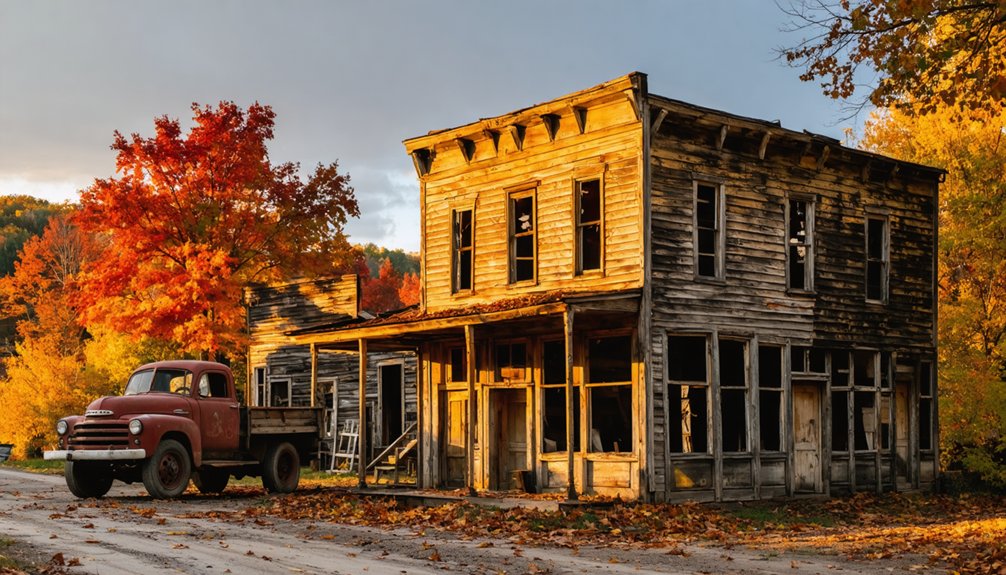
As crimson maples frame crumbling foundations and morning mist clings to abandoned mine shafts, fall transforms New York’s ghost towns into landscapes straight from Gothic literature.
These ghost towns across New York state reveal stories of prosperity long forgotten, as nature reclaims what was once bustling with life. A stroll through their deserted streets evokes a sense of nostalgia, while the echoes of history blend with the whispers of the wind. Each decaying structure stands as a testament to the passage of time, inviting exploration and reflection amidst the haunting beauty.
You’ll discover urban legends and folklore stories whispered through every windswept ruin from September through October.
Essential Planning Tips:
- Respect boundaries: Acquire permissions before exploring abandoned sites and honor all posted signs
- Time it right: Visit late September through October for peak foliage and nearby Halloween events in Lake Placid
- Dress appropriately: Wear hiking boots for trails to Upper Works mines and remote Great Camp ruins
- Enhance your adventure: Combine ghost town exploration with the Haunted History Trail’s guided tours statewide
Remote locations like Tahawus lack facilities, so prepare for variable autumn temperatures and forested terrain where you’re truly on your own.
What to Bring When Exploring Abandoned Sites
Before stepping through the weathered doorframe of any abandoned structure, you’ll need gear that transforms curiosity into calculated exploration. Pack sturdy boots with ankle support, cut-resistant gloves, and a hard hat—falling debris doesn’t announce itself. Your powerful headlamp keeps both hands free for scavenger hunts through forgotten rooms, while backup batteries ensure darkness won’t cut your adventure short.
Layer durable clothing beneath that vintage jacket you’re wearing for photography tips-worthy shots. A dust mask protects against asbestos and decades of decay, while safety glasses shield your eyes from crumbling plaster. Bring a basic first aid kit, whistle, and rope for unexpected situations.
GPS navigation prevents you from becoming another ghost story, and that emergency contact waiting outside? They’re your lifeline to freedom.
Frequently Asked Questions
Are Guided Tours Available for Any New York Ghost Towns?
Yes, you’ll find guided tours exploring New York’s “resting places of the past.” These experiences blend historical preservation with storytelling, though some forbidden zones remain off-limits. Choose from NYC’s urban haunts, Historic Huguenot Street, or Saratoga Springs’ paranormal adventures.
For those seeking a different kind of exploration, ghost towns in New York state offer a unique glimpse into the abandonment of once-thriving communities. Visitors can wander through remnants of history, where echoes of the past linger in the air, revealing stories of lives once lived. These sites not only attract history enthusiasts but also lure ghost hunters looking for paranormal encounters in the eerily silent landscapes.
Which Ghost Towns Are Wheelchair Accessible or Suitable for Families?
You’ll find accessibility options at Tahawus with crushed gravel paths and Feltville/Glenside Park featuring wheelchair-friendly buildings. Family-friendly sites include Doodletown’s interpretive trails and Feltville’s self-guided tours, though terrain varies considerably between locations.
Can You Camp Overnight Near These Abandoned Locations?
You’ll need to verify camping regulations with individual park authorities before pitching your tent. Most ghost town sites prohibit overnight stays, though surrounding state lands may offer designated campgrounds. Always follow safety precautions when exploring abandoned areas.
What Are the Best Months to Photograph Ghost Towns in Fall?
You’ll capture the best ghost town shots during late September through mid-October when autumn foliage peaks. Photography tips: arrive at dawn to avoid crowds and catch golden light illuminating abandoned structures against vibrant fall colors at higher elevations first.
Do You Need Permits to Visit These Sites?
Picture crumbling foundations waiting for your lens—most New York ghost towns don’t require permits since they’re abandoned. However, check legal restrictions on private property beforehand. Always take safety precautions exploring unstable structures, and respect posted boundaries for liability protection.
Exploring historic ghost towns in New York offers a glimpse into the past and can evoke haunting stories of the lives once lived there. As you wander through these remnants of history, be sure to capture the unique architectural details that tell the story of their former glory. From abandoned railroads to dilapidated homes, each site has its own charm and mysteries waiting to be uncovered.
References
- https://943litefm.com/abandoned-ghost-towns-new-york/
- https://www.onlyinyourstate.com/experiences/new-york/ghost-towns-ny
- https://wyrk.com/new-york-state-ghost-town/
- https://www.atlasobscura.com/things-to-do/new-york-state/abandoned
- https://visitadirondacks.com/fall/abandoned-places-ghost-towns
- https://hudsonvalleycountry.com/6-mysterious-hudson-valley-ghost-towns/
- https://www.youtube.com/watch?v=Nw2j2-YSknU
- https://scenesfromthetrail.com/2017/06/10/bald-mountain-the-timp-and-doodletown-bear-mountain-state-park/
- https://www.atlasobscura.com/places/doodletown
- https://midatlanticdaytrips.com/2022/06/doodletown/