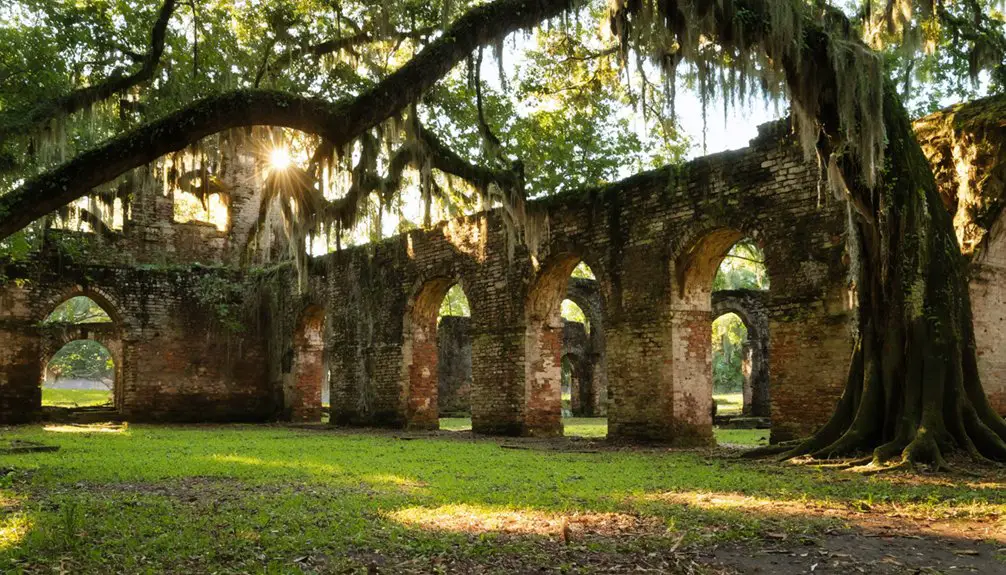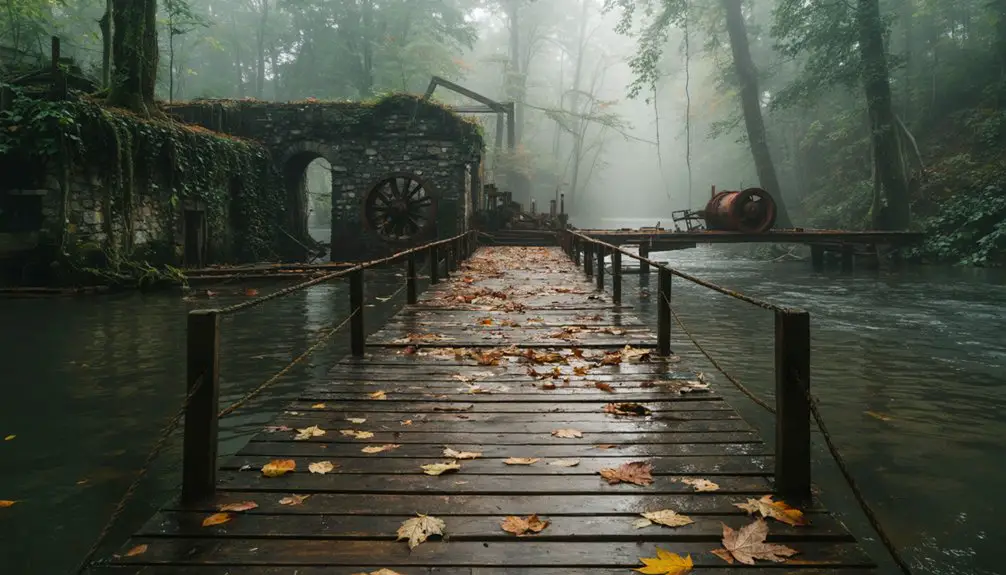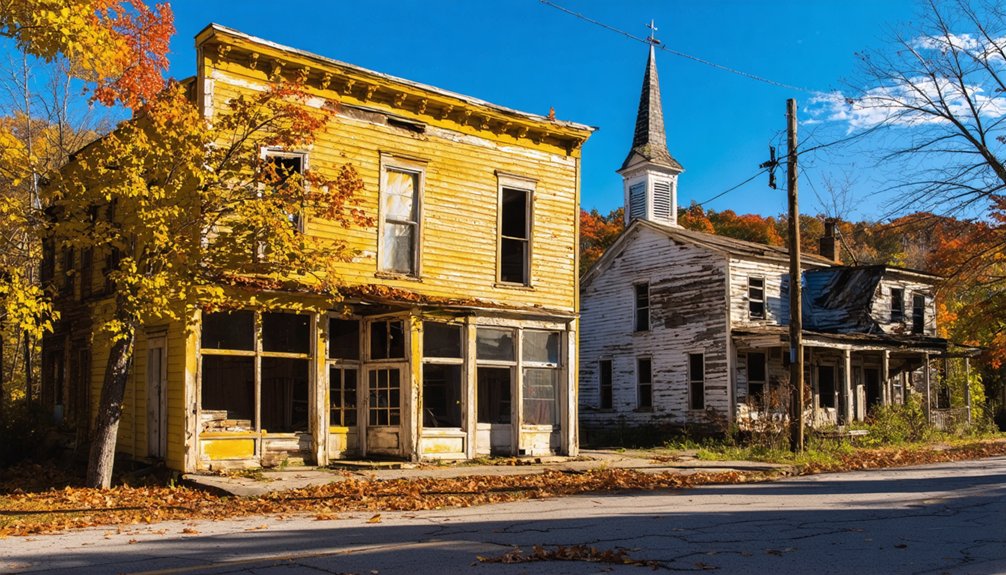
You’ll find North Carolina’s most atmospheric ghost towns when fall foliage frames their forgotten ruins—from Proctor’s submerged foundations beneath Fontana Lake to Mortimer’s moss-covered mill machinery along Wilson Creek. Henry River Mill Village offers *Hunger Games* film nostalgia, while Portsmouth Village’s maritime cemetery stands silent on the Outer Banks. Mid-October brings ideal hiking conditions with fewer crowds, morning fog, and dramatic drawdowns that reveal underwater relics. Proper preparation, sturdy boots, and respect for these historic sites guarantee you’ll experience the full story behind each abandoned settlement.
Key Takeaways
- Proctor, submerged in 1943, is accessible via 22-mile hike or boat, with annual Decoration Day cemetery gatherings each fall.
- Mortimer’s cotton mill ruins emerge from woods along Wilson Creek, featuring moss-covered machinery and a preserved one-room schoolhouse.
- Judson’s underwater remnants become visible during Fontana Lake drawdowns, revealing foundations, chimneys, and cemetery stones for exploration.
- Henry River Mill Village, featured in *The Hunger Games*, offers weathered 1905 cottages and scenic fall foliage photography opportunities.
- Fall provides optimal conditions with mid-October foliage, cooler temperatures, and occasional low water levels revealing submerged historical artifacts.
Proctor: a Deep Mountain Adventure Into Lumber History
Deep in the Smoky Mountains, where Hazel Creek whispers through valleys that once rang with sawmill shrieks, lies Proctor—a ghost town drowned by progress and war. Founded in 1886 by lumber barons, this boomtown thrived until Fontana Dam‘s 1943 construction submerged its streets, displacing 1,200 families and leaving only stone foundations and rusted metal skeletons behind.
You’ll reach Proctor by hiking 22 miles or chartering a boat across Fontana Lake—no roads penetrate this wilderness. The infamous “Road to Nowhere” promised cemetery access but ends abruptly at an eerie tunnel, abandoned since the 1970s.
Now local wildlife roams the Calhoun House ruins while fall foliage blazes around forgotten graves. Twenty-six cemeteries remain above the waterline, where descendants still boat across to honor their buried ancestors. The Ritter Lumber Mill once powered this company town, and its remnants still mark the landscape where industry shaped mountain life. Every year on Decoration Day, residents and visitors traverse the lake to tend these sacred grounds, a tradition maintained through decades of court battles.
Mortimer: Cotton Mill Ruins Along Wilson Creek
Mortimer’s forest-draped cotton mill ruins emerge from the undergrowth like stone monuments to catastrophe, their crumbling walls and rusted machinery half-swallowed by decades of vines and moss.
You’ll discover the skeletal remains of a schoolhouse standing sentinel among the trees, its empty windows framing views of Wilson Creek—the same waterway that rose to swallow this town in 1940.
The overgrown paths threading through these foundations double as hiking trails to pristine creek access points, where you can still read the flood’s fury in scoured rock and displaced boulders.
The town’s name derives from Mortemer village in Normandy, carrying across the Atlantic the same Norman origins that once marked medieval English nobility.
The town once sustained around 800 residents during its lumber mill heyday, complete with a theater and hotel that catered to workers and visitors before disaster struck in 1916.
Forest-Reclaimed Mill Foundations
Along the banks of Wilson Creek, where water once powered a thriving cotton mill, moss-covered foundations emerge from the forest floor like ancient monuments. You’ll discover rusted machinery half-swallowed by vines, their gears frozen mid-turn since 1940’s catastrophic flood.
The forest reclamation here isn’t destruction—it’s transformation, creating something hauntingly beautiful from abandonment.
Wander freely through collapsed building foundations where families once worked cotton into cloth. Timber relics from the original lumber operations lie scattered among newer growth, creating layers of industrial archaeology. One white building survived the devastating flood waters that forced the town’s 800 residents to evacuate permanently.
The ruins sprawl along the creek, unrestricted by fences or admission fees. You’re welcome to photograph, explore, and piece together Mortimer’s story through these crumbling witnesses. Mortimer’s history stretches back to 1904 when construction began as a mill town for Ritter Lumber Company.
Nature’s patient conquest transforms this ghost town into an outdoor museum where history breathes beneath autumn leaves.
Crumbling Schoolhouse Remnants
Beyond the scattered industrial debris, you’ll find the skeletal remains of Mortimer’s one-room schoolhouse perched on higher ground—a deliberate choice that couldn’t save it from eventual abandonment.
The schoolhouse history reveals a community’s determination to educate its children despite living on flood-prone land. Warped wooden frames and collapsed roof beams speak to decades of neglect since families evacuated after 1940’s catastrophic deluge.
You can trace education remnants through the crumbling foundation stones and rusted metal fixtures that once anchored desks. Autumn leaves now fill spaces where children once recited lessons, while vines snake through glassless windows.
The structure stands as a testament to Mortimer’s complete dissolution—even buildings built above the floodwaters couldn’t survive a town’s death. The Civilian Conservation Corps repaired many damaged buildings throughout the 1930s, though their restoration efforts ultimately proved futile against the town’s inevitable decline.
Hiking Wilson Creek Access
How do you reach a ghost town that floods claimed over a century ago? You’ll navigate Brown Mountain Beach Road as it transforms from pavement to gravel, winding through Wilson Creek‘s rugged gorge.
Park along the roadside and descend steep, rocky slopes toward the water’s edge where Mortimer’s cotton mill ruins emerge from the forest floor.
White Rocks Trail drops 470 feet in less than a mile, marked by dim orange blazes through hardwoods ablaze with seasonal foliage. The path demands experienced legs—this isn’t casual walking territory.
Wilson Creek flows briskly over smooth rocks below, its deep pools perfect for trout fishing between explorations. The creek stretches over 23 miles before flowing into Johns River. This waterway earned its National Wild and Scenic River designation in August 2000, protecting its remote beauty for future generations. Watch for wildlife sightings as you pick through foundation stones and rusted machinery scattered among rhododendron thickets, remnants of the 1915 catastrophe.
Judson: Underwater Remnants and Woodland Mysteries
You’ll find Judson’s haunting remains beneath Fontana Lake’s surface, where an entire mountain settlement lies submerged since 1944.
During extreme drawdowns, you can glimpse building foundations, cemetery stones, and remnants of 600 displaced lives through the water or along exposed shorelines.
Remote trails lead you to this eerie site where homes, shops, and sacred burial grounds transformed into an underwater ghost town that occasionally resurfaces to reveal its secrets.
The lake drops to these revealing levels approximately 1 to 3 times annually, offering rare opportunities to witness the submerged town’s remains.
Flooded Ruins Below Surface
When Fontana Lake’s water levels plunge during severe drawdowns, the skeletal remains of Judson pierce through the surface like gravestones marking a drowned civilization. You’ll witness foundations, graves, and structural remnants from this 600-person community that vanished beneath the reservoir in 1944.
Underwater exploration reveals the sacrifice made for wartime aluminum production—homes and heritage traded for ships and munitions.
During exceptional drawdowns, you can arrange pontoon boat tours to view these submerged relics through clear waters. The highest structures emerge first, creating an otherworldly landscape where chimneys and building bases stand as monuments to displacement.
It’s haunting evidence of how 600 residents lost everything when the federal government flooded their ancestral lands, leaving only these ghostly markers beneath Fontana’s waters.
Remote Hiking Trail Access
Accessing Judson’s haunting remnants demands commitment—you’ll traverse gravel roads branching from Fontana Dam before setting out on challenging 4-6 mile roundtrip hikes through Nantahala National Forest’s remote backcountry.
Steep, rocky paths climb through dense woodland where vegetation growth conceals potential artifacts and obscures minimal trail markers. GPS becomes essential when guiding these mysterious routes where visitors report unexplained sensations that send them retreating early.
Essential preparation for your autumn expedition:
- Timing matters: Coordinate with TVA’s 1-3 annual drawdowns (mid-October ideal) when dropping water levels expose foundations and graves
- Safety protocols: Pack water, sturdy boots for root-obstructed paths, and prepare for wildlife encounters including active bear populations
- Communication: Inform others of your itinerary—cell service fails and emergency evacuations prove challenging in these isolated sections
Night exploration remains inadvisable given disorientation risks and persistent haunting reports.
Abandoned Mountain Settlement History
The town of Judson emerged in the early 1900s along the Tuckasegee River‘s mountain bends, where timber barons recognized fortune in western North Carolina’s virgin forests.
You’ll discover a settlement that thrived without electricity, where self-reliant families logged timber, farmed steep hillsides, and traded moonshine through isolated hollows.
By the 1940s, federal flood control plans sealed Judson’s fate—the Tuckasegee’s impoundment created Fontana Lake, submerging homes beneath 50-100 feet of water.
Today, you can witness abandoned artifacts emerging during droughts: chimneys breaking the surface, foundation stones scattered along receding shorelines.
The surrounding Pisgah National Forest harbors moss-covered ruins where mountain legends intertwine with Cherokee history.
You’re exploring a landscape that refuses erasure, where wilderness reclaims what government projects tried to erase forever.
Henry River Mill Village: Hollywood’s Forgotten Mill Town
Nestled in the foothills of Burke County, Henry River Mill Village emerges from the hardwood forest like a sepia-toned photograph come to life. You’ll discover thirty-five weathered cottages where textile workers once lived, their walls whispering stories of company scrip and twelve-hour shifts. The 1905 settlement achieved unexpected fame when Hollywood transformed it into District 12 for *The Hunger Games*, though its authentic history proves equally compelling.
What makes Henry River unforgettable:
- The 30-foot concrete dam still stands defiant after surviving floods and hurricanes since 1905.
- Crumbling worker cottages showcase urban decay alongside emerging historic preservation efforts.
- Saturday visits let you explore this isolated compound where 450 workers once thrived.
Tread carefully—collapsing floors make interiors treacherous, but the exterior views capture autumn’s golden light perfectly against century-old brick.
Portsmouth Village: Coastal Legends of the Outer Banks
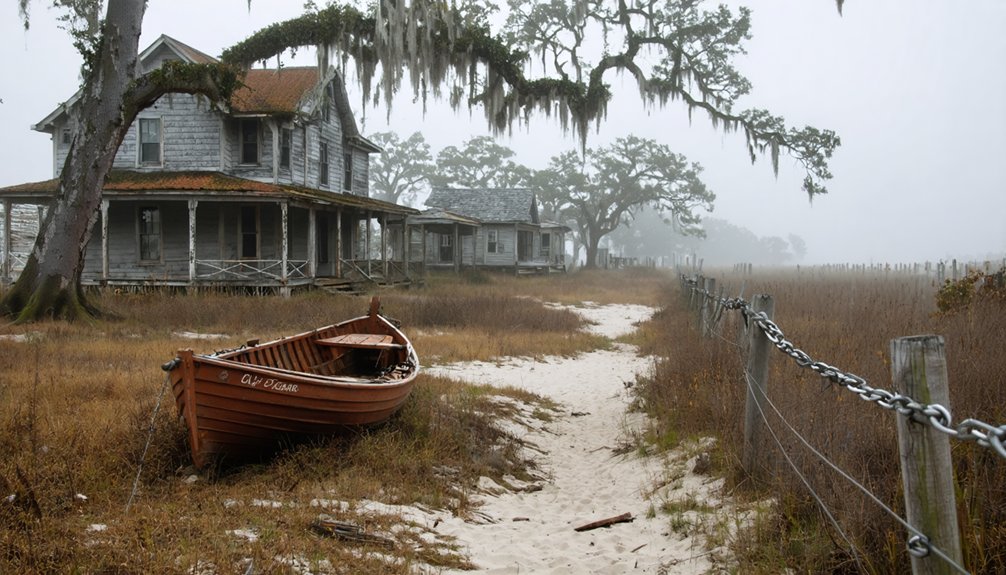
Only a boat can carry you to Portsmouth Village, where Atlantic winds shuffle through empty doorways and salt marsh grass reclaims what 685 souls once called home. This 1753 pilot town once channeled two-thirds of North Carolina’s exports through Ocracoke Inlet, handling 1,400 vessels annually before storms carved new passages and diverted the maritime traffic elsewhere.
You’ll walk lanes between restored buildings—the Methodist church, schoolhouse, Coast Guard station—their interiors frozen as if residents just stepped out for supper. Shipwreck stories echo through the weather station that replaced the marine hospital. Maritime folklore clings to every dock piling and cemetery headstone.
The abandoned island offers complete solitude: no water, no food, no crowds. Just you, the surf, and ghosts of trans-Atlantic commerce.
Ghost Town in the Sky: Wild West Meets Mountain Peaks
Perched at 4,650 feet where Appalachian ridges slice through cloud banks, Ghost Town in the Sky defied every principle of sensible theme park construction when R.B. Coburn transformed Buck Mountain into North Carolina’s wildest roadside attraction in 1961.
You’d ride double incline railways up 77-percent grades—48 passengers at a time—to reach forty replica Western buildings constructed with 300,000 feet of lumber.
What Made This Place Legendary:
- 400,000 annual visitors during peak 1970s operations made it essential tourism development for Maggie Valley
- North Carolina’s longest chairlift carried you 3,370 feet at 310 feet per minute
- History preservation through abandonment—the entire town still stands, though ownership disputes keep gates locked
Now it’s caught between resurrection plans requiring 200 employees and trespassing arrests that rack up hundreds annually.
Best Times to Explore North Carolina’s Ghost Towns in Autumn
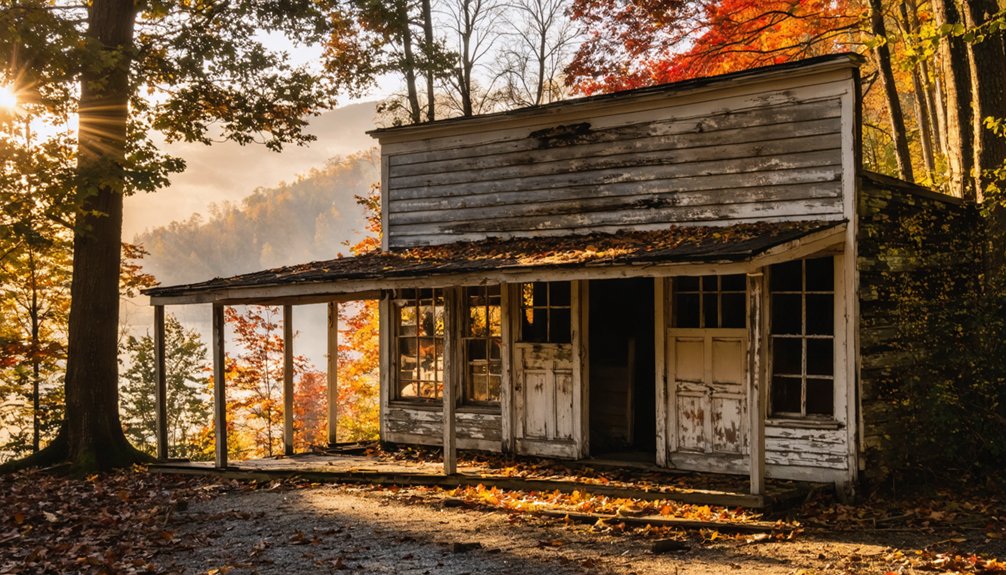
When those first dogwoods blaze scarlet across abandoned mining camps in late September, you’re witnessing North Carolina’s ghost towns transform into something more haunting than their human abandonment ever achieved.
You’ll find ideal exploration from mid-October through early November, when fall foliage peaks across elevations and cooler temperatures make scrambling through forgotten structures comfortable.
Morning fog burns off to reveal dilapidated facades framed by crimson maples, while fewer shoulder-season visitors mean you’ll walk empty streets alone.
Time your visits for weekday mornings when shadow play across weathered buildings creates otherworldly atmospheres.
Cooler nights activate seasonal wildlife—listen for rustling creatures reclaiming civilization’s remnants.
Those crisp September and October temperatures don’t just enhance leaf colors; they sharpen every detail of decay surrounding you.
Essential Tips for Hiking to Remote Abandoned Sites
Before you set foot on overgrown paths leading to North Carolina’s forgotten settlements, understand that reaching these remote ghost towns demands preparation beyond casual day hikes. These decaying structures hide in wilderness where trails fade into memory.
As you explore abandoned towns in North Carolina, be prepared for encounters with nature reclaiming what once was. Each abandoned building tells a story of its past, while the surrounding landscapes are often breathtaking yet eerie. Keep your camera ready, as these forgotten places offer a unique glimpse into history that few have experienced firsthand.
As you venture deeper into scenic ghost towns in North Carolina, the haunting beauty of the landscapes reveals both isolation and intrigue. Each turn may lead you to remnants of a once-thriving community, where nature intertwines with history in captivating ways. The serenity of these desolate environments invites reflection, making your journey not just a hike, but a step back in time.
Your essential checklist:
- Navigate confidently – Carry GPS backup since historical markers rarely survive decades of abandonment. Download offline maps before losing signal.
- Pack self-sufficiency – Bring two quarts of water minimum, emergency shelter, and supplies for campfire cooking if you’re caught past sunset. These locations don’t offer convenient exits.
- Capture responsibly – Trail photography requires stable footing on rotting structures. Wear ankle-supporting boots and test each step before shifting weight.
Inform someone of your route and return time.
The freedom to explore vanished communities carries real consequences when isolation meets injury.
Frequently Asked Questions
Are Pets Allowed When Visiting North Carolina’s Ghost Towns?
Yes, you’ll find pet policies generally welcome leashed companions at North Carolina’s ghost towns like Henry River Mill Village. You’re free to explore with your furry friend, just prioritize pet safety with water and paw protection.
Do Any Ghost Towns Require Entrance Fees or Permits?
Your wallet won’t gather dust at most ghost towns—fee requirements vary by location. Ghost Town in the Sky charges admission around $25, while Henry River Mill Village requests $18. Fort Raleigh welcomes you freely without permit restrictions.
Can You Camp Overnight Near These Abandoned Sites?
You’ll find camping opportunities near most ghost towns on national forest land, following dispersed camping rules. Practice camping safety and respect historical preservation by keeping distance from fragile structures. Always verify local regulations before setting up camp.
Are Guided Tours Available for Any Ghost Town Locations?
Guided ghost tours aren’t available for abandoned ghost towns themselves. However, you’ll discover historic preservation efforts and local legends through nearby city tours in Asheville, Beaufort, Charlotte, and Greensboro—exploring haunted sites where freedom-seeking spirits still wander.
What Cell Phone Coverage Exists at Remote Ghost Towns?
You’ll find cell phone connectivity extremely limited at remote ghost towns. Signal strength drops dramatically in mountainous terrain, especially during tourist seasons. Don’t count on your provider’s coverage—download maps offline and prepare for complete disconnection from networks.
References
- https://www.heartofnorthcarolina.com/blog/post/nostalgic-small-town-fall-experiences-in-the-heart-of-nc/
- https://nceatandplay.com/features/fall-in-north-carolina-bucket-list-of-best-things-to-do/
- https://www.northcarolinahauntedhouses.com/fall-attractions/?filter=durham
- https://www.youtube.com/watch?v=iWhjTfCyUpY
- https://www.visitnc.com/list/ncs-mysterious-disappearances-and-abandoned-places
- https://www.atlasobscura.com/things-to-do/north-carolina/ghost-towns
- https://www.romanticasheville.com/ghost_town.htm
- https://henryrivermillvillage.com
- https://www.islands.com/1977921/proctor-north-carolina-great-smoky-mountains-ghost-town-war-history-fishing-destination/
- https://www.atlasobscura.com/places/proctor-lost-ghost-town-hazel-creek