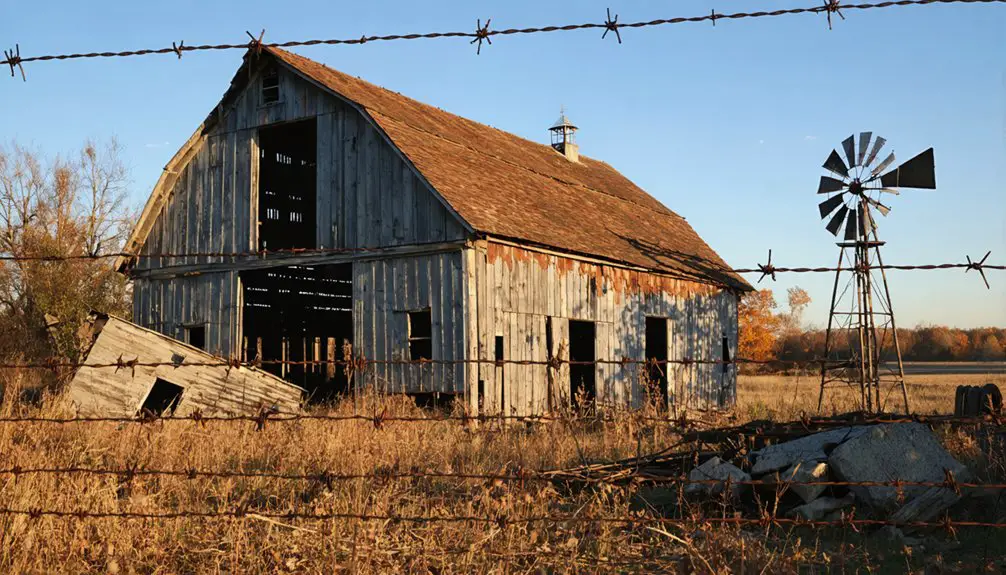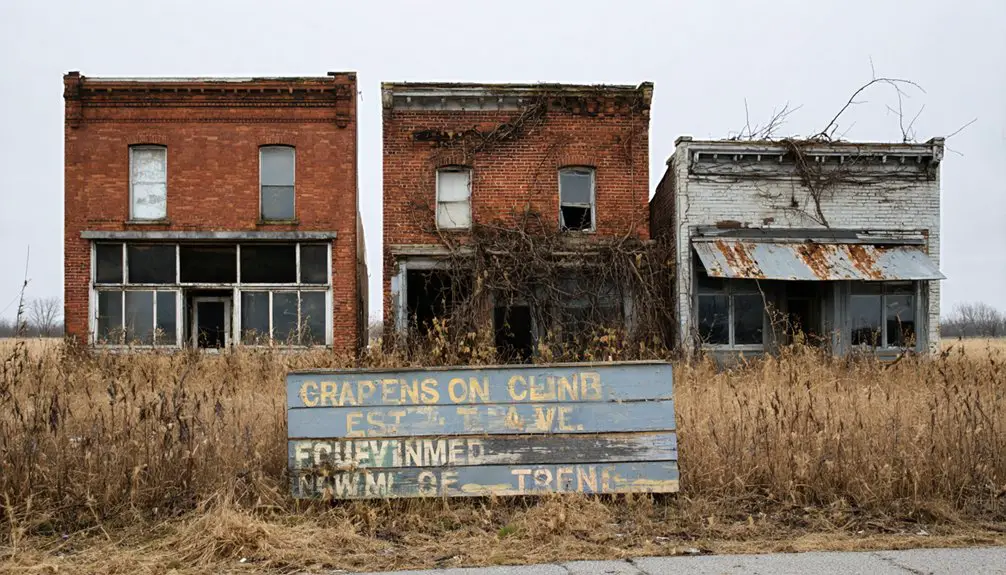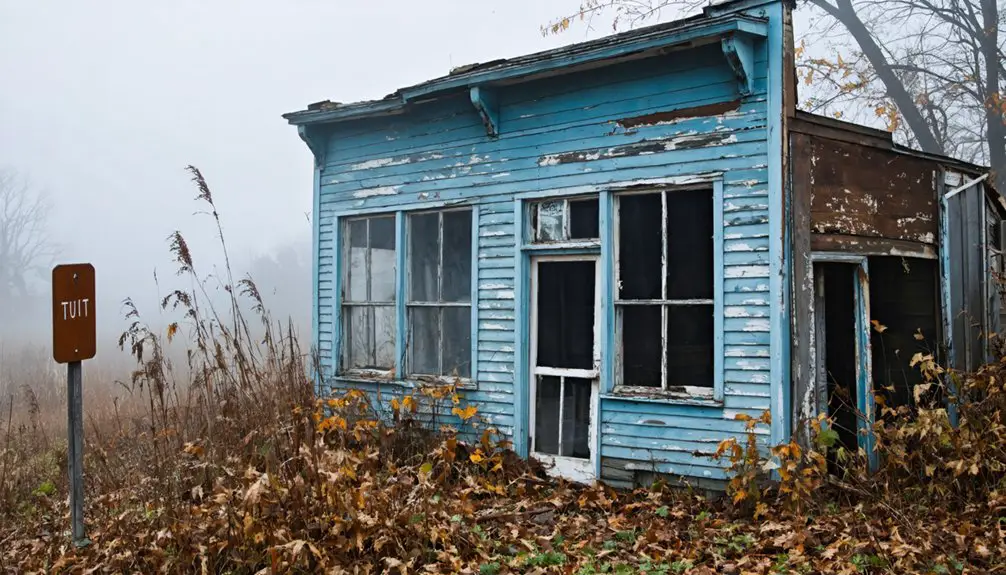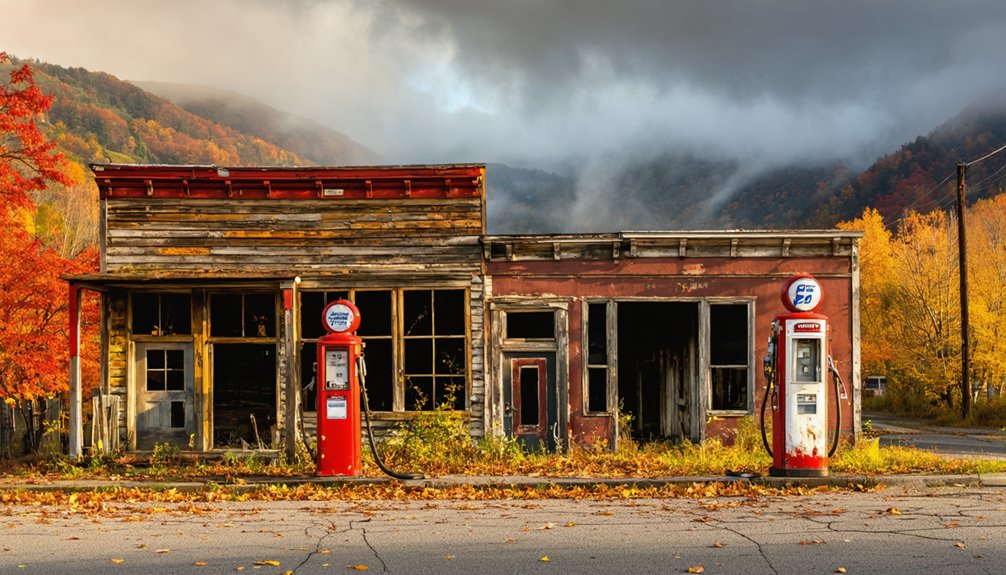
You’ll find Ohio’s most haunting ghost towns wrapped in fall’s fiery colors, where crumbling brick foundations peek through crimson leaves. Moonville’s 1856 railroad tunnel echoes with lantern-wielding ghost stories, while Haydenville’s abandoned company houses stand frozen beneath sandstone cliffs. San Toy’s coal relics hide among overgrown trails, and Orbiston’s iron furnace ruins scatter across forests blazing with autumn gold. Each site becomes eerily beautiful when fog rolls through October mornings, transforming forgotten settlements into atmospheric landscapes that reveal their secrets to those who venture beyond the trailhead.
Key Takeaways
- Moonville in Vinton County features an 1856 railroad tunnel, cemetery, and ghost legends, especially atmospheric on foggy autumn nights.
- Haydenville in Hocking County offers 120+ historic properties amid sandstone cliffs and colorful fall foliage since 1852.
- San Toy in Perry County displays coal mining remnants, pioneer cemeteries, and stories of lawless frontier life from the 1920s.
- Orbiston showcases iron furnace ruins from the 1880s along scenic trails scattered with slag amid fall wilderness landscapes.
- Fallsville features cascading waterfalls, 1848 mill ruins, and Native American treasure legends surrounded by autumn forest and farmland.
Moonville: a Haunted Railroad Town With Legendary Ghost Stories
Deep in the wooded hollows of Vinton County, where Raccoon Creek cuts through southeastern Ohio, the skeletal remains of Moonville cling to the hillsides like a half-forgotten memory.
This railway town thrived during the mid-1800s iron and coal boom, serving miners and railroad workers until economic decline drove out the last family in 1947.
Today, you’ll find haunting historical architecture—the 1856 tunnel, crumbling foundations, and a weathered cemetery accessible via Moonville Rail Trail.
But it’s the ghostly encounters that draw brave visitors. Legend speaks of Theodore Lawhead, the lantern-wielding engineer killed in an 1880s collision, and the Lavender Lady who appears near the tunnel’s entrance.
Over 21 documented deaths on these treacherous tracks have fueled folklore that persists through foggy autumn nights. The name Moonville itself refers to multiple geographical locations, with this Ohio ghost town being the most well-known among them.
Haydenville: Historic Company Town in the Heart of Hocking Hills
Nestled among the sandstone cliffs and autumn-crowned hills of Hocking County, Haydenville stands as Ohio’s last entirely company-owned town—a remarkable fossil of American industrial ambition.
Founded in 1852 by Columbus industrialist Peter Hayden, this living museum reveals the stark reality of nineteenth-century labor: workers paid in company scrip, housed in company homes, shopping at company stores.
Every structure—from rock-faced brick homes to the 1892 Methodist church—was built from locally manufactured materials, transforming the village into a three-dimensional advertisement.
Today’s industrial architecture tells stories of control and survival.
The compact, linear settlement pattern kept workers within walking distance of the factory, ensuring a ready labor force at all hours.
The town’s preserved structures reveal its history in mining and brick-making industries, which defined its economic identity for generations.
Over 120 contributing properties earned National Register status in 1973, preserving what employees couldn’t escape until the 1960s.
Walking these streets, you’ll witness historic preservation that doesn’t romanticize—it reveals.
San Toy: Coal Mining Remnants and Pioneer Cemeteries
Where southeastern Perry County‘s forested ridges still bear scars from coal’s brutal legacy, San Toy rises from memory like smoke from its long-dead mines. You’ll find coal relics scattered through these woods—crumbling foundations where 2,500 souls once carved existence from stone and darkness.
The Sunday Creek Coal Company’s empire collapsed spectacularly in 1924 when disgruntled miners torched railroad ties, consuming the hospital and theatre in flames that sealed the town’s fate.
Walk these overgrown roads where gunfights erupted daily, where thirteen men once crammed into a jail cell barely fit for three. Only that jailhouse stands intact now, a monument to lawlessness. The town’s name itself echoes an unlikely source—a popular musical comedy that premiered in London in 1899, its exotic appeal perhaps offering escape from the harsh realities of mining life. By 1931, the exodus proved complete when 17 of 19 registered voters chose to dissolve their dying town.
Beyond the coal relics, pioneer cemeteries hold the real stories—weathered markers whispering names of those who gambled everything on black gold and lost.
Orbiston: Iron Furnace Ruins Along Scenic Trails
You’ll find Orbiston’s crumbling iron furnace foundations rising from the forest floor like industrial tombstones, marking where 500 souls once hammered out Ohio’s iron destiny in the 1880s.
The weathered grave markers at Bethel Ridge Cemetery tell stories of furnace workers and their families who vanished when purer Great Lakes iron rendered their operation obsolete.
Today, scenic woodland trails wind past these skeletal ruins, where autumn leaves blanket the same ground that once rang with the clang of hammers and the roar of blast furnaces. The Hocking Valley Railroad once served this thriving industrial station, connecting Orbiston’s iron production to broader markets before economic forces shuttered the operation. Similar furnaces required hundreds of workers to transport fuel, move ore, and maintain the fires that kept production running day and night.
Historic Iron Industry Legacy
Deep in the forests of Hocking County, the stone ruins of Orbiston’s iron furnace stand as weathered monuments to Ohio’s vanished industrial past. You’ll find slag scattered across the forest floor—pockmarked glass-like remnants from smelting operations that once consumed 1,200 bushels of charcoal daily.
Industrial archaeology reveals how this 1877 settlement thrived around Ogden Furnace, housing over 500 residents who produced 3,000 tons of iron annually. The furnace’s truncated stone pyramid construction, built adjacent to the hillside for operational efficiency, enabled workers to dump raw materials through elevated bridge lofts during grueling 12-hour shifts.
Heritage preservation efforts have transformed these crumbling stone pyramids into accessible trailside destinations. Historical markers detail the Hanging Rock Iron Region‘s century-long dominance, from 1818 through 1916. At nearby Lake Hope State Park, the Hope Furnace chimney still stands, constructed in 1853-54 and operational for two decades before iron production ceased in 1874.
When Great Lakes iron proved superior and steel technology advanced, Orbiston’s furnace fell silent. Today, nature reclaims the chimneys and foundations—silent testimony to southeastern Ohio’s raw, unrestrained industrial ambition.
Bethel Ridge Cemetery Markers
Among the weathered foundations and crumbling stone chimneys of Orbiston, Bethel Ridge Cemetery stands as the most haunting proof to the iron workers who once called this wilderness home.
You’ll discover 768 memorial records here, each telling stories of families who braved Ohio’s iron era from 1877 through the mid-1950s. Cemetery preservation efforts have maintained markers like War of 1812 veteran Samuel Poling’s, alongside Benjamin and Elizabeth Poling, who donated this sacred ground.
The grave marker symbolism reveals everything—flat granite stones emerging from autumn leaves, black polished surfaces reflecting Ohio’s changing seasons. These aren’t just monuments; they’re declarations of independence from forgotten communities.
Walk among them, and you’re touching genuine frontier resilience, where iron furnace ruins meet eternal rest.
Nature Trails Through Ruins
Where Ogden Furnace once roared with 1870s iron production, autumn-blazed trails now wind through skeletal ruins that nature’s methodically reclaiming. You’ll discover crumbled furnace structures and foundations along paths where forests have swallowed what coal and iron built.
The trails demand minimal maintenance—nature’s doing most of the work—as they guide you past collapsed mine entrances and slag-scattered sites near Johnson Run Creek.
Plant identification becomes unexpectedly compelling here; maples and oaks now thrive where hillsides were once stripped bare for charcoal. Glass-like smelting residue glints beneath fallen leaves, marking where Hanging Rock Iron Region produced over 100,000 tons annually.
These wooded routes off State Route 160 offer genuine exploration without tourist crowds—just you, vanished industry, and Ohio’s reclaimed wilderness swallowing evidence of ambition.
Fallsville: Hidden Waterfalls and Native American Legend
You’ll discover Fallsville through the rhythmic sound of its waterfall cascading over the same rocks that once powered Simon Clouser’s grist mill in 1848.
The preserved hiking trails wind past stone foundations and scattered remnants where eight houses once stood, while locals still whisper about the Native American girl who knocks on doors each Christmas Eve, searching for her father’s buried treasure.
Before you explore these wooded paths in autumn, check current trail conditions and carry a map—the settlement that anticipated railroad prosperity now exists only as archaeological fragments beneath red and gold leaves.
Waterfall and Historic Remnants
Deep within Clinton County‘s wooded gorges, a 15-foot cascade spills over ancient rock where a once-thriving settlement has vanished into legend. You’ll discover Fallsville Falls stretching 25 feet across Clear Creek, its water flow surging powerfully after rainfall before diminishing to whispers during drought.
The crumbling stone walls of John Timberlake’s 1820s grist mill stand sentinel beside the falls, marking where an entire town once flourished. By 1848, Fallsville boasted three streets lined with homes, all now reclaimed by forest and farmland.
While Native legends specific to these falls remain elusive in written records, the oral traditions likely echo through the gorge alongside the water’s timeless rhythm, their stories absorbed into the mist and shadows.
Christmas Eve Treasure Legend
The forgotten stones of Timberlake’s mill guard more than industrial history—they stand watch over one of Ohio’s most persistent supernatural mysteries. Native American legends tell of Ashani, a Shawnee murdered by robbers along this desolate trail.
The thieves buried their stolen goods near the creek falls, never returning to claim them.
Each Christmas Eve, locals report knocking—”wrap wrap wrap”—on doors throughout the hollow. Christmas Eve spirits, they say, are attempts by Ashani’s ghost to reveal the treasure’s location. The Clouser sisters, who once lived here, heard these desperate knocks annually but couldn’t decipher the phantom’s message.
You’ll find only ruins now—crumbling steps by the falls where their house stood. The cache remains hidden, and the knocking continues.
Trail Access and Safety
Finding Fallsville Falls requires steering a somewhat hidden approach that rewards the persistent explorer.
You’ll locate the trailhead on Careytown Road, two miles south of town, where a gated gravel road marks your entry into this 1,785-acre wilderness.
The three-quarter-mile path transforms from maintained gravel into authentic backcountry terrain—expect roots, rocks, and mud that’ll test your footing, especially after rainfall.
While trail maintenance remains minimal by design, preserving the area’s wild character, this same ruggedness demands respect.
The steep gorge descent isn’t for the unprepared.
Bring proper footwear and supervise children closely near cliff edges.
Rain boots serve double duty for muddy sections and creek wading.
Between wildlife observation opportunities and traversing the challenging terrain, you’re earning this 15-foot waterfall destination through genuine adventure.
Sprucevale: Evening Lantern Walks Through Shaker History
- Union Village – Ohio’s largest Shaker settlement near Lebanon offers documented historical significance.
- Watervliet – Features preserved buildings and authentic Shaker heritage near Dayton.
- North Union – Located in Shaker Heights, where street names commemorate this vanished community.
- Shaker Historical Society – Provides educational programs about Ohio’s Shaker past.
For lantern tours highlighting America’s communal religious movements, you’ll need to visit confirmed historic sites. These authentic locations offer real connections to Ohio’s spiritual past without fabricated narratives.
Best Times to Visit Ohio Ghost Towns During Fall Season
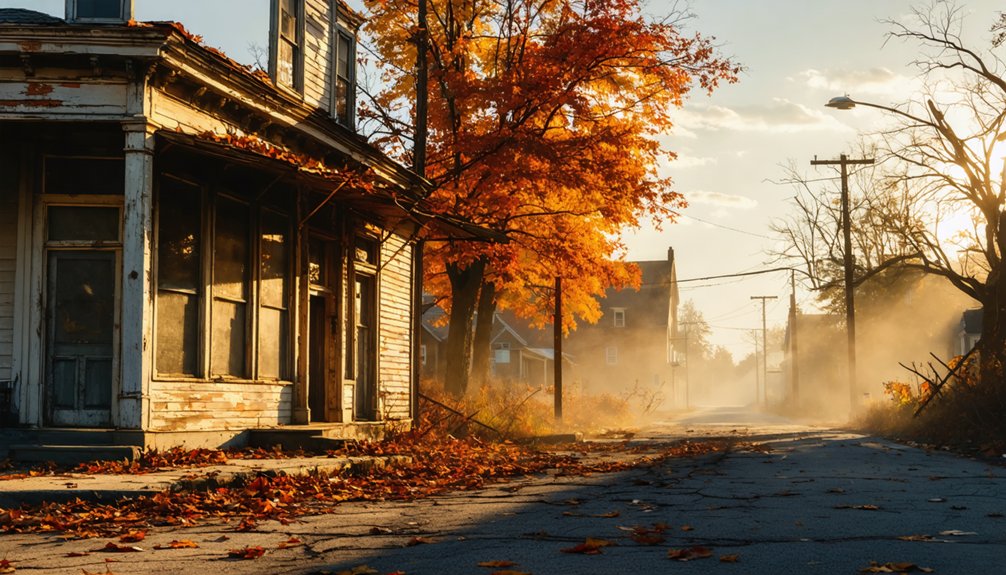
When October’s crimson and gold leaves begin their gentle descent across Ohio’s countryside, ghost towns transform into haunting tableaus that blur the line between natural beauty and historical melancholy.
You’ll find peak conditions from early to mid-October, when autumn foliage reaches its most vibrant display across regions like Hocking Hills and Cuyahoga Valley.
The crisp air between noon and 5pm offers ideal conditions for seasonal photography, capturing abandoned structures framed by brilliant reds and golds.
If you’re exploring areas near Sprucevale during turkey hunting season, wear bright clothing for safety.
Mid-October weekends get crowded—the Medina County Fall Foliage Tour runs October 11-12—so consider weekday visits for solitude.
Morning light filtering through amber leaves creates otherworldly scenes you won’t find any other season.
What to Bring When Exploring Abandoned Town Sites
Before stepping through the weathered doorframe of Ohio’s forgotten settlements, you’ll need more than just curiosity filling your backpack. These crumbling structures demand preparation that balances adventure with safety.
Essential gear for your ghost town exploration:
- Hands-free illumination – Headlamps let you navigate collapsed staircases while keeping both hands available for climbing and night photography opportunities.
- Protective layers – Cut-resistant gloves and sturdy boots shield you from rusty metal and unstable debris.
- Respiratory protection – Dust masks defend against decades of accumulated mold and airborne hazards.
- Documentation tools – Smartphones capture haunting architectural details before weather claims another piece of history.
Don’t forget equipment maintenance essentials: backup batteries, a multi-tool for quick repairs, and water to sustain your exploration.
Freedom means taking responsibility for your safety in these untamed spaces.
Safety Tips for Ghost Town Adventures in Autumn

Your backpack loaded with gear means nothing if your first step through a ghost town’s threshold ends in disaster. Test floors before committing weight—toss debris ahead or hug structural walls instead of crossing room centers where collapse risk peaks.
Drone photography lets you scout dangerous zones from above before ground exploration.
Wear N95 respirators in enclosed spaces where mold thrives, and apply mentholated ointment beneath your nose when decay lingers thick.
Layer clothing for autumn’s temperature swings between sunlit clearings and shadowed ruins.
Pack offline maps since cell service vanishes in remote settlements.
For wildlife observation, carry air horns—abandoned structures attract curious animals.
Leave route details with trusted contacts, test suspicious floors, and remember: the best adventures are ones you walk away from intact.
Frequently Asked Questions
Are Dogs Allowed on Ghost Town Trails and Hiking Areas?
Most ghost town trails welcome your furry explorer on pet friendly trails, but you’ll need to follow dog leash requirements. Check specific locations beforehand—some historic sites restrict access while others let you roam freely together through abandoned ruins.
Do Any Ghost Towns Offer Guided Tours Year-Round or Just in Fall?
You’ll find Toledo Ghost Tour operates year-round, letting you explore historical preservation and local legends whenever wanderlust strikes. Most others run seasonally in fall, but Toledo’s nightly tours mean you’re never bound by calendar constraints.
If you’re looking for similar experiences, consider exploring abandoned places in Cincinnati Ohio, where stories of the past linger in every crumbling structure. Each site offers a haunting yet fascinating glimpse into history, inviting adventurers and urban explorers alike to uncover hidden gems. As you navigate through these forgotten locations, you’ll gain a deeper appreciation for the rich tapestry of Ohio’s urban landscape.
Exploring abandoned places in Cincinnati Ohio will lead you to witness the vibrant autumn colors in Ohio ghost towns, where the remnants of the past are adorned with nature’s brilliance. The striking reds, oranges, and yellows enhance the atmosphere, making each visit a picturesque experience that feels straight out of a storybook. As you wander through these serene landscapes, you’ll be struck by the juxtaposition of decay and the beauty of the season, providing a unique backdrop for reflection and discovery.
Can I Camp Overnight Near These Ghost Town Locations?
You’ll find limited overnight camping directly at these sites due to historical preservation efforts. However, nearby state lands often permit dispersed camping where you can sleep under stars while local legends whisper through the trees around you.
Are the Ghost Towns Wheelchair Accessible or Suitable for Strollers?
You’ll find excellent accessibility options at most locations. Ghost Town Findlay and Serpent Mound offer stroller friendly pathways with paved surfaces, while Moonville Tunnel’s flat trail works well. Ohio State Reformatory requires advance booking for wheelchair tours.
Do I Need Permits to Photograph or Explore These Abandoned Sites?
Like wandering into forgotten Wild West territory, you’ll need to contemplate legal considerations first. For abandoned sites, always secure photography permissions from property owners—trespassing charges can quickly end your exploration adventure before it begins.
References
- https://www.ohiohauntedhouses.com/fall-attractions/
- https://www.shoresandislands.com/blog/post/fall-haul-get-your-fill-of-fall-in-shores-islands-ohio-part-two/
- https://www.ohiotraveler.com/stay-tuned-for-colorful-spooky/
- https://hockingvacations.com/blog/exploring-the-ghost-towns-of-ohio-unearthing-forgotten-histories
- https://ohioghosttowns.org/top-10-haunted-towns/
- https://www.youtube.com/watch?v=QWTtG6njIDs
- https://ohio.org/travel-inspiration/articles/haunted-getaways-for-fall
- https://visitvintoncounty.org/history/moonville-tunnel/
- https://en.wikipedia.org/wiki/Moonville
- https://www.kitgentry.com/spooklights_moonville.html