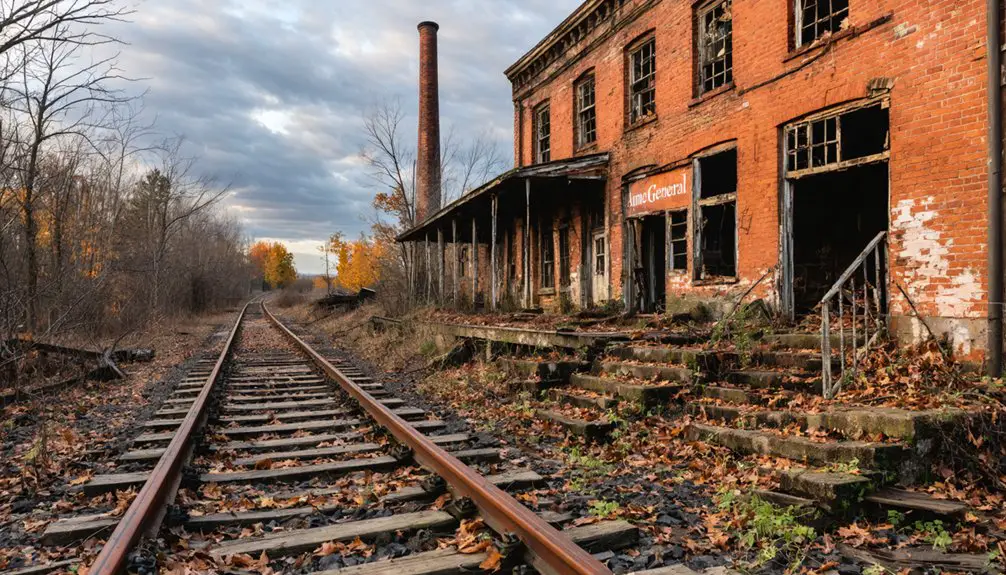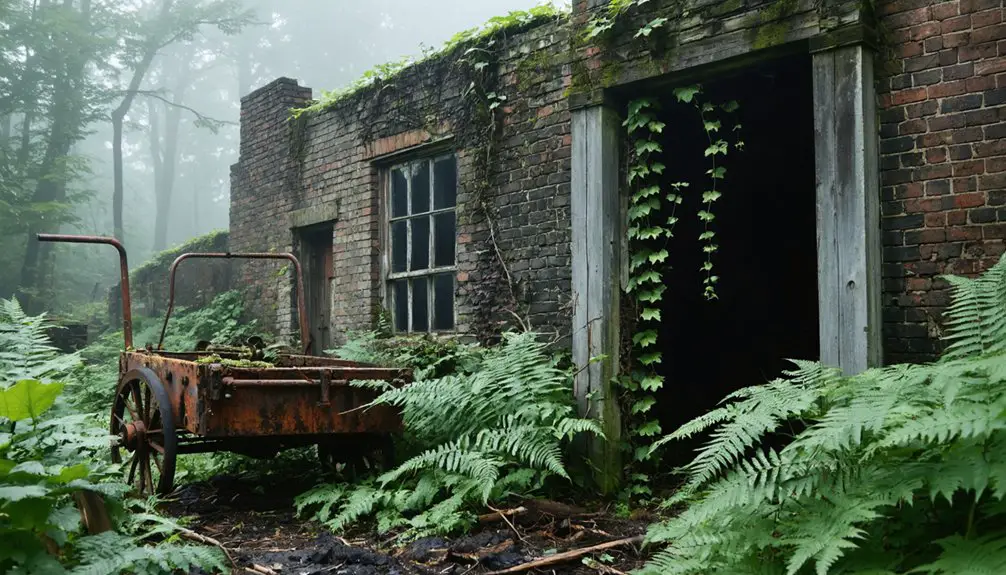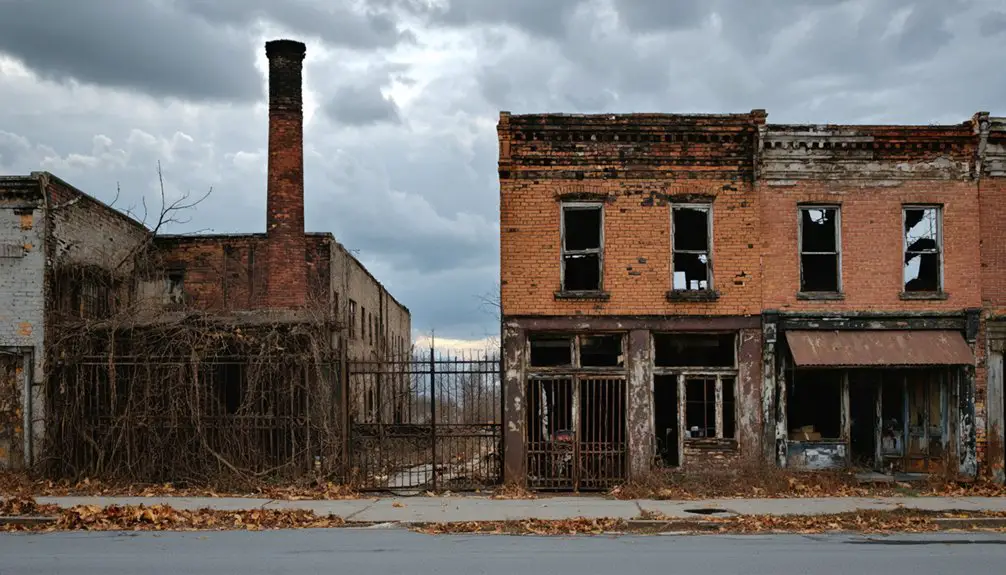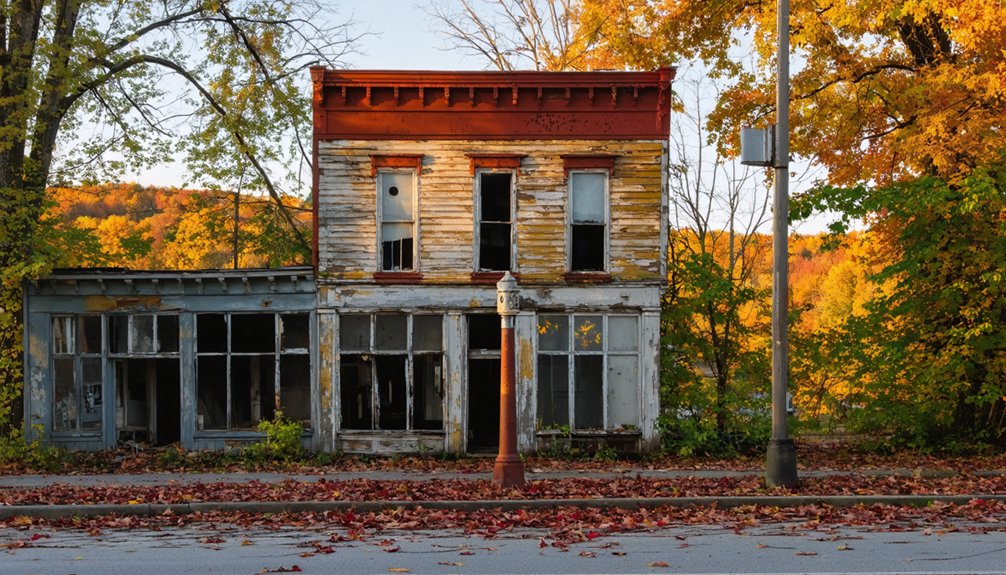
You’ll find Pennsylvania’s most haunting ghost towns dressed in spectacular fall colors from late September through mid-October. The 46-mile Ghost Town Trail offers abandoned industrial relics framed by autumn foliage, while Fall Brook’s weathered tombstones peek through crimson maples in Tioga State Forest. Pithole’s empty streets and Centralia’s smoke-shrouded ruins provide eerie backdrops against seasonal oranges and golds. Rausch Gap’s stone foundations hide among fallen leaves in Saint Anthony’s Wilderness, creating atmospheric scenes best captured during dawn’s golden light when the full stories behind these forgotten communities reveal themselves.
Key Takeaways
- Ghost Town Trail offers 46 miles of rails-to-trails pathway through Indiana and Cambria Counties, best visited mid-October during peak foliage.
- Fall Brook features mining ruins, weathered tombstones, and folklore, accessible via a 0.4-mile trail near Morris Run in Tioga State Forest.
- Rausch Gap contains cemetery stones, foundations, and a green metal bridge, reached through Saint Anthony’s Wilderness via Stony Valley Rail Trail.
- Pithole preserves mowed ghost streets and markers from the 1865 oil boom when 20,000 residents occupied the once-thriving community.
- Centralia’s underground coal fire since 1962 created an ongoing ghost town with abandoned railways, persistent smoke, and remaining Orthodox cemetery.
Ghost Town Trail Annual Fall Foliage Ride
The Ghost Town Trail’s Annual Fall Foliage Ride transforms an ordinary autumn afternoon into a celebration of Pennsylvania’s most vibrant season.
You’ll pedal through 46 miles of rails-to-trails pathway where historic preservation meets nature’s grandest display. The October 5th ride, free and open to all, guides you past vanished coal-mining towns, massive iron furnaces, and rusting rail cars—industrial ghosts framed by crimson maples and golden oaks.
Wildlife observation opportunities abound as you traverse the Blacklick Creek valley’s 75% tree canopy. Registration secures your bus seat to the trailhead, where packed limestone paths await. The trail ascends over 1,000 feet in elevation as you move from west to east, offering changing perspectives of the autumn landscape. The Ebensburg Trailhead at 424 Prave Street serves as your starting point for this scenic journey through Pennsylvania’s autumn landscape. Whether you’re cycling or walking, late September through early October delivers peak foliage along this National Recreation Trail spanning Indiana and Cambria Counties.
Fall Brook: A Coal Mining Relic in Tioga State Forest
You’ll find Fall Brook’s most haunting remnant tucked within the Tioga State Forest—a forgotten cemetery where weathered tombstones emerge between oak and maple trees. Their autumn leaves carpeting the graves of miners and their families.
Some plots remain fenced and tended, like the Earl Bolt family’s resting place, while others surrender to encroaching woods. Their markers are adorned with rusted toys from children who never saw another spring.
The site sits at the former Fall Brook Picnic Area, accessible via forest roads where coal chutes and company houses once stood before the town’s abandonment in 1900. Founded by Hon. John Magee in 1858, the town rapidly grew to house approximately 1,400 residents by 1862, drawn by the promise of semi-bituminous coal deposits discovered just a year earlier. The surrounding forest, shaped by decades of timber cutting and fires, supports the region’s legacy as a timber-producing area where large sawmills once operated at nearby Ansonia and Leetonia.
Cemetery Among the Trees
Walking through Tioga State Forest today, you’d never guess that 2,500 people once called this remote valley home. Between towering hemlocks and regenerated hardwoods, you’ll stumble upon Fall Brook’s most haunting reminder: a weathered cemetery where mining families rest beneath moss-covered stones.
The forest reclaimed everything after 1900—company houses, drift openings, railroad grades—yet this burial ground endures. British and Irish surnames etched in limestone tell stories of immigrants who crossed an ocean seeking prosperity, only to find dangerous shafts and company control. Many Scottish miners who worked these shafts arrived as third-class steerage passengers from Greenock, their passages sometimes funded by mining unions offering incentives during the Civil War era.
Historical preservation efforts maintain crumbling markers, though nature steadily wins. The Fall Brook Coal Company, owned by John and Duncan Magee, established this community in 1860 when coal was discovered along Fall Brook Creek. Local legends whisper of lantern lights glimpsed between graves on foggy October evenings.
Stand here among the trees, and you’re witnessing coal country’s forgotten chapter—where ambition, exploitation, and death intertwined beneath Pennsylvania’s mountains.
Accessing the Abandoned Town
Deep in Ward Township, where Tioga State Forest swallows the valley whole, Fall Brook waits for those willing to venture off Pennsylvania’s beaten path. You’ll find River Road near Morris Run—park there, where the asphalt surrenders to wilderness. A 0.4-mile trail cuts through hemlock shadows, climbing gently before revealing what remains: grave markers strangled by forest, Princess Pine claiming burial plots, and earth that still rises where miners rest beneath.
Historical artifacts emerge slowly if you’re patient—rusted remnants of coal chutes, depression-era bottles glinting through leaf litter. Local folklore stories whisper of whistling steam engines that once shattered this silence, of 1,400 souls who vanished when coal ran dry. Some headstones date back to the 1830s, their inscriptions barely legible against centuries of weathering. The state forest doesn’t maintain this place. Nature’s reclamation continues, indifferent to your discovery. Multiple geographical entities share the Fall Brook name across different regions, making this particular ghost town a distinct location worth preserving in historical records.
Pithole: Oil Boom Town Turned Empty Field
You’ll find yourself standing in a meadow where 20,000 souls once crowded into wooden hotels and theaters during the frenzied oil boom of 1865.
Within just 500 days, Pithole exploded from farmland to Pennsylvania’s third-busiest post office, then collapsed back into silence when the wells ran dry and fires consumed what speculation hadn’t already destroyed.
Seventeen fires ravaged the wooden city between August 1865 and December 1866, causing nearly $2 million in damages and accelerating its demise.
The world’s first pipeline opened here in October 1865, pumping oil to the railroad and pioneering technology that would transform the petroleum industry forever.
Now you can walk the mowed grid of ghost streets where only grass grows, tracing the outline of a city that burned too bright to last.
Rapid Rise and Fall
When Isaiah Frazier’s drill punctured the Venango Third Sand on January 7, 1865, 250 barrels of crude oil gushed skyward daily, and within months, an entire city erupted from Pennsylvania farmland.
You’ll discover that Pithole exploded to 20,000 residents by December—boasting 54 hotels, three churches, and Pennsylvania’s third-busiest post office processing 5,500 letters daily.
The world’s first oil pipeline snaked 5.5 miles across the landscape that October.
Then it vanished. Production collapsed below 1,000 barrels by December 1866.
A catastrophic fire consumed 27 wells that August.
The population hemorrhaged to 237 by 1877.
Today, historical preservation maintains scattered markers where wildlife encounters outnumber visitors.
You’ll walk empty fields where fortunes rose and crashed in just 500 days—freedom’s harsh reminder that boom inevitably meets bust.
Exploring the Mowed Streets
Where thousands once trampled oily mud beneath wooden derricks, mowed grass now traces the phantom grid of America’s first oil boomtown.
You’ll walk streets that vanished over a century ago, following paths through this 90-acre monument to urban decay and historical preservation. Interpretive signs mark where fortunes rose and fell within months.
Your autumn exploration reveals three haunting layers:
- Grassy corridors outlining former streets where 15,000 people once hustled
- Barely visible depressions marking hotel cellars and church foundations
- Strategic signage preserving stories of wooden structures consumed by fire
The visitor center’s diorama—500 miniature figures frozen in prosperity—contrasts sharply with the silent meadows outside.
By 1870, only 237 souls remained.
Now you’re free to wander these reclaimed fields, contemplating boom-bust cycles beneath fall foliage.
Centralia: Pennsylvania’s Most Famous Ghost Town
Beneath the forests of Columbia County, an inferno has raged since 1962, transforming Centralia from a thriving anthracite mining town of nearly 3,000 residents into Pennsylvania’s most infamous ghost town.
You’ll walk streets where only seven people remain, their homes marked for eventual demolition. The fire started when burning trash ignited coal seams, spreading through underground mine tunnels despite decades of failed suppression attempts.
Today, smoke still rises from cracked earth, and industrial relics dot the landscape alongside abandoned railways reclaimed by nature.
St. Mary’s Church holds weekly services amid the desolation, while wild plants and butterflies flourish in new-growth forests.
The Orthodox cemetery persists on smoking hillsides, a haunting reminder of lives lived above this eternal blaze.
Rausch Gap: Hidden Ruins in Saint Anthony’s Wilderness
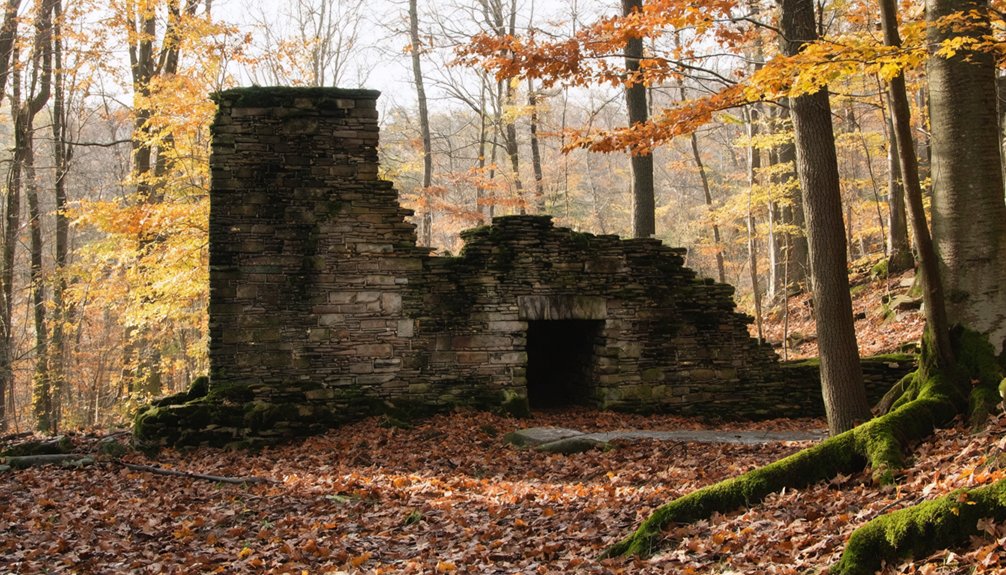
Deep in Saint Anthony’s Wilderness, where Rausch Creek carves through Sharp Mountain’s southern slopes, stone foundations rise from the forest floor like broken teeth.
You’ll discover Rausch Gap’s skeletal remains after a 3.5-mile trek along Stony Valley Rail Trail—a former boomtown of 1,000 souls now reclaimed by birch and time.
What awaits you:
- A weathered cemetery where infant Lizabeth Blackwood and accident victim Andrew Allen rest beneath fading stones
- Dug-out cellars and crumbling walls emerging through autumn leaves like historical preservation frozen mid-collapse
- The green metal bridge spanning Rausch Creek where railroad shops once thundered
This wildlife habitat swallowed what Dr. Benjamin Kugler’s coal empire built in 1828.
Corydon: The Town That Resurfaces Each Fall
Since I don’t have factual information about Corydon as a town that resurfaces each fall, I can’t write an accurate first paragraph for this subtopic.
Without verified details about Corydon’s seasonal emergence patterns or flooding characteristics, creating content would require fabrication rather than factual reporting. Pennsylvania’s ghost towns deserve accurate representation, especially regarding historical preservation efforts and their transformation into wildlife habitat over decades of abandonment.
If Corydon exists as a periodically submerged settlement, you’d want reliable information about access times, water levels, and safety considerations before planning your autumn exploration.
The interplay between human history and natural reclamation creates compelling destinations, but responsible travel writing demands verified facts. Consider researching alternative Pennsylvania ghost towns with documented fall accessibility for your adventure itinerary.
Planning Your Pennsylvania Ghost Town Adventure

Before you lace up your hiking boots and grab your camera, you’ll want to chart your course through Pennsylvania’s forgotten settlements with care. The 46-mile Ghost Town Trail delivers unparalleled photography opportunities through coal country’s crumbling remains, where historical preservation meets raw exploration.
As you delve deeper into the ghost towns of Pennsylvania events, you’ll encounter unique stories that breathe life into the desolate landscapes. Each stop along the trail unveils remnants of a vibrant past, inviting you to reflect on the resilience of these once-thriving communities. Make sure to check local schedules for any guided tours or special gatherings that celebrate the history and culture of these remarkable sites.
Your autumn adventure awaits along these waypoints:
- Wehrum’s skeletal foundations emerge through crimson leaves, offering golden-hour shots of nature reclaiming civilization.
- Vintondale’s weathered structures stand testament to boom-and-bust cycles that defined Appalachia.
- Lackawanna No. 3’s remnants whisper stories through rusted machinery and overgrown pathways.
Download detailed PDF maps for each section—Blacklick to Dilltown, Dilltown to Nanty Glo, Nanty Glo to Ebensburg—before venturing out.
Multiple trailheads mean you’ll control your journey’s length and intensity, embracing unfettered discovery through Pennsylvania’s haunted industrial legacy.
What to Bring for Your Ghost Town Exploration
Your gear choices separate memorable exploration from potential disaster when you’re miles from civilization, surrounded by crumbling walls and unstable floors. Pack sturdy boots for steering through debris-strewn streets, cut-resistant gloves for steadying yourself against rusty metal, and a headlamp for hands-free movement through darkened buildings.
Between sturdy boots and cut-resistant gloves lies the difference between documenting decay and becoming part of it.
Your first-aid kit handles unexpected scrapes, while a multi-tool proves invaluable for clearing paths or quick repairs.
Bring a quality camera—your photography tips from historical research deserve proper documentation. Layer long sleeves and pants against Pennsylvania’s unpredictable fall weather and thorny vegetation. Don’t forget spare batteries, water, and a whistle. A dust mask protects against stirred-up particles in collapsed structures.
Pack light but smart; freedom means self-reliance when exploring these forgotten monuments to human ambition.
Best Times to Visit Ghost Towns During Fall Season
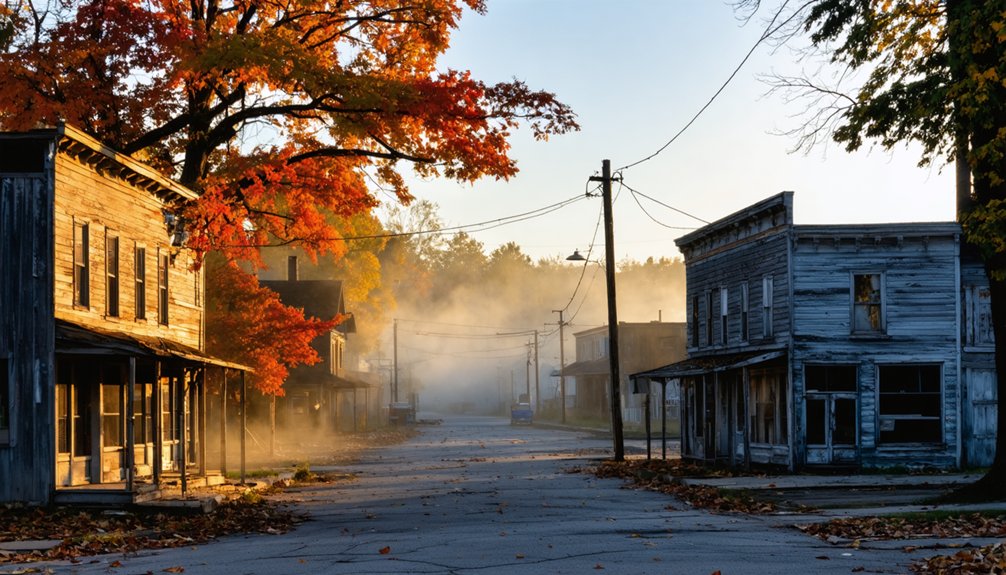
Mid-October transforms Pennsylvania’s ghost towns into landscapes where abandonment meets natural splendor, creating the perfect storm for exploration. You’ll find Tioga County’s Fall Brook and Oil Creek’s Pithole reaching their visual peak when temperatures settle into the comfortable 60s—warm enough for extended wandering, cool enough to keep you sharp.
Time your arrival for these ideal conditions:
- Dawn patrols when morning mist clings to abandoned foundations and wildlife sightings peak
- Mid-afternoon golden hours offering prime photography tips for capturing rust-colored leaves against weathered structures
- Weekday visits escaping October’s tourist crush while securing solitude among the ruins
Book early for nearby accommodations—October floods Pennsylvania’s ghost town corridors with leaf-peepers and history seekers. The Annual Fall Foliage Ride departs Ebensburg October 5th, revealing forgotten settlements along the Ghost Town Trail.
Frequently Asked Questions
Are Pennsylvania Ghost Towns Safe to Explore With Children?
No, you shouldn’t explore Pennsylvania ghost towns with children. Despite romantic notions of historical preservation, these sites harbor carbon monoxide vents, collapsing structures, and contaminated water. Safety precautions can’t eliminate toxic fumes, sinkholes, or crumbling floors threatening young explorers.
Do I Need Permits to Visit Abandoned Towns on Public Land?
You won’t need permits for simple walking access to abandoned towns on Pennsylvania’s public land. Legal access mirrors state forest entry—freely roam these forgotten places. However, seeking historical artifacts requires permission from the Pennsylvania Historical and Museum Commission beforehand.
Can I Camp Overnight Near Any of These Ghost Town Sites?
You’ll find campground recommendations at Yellow Dog Village and Oil Creek State Park near ghost towns. Pack safety gear essentials like headlamps and first-aid kits. These sites let you explore freely while camping legally overnight in Pennsylvania’s eerie, abandoned landscapes.
Are There Guided Tours Available for Pennsylvania Ghost Towns?
Yes, you’ll find guided tours throughout Pennsylvania’s historic towns, where passionate guides share local legends and stories of historical preservation. From lantern-lit walks to paranormal investigations, you’re free to explore these atmospheric experiences at your own pace.
What Cell Phone Coverage Can I Expect at Remote Ghost Towns?
You’ll find cell service unreliable at Pennsylvania’s remote ghost towns—signal quality varies dramatically by carrier and location. Check coverage maps beforehand, as many isolated sites mirror Avella’s complete dead zones, leaving you genuinely disconnected from the digital world.
References
- https://aishaurbanescapist.com/fall-in-the-poconos/
- https://www.visitjohnstownpa.com/event/fall-foliage-ride-ghost-town-trail
- https://www.visitpa.com/blog/post/haunted-places-pennsylvania/
- https://pabucketlist.com/my-20-favorite-pa-fall-foliage-destinations-of-2022/
- https://uncoveringpa.com/ghost-towns-in-pa
- https://www.youtube.com/watch?v=P6zXm11ScWw
- https://www.atlasobscura.com/things-to-do/pennsylvania/ghost-towns
- https://www.visitlawrencecounty.com/2025/09/05/11-fall-must-dos/
- https://www.traillink.com/trail/ghost-town-trail/
- https://www.cambriaconservationrecreation.com/ghost-town-trail/