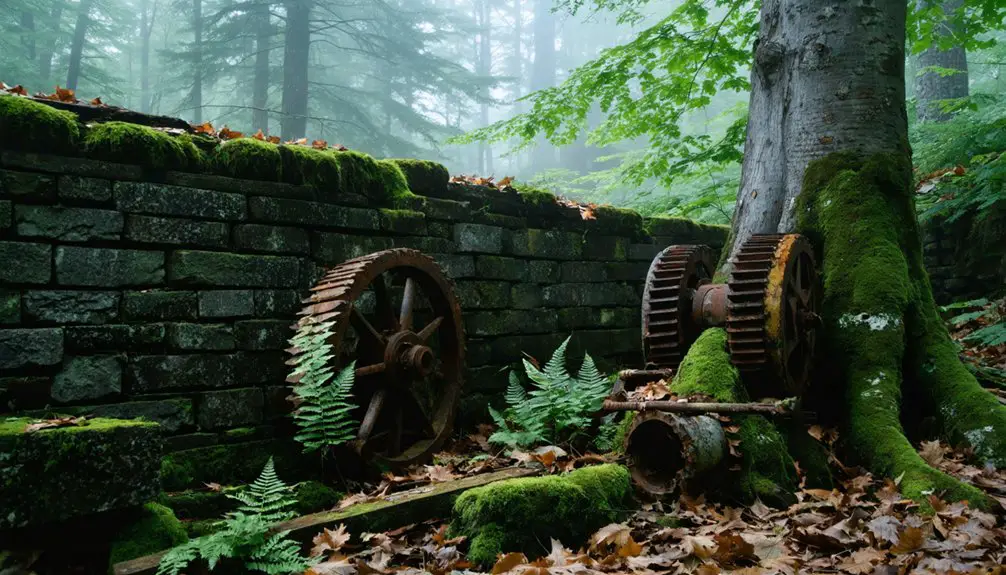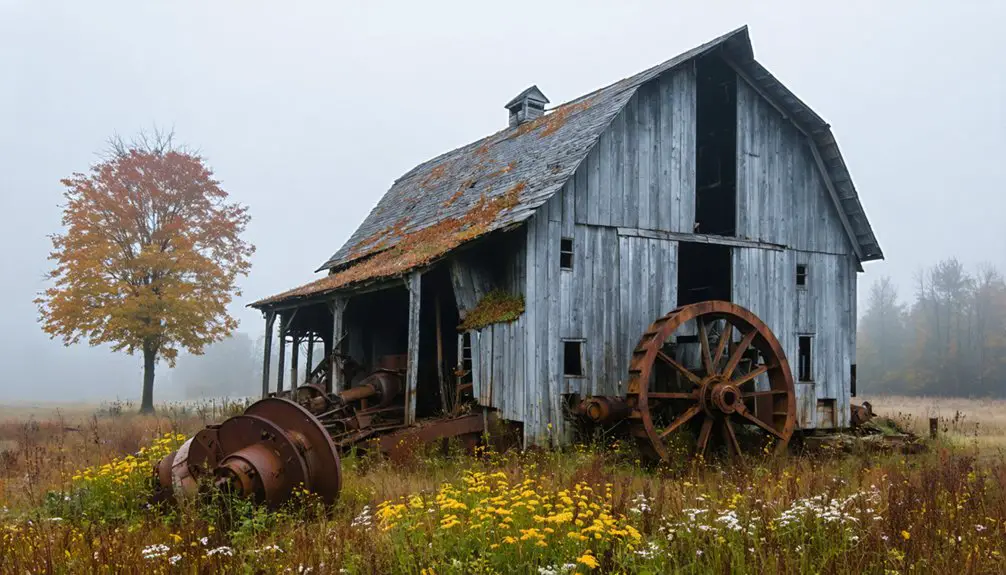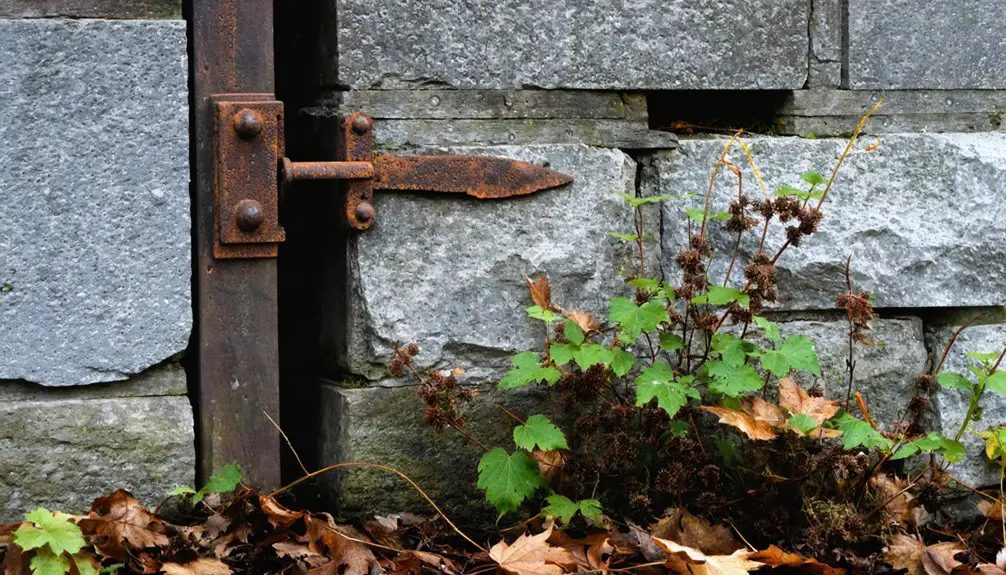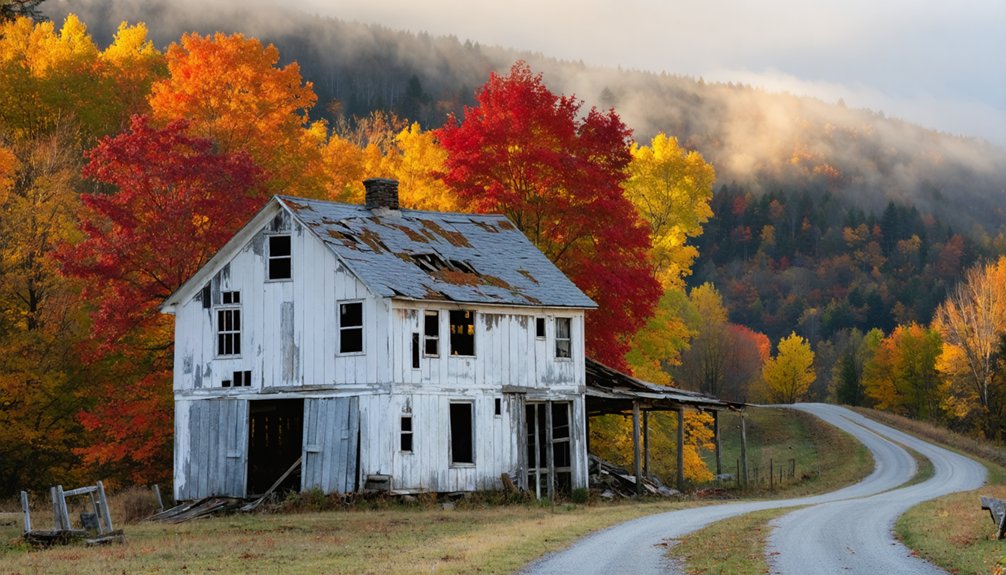
You’ll find Vermont’s most enchanting ghost towns nestled within the Green Mountains during peak fall foliage in early October. Explore Greenbank’s Hollow in Danville, where marked mill foundations sit beside a restored covered bridge, or venture into Somerset’s eerie cemetery with 321 weathered headstones surrounded by crimson maples. Glastenbury offers darker allure with its mysterious disappearances and flickering legends, while submerged Ricker Basin hides 1816 stone cellars beneath Waterbury Reservoir. Each site reveals pioneer stories etched in crumbling foundations and autumn-framed ruins.
Key Takeaways
- Greenbank’s Hollow in Danville features marked foundations, a restored covered bridge, and accessible trails managed by the Historical Society.
- Somerset in Green Mountain National Forest offers stone ruins, mill structures, weathered cemetery headstones, and stunning crimson-and-gold autumn foliage views.
- Glastenbury, disincorporated in 1937, attracts visitors with eerie folklore, mysterious disappearances, and deep Green Mountain wilderness exploration opportunities.
- Lewiston near the Connecticut River displays crumbling foundations, cellar holes, and a memorial church from its 1767 origins.
- Waterbury Reservoir hides Ricker Basin’s submerged remnants, with underwater foundations from 1816 settlements visible to divers year-round.
Greenbank’s Hollow: a Preserved Mill Town With a Historic Covered Bridge
Tucked along a winding brook in Danville, the skeletal remains of Greenbank’s Hollow tell the story of Vermont’s vanished mill economy through weathered granite foundations and moss-covered cellar holes. You’ll discover where Benjamin Greenbank’s five-story woolen mill once produced 700 yards of cloth daily before December 14, 1885, when flames consumed everything—the mill, store, homes, and the covered bridge that was the village’s lifeline.
The Danville Historical Society‘s preservation techniques transformed this abandoned settlement into an accessible historical park. You’re free to explore marked foundations identifying original structures, walk the restored covered bridge spanning the creek, and trace stone walls along the river. The surrounding landscape sits within Vermont’s ancient Green Mountains, rolling hills softened by hundreds of millions of years of erosion from peaks that once rivaled the Himalayas in height. At its industrial peak, the operation supported 25 local families and connected nearly 15,000 sheep farmers to regional textile markets.
The site’s historical significance extends beyond industrial archaeology—it’s a testament to how quickly prosperity vanishes when economic foundations collapse.
Glastenbury: the Mysterious Ghost Town With a Dark History
Deep in Vermont’s Green Mountains, where even the Adnaik tribe refused to tread, Glastenbury stands as the state’s most unsettling ghost town—a place where prosperity, sanity, and people themselves seemed to vanish without explanation.
Once home to 250 residents, this logging settlement collapsed after an 1898 flood destroyed its infrastructure. The state disincorporated it in 1937 when fewer than twenty souls remained.
But abandonment isn’t what haunts Glastenbury. Between 1945-1950, at least four people disappeared without trace near Glastenbury Mountain—including a 75-year-old guide and a woman in red. The missing also included an 18-year-old student and an 8-year-old boy who vanished while hiking.
Urban legends now swirl around the “Bennington Triangle”: man-eating boulders, dimensional portals, and eight-foot hairy beasts.
The folklore stories persist. Strange lights flicker. Unidentifiable odors drift through empty forests. Two murders in the 1890s marked the beginning of the town’s dark descent. Something darker than poverty drove people away.
Somerset: A Vanished Community in the Green Mountain National Forest
You’ll find Somerset’s scattered stone foundations half-swallowed by moss and leaf litter, marking where homes and mills once stood before the town died in the early 1900s.
The forgotten cemetery sits deeper in the woods, its weathered markers leaning at odd angles beneath brilliant red maples and golden birches that now reclaim the clearings loggers stripped bare. Many children rest here, their small headstones a somber reminder of the hardships faced by Somerset’s original residents.
Somerset became a ghost town in 1937, joining neighboring communities that disappeared as logging and industry declined in this mysterious corner of Vermont.
Access these haunting remnants via the Somerset Reservoir trail system, where autumn’s explosion of color transforms your hike into a time-traveling journey through Vermont’s vanished past.
Stone Ruins and Cemetery
The forest has reclaimed what logging once stripped bare, and Somerset’s stone ruins emerge from the undergrowth like broken teeth. You’ll find skeletal mill structures where charcoal kilns once roared, their foundations cracked by a century of freeze-thaw cycles. Flood debris lies scattered like evidence at a crime scene, rusted iron bolts jutting from moss-covered masonry.
The small cemetery holds deeper weight. Nineteenth-century gravestones lean at odd angles, marking the 321 souls who once called this place home. Haunted legends swirl around these forgotten graves, amplified by the Bennington Triangle disappearances that occurred nearby. Between 1945 and 1950, five individuals vanished in the area without trace—despite extensive searches involving bloodhounds, aircraft, and military personnel. The region’s dark history includes Carol Herrick, an outdoorswoman found dead with her lungs punctured, seemingly “squeezed” to death near her cousin’s unfired gun.
For those seeking archaeological insights beyond sanitized history books, Somerset delivers raw truth: empires built on finite resources crumble, leaving only stone and stories.
Fall Foliage Trail Access
Autumn transforms Somerset’s wilderness trails into corridors of fire—crimson maples and golden birches arch overhead while your boots crunch through leaves concealing century-old foundations.
You’ll navigate these Green Mountain National Forest paths without crowds or seasonal festivals, just the whisper of wind through empty valleys. The Long Trail near Glastenbury Mountain offers striking views, while Somerset Reservoir routes lead you past cellar holes emerging from rust-colored ferns. Somerset stands as one of three settlements—alongside Fayville and Glastenbury—that became ghost towns in this 36-square-mile wilderness.
Early fall provides stable weather before winter closes access entirely. Local urban legends speak of compass needles spinning erratically here, but you’ll find the real mystery lies in imagining 321 voices once echoing through these silent woods. This region forms part of the Bennington Triangle, a 100-square-mile area notorious for mysterious disappearances between 1945 and 1950.
Pack water and maps—this wilderness rewards those who embrace solitude over comfort.
Lewiston: A Quiet Settlement Lost to Time
Tucked between rolling hills and the Connecticut River’s edge, Lewiston whispers stories of a vanished era through crumbling stone foundations and leaf-filled cellar holes. You’ll discover Dr. Joseph Lewis’s 1767 settlement where brook-powered mills once thrived, supplying coal to Dartmouth College across the water.
The town’s heartbeat stopped when oil replaced coal and dam construction swallowed farmland—Interstate 91’s 1967 expansion delivered the final blow.
Today, you’re free to wander among the ruins without crowds or restrictions. A solitary memorial church stands sentinel over scattered cellar holes, a memento to historical preservation efforts.
Archaeological surveys have mapped the site, but you’ll forge your own path through autumn leaves, tracing vanished streets where Vermont’s ghost town legacy lives in stone and memory.
Ricker Basin: Stone Cellars and Forgotten Footpaths
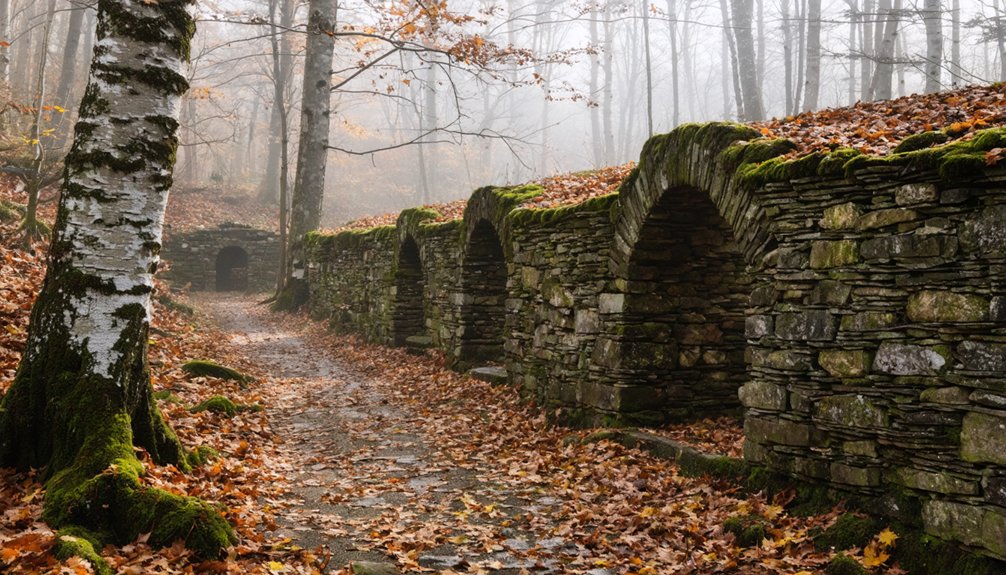
While Lewiston slumbers beside the Connecticut River, another ghost town clings to Vermont’s mountainous interior—Ricker Basin, where Joseph Ricker’s 1816 homestead sparked a settlement that would one day vanish beneath reservoir waters.
Joseph Ricker’s 1816 homestead birthed a thriving mountain settlement, only to disappear forever beneath the rising waters of progress.
You’ll discover stone cellar holes scattered through Green Mountain National Forest, remnants of fifty families who once worked these southeastern slopes. The rocky soil challenged dairy farming, but timber logging thrived until successive floods—1927’s catastrophic deluge, then 1934’s final blow—drove survivors away.
When the Waterbury Reservoir filled in 1938, it swallowed roads, foundations, and dreams. Today you can trace forgotten footpaths past the Almeran Goodell farmhouse and explore weathered cemeteries.
Below the reservoir’s surface, divers navigate an eerie underwater ghost town where silt-covered foundations mark homesteads frozen in time.
Smithfield: Farming Community Marked by Foundations and Memory
You’ll find Hanton City’s crumbling stone foundations scattered through Smithfield’s woods like scattered teeth, remnants of three English families who carved out a yeoman’s existence after King Philip’s War.
The settlement that thrived in the 1730s now reveals itself only through cellar holes and dilapidated walls, where maples and oaks have reclaimed what the Hantons, Paines, and Shippees once cleared.
Walk the trail from West Reservoir Road three-quarters of a mile in, and you’ll step into clearings where chimneys once warmed families who vanished over a century ago.
Small Agricultural Settlement Origins
The ghost of Smithfield begins with a land grant—23,040 acres carved from wilderness in 1763, though New York’s overlapping claim of 25,000 acres created disputes that shadowed every settler who arrived.
You’ll find traces of their independent spirit in scattered foundations—pioneers who chose isolation over villages, staking claims on wilderness pitches where they’d answer to no one.
They torched vast stretches of forest, treating ancient trees as mere obstacles to freedom.
Around charred stumps, they planted corn yielding forty bushels per acre, wheat at twenty.
By 1815, apple trees fruited on every farm.
This wasn’t rural development by design but necessity—families with one cow, some pigs, clearing enough land to survive.
Cultural preservation here means remembering their fierce self-reliance.
Remnants of Stone Foundations
Beneath maples now sixty feet tall, stone foundations emerge from leaf litter like exposed bones—rectangles of fieldstone that once cradled kitchens where women churned butter and baked cornbread in basement hearths.
You’ll trace worn steps descending into cellar holes, imagining root vegetables stored in cool darkness. These aren’t ancient artifacts from some distant civilization—they’re remnants of 1730s farm life, abandoned by the early 1800s when families drifted toward better prospects.
Wander beyond the main foundations and you’ll discover corn crib ruins, a defunct dam, stone walls snaking through forest. A well gapes near one foundation, its depths hinting at underground tunnels of mythology rather than reality.
Three gravestones mark the cemetery where Smiths and others rest, their names weathered but defiant against a century of neglect.
Memorial Church Stands Today
While Smithfield’s farmsteads crumbled back into Vermont soil, one structure defied the settlement’s disappearance—though you won’t find it among the cellar holes. The United Church of Northfield, built in 1836 as Charles Paine’s meeting house for millworkers, stands proudly in Depot Square—a symbol of historical preservation and community memory transcending abandoned settlements.
This white clapboard Greek Revival beauty survived when fires consumed Depot Square’s 19th-century structures. You’ll recognize its:
- Clock tower piercing autumn skies above surrounding maples
- Original 1836 exterior virtually unchanged except missing horse sheds
- Widened sanctuary from 1850s modifications adding sixteen pews
- Howe’s Hall beneath where community gatherings echo upward
The building embodies freedom’s continuity—from Smithfield’s pioneer spirit through today’s Open and Affirming congregation championing diversity and justice.
Best Times to Explore Vermont’s Ghost Towns in Autumn
Timing your ghost town adventure requires matching nature’s most dramatic color show with accessible trails and crisp autumn air. Target late September through early October for northern sites like Ricker Basin, when golden birches frame abandoned foundations.
Central Vermont’s ghost towns, including trails near Montpelier, explode with color during the second week of October—your sweet spot for wildlife observation as deer browse through ruins at dawn.
The scenery is truly breathtaking, as ghost towns in Vermont’s fall colors offer a stunning backdrop for photographers and nature lovers alike. As the vibrant foliage transforms the landscape, the tranquility of these forgotten places invites reflection and exploration. Visitors can wander through the remnants of the past, all while soaking in the striking hues of red, orange, and gold that blanket the hillsides.
Southern locations like Madame Sherri’s Castle reward mid-October visits when seasonal weather delivers those perfect 50-degree mornings.
Higher elevation ghost towns shine brightest around mid-October, though you’ll want to check trail conditions after early snowfall.
Columbus Day weekend typically captures central Vermont at its peak, offering you maximum color intensity while maintaining comfortable hiking temperatures through forested ghost town paths.
What to Bring When Visiting Abandoned Sites in Fall

You’ll need three essentials before stepping into Vermont’s frost-touched ruins: reliable wayfinding tools (a compass and offline maps work when cell service vanishes), layered clothing that shields you from sudden temperature drops inside crumbling structures, and a sturdy camera to capture peeling wallpaper backlit by autumn’s golden hour.
I learned this the hard way during my first ghost town visit, when October’s deceptive sunshine gave way to bone-chilling winds inside an abandoned mill.
Pack light but smart—your safety gear shouldn’t weigh you down while climbing rickety stairs or traversing debris-strewn floors.
The crunch of broken glass beneath your boots and the musty smell of decades-old decay hit you the moment you step through a collapsed doorway—and that’s when you realize proper gear separates an exciting exploration from a dangerous mistake. Vermont’s abandoned sites demand respect and preparation.
Your essential safety gear and navigation tools should include:
- Heavy-duty gloves and sturdy boots protect against rusty nails and debris lurking in shadows
- Headlamp with extra batteries keeps your hands free for climbing rotted staircases
- GPS device and waterproof maps prevent getting lost in sprawling ghost town complexes
- Basic first aid kit addresses cuts from jagged metal and broken timber
Pack a respirator mask too—those old buildings harbor dust and potentially hazardous particles you can’t see.
Weather-Appropriate Clothing Layers
How quickly can Vermont’s fall weather turn from sunny afternoon to bone-chilling dusk inside an abandoned mill? You’ll need strategic layering techniques to stay comfortable while exploring these forgotten places.
Start with merino wool base layers—they’ll wick moisture as you navigate debris-filled rooms. Add a flannel shirt or lightweight wool sweater for breathability. Your outer shell matters: pack a water-resistant windbreaker for sudden rain squalls.
For bottoms, choose hiking pants over jeans when climbing rickety stairs or crawling through broken windows. Fleece-lined tights work under skirts if you’re documenting sites for social media.
Don’t skip accessories—Darn Tough wool socks prevent blisters during long explorations, and a wool hat protects against drafts whistling through collapsed roofs. Smart clothing choices mean more freedom to investigate without rushing back to warmth.
Photography and Documentation Equipment
Once you’ve mastered staying warm through hours of exploration, capturing these decaying spaces becomes your next challenge. Vermont’s abandoned sites demand specific gear for fall’s early-darkening afternoons and shadowy interiors.
Essential Photography Kit:
- Wide-angle lens (17-50mm f/2.8) – captures cramped spaces sharp and fast in dim light
- Compact tripod – enables 2-30 second exposures when natural light fades around 5pm
- Flashlight – illuminates pitch-black basements and electricity-free corridors
- Lightweight mirrorless camera – maneuvers easily through debris while climbing
Skip the heavy gear. You’ll regret hauling reflectors and multiple lenses by the second floor. Focus on forgotten details: dusty ledgers, crooked chairs, remnants telling authentic stories.
Drone photography reveals structural decay from above, while night shooting transforms these spaces into haunting compositions at ISO 640.
Photography Tips for Capturing Ghost Towns Among Fall Foliage
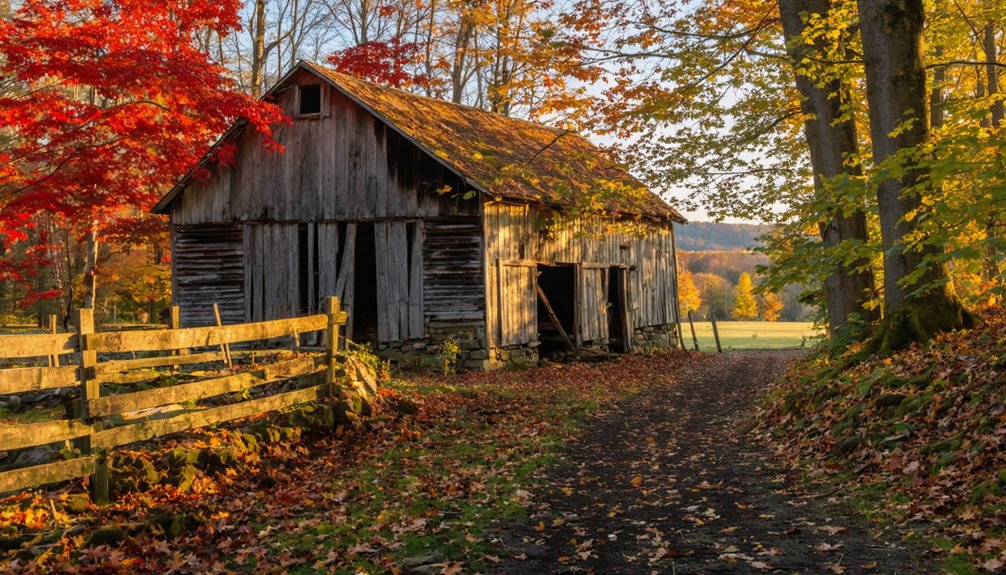
When autumn transforms Vermont’s ghost towns into scenes of haunting beauty, photographers face the thrilling challenge of capturing both decay and vibrant life in a single frame.
You’ll want to shoot during golden hour, when warm light bathes crumbling walls in amber tones that complement the fiery maples. Crouch low to capture fallen leaf carpets threading through urban decay, or frame weathered doorways with nature’s brilliant intrusion.
Golden hour transforms abandonment into art—where decay meets October fire, every crumbling threshold becomes a canvas of amber light.
Pack your tripod for those moody interior shots—a 30-second exposure at f/8 lets you paint abandoned rooms with your flashlight while windows drink in the ambient glow.
Don’t overlook candid portraits of fellow explorers silhouetted against blazing foliage. On overcast days, you’ll find colors pop without harsh shadows, revealing textures in peeling paint and frost-touched leaves alike.
Respecting History: Guidelines for Exploring Vermont’s Abandoned Places
Before you step through that listing doorframe or peer into a window clouded with decades of grime, you’re crossing an invisible threshold between curiosity and responsibility. Vermont’s abandoned places hold stories worth preserving, and your exploration shouldn’t accelerate their decay.
Follow these essential guidelines:
- Obtain permission before entering private property—trespassing violates local preservation laws and disrespects owners.
- Report discoveries to Vermont’s Division for Historic Preservation for potential survey inclusion.
- Never disturb archeological resources or remove artifacts that document community identity.
- Respect no-entry zones in Certified Local Government areas awaiting commission review.
Historic site guidelines exist because neglect and unauthorized alterations threaten Vermont’s architectural heritage.
Your camera captures memories; your restraint preserves them for generations seeking their own connection to these haunting remnants.
Frequently Asked Questions
Are Vermont Ghost Towns Accessible for Visitors With Mobility Limitations?
Most Vermont ghost towns aren’t publicly accessible, but you’ll find accessibility improvements at official historic sites instead. Wheelchair-friendly paths wind through rail trails and heritage museums, where you can explore autumn’s golden landscapes and Vermont’s storied past freely.
In addition to these improvements, many historic sites in Vermont offer guided tours that delve into the rich history of the region. Visitors can learn about the state’s unique architecture and the stories behind each site, enhancing their experience. During your visit, be sure to check out the local exhibits that highlight Vermont’s cultural heritage.
Do I Need Permits to Explore Ghost Towns on Public Land?
You don’t need permits for simple exploration on public lands, but you’ll want permission before entering private property. Respect historical preservation efforts—these weathered remnants tell stories of Vermont’s past that deserve protection and reverence.
Are Ghost Town Sites Safe for Children to Visit?
You’ll find these haunted landmarks surprisingly safe for supervised kids—wide trails, minimal hazards, just crumbling stone walls and forest. History preservation means accessible sites where your family can freely explore Vermont’s past without restrictions or danger.
Can I Camp Overnight Near Vermont’s Abandoned Settlements?
You’ll need landowner permission for most abandoned settlements on private property. State lands near historical sites offer designated primitive camping with stunning photography opportunities while respecting historical preservation rules—just follow setback requirements and Leave No Trace principles.
Are Guided Tours Available for Vermont Ghost Town Exploration?
You’ll find guided ghost tours in Burlington, Montpelier, Woodstock, and Stowe—but they focus on paranormal activity, not abandoned settlements. For authentic ghost town exploration with historical preservation and photography opportunities, you’re better off venturing independently.
References
- https://kids.kiddle.co/List_of_ghost_towns_in_Vermont
- https://www.youtube.com/watch?v=2fvPo9iQC-w
- http://freepages.rootsweb.com/~gtusa/history/usa/vt.htm
- https://www.onlyinyourstate.com/experiences/vermont/ghost-town-vt
- https://www.geotab.com/ghost-towns/
- https://www.youtube.com/watch?v=YrQNbrIrNT8
- https://wend.ca/?p=83940
- https://www.atlasobscura.com/places/the-forgotten-village-at-greenbanks-hollow-danville-vermont
- https://www.vermonter.com/greenbanks-hollow/
- https://ournewenglandlegends.com/podcast-385-the-ruin-of-greenbanks-hollow/