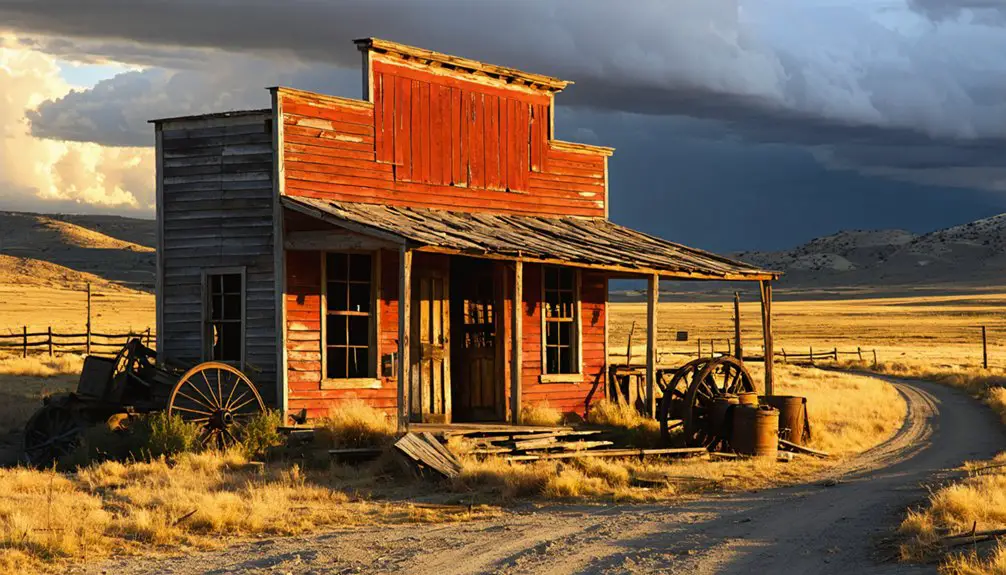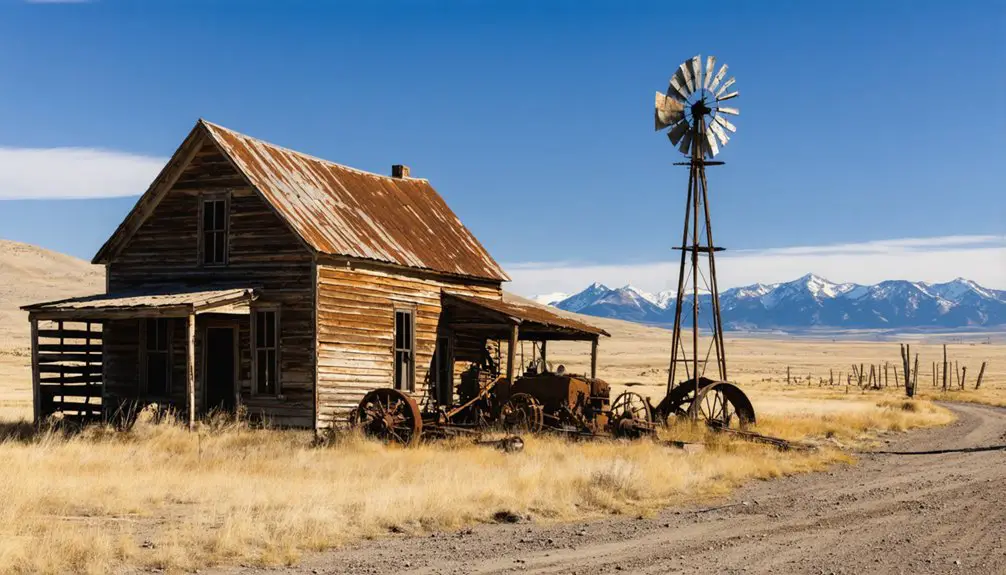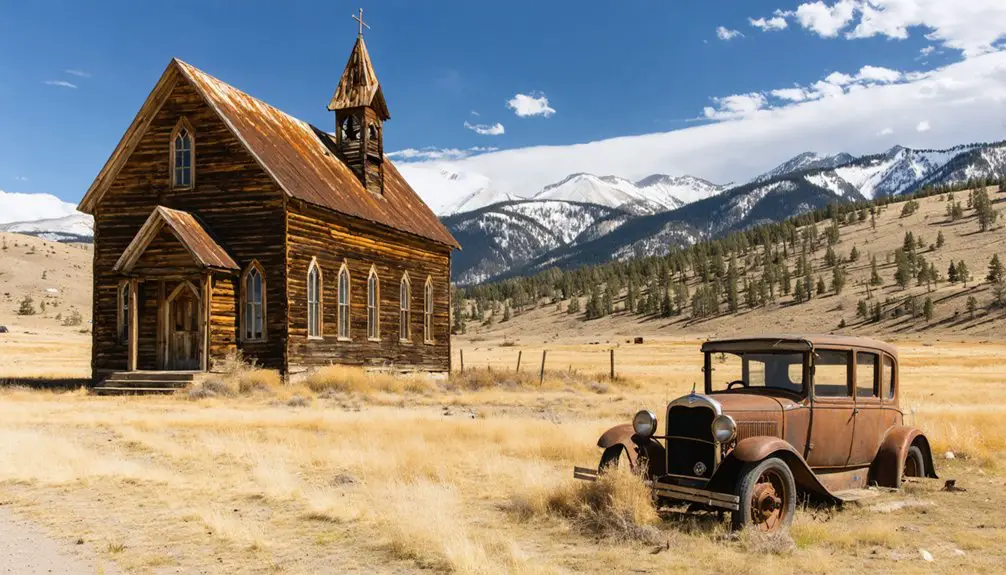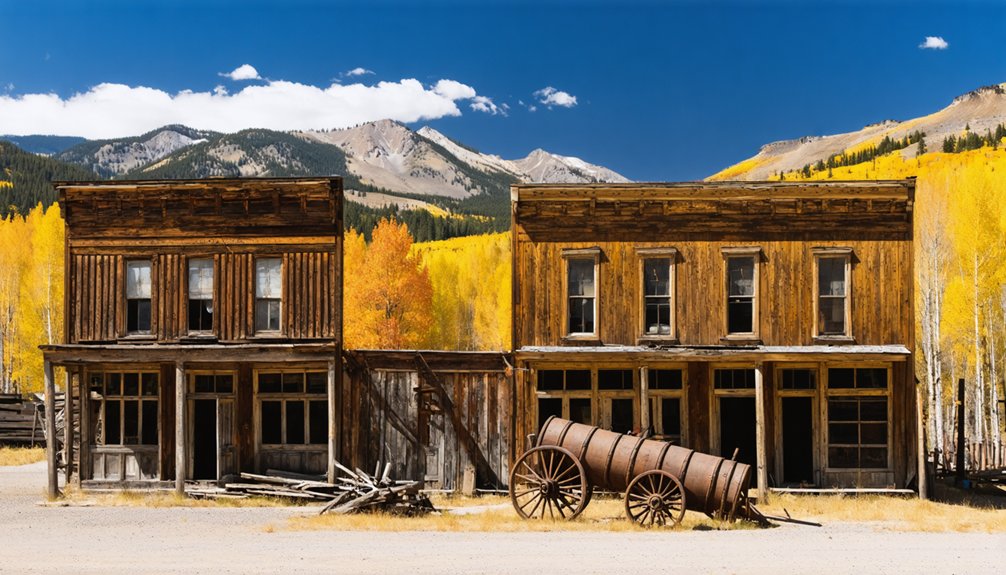
You’ll find Wyoming’s ghost towns at their atmospheric best during fall, when cooler temperatures make exploration comfortable and golden light bathes weathered structures. Start with Kirwin at 9,200 feet, featuring preserved log cabins and mine shafts accessible via rugged 4WD trails. Near Thermopolis, Gebo offers haunting stone foundations and a historic cemetery, while South Pass City presents over 30 original 1860s buildings. The season provides ideal conditions before winter snows close mountain access, and you’ll discover exactly how to navigate these remote locations safely.
Key Takeaways
- Fall offers milder temperatures, fewer crowds, and optimal lighting for exploring Wyoming’s ghost towns before winter snow blocks access.
- Gebo features crumbling coal town ruins and a weathered cemetery, best photographed in fall’s golden light near Thermopolis.
- Kirwin sits at 9,200 feet with preserved log cabins and mine structures, requiring high-clearance 4WD through rugged terrain.
- South Pass City hosts Gold Rush Days in September with over 30 original 1860s structures and authentic heritage reenactments.
- Miner’s Delight contains 17 structures atop a mountain, with legends of Calamity Jane and $5 million in processed gold ore.
Why Fall Is the Perfect Time to Explore Wyoming’s Ghost Towns
When autumn settles over Wyoming’s high desert, the ghost towns emerge from their summer haze with a clarity that’ll stop you mid-step. The harsh badlands light sharpens every brick edge at Gebo, while fall’s bronze meadows frame Kirwin’s weathered cabins against serrated peaks.
You’ll escape summer’s scorching heat and winter’s avalanches safety concerns, steering through uneven ground in ideal conditions before snow slicks those remote four-wheel-drive roads.
The solitude matters here. You’ll wander South Pass City at your own rhythm, no crowds breaking your concentration as sunset filters golden through collapsed doorways. The town’s Bartlett Inn carries tales of Wyoming’s notorious serial killers, adding an eerie dimension to your exploration of this historic mining settlement.
Wildlife encounters require awareness, but milder temperatures reduce risks while you explore. Mountain weather demands layers—those surprises come fast—yet fall’s window offers the perfect balance between accessibility and the raw, untamed landscapes that drew prospectors here generations ago. At Gebo, you’ll find weathered mining structures and residential remnants that once housed hundreds of families during the coal boom’s peak.
Kirwin: A Well-Preserved Mining Town at 9,000 Feet
Tucked at 9,200 feet in the Absaroka Mountains, Kirwin clings to its steep valley like a stubborn memory that refuses to fade. You’ll find remarkably preserved log cabins, the Wolf Mine shaft house, and an assay shop—all stabilized by the Forest Service since 1999.
This wasn’t your typical hell-raising mining camp; investors banned saloons and gambling, creating an oddly civilized outpost that peaked at 200 residents during 1904-1906.
Mining legends speak of $90-per-ton gold assays and 15,000 feet of tunnels chasing copper and silver veins.
But ghostly tales persist too—locals claim prospectors fled cursed ground despite the minerals. Visitors report hearing unexplained voices and moans echoing through the abandoned buildings, particularly in the old structures where spirits are believed to linger.
The 1907 avalanche that killed three and triggered mass exodus only deepened the mystery.
Today, you’ll hike past remnants of dreams that couldn’t survive isolation. The journey demands a high-clearance 4WD vehicle to navigate Forest Service Road 200’s unbridged river crossings and rough mountain terrain, accessible only from mid-May through November.
Getting to Kirwin: What to Expect on the Journey
You’ll leave pavement behind in Meeteetse and spend the next 40 miles climbing through Shoshone National Forest on roads that shift from gravel to rock to dirt, demanding constant attention as your four-wheel drive navigates steep grades and multiple river fords. Plan for at least two hours of technical driving—longer if you stop to pick wild raspberries or photograph the mining ruins clinging to hillsides beneath Francs Peak’s 13,153-foot summit.
The journey tests both your vehicle and your nerve, but those mountain views and the promise of Kirwin waiting at 9,000 feet make every water crossing worth it. This former gold mining town from the late 1800s now stands as a preserved ghost town, offering visitors a tangible connection to Wyoming’s mining heritage. At the end of your drive, you’ll find a parking lot equipped with informational signs and a vault toilet, where all vehicles must be highway legal.
Road Conditions and Terrain
Reaching Kirwin isn’t for the faint of heart—this journey demands a capable four-wheel drive vehicle and a sense of adventure that matches the rugged Absaroka Mountains themselves. You’ll shift from highway to secondary road, then gravel and rock surfaces as you climb toward 9,200 feet elevation.
The path grows increasingly technical with steep grades, multiple creek crossings, and bumpy conditions that intensify past the halfway point. Vehicle maintenance becomes critical here—check your clearance, 4WD system, and tire condition before attempting this route. Weather preparedness matters equally, as fall brings potential snow accumulation and frost-slicked creek beds at this altitude.
The road eventually closes to vehicles, requiring a 0.4-mile walk along the Wood River. Many experienced adventurers recommend a Polaris RZR for traversing the backtrails’ unmaintained sections. The complete drive from Cody spans approximately 65 miles, beginning on paved highway before transitioning to graded gravel and ultimately a narrow Forest Service road. For those without suitable four-wheel-drive vehicles, guided tours are available to help you navigate the challenging terrain safely.
Distance and Travel Time
From Meeteetse’s weathered storefronts and single eatery, the journey to Kirwin stretches roughly 40 miles southwest into increasingly wild terrain—a distance that translates to several hours rather than the hour you’d expect on pavement.
This primitive dirt road climbs relentlessly through the Absaroka Mountains, crossing four waterways round-trip while testing your vehicle’s capabilities.
Plan a full day for this adventure, factoring in trail difficulty that demands careful navigation and frequent stops to scan for local wildlife.
The technical route winds through bear country where elk graze mountainsides and moose inhabit streambanks.
You’ll need that high-clearance four-wheel drive not just for bragging rights, but survival—this isn’t a shortcut you can rush.
Tell someone your itinerary before disappearing into Shoshone National Forest‘s backcountry.
If you’re uncertain about tackling the rugged terrain independently, tour companies in Meeteetse offer guided trips with historical explanations to enhance your ghost town experience.
Along the journey, you’ll find some smooth stretches between the more challenging segments, offering brief respite from the constant jarring.
Guided Tours and ATV Adventures at Kirwin
You’ll find two main ways to experience Kirwin’s remote beauty: join the Meeteetse Museums’ guided ATV tour each August, where historians lead convoys through 34 miles of rugged mountain terrain while sharing mining camp stories.
Or strike out independently with your own ATV any time the mountain pass allows. The museum tour books up fast—locals say it’s worth reserving months ahead to guarantee your spot among the log cabins and rusted mine equipment.
If you’re riding solo, you’ll need high-clearance four-wheel drive or a capable off-road vehicle, plus bear spray and a full tank of gas, since the nearest services sit 40 miles back in town.
Annual August Museum Tour
Every August, the Meeteetse Museums organize an unforgettable expedition to Kirwin ghost town, transforming what could be a challenging solo adventure into an educational journey through Wyoming’s mining past.
You’ll depart at 9 am on August 9th, reaching the remote site by 10:30 am after traversing multiple river fords in high-clearance vehicles.
Elizabeth Foss brings Kirwin’s eventful mining history to life while geologist Lynn Sessions explains the surrounding mountain geology.
You’ll need weather preparedness—conditions change rapidly in Shoshone National Forest.
Pack your lunch, water, and watch for local wildlife along the rough logging roads.
Limited carpools exist, but most bring their own capable vehicles.
This free seven-hour round trip from Cody lets you explore authentic ghost town remains without the uncertainty of finding it alone.
Off-Road ATV Options
The rugged 26-mile trail to Kirwin demands more than determination—it requires the right machine beneath you. Several outfitters in Meeteetse and Cody rent Polaris Side by Sides and Arctic Cat ATVs equipped for Wood River Valley‘s punishing terrain.
You’ll ford rivers, navigate dry creek beds, and climb to 9,200 feet through Shoshone National Forest.
Polaris Adventures and Kirwin Ghost Town Rides offer guided trips with historians who’ll decode the mining camp’s past while managing the technical aspects. They provide bear spray, satellite rescue devices, and off road equipment rated for these conditions.
Self-guided adventurers receive detailed maps and Garmin units—just bring water and expect a full day. Either way, you’re contributing to historical preservation while conquering one of Wyoming’s most authentic backcountry experiences.
Gebo: Stone Ruins and Historic Cemetery
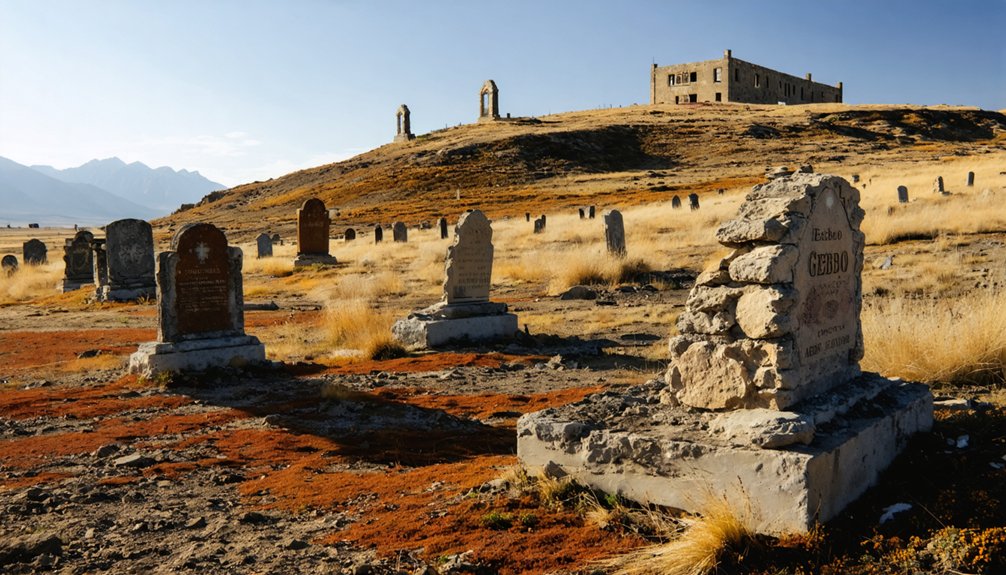
Nestled in the quiet hills about 11 miles north of Thermopolis, Gebo’s crumbling stone foundations and weathered cemetery tell the story of a once-thriving coal town that housed over 2,000 souls during its early 1900s heyday.
You’ll find the site accessible via a dirt road off U.S. 20, where fall’s wildflower blooms soften the abandoned landscape and wildlife encounters with pronghorn are common.
What You’ll Discover:
- Cemetery remains with heartbreaking infant graves reflecting brutal mining camp realities
- Foundation remnants from the business district, school, and church scattered across sagebrush plains
- Atmospheric solitude amplified by wind patterns that create eerie sounds through stone ruins
- Historical significance spanning international settlement from 16 nations during coal boom years
The 1971 bulldozing left minimal structures, but fall’s golden light transforms ruins into haunting photographic subjects.
Essential Safety Tips for Visiting Remote Ghost Town Sites
While ghost town exploration offers unforgettable connections to Wyoming’s frontier past, these remote sites demand respect for both their isolation and hazards. You’ll need to fuel up frequently—gas stations don’t exist on these backcountry routes. Pack one gallon of water per person daily, plus first-aid supplies, extra food, and sturdy boots for traversing crumbling structures.
Wildlife awareness becomes critical in fall when bears prepare for hibernation. Maintain 100 yards distance, carry bear spray, and make noise in low-visibility areas. Store food in bear-resistant containers hung three yards high.
Camp safety requires choosing BLM sites near ghost towns rather than inside them. Share your itinerary beforehand and never deviate without notice. Download offline maps since GPS fails regularly. Watch your step around unstable debris, avoid entering collapsing buildings, and pack out everything you bring.
South Pass City State Historic Site: Living History Experience
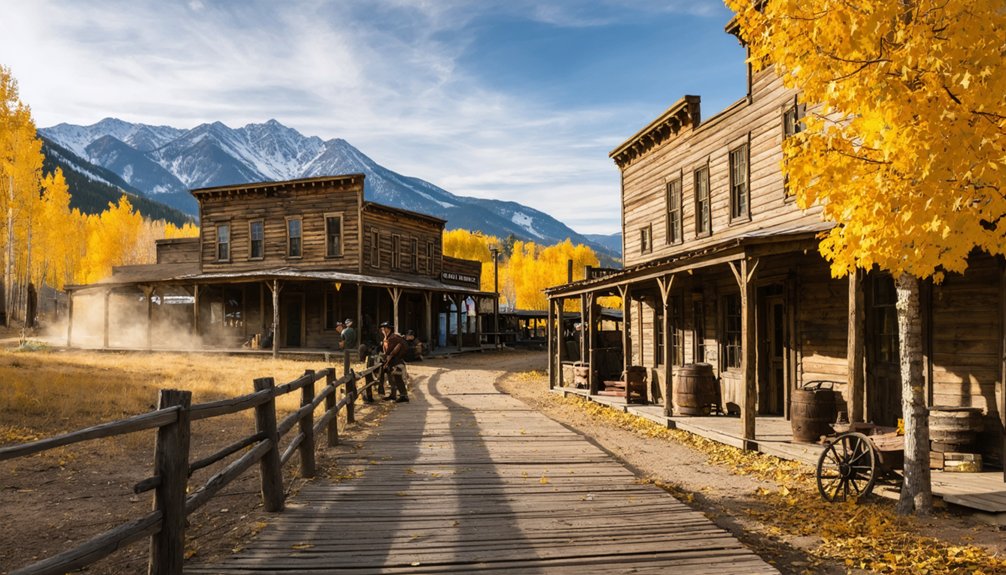
You’ll find over 30 original 1860s structures still standing at South Pass City, from the weathered Carissa Saloon to the sturdy stone jail where miners once sobered up.
Each September, the site comes alive during Gold Rush Days when costumed interpreters demonstrate stamp mill operations and pan for gold in Sweetwater Creek, just as prospectors did in 1867.
Fall’s crisp temperatures and thinner crowds make it the ideal time to explore this remote high-elevation ghost town before winter snow closes the unpaved access roads.
Original Buildings Still Stand
At South Pass City State Historic Site, stepping through weathered doorways feels like interrupting a conversation that paused in 1870. You’ll discover over 20 original buildings where historic preservation meets authentic Western grit.
Each structure is filled with 30,000 artifacts from Wyoming’s gold rush era.
Notable Buildings You Can Explore:
- 1890 Carissa Saloon – where artifact restoration reveals bullet holes and card tables
- 1896 Smith-Sherlock Co. Store – shelves still stocked with period goods
- South Pass Hotel – walk freely through guest rooms frozen in time
- E.A. Slack cabin – home to the South Pass News publisher in 1871
The state’s 1966 purchase saved these National Register structures from collapse.
Now you’ll peer through plexi-glass into saloons and schoolhouses, or step inside select buildings where floorboards creak under your boots.
Annual Gold Rush Days
Every July, the ghost town shakes off its dusty stillness when Gold Rush Days transforms South Pass City into a raucous 1860s mining camp. You’ll watch baseball players in vintage uniforms compete using century-old rules while anvils blast skyward every hour—a thunderous spectacle powered by gunpowder that’ll make your chest vibrate.
Try your luck gold panning in icy creek water, then descend into Carissa Mine to see authentic industrial machinery. Blacksmiths hammer red-hot iron, Conestoga wagons creak past, and Shoshone artisans weave traditional baskets. You can swig sarsaparilla in the saloon between stamp mill demonstrations.
This two-day event ($5 admission) draws crowds from across Wyoming who crave authentic Western heritage. Started in 2001, it’s become the park’s longest-running celebration—though 2025’s happening June 12-13 instead.
Fall Season Accessibility Benefits
When summer’s tourist throngs finally dissipate, South Pass City reveals a quieter charm that serious history buffs appreciate most. You’ll navigate weathered boardwalks and peer into authentic structures without jostling for position, experiencing the site as settlers knew it—isolated and raw.
The fall changeover brings distinct advantages:
- Reduced hours (10:00 AM – 3:00 PM, Thursday-Saturday) mean smaller crowds exploring 23 original buildings.
- Fall foliage transforms surrounding gulches into gold-and-crimson backdrops for photography.
- Wildlife viewing improves as animals prepare for winter across accessible grounds.
- Sunrise-to-sunset access lets you explore independently beyond operational hours.
Though mine tours cease after September, you’re free to wander among 30,000 artifacts and mining remnants. Wyoming’s autumn weather demands sturdy boots—but rewards adventurers with solitude among genuine frontier architecture.
Eadsville: Mountain Mining Remnants at High Elevation
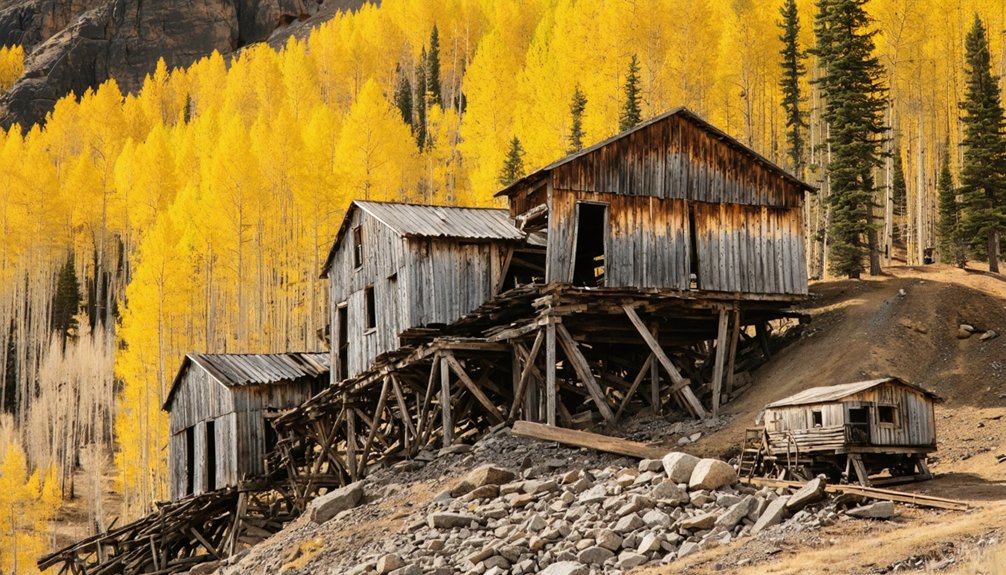
High on Casper Mountain’s slopes at nearly 8,000 feet, Eadsville clings to existence through scattered cabin foundations and a stubborn spring that once promised fortune.
At 8,000 feet, Eadsville survives through crumbling foundations and one persistent spring—remnants of dreams that couldn’t outlast the mountain’s isolation.
Charles W. Eads staked his claim here in 1891, luring 40-50 hopeful miners with tales of copper and gold.
The mountain scenery surrounding these weathered stone remnants tells their story better than exaggerated reports ever could—isolation defeated ambition when ore ran thin.
You’ll need 4WD to reach this ghost town, twelve miles south of Casper in Red Creek drainage.
Weather considerations matter at this elevation; September offers your best window before winter buries the site under deep snow.
Walk among the foundations where miners once sheltered their families.
Touch the spring that still flows.
A small grave and historical marker preserve what harsh elements tried erasing.
Miner’s Delight: Seventeen Structures Atop the Mountain
Gold whispers through Spring Gulch drew Jonathan Pugh to Peabody Hill in 1867, and the camp he founded—first called Hamilton City, then renamed for its richest mine—grew into seventeen weathered structures you can still walk among today.
You’ll discover this remote mountaintop site 120 miles northwest of Rawlins, managed by BLM with trails crossing creeks to scattered cabins.
Ghost town legends run deep here:
- Calamity Jane called this home before her Deadwood fame
- Henry Comstock lived here before striking Nevada’s legendary lode
- The 1893 “brass lock service mystery” involved stolen registered letters from the stagecoach
- Mining technology like the 10-stamp mill crushed over $5 million in gold ore before costs exceeded recovery
Cross the footbridge and explore seven cabins, saloons, and privies hiding in underbrush—your accessible escape into Wyoming’s untamed past.
Planning Your Fall Ghost Town Adventure in Wyoming
As September’s aspens turn gold across Wyoming’s high country, you’ll find the state’s ghost towns at their most dramatic—weathered cabins framed by amber hillsides, crisp air carrying none of summer’s dust, and roads firm enough for exploration before winter snows seal them off.
The blend of autumn beauty in ghost towns creates a hauntingly picturesque backdrop for any adventurer seeking solitude. Abandoned mines and decaying storefronts take on a vibrant charm, inviting exploration and reflection. It’s a perfect time for photographers to capture the juxtaposition of nature reclaiming its space against the remnants of human endeavor.
Pack your four-wheel-drive essentials: recovery gear, extra fuel, and layered clothing for temperature swings. Meeteetse Museums coordinates official Kirwin tours through September, though independent exploration requires serious off-road capability.
The technical 40-mile route demands full attention.
Wildlife encounters intensify during fall migrations—elk bugle near South Pass City, while wild horses roam Winton’s access roads. Bring telephoto lenses for seasonal photography opportunities: golden light illuminating mining relics, dramatic storm clouds rolling over abandoned structures.
These abandoned settlements reward self-reliant travelers willing to navigate unmarked trails and embrace solitude.
Frequently Asked Questions
Are Pets Allowed at Wyoming Ghost Town Sites?
Pet policies vary across Wyoming’s ghost towns—you’ll find freedom to explore with your furry companion at South Pass City and Kirwin, but leash requirements apply. Old Trail Town doesn’t allow pets, so plan accordingly for your adventure.
Do I Need a Permit to Visit Ghost Towns on Forest Service Land?
You won’t need to “swipe right” for permission—casual ghost town visits on Forest Service land don’t require permits. However, respect private property boundaries and check wilderness restrictions beforehand. Always tread lightly and preserve these historic sites for future explorers.
What Cell Phone Coverage Can I Expect at Remote Ghost Town Locations?
You’ll find cell phone reception spotty or nonexistent at most remote ghost towns. Download offline maps beforehand, since connectivity options vanish in mountain valleys. AT&T performs best statewide, but don’t count on signal when you’re exploring backcountry ruins.
Are There Camping Facilities Near These Ghost Towns?
You’ll find nomadic camping at Sage Creek’s abandoned railroad site, though you’ll need self-contained gear. Superior offers day-use parks only. For historical preservation insights and local guided tours, contact site managers who’ll share maps and authentic exploration routes.
Can I Use a Drone to Photograph Wyoming Ghost Towns?
You’ll need to ditch telegraphing your shots first—check drone regulations before flying. Most ghost towns sit on private land requiring permission. Follow photography tips: register your drone, respect “No Trespassing” signs, and capture those weathered facades freely.
References
- https://travelwyoming.com/blog/stories/post/5-wyoming-ghost-towns-you-need-to-explore/
- https://bighorndrifters.com/elementor-2633/
- https://windriver.org/spookiest-places-wyoming/
- https://www.youtube.com/watch?v=GEoxbcwf8Ks
- https://www.youtube.com/watch?v=Oe33S_KII3k
- https://www.tripadvisor.com/Attractions-g28973-Activities-c47-t14-Wyoming.html
- https://www.wyomingcarboncounty.com/?id=123:5-ghost-towns-to-explore
- https://takingthekids.com/long-abandoned-wyoming-ghost-towns-where-the-old-west-still-lingers/
- https://www.visitkeweenaw.com/listing/wyoming-the-ghost-town/519/
- https://beautifuldaytraveler.wordpress.com/2025/10/17/kirwin-wyoming-discovering-one-of-americas-most-haunted-and-well-preserved-ghost-towns/comment-page-1/