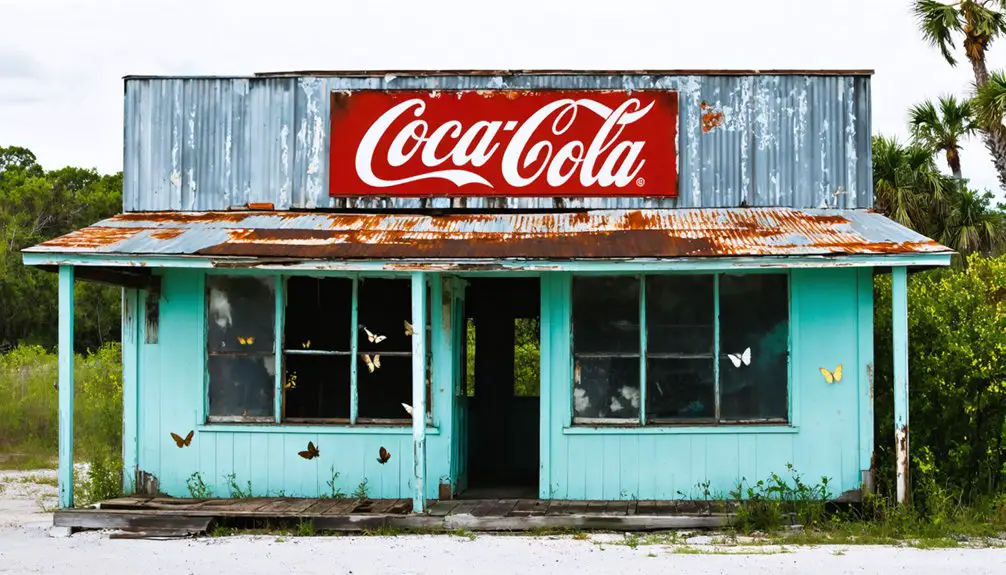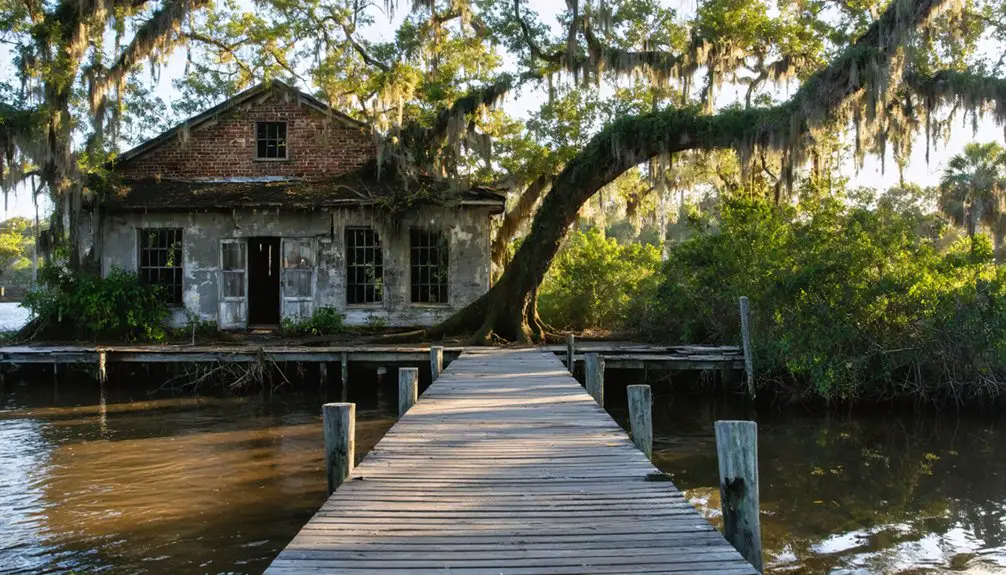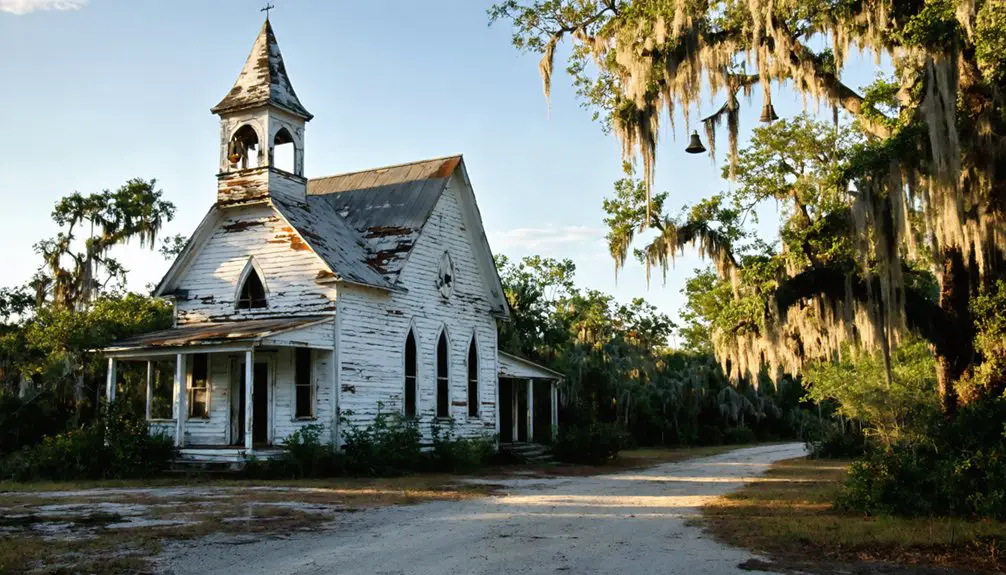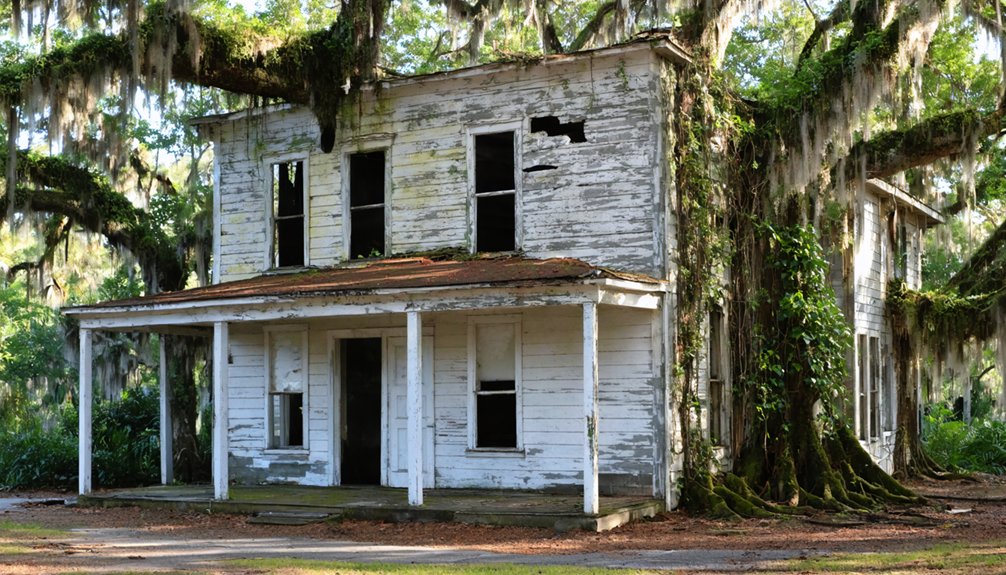
You’ll find Florida’s most accessible ghost towns at Fort Dade on Egmont Key, where Spanish-American War ruins sprawl across six miles of brick paths, and Eldora within Canaveral National Seashore, where two surviving structures tell the story of the catastrophic 1895 freeze that destroyed a citrus empire. The Olustee Battlefield preserves Civil War shadows in pine forests, while Everglades settlements like Flamingo have nearly vanished into dense wetlands. Each site reveals how nature, disaster, and abandonment have shaped Florida’s forgotten communities into haunting landscapes worth exploring.
Key Takeaways
- Fort Dade on Egmont Key features Spanish-American War ruins accessible only by boat, with six miles of brick paths through historic structures.
- Eldora in Canaveral National Seashore offers guided tours of a citrus town abandoned after the devastating 1895 freeze destroyed its economy.
- Olustee Battlefield Historic State Park preserves the site of Florida’s bloodiest Civil War battle from February 1864 with over 2,800 casualties.
- Flamingo’s foundations remain visible 4.5 miles from the current campground, marking a settlement established in 1892 that disappeared by 1910.
- Stiltsville near Miami features underwater skeletal pilings from former coastal structures, showcasing Florida’s submerged maritime history.
Fort Dade on Egmont Key: A Spanish-American War Outpost Frozen in Time
While modern warships glide past its shores, Fort Dade’s crumbling brick buildings stand sentinel on Egmont Key, a windswept barrier island guarding the mouth of Tampa Bay.
You’ll discover colonial architecture from 1898, when this Spanish-American War fortress housed 300 soldiers in self-contained luxury—complete with bowling alleys and movie theaters.
Though the fort never fired a shot in anger, becoming obsolete before World War I, its ruins tell tales of military ambition.
Six miles of brick paths lead you through ghostly barracks, gun batteries, and a power plant, while pirate legends swirl around the 1848 lighthouse still warning ships away.
The island’s footprint has dramatically diminished over time, shrinking from 580 acres in 1877 to roughly 200 acres today due to erosion and rising seas.
A small cemetery established between 1864 and 1909 holds the remains of Union and Confederate soldiers who served on the island.
Today’s Tampa Bay pilots share this preserved outpost with one park ranger, maintaining its frozen-in-time solitude accessible only by boat.
Eldora: Where the Great Freeze of 1895 Ended a Citrus Empire
Eldora thrived as a citrus powerhouse until December 1894, when arctic winds brought temperatures plummeting to 18°F.
Followed by an even more brutal 11°F freeze in February 1895.
The back-to-back freezes destroyed every orange, grapefruit, lemon, and lime on the trees, splitting bark and killing new growth.
Production crashed from six million boxes annually to just 100,000.
Land values collapsed from $1,000 per acre to a mere $10, leaving growers financially devastated.
The catastrophe drove desperate citrus farmers southward, where their exodus ultimately led to Miami’s founding in 1896.
Today, you can explore the scattered ruins of this once-prosperous community, where weathered foundations and abandoned groves tell the story of Florida’s greatest agricultural catastrophe.
Citrus Boom Before 1895
Before the catastrophic freeze of 1895 would silence its bustling docks and devastate its groves, the waterfront settlement of Eldora thrived as an essential node in Florida’s explosive citrus expansion.
You’d have witnessed over 100 residents tending historic orchards that stretched along Mosquito Lagoon’s shores, harvesting oranges bound for northern markets. The citrus industry transformed this remote community into a prosperous agricultural hub.
With shallow-draft steamboats hauling millions of boxes annually to New Smyrna’s distribution points.
Eldora’s groves contributed to Florida’s staggering pre-1895 output of 6 million boxes per year.
Refrigerated railcars had opened unprecedented opportunities since 1866, while General Sanford’s Valencia varieties revolutionized production.
You’d have seen farmers diversifying with honey from orange blossoms, vegetables, and seafood—all flowing through Eldora’s critical steamboat connections. The village operated under the name Fairview, with residents relying on a school, post office, and steady waterway boat traffic. The Florida Fruit Growers Association, formed in 1874, helped organize the industry’s rapid expansion during these boom years.
The Devastating Great Freeze
Within mere weeks, nature delivered a one-two punch that would obliterate Eldora’s citrus empire and reshape Florida’s agricultural landscape forever. The historical weather catastrophe began December 29, 1894, when temperatures plummeted to 18°F, destroying fruit still clinging to branches. Growers watched helplessly as their season’s harvest blackened overnight.
Then came February’s brutal finale. Warm weather had deceived trees into sprouting vulnerable new growth before temperatures crashed to 11°F, splitting bark from crown to root.
The agricultural decline was staggering:
- Production collapsed from 6 million boxes to just 100,000
- Entire groves stood lifeless—21,737 acres yielded nothing
- Land values cratered as thousands abandoned their properties
The industry’s recovery proved painfully slow, requiring approximately seven years for replacement trees to reach maturity. The catastrophe marked a pivotal moment in Florida’s agricultural history, forcing the citrus industry to fundamentally rethink cultivation practices and location strategies. You’ll find few traces of Eldora’s former prosperity today, just ghostly remnants of Florida’s greatest agricultural disaster.
Visiting Eldora’s Remnants Today
Today, you’ll discover Eldora’s haunting remains within Canaveral National Seashore, where the Mosquito Lagoon shoreline preserves fragments of Florida’s greatest agricultural catastrophe. You’ll reach the ghost town via Eldora Loop Road, finding two surviving structures that escaped demolition’s grip.
The restored Eldora House, built in 1877, now serves as a museum showcasing artifacts from the community’s rise and fall.
Historical preservation efforts by the National Park Service and Friends of Canaveral transformed this neglected site—once overrun with trees growing through collapsed walls—into an accessible window into 1890s frontier life. Park rangers provide historical explanations during tours, bringing to life the stories of residents who once thrived along these shores. A boardwalk through mangroves leads to scenic tidal creek views, offering glimpses of the natural landscape that shaped this community’s fate.
Two short trails from the parking area reward you with stunning lagoon views across waters that once witnessed bustling citrus shipments. An audio tour guides your exploration through remnants of dreams frozen by nature’s merciless hand.
Ellaville: A Company Town Lost to Economic Collapse
Along the western banks of the Suwannee River, George Franklin Drew carved out an ambitious industrial settlement in 1861 that would bear the name of his devoted servant, Ella. What began as Florida’s largest sawmill operation—employing over 500 workers and processing timber from 90,000 acres—eventually succumbed to resource exhaustion and natural disasters.
You’ll find Ellaville’s industrial legacy scattered along the riverbank, telling a cautionary tale of boom-and-bust economics:
- The original sawmill burned in 1898, triggering irreversible decline
- Timber decline made rebuilding economically impossible as yellow pine supplies vanished
- Devastating floods and the Great Depression delivered final blows to remaining operations
Drew himself became Florida’s governor in 1876, though his thriving company town transformed into ruins within decades—a stark reminder of dependence on finite natural resources.
Military Strongholds: Fort Drum and Olustee’s Battlefield Shadows
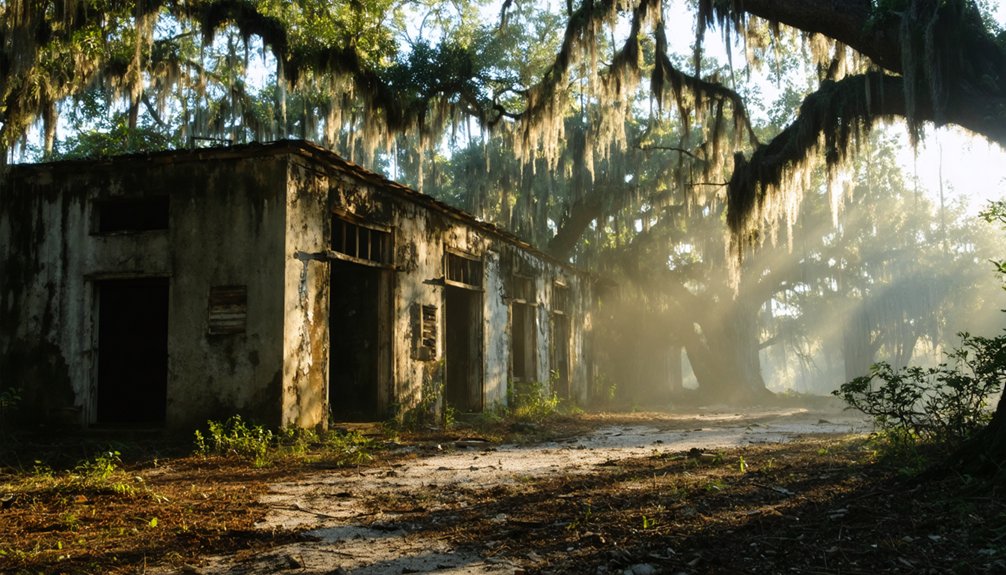
You’ll find Florida’s military ghost towns tell stories of strategic defense and violent conflict that shaped the state’s destiny. Fort Drum emerged as a vital outpost during the Seminole Wars, positioned where military roads converged to control movement through central Florida’s wilderness.
Meanwhile, Olustee’s abandoned settlements bear witness to the Civil War’s bloodiest Florida battle, where Confederate forces clashed with Union troops in 1864, leaving behind communities that never recovered from war’s devastation.
Fort Drum’s Strategic Past
When military planners surveyed the windswept Pine Plains of northern New York in 1908, they recognized terrain that would shape America’s military readiness for generations. Brigadier General Frederick Dent Grant arrived with 10,000 troops, establishing what would become Fort Drum—a cornerstone of defense history.
The region’s military strategy roots stretch back to 1809, when Sackett’s Harbor became the northern frontier’s command center during the War of 1812.
You’ll discover how 750 American defenders repelled British forces in 1813, protecting critical naval operations.
Fort Drum’s evolution showcases America’s expanding military reach:
- 1935’s massive peacetime maneuvers brought 36,500 soldiers across 100 miles of tactical terrain
- Multiple conflicts engaged troops from the Spanish-American War through the Boxer Rebellion
- Continuous training operations maintained strategic readiness throughout peacetime and war
Olustee’s Civil War Legacy
While Fort Drum secured America’s northern frontier, Florida’s interior became the stage for one of the Civil War’s bloodiest single-day engagements. On February 20, 1864, over 10,000 troops clashed near Olustee station in Baker County’s pine forests.
You’ll find where Union forces, including the legendary 54th Massachusetts, fought Confederate defenders in a brutal five-hour battle that claimed 2,807 casualties.
General Truman Seymour’s campaign to sever Rebel supply lines and establish a pro-Union government ended in devastating defeat.
Today, battlefield preservation efforts protect this historic ground where freedom-seeking soldiers, both black and white, shed blood. Visit Olustee Battlefield Historic State Park to walk these hallowed acres where Confederate victory maintained Florida’s interior autonomy until war’s end.
Everglades Ghost Towns: Nature’s Victory Over Human Ambition
The Everglades have reclaimed dozens of ambitious settlements that once dotted Florida’s wetlands, leaving behind scattered foundations and cautionary tales of humanity’s struggle against one of nature’s most unforgiving environments.
Urban decay consumed these communities faster than developers anticipated, while cultural erosion erased their once-vibrant communities from maps and memory.
Nature’s relentless appetite devoured concrete dreams and wooden hopes, leaving only waterlogged whispers where ambition once thrived.
Notable Abandoned Everglades Settlements:
- Flamingo – Settled in 1892 with 38 stilted shacks, this fishing village dwindled to three occupied homes by 1910. Today, only foundation remnants exist 4.5 miles from the current campground.
- Okeelanta – Hurricanes and floods swallowed this planned settlement entirely, creating a ghost town that exemplifies failed Everglades conquest.
- Lost City – Hidden south of Alligator Alley, this legendary three-acre Seminole site allegedly hosted Al Capone’s moonshine operations before vegetation consumed it completely.
Coastal Remnants: From Punta Rassa to Stiltsville’s Underwater Ruins
Long before luxury condominiums transformed Florida’s coastline, Punta Rassa stood as the state’s most essential commercial gateway—a weathered cattle port where Cracker cowboys drove herds across palmetto prairies to waiting ships bound for Cuban markets.
You’ll find little remaining of Jake Summerlin’s empire except wildlife habitats reclaiming abandoned foundations. The 1866 telegraph station—which first relayed news of the USS Maine’s sinking—operated until 1942 before succumbing to coastal erosion.
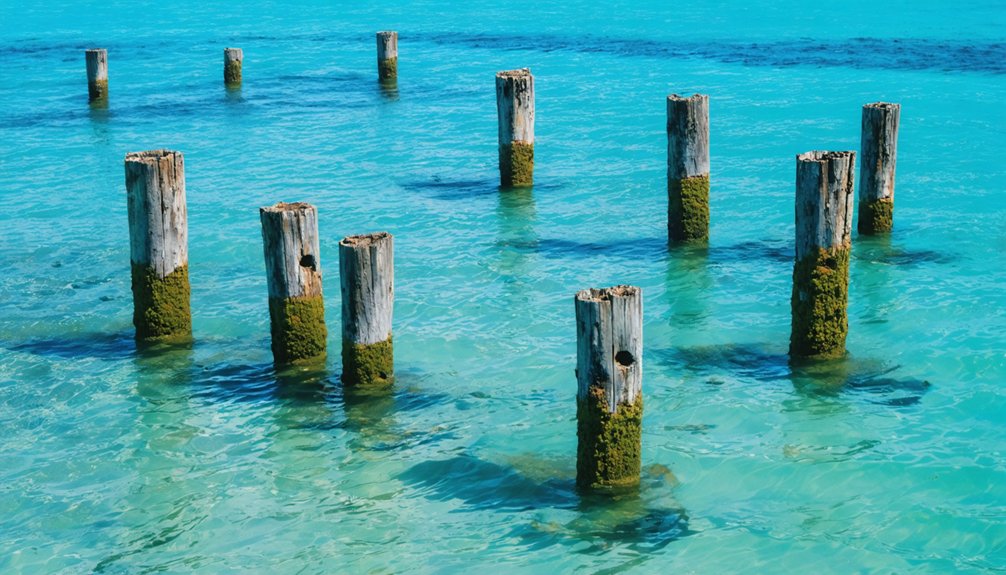
Today, marine archaeology reveals Punta Rassa’s secrets through half-dozen shipwrecks scattered offshore. These underwater ruins mirror Miami’s Stiltsville—another coastal settlement reduced to skeletal pilings.
A solitary guesthouse barge from 1966 marks where the Schultz Hotel once hosted Theodore Roosevelt. Hurricane Ian‘s thirteen-foot surge in 2023 nearly erased what remained of this frontier outpost.
Frequently Asked Questions
Are Guided Tours Available for Florida’s Ghost Towns?
You’ll find excellent guided tours exploring Florida’s haunted historic sites, from Apalachicola to Key West. These experiences blend historical preservation with spine-tingling tales, letting you discover ghostly legends and paranormal hotspots while walking through authentically preserved locations stateped in mystery.
What Should Visitors Bring When Exploring Abandoned Florida Settlements?
You’ll need sturdy boots, water, bug spray, and navigation tools while respecting history preservation at abandoned sites. Take essential safety precautions like sunscreen, first-aid supplies, and trail maps to explore Florida’s forgotten settlements responsibly and independently.
Which Ghost Towns Require Special Permits or Permissions to Visit?
Don’t let red tape trap you—Castillo de San Marcos, Egmont Key, and Old St. Augustine Jail require permitted access through reservations or special credentials. Skipping authorization risks illegal trespassing charges, so you’ll need advance booking for these restricted paranormal hotspots.
Are Any Florida Ghost Towns Dangerous to Explore Alone?
Yes, several Florida ghost towns pose serious dangers for solo urban exploration. You’ll need essential safety precautions at Fort Dade (boat-only access), Okeelanta (Everglades wildlife), and Olustee (unexploded ordnance). Always bring companions and proper gear.
What Is the Best Time of Year to Visit Florida Ghost Towns?
Visit Florida ghost towns during spring or fall when you’ll enjoy mild temperatures perfect for exploring historical preservation sites. These seasons offer fewer crowds, letting you freely discover local legends without summer’s oppressive heat or hurricane risks.
References
- https://www.florida-backroads-travel.com/florida-ghost-towns.html
- https://www.ghosttowns.com/states/fl/fl.html
- https://www.youtube.com/watch?v=-vPPooDMJ5U
- https://www.atlasobscura.com/things-to-do/florida/ghost-towns
- https://www.timeout.com/florida/florida-ghost-towns
- https://patchproflorida.com/blog/the-fascinating-history-of-floridas-ghost-towns/
- https://floridatrailblazer.com/tag/ghost-towns/
- https://floridaseminoletourism.com/a-dark-history-at-egmont-key/
- https://www.legendsofamerica.com/fort-dade-egmont-key/
- https://www.floridastateparks.org/learn/history-egmont-key