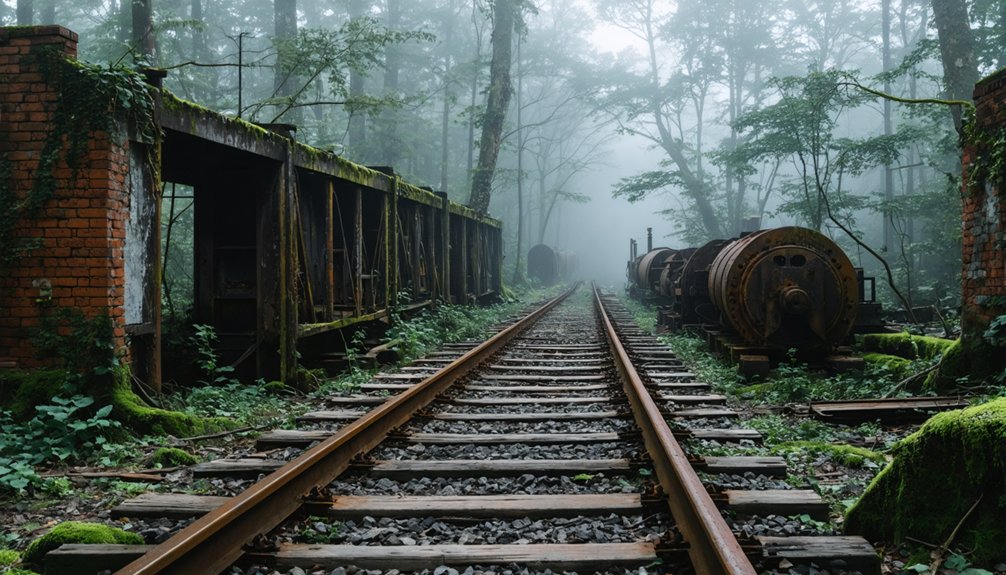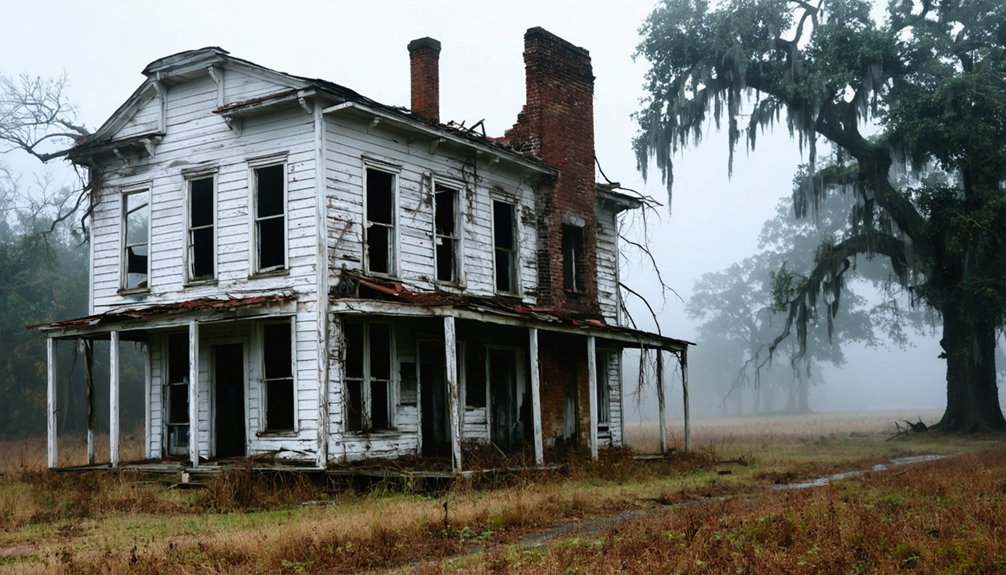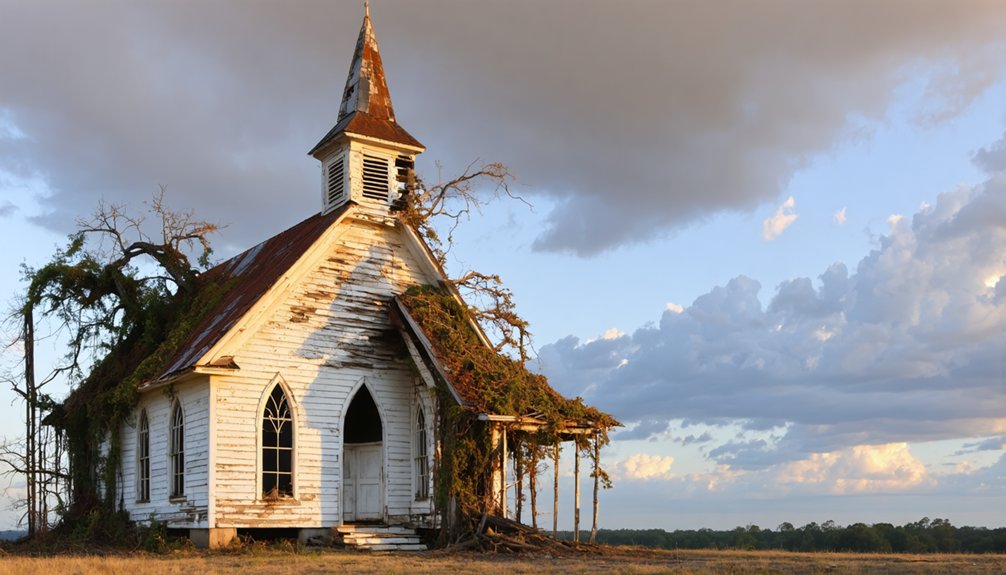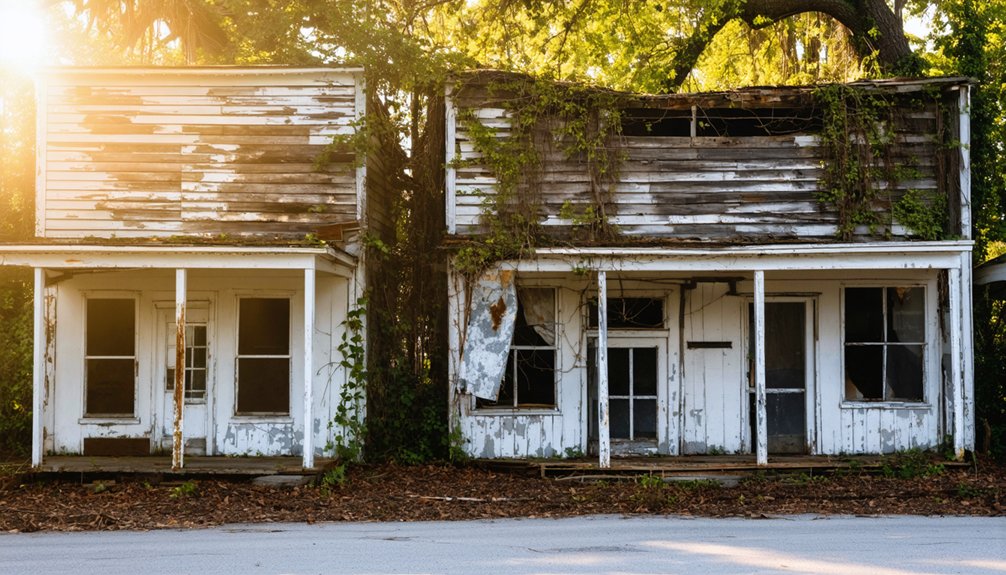
You’ll find Georgia’s most compelling ghost towns scattered across the Piedmont and coastal plains—Wrightsboro’s Quaker stone walls standing along Middle Creek, Scull Shoals’ paper mill ruins beside the Oconee River, and Auraria’s gold rush remnants in the northern hills. Sunbury’s colonial earthworks overlook the Medway, while Ebenezer’s centuries-old church still welcomes worshippers. Each site offers crumbling foundations, overgrown cemeteries, and tangible connections to communities that thrived before economic shifts, floods, and bypassed railroads reclaimed them. The stories behind these weathered structures reveal much deeper truths about Georgia’s past.
Key Takeaways
- Scull Shoals features Georgia’s first paper mill ruins along the Oconee River, with visible stone foundations and primitive camping opportunities.
- Wrightsboro offers Quaker town architecture, including the Rock House, 1810-1812 church, and historic cemeteries from its revolutionary-era founding.
- Auraria marks Georgia’s first gold rush site (1828), once supporting 10,000 miners and producing $20 million in gold.
- Sunbury showcases Fort Morris earthwork fortifications and colonial remains from Georgia’s second-largest 18th-century port town.
- Apalachee displays cotton-era remnants including brick walls, crumbling warehouses, and an active 1857 Baptist Church still serving visitors.
Wrightsboro: Georgia’s Southernmost Quaker Settlement
You’ll find remnants of their compact town plan along Middle Creek—Quaker architecture evident in the Rock House‘s thick stone walls and the 1810-1812 church building.
Their principled nonviolence proved costly during the Revolution, when Patriot raiders burned homes and killed dozens.
The community’s anti-slavery stance ultimately led most Quakers to migrate north to Ohio and Indiana between 1805-1809, as neighboring farms prospered through enslaved labor.
The town thrived in the early 19th century with a general store and school, but decline accelerated when the railroad bypassed Wrightsboro in favor of Thomson during the 1830s.
Scull Shoals: Home to Georgia’s First Paper Mill
Where Middle Georgia’s piedmont hills descend to the Oconee River, stone foundations and crumbling mill races mark what was once the state’s most innovative industrial settlement.
You’ll discover Scull Shoals through a four-mile trail winding past ruins of Georgia’s first paper mill, chartered in 1817. This industrial archaeology site reveals how entrepreneurs harnessed waterpower to transform cotton rags into currency and newspapers, employing up to 100 workers at its 1830s peak.
The town thrived as a trading hub until floods and railroad bypasses triggered its abandonment by the early 1900s. Today’s heritage preservation efforts maintain interpretive signs among the scattered stone walls where 500 residents once lived.
You’re free to explore these remnants, camp primitively, and contemplate innovation’s impermanence beneath Georgia pines.
Auraria: A Gold Rush Town Frozen in Time
You’ll find Georgia’s first gold rush didn’t happen in California—it exploded here in 1828 at Calhoun Mine, drawing thousands to the boomtown of Auraria nearly two decades before western prospectors struck it rich.
Walk the remains of Gold Diggers’ Road today, and you’ll see crumbling buildings where 4,000 residents once lived, worked, and extracted $20 million in gold from Cherokee land.
This ghost town‘s rapid collapse mirrors its meteoric rise: from wilderness to thriving city in six years, then abandoned to silence when California’s glitter proved irresistible in 1849. Among the town’s colorful characters was Grandma Paschal, known as the “Angel of Auraria,” who ran a no-liquor tavern and served as the community’s unofficial nurse. The town’s legacy extended westward in 1858 when the Russell boys from Auraria established a new settlement near Cherry Creek that would eventually become Denver, Colorado.
Georgia’s First Gold Rush
Twenty years before California’s famous forty-niners struck it rich, prospectors flooded into the North Georgia mountains with nothing but pans, pickaxes, and dreams of fortune. When gold surfaced near Auraria in 1828, it ignited America’s first major gold rush.
By 1832, this instant boomtown swelled to 1,000 souls, supporting up to 10,000 miners along the Chestatee and Etowah rivers.
The Georgia Gold Belt yielded $20 million between 1829 and 1839, attracting fortune-seekers who’d later carry their expertise to Colorado and California. Experienced Georgia miners, including William Greeneberry Russell, led expeditions to Colorado in 1858, where they established placer mining operations along the South Platte River. Miners struggled to convert their raw gold into currency, often accepting discounts at local establishments or relying on private coiners like Templeton Reid who issued $2, $5, and $10 gold pieces. Today, ghost town mysteries linger among Auraria’s scattered ruins, where urban legends speak of hidden veins still waiting beneath the red clay.
The rush that displaced the Cherokee and birthed the Dahlonega Mint now rests silent in the pines.
Abandoned Structures and Remnants
Along the dusty stretch of Gold Diggers’ Road, weathered frames and crumbling stone foundations mark where Auraria’s dreams collapsed into silence. You’ll find Grandma Paschal’s hotel, where U.S. Mint officials once debated currency over dinner, now surrendering to structural decay.
Nathaniel Nuckolls’ tavern stands hollow, its walls echoing with phantom toasts from fortune-seekers who’ve long departed.
The ridge between the Chestatee and Etowah Rivers holds these forgotten hulks—William Dean’s cabin, John Ware’s confectionery building—each structure whispering tales of America’s first true gold rush.
While artifacts preservation efforts through Vanishing Georgia photographs capture what remains, nature claims more territory daily.
The Calhoun Mine, operational until 1939, represents the town’s stubborn persistence. Among the surviving landmarks, Woodys Store stands as an iconic though shuttered monument, its doors closed since the 1980s.
These ruins aren’t just relics—they’re testament to unrestrained ambition. The town’s legacy extends beyond Georgia’s borders, as William Greeneberry Russell led settlers from Auraria to Colorado in 1858, establishing another mining town bearing the same name.
Economic Decline and Legacy
When gold fever gripped Auraria in 1829, nobody imagined the boom would collapse within two decades. You’ll find the town’s downfall stemmed from three crushing blows: political rejection when Dahlonega claimed the county seat in 1833, mineral scarcity as placer deposits vanished by 1840, and the catastrophic population migration to California in 1849.
Within days of news reaching Georgia, 4,000 residents dwindled to under 300. The exodus wasn’t just local—Auraria miners carried their expertise west, founding Colorado’s Auraria (now Denver) and influencing rushes from Pike’s Peak to Alaska.
Between 1829 and 1839, $20 million in gold flowed from Cherokee country, yet today you’ll walk through America’s first ghost town, a haunting testament to fortune’s fleeting nature. During its heyday, the town’s rowdy character mirrored Wild West boomtowns, complete with numerous saloons and legally permitted gambling establishments. The site was declared a national historic site, preserving its legacy as the nation’s inaugural abandoned mining settlement.
Sunbury: Colonial Port on the Medway River
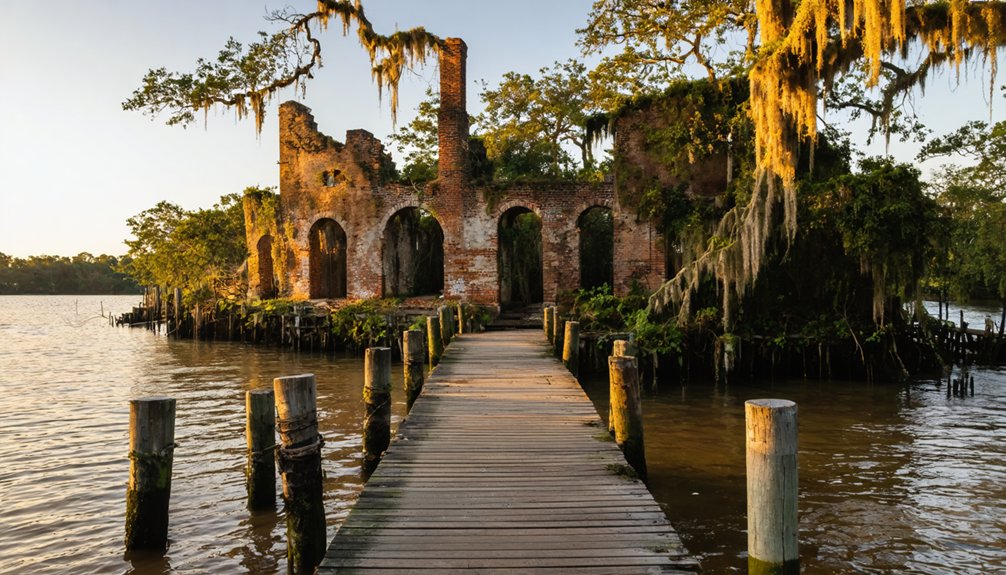
Founded in 1758 on the Medway River’s marshy banks, Sunbury rose from coastal wilderness to become colonial Georgia’s second-largest town in less than two decades.
This Colonial Port rivaled Savannah itself, with 56 vessels clearing its wharves in 1772 alone.
You’ll find three Declaration signers connected to this independent-spirited settlement, including Dr. Lyman Hall who owned riverfront lots.
Fort Morris anchored Sunbury’s defenses, where patriots famously repelled British demands in 1778.
Today you can explore:
- Earthwork fortifications overlooking Saint Catherines Sound
- Museum exhibits documenting the garrison’s 200 defenders
- Walking trails through abandoned town sites along the Medway River
Revolutionary warfare ultimately destroyed what prosperity had built, leaving only haunting remnants of Georgia’s once-thriving port.
Ebenezer: a Preserved Historic Landmark With Active Heritage
Unlike most Georgian ghost towns crumbling into forgotten marshland, Ebenezer persists as a living monument to religious freedom and immigrant determination. You’ll find the Jerusalem Evangelical Lutheran Church—Georgia’s oldest church building—still hosting weekly services for America’s oldest continuous Lutheran congregation, a remarkable feat of cultural preservation spanning nearly three centuries.
Founded in 1734 by Salzburger Protestant refugees fleeing Austrian persecution, this settlement relocated twice before establishing its lasting footprint at Red Bluff. Though the Revolutionary War left it devastated and abandonment followed in 1855, heritage tourism now breathes new life into these hallowed grounds.
Visit during Labor Day or March 12 Landing Day when the Georgia Salzburger Society opens both sites. You’re walking where refugees built their utopia, rejecting slavery while establishing thriving silk mills and Indian trade routes.
Apalachee: Greene County’s Forgotten Village
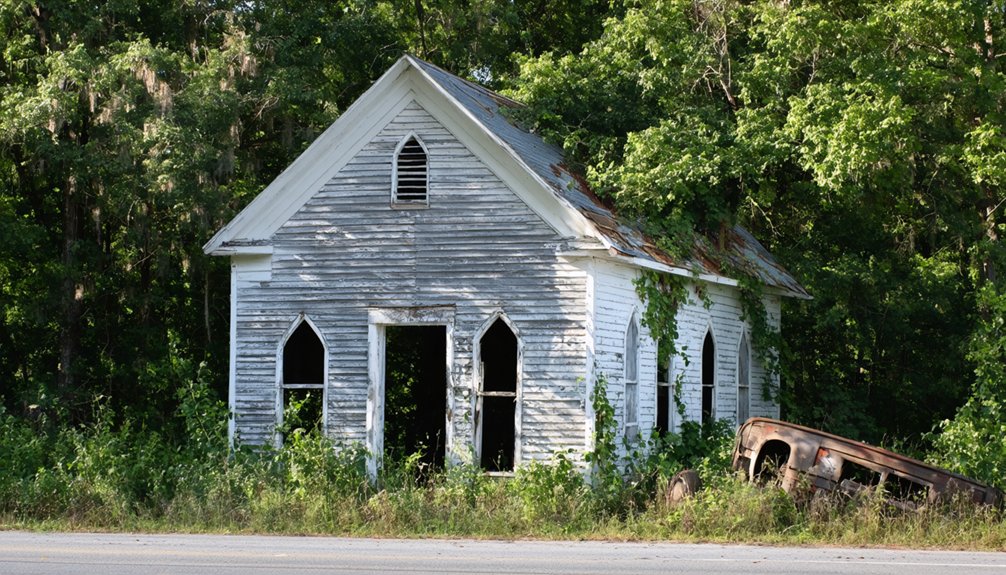
You’ll find Apalachee scattered across the landscape where Greene and Morgan Counties meet. Its origins reach back before 1820 when pioneers first cleared land near the Oconee River.
The town that once bustled with cotton gins, general stores, and the Florence Depot now exists primarily in crumbling schoolhouse walls and overgrown railroad beds. What remains tells the story of a community that thrived for a century before slipping into obscurity, leaving behind only fragments for those willing to search the woods and fields.
Historical Significance and Origins
Nestled in what would become Greene County, the settlement that locals first knew as Dogsboro emerged around 1820 as one of the region’s earliest communities.
The railroad‘s 1888 arrival transformed everything, prompting a name change to Florence after settler Joe C. Few’s daughter.
By 1896, you’d find it rechristened Apalachee—borrowed from the nearby river and its indigenous heritage—after discovering another Georgian Florence already existed.
The town’s evolution reflected three distinct phases of community governance:
- Dogsboro era (1820-1888): Informal settlement without official incorporation
- Florence period (1888-1896): Railroad-driven growth and identity shifts
- Apalachee incorporation (1907): Formal recognition by Georgia’s General Assembly
This agricultural legacy centered on cotton prosperity, establishing Apalachee as a commercial hub complete with gins, warehouses, and thriving cultural societies that celebrated the independent spirit of rural Georgian life.
Current State of Ruins
Today, Apalachee exists as scattered brick walls and crumbling foundations reclaimed by Georgia’s forest, a stark contrast to its once-bustling identity as a commercial center. You’ll find three standing walls of the 1846 warehouse and an arched bridge that once carried workers across the raceway—though flooding often obscures these remnants.
The industrial archaeology tells a sobering story of environmental degradation: fourteen feet of silt from 19th-century cotton farming buried the original rapids that powered these mills. Stone pilings pierce the Oconee River when water levels drop, while chimney bases hide throughout the woods.
The Forest Service manages this historic recreation area, but enforcement against metal detecting remains questionable, leaving these ruins vulnerable to those who’d strip history for profit.
Visiting the Abandoned Site
Finding Apalachee requires intent—this isn’t a place you stumble upon accidentally. Located north of Madison along Highway 441, this quiet corner of Morgan County rewards those seeking industrial archaeology off the beaten path.
You’ll discover:
- The 1857 Baptist Church – Still standing as the community’s spiritual anchor.
- Railroad corridor remnants – Where two lines once converged for cotton transport.
- Historic marker – Placed in 2007, documenting the settlement’s pre-1820 roots.
The landscape whispers stories of bustling cotton gins and three general stores that once defined prosperity here.
Community preservation efforts maintain memory through these scattered landmarks.
Today’s poultry farms and hay fields blanket what Dogsborough’s pioneers carved from wilderness, offering solitude for those who value independence over crowds.
What to Expect When Exploring Georgia’s Abandoned Towns
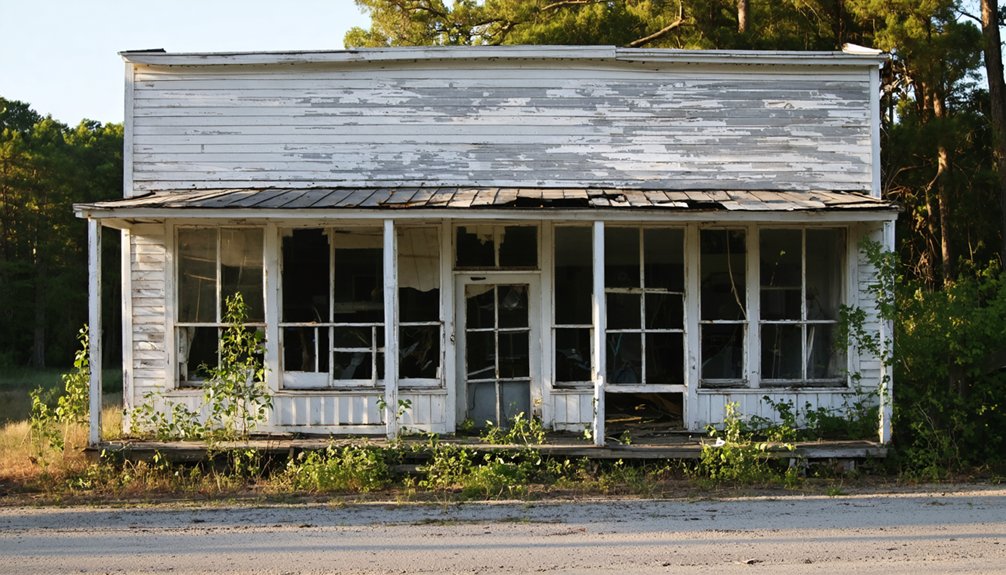
When you step into Georgia’s abandoned towns, you’ll encounter a striking duality—ornate facades crumbling into ruin while nature patiently reclaims what humans left behind. Graffiti-covered walls and vine-wrapped structures create an atmosphere thick with isolation and eerie silence.
You’ll navigate multiple levels of decaying sanatoriums, tread carefully through factory ruins, and discover churches surrendering to the forest. The overgrown vegetation conceals hazards beneath your feet while masking the true extent of structural decay.
Urban legends and haunted legends permeate these spaces—whispers echo through empty corridors, unexplained footsteps follow you, doors slam without cause. Some believe spirits linger, trapped by unfinished business.
Whether you’re drawn by historical curiosity or supernatural intrigue, these sites demand respect. You’re exploring at your own risk, where isolation amplifies every sound and crumbling roofs threaten without warning.
Best Practices for Visiting Ghost Town Sites
Before you venture into Georgia’s ghost towns, equipping yourself properly can mean the difference between a memorable expedition and a dangerous mishap. You’ll need sturdy closed-toe shoes for traversing crumbling foundations and cobblestones, plus a reliable flashlight to illuminate dim interiors where hazards lurk.
Proper gear—sturdy footwear and dependable lighting—separates successful ghost town exploration from potential disaster in Georgia’s crumbling historic sites.
Essential preparation includes:
- Share your itinerary with trusted contacts and carry a fully charged phone
- Secure travel insurance covering accidents in remote locations
- Pack water to combat Georgia’s humid conditions
Respect community guidelines by following marked paths and tour protocols—unauthorized exploration damages these fragile sites.
Photography etiquette demands silence at sensitive locations; lower your voice and pocket distractions.
Travel during daylight hours with companions, trust your instincts when situations feel wrong, and remember: these decaying structures tell stories worth preserving through responsible exploration.
Preserving History: The Importance of Georgia’s Ghost Towns
Georgia’s ghost towns stand as tangible witnesses to the state’s turbulent past, their weathered structures preserving stories that textbooks alone can’t convey. You’ll discover archaeological excavations revealing foundations of America’s first paper mill at Scull Shoals, where factory walls emerge from overgrown vegetation.
Among these remnants, you’ll find abandoned towns in Georgia’s history that once thrived with industry and community. Each site offers a glimpse into the lives of those who called these places home, leaving behind artifacts and memories waiting to be uncovered. Exploring these ghost towns can ignite a sense of wonder, as you walk the same paths that generations before once traveled.
Revolutionary War-era cemeteries at Wrightsboro connect you to Quaker settlers who defied convention, while Auraria’s crumbling hulks along Gold Diggers’ Road whisper of fortune-seekers’ dreams.
These sites steeped in folklore legends offer more than nostalgia—they’re laboratories of human ambition and failure.
New Ebenezer’s utopian experiment, Constitution’s defiant 1911 ordinance against cemetery development, and bridges spanning forgotten trade routes remind you that perseverance leaves marks. Preservation protects your right to explore authentic histories without sanitized narratives controlling the experience.
Frequently Asked Questions
Are Guided Tours Available for Georgia’s Ghost Towns?
Yes, you’ll find guided tours exploring Georgia’s ghost towns, where historical preservation meets local legends. These experiences let you wander freely through abandoned sites while uncovering haunting tales, paranormal activity, and forgotten stories that shaped the state’s mysterious past.
As the sun sets, the haunting beauty of ghost towns comes alive, casting long shadows that whisper secrets of days gone by. Each corner reveals remnants of architecture that tell stories of resilience and loss, inviting you to ponder the lives once led in these now-silent streets. Exploring these forgotten places offers not just a glimpse into history but a chance to connect with the spirit of the past that still lingers in the air.
What Is the Best Time of Year to Visit These Abandoned Sites?
Fall offers you the finest conditions—crisp air between 55°F and 75°F enhances historical preservation efforts while vibrant foliage creates stunning photography opportunities. You’ll find fewer crowds restricting your exploration, and comfortable temperatures let you document these forgotten places thoroughly.
Do I Need Special Permits to Explore Ghost Town Properties?
You’ll typically need permits for structured exploration, especially on state lands or archaeological sites. Legal considerations protect these fragile spaces, while preservation efforts guarantee future generations can experience their haunting beauty. Always respect posted boundaries and obtain proper authorization.
Are Ghost Towns in Georgia Safe for Children to Visit?
Ghost towns can be safe for children if you’re careful. Watch for unstable structures and debris. Haunted legends add excitement, but preservation efforts often mean restricted access. You’ll need to supervise kids closely and respect posted warnings throughout your exploration.
Can I Camp Overnight Near Any of These Historic Locations?
You’ll need to camp at nearby Georgia State Parks rather than directly at ghost town sites. Historic preservation rules protect these locations, while designated campgrounds guarantee camping safety with proper facilities, following Leave No Trace principles you’d expect.
Exploring ghost towns in Georgia offers a unique glimpse into the past, showcasing the remnants of vibrant communities that once thrived. As you journey through these eerie landscapes, you’ll discover intriguing stories behind the buildings and the lives of those who once inhabited them. Make sure to pack your camera to capture the haunting beauty and atmosphere of these forgotten places.
As you venture into these abandoned towns in Georgia, each step brings you closer to understanding the history that shaped these areas. Some locations even hold local legends that add to their mystique, making exploration an adventure filled with surprises. Don’t forget to check out the nearby trails where you can witness nature slowly reclaiming these once-bustling sites.
References
- https://freepages.rootsweb.com/~gtusa/history/usa/ga.htm
- https://roughdraftatlanta.com/2021/05/23/travels-with-charlie-georgias-ghost-towns-slideshow/
- https://www.ghosttowns.com/states/ga/ga.html
- https://www.ezhomesearch.com/blog/ghost-towns-in-georgia/
- https://www.geotab.com/ghost-towns/
- https://vanishinggeorgia.com/tag/georgia-ghost-towns/
- https://www.freakyfoottours.com/us/georgia/
- https://www.youtube.com/watch?v=OfhPAHTOkJE
- https://theforgottensouth.com/quaker-rock-house-georgia/
- https://theclio.com/entry/26703