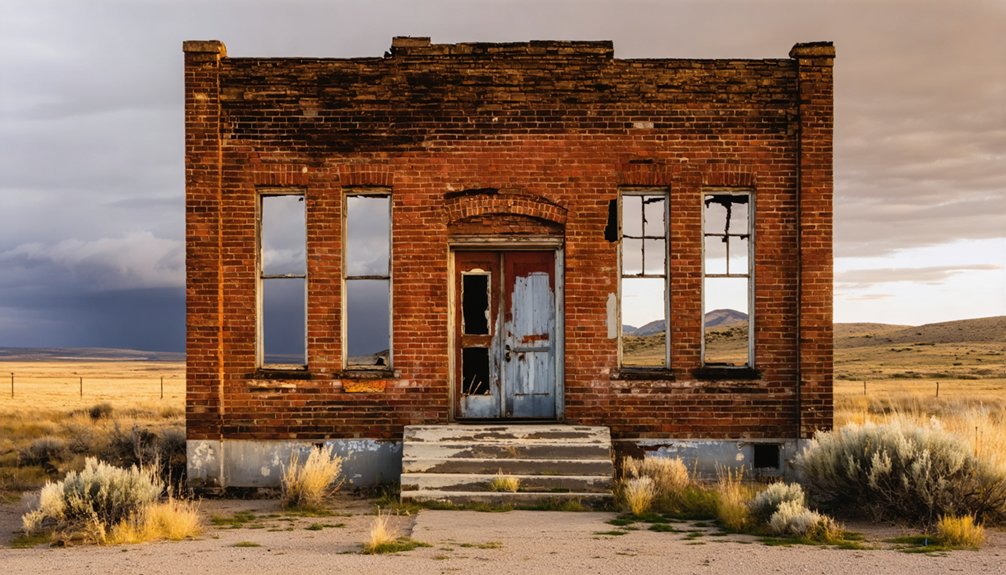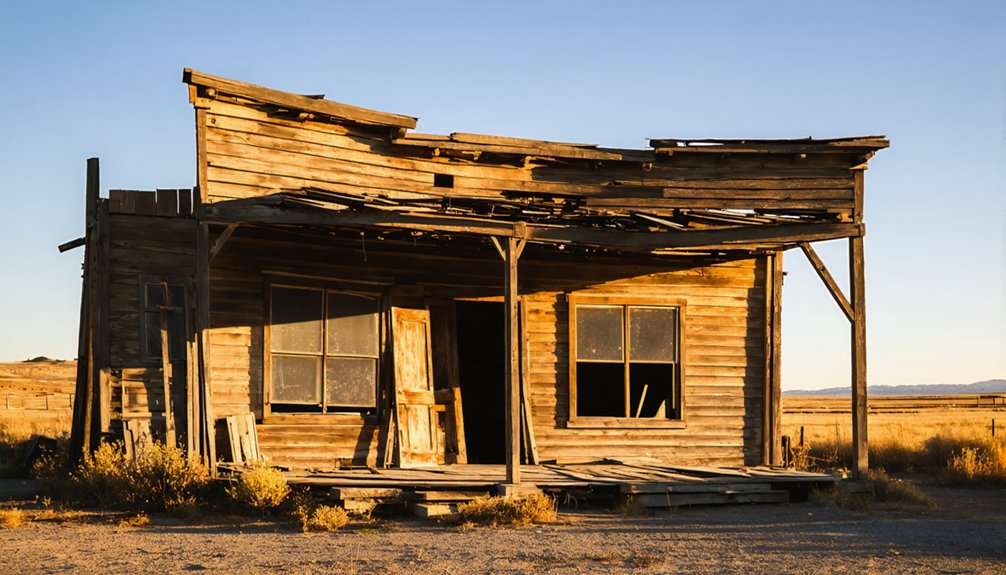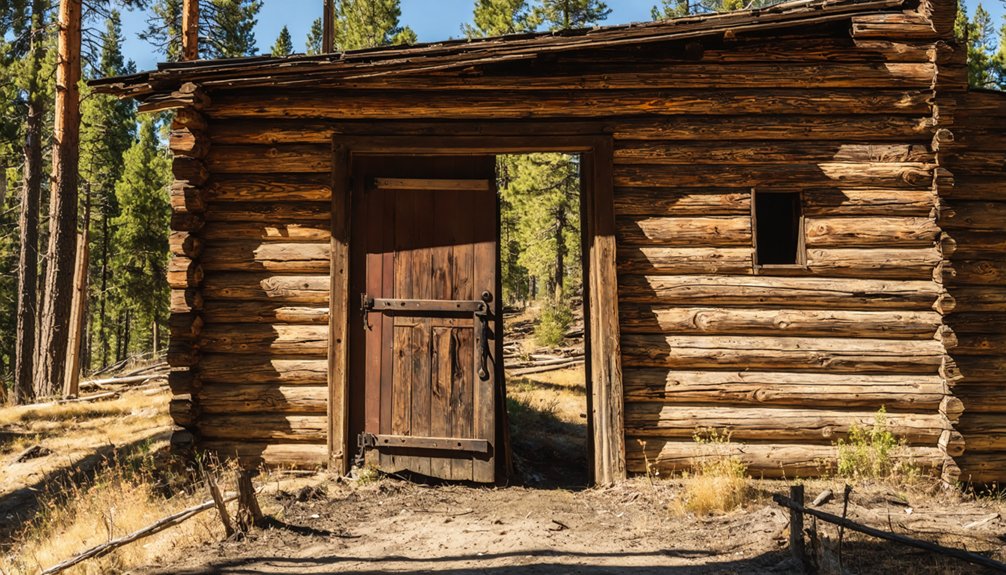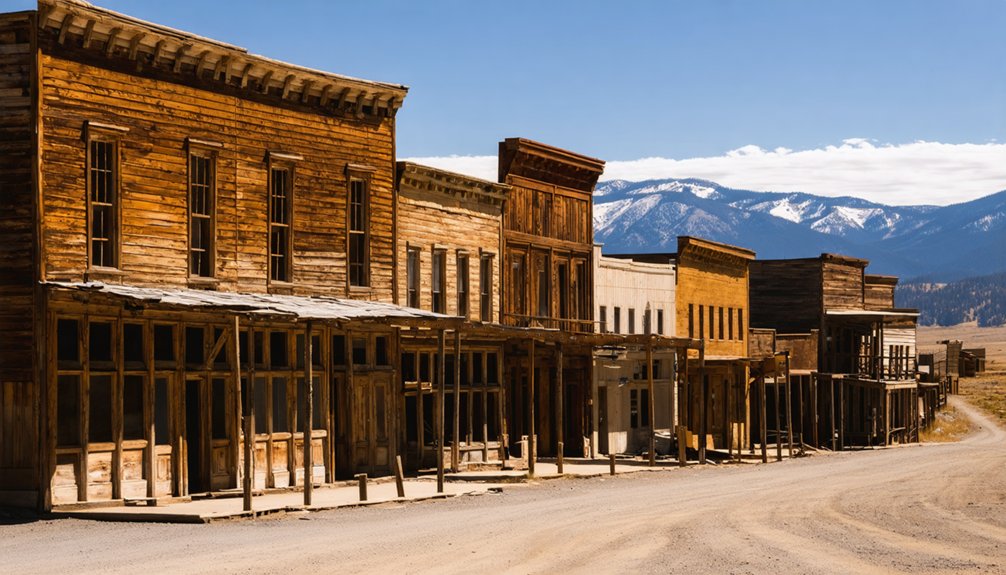
You’ll find Idaho’s most impressive ghost towns scattered across remote mountain canyons and high desert valleys. Silver City, perched at 6,000 feet in the Owyhee Mountains, showcases 70 original 1860s buildings and is considered America’s best-preserved mining settlement. Custer and Bayhorse in the Land of Yankee Fork State Park offer remarkably intact stamp mills and weathered cabins from $12 million gold rushes. For something different, Chesterfield presents a pioneer Mormon colony founded in 1879. Each site reveals authentic frontier architecture, hand-hewn structures, and the stories behind Idaho’s $100 million mining legacy waiting just beyond the next turn.
Key Takeaways
- Silver City, Idaho’s most impressive ghost town, features 70-75 original 1860s structures at 6,000 feet in the Owyhee Mountains.
- Custer and Yankee Fork preserve buildings from an 1870s gold rush, including a school, jail, and Chinese district remnants.
- Bayhorse Ghost Town contains an intact stamp mill, charcoal kilns, and original log cabins protected since 1976.
- Bonanza flourished during the 1881 silver boom with 600 residents before fires caused relocation to nearby Custer.
- Chesterfield, founded in 1879, is Idaho’s best-preserved Mormon ghost town with substantial pioneer architecture and public buildings.
Silver City: Idaho’s Largest and Most Famous Ghost Town
Perched at 6,000 feet in Idaho’s rugged Owyhee Mountains, Silver City stands as the state’s most impressive ghost town—a weathered proof to the frantic silver rush that transformed this remote canyon into one of Idaho Territory’s major cities.
You’ll discover 70-75 original structures from the 1860s, including an 1869 Masonic Lodge and the seasonally-operated Idaho Hotel. This historic preservation effort has earned Silver City recognition as America’s best-preserved ghost town, protecting $60 million worth of mining history.
This rich history once supported 2,500 residents and 75 businesses. The settlement began in 1864 after prospectors discovered deposits that yielded $2,800 in gold and $7,000 in silver per ton. Among tourist attractions, you can explore nearly a dozen cemeteries and mining tunnels stretching 70 miles underground. Silver City was the first in Idaho Territory to establish a daily newspaper, telegraph, electricity, and telephone services.
Visit during the September open house when about 60 seasonal families open their privately-owned buildings for self-guided exploration.
Custer and the Yankee Fork Gold Rush Legacy
You’ll find Custer nestled in the mountains where Jordan’s 1870 expedition sparked a rush that ultimately produced over $12 million in precious metals, with this single town contributing more than half that fortune.
The ghost town’s weathered structures stand as reminders of the boom years when its massive mill surpassed even the famous Charles Dickens mine, pushing 1881 production past the million-dollar mark.
Just downstream, you can tour the 988-ton Yankee Fork Gold Dredge—a four-story behemoth that chewed through 5.5 miles of streambed between 1940 and 1952, leaving behind serpentine tailings that permanently reshaped the landscape. Measuring 112 feet long, 54 feet wide, and 64 feet high, this self-powered giant served as Idaho’s largest dredge operation before ceasing work when available mining claims ran out. The operation extracted over $1 million in gold from the land during its years of continuous service.
Custer’s Gold Rush History
When prospectors struck gold along the Yankee Fork in 1867, they couldn’t have imagined the boom town that would rise here a decade later.
You’ll find Custer’s origins trace to 1879, when speculators laid out streets for the General Custer Mill.
Mining techniques evolved rapidly—a 3,200-foot aerial tram hauled ore to a 20-stamp steam-powered mill that crushed dreams and fortunes alike.
Town infrastructure stretched half a mile along one dusty street: schoolhouse, jail, Miner’s Union Hall, even a baseball team.
By 1896, 600 souls called this place home, with the Lucky Boy Mine employing 130 men.
But freedom comes with risk—the mines played out by 1910, leaving weathered saloons and silent residences.
Among Custer’s diverse population, 49 Chinese residents lived in their own district complete with laundry, shops, and a joss house where they celebrated Chinese New Year.
Devastating fires in 1889 and 1897 forced many Bonanza businesses to relocate here, swelling Custer’s commercial district before its inevitable decline.
Today, you can walk among these preserved buildings, touching the rough-hewn logs where fortune-seekers once staked everything.
Yankee Fork Dredge Tours
Between the ghost towns of Custer and Bonanza, a rusting behemoth sits marooned in the Yankee Fork River—988 tons of industrial ambition that once clawed through riverbeds 24 hours a day. You’ll find this old dredge standing 64 feet tall, its 72 buckets frozen mid-scoop since 1953.
From Memorial Day through Labor Day, volunteer docents—many descendants of original workers—guide tours through the mining machinery for just $5. You’ll walk the same decks where crews extracted $11 million in gold and silver, processing gravel through separation systems that ran continuously during WWII until government restrictions shut it down.
The surrounding landscape tells its own story: five and a half miles of tailings snake along the Yankee Fork, *testament* to the dredge’s relentless appetite for precious metal. The Snake River Mining Dredge operated as a subsidiary of the Silas Mason Company, which brought the massive machinery to life in October 1939 after years of coordinating efforts to revive the area’s mining operations. Two Ingersoll-Rand diesel engines, each producing 350 horsepower, powered the buckets that transformed this remote Idaho valley into an industrial mining operation.
Bayhorse: A Remarkably Preserved Mining Mill Site
Tucked into a narrow canyon along Bay Horse Creek, this weathered mining settlement stands as one of Idaho’s most intact ghost town sites, where you can still walk past the skeletal remains of a massive stamp mill clinging to the hillside.
A weathered stamp mill clings to the hillside, its skeletal remains standing as testament to Idaho’s silver mining legacy.
The 1880 smelter once processed thirty tons of ore daily, producing eighty tons of bullion monthly before shutting down in 1889.
You’ll find charcoal kilns, mining equipment, and foundations scattered along the main dirt street—tangible evidence of $10 million extracted from these mountains.
The town’s name traces back to a prospector working between Clayton and Challis who used bay horses, though fellow miners couldn’t recall his actual name.
Idaho’s preservation efforts since 1976 have protected this National Register site, which became part of Land of the Yankee Fork State Park in 2006.
The mining technology visible here reveals how remote nineteenth-century operations transformed raw ore into pure silver bars worth millions.
Several original log cabins and frame houses remain standing, some featuring exterior staircases that provided access to second-floor living quarters.
Bonanza and the Silver Boom Era
When you stand among Bonanza’s weathered wooden frames and crumbling foundations, you’re walking through what was once a thriving settlement of 600 souls chasing silver fortunes in 1881.
The town’s skeletal remains tell the story of Idaho’s silver boom—from the General Custer Mine’s discovery in 1877 to the devastating fires that sent residents fleeing to neighboring Custer by 1910.
Just half a mile north, you’ll find the massive Yankee Fork Gold Dredge, a later addition from 1939 that you can tour to see the industrial mechanisms that pulled over $1 million in gold from these mountain streams.
Bonanza’s Silver Mining History
The story of Bonanza began with a flash of gold along Yankee Fork’s tributary near Jordan Creek in 1870, though the real treasure lay hidden for five more years. When William Norton’s pickaxe struck silver in July 1875, he’d hand-dig $20,000 worth of ore alongside partner John Rohrer.
By spring 1877, the Ramshorn mine emerged as the district’s heavyweight producer.
Mining technologies that transformed Bonanza:
- Water-propelled smelter processing 30+ tons daily by 1880
- Bayhorse Smelter churning out 80 tons of bullion monthly
- 1885 refinery enabling pure silver bar shipments
Town architecture reflected frontier practicality—hand-hewn log structures topped with shake roofs. Charles Franklin platted lots selling for $40-$300, and miners built quickly.
The saloon went up first, naturally, drawing prospectors from across the region.
Exploring the Town Today
Local preservation efforts through Land of Yankee Fork State Park maintain this ghost town’s accessibility. Half a mile north, you can explore massive gold dredge machinery that extracted $11 million in gold between 1939-1952.
Walk the original town layout where Charles Franklin once sold lots for $40-$300, and you’ll experience authentic remnants of Idaho’s mining frontier without modern commercialization obscuring the raw historical reality.
Gilmore and Lemhi County’s Mining Heritage
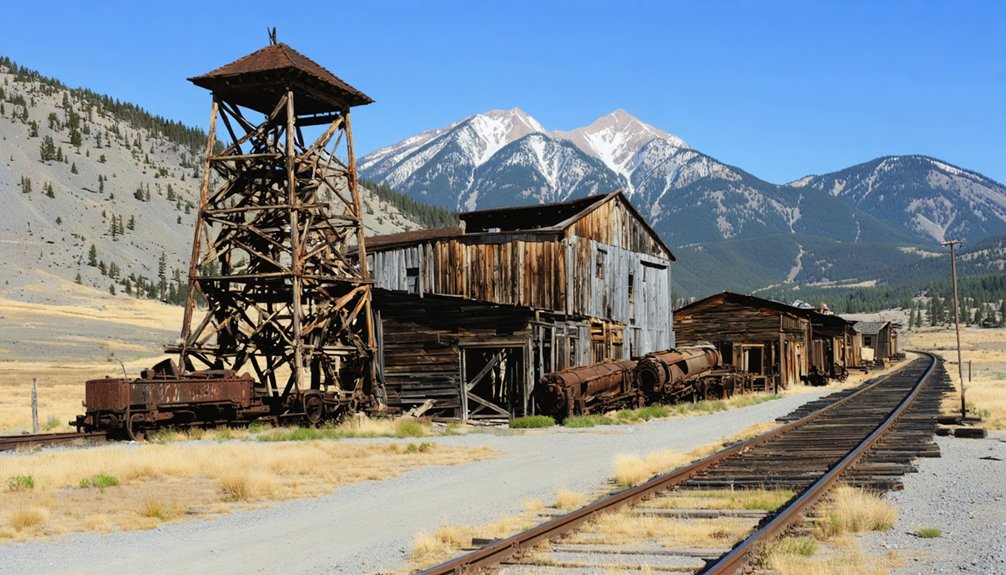
The Texas Mining District’s legacy unfolds through:
- The Gilmore & Pittsburgh Railroad (1910) – Engineering marvel connecting isolated mines to Montana markets, finally making large-scale operations viable.
- Peak production figures – 7,750 tons of lead and 351,500 ounces of silver shipped in fiscal year 1910-1911 alone.
- The Hilltop Mine’s 48-year run – Extracting $11 million worth of ore from 1915-1963.
Ghost town preservation efforts now protect what remains of this hard-won heritage, where independence and determination built empires against impossible odds.
Chesterfield: A Pioneer Mormon Settlement
Chester Call and Christian Nelson carved this colony from nothing in 1879, building substantial I-houses and public buildings that showcase remarkable pioneer architecture.
The LDS meetinghouse, tithing office, and amusement hall demonstrate craftsmanship that survived where modern construction often fails.
Thanks to the Chesterfield Foundation‘s historic preservation efforts since 1979, you can explore this ghost town Memorial Day through Labor Day.
It’s Idaho’s best-preserved Mormon settlement—authentic, unvarnished, and distinctly invigorating.
Frequently Asked Questions
Are Idaho’s Ghost Towns Safe to Explore With Children?
Idaho’s ghost towns aren’t safe for unrestricted child exploration. You’ll find dangerous mine shafts, lead contamination, and unstable structures. For family safety while respecting historical preservation, stick to guided tours at managed sites like Custer, where established paths protect both visitors and artifacts.
For those interested in exploring the remnants of the Wild West, historic ghost towns in Idaho offer a glimpse into the past. These towns, like Silver City and Rocky Bar, are rich in stories and history, attracting visitors who appreciate their unique charm. While it’s tempting to wander freely, adhering to safety guidelines is essential to ensure an enjoyable experience.
For those looking for more adventure, ghost towns to explore in Idaho can reveal hidden treasures and fascinating tales of the past. Each site has its own story, from bustling silver mines to quiet streets left behind by once-thriving communities. Be sure to bring a camera; the haunting beauty of these abandoned places makes for perfect photo opportunities while you respect their history.
What Is the Best Time of Year to Visit Ghost Towns?
When nature’s less hospitable moods subside, late spring through early fall offers you ideal seasonal weather for ghost town adventures. You’ll capture stunning photography opportunities amid preserved buildings, navigate accessible roads freely, and explore historic sites without winter’s constraints limiting your journey.
Do I Need a Four-Wheel-Drive Vehicle to Reach These Locations?
Vehicle requirements vary by location. You’ll manage fine with a standard car for Placerville and Gilmore, but road conditions at Silver City and Rocky Bar improve considerably with four-wheel-drive, especially during unpredictable weather seasons.
Are There Camping Facilities Near Idaho’s Ghost Towns?
You’ll strike gold with camping amenities near Idaho’s ghost towns! From primitive Camp Badger at Gilmore ($5-$8/night) to Salmon-Challis National Forest’s 87 campgrounds, nearby accommodations range from backcountry sites to full-service options with hookups.
Can I Metal Detect or Collect Artifacts at Ghost Town Sites?
You can’t metal detect at ghost towns on public land due to legal restrictions protecting sites over 100 years old. However, you’ll find freedom on private property with written permission regulations satisfied and ownership terms negotiated beforehand.
References
- https://www.thegoldminehotel.com/ghost-towns-and-haunted-places-in-idaho
- https://idaho-forged.com/idahos-ghost-towns-eerie-yet-approachable/
- https://history.idaho.gov/wp-content/uploads/2018/08/0064.pdf
- https://visitidaho.org/things-to-do/ghost-towns-mining-history/
- https://en.wikipedia.org/wiki/List_of_ghost_towns_in_Idaho
- https://www.hhhistory.com/2016/10/a-ghost-town-that-lives-on-by-marilyn.html
- https://westernmininghistory.com/towns/idaho/silver-city/
- https://www.youtube.com/watch?v=rTSZSlxTmbs
- https://www.youtube.com/watch?v=W347SjpcWF0
- https://www.historicsilvercityidaho.com