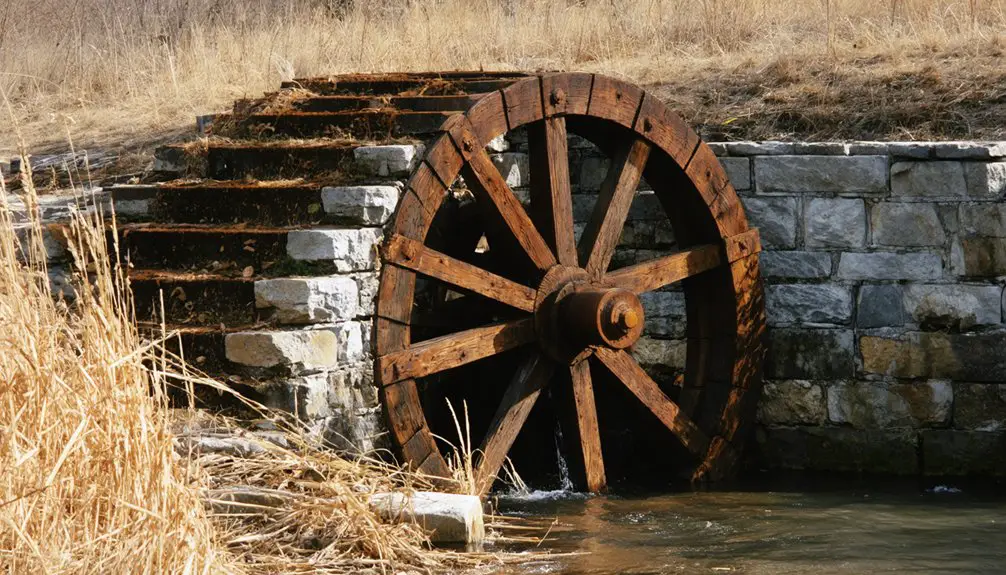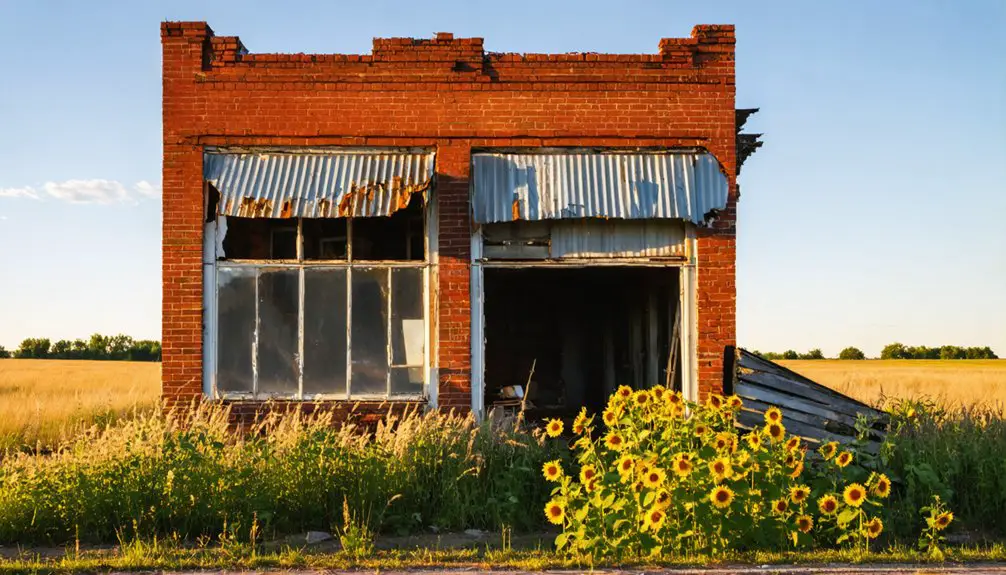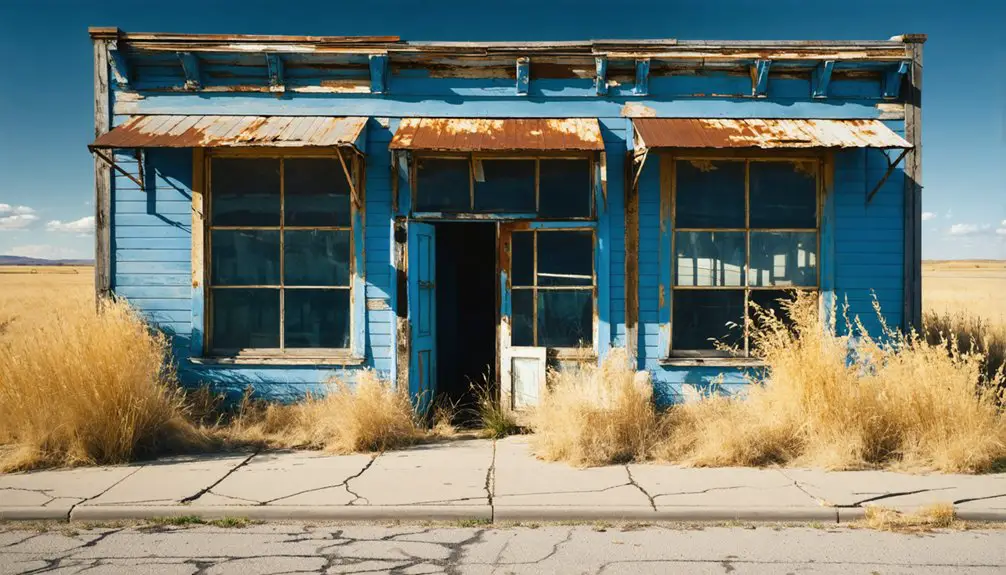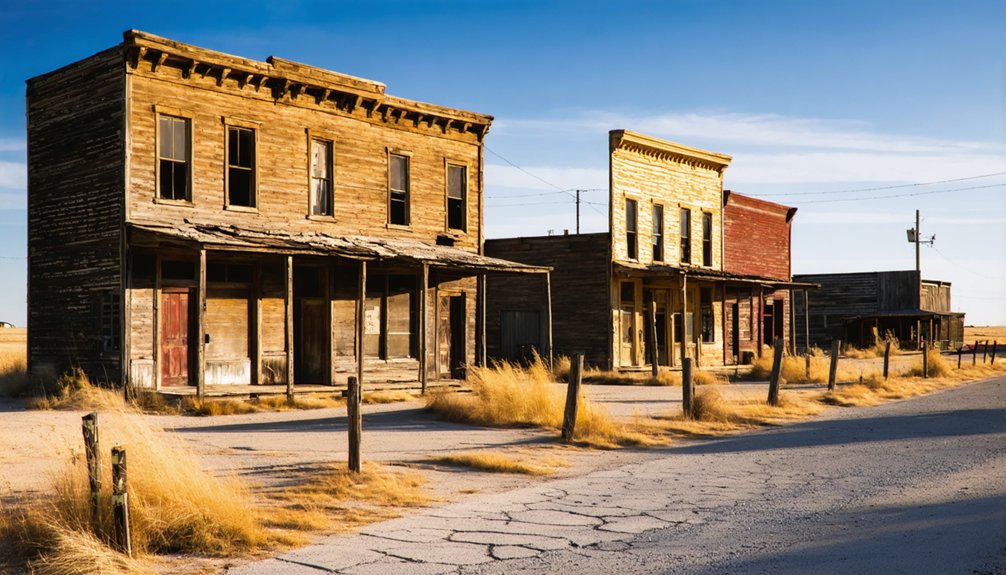
You’ll find Kansas’s most compelling ghost towns along historic cattle trails and river corridors, where constitutional battles and frontier commerce left tangible ruins. Visit Lecompton’s Constitution Hall with fraudulent 1858 ballots, explore western settlements like Eminence reduced to wheat fields and brick pillars, or walk Caldwell’s quarter-mile Chisholm Trail ruts where six million cattle passed. Southern Sedgwick County’s Viola and Clonmel offer crumbling storefronts, while preserved sites like Old Cowtown Museum provide authentic 1870s buildings. Proper planning with maps, weather checks, and safety supplies guarantees you’ll discover where territorial violence and economic ambition shaped abandoned prairies.
Key Takeaways
- Lecompton features Constitution Hall with 1858 fraudulent ballots and murals depicting Kansas’s pro-slavery conflicts and turbulent territorial past.
- Chisholm Trail towns like Caldwell and Abilene preserve visible trail ruts and remnants from 1867-1889 cattle drives.
- Western Kansas ghost towns including Eminence, Ravanna, and Terryton now show ruins like brick pillars amid wheat fields.
- Old Cowtown Museum in Wichita and Boot Hill Museum in Dodge City offer preserved 1870s buildings and frontier reenactments.
- Use mapping tools like BatchGeo and Legends of Kansas website; pack water, check weather, and verify road conditions.
Historic Territorial Capital: Lecompton’s Living Museum
A wooden candle box sits behind glass at Constitution Hall, its weathered surface concealing one of America’s most explosive secrets—fraudulent ballots from 1858 that nearly tipped the nation into war. You’ll find this relic in Kansas’s original territorial capital, where Lecompton history breathes through limestone walls and wooden beams.
Behind weathered wood and glass lies democracy’s darkest moment—fraudulent ballots that nearly ignited a nation’s war over its soul.
Walk Constitution Hall’s creaking floors where pro-slavery politicians drafted their controversial constitution. The Territorial museum, completed in 1882, stands where Eisenhower’s parents wed as students.
You’ll discover Civil War artifacts and Victorian relics that tell freedom’s complicated story.
This town of 600 souls preserves seven hotel sites and Democratic headquarters where the nation’s conscience wrestled with bondage. Founded in 1854 on a Wyandotte Indian land claim, the settlement was originally called Bald Eagle before being renamed to honor the territorial chief justice. The 1916 fire led to replacement brick structures that now anchor the downtown, their murals depicting the town’s turbulent past. It’s living proof that liberty’s birthplace wasn’t pristine—it was blood-soaked Kansas soil.
Western Kansas Abandoned Settlements in Finney and Ellis Counties
Wheat fields ripple endlessly across northeast Finney County, concealing the ghostly foundations of Eminence—a town that died fighting for power it never held. You’ll find its crumbling rival Ravanna nearby, where abandoned schoolhouses and fading cemeteries mark the 1887 county seat war that brought Bat Masterson from Dodge City to keep the peace.
Neither won. Garden City claimed the prize, leaving both settlements to weather droughts and blizzards until their final residents departed in the 1940s.
Drive these lonely roads and you’ll discover brick pillars jutting from plowed earth, courthouse walls standing guard over nothing. Terryton, Buffalo Center, Plymell—they’re all out here, reclaimed by wheat. In Terryton’s brief heyday, the Old Kentucky Home served as community church where settlers gathered for Saturday ball games between the stores and hotel that lined the stage route.
The rivalry began when Ravanna won the 1887 election by 35 votes, though accusations of ballot stuffing sent the dispute all the way to the Kansas Supreme Court. No signs direct you. Just coordinates, determination, and Kansas wind.
Southern Sedgwick County Towns Eclipsed by Wichita’s Growth
The county seat battles of western Kansas played out in open prairie, but Wichita’s expansion erased its rivals through quiet suburban sprawl.
You’ll find Viola twenty miles southwest, where five residents occupy what once housed five hundred. Its main street dissolves into dirt, railroad tracks still cutting through unpaved side streets. Drive west to Aness’s vanishing storefronts—church, saloon, and schoolhouse crumbling along the same rail line. The post office moved here from extinct Kalamazo in 1887, serving fewer than a hundred souls. Wil Wilson, a businessman from Arcade, New York, founded the settlement and named it after his wife An S Wilson.
Peck offers a Horticulture Center where shops once stood, its post office silent for 120 years. Ruby’s forgotten landmarks disappeared entirely beneath modern construction.
Clonmel preserves its oldest building from 1947, a church standing beside cemetery plots and abandoned railroad remnants. These towns didn’t die dramatically—they faded as Wichita’s gravity pulled residents toward opportunity, leaving prairie quiet behind.
Sumner County’s Fading Cowtowns and River Communities
You’ll find Sumner County’s ghost towns clustered where the Chisholm Trail once thundered with cattle drives, particularly around Hunnewell—a shipping point that roared to life in 1880 with saloons and stockyards before fading to just 44 residents today.
Along the Ninnescah and Arkansas rivers, settlements like Adamsville and Sumner City collapsed when railroad lines shifted and agriculture declined, leaving behind crumbling foundations in the prairie grass.
Near Conway Springs, you can still trace the outline of Salt City’s mineral springs resort at the old dam site, where a 50-acre lake once drew visitors to bathhouses that have long since vanished.
Perth once peaked at 400 residents in the 1920s as a livestock shipping center before its remote location and school consolidation led to decline, with its post office finally closing in 1954.
Though not in Sumner County, the town of Sumner near Atchison tells a similar tale—once boasting a population of 2,000 by 1858, it vanished after droughts, tornadoes, and grasshopper infestations drove residents away, leaving only an overgrown cemetery as proof it ever existed.
Historic Chisholm Trail Gateway
Long before Sumner County’s grasslands fell silent, they thundered with the hoofbeats of millions of Texas longhorns following the Chisholm Trail north to Kansas railheads.
You’re standing where cowboy legends were born—where 6 million cattle traveled 800 miles from South Texas between 1867 and 1889. Jesse Chisholm’s 1864 wagon road became the gateway to fortune, stretching from the Canadian River to the Arkansas near Wichita.
Near Caldwell, you’ll find trail ruts spanning a quarter-mile wide, worn deep by endless herds. The trail’s terminus shifted over the years from Abilene to Newton, then Wichita, before finally settling at Caldwell. Joseph McCoy built stockyards in Abilene in 1867, transforming the frontier town into the first major cattle shipping point.
This Chisholm Trail history ended when barbed wire and Oklahoma’s 1889 Land Run transformed open range into farmland.
Arkansas River Settlement Decline
When George W. Miller purchased 93 acres in Hunnewell back in 1885, he couldn’t have predicted the complete collapse awaiting these Arkansas River settlements. You’ll find abandoned warehouses where 1,500 cattle loads once shipped annually through bustling railyards.
The 1880s prosperity evaporated when railroads rerouted through larger hubs, leaving Hunnewell’s population to plummet from 168 to just 44 souls.
Nature struck Sumner even harder—drought, tornadoes, and grasshoppers devastated the community between 1859-1860, forcing mass exodus.
Today you’ll discover forgotten homesteads reduced to foundation stones, their timbers hauled away decades ago. Only cemeteries remain intact, marking where thriving cowtowns once controlled the cattle shipping empire.
These ghost towns offer raw glimpses into frontier communities that couldn’t withstand economic shifts and natural disasters.
Mineral Springs Resort Legacy
Across Kansas’s prairie landscape during the 1880s, entrepreneurs transformed ordinary natural springs into elaborate resort complexes that promised miraculous cures for everything from rheumatism to dyspepsia.
You’ll find remnants of these ambitious ventures scattered throughout the state, where Native American folklore legends once attributed miraculous healing properties to mineral-rich waters. Visitors hunted ancient artifacts between treatments, climbing bluffs and exploring timberlands while consuming bottled spring water at $1 per twenty-case.
Eagle Springs showcased a captive eagle as its promotional symbol, while Blasing Springs’ twelve-room limestone hotel offered steam baths for just $1 daily.
Preserved Historic Sites With Standing Structures and Museums
While many Kansas ghost towns exist only as weathered foundations and prairie grass, several sites stand as tangible monuments to the state’s frontier past.
You’ll find Pawnee’s territorial capitol building standing proudly in Riley County, where Kansas government took its first steps.
The abandoned structures of Neuchatel tell French settler stories through a restored church, schoolhouse, and cemetery.
Potwin Place’s faded signage marks its incorporation into Topeka, now a National Register district you can explore.
For immersive experiences, Old Cowtown Museum in Wichita relocates authentic 1870s buildings, including the 1868 Munger House.
Boot Hill Museum sits on Dodge City’s original cemetery grounds, where you’ll witness gunfight reenactments and walk through saloon recreations.
These preserved sites let you touch frontier history directly—no ropes, no barriers.
Remote Prairie Settlements Along Kansas Rivers
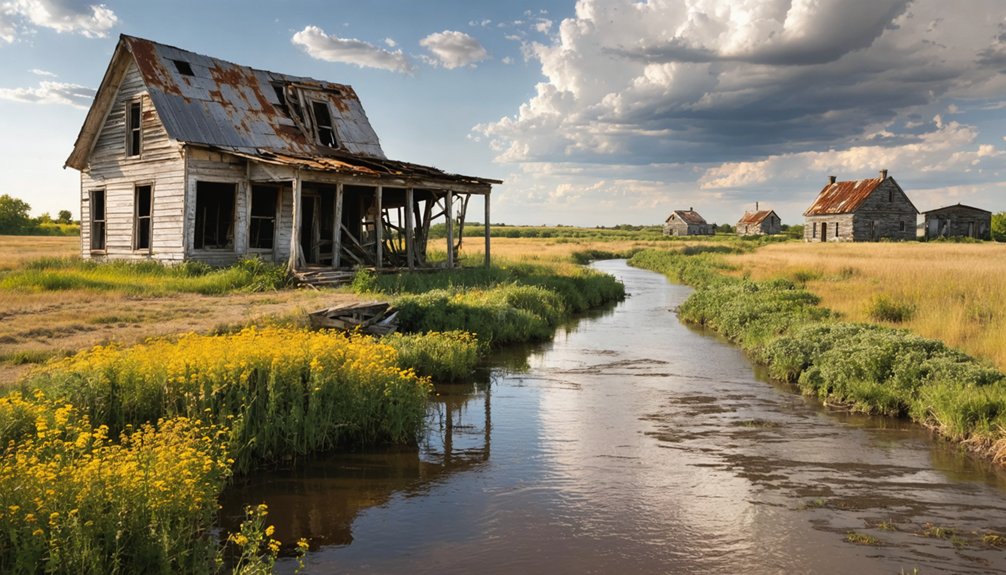
You’ll find Kansas’s most haunting river settlements where railroad tracks once crossed the Vermillion, Solomon, and Cottonwood Rivers—towns that thrived briefly before the prairie reclaimed them.
At Vliets along the Vermillion, only a Co-op Elevator stands among the tall grass where 350 residents once built their lives.
Drive to Densmore near the Solomon River and you can still walk through St. Mary’s Church and peer into deteriorated homes frozen in their 1992 abandonment.
Territorial Kansas River Towns
When Kansas Territory opened for settlement on May 30, 1854, river towns erupted along the Missouri and Kansas Rivers like mushrooms after spring rain. You’ll discover Quindaro’s ghost remains, where Free-State supporters once disembarked from thirty-six steamboats weekly during 1856’s peak season.
The natural rock ledge created perfect landing conditions before the town vanished in the 1940s.
River commerce transformed Native settlements into ideological battlegrounds. Leavenworth claimed Kansas’s oldest city title by June 1854, positioning itself as proslavery headquarters while steamboats hauled fortune-seekers westward.
The Kansas River proved trickier—traders worked these waters since the 1700s, but sandbars and shallow depths restricted navigation to spring floods.
Ferries like Grinter’s and Pappan’s connected civilization’s threads where steamboats couldn’t venture.
Solomon River Settlement Remains
Beyond the territorial battlegrounds, the Solomon River carved isolation into Kansas’s heartland where scattered families built their survival into riverbank fortifications. You’ll find Fort Solomon’s remnants near Ottawa County, where fourteen families crowded into twenty log houses during 1864’s brutal raids. They’ve long since collapsed, but archaeological sites mark where stockade walls once stood.
Five miles west of Beloit, Solomon Rapids Stockade transformed from defensive refuge to mill town by 1870. Ancient artifacts reveal settlements dating to 1030 A.D., proving this river sustained communities for centuries. French explorers named it in 1744, but you’re following older paths—where hunters, trappers, and homesteaders read the landscape’s promises: water, timber, defensible banks.
Even Nicodemus‘s founders recognized these advantages when establishing their African-American colony in 1877.
Planning Your Kansas Ghost Town Exploration
Successful ghost town exploration in Kansas hinges on thorough preparation before you venture onto dusty rural roads and overgrown prairie paths. Start with interactive mapping tools like BatchGeo and Proxi.co to pinpoint locations, then cross-reference the Legends of Kansas website for ghost town architecture details and historical context.
As you uncover the stories behind abandoned towns in Kansas history, take note of the unique architectural styles that tell tales of a bygone era. Each visit offers a glimpse into the lives of those who once inhabited these now-desolate spaces, making it a captivating experience for history enthusiasts. Make sure to document your findings, as these insights contribute to a richer understanding of the region’s past.
Preparation separates successful ghost town explorers from those who end up stranded on impassable Kansas backroads without cellular service.
Spring and fall offer ideal weather, while summer’s heat can make remote sites uncomfortable. Pack water, first aid supplies, and inform someone of your itinerary—cellular service disappears quickly in counties like Norton and Rooks.
Respect ghost town preservation efforts by staying off private property near surviving structures. Check road conditions before departure, especially after rain when unpaved routes become impassable.
Early morning light transforms crumbling foundations into dramatic photographic subjects, revealing the freedom these abandoned settlements once represented.
Frequently Asked Questions
Are Kansas Ghost Towns Safe to Explore Without a Guide?
No, you’ll face serious safety risks exploring alone—lead-contaminated dust, collapsing structures, and unclear private property boundaries create real dangers. Without guides, you’re charting toxic superfund sites and unstable buildings with zero emergency backup.
What Time of Year Is Best for Visiting Kansas Ghost Towns?
Fall’s your prime window for ghost town adventures. You’ll find ideal seasonal planning from September through November, when cooler temperatures make remote access easier and haunted tours peak. Spring offers comfortable exploration, while winter’s harsh conditions restrict your freedom to roam.
Do Any Kansas Ghost Towns Have Overnight Accommodations Nearby?
You’ll find incredible overnight stays near Kansas’s most legendary ghost towns! The Historic Wolf Hotel in Ellinwood and Hotel Josephine in Holton blend haunted legends with historic landmarks, offering you authentic paranormal experiences alongside comfortable beds and fascinating guided tours.
Are Ghost Town Sites on Private Property Accessible to Visitors?
You’ll need landowner permission before exploring ghost towns on private property. Trespassing regulations protect private property rights strictly in Kansas, so you can’t freely wander these abandoned sites without explicit approval from owners who control access to their land.
Be sure to research the history of abandoned towns in Kansas, as many have fascinating stories and rich histories. Some towns became victims of economic decline, while others were deserted due to natural disasters or changing transportation routes. Understanding their backgrounds can enhance your exploration and provide deeper insights into the state’s past.
Many enthusiasts look forward to the annual events in kansas ghost towns, where they can engage with local history and share their experiences. These gatherings often include guided tours, storytelling sessions, and local artisans showcasing their crafts. Participating can provide a deeper appreciation of the heritage and stories behind these forgotten places.
Many of these ghost towns in Kansas history provide a glimpse into the past, showcasing the remnants of communities that once thrived. Visitors often find intriguing artifacts and dilapidated structures that tell the story of the people who lived there. Exploring these areas can be a unique experience, but always remember the importance of respecting property rights and the historical significance of these sites.
Which Kansas Ghost Towns Are Most Family-Friendly for Children?
You’ll find Atchison and Overland Park perfect for young explorers seeking spine-tingling adventures. Historical preservation meets local legends through kid-friendly ghost tours, costumed characters, and hayrides—offering thrills without nightmares, letting families embrace spooky freedom together.
References
- https://en.wikipedia.org/wiki/List_of_ghost_towns_in_Kansas
- https://legendsofkansas.com/kansas-ghost-town-list/
- https://www.kcur.org/arts-life/2022-04-09/ghost-towns-are-all-around-kansas-city-if-you-know-where-to-look
- https://www.legendsofamerica.com/ks-ghosttowns/
- https://www.youtube.com/watch?v=VPZtNoncnig
- https://www.youtube.com/watch?v=OyBXD18P_j4
- https://abandonedks.com/maps/
- https://en.wikipedia.org/wiki/Lecompton
- https://lecomptonkansas.com
- https://civilwaronthewesternborder.org/partners-staff/lecompton