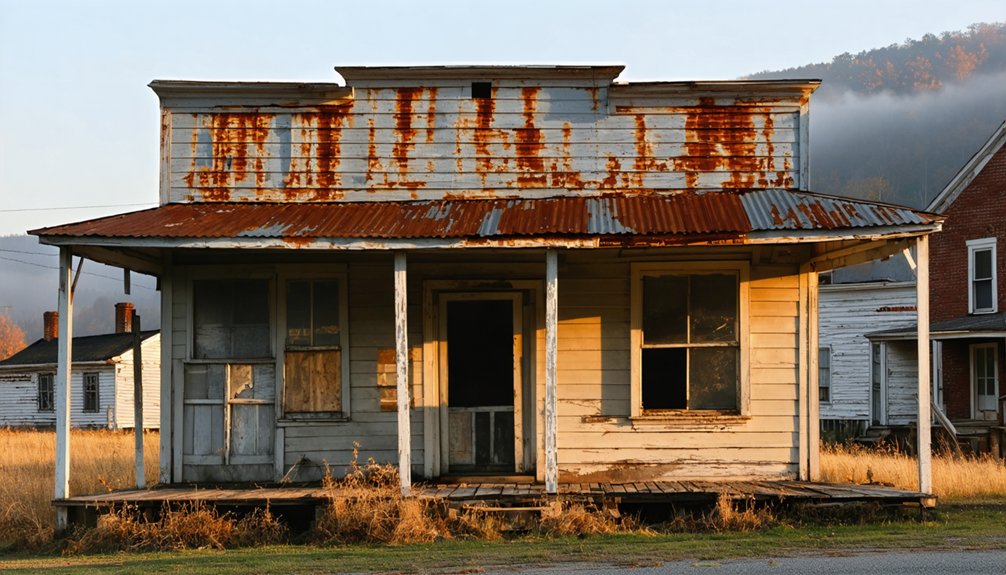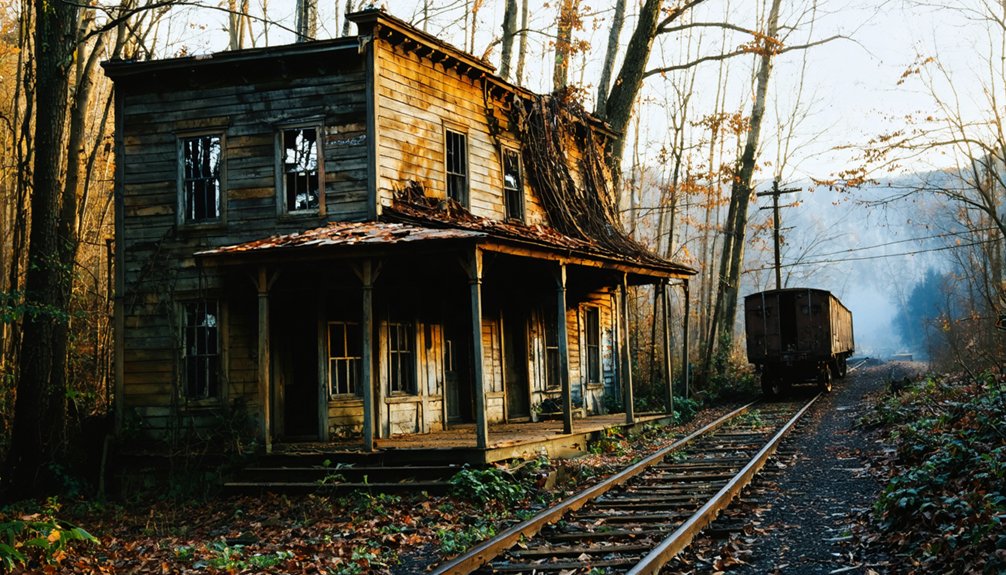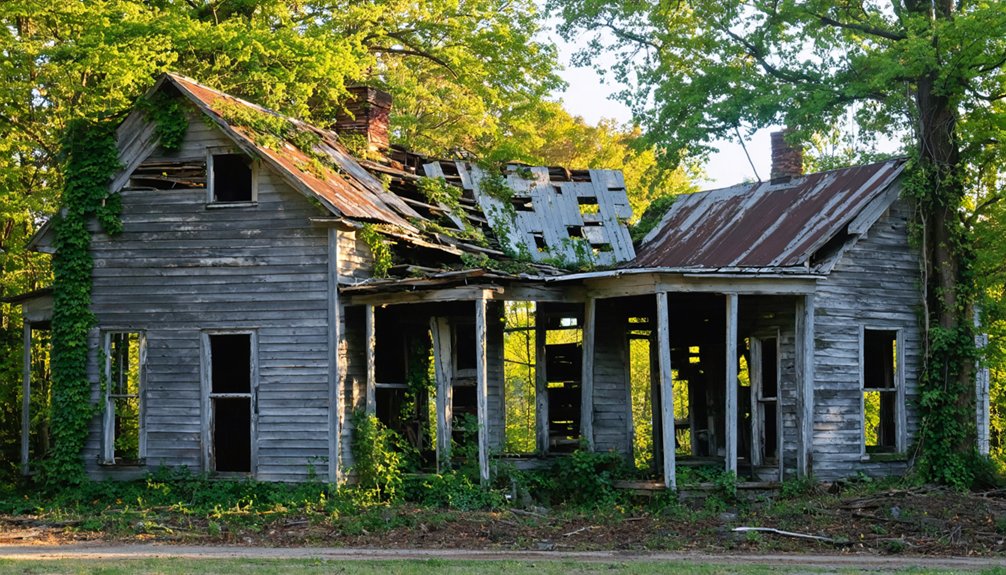
You’ll discover Kentucky’s most accessible ghost towns at Blue Heron, where skeletal wire frames and audio recordings bring a 1937 coal camp back to life, and Barthell, a meticulously restored mining community with underground passages and vintage locomotives. Creelsboro’s submerged streets rest beneath Lake Cumberland’s waters, while Golden Pond’s moonshine legacy now attracts 1.5 million annual visitors to its wilderness trails. Each site preserves authentic structures, weathered machinery, and the voices of those who once called these vanished communities home.
Key Takeaways
- Blue Heron offers authentic coal mining structures, audio recordings from miners, and scenic trails blending industrial history with natural beauty.
- Barthell features a reconstructed coal camp with underground passages, old locomotives, and annual cultural festivals celebrating mining heritage.
- Bells Mines showcases early immigrant mining communities through weathered headstones and foundation remains scattered in dense woodland since 1842.
- Creelsboro’s submerged remnants beneath Lake Cumberland include stone arches and burial grounds, preserved through historic districts and documentaries.
- Golden Pond’s erased moonshine town now offers 500 miles of trails and extensive recreational opportunities attracting 1.5 million annual visitors.
Paradise: The Town That Vanished for Progress
Nestled along the Green River in Muhlenberg County, Paradise began its quiet existence in the early 19th century as Stom’s Landing, a humble trading post where Leonard Stom’s ferry carried travelers across the water.
Settlers renamed it Paradise for the area’s natural beauty, and by 1852, a post office anchored the growing community.
Everything changed in 1959 when coal mining arrived, followed by TVA’s massive Paradise Fossil Plant.
Ash rained down constantly. Noctious gases made breathing difficult. Gardens died.
The urban decay wasn’t gradual—it was forced.
TVA bought every property, demolished every building, and erected the world’s largest boiler where homes once stood.
Residents received minimal compensation for their properties before being persuaded to leave their homes forever.
The plant later expanded to include Paradise Unit 3 with a cyclonic fired boiler, further cementing the industrial transformation of the area.
Today, you’ll find only a hillside cemetery overlooking industrial ruins—a stark environmental legacy reminding us what “progress” sometimes costs.
Blue Heron: A Mining Camp Reborn as a Living Museum
When you step into Blue Heron’s interpretive center, you’ll encounter something remarkable—skeletal metal frames standing exactly where homes, the tipple, and the schoolhouse once buzzed with mining camp life.
These “ghost structures” hold photographic panels and audio recordings from former residents, letting their voices echo across the Big South Fork riverbank as you walk through the preserved company town layout.
You’re not just looking at ruins; you’re experiencing a vanished community that miners, families, and the coal company built together along this remote Kentucky waterway. The town emerged to support Mine 18, which opened in 1937 and operated until December 1962, shipping coal via railroad through these now-silent gorges. After the mine’s closure, the Stearns Coal & Lumber Company buildings were either demolished or left to decay before the National Park Service reimagined the site as an open-air museum in the 1980s.
Ghost Structures Tell Stories
Along the banks of the Big South Fork River, skeletal frames stand where a bustling coal mining camp once thrived. You’ll walk through wire-frame outlines of homes, the company store, and the bath house where miners once cleaned off layers of coal dust. These ghost structures aren’t reconstructions—they’re deliberately incomplete, inviting you to fill in the gaps with your imagination.
What brings them alive are the voices. Oral history recordings play from hidden speakers, sharing raw accounts of life underground. You’ll hear miners describe the darkness, the dampness, and the wildcat strike that forced the company’s hand. The depot serves as your starting point, where models of the town during the 1950s help you visualize the community at its peak. The site takes its name from the blue heron that inhabits the surrounding river valley.
Industrial remnants like authentic coal cars and a weathered locomotive punctuate the site, tangible proof that real people carved their lives from these unforgiving hills.
Company Town Layout Preserved
Unlike most ghost towns that fade into obscurity, Blue Heron’s Mine 18 has been deliberately frozen in time through an innovative preservation approach. You’ll walk through steel-framed “ghost structures” that mark where hundreds of miners and their families once lived from 1937 to 1962.
This historic preservation project recreates the entire company town operated by Stearns Coal & Lumber Company.
The site includes:
- A full-scale coal tipple replica with original mining machinery and coal cars positioned beneath
- The reconstructed mine entrance where miners descended into Cumberland Plateau’s depths
- Ghost-frame buildings housing the school, homes, and railroad depot
You’re free to explore the self-guided layout that reveals how isolated mining communities functioned. Each structure features button-activated audio testimonies from former residents, bringing authenticity to your exploration. The museum operates as a free outdoor attraction open during daylight hours, making it accessible to all visitors interested in Kentucky’s mining heritage.
Riverside Setting and Access
Nestled against the Big South Fork of the Cumberland River, Blue Heron occupies one of Kentucky’s most dramatic riverside settings where coal mining history meets natural grandeur.
You’ll discover the site through the Blue Heron Loop Trail, which winds from high plateau overlooks down to waterfront vistas where miners once hauled coal to waiting rail cars. The trail’s scenic route takes you past Devil’s Jump and Cracks in the Rock—rugged landmarks that frame your approach to the ghost structures below.
River crossings define your journey through McCreary County’s backcountry, where shaded hollows open suddenly onto sweeping views of the Cumberland’s south fork.
The trailhead offers visitor amenities before you descend into this remote canyon where the Stearns Coal & Lumber Company carved civilization from wilderness.
Barthell: Preserved Coal Town in the Kentucky Foothills
You’ll find Barthell tucked in the Kentucky Foothills, where the Stearns Coal Company breathed life into McCreary County back in 1902.
After a devastating 1943 fire reduced the original tipple to ashes, the Koger family poured over $500,000 into resurrecting this coal camp as an open-air museum in 1999.
Walk among the reconstructed structures and you’re stepping through the same grounds where miners defied strikes during wartime and families danced atop the tipple on summer evenings in the 1920s.
The camp’s Mine Two closed in 1919, marking the end of one of Barthell’s original mining operations that began under L.E. Bryant’s supervision.
The restoration includes original tram locomotives that once hauled coal through the camp’s extensive underground passages.
Coal Camp History
Deep in McCreary County’s foothills, Barthell Coal Camp sprang to life in 1902 when J.S. Stearns arrived to establish one of 18 company towns that would define the region’s industrial era.
You’ll discover a place where corporate control shaped every aspect of daily existence, from housing to commerce.
The camp’s turbulent history reveals the tensions inherent in these isolated communities:
- 1908 labor strikes erupted violently, culminating in a shoot-out and hotel burning when union organizers challenged company authority.
- 1943 miners defied a national strike, choosing patriotic duty over organized labor during wartime.
- 1930 marked peak production at 100,961 tons, demonstrating the camp’s economic significance.
After the 1943 tipple fire destroyed Mine One, operations gradually ceased.
Following decades of abandonment, the camp underwent six years of restoration before reopening in 1999, preserving the legacy of Harold C. “Sonny” Koger’s father who worked at the site for 48 years.
Exploring Restored Structures
Today’s Barthell stands as a tribute to one family’s determination to preserve history. Harold “Sonny” Koger and his family invested over $500,000 and six years reconstructing this open-air museum. They transformed dismantled ruins into an authentic coal camp experience.
You’ll walk among structures that once housed miners from 1902 through the 1950s, feeling the weight of their daily struggles and triumphs.
The site comes alive during cultural festivals, particularly the annual July 4th celebration—a tradition dating back to 1903’s first coal shipment.
You’ll discover work by local artisan craftspeople who’ve helped restore original buildings to their former glory. Each reconstructed facility tells stories of the 18 mining camps that once dotted these Kentucky Foothills.
This offers you unfiltered access to a vanished way of life.
Bells Mines: Hidden Remnants in Big Rivers Wildlife Area
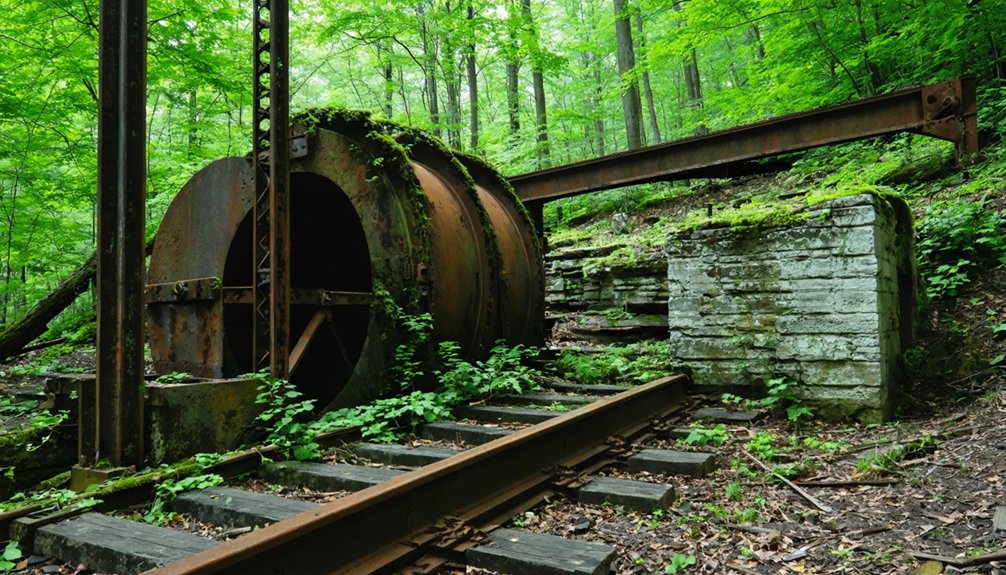
Tucked between the towns of Sturgis and Marion in Crittenden County, Bells Mines represents one of Kentucky’s most enigmatic ghost towns—a place where coal dust once clouded the air and immigrant miners carved out lives in the unforgiving earth.
Founded in 1842, this settlement’s mineral history stretches back nearly two centuries, attracting Bavarian, Prussian, and Irish workers seeking fortune beneath Kentucky soil.
Today, you’ll find scant evidence of the bustling community within Big Rivers Wildlife Area:
- Weathered headstones in Bells Mines Cemetery marking final resting places
- Hidden foundation remnants scattered throughout dense woodland
- Faint traces of the railroad branch that once hauled “the state’s finest coal” to Sturgis
Cemetery preservation efforts maintain this haunting connection to Kentucky’s coal-mining past, though urban legends whisper of unexplained phenomena among the monuments.
Creelsboro: The Community Beneath the Cumberland Dam
While Bells Mines vanished slowly through abandonment, Creelsboro met a different fate—one written in federal legislation and sealed by rising waters. The Cumberland River community thrived for over a century before Wolf Creek Dam’s construction began in 1941.
A century of river life erased by federal decree and the inevitable march of progress-engineered floodwaters.
By 1952, the entire town disappeared beneath Lake Cumberland’s surface.
You can still explore what remains. The Creelsboro Rural Historic District stretches ten miles along the Cumberland River from the dam downstream. Most striking is the Historic Arch—locally called “The Rockhouse”—the largest natural stone arch east of the Rockies.
It once served as a gateway to the river valley, with Native American burial grounds atop its span.
The documentary “Creelsboro and the Cumberland” preserves residents’ memories, ensuring this submerged community isn’t forgotten.
Golden Pond: Moonshine Country Turned National Recreation Area
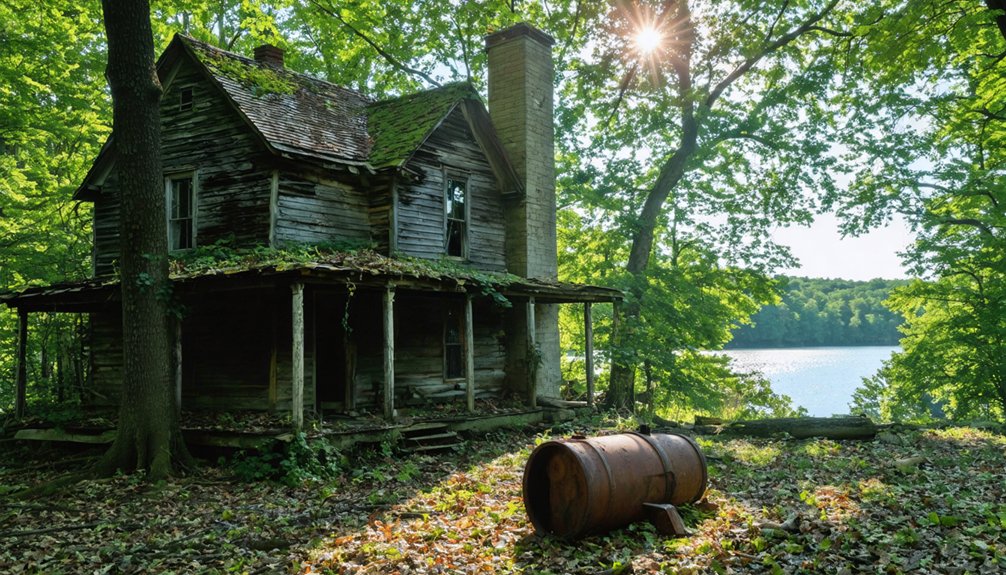
Between the Tennessee and Cumberland Rivers, Golden Pond thrived as the unlikely capital of Kentucky’s moonshine country. You’ll find its spirit preserved at the visitor center, though TVA’s 1963 land acquisition erased the original settlement by 2010. What replaced it became something extraordinary:
- 170,000 acres of wilderness stretching across America’s largest inland peninsula
- 500 miles of trails winding through undisturbed river ecosystems
- 300 miles of pristine shoreline where flora fauna flourish freely
The same remote landscape that once sheltered illicit distillers now offers complete solitude.
Historic photos reveal where 200 residents lived before evacuation began in 1964. Today, 1.5 million visitors annually explore what locals call “Between the Rivers”—a monument to both forgotten communities and untamed spaces where you’re truly free to wander.
Frequently Asked Questions
Are Kentucky’s Ghost Towns Safe to Explore Without a Guide?
No, you’ll face serious dangers exploring alone—collapsed structures, toxic materials, and legal troubles await. Despite local legends drawing you in, these sites present real preservation challenges and hazards that experienced guides help you navigate safely.
What’s the Best Time of Year to Visit These Abandoned Sites?
You’ll find October perfectly aligns your ghost town adventure with peak foliage and Halloween events. Spring through fall offers ideal climbing access to abandoned structures, while soft autumn light provides unbeatable photography tips for capturing weathered buildings and atmospheric decay.
Exploring annual events in Kentucky ghost towns can enhance your experience, bringing history to life through festivals and guided tours. Each site has its own unique stories, often celebrated through art, music, and local cuisine that reflect the region’s rich heritage. As the sun sets, the ghost towns take on a haunting charm, inviting you to uncover the mysteries of the past.
Do I Need Special Permits to Access These Ghost Town Locations?
You generally don’t need permits for most Kentucky ghost towns on public land. However, watch for access restrictions on private property—always seek permission first. Some sites have historic preservation protections requiring special authorization before exploring or documenting.
Exploring abandoned towns in Kentucky can provide a fascinating glimpse into the past. Each site tells a unique story of the people and events that shaped the region. Keep in mind that some of these locations may be more fragile than they appear, so tread lightly and leave no trace of your visit.
Many visitors are drawn to ghost towns across Kentucky for their eerie beauty and the history they hold. As you wander through these remnants of the past, you’ll encounter crumbling structures and overgrown landscapes that evoke a sense of nostalgia. Remember to capture the stories that each location embodies, allowing you to share the allure of these forgotten places with others.
Are There Guided Tours Available for Any Kentucky Ghost Towns?
You’ll find guided ghost tours in Kentucky cities like Lexington and Louisville that explore haunted legends and historic preservation efforts, but authentic abandoned ghost towns lack organized tours—you’re free to explore these forgotten places independently.
Exploring abandoned sites in Kentucky can be an exhilarating experience for those with a penchant for the eerie and forgotten. From dilapidated homes to overgrown factories, each location tells a story of its past, fraught with mystery and nostalgia. As you wander through these haunting remnants, you may stumble upon artifacts that evoke the region’s rich history and culture.
The allure of ghost towns in Kentucky history lies not only in their eerie ambiance but also in the stories that inhabit them. Many of these abandoned places have become popular among urban explorers and photographers seeking to capture the beauty of decay. As you delve deeper, you’ll uncover remnants of daily life long forgotten, each ghostly echo whispering tales of the people who once called these towns home.
Can I Camp Overnight Near These Historic Ghost Town Sites?
Like modern pioneers, you’ll find overnight camping near most sites, though camping regulations protect historical preservation at townsites themselves. Carter Caves and Land Between the Lakes offer full campgrounds, while Kentucky Camp provides primitive sites just outside the historic area.
References
- https://kids.kiddle.co/List_of_ghost_towns_in_Kentucky
- https://wbkr.com/visit-these-20-creepy-kentucky-ghost-towns-for-a-halloween-road-trip/
- https://www.onlyinyourstate.com/experiences/kentucky/12-ghost-towns-in-ky
- http://freepages.rootsweb.com/~gtusa/history/usa/ky.htm
- https://www.youtube.com/watch?v=D9gOmfCuKLs
- https://everafterinthewoods.com/abandoned-ghost-towns-in-kentucky-that-still-hold-echoes-of-the-past/
- https://www.freakyfoottours.com/us/kentucky/
- https://www.geotab.com/ghost-towns/
- https://www.onlyinyourstate.com/experiences/kentucky/ghost-town-ky
- https://dablogfodder.blogspot.com/2017/01/paradise-kentucky.html