You’ll find Michigan’s most fascinating ghost towns scattered across the Upper Peninsula and shorelines, where preserved industrial sites tell stories of boom-and-bust economies. Walk through Fayette’s complete iron-smelting complex with 20 original structures overlooking Lake Michigan, explore Fiborn’s limestone quarry ruins hiding cave systems along the Niagara Escarpment, or tour Laurium’s intact Victorian mansions built from copper mining wealth. Glen Haven offers restored logging-era buildings within Sleeping Bear Dunes, while Baltic’s crumbling mine sites reveal the copper industry’s dramatic rise and fall across this mineral-rich landscape.
Key Takeaways
- Fayette features over 20 preserved structures from 1867-1891, including furnace complexes and charcoal kilns along scenic five-mile trails.
- Glen Haven offers authentic wooden sidewalks, a blacksmith shop, and maritime museum within Sleeping Bear Dunes National Lakeshore.
- Fiborn is a 480-acre limestone quarry preserve with concrete foundations, ore-car loaders, and Michigan’s longest cave system.
- Baltic displays crumbling mine offices, 96-foot concrete obelisks, and overgrown trails from its 1898-1931 copper mining era.
- Central Mine on Keweenaw Peninsula showcases weathered remnants from its 1854-1898 copper production peak of 2.5 million pounds.
Fayette: A Preserved Iron-Smelting Community on Lake Michigan
Tucked along the limestone bluffs of Michigan’s Garden Peninsula, Fayette Historic State Park preserves one of the Upper Peninsula’s most complete ghost towns.
It was a once-thriving iron-smelting operation that shaped the region’s industrial heritage.
You’ll discover over 20 original structures from the 1867-1891 boom years, when 500 residents transformed Negaunee ore into award-winning pig iron using local hardwood charcoal and limestone flux.
The iron industry’s demands drove this remarkable community, where immigrant workers lived in company housing while producing 229,288 tons of metal for Cleveland foundries.
When charcoal became uneconomical and forests depleted, Jackson Iron Company simply walked away, leaving everything intact.
The centrally-located machine shop, built from limestone with wrought iron shutters and powered by a steam engine, proved essential for maintaining furnace operations and preventing costly production shutdowns.
Today’s historic preservation efforts let you explore furnace complexes, charcoal kilns, and period-furnished buildings along five miles of trails overlooking Big Bay de Noc’s turquoise waters.
The protected harbor location on Lake Michigan facilitated efficient shipping operations, offering calmer waters than Lake Superior for transporting the high-quality pig iron to distant markets.
Glen Haven: From Logging Settlement to Living History
Where limestone bluffs defined Fayette’s identity, sandy dunes shaped Glen Haven’s destiny along Lake Michigan’s eastern shore. You’ll discover a town born in 1857 as Sleeping Bearville, where steamers once loaded firewood and David H. Day’s lumber empire transformed wilderness into profit.
Glen Haven rose from sandy shores in 1857, where steamers and lumber barons carved destiny from Lake Michigan’s wilderness frontier.
When timber vanished and automobiles made steamers obsolete, the Great Depression delivered the final blow.
Today’s historical preservation lets you explore what isolation couldn’t erase. The National Park Service’s restoration work reveals authentic wooden sidewalks, a blacksmith shop, and maritime museum where you’ll connect with Michigan’s frontier past. Day’s vision extended beyond lumber as he planted cherry trees across the cleared landscape, attempting to sustain the community through agriculture. The town’s economy continued operating through dune wagon rides for tourists until 1978, extending its commercial life well beyond the lumber era’s end. This isn’t manufactured nostalgia—it’s living history within Sleeping Bear Dunes National Lakeshore.
Tourism development here respects what came before, offering you genuine freedom to walk paths that loggers and steamer captains once traveled.
Fiborn: Hidden Quarry Town in the Karst Preserve
Deep within Michigan’s Upper Peninsula, between St. Ignace and Newberry, you’ll discover Fiborn’s compelling story etched in limestone and memory.
This quarry village thrived from 1905 to 1936, supplying high-calcium limestone to Canadian steel mills until cheaper shipping methods sealed its fate.
Today, the 480-acre Fiborn Karst Preserve invites you to explore freely along self-guided trails.
You’ll encounter ghost town ruins—concrete foundations, ore-car loaders, and remnants of workers’ lives scattered through the forest.
The Barbara Ann Patrie Memorial Trail leads you past dramatic karst formations where water has dissolved limestone into sinkholes, caves, and disappearing creeks.
The limestone outcrops here are part of the Niagara Escarpment, a band of resistant Silurian dolomite that stretches from Michigan into Ontario.
Beneath the preserve lies the Hendrie River Water Cave, Michigan’s longest known cave, though its narrow passages and hazardous conditions mean entry requires both a guide and permit.
It’s raw, unpolished history you can touch and explore without barriers, managed by volunteers who maintain trails monthly while preserving this hidden testament to industrial ambition.
Laurium: Victorian Architecture of the Copper Country
You’ll discover Laurium isn’t quite a ghost town—it’s a remarkably preserved Victorian-era mining village where copper barons’ mansions still line the streets.
Founded in 1895 during Michigan’s copper boom, this historic district showcases over 90% original residential structures built between 1880 and 1915. From modest miners’ homes to the spectacular 13,000-square-foot Laurium Manor Inn, the variety of architecture is striking.
Walking these streets feels like stepping into the Gilded Age, where ornate shingle-style houses and Classical Revival estates tell the story of America’s first major copper mining region. The town’s name pays homage to Laurion, Greece, the ancient silver mining region that was crucial to the Greek economy. The village encompasses 11.99 miles of streets across approximately 400 acres, a dramatic expansion from its original six blocks bounded by First and Fourth Streets.
Mining Town’s Architectural Heritage
During the copper boom’s golden era between 1890 and 1915, Laurium transformed from a modest 20-acre, six-block plat into a showcase of Victorian opulence that still captivates visitors today. You’ll discover mining architecture that speaks to unimaginable wealth.
34-room Victorian Hall features six hand-carved fireplaces and Tiffany-style stained glass. While the massive Laurium Manor Inn spans 13,000 square feet as the region’s largest mansion.
These Victorian mansions weren’t modest investments; the Jones House alone cost over $12,000 in 1906. Walk past Corinthian columns, half-timbered gables, and Jacobsville sandstone trim that define this architectural legacy. The 7000 sq.ft. brick and sandstone Victorian Hall mansion was designed by architect Charles Maass and completed in 1906 for Norman Macdonald.
Though population plummeted from boom times to 3,000 by the 1950s, these spectacular homes survived, offering you tangible connections to copper country’s audacious past. Architect Paul H. Macneil contributed significantly to the area’s architectural heritage, designing the First Baptist Church with its distinctive Gothic-arched windows and Jacobsville sandstone trim in 1907-08.
Exploring Historic Laurium Village
Walking through Laurium’s historic district feels like stepping onto a preserved Victorian stage where copper wealth once commanded center stage.
You’ll discover the magnificent Thomas H. Hoatson House, a 13,000-square-foot mansion featuring gilded elephant leather walls and hand-painted murals that whisper ghost stories of mining barons’ extravagant lifestyles.
The district’s 90% residential composition showcases authentic 1880-1915 architecture, with most structures maintaining their original front-gabled frame construction.
Preservation efforts have transformed these copper-era homes into living history, including several participating locations within Keweenaw National Historical Park.
You’re free to explore at your own pace, discovering everything from the renovated 1914 Village Hall to George Gipp’s birthplace.
Modern restaurants and shops nestle among historic mansions, letting you experience Victorian grandeur without sacrificing contemporary comfort.
Baltic: Remnants of Upper Peninsula Mining Heritage
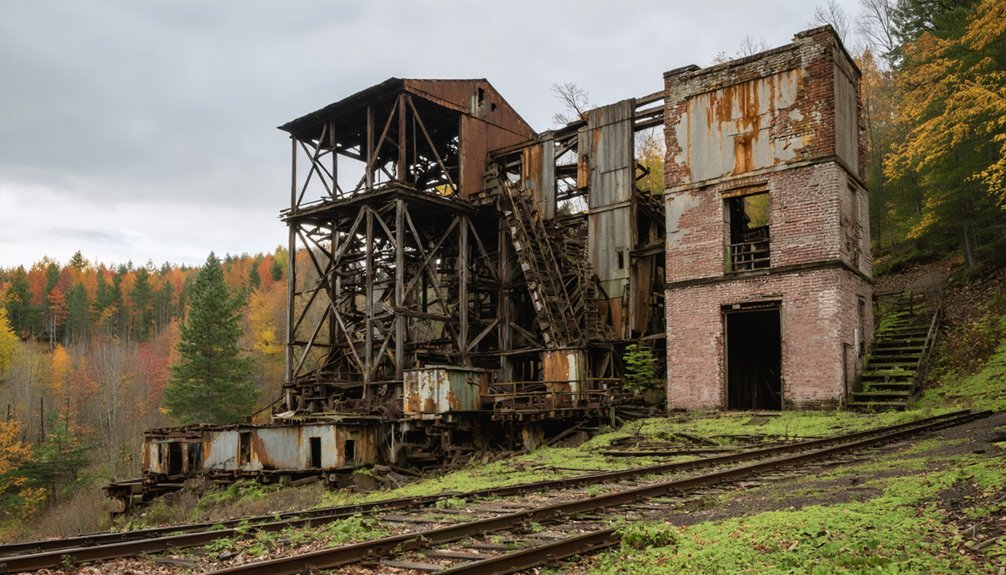
You’ll find Baltic tucked six miles southwest of Houghton along M-26, where a once-thriving company town of 3,000 miners has vanished into the Upper Peninsula brush.
The Baltic Mining Company built this settlement in 1898 to house workers near the shafts, which eventually plunged over 3,800 feet deep and yielded nearly 300 million pounds of copper before closing in 1931.
Today, you can explore crumbling mining buildings, forgotten foundations, and striking 96-foot Egyptian Revival concrete obelisks that still mark the original shaft locations from 1919.
Baltic’s Mining Town History
The story of Baltic begins in 1897, when investors recognized the copper-rich potential of land near South Range in Houghton County. By 1898, the Baltic Mining Company launched operations, sinking five shafts that would eventually reach depths of 3,839 feet.
You’ll find this wasn’t just about extracting ore—it was about building freedom through honest work.
The worker community grew rapidly around the mine, reaching 1,200 residents by 1905 and peaking at 3,000 in 1918.
Mining technology of the era enabled extraction of native copper from the Baltic Lode, ultimately yielding 276 million pounds over 34 years.
The town featured everything miners needed: a post office, general store, and doctor’s office.
When ore depleted in 1931, residents scattered, leaving behind their copper-country legacy.
Exploring the Abandoned Site
Six miles southwest of Houghton along M-26, Baltic’s scattered remnants emerge from the Keweenaw Peninsula brush like fragments of a copper-fueled dream. You’ll discover crumbling foundations, rock piles, and copper shards where 276 million pounds of ore once flowed from shaft #3’s staggering 3,839-foot depths.
Trails wind through grass fields toward historical mining equipment and abandoned structures, but tread carefully—overgrowth conceals mine shaft safety hazards including open wells plunging 25+ feet into darkness.
The ghost town rewards adventurous exploration. You can prospect for copper remnants among tailings, photograph deteriorated buildings, and imagine the bustling community that housed workers, a general store, and doctor’s office.
Nearby Atlantic Mine, Cliff Mine, and Central Mine Museum Complex extend your copper country journey beyond Baltic’s haunting landscape.
Central Mine: Ruins of the Keweenaw Copper Boom
Deep in Michigan’s Keweenaw Peninsula, Central Mine stands as a haunting monument to the region’s forgotten copper empire. You’ll discover ruins where prehistoric pits first revealed massive copper deposits in 1854, sparking operations that dominated the district until the 1890s.
At its zenith in 1882, this ghost town preservation site produced over 2.5 million pounds of copper—the only profitable mine in Keweenaw County that year. Wander past crumbling structures where 206 miners once worked with revolutionary power drills and compressors.
The copper mining operation thrived for decades before geological faults ended the bonanza in 1898. By 1905, only 100 souls remained.
Today, you’re free to explore these weathered remnants of Michigan’s billion-pound copper legacy.
Frequently Asked Questions
What Is the Best Time of Year to Visit Michigan Ghost Towns?
You’ll find fall (September-October) offers the best visiting months when seasonal weather transforms ghost towns into atmospheric wonders. With 161 inches of snow possible in winter, autumn’s crisp air and reduced crowds let you explore freely before harsh conditions arrive.
Are Michigan Ghost Towns Safe to Explore With Children?
Michigan ghost towns aren’t safe for children due to structural hazards, contaminants, and unstable buildings. You’ll need extensive safety precautions before exploring. Consider supporting historical preservation efforts through guided tours instead, where you’ll experience history without risking your family’s wellbeing.
The haunting beauty of Michigan ghost towns captures the imagination, drawing in those fascinated by their eerie charm. Each abandoned structure tells a story of a once-thriving community, inviting exploration and reflection on the past. By choosing to appreciate these sites from afar, you can still soak in the atmosphere while preserving their historical significance.
For those looking for ghost towns to explore in Michigan, there are several notable locations that offer a glimpse into the state’s rich history. It’s essential to research each site beforehand to understand its history and any risks involved. Engaging with local historians can enhance your experience, providing insights that deepen your appreciation for these forgotten places.
Do I Need Special Permits to Visit Ghost Towns in Michigan?
Managing ghost town access isn’t a bureaucratic maze—you’ll need Michigan Recreation Passports for state parks, but no special permits otherwise. Just respect private property boundaries and preservation rules, and you’re free to explore these abandoned timepieces responsibly.
Many of these abandoned towns in Michigan tell stories of a bygone era, with crumbling buildings and overgrown streets that peek into the past. While exploring, you may encounter remnants of old businesses and homes, which can spark the imagination about the lives once lived there. Remember to bring a camera to capture the haunting beauty of these forgotten places.
Which Ghost Towns Have Nearby Camping or Lodging Options Available?
You’ll find camping near ruins at Fayette Historic State Park with 61 campsites and a lodge, while Keweenaw Area ghost towns offer rustic accommodations from cabins to glamping sites. F.J. McLain and Ozark provide additional options nearby.
Can I Take Photographs Inside the Buildings at These Historic Sites?
Don’t let wanderlust cloud your judgment—interior photography crosses legal boundaries at most Michigan ghost towns. Preservation restrictions and trespassing laws prohibit entering buildings, but you’ll capture stunning exterior shots from public spaces, keeping your adventure both memorable and lawful.
References
- https://www.ghosttowns.com/states/mi/mi.html
- https://www.awesomemitten.com/ghost-towns-in-michigan/
- https://wgrd.com/michigan-ghost-town-map/
- https://www.youtube.com/watch?v=7-vjuqiGWJU
- https://www.nps.gov/slbe/learn/historyculture/ghosttowns.htm
- https://99wfmk.com/michigan-ghost-town-gallery/
- https://visitescanaba.com/blog/the-history-of-an-iron-smelting-town
- https://www.youtube.com/watch?v=yyYu9j1naDA
- https://nmgl.org/fayette-fall-1963/
- https://www.theinnatstonecliffe.com/blog/fayette-historic-townsite-a-ghost-town-frozen-in-1891