You’ll find Mississippi’s most mesmerizing ghost town in Rodney, where eight residents now inhabit what was once a bustling port of 4,000. This former state capital offers crumbling antebellum churches with Civil War cannonball scars, a hilltop cemetery holding 200 graves dating to 1828, and haunting architectural remnants from the 1800s. The Mississippi River’s 1870 course change severed Rodney’s lifeline, freezing this steamboat-era settlement in time. Navigate 12 miles of winding backroads to discover preserved structures that reveal the town’s dramatic transformation from prosperity to abandonment.
Key Takeaways
- Rodney, founded in the 1700s, was Mississippi’s former capital with antebellum architecture and Civil War-damaged historic churches.
- The Mississippi River shifted two miles west in 1870, severing Rodney’s trade routes and causing its abandonment.
- Three notable churches remain: Rodney Presbyterian (1832), Mount Zion Baptist (1851), and relocated Sacred Heart Catholic (1868).
- The hilltop cemetery contains over 200 graves dating to 1828, including Revolutionary War veterans and early settlers.
- Access Rodney via Highway 61 near Lorman, traveling twelve miles through dirt roads to reach crumbling structures.
Rodney: A Mississippi River Port Frozen in Time
Tucked along what was once a thriving bend of the Mississippi River, Rodney stands as one of the state’s most hauntingly preserved ghost towns. You’ll discover a settlement that once rivaled New Orleans as a bustling port, home to 4,000 residents, opera performances, and 53 stores by the 1860s.
Today, only eight people remain among crumbling structures and forgotten dreams. Unlike destinations with local cuisine and cultural festivals, Rodney offers something rarer: authentic abandonment. Yellow fever, devastating fires, and Civil War skirmishes weakened the town, but nature delivered the final blow when the Mississippi shifted two miles west in 1870. Union gunboats bombarded the town in retaliation after Confederate soldiers captured Union troops during a church service. The town was originally founded in the 1700s and called Petit Gulf by the French, distinguishing it from the nearby Grand Gulf before being renamed Rodney in 1814.
Walk through the three-acre cemetery where 200 graves mark lives from 1828 onward, then visit the lone surviving Rodney Presbyterian Church—a weathered testament to prosperity lost.
Exploring the Antebellum Architecture and Church Ruins
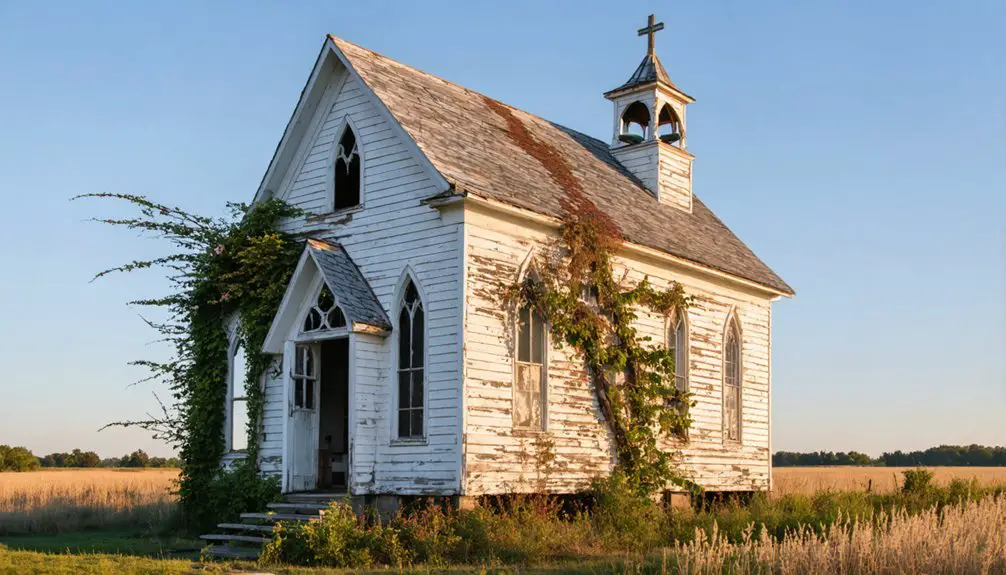
You’ll discover historic churches still anchoring these ghost towns, their weathered facades bearing witness to Mississippi’s complex past. The Rodney Presbyterian Church stands as a haunting testimony to the Civil War, its replica cannonball embedded above the balcony windows marking where Union gunboats struck the building.
As you wander through these ghost towns in Mississippi, you’ll find remnants of past lives, from crumbling homes to rusted vehicles long abandoned. Each location tells a story of prosperity followed by decline, leaving behind silent echoes of what once was. The landscape is dotted with remnants of the past, inviting exploration and reflection on the fleeting nature of time and community.
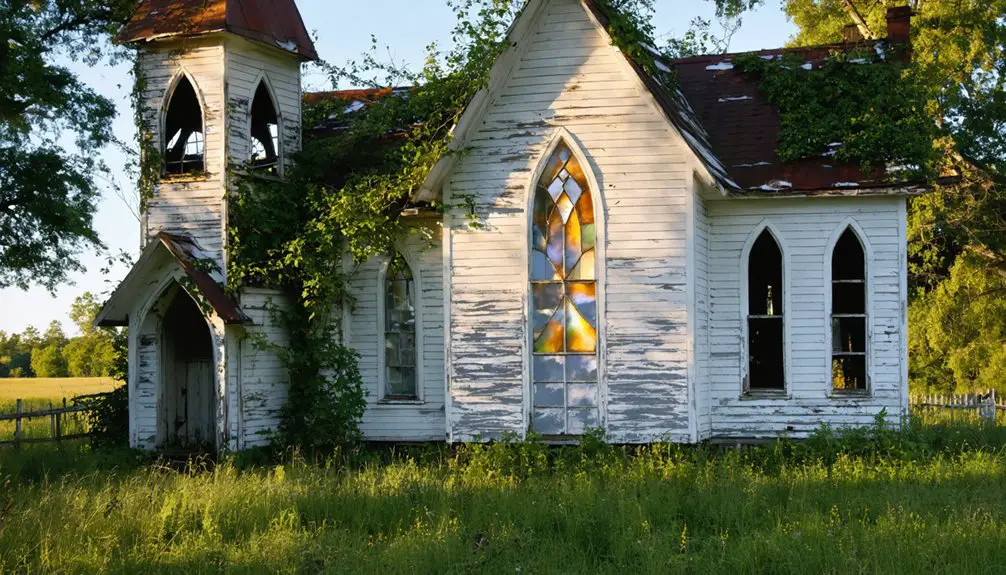
These structures showcase remarkable Carpenter Gothic details and eclectic architectural blends—like Mount Zion Baptist Church’s fusion of Greek Revival arches with Gothic Revival gables—while preservation groups work tirelessly to protect what remains of these sacred spaces. Beyond the churches, ghost town enthusiasts can explore abandoned antebellum estates like Stanton Hall from 1857, which once occupied an entire city block as a cotton broker’s residence. The influence of Creole, French, and Spanish architectural traditions can be seen throughout Mississippi’s abandoned religious structures, creating a distinctive regional character that sets these ghost town churches apart from those in other parts of the American South.
Historic Churches Still Standing
Among Rodney’s weathered remnants, three historic churches stand as the most compelling architectural survivors, each telling a distinct chapter of the town’s antebellum prosperity and gradual decline.
You’ll find the 1832 Rodney Presbyterian Church showcasing Federal-style red brick construction with distinctive fanlights. Its tower still bears Civil War cannonball damage. During an 1863 skirmish, Confederate cavalry surrounded the church during services and exchanged fire with Union sailors inside the sanctuary. A cannonball remains lodged in the church’s front, serving as a permanent reminder of this violent encounter.
The 1851 Mt. Zion Baptist Church presents striking Greek Gothic elements with a silver dome rising above surrounding woods. However, severe flood damage has left it derelict and vegetation-covered.
Sacred Heart Catholic Church, built in 1868, couldn’t withstand repeated submersion and was relocated to Grand Gulf Military Park in 1983.
These architectural styles—Federal, Greek Gothic, and Carpenter Gothic—represent Mississippi’s religious heritage. Though only Presbyterian Church remains accessible within the ghost town itself.
Carpenter Gothic Architectural Details
Standing 300 yards from the Mississippi River’s edge, Sacred Heart Catholic Church once showcased Mississippi’s finest example of Carpenter Gothic architecture before flood damage forced its 1983 relocation to Grand Gulf Military Park.
You’ll recognize this 1868 structure by its board and batten siding creating dramatic vertical lines that pierce skyward. Heavy label moldings frame each window and door, echoing medieval stone drip molds without the weight or cost.
Gothic pinnacles crown the roofline, adding spire-like drama against Mississippi skies. This wooden interpretation of grand European cathedrals made elaborate design accessible to post-Civil War congregations rebuilding from nothing. Irish immigrant Patrick Murphy erected the church on land deeded by George and Nancy Hay in 1867. The church now serves as a non-denominational chapel, hosting community events in its new location.
The church survived Union gunboat shelling in 1864, when USS Rattler’s cannons struck but couldn’t destroy its resilient frame—a testament to humble materials defying both warfare and time.
Preservation and Relocation Efforts
When Rodney’s Presbyterian Church threatened to collapse after 170 years of Mississippi weather, Angel Puckett rallied board members with deep family roots to form the Rodney History + Preservation Society in 2017.
You’ll witness restoration challenges firsthand—emergency stabilization battles against time while fundraisers seek matching investments.
The three-acre cemetery presents even tougher obstacles: 200 graves dating to 1828 buried beneath overgrowth, tombstones tumbled down embankments, and timber rattlers defending their territory. That 2015 snakebite requiring multiple antivenom doses wasn’t legend.
Community involvement transforms this ghost town each month.
You’ll find volunteers mowing church lawns, sweeping interiors, and clearing cemetery brush.
February 2019’s cleanup drew 65 determined souls.
Mississippi’s Archives and History Department backs these efforts with grants—$46 million distributed since 2001—proving preservation beats abandonment. The department also provides technical assistance to help guide restoration projects through complex historical preservation requirements. Churches and community buildings may qualify for Mississippi’s 25% state tax credit when rehabilitated according to the Secretary of the Interior’s Standards for Rehabilitation.
The Historic Cemetery: 200 Graves Tell Stories of the Past
Behind the Presbyterian church, you’ll navigate a steep dirt path that climbs to Rodney’s three-acre hilltop cemetery. At least 200 graves, dating back to 1828, lie hidden beneath dense overgrowth.
Tombstones have toppled and disappeared into vegetation, while some markers have tumbled down the embankment into the forest below. This makes the site easy to miss without prior knowledge.
These weathered graves reveal the stories of Rodney’s former population of nearly 4,000 residents, including German settlers and founding families. Their ancestors still visit this rambling, abandoned burial ground.
Steep Access Behind Church
The hidden path to Rodney’s Presbyterian Church cemetery won’t reveal itself easily. You’ll need to circle behind the 1832 red brick structure and climb a rough, heavily-rutted trail up the bluff. This graveyard access demands real physical effort—expect huffing and puffing as you ascend the steep dirt path through muscadine vines and poison ivy.
Once you reach the three-acre burial ground, you’ll discover:
- Over 200 graves dating back to 1828, many hidden beneath overgrowth and fallen trees
- Poignant inscriptions like “Angels guard thee until we meet to part no more”
- Revolutionary War Captain Philemon Hodges’ marker (1760-1848) resting among early settlers
The effort rewards you with an authentic exploration experience—no sanitized tourist site, just raw history waiting on that isolated hilltop.
Overgrown Tombstones and Markers
Scattered across three overgrown acres, over 200 graves disappear beneath tangled muscadine vines and fallen trees—some markers tumbled down the forest embankment, others swallowed entirely by decades of neglect. You’ll struggle to navigate this cemetery dating back to 1828, where botanical overgrowth claims more territory each season.
Marker erosion has rendered countless inscriptions illegible, their stories fading with each passing storm.
Despite the decay, you’re witnessing something remarkable—a raw, untamed monument where preservation groups battle nature’s reclamation. Each February, descendants and history enthusiasts descend on these grounds, wielding clippers and cameras to document what remains.
The Sons of Confederate Veterans join volunteers in pushing back the wilderness, though they’re fighting a losing battle.
You’ll experience history on its own terms here, unmanicured and uncompromising.
Evidence of Town’s History
Climbing the steep dirt path behind Rodney’s Presbyterian church, you’ll discover a three-acre graveyard that’s been documenting death—and life—since 1828. Among the 200+ graves, you’ll find historic relics proving this wasn’t some backwater settlement—Rodney once thrived with nearly 4,000 residents, briefly serving as Mississippi’s state capital.
The weathered markers reveal compelling evidence:
- German immigrant Lawrence Buerkle’s 1840s burial alongside other early settlers who built a river port rivaling St. Louis
- Ancestors of current locals like Kathy Moody, with dozens of family members resting here
- Tombstones commemorating residents who frequented Rodney’s banks, newspapers, hotels, and opera house
While local ghost stories swirl around these abandoned grounds, the cemetery‘s real power lies in its testament to ambition, community, and inevitable decline.
What Remains: Buildings and Structures Still Standing Today
Despite decades of abandonment and relentless flooding from the Mississippi River, Rodney’s most impressive structures still stand as weathered monuments to its former prosperity. You’ll find the 1832 Presbyterian Church, Mississippi’s finest Federal-style building, with a Civil War cannonball replica still embedded above its balcony. The slave gallery remains accessible via a narrow winding staircase.
Nearby, the 1851 Mt. Zion Baptist Church showcases Greek Gothic Revival architecture with its distinctive silver dome, now surrounded by wildlife habitats reclaiming the grounds. The circa 1890 Masonic Lodge and Alston’s Grocery from 1840 stand among scattered ruins.
Beyond the buildings, you can explore the three-acre cemetery containing 200+ graves dating to 1828, though flooding and time have toppled many markers into the undergrowth, far from any local cuisine.
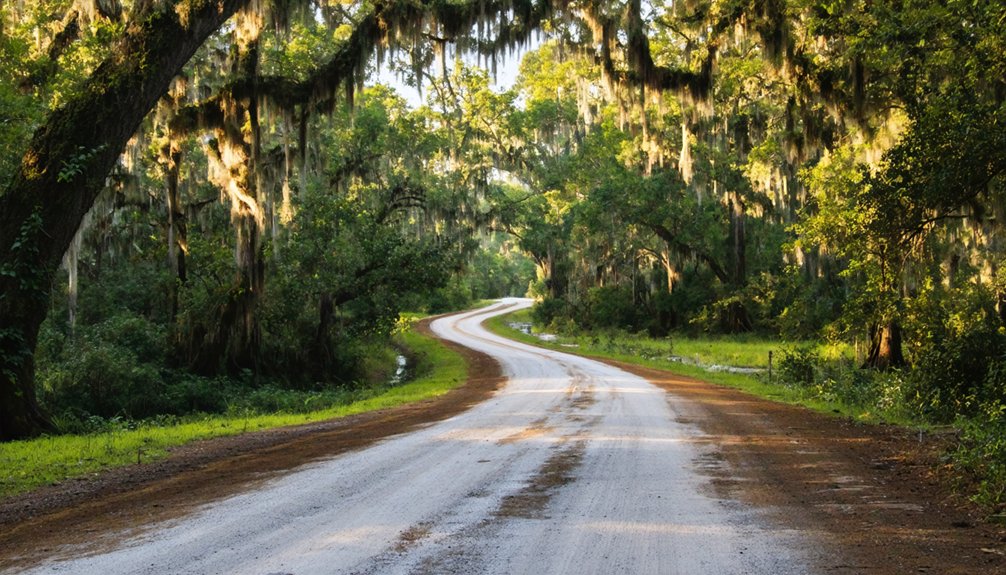
Reaching Rodney requires traversing one of Mississippi’s most challenging backroad journeys, a 12-mile adventure that tests both your vehicle and your commitment to exploring forgotten places.
Start behind the Old Country Store on Highway 61 in Lorman—grab some local cuisine before you go—then head northwest on what barely resembles a road. You’ll pass Cane Ridge Cemetery as surfaces shift between blacktop, dirt, and gravel.
Navigation Tips:
- Watch for the water tank marking Firetower Road, your alternative route from Route 552 west.
- Expect mud on the final stretch into former Commerce Street, especially after rain.
- Look for the curb when the road dips and repaves—this inexplicable subdivision-style border signals you’ve arrived.
Urban legends surround this isolated approach, adding mystery to your journey into Mississippi’s haunted past.
As you uncover the secrets of this region, you might be drawn to ghost towns in Mississippi to explore. Each site tells a story of abandoned dreams and whispers of those who once called these places home. The eerie silence and crumbling structures invite adventurous spirits to uncover the chilling history etched into the very soil.
These ghost towns in Mississippi history offer a glimpse into a bygone era, where vibrant communities once thrived before succumbing to time. Exploring these remnants, you’ll encounter tales of prosperity and decline, resonating with the spirits of those who left their mark. As you wander through abandoned streets, you may feel an unsettling connection to the past that lingers in the air.
The Rise and Fall of a Steamboat Era Boom Town
Before the river betrayed it, Rodney commanded the Mississippi’s commerce like few ports could match. By the 1850s, you’d have found yourself amid 4,000 residents in the region’s busiest port between New Orleans and St. Louis. River trade transformed this strategic landing into a powerhouse—35 stores, two banks, newspapers, and a grand hotel with ballroom lined its streets.
Cotton receipts functioned as currency while steamboats loaded millions of pounds bound for distant markets.
The Civil War impact proved devastating. After capturing 17 Union sailors at church in 1863, Confederate cavalry couldn’t prevent eventual Union retaliation—soldiers from Vicksburg plundered nearly every home. Then nature delivered the killing blow: a sandbar formed around 1870, shifting the Mississippi three miles westward, eliminating Rodney’s lifeblood overnight.
Planning Your Visit: Nearby Attractions and Preservation Efforts
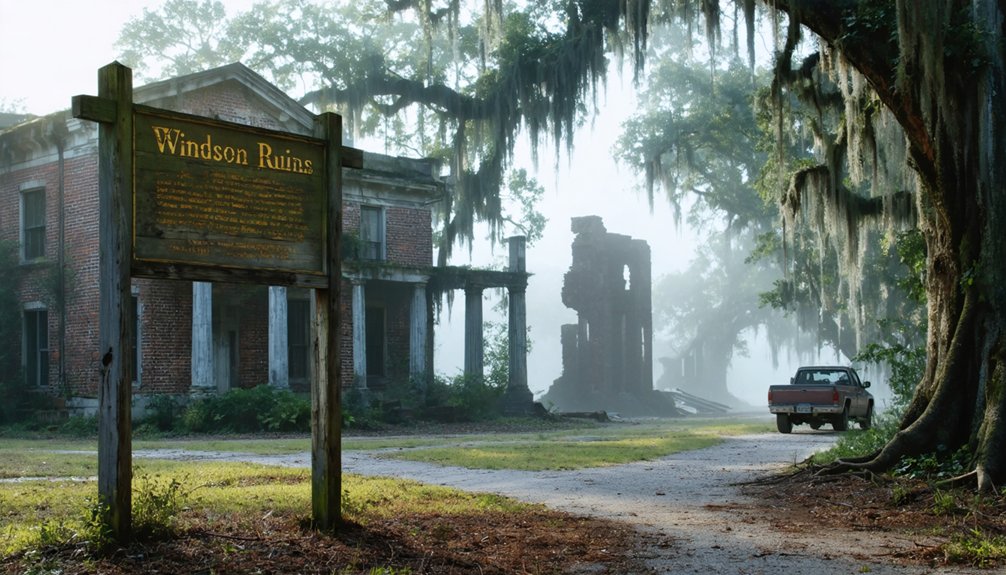
Today’s Rodney stands quietly accessible just off the Natchez Trace Parkway near Lorman, where you’ll discover preservation efforts have kept the town’s most striking features intact.
The National Park Service maintains walking trails through these atmospheric ruins, while the Greek Gothic Baptist Church‘s silver dome and red-brick Presbyterian Church showcase architectural grandeur frozen in time.
Essential visiting considerations:
- Winter months offer ideal exploration conditions with minimal local wildlife concerns and comfortable temperatures for trail hiking.
- Rocky Springs provides free primitive camping with 22 first-come, first-served sites featuring picnic tables and restrooms.
- Combine ghost town visits with nearby Owens Creek Waterfall and spring-fed trails for complete Natchez Trace experience.
Seasonal festivals occasionally enliven these forgotten streets, though Rodney’s authentic appeal lies in its undisturbed solitude and remarkably preserved nineteenth-century structures.
Frequently Asked Questions
Are There Any Safety Concerns When Exploring Rodney’s Abandoned Structures?
Yes, you’ll face serious structural stability threats—beams leaning precariously, floors collapsing beneath feet. You’re trespassing on private property at your own risk. Bring safety gear, watch for snakes, and never enter these dangerously deteriorating buildings alone.
Is There an Admission Fee to Visit Rodney Ghost Town?
No, you won’t pay anything to explore Rodney Ghost Town. It’s completely free to visit this open historic site, though you’ll find minimal visitor amenities or formal historical preservation—just authentic, unguarded ruins waiting for your discovery.
Can Visitors Enter the Remaining Churches and Buildings in Rodney?
You can explore the historic architecture of Rodney’s remaining churches and buildings freely. Despite ongoing preservation efforts, these structures sit open to adventurous visitors who don’t mind traversing flood damage and overgrown paths to experience authentic ruins.
What Are the Best Times of Year to Visit Rodney?
You’ll find winter offers the best visit to Rodney, when cooler seasonal weather keeps venomous snakes dormant and allows safe exploration. The comfortable temperatures also provide ideal conditions for best photography while you roam this atmospheric ghost town freely.
Are Guided Tours Available at Rodney Ghost Town?
No official guided tours exist—you’re free to forge your own path through Rodney’s historical significance. Local guides occasionally offer excursions, but self-exploration delivers the best photographic opportunities, letting you discover this haunting relic at your own pace.
References
- https://en.wikipedia.org/wiki/List_of_ghost_towns_in_Mississippi
- https://kids.kiddle.co/List_of_ghost_towns_in_Mississippi
- http://sites.rootsweb.com/~mstttp/ghosttowns.htm
- https://freepages.rootsweb.com/~gtusa/history/usa/ms.htm
- https://mississippifolklife.org/articles/haunted-by-a-ghost-town-the-lure-of-rodney-mississippi
- https://theforgottensouth.com/rodney-mississippi-ghost-town-history-tour/
- https://www.geotab.com/ghost-towns/
- https://www.tripadvisor.com/Attraction_Review-g28945-d10045204-Reviews-Rodney_Ghost_Town-Mississippi.html
- https://backroadplanet.com/haunting-rodney-mississippi/
- https://www.susantregoning.com/blog/rodney-ghost-town