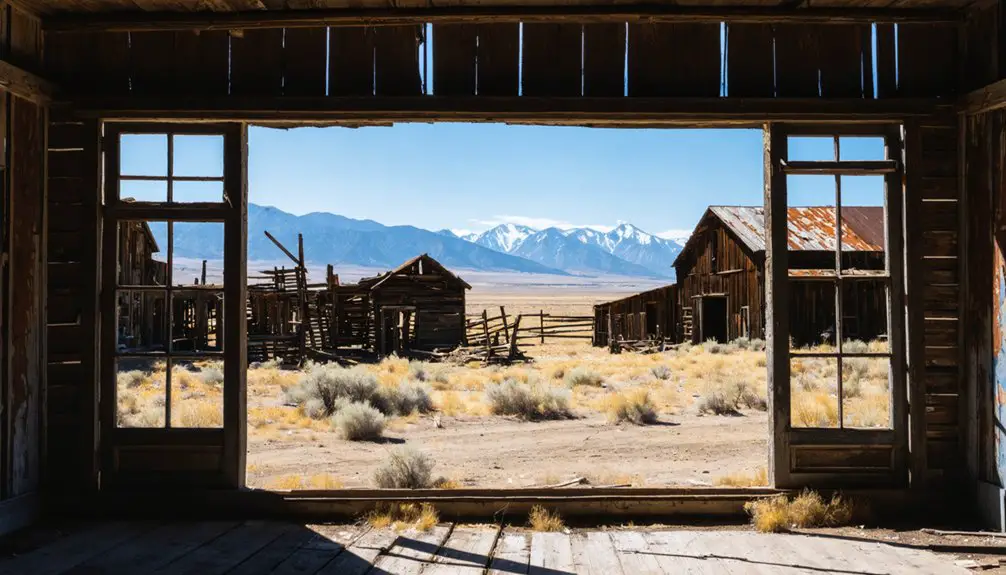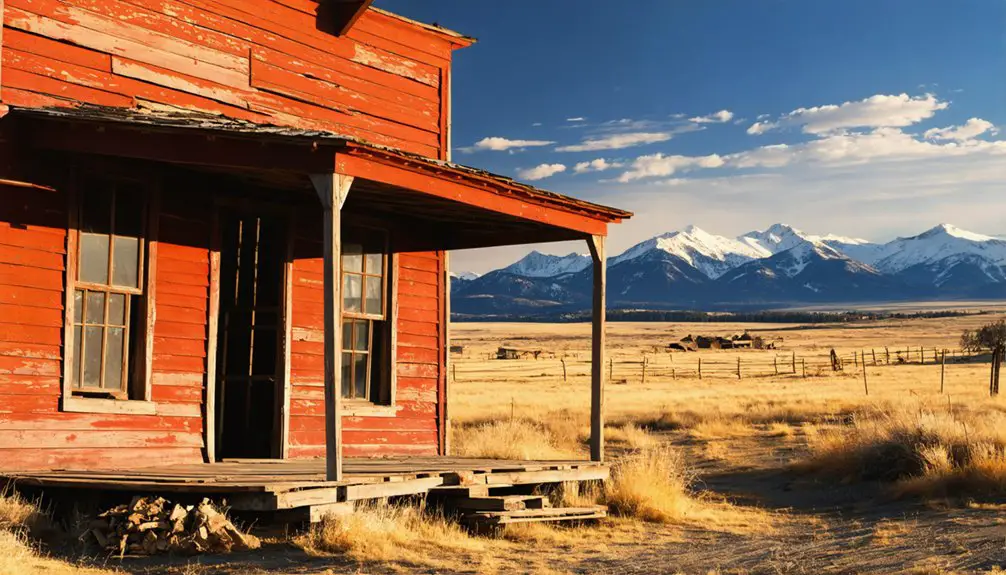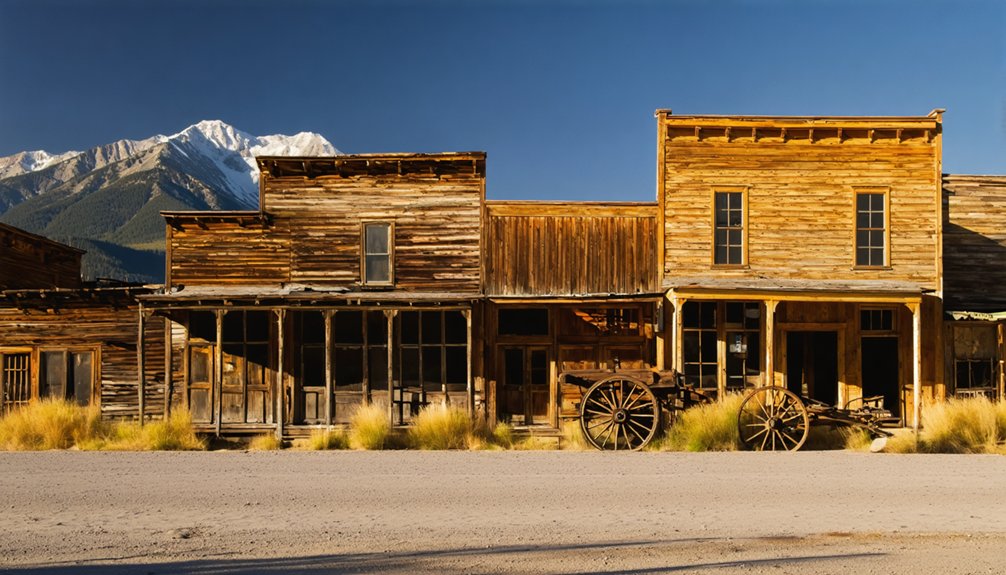
You’ll find Montana’s best-preserved ghost towns scattered across mountain valleys where 19th-century prospectors struck it rich. Bannack State Park, the site of Montana’s first major gold rush, features over 50 original structures from the 1860s. Virginia City offers living history demonstrations among 100+ authentic buildings, while Garnet’s remote location at 6,000 feet elevation keeps it remarkably intact. Granite earned its “Silver Queen” title producing $40 million before the 1893 crash. Each weathered building and rusted mining relic tells stories of frontier fortunes won and lost.
Key Takeaways
- Bannack State Park features over 50 original structures from Montana’s first gold rush and is designated a National Historic Landmark.
- Virginia City offers living history demonstrations across 100 buildings with 1.2 million artifacts; admission is $10–$12 per adult.
- Garnet Ghost Town sits at 6,000 feet elevation and is Montana’s best-preserved ghost town with six intact structures including saloons.
- Granite Ghost Town was once “Montana’s Silver Queen,” yielding $40 million before the 1893 silver crash; requires 4WD access.
- Marysville features the 1886 Methodist-Episcopal Church and remnants of the Drumlummon Mine, which produced half the region’s pre-1900 gold.
Bannack State Park
On July 28, 1862, John White and his fellow Pikes Peakers crouched along Grasshopper Creek’s muddy banks, panning for color in the cold Montana water. Their strike sparked Montana’s first major gold rush, pulling over 3,000 fortune-seekers to this remote valley by 1863.
You’ll walk streets where Sheriff Henry Plummer secretly ran the “Innocents” gang until vigilantes strung him up in 1864. Mining technology of that era yielded over $500,000 in gold that first year alone.
The territorial capital stood here briefly before everyone chased richer strikes to Alder Gulch.
Today’s ghost town preservation efforts maintain over 50 original structures frozen in time. The site earned recognition as a National Historic Landmark, cementing its importance in preserving the American frontier experience. Montana’s Fish, Wildlife, and Parks keeps Bannack authentic—no tourist traps, just raw history you’re free to explore on foot. The park welcomes visitors year-round with seasonal hours, from 8 a.m. to 9 p.m. in summer and 8 a.m. to 5 p.m. during winter months.
Virginia City
You’ll find Virginia City’s story begins with a $100 million secret—the richest placer gold strike in the Rockies, discovered in Alder Gulch back in 1863. Today, you can walk through 30+ preserved buildings that Charles and Sue Bovey rescued from decay in the 1940s, transforming this former territorial capital into a living Victorian museum.
Where you’ll spot gallows on Boot Hill and ride a narrow-gauge railroad between ghost towns. The Montana Heritage Commission manages over 250 buildings and operates key attractions including panning experiences and museums. The town attracts approximately 70,000 visitors annually, though only 150 residents call it home year-round. The journey requires commitment: you’re looking at a 90-mile drive from Yellowstone’s west entrance, but you’ll be rewarded with an authentic mining camp frozen in time.
Gold Rush History
The strike that would transform Montana Territory began unremarkably enough—a group of prospectors including William Fairweather and Henry Edgar stumbled upon placer gold in an alder-choked streambed on May 22, 1863.
What followed became the stuff of gold rush legends.
Alder Gulch’s staggering wealth attracted 10,000 fortune-seekers by fall 1863, creating an eleven-mile continuous settlement. The numbers tell the story:
- First three seasons: $30 million in placer gold extracted using ancient mining techniques.
- Peak population: 10,000 residents spawned eight distinct towns along the gulch.
- Total production: An estimated $100 million throughout the 18th-19th centuries.
You’ll find remnants of hydraulic operations, Chinese reworked claims, and early dredging sites—testament to miners who chased freedom and fortune through Montana’s richest Rocky Mountain placer strike. Virginia City’s success elevated it to serve as Montana’s territorial capital from 1865 to 1875, cementing its political importance beyond mere mineral wealth. The community’s population was notably diverse, with approximately one-third of residents being Chinese in 1870, alongside Euroamericans, Lemhi Shoshone, Mexicans, and African Americans.
Living Museum Experience
Standing amid Nevada City’s weathered boardwalks, you’ll encounter something far richer than a typical museum experience—this is one of America’s largest outdoor collections of Old West artifacts outside the Smithsonian itself.
With 1.2 million pieces spread across one hundred buildings from the 1860s-1900s, you’re free to wander at your own pace through authentic frontier life.
On summer weekends, living history interpreters transform the ghost town into a working community. You’ll watch blacksmiths hammer glowing iron, try your hand at faro in the saloon, and engage with interactive crafts using period-accurate tools.
These historical reenactments aren’t staged performances—they’re genuine demonstrations of frontier skills.
The Music Hall houses Charles Bovey’s impressive collection of automated music machines, including player pianos, violanos, and band organs that you can activate with quarters.
You can explore notable historic structures like the Criterion Hall, Sedman House, and the Gallows Barn as you walk through the outdoor museum.
Adults pay $12 on weekends ($10 weekdays), with reduced rates for seniors and children.
Last entry’s at 5 PM daily through Labor Day.
Getting to Virginia City
Perched at 5,892 feet in Madison County’s mountainous terrain, Virginia City sits along the historic Alder Gulch where gold fever once gripped thousands. You’ll find this authentic mining legends hub in Montana’s southwestern reaches, where haunted folklore whispers through weathered boardwalks.
Planning Your Journey:
- From Bozeman: Drive 75 miles west through spectacular mountain passes—roughly 90 minutes of unbridled landscape.
- From Yellowstone: Head north 85 miles, combining your park adventure with Old West exploration.
- Navigation: Use coordinates 45.29611°N, 111.93694°W for precise GPS routing to zip code 59729. For technical mapping purposes, the location corresponds to UTM zone 12T with specific easting and northing measurements used in surveying applications.
The remote location (population 219) demands preparation. Fill your tank beforehand—gas stations vanish quickly in Montana’s vast spaces. You’re entering America/Denver timezone territory, where cellular service becomes sporadic and freedom feels tangible. While Nevada’s Virginia City maintained over 100 saloons during its 1870s heyday, Montana’s namesake offers its own distinct frontier atmosphere.
Elkhorn State Park
Deep in the Elkhorn Mountains at nearly 6,500 feet elevation, Montana’s smallest state park preserves just two weathered structures on less than an acre of land. You’ll find Fraternity Hall and Gilliam Hall standing as silent witnesses to mining history that once drew 2,500 souls chasing silver dreams.
Montana’s smallest state park: less than an acre preserving two weathered halls where 2,500 silver dreamers once gathered.
The Elkhorn Mine pulled $14 million from these mountains before the 1893 Silver Crash devastated everything.
You’ll navigate 13 miles of gravel road from Boulder—a 30-minute journey into authentic Western solitude.
The preservation efforts here feel invigoratingly minimal: no guided tours, no gift shops, just open buildings you can explore freely.
Beyond the park, 75 former structures are marked only by weathered signs, while Elkhorn Cemetery‘s 1880s headstones tell stories of diphtheria and frontier hardship that shaped this rugged landscape.
Marysville
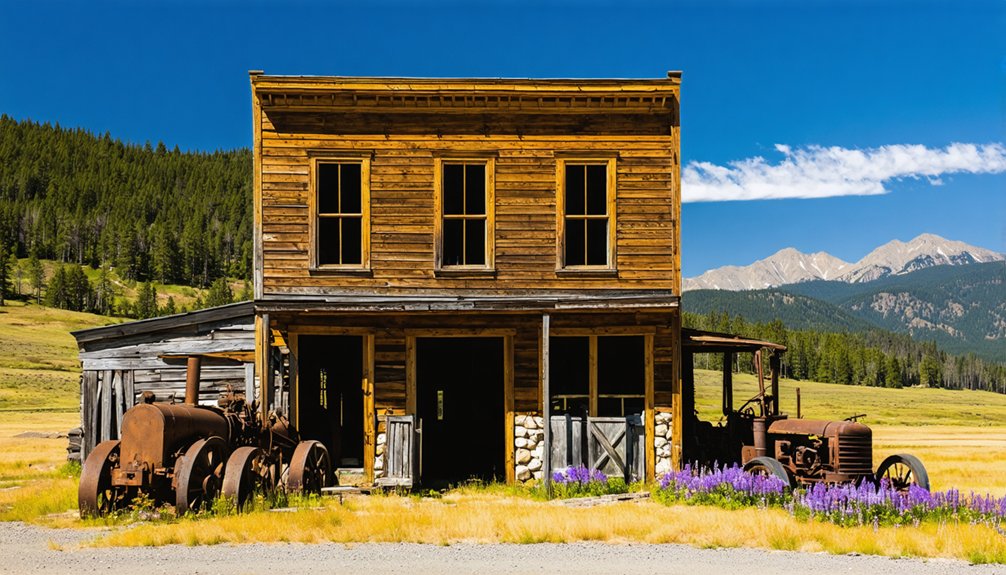
Twenty miles northwest of Helena, you’ll discover where Irish Tommy Cruse struck the motherlode in 1876—a gold vein so rich it transformed Silver Creek into Marysville, once the world’s leading gold producer.
The Drumlummon Mine alone churned out half the region’s $50-60 million in gold before 1900.
Today’s semi-ghost town preserves its mining legends through historic buildings on the National Register:
- The 1886 Methodist-Episcopal Church, Marysville’s most photographed structure
- J.A. Shaffer Mercantile from 1895, standing sentinel over empty streets
- Nels Lund Saloon, where prospectors once celebrated strikes
Haunted tales linger—locals whisper about the headless woman wandering Bald Butte and the hook-handed miner prowling American Gulch.
With fewer than 100 residents, you’ll explore picturesque cabins dotting hillsides, mining remnants, and interpretive signs documenting when this outpost nearly eclipsed Helena itself.
Rimini
Just sixteen miles south of Helena, Rimini sprawls across a narrow valley where Ten Mile Creek cuts between Red Mountain and Lee Mountain—a silver camp that nearly vanished after the 1893 crash but refused to die completely.
You’ll find ghost town preservation meeting real life here. Permanent residents still call Rimini home, their numbers swelling on summer weekends when seasonal cabin owners return. The 1904 schoolhouse—now a community hall—anchors the settlement, while interpretive signs guide you through mining history spanning over 100 operations that pulled $7 million from these hills.
No gates, no admission fees, no guided tours. Just open roads through Helena-Lewis and Clark National Forest leading to false-front buildings and restored miners’ cabins. The Porphyry Dike Mine‘s skeletal remains remind you why this place survived.
Granite Ghost Town
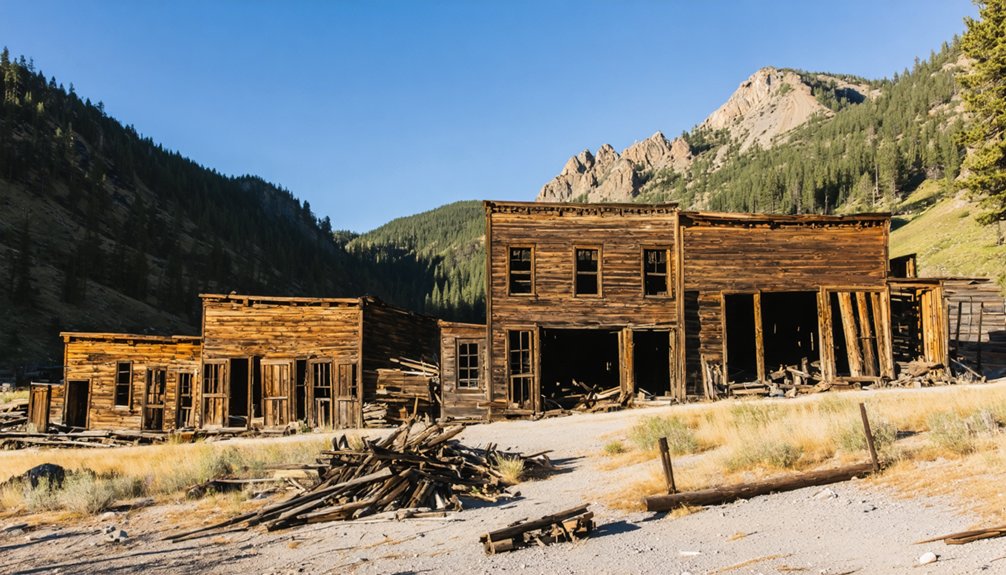
While most mining camps scratched modest livings from Montana’s mountains, Granite Ghost Town earned its crown as “Montana’s Silver Queen”—the richest silver mine on earth that pulled $40 million from a mountainside discovered by sheer accident.
From accidental discovery to Montana’s Silver Queen—$40 million in riches earned Granite its legendary crown as earth’s richest silver mine.
You’ll find mining history preserved across this windswept site where 3,000 souls once thrived. The 1893 silver crash emptied this boomtown within months, leaving behind:
- Miners’ Union Hall ruins – three-story skeleton where miners danced and organized
- 100-stamp mill remains – testament to $250,000 monthly production peaks
- Mine superintendent’s house – fully preserved relic of prosperity
Ghost town preservation efforts maintain trails threading through scattered foundations along Finnlander Lane and Cornish Row.
You’ll need 4WD for the four-mile climb from Philipsburg—winter snows seal this mountain fortress, just as economic forces did in 1893.
Garnet Ghost Town
At 6,000 feet in the Garnet Mountains, where garnet-flecked granite glints ruby-red in the afternoon sun, you’ll discover Montana’s best-preserved ghost town frozen in time since the last resident locked up in 1950.
You’re free to wander past Kelly’s Bar, Dahl’s Saloon, and the J.R. Wells Hotel—sixteen structures standing exactly as miners left them.
Mining relics scatter the landscape: rusted stamp mills, abandoned shafts from fifty separate claims, and weathered headframes marking veins that yielded nearly $1.4 million in gold.
Preservation efforts by the BLM and Garnet Preservation Association mean you’ll explore authentically, without theme-park fakery.
The 1912 fire’s charred foundations remain untouched.
Drive the rough road east from Missoula yourself—no guided tours required.
Just you, elevation, and history.
Castle Town
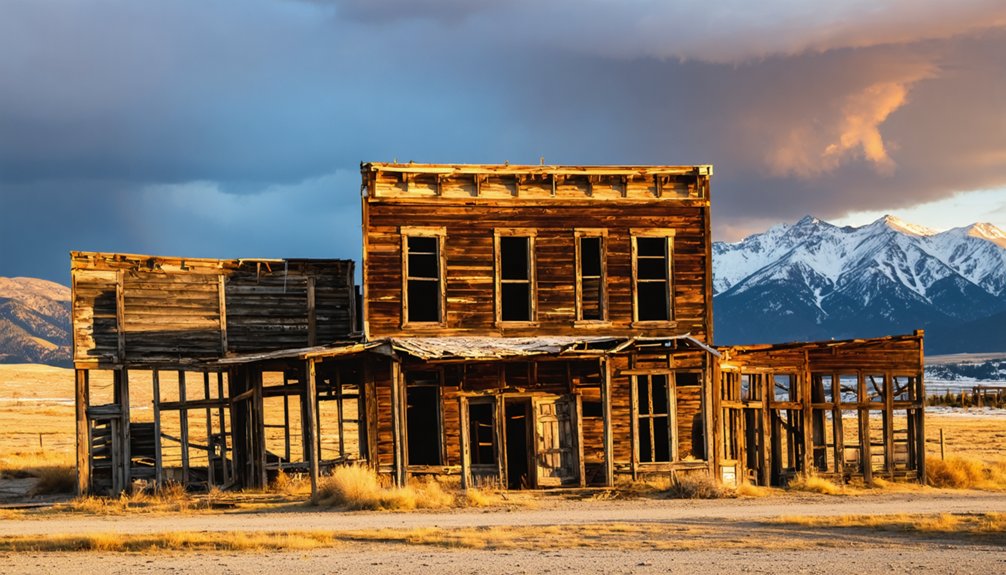
South of White Sulphur Springs, where Castle Mountain’s silver-veined slopes once echoed with stamp mill thunder, weathered structures mark what 2,000 fortune-seekers called home in the 1890s.
You’ll find this authentic ghost town architecture off Highway 294, where a dozen buildings still stand defiant against Montana’s elements.
Exploring the abandoned towns of Montana reveals a glimpse into the past, with remnants of old storefronts and dilapidated homes telling stories of a once-thriving community. Each town holds its own unique history, enticing adventurers and history buffs alike to uncover hidden tales and forgotten relics. As you wander the quiet streets, the haunting beauty of these places becomes a powerful reminder of time’s passage.
What remains standing:
- Original cabin structures from the 1880s boom
- The weathered schoolhouse where miners’ children studied
- Stone foundations marking fourteen saloons and merchant establishments
Historic silver mines like the Cumberland produced ore here until 1950, though the 1893 Silver Panic emptied most claims decades earlier.
You can view the site from public roads, but venturing onto private property requires permission.
The town’s isolation—what once made transportation costs prohibitive—now preserves its authentic frontier character.
Comet
Twenty miles south-southwest of Helena, where High Ore Creek cuts through Jefferson County’s high desert terrain, the ghost town of Comet sprawls across 35 acres of private grazing land that welcomes curious visitors.
You’ll find over two dozen crumbling structures frozen in time since 1941, when workers abandoned their tools mid-shift and never returned.
The mining history here runs deep—$20 million in silver, gold, and copper flowed from these hills between 1883 and 1941, supporting 1,000 residents at peak operation.
Today, ghost town preservation efforts rely on volunteers and nature’s mercy.
Access Comet via High Ore Road north from I-15 exit 160.
You’ll explore Rosie’s boarding house, the ore hopper, and processing plant freely—no admission fees, no restrictions, just authentic Western abandonment.
Coolidge
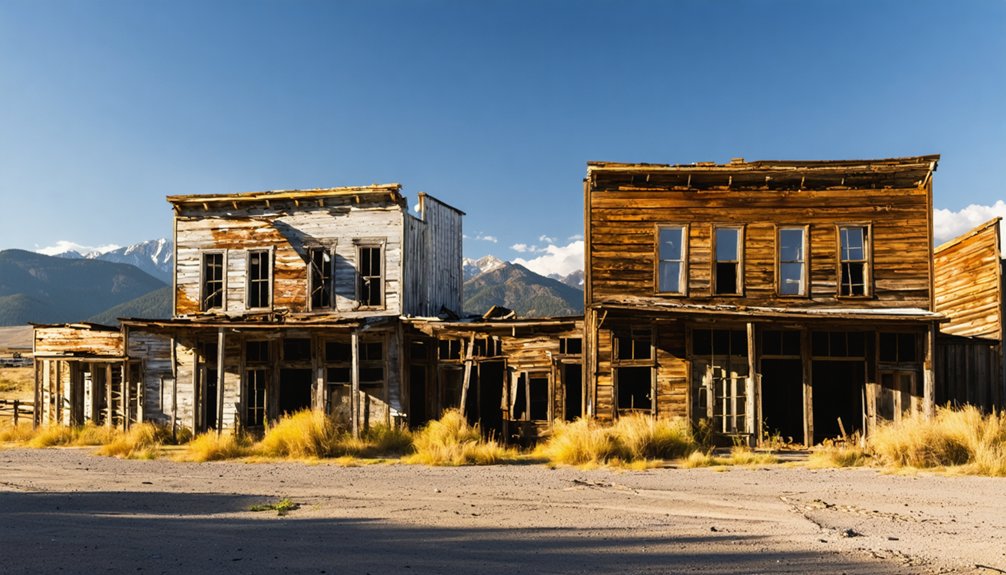
- Tar paper structures replaced tent camps as 450 residents built their silver dreams.
- Double-walled saunas insulated with sawdust provided relief after brutal shifts underground.
- Company stores and boarding houses formed the community’s backbone.
When silver prices collapsed in 1923, followed by the catastrophic 1927 dam failure, freedom-seeking prospectors abandoned their claims.
Today, you’ll explore crumbling buildings slowly returning to wilderness—a National Register site offering authentic glimpses into Montana’s rugged past.
Frequently Asked Questions
What Is the Best Time of Year to Visit Montana Ghost Towns?
Picture yourself wandering sun-baked streets in late summer—that’s Montana’s sweet spot. The best visiting seasons run June through September, when you’ll dodge seasonal weather threats like spring mud and winter’s road-blocking blizzards while exploring freely.
Are Montana Ghost Towns Safe to Explore With Children?
Montana’s ghost towns are generally safe for children with proper safety precautions—watch for unstable structures and wildlife. You’ll find family-friendly activities like exploring old buildings and gold panning, creating unforgettable adventures while respecting these historic sites.
Many visitors are drawn to the allure of ghost towns in western Montana, where the tales of the past come alive in crumbling structures and rugged landscapes. As you wander through these remnants of history, take the time to appreciate the stories behind each abandoned site, fostering a connection to the rich heritage of the region. These explorations not only provide an educational experience but also inspire a sense of wonder about the lives once lived in these now-quiet towns.
Do I Need Special Permits to Visit Ghost Towns in Montana?
You won’t need to swipe any digital passes at most sites. Permit requirements vary—BLM locations like Garnet charge $10 daily fees, while Granite needs $8 vehicle passes. Legal restrictions? Minimal. Just respect preserved buildings and you’re golden.
Can I Camp Overnight Near Montana Ghost Town Sites?
Yes, you can camp near most Montana ghost towns with proper camping gear and safety precautions. Bannack offers designated sites, while Garnet permits free dispersed camping beyond a half-mile radius. Always follow Leave No Trace principles.
What Should I Bring When Visiting Remote Montana Ghost Towns?
Montana has over 60 documented ghost towns. You’ll need essential travel gear: detailed maps, extra fuel, and water. Critical safety precautions include first-aid kits, layered clothing for sudden weather shifts, and emergency tools since cell service disappears completely.
Exploring ghost towns in Montana history can feel like stepping back in time. Each town carries stories of the past, revealing the challenges and triumphs of those who once called them home. Be prepared to encounter remnants of mining operations and old railroads that tell tales of a rugged frontier.
As you wander through these ghost towns in Montana’s history, you may find yourself uncovering artifacts that hint at daily life during more prosperous times. Photographers and historians alike are drawn to these eerie remnants, captivated by the juxtaposition of nature reclaiming spaces once bustling with human activity. Each visit provides a unique perspective on the state’s rich and complex narrative, making it a fascinating endeavor for those interested in the past.
References
- https://www.roamingnearandfar.com/montana-ghost-towns-near-helena/
- https://en.wikipedia.org/wiki/List_of_ghost_towns_in_Montana
- https://www.mountain-home.com/blog/vacation-planning/guide-montana’s-ghost-towns
- https://southwestmt.com/pdfs/Southwest-Montana-Ghost-Towns-Printable-Map.pdf
- https://www.youtube.com/watch?v=BQH5LghhkVs
- https://www.youtube.com/watch?v=BNDINIXiOqw
- https://visitmt.com/things-to-do/ghost-towns
- https://fwp.mt.gov/stateparks/granite-ghost-town
- https://montanastateparksfoundation.org/parks/bannack-state-park/
- https://www.bannack.org/about/bannack-state-park