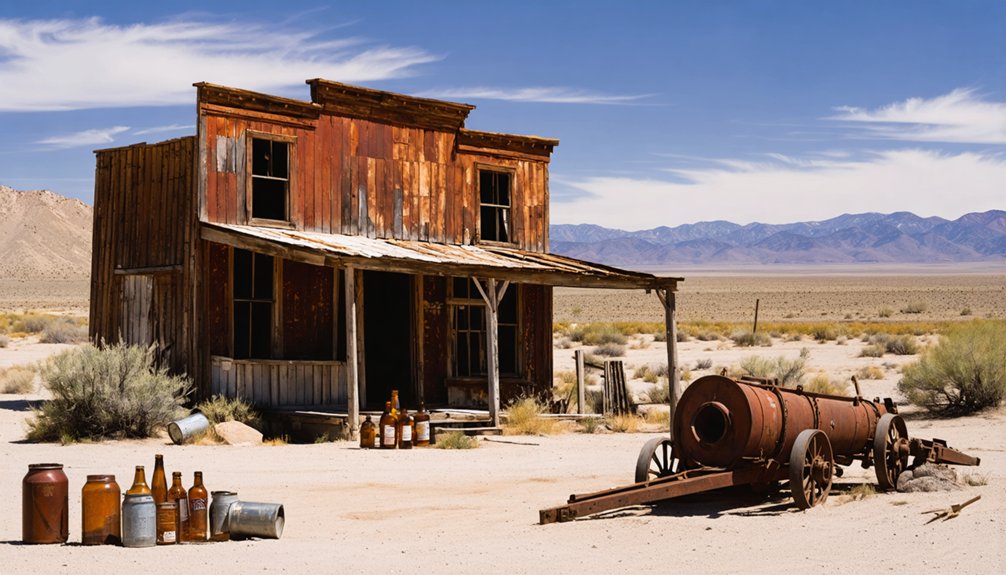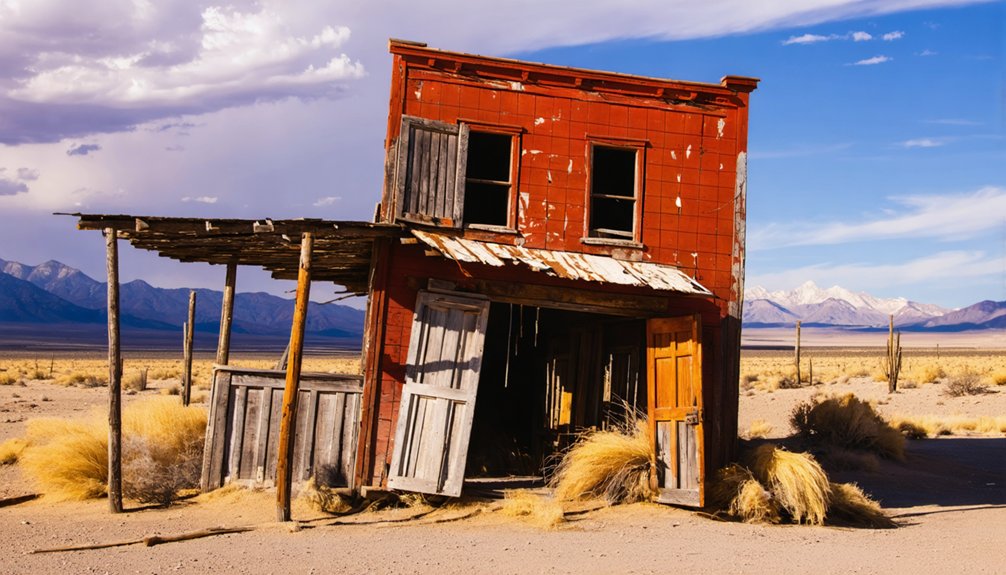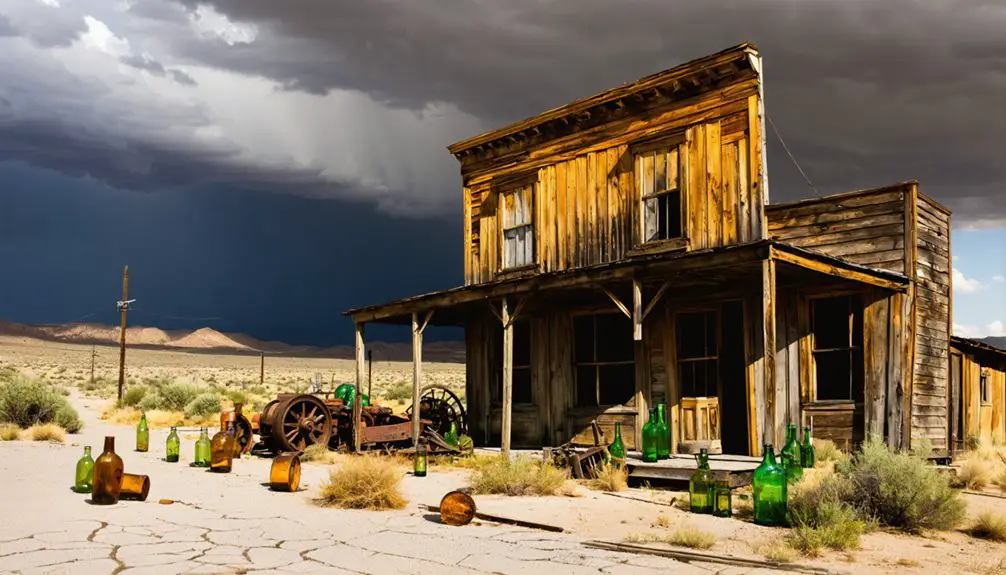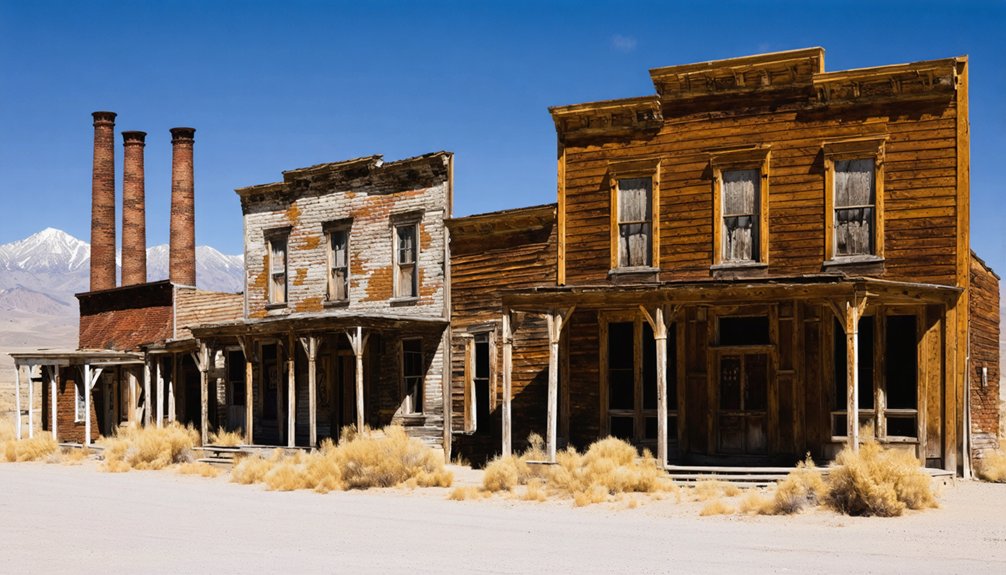
You’ll find Nevada’s most compelling ghost towns scattered across desert highways, each telling stories of boom-and-bust mining heritage. Rhyolite showcases gold-rush architecture including a famous bottle house, while Goldfield preserves 120 structures from its 30,000-resident peak. Belmont‘s 1876 courthouse stands remarkably intact 75 miles from Tonopah, and remote Jarbidge marks America’s last stagecoach robbery site. Near Las Vegas, Goodsprings‘ Pioneer Saloon still displays authentic bullet holes from frontier shootouts. Spring and fall offer ideal exploring conditions, though these remote sites demand careful planning for photography, safety protocols, and the unpaved roads that reveal Nevada’s preserved mining past.
Key Takeaways
- Rhyolite features iconic ruins including a bottle house and $90,000 bank building, protected by BLM near Death Valley.
- Goldfield offers 120 historic structures spanning 200 acres, including the haunted 1908 Goldfield Hotel and restored courthouse.
- Belmont’s preserved 1876 brick courthouse and silver mining remnants are listed on the National Register of Historic Places.
- Jarbidge sits in remote northern Nevada, featuring 1910s buildings and the site of America’s last stagecoach robbery in 1916.
- Goodsprings’ Pioneer Saloon retains authentic Wild West character with bullet holes, original 1880s bar, and surrounding desert wild horses.
Rhyolite: Nevada’s Most Photographed Ghost Town
On August 4, 1904, prospectors Frank “Shorty” Harris and Ernest “Ed” Cross struck high-grade gold ore in Nevada’s Bullfrog Hills, igniting one of the Silver State’s most spectacular boom-and-bust stories.
Within six months, Rhyolite exploded to 5,000 residents, boasting 50 saloons, three railroads, and a $90,000 bank building. The town’s mines produced over $1 million in bullion within three years—equivalent to $27 million today. Over 85 mining companies operated in the area, with the Montgomery-Shoshone mine leading production.
Rhyolite erupted from desert dust to boomtown glory in mere months, its mines churning out millions as three railroads hauled fortune-seekers westward.
The 1907 financial panic triggered Rhyolite’s collapse. By 1920, only 14 people remained among crumbling structures and abandoned underground tunnels.
Today, you’ll find the Bureau of Land Management protecting these ancient artifacts of Nevada’s mining heritage. The iconic Cook Bank Building and Tom Kelly’s Bottle House—constructed with 50,000 beer bottles—stand as monuments to frontier ingenuity near Death Valley National Park’s eastern boundary. The Bottle House was restored in 1925 by Paramount Pictures, preserving one of Rhyolite’s most unique structures.
Goldfield: From 30,000 Souls to Haunted Remnants
You’ll find Goldfield’s historic downtown remarkably preserved, with original brick buildings lining streets where 30,000 fortune-seekers once rushed during Nevada’s greatest gold boom.
Start your walking tour at the legendary Goldfield Hotel, a four-story monument to 1908 opulence that’s been shuttered since 1945—locals swear its empty halls harbor restless spirits from the mining era. The Esmeralda County Courthouse, built in 1907, still operates today with its original Tiffany lamps and period furnishings on display.
The authentic Sagebrush Saloons downtown offer another glimpse into the town’s raucous past, where paranormal encounters reportedly outnumber the living patrons who still belly up to century-old bars. In 1910, the town reached its zenith when ore production peaked at a staggering $11 million in value, making Goldfield one of Nevada’s richest mining districts.
Historic Downtown Walking Tour
Walking through Goldfield’s dusty streets today, you’ll find it hard to imagine that this collection of weathered buildings once housed Nevada’s largest city. The 200-acre Historic District preserves nearly 120 structures from the 1904-1909 boom, when 20,000 residents crowded these blocks.
You’ll discover mining legends etched into every corner—from the brick courthouse that arrived with the county seat in 1907 to headframes still standing sentinel over abandoned shafts.
The 1923 moonshine explosion destroyed most wooden buildings, leaving primarily stone and brick survivors. Preservation challenges mount as structures weather another century, but the district’s National Register status since 1982 helps protect these remnants.
Mill foundations and mine dumps frame your walk, testament to $2.3 million in ore that built this now-silent empire. Today’s remaining residents maintain a median household income of $121,094, suggesting the modern community bears little resemblance to the frenzied mining camp of yesteryear. The current population has dwindled to just 231 residents, a stark contrast to the tens of thousands who once sought their fortunes here.
Haunted Hotel and Saloon
The Goldfield Hotel rises four stories above the dusty streets, its Edwardian facade dominating the town’s skyline as Nevada’s most notorious haunted landmark.
Built in 1908 for $400,000, this once-spectacular 150-room establishment now attracts ghost hunters and thrill seekers exploring its documented hotel hauntings. The hotel served as luxurious accommodations for upper-class clientele traveling between Chicago and San Francisco during its heyday. Designed by George E. Holesworth, the hotel featured crystal chandeliers, gold-leaf ceilings, and mahogany walls throughout its 154 rooms.
The most famous ghost sightings center on Elizabeth, a prostitute allegedly chained in room 109, where visitors report hearing cries for her lost child.
You’ll encounter additional paranormal activity throughout:
- The Stabber menaces guests in the Gold Room with a kitchen knife before vanishing
- Three child spirits tap shoulders in the mahogany-trimmed lobby, then giggle and disappear
- Cigar smoke signals George Wingfield’s presence on the first floor
- Human remains discovered near the elevator shaft hint at darker secrets
- A suicide victim pledged to become the hotel’s newest ghost in 2017
Belmont: 150-Year-Old Silver Mining Heritage
You’ll find Belmont’s 1876 brick courthouse standing remarkably intact among the ruins, 80 km northeast of Tonopah in Nevada’s remote central basin.
This former Nye County seat thrived from 1865 to 1889, when miners extracted $15 million worth of silver from ore averaging 25 ounces per ton.
The scattered foundations of stores, saloons, and mill works now mark where 2,000 residents once sustained a cosmopolitan community complete with a Music Hall, racetrack, and Chinatown. The richest deposits occurred as silver chloride cerargyrite above the water table, while deeper sulfide ores required expensive pumping that eventually made mining uneconomical.
The entire town was listed on the National Register of Historic Places in 1972, recognizing its significance as one of Nevada’s best-preserved mining communities.
Historic Courthouse and Ruins
Perched on a high-desert hillside where vigilante justice once reigned, Belmont’s brick courthouse stands as Nevada’s most authentic monument to frontier governance. Completed July 4, 1876, this $20,000 structure replaced rope justice with formal trials until 1905.
You’ll find every brick was fired locally, foundation rock quarried from surrounding terrain, and Sierra forest timber hauled by wagon to this remote outpost.
What You’ll Discover:
- Original 1876 roof showcasing exceptional craftsmanship
- Square wooden cupola crowning the brick façade
- Historic jail cells returned from Gabbs, viewable at rear
- Guided tours May-September revealing 150-year-old architecture
- Unmarked graves beneath piñon pine where vigilante victims rest
Restoration efforts by Friends of the Belmont Courthouse continue despite preservation challenges in Nevada’s harsh desert climate.
Remote Central Nevada Location
Deep in Nevada’s high desert, Belmont sits isolated along a rugged mountain slope 75 miles northeast of Tonopah, accessible only by unpaved roads that wind through sage-covered valleys. You’ll find this forgotten mining camp at an elevation where silica formations once concealed some of the richest silver deposits in Nye County’s history.
The journey itself embodies the spirit of exploration—no gas stations, no cell service, just raw desert landscape stretching endlessly. During its 1865-1889 heyday, ore averaged 25 ounces of silver per ton, extracted from shallow workings above the water table.
Today, adventurous rockhounds still discover remnants of mineral collections on century-old mine dumps, where silver chloride, copper, lead, and antimony once fueled a booming population that’s now completely vanished into Nevada’s unforgiving wilderness.
Jarbidge: America’s Last Gold Rush Outpost
Tucked into a remote canyon in northern Nevada, Jarbidge stands as a proof of one of America’s last frontier gold rushes. When David S. Bourne discovered rich ore in 1909, prospectors transformed this wilderness into Nevada’s leading gold producer by 1918.
The camp’s mining techniques evolved from simple trenching and gold prospecting to sophisticated underground operations, ultimately yielding $10 million in precious metals.
Today’s adventurers can explore:
- Historic wooden buildings surviving from the 1910s boom
- The site of America’s last stagecoach robbery (1916)
- Nearby Jarbidge Wilderness for backcountry exploration
- Remnants of the Elkoro Mining Company’s operations
- Authentic Old West atmosphere in an isolated setting
Though fire devastated the business district in 1919, Jarbidge’s rugged spirit endures for those seeking genuine frontier history.
Goodsprings: Wild West Living History Near Las Vegas
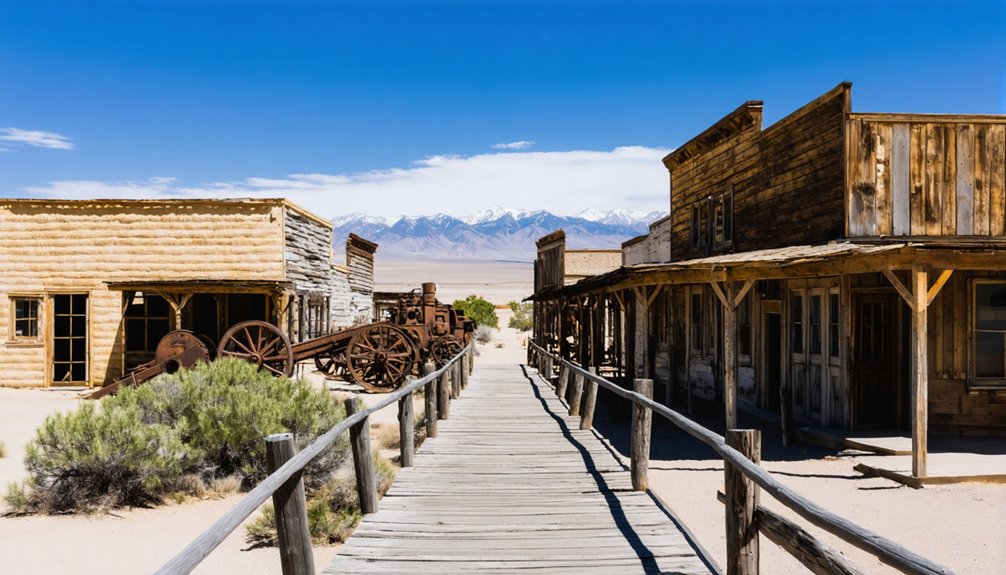
You’ll step back in time at the Pioneer Saloon, a 1913 watering hole where miners once gathered. Bullet holes still mark the walls from Wild West showdowns.
The authentic atmosphere draws visitors who want to sip a cold drink in the same space where prospectors celebrated their strikes and mourned their losses over a century ago.
Beyond the saloon’s swinging doors, you might spot wild horses roaming the surrounding desert terrain. Their untamed presence adds to the frontier spirit that still defines this historic mining town.
Historic Pioneer Saloon Experience
When you step through the doors of the Pioneer Saloon in Goodsprings, you’re walking into a genuine 1913 time capsule that’s weathered over a century of American history. Everything remains original—from the cherry wood Brunswick bar shipped from Maine in the 1880s to the stamped tin walls and ceiling ordered from a catalog.
You’ll experience authentic Wild West atmosphere through:
- Real bullet holes in the walls from historic gunfights
- Mining relics and historic signage throughout the space
- The legendary Ghost Burger and craft spirits at Nevada’s oldest continuously operating bar
- Live music in the same room where Clark Gable mourned Carole Lombard
- Reported hauntings, including Paul Coski’s ghost and mysterious phone rings
This isn’t a recreation—it’s the real deal, preserved by caretakers who understand freedom-loving visitors crave genuine history.
Wild Horse Encounters
Nevada’s wild horse population—over 38,000 strong—creates one of the American West’s most authentic living connections to frontier history, and Goodsprings positions you perfectly to witness these magnificent symbols of freedom.
You’ll find nearby herds at Red Rock’s 157,443 acres (under 30 horses) and Wheeler Pass in the Spring Mountains (55 horses, 30 burros).
Cold Creek serves as your prime spotting location, though you’ll need a 4WD vehicle for access.
Understanding Wild Horse Behavior enriches your encounters—these animals double their population every 4-5 years, demonstrating nature’s resilience.
Conservation Strategies include BLM roundups and fertility control programs managing the balance between freedom and sustainability.
Summer months offer easiest viewing in open country, where you’ll witness mustangs roaming exactly as they did during Goodsprings’ mining heyday.
Tybo: Preserved Mining Equipment and Desert Ruins
Tucked away in Nevada’s Hot Creek Range, Tybo stands as one of the state’s most authentic ghost towns. Here, preserved industrial relics tell the story of a once-thriving silver-lead mining operation.
You’ll find mining relics scattered across dramatic desert landscapes, from the original hoist house to more than a dozen massive brick charcoal kilns rising 25 feet high.
Essential features to explore include:
- Historic charcoal kilns located 1.5 miles from town center, accessible via eroded canyon roads
- Original general store with distinctive brick front and arched windows
- Restored brick schoolhouse dating to 1876
- Wells Fargo Office ruins among scattered foundations
- Wonderstone deposits for rockhounding along eastern hillsides
You’ll need caution around uncovered mine shafts while hiking this authentic mining landscape.
Planning Your Nevada Ghost Town Road Trip
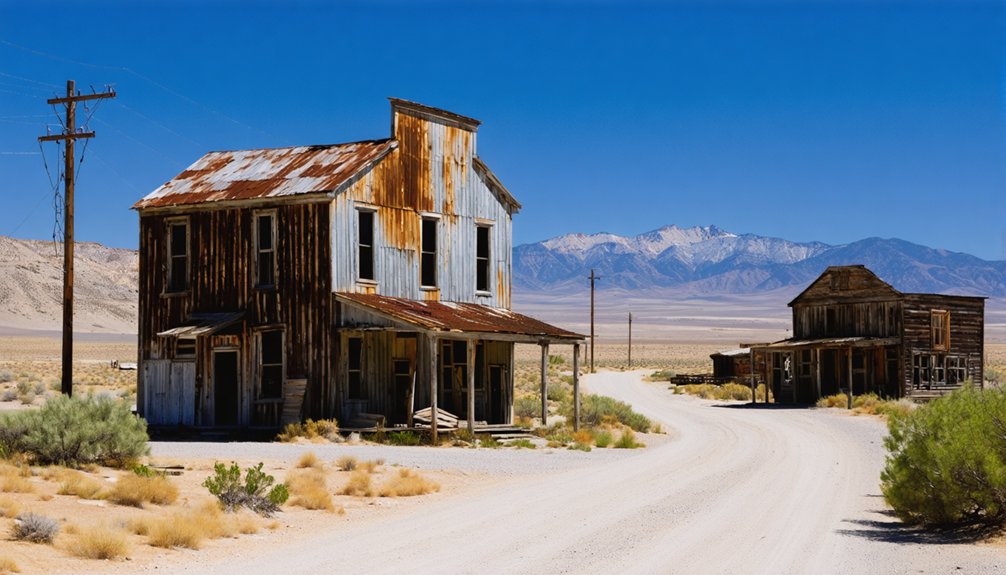
Planning a successful Nevada ghost town adventure requires strategic routing through one of America’s most remote landscapes, where distances between destinations can stretch beyond 200 miles without services.
Nevada’s ghost towns demand careful planning—expect vast distances exceeding 200 miles between destinations with zero services along the way.
You’ll find proven itineraries like the Death Valley Rally covering 370 miles through multiple sites, or the ET Highway loop connecting Rhyolite and Goldfield from Las Vegas.
Pack extra water, car repair essentials, and share your route with someone trusted—cell reception disappears for long stretches.
Off-road navigation demands a high-clearance vehicle for rocky sites like Rockland, and you’ll need to contact BLM offices for current conditions.
Ghost town preservation efforts at places like Sutro Tunnel require advance membership, while Virginia City’s popular tours need reservations.
Strategic planning transforms these isolated ruins into unforgettable freedom-seeking expeditions.
Best Times to Visit Nevada’s Abandoned Mining Towns
While summer’s triple-digit heat transforms Nevada’s ghost towns into sweltering outdoor ovens, spring and fall provide ideal exploration windows where comfortable temperatures meet accessible roads. You’ll find March through May particularly rewarding, with 60-80°F days perfect for eco friendly travel through blooming desert landscapes.
September to November delivers equally pleasant 50-75°F weather after monsoon risks subside.
Seasonal Planning Essentials:
- Spring: Snowmelt improves gravel roads to remote Jarbidge; wildflowers frame historic ruins.
- Fall: Dry dirt roads grant high-clearance vehicle access to Belmont mill; reduced rattlesnake activity.
- Winter: Solitude at sites like St. Thomas compensates for limited access.
- Events: August’s Jarbidge Days and Halloween pig roasts pair local ghost stories with community celebrations.
- Safety: Avoid July-August flash floods at canyon locations like Tunnel Camp.
Photography Tips for Capturing Ghost Town Architecture
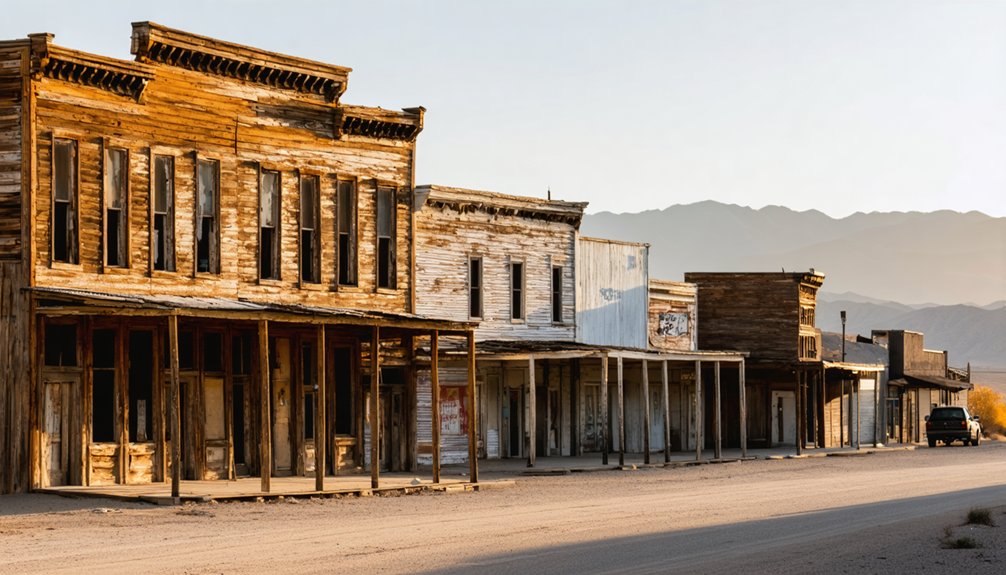
Once you’ve timed your visit to Nevada’s ghost towns perfectly, you’ll want to capture their haunting beauty through your camera lens. Your lens selection matters—pack a wide-angle for sweeping main street shots and dramatic building scale, plus a prime lens for intimate architectural details like rusted door handles and weathered ornaments.
The right lenses transform abandoned ruins into artistry—wide-angles capture desolation’s scope while prime lenses reveal decay’s intimate poetry.
Bring a sturdy tripod for those essential long exposures in dimly lit saloons and jails.
Master lighting techniques by shooting during golden hour when shadows dance across abandoned structures, or try flashlight painting to illuminate forgotten interiors during extended exposures.
Focus on decay’s rich palette: rust-orange staircases, ivy-covered walls, and crumbling window frames. Don’t overlook small artifacts—old bottles, scattered tools, and vintage furniture tell compelling stories of lives left behind.
Safety Considerations When Exploring Historic Sites
Before you step through that weathered doorway or peer down that abandoned mineshaft, understand that Nevada’s ghost towns pose real dangers that have claimed lives.
Historic structures collapse without warning, and ground above old mining operations can give way beneath your feet.
Wildlife safety demands awareness of rattlesnakes and other desert creatures inhabiting these ruins.
Environmental preservation isn’t just ethical—it’s practical survival.
Essential Safety Protocols:
- Carry GPS, maps, and extra fuel; cell service is nearly nonexistent
- Never enter boarded-up buildings or use structures as vehicle anchors
- Travel in groups with recovery gear for emergencies
- Pack survival manuals and wilderness medicine guides
- Respect “No Trespassing” signs and private property boundaries
Your freedom to explore depends on responsible conduct that protects both you and these irreplaceable sites.
Frequently Asked Questions
Are Nevada Ghost Towns Suitable for Children and Family Visits?
Yes, Nevada’s ghost towns are excellent for families. You’ll find family-friendly activities like mine tours, cowboy shows, and museums that bring historical preservation to life. Kids can explore authentic buildings while learning about the Wild West era interactively.
Do I Need Special Permits to Explore Ghost Town Buildings?
You don’t need special permits for most Nevada ghost towns on public land, but you must follow access regulations and historical preservation laws. Never enter unstable structures, respect private property boundaries, and avoid disturbing artifacts or buildings.
Exploring abandoned towns throughout Nevada can be a unique adventure, offering glimpses into the past and the stories that shaped the region. Be sure to bring a camera to capture the haunting beauty of these deserted places, but maintain a respectful distance from any remnants of former lives. Each visit is an opportunity to appreciate the history while ensuring that these ghost towns remain preserved for future visitors.
As you explore ghost towns in Nevada, take the time to learn about their unique histories and the reasons behind their abandonment. Each site offers a window into the past, inviting exploration and reflection on the lives that once flourished there. Connecting with local guides can enhance your experience, providing deeper insights and stories that bring these eerie locations to life.
What Kind of Vehicle Is Recommended for Reaching Remote Ghost Towns?
You’ll need a high-clearance 4×4 vehicle with proper off road vehicles capabilities to reach Nevada’s remote ghost towns. Essential vehicle preparation includes full-size spare tires, winches, traction boards, and three days’ worth of emergency supplies for true backcountry independence.
Can I Camp Overnight Near Nevada’s Ghost Town Sites?
Yes, you can camp near most Nevada ghost towns on BLM land for free, up to 14 days. Follow historical preservation guidelines, take safety precautions around old structures, and practice Leave No Trace principles while exploring.
Are There Guided Tours Available for Nevada Ghost Towns?
Picture weathered wooden buildings emerging from desert dust—you’ll find extensive guided exploration options throughout Nevada’s ghost towns. Historical preservation comes alive through Pink Jeep Tours, Carson City Ghost Walks, and multi-day packages offering authentic Western adventures with expert storytellers.
As you venture into the heart of the Silver State, ghost towns to visit in Nevada reveal tales of a bygone era etched into the landscape. Each site, from the haunting remnants of Virginia City to the eerie beauty of Rhyolite, offers a unique glimpse into the lives that once thrived in these now-desolate locations. Take the time to explore the rich history and captivating stories that make these ghost towns a must-visit for any adventurer.
References
- https://en.wikipedia.org/wiki/List_of_ghost_towns_in_Nevada
- https://www.visittheusa.com/experience/6-nevada-ghost-towns-explore-if-you-dare
- https://www.atlasobscura.com/things-to-do/nevada/ghost-towns
- https://www.smithsonianmag.com/sponsored/nevadas-living-and-abandoned-ghost-towns-180983342/
- https://nvtami.com/nevada-ghost-towns-map/
- https://travelnevada.com/ghost-town/
- https://nvtami.com
- https://forgottennevada.org/sites/newlist.html
- https://www.rhyoliteghosttownnevada.org/explore/rhyolite-ghost-town
- https://www.nvexpeditions.com/nye/rhyolite.php