You can explore six remarkable ghost towns across New Hampshire, including Monson—the state’s oldest inland settlement dating to 1737—with its accessible stone walls and cellar holes across 280 acres. Old Hill Village offers tree-lined streets and foundations from its 1941 relocation, while Livermore reveals moss-covered mill ruins and a brick powerhouse from its logging heyday. Zealand showcases James Everell Henry‘s ruthless logging empire, and Beebe River features preserved boarding house foundations. These sites offer year-round hiking trails, ranger-led tours, and interpretive signs that reveal the complex stories behind each community’s abandonment.
Key Takeaways
- Monson Historic Park features 200 acres of trails, stone walls, cellar holes, interpretive signs, and the restored 1756 Gould House museum.
- Old Hill Village offers accessible foundations, cellar holes, plaques, and a tree-lined main road from the 1937–1941 dam relocation.
- Livermore displays moss-covered foundations, a red brick powerhouse, and mill ruins from its 1876–1949 logging town era.
- Zealand preserves remnants of James Everell Henry’s 1880s logging operation, including boarding house foundations and railroad station sites.
- White Mountain National Forest contains 18 house foundations, mill ruins, and ranger-led tours along former railroad paths.
Old Hill Village: A Town Sacrificed for Flood Control
In 1937, residents learned their home would become Franklin Falls Dam‘s reservoir zone. Facing unprecedented relocation challenges, citizens formed an association and constructed an entire replacement village by June 1941—complete with town hall, school, and thirty houses on higher ground.
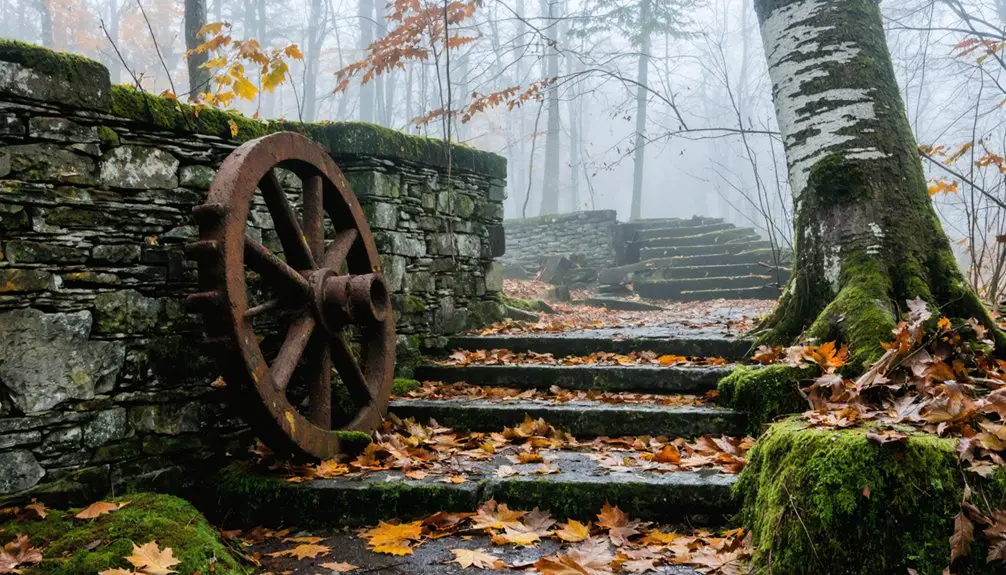
Today, you’ll find accessible foundations, cellar holes, and plaques marking where buildings once stood, creating a haunting testimony to individual sacrifice demanded by government intervention. The distinctive tree-lined main road remains intact, with statuesque trees still standing as silent witnesses to the village that once thrived beneath their canopy. Among the surviving structures, Academy Hall, built in 1832 and serving as a school until 1909, now stands overgrown in the abandoned landscape.
Livermore: White Mountains Lumber Town Frozen in Time
Deep within the White Mountains near Bartlett, the lumber town of Livermore stood as a monument to 19th-century industrial ambition. Founded in 1876 by Boston’s Saunders family, this logging community thrived with 200 residents, two mills, and eighteen homes by 1900.
The family legacy included a luxurious mansion overlooking their timber empire.
Industrial decline began with tragedy—a 1880 smallpox epidemic claimed 40 lives, followed by the devastating 1927 flood that destroyed the mill and railroad bridges.
Operations ceased by 1928, and the last residents departed by 1949.
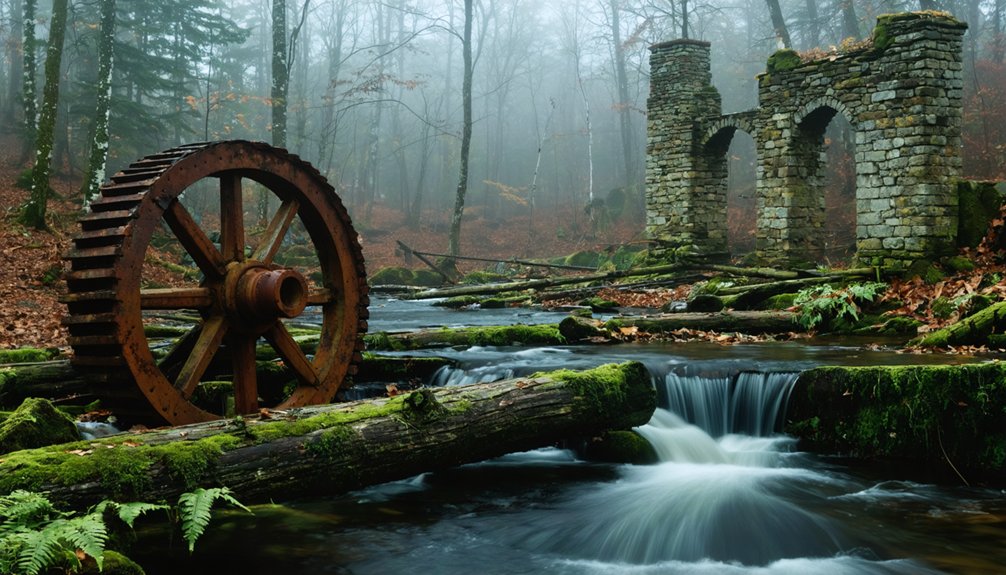
Today, you’ll discover moss-covered foundations, brick mill remains, and scattered artifacts reclaimed by White Mountain National Forest. Among the most striking ruins stands a dramatic red brick structure, once part of the town’s powerhouse. Explorers have found remnants including glass, cans, pipes, metal fragments, and even a horseshoe among the ruins.
The town charter was revoked in 1951, leaving only stone memories of this once-thriving settlement.
Monson: New Hampshire’s First Inland Settlement Lost to Nature
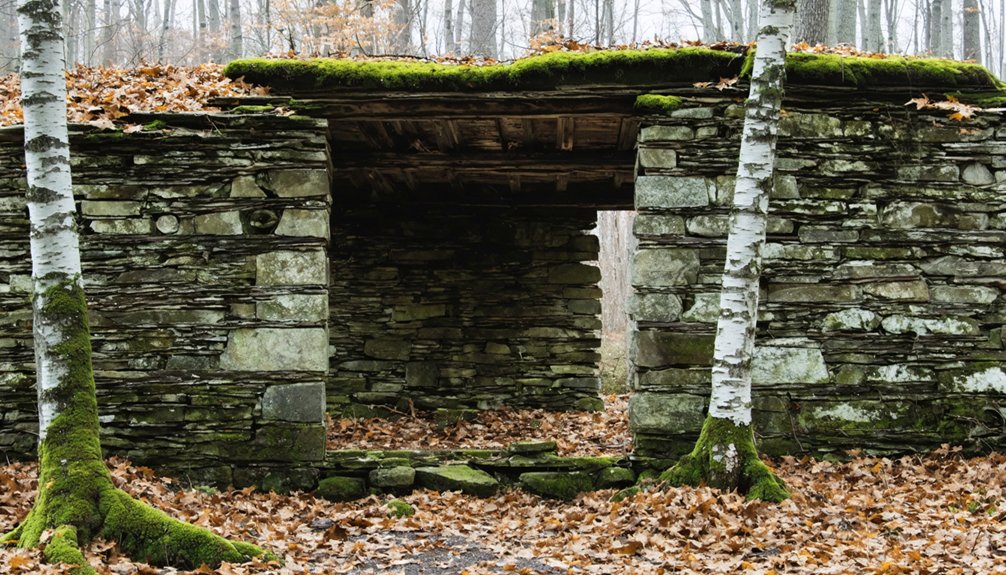
You’ll discover a remarkable 280-acre historic park where stone walls, cellar holes with interpretive signs, and remnants like a horse tie-up tell the story of families who carved out farms here from 1737 onward.
The settlement’s mysterious collapse by 1770 puzzles historians to this day—despite covering 17,000 acres of farmland, residents abandoned their homes after the community failed to build essential infrastructure like a meeting house or school.
Grassroots preservation efforts in 1998 saved this archaeological treasure from luxury development, transforming it into New Hampshire’s most accessible ghost town where you can walk the original roads and explore labeled homesteads dating back nearly three centuries. Wide trails accommodate hiking, biking, and cross-country skiing, letting you experience the village’s haunting beauty year-round. Visit the small museum inside the restored Gould House to view historical displays that bring the settlement’s story to life.
Archaeological Treasures and Preservation
Wandering through the forests of Hollis and Milford, you’ll discover stone-lined cellar holes and crumbling walls that mark New Hampshire’s first inland colony—a settlement that predates the Revolutionary War by four decades.
Archaeological layers reveal seventeen homesteads scattered across 200 acres, each labeled with interpretive signs detailing the families who carved civilization from wilderness in 1737.
You’re free to explore ancient artifacts and foundations along former roads—now peaceful trails—that wind through the sprawling site.
The restored Gould House (1756) occasionally opens as a museum, offering a tangible connection to colonial life.
When luxury developers threatened this treasure in 1998, locals fought back.
The Society for the Protection of New Hampshire Forests now safeguards these ruins, ensuring you can walk where pioneers once thrived.
The town’s demise came from harsh weather conditions, poor soil quality, and limited resources that drove settlers away by 1770, just decades after they arrived from Massachusetts and Nova Scotia.
Despite its brief existence, Monson never established a meeting house or school, reflecting how quickly the settlement struggled before being abandoned and forgotten for two centuries.
Why Settlement Ultimately Failed
The preserved ruins tell only half of Monson’s story—the other half lies in understanding why these pioneers abandoned their hard-won homesteads after just three decades.
Environmental decline played a devastating role as harsh conditions overwhelmed the settlers’ determination. The dense forests and challenging terrain restricted agricultural expansion beyond subsistence farming, while the absence of natural resources prevented economic growth.
What’s most revealing about this settlement abandonment is what they didn’t build: no meeting house, no school—only a livestock pound. Without civic infrastructure to bind the community together, individual families faced mounting hardships alone.
Today, visitors can walk among the cellar holes of these abandoned homesteads, imagining the lives of settlers who struggled against insurmountable odds in one of New Hampshire’s first inland towns.
Zealand: James Everell Henry’s Vanished Logging Empire
Deep in Carroll township around 1880, lumber baron James Everell Henry carved out Zealand from the wilderness to fuel his ambitious logging empire. You’d have found a complete company town here—boarding houses, two railroad stations, a post office, and massive charcoal kilns supporting operations that employed up to 250 men.
Henry’s timber exploitation was ruthless, with heavy clear-cutting across his 10,000-acre domain drawing sharp criticism from contemporary press. The railroad development proved equally impressive: his Zealand Valley Railroad stretched 11 miles into the forest, while connections to major lines facilitated lumber transport. The town’s charcoal sales exceeded $75,000 in 1880, far surpassing the $25,000 earned from lumber that same year.
East Weare: When Progress Left a Village Behind
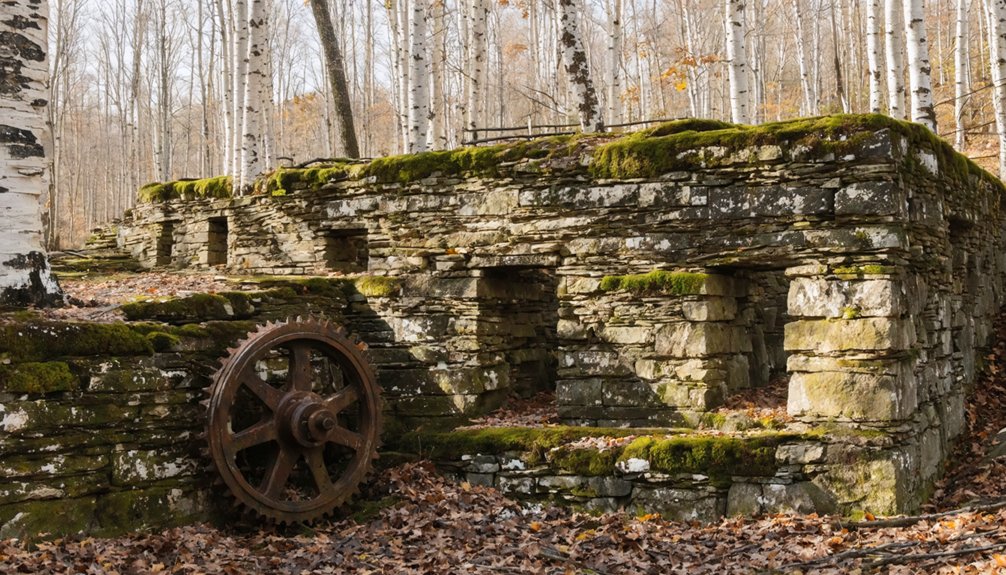
Unlike Zealand’s gradual abandonment, East Weare vanished by government decree in 1960 when the Everett Flood Control Project condemned an entire village to the depths.
You’ll find this tale particularly unsettling—families received destruction notices while still living in their homes as heavy equipment rolled through Route 77, dismantling their community piece by piece.
This agricultural settlement, established in 1764 with over 60 farming families, thrived for nearly two centuries. Residents farmed, logged, and worked in local toy shops until contractors systematically destroyed their village that June.
Today, you can’t capture ghost town photography here—East Weare lies submerged beneath a reservoir.
Only a historical marker (#143) remains above water, commemorating this community that sacrificed everything for “progress.”
Urban decay took just months to complete what typically requires decades.
Beebe River: Echoes of the White Mountains Timber Boom
You’ll find Beebe River nestled in the White Mountains, where a timber baron’s utopian vision created a thriving mill town in 1917—complete with modern amenities that rivaled urban centers of the era.
The 25-mile railroad that once carried spruce for WWI airplanes now lies silent, its steel rails long salvaged for another war effort.
Today, crumbling foundations and overgrown roads mark where 200 workers lived, worked, and played before economic collapse transformed this ambitious settlement into one of New Hampshire’s most haunting ghost towns.
Logging Industry Origins
The Beebe River logging operation emerged during the final chapter of New Hampshire’s massive timber harvest, when virgin forests in the White Mountains fell to industrial-scale clear-cutting. Between the mid-1880s and 1920, timber harvesting stripped nearly every mountainside across the region, transforming pristine wilderness into barren slopes.
You’ll find that logging practices of this era were ruthlessly efficient—Parker-Young Company acquired the 22,000-acre Beebe River tract in 1917 specifically to access remaining virgin timber in the watershed and Sandwich Mountain Range. The operation targeted valuable spruce and hardwood species through extensive railroad networks that penetrated deep into these forests.
Town Layout and Infrastructure
Massive logging operations required equally substantial infrastructure, and Parker-Young Company constructed an entire settlement from scratch to house workers and facilitate timber extraction.
You’ll find remnants of remarkably sophisticated urban planning throughout Beebe River‘s abandoned layout.
The company built boardinghouses, a company store, and a school along the main thoroughfare, creating a self-sufficient community deep in the White Mountains wilderness.
Infrastructure challenges were considerable—the settlement needed reliable power transmission, water systems, and rail connections to function efficiently.
Today, you can still trace the grid-like street pattern and foundation outlines where buildings once stood.
The town’s strategic positioning along the river and rail line demonstrates how industrial necessity shaped frontier settlement patterns in early twentieth-century New Hampshire.
Visiting the Ruins Today
Today, Beebe River’s scattered cellar holes and foundation remnants lie within the White Mountain National Forest, where over 600 such archaeological sites mark the locations of vanished logging communities.
You’ll discover 18 house foundations, a boarding house that once sheltered 200 workers, and ruins of the sawmill and bobbin mill—all testaments to industrial decay reclaimed by nature. Forest regeneration has transformed the cutover wasteland into thriving woodland, though scars from the devastating 1923 Flat Mountain fire remain visible along the trails.
You can access the site via former railroad paths, following 25 miles of Beebe River drainage from Campton.
Ranger-led tours recount the utopian dream inspired by Hopedale’s ideals, while you explore mesmerizing remnants of this grandfather-era timber boom.
Exercise caution around unstable ruins and overgrown paths.
What to Expect When Exploring New Hampshire’s Ghost Towns
When you venture into New Hampshire’s ghost towns, you’ll discover haunting landscapes where nature has reclaimed abandoned settlements, transforming former villages into mysterious woodland trails. You’ll walk along overgrown cellar holes and crumbling stone walls that mark where families once lived.
Among these ghost towns in New Hampshire, stories of the past echo through the trees, inviting adventurous souls to explore their rich history. Each abandoned structure tells a tale of resilience and change, illustrating the passage of time in this picturesque state. As you wander deeper, you might even stumble upon remnants of old roads or the foundations of homes, all shrouded in the tranquil beauty of nature.
The atmosphere shifts between peaceful meadows and eerie woodlands, where visitors report unexplained phenomena—distant drumbeats echoing Native history and mysterious flashes of light piercing the forest. Some sites have documented paranormal activity, adding an unsettling edge to your exploration.
You’ll find hand-carved trail markers, informative plaques, and restored structures like the Gould House museum. Most locations offer easy, flat terrain requiring 1-2 hours to explore.
There’s no admission fee, and you’re free to wander these forgotten places at your own pace, experiencing authentic historical remnants without barriers.
Preserving History: Archaeological Sites and Historical Markers
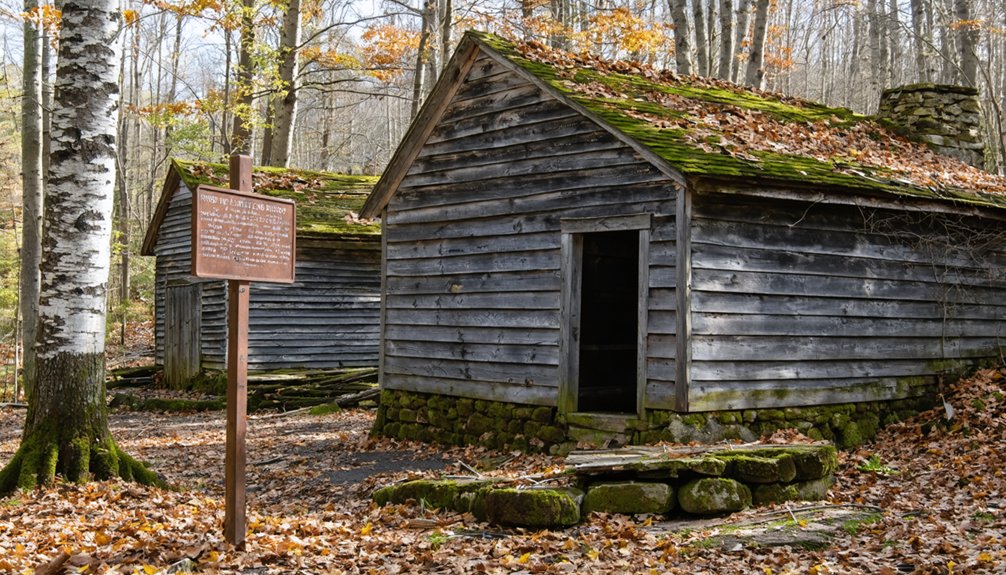
Beneath the forest canopy of New Hampshire’s abandoned settlements lies some of the most significant archaeological evidence of colonial life in New England. You’ll discover preserved stone foundations, century-old cellar holes, and rutted pathways that tell stories of frontier existence from 1737 onward.
Artifactual Significance markers you’ll encounter include:
- Signposts detailing homestead genealogy and historical context at family sites like the Gould and Wallingford properties
- Hand-drawn maps from longtime caretakers guiding you to specific locations throughout 17,000-acre settlements
- Stone walls marking original property boundaries and settlement patterns
Thanks to collaborative preservation efforts by the Society for the Protection of New Hampshire Forests and state historical organizations, these sites remain accessible through trails and seasonal roads. You’re free to explore this Cultural Heritage while contributing to its protection for future generations.
Frequently Asked Questions
Are Ghost Town Sites in New Hampshire Accessible Year-Round or Seasonally Closed?
You’ll find mixed accessibility—some sites welcome year-round exploration while others close seasonally. Historical preservation efforts and environmental impact from winter conditions determine access. Monson Center and Russell-Colbath grounds stay open, but Willey House closes mid-October.
Do I Need Special Permits to Visit Abandoned Town Sites?
No bureaucratic nightmare here! You’ll only need $5 cash at Russell-Colbath House for parking. Respect private property boundaries and follow preservation rules—don’t pocket artifacts. Most sites welcome free exploration, letting you roam these historic ruins unrestricted.
Are There Guided Tours Available for New Hampshire Ghost Towns?
You won’t find guided tours for NH’s ghost towns like Monson or Livermore—they’re completely self-guided adventures. You’ll explore freely using trail markers highlighting historical significance, while preservation efforts maintain these authentic 1700s sites for independent discovery.
What Safety Precautions Should I Take When Exploring These Locations?
You’ll need sturdy boots, flashlights, and awareness of structural hazards like rotting floors and unstable foundations. Watch for wildlife encounters, respect property boundaries, travel with others, and always inform someone of your exploration plans beforehand.
Can I Legally Take Artifacts or Souvenirs From Ghost Town Sites?
Hands off—artifact removal from ghost town sites violates federal law. Legal considerations are crystal clear: you can’t take souvenirs, bottles, or metal objects from these locations. They’re protected historical evidence, not freebie mementos for your collection.
References
- https://vitabrevis.americanancestors.org/2016/11/new-hampshire-ghost-town
- https://wjbq.com/abandoned-ghost-town-of-livermore-is-new-hampshires-smallest-town/
- https://kids.kiddle.co/List_of_ghost_towns_in_New_Hampshire
- https://thefrogandpenguinn.blogspot.com/2021/07/a-nh-ghost-town.html
- https://www.youtube.com/watch?v=mFBYIdURBvQ
- https://outdoorodyssey.net/2022/11/03/the-haunted-ghost-town-of-livermore-nh/
- https://en.wikipedia.org/wiki/List_of_ghost_towns_in_New_Hampshire
- https://www.visitwhitemountains.com/blog/post/spooky-stories-ghost-towns-and-historic-haunted-spots/
- https://www.whitemountainhistory.org/abandoned-towns
- https://1happyhiker.blogspot.com/2014/10/a-visit-to-new-hampshire-historic-place.html