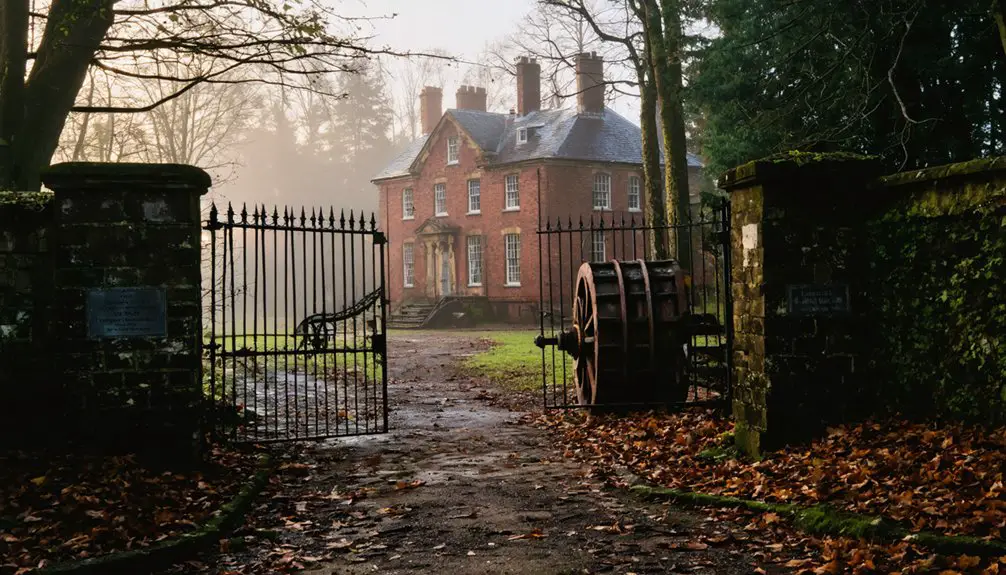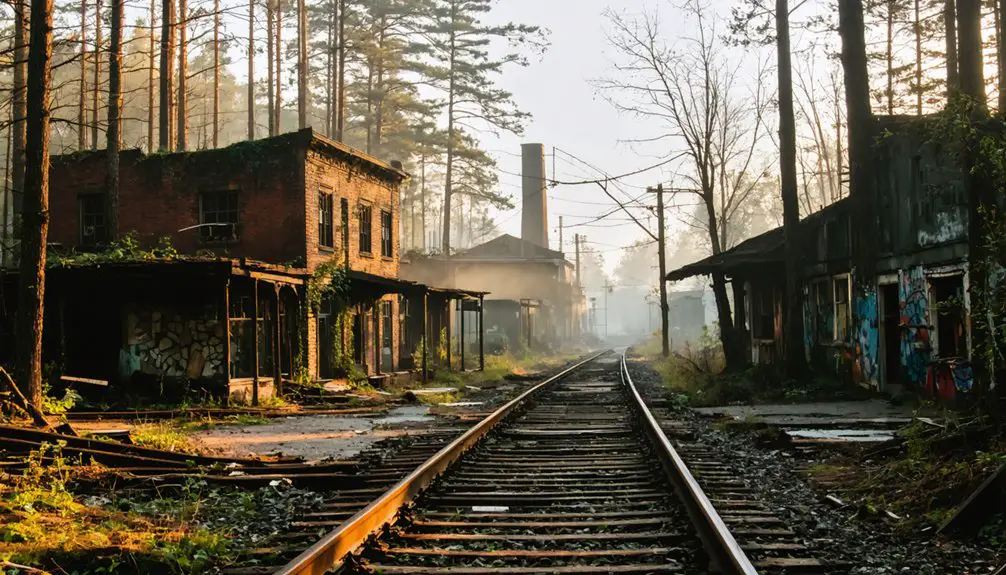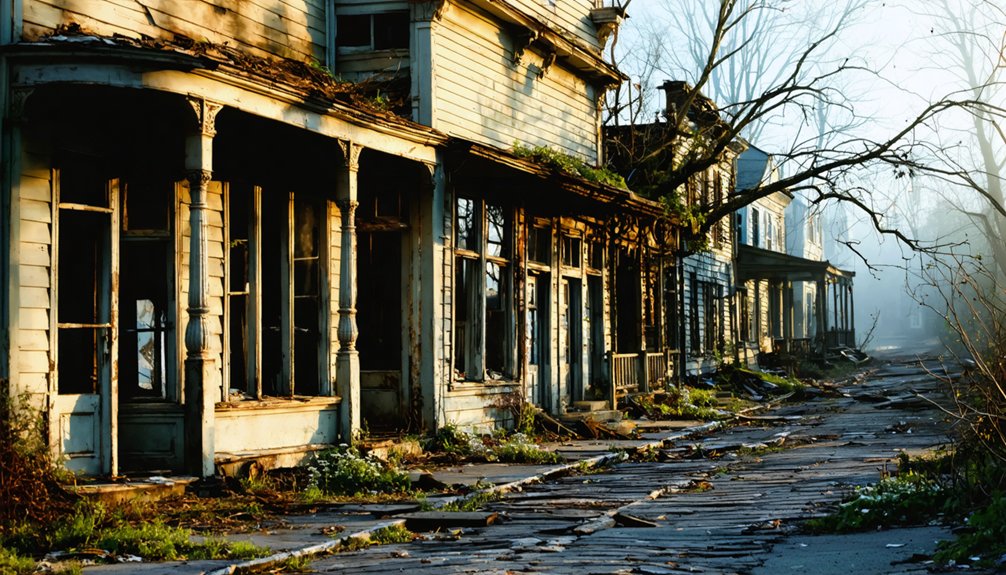
You’ll find several preserved ghost towns across New Jersey that showcase the state’s industrial and agricultural past. Batsto Village in the Pine Barrens features over 30 structures from its 1766 ironworks origins, while Feltville’s eight surviving buildings tell the story of David Felt’s 1847 mill community. Whitesbog Village preserves the birthplace of commercial blueberry cultivation, and Waterloo Village displays authentic Morris Canal infrastructure. Each site offers self-guided tours from dawn to dusk, with spring through fall providing ideal conditions for exploring these historically significant settlements and understanding their distinct roles in New Jersey’s development.
Key Takeaways
- Batsto Village in the Pine Barrens features over 30 preserved structures and offers living history demonstrations and guided tours.
- Feltville in Watchung Reservation has eight original buildings accessible daily from dawn to dusk with free self-guided tours.
- Waterloo Village on the Musconetcong River displays authentic industrial archaeology including working locks and a 1859 Methodist Church.
- Whitesbog Village in Browns Mills showcases the birthplace of commercial blueberry cultivation with original worker housing and harvest demonstrations.
- Ong’s Hat near Southampton Township offers mysterious folklore and dark legends at its historic Quaker settlement location.
Batsto Village: Revolutionary War Iron Works Turned Historic Museum
Deep within the Pine Barrens of Burlington County, Batsto Village stands as one of New Jersey’s most significant colonial-era industrial sites. Founded in 1766 by ironmaster Charles Read, this iron forge produced essential munitions and camp kettles for the Continental Army during the Revolutionary War.
The village’s strategic location along the Batsto River provided water power, while surrounding forests supplied charcoal for the furnaces.
You’ll find over 30 preserved structures showcasing both industrial innovation and domestic crafts, including the gristmill, blacksmith shop, and Richards family mansion. The site operated for over a century under the Richards family before shifting to glassmaking.
Today, Wharton State Forest protects this National Register property, where living history demonstrations and walking tours reveal New Jersey’s manufacturing heritage. Seasonal programs include “History at Sunset” walking tours led by historians who share engaging stories about Batsto’s Revolutionary War contributions, including tales of British spies and privateer activities at nearby Chestnut Neck. The village name derives from the Swedish word “bastu,” meaning bathing place, likely referencing the site’s early use by Lenni Lenape Native Americans.
Feltville: The Deserted Village of Watchung Reservation
You’ll find Feltville nestled in Berkeley Heights’ Watchung Reservation, where David Felt built a complete mill town in 1847 that housed 178 residents before his 1860 retirement triggered its abandonment.
The site’s transformation from prosperous factory settlement to failed business ventures, then Glenside Park Resort, and finally Depression-era housing created the preservation you’ll encounter today.
Ten original structures—including eight houses, a church, and Masker’s Barn—remain accessible for self-guided tours through this 1980-listed National Register site.
The land was first settled in 1736 by Peter Willcocks, an English businessman who built a dam and sawmill along Blue Brook.
The nearby Wilcox Badgley Cemetery contains one original headstone commemorating John Wilcox, who died in 1776, with the rest being memorial replacements.
Three families still maintain permanent residence.
David Felt’s Factory Town
Tucked within Watchung Reservation’s 2,000 acres, Feltville stands as New Jersey’s most intact 19th-century mill village. David Felt transformed this frontier settlement into a thriving factory town in 1844, purchasing over 600 acres from Willcocks descendants. By 1847, he’d constructed a printing mill powered by Blue Brook’s two dams, eleven worker houses, a church-store, and schoolhouse—all in vernacular Greek Revival style.
The 1850 census recorded 178 residents who called “King David’s” paternalistic community home. Children from working-class families often began labor at age 12, though Felt provided free schooling reflecting his paternalistic welfare ideas.
Today’s eco tourism opportunities let you explore eight surviving homes, the restored Masker’s Barn carriage house, and original structures along self-guided trails off Glenside Avenue. The site features a visitor center providing historical information and hosts seasonal activities including apple cider pressing and haunted family hayrides before Halloween.
Local folklore legends persist about mill pond drownings and mysterious 1912 disappearances, adding atmospheric intrigue to your historical wanderings through this State and National Register-listed site.
Rise and Decline Timeline
Long before David Felt’s industrial ambitions reshaped this Union County landscape, Peter Willcocks arrived from Long Island in 1736 to establish the area’s first settlement. He built a dam across Blue Brook to power his sawmill, creating what locals called Peter’s Hill.
Felt’s 1845 purchase of 760 acres transformed this milling community into a planned factory village housing 175 workers by 1850. The community included a church and school alongside multiple family residences. Buildings were constructed in a vernacular Greek Revival style. The Panic of 1857 devastated Felt’s real estate investments, forcing his 1860 retirement.
Within a decade, abandoned architecture dotted the empty bluff—every resident had fled. Warren Ackerman rescued the site from urban decay in 1882, converting it into Glenside Park resort.
When that venture failed in 1916, the property passed to Union County’s park system, which rented the historic structures until the 1960s.
Visiting the Historic District
Today’s Feltville Historic District preserves eight residential structures, most dating to the eighteenth century, alongside a church building, general house, and Masker’s Barn—a carriage house Warren Ackerman constructed during his tenure as the site’s proprietor.
You’ll find the grounds open daily from dawn to dusk for self-guided exploration without admission fees.
Modern amenities include a visitor center operating Saturdays, Sundays, and most holidays from noon to 5 p.m.
While guided tours aren’t regularly scheduled, you can navigate independently through worker cottages that once housed mill employees. Signage and brochures help visitors navigate the site and learn about its history.
The 6-mile Watchung Reservation History Trail connects sixteen historical points, including this National Register site.
Union County Department of Parks & Recreation maintains stewardship, ensuring you can access this documented colonial settlement and industrial heritage site year-round.
Ong’s Hat: Pine Barrens Settlement Steeped in Legend
You’ll find Ong’s Hat at 794 Magnolia Road in Southampton Township, where early Quaker settlers like Jacob Ong established homesteads around 1700, creating a stopping point between Egg Harbor and Burlington.
By the 1860s, this Pine Barrens settlement thrived as a social center known for bootlegging and prizefighting, documented in Henry Charlton Beck’s 1936 work “Forgotten Towns of Southern New Jersey.”
The town’s darker history emerged around 1917 when pine hawker John Zimbacke and his wife vanished from their cabin—her skull discovered nine years later near a cranberry bog, marking one of Burlington County’s enduring unsolved murders. Detective Ellis Parker extensively investigated crimes in the area, including disappearance cases and murders that remain unresolved to this day.
Early Settlement and Family History
The Ong family‘s arrival in New Jersey traces back to Francis Ong, who disembarked at Boston Harbor aboard the ship Lyon on February 5, 1631, as a member of the Society of Friends seeking religious tolerance.
These Quakers initially settled in Little Egg Harbor, Burlington County, in the early 17th century.
Historical artifacts and family genealogies document Jacob Ong’s purchase of 100 acres in Northampton Township around 1700, likely for cedar harvesting.
You’ll find the Ong surname appearing in county records from the late 17th century onward.
Family descendants established a grain transport route between Little Egg Harbor and Burlington, creating a stopping point that became integral to the settlement’s identity.
A 1778 map of Hessian encampments marks the location as “Ong’s,” predating Revolutionary War records.
Dark Tales and Mysterious Deaths
Beyond its Quaker origins and Revolutionary War connections, Ong’s Hat harbors darker chapters that have cemented its reputation as one of New Jersey’s most enigmatic ghost towns.
In the early 20th century, Polish immigrants John and Mrs. Chininiski settled here before both mysteriously vanished. Hunters later discovered a female skeleton in nearby woods, presumed to be Mrs. Chininiski.
Burlington County Sheriff Ellis H. Parker displayed the skull in his office for years as a reminder of this unsolved case.
Haunted legends intensified during the 1980s when the Institute for Chaos Studies, led by alleged Sufi mystic Wali Fard, established operations in a local cabin.
Secret societies and conspiracy theories flourished, with rumors claiming the group discovered interdimensional portals before vanishing entirely—spawning what many consider the internet’s first alternate reality game.
Jersey Devil Folklore Connection
Among Pine Barrens folklore, few locations share deeper connections to Jersey Devil mythology than Ong’s Hat. This settlement’s mysterious disappearances and violent history made it fertile ground for regional legends intersecting with broader Pine Barrens legends.
The folklore connection manifests through:
- Geographic positioning in Burlington County’s dense Pine Barrens, the Jersey Devil’s traditional haunting grounds since the Leeds Point origin story.
- John Zimbacke’s 1917 disappearance with his wife, their unexplained vanishing fueling speculation about supernatural forces.
- The unsolved murder of a Polish woman, her skull preserved as evidence while locals whispered about unnatural predators.
- Prizefighting operations and bootlegging creating an atmosphere where Jersey Devil folklore thrived among those seeking explanations for the area’s lawlessness.
You’ll find Ong’s Hat represents where documented violence merged with cryptid mythology.
Waterloo Village: Restored Morris Canal Town
Nestled along the Musconetcong River in Byram Township, Sussex County, Waterloo Village stands as northwestern New Jersey’s most intact 19th-century Morris Canal port town.
Waterloo Village preserves northwestern New Jersey’s most complete 19th-century Morris Canal port town along the Musconetcong River.
You’ll explore authentic industrial archaeology through working locks, inclined planes, and a stone grist mill dating to the canal era.
The 1859 Methodist Church and Smith’s Store showcase heritage preservation efforts that earned National Register status in 1977.
The Waterloo Foundation operated the site as a living history museum from 1967 until 2006, when declining revenues ended their lease.
You can now visit this open-air museum within Allamuchy Mountain State Park from sunrise to sunset.
Though deteriorating buildings remind you that ongoing restoration remains critical for preserving these irreplaceable canal resources and historic structures.
Whitesbog Village: Birthplace of Commercial Blueberries
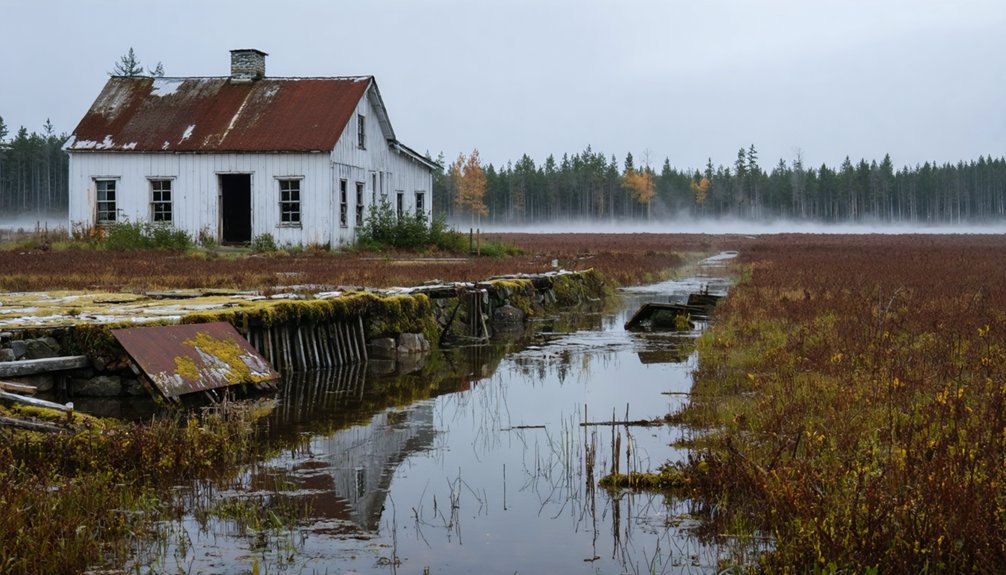
Located in Browns Mills within Brendan T. Byrne State Forest, Whitesbog Village stands as the birthplace of America’s cultivated blueberry industry. Founded mid-1800s by James A. Fenwick for cranberry farming, the operation expanded under Joseph J. White to become New Jersey’s largest cranberry farm by the early 1900s.
Elizabeth Coleman White revolutionized agriculture here, beginning blueberry experiments around 1910. By 1916, she’d developed the first commercially viable highbush varieties.
You’ll explore authentic remnants of this self-sufficient company town:
- Worker housing, general store, and processing buildings from 1890-1925
- Elizabeth White’s 1923 house with original blueberry bushes still standing
- 3,000 acres of cranberry bogs, blueberry fields, and sugar sand roads
- Monthly village tours and October cranberry harvest demonstrations
The National Register-protected site opens weekends year-round.
Double Trouble: Pine Barrens Industrial Ghost Town
You’ll find Double Trouble Village nestled within 8,000 acres of Pine Barrens wilderness.
The area is home to fourteen restored structures from the late 19th and early 20th centuries that preserve New Jersey’s lumber and cranberry heritage.
The historic district, listed on the National Register since 1978, includes an operational sawmill (restored 1995), cranberry sorting and packing house (restored 1996), general store, schoolhouse, and workers’ residences.
From 8:00 AM to dusk daily, you can explore marked trails connecting the village to Cedar Creek’s watershed, cranberry bogs, and the reservoir that powered this industrial settlement from 1765 through the mid-20th century.
Industrial Heritage and Ruins
Deep in the Pine Barrens, Harrisville’s industrial ruins tell a story of economic adaptation and ultimate failure.
What you’ll discover at this site reveals the region’s transformation from metal manufacturing to papermaking, driven by market pressures and technology evolution.
The surviving structures showcase:
- Stone and brick paper mill foundations – constructed with imported non-native stone, likely transported by wagon or river.
- Wading River dam remnants – engineered to power the mill’s machinery through waterpower.
- Underground gas piping system – innovative infrastructure from the Harris family’s modernization efforts using gasoline vapor generators.
- Worker housing foundations – scattered evidence of the village that once supported the industrial operation.
Joseph Wharton’s 1896 acquisition marked the beginning of abandonment.
A devastating 1914 fire completed the town’s transformation into ruins you can explore today.
Exploring the Village Today
Unlike Harrisville’s scattered ruins, Double Trouble State Park offers you a remarkably intact industrial village where fourteen restored buildings stand ready for exploration. You’ll find the 1995-restored sawmill, cranberry sorting house, general store, and schoolhouse at 581 Pinewald Keswick Road in Bayville. The site is open daily from 8:00am to dusk with free admission.
You can navigate marked trails through 200+ acres of Pine Barrens cedar forest and preserved cranberry bogs along Cedar Creek.
The Interpretive Center provides context for self-guided tours, though guided options also exist. The site hosts community events and showcases local art that interpret the region’s industrial heritage.
Since New Jersey’s 1964 purchase, the Division of Parks and Forestry has maintained this National Register district as accessible watershed protection. It’s your gateway to understanding Pine Barrens ecology and nineteenth-century cranberry culture.
Best Times to Visit New Jersey’s Ghost Towns
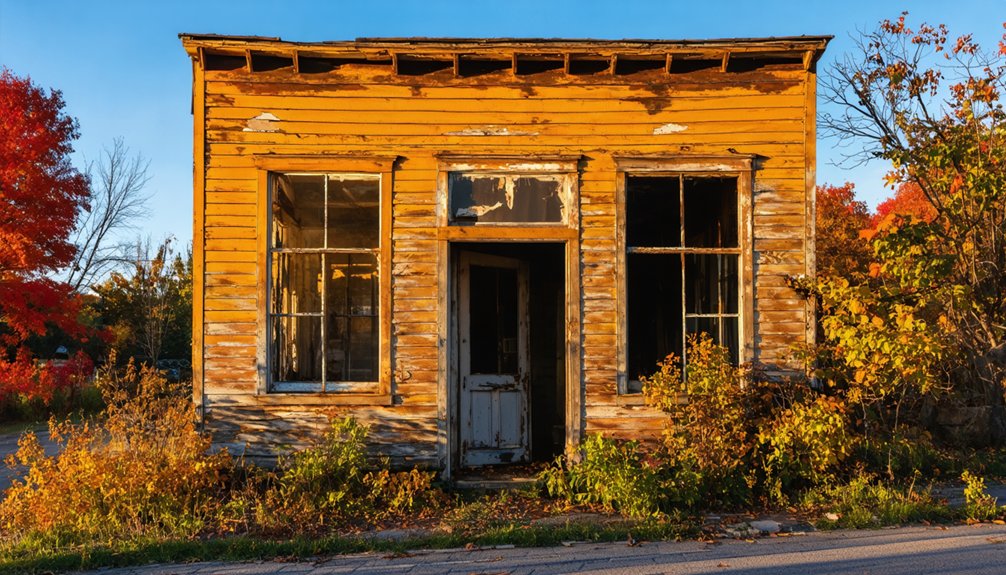
Since most of New Jersey’s ghost towns operate on seasonal schedules, timing your visit requires careful planning around specific access windows. You’ll find daylight hours offer ideal exploration conditions at sites like Batsto Village and Feltville Historical District, which welcome self-guided tours dawn to dusk. Post-Labor Day brings free entry opportunities and fewer crowds at preserved villages.
In addition to these historic sites, the ghost towns of New Jersey provide a unique glimpse into the past, showcasing abandoned buildings and remnants of former communities. Exploring these locations not only offers a sense of adventure but also an opportunity to reflect on the stories they hold. Be sure to check local resources for guided excursions that delve into the rich history behind these intriguing destinations.
Plan visits around seasonal schedules and daylight hours, with post-Labor Day offering the best combination of free access and smaller crowds.
Suitable visiting periods include:
- Spring through fall for comfortable 1.5-mile walking tours through outdoor sites
- October for special ghost tours featuring urban legends and haunted anecdotes at Allaire, Cape May, and Flemington
- Sundays May-October for Walpack Center museum access
- Post-Labor Day for complimentary admission to Batsto Village and reduced visitor traffic
Avoid winter months when trails like those at Watchung Reservation become challenging to navigate.
What to Bring When Exploring Abandoned Settlements
Before venturing into New Jersey’s abandoned settlements, you’ll need specialized equipment that addresses the unique challenges of Pinelands wilderness and decaying industrial structures. Pack sturdy hiking boots for uneven terrain at Batsto Village, along with long pants and bug spray to combat mosquito-heavy sites in Wharton State Forest.
Navigation tools—detailed maps, GPS devices, and compasses—prove essential for remote locations like Whitesbog Village where cell service fails. Bring water (minimum 2 liters), first-aid supplies, and gloves for handling rusted debris at Amatol ruins.
Document your findings with cameras and notebooks while respecting wildlife conservation principles. Though guided tours offer structured access to preserved sites like Waterloo Village, independent explorers require flashlights, weather-resistant gear, and park passes for state forest entry.
Photography Tips for Capturing Historic Sites
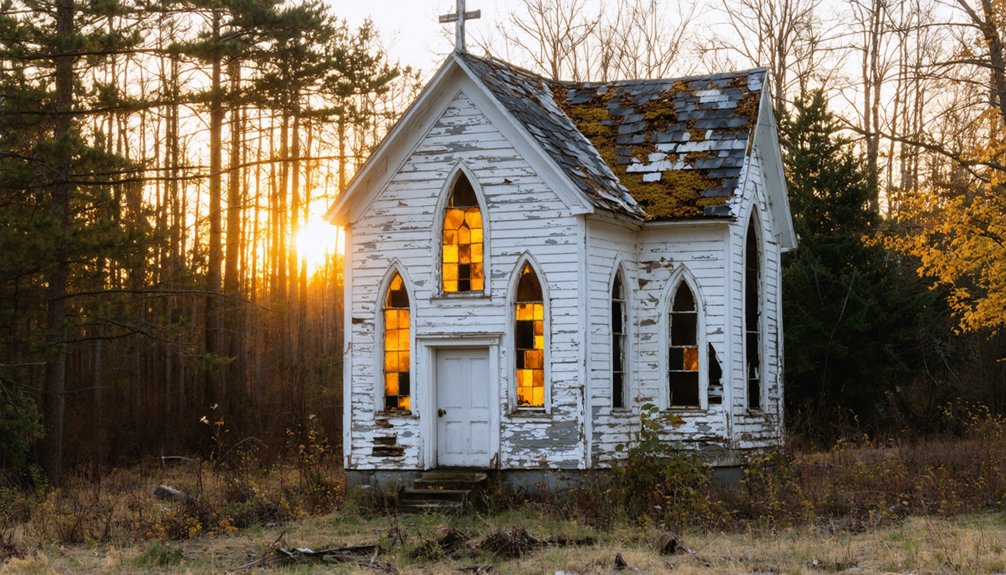
When photographing New Jersey’s ghost towns, you’ll confront extreme lighting challenges that define abandonment photography—from Batsto’s sun-drenched windows casting harsh shadows across iron forge interiors to Amatol’s munitions bunkers where darkness swallows nearly all ambient light.
Master these conditions with targeted techniques:
- Bracket exposures to capture both bright window light and dark corridor details in single composite images
- Deploy graduated neutral density filters during seasonal lighting shifts—autumn’s low-angle sun creates ideal conditions for balanced single-shot exposures
- Shoot upward from ground level with 24mm wide-angle lenses to emphasize structural vastness in compact spaces
- Focus on urban decay details—rusted machinery fragments, collapsed timber beams, discarded period objects—as powerful compositional anchors
Bring your tripod; New Jersey’s ghost towns demand long exposures that reveal their hidden character.
Respecting Historic Preservation and Property Rules
Though New Jersey’s abandoned settlements offer compelling subjects for documentation, you’ll navigate a complex preservation framework spanning three governmental tiers.
Documenting New Jersey’s ghost towns requires understanding federal, state, and local preservation laws that regulate these historically significant sites.
The National Historic Preservation Act of 1966, New Jersey’s Registration of Historic Places Act of 1970, and Municipal Land Use Law create overlapping jurisdictions that restrict alterations to exterior materials, construction, and even paint colors without planning board approval.
Historic building codes protecting sites like Feltville—which received over $6.5 million in preservation funding through New Jersey Historic Trust grants—reflect substantial public investment you’re obligated to respect.
While you’re free to photograph accessible grounds from dawn to dusk, understand that disturbing, removing, or receiving artifacts from public property remains illegal under N.J. Admin. Code § 7:7-9.34.
The 2023 Berardo case demonstrates how municipality overreach affects property rights, but archaeological protections remain non-negotiable.
Frequently Asked Questions
Are These Ghost Towns Safe to Visit With Children?
You’ll find most NJ ghost towns safe for children when sticking to maintained sites like Batsto and Waterloo Villages. However, urban exploration in remote Pine Barrens locations requires adult supervision and proper safety precautions due to unmarked trails and aging structures.
Can I Bring My Dog to New Jersey’s Historic Ghost Towns?
Your canine companion’s your passport here—you’ll find dog friendly restrictions minimal at New Jersey’s historic ghost towns. All four sites welcome leashed pets under state park regulations, though pet safety guidelines require six-foot leads and owner supervision throughout preserved grounds.
Do Any Ghost Towns Offer Guided Tours or Self-Guided Exploration Only?
You’ll find both options: Batsto and Waterloo Villages offer guided tours through historically preserved structures, while Feltville and Estell Manor provide unrestricted self-guided exploration of ghost town archaeology sites, giving you freedom to discover New Jersey’s abandoned settlements independently.
Are There Admission Fees to Visit These Abandoned Settlements?
You’ll find most New Jersey ghost towns completely free to explore, with state parks, county reservations, and historic districts offering unrestricted access. You can enjoy history preservation sites and photography opportunities without admission fees limiting your wandering.
Among the ghost towns to explore in New Jersey, you’ll discover remnants of past lives and the captivating stories they tell. Each site offers a unique glimpse into the state’s diverse history, where time seems to stand still. As you wander through the abandoned streets and crumbling buildings, you’ll feel a sense of adventure and curiosity, perfect for history buffs and thrill-seekers alike.
Many of these abandoned sites in New Jersey are steeped in legend, making them ideal for those intrigued by the supernatural. Visitors often share encounters with local folklore while exploring the eerie landscapes left behind. Each location invites you to unravel the mysteries of what once was, igniting your imagination as you delve deeper into the remnants of history.
What Nearby Amenities Exist for Dining or Restrooms During Visits?
Need conveniences during exploration? You’ll find parking facilities at Watchung Reservation and Allamuchy Mountain State Park, while restroom accessibility exists through nearby gas stations, diners, and park trailheads serving each ghost town location throughout Union, Burlington, and Sussex Counties.
References
- https://en.wikipedia.org/wiki/List_of_ghost_towns_in_New_Jersey
- https://jerseydigs.com/ghost-towns-in-nj/
- https://rsftripreporter.net/gone-goner-ghost-towns-new-jersey-pine-barrens-part/
- https://www.jerseysbest.com/community/take-a-road-trip-through-n-j-s-spooky-ghost-towns-to-see-peculiar-pieces-of-history/
- https://southjerseytrails.org/2017/03/16/six-pine-barrens-ghost-towns-to-explore/
- https://www.youtube.com/watch?v=ZIp3AYb0ulw
- https://pinelandsalliance.org/learn-about-the-pinelands/pinelands-history-and-culture/ghost-towns-of-the-pine-barrens/
- https://schifferbooks.com/products/ghost-towns-of-new-jersey
- https://foxattimbercreek.substack.com/p/ghost-towns-of-the-pine-barrens
- https://en.wikipedia.org/wiki/Batsto_Village