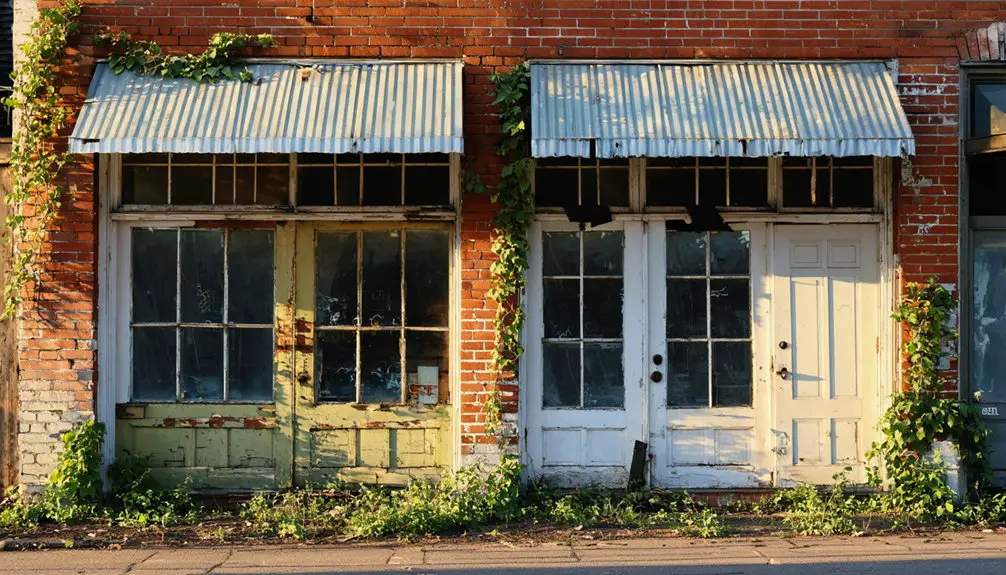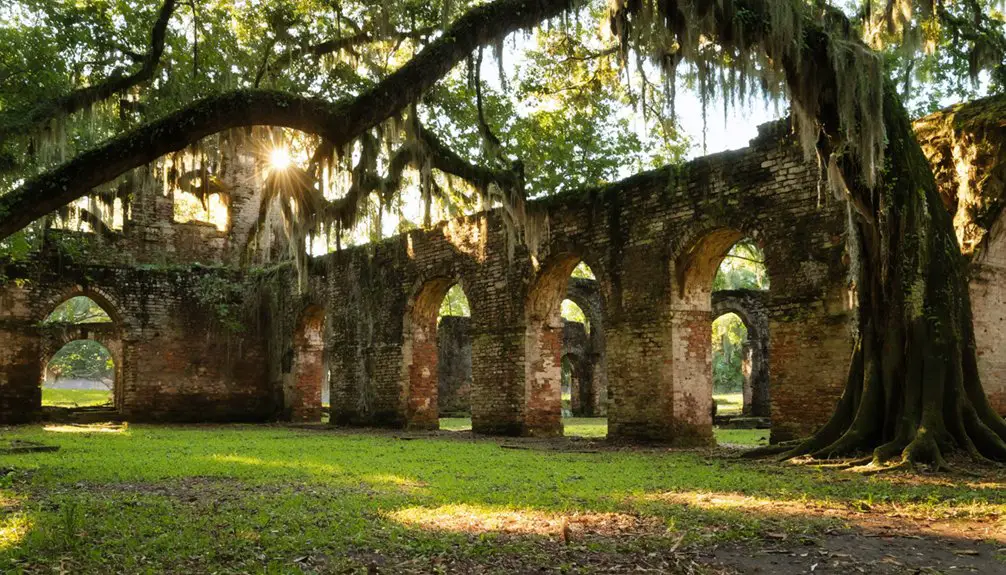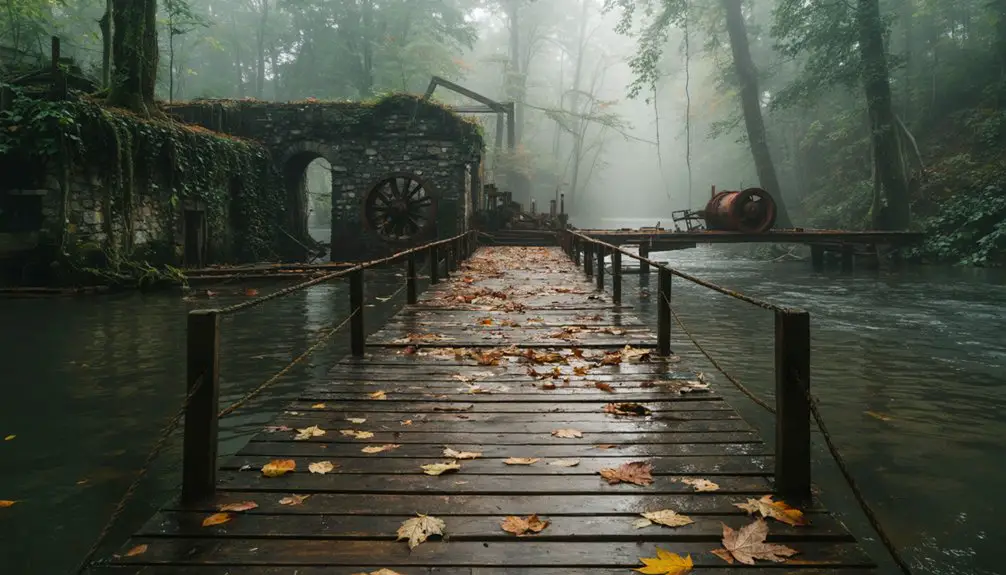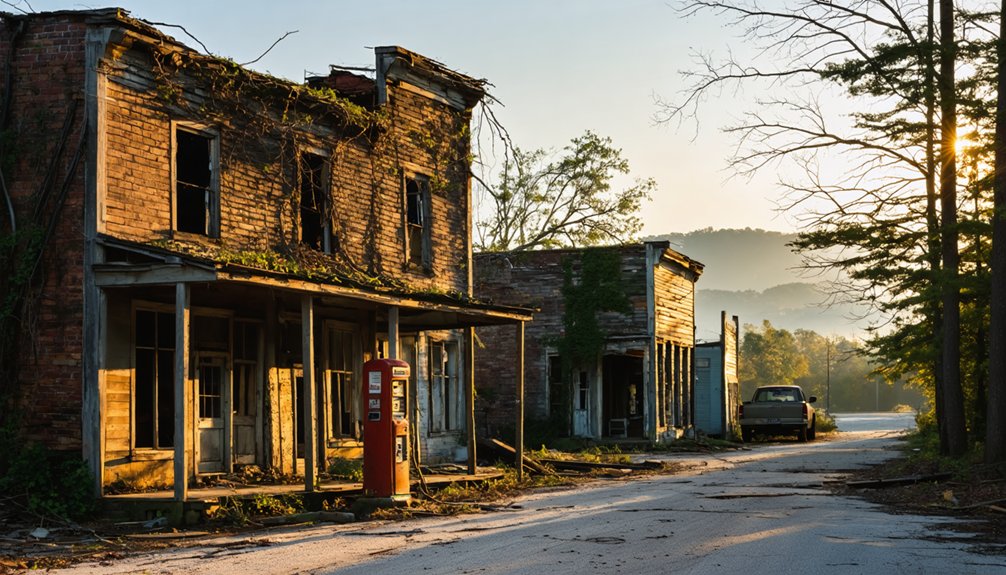
North Carolina’s ghost towns transport you from coastal fishing villages to submerged mountain settlements. You’ll find Henry River Mill Village‘s 35 worker cottages from *The Hunger Games*, Brunswick Town‘s Revolutionary War ruins, and Portsmouth Village‘s pristine 1800s structures accessible only by boat. Explore Proctor beneath Fontana Lake’s waters, Lost Cove’s isolated chimneys in Pisgah National Forest, or Cape Lookout Village’s preserved maritime community. Each site offers distinct historical periods—from colonial trade ports to Civil War fortifications—and varying accessibility levels that’ll match your adventure preferences and uncover deeper stories behind these abandoned communities.
Key Takeaways
- Henry River Mill Village in Burke County features 35 worker cottages and mill remnants, famous as *The Hunger Games* filming location.
- Portsmouth Village on Hatteras Island preserves 12 historic structures including a church and schoolhouse, accessible only by boat.
- Brunswick Town offers colonial ruins and Civil War earthworks, showcasing Revolutionary War history and Fort Anderson fortifications.
- Cape Lookout Village contains 20 preserved structures across 810 acres, reachable by ferry with historic life-saving station and lighthouse.
- Proctor, submerged beneath Fontana Lake, features accessible cemeteries and lumber mill ruins explored by kayak or hiking trails.
Henry River Mill Village: A Hollywood Ghost Town
Tucked away in the foothills of Burke County, Henry River Mill Village stands frozen in time—a haunting affirmation to North Carolina’s textile heritage and an unexpected Hollywood landmark. You’ll discover approximately 35 worker cottages showcasing 1920s architecture, a two-story boarding house, and the remnants of a once-thriving mill community founded in 1904.
This self-contained village operated for decades before economic pressures shuttered operations in the late 1960s.
The site gained fame as District 12’s filming location in The Hunger Games, transforming this authentic ghost town into a pilgrimage site for fans. The village infrastructure evolved significantly over the decades, transitioning from waterpower to electricity by 1926 to meet growing production demands. Now listed on the National Register of Historic Places, you can explore the 76-acre property on Saturdays.
Navigate crumbling structures and field stone retaining walls at your own risk—adventure awaits along the Henry River gorge. The village hosts annual seasonal events including Mill Village Fest, haunted tours, and Halloween festivities complete with paranormal storytelling and costume contests.
Brunswick Town: Colonial Ruins With Revolutionary History
You’ll discover Brunswick Town’s dramatic transformation from a thriving colonial port to Revolutionary War battleground.
The British troops razed the settlement in 1776 after inhabitants fled in fear of reprisal.
The ruins gained new purpose during the Civil War when Confederate engineers built Fort Anderson directly atop the abandoned town, creating earthworks that ironically preserved what lay beneath through nearly a century of obscurity.
Founded in 1726 and funded by the lucrative export of tar, pitch, and turpentine to Europe and the West Indies, the settlement once sprawled across 360 acres with over 300 lots, a courthouse, and jail.
The town shared its name with various places throughout history, from German duchies to Canadian provinces, reflecting the widespread influence of the House of Brunswick across the colonial world.
Today, you can walk among the exposed foundations where two wars left their mark—from burned colonial structures to Civil War trenches that still scar the landscape.
Revolutionary War Destruction
Before flames consumed Brunswick Town in 1776, this thriving Cape Fear River port had already earned its place in Revolutionary history as the site of the colonies’ first armed resistance against British taxation.
You’ll walk grounds where Patriots trapped Governor Tryon in 1766, forcing an end to stamp tax collection.
When war erupted, HMS Cruizer’s crew torched the settlement, leaving only St. Philip’s Church’s haunting walls standing among colonial architecture ruins.
Today, you’ll discover ancient artifacts and building foundations preserved beneath earthworks for over two centuries.
The 1958 archaeological excavations revealed a ghost town frozen in time—a place where liberty-seekers made their stand.
Trail markers guide you through what remains of America’s first violent rebellion against British authority.
At its peak in 1772, 142 ships departed the bustling port, carrying naval stores, tobacco, and furs to markets across the Atlantic.
The British fleet’s arrival at Cape Fear on March 12, 1776 marked the beginning of intensified naval operations that would seal the town’s fate.
Civil War Fort Anderson
Nearly a century after Revolutionary flames scarred this riverside settlement, Confederate forces transformed Brunswick Town’s abandoned grounds into a military stronghold.
In March 1862, Major General Samuel Gibbs French constructed Fort Anderson—earthen batteries rising from colonial foundations to guard Wilmington’s essential port. This Confederate defenses masterpiece showcased brilliant Civil War strategy, controlling the Cape Fear River’s lower reaches. Originally named Fort St. Philip, the fortification was renamed to honor Col. George B. Anderson.
You’ll discover impressive remains:
- Earthwork fortifications that sheltered troops in bombproofs during Union bombardments
- Sixty archaeological features revealing both colonial and military history
- St. Philip’s Church ruins standing sentinel among the earthworks
- Self-guided trails winding through strategic cannon positions
The fort held until February 1865, delaying Union advances for weeks after Fort Fisher‘s fall. After enduring intense bombardment and facing encircling Union forces, Confederates abandoned the stronghold on February 19, 1865, retreating northward toward Wilmington.
Today, you’ll walk where blockade runners once delivered precious supplies to Confederate forces fighting for their cause.
Portsmouth Village: A Coastal Ghost Town Accessible by Boat
You’ll need to board a passenger ferry from Ocracoke Island or navigate your own small vessel to reach Portsmouth Village, one of North Carolina’s most hauntingly beautiful ghost towns. Once you arrive on this windswept barrier island, you’ll discover about a dozen remarkably preserved structures—including a Methodist church, restored schoolhouse, post office, and Coast Guard station—standing as silent witnesses to a community that peaked at nearly 700 residents in 1860.
The National Park Service maintains this 250-acre historic site, where some homes remain so untouched they appear as if families simply stepped out for an afternoon, frozen in time since the final two residents departed in 1971. The village’s decline began after an 1846 hurricane severely damaged the port infrastructure and altered the island’s geography, making the once-vital shipping channel less navigable. Before visiting, remember to pack all necessary supplies including water, snacks, sunscreen, and bug repellent, as the island offers no amenities beyond a single restroom.
Boat-Only Access Required
Tucked along North Carolina’s Outer Banks, Portsmouth Village stands as one of the state’s most hauntingly beautiful ghost towns—and you’ll need a boat to reach it. This abandoned settlement within Cape Lookout National Seashore offers adventurers a rare glimpse into marine archaeology and thriving coastal ecosystems.
Your journey options include:
- Ferry service from Ocracoke Island: 20-minute crossings deliver you directly to Portsmouth
- Vehicle ferry from Atlantic or Davis: 45-minute trips with four to eight daily departures
- Private boats: Navigate through Ocracoke Inlet or Cedar Island to docks at either island end
- Charter services: Hatteras Island operators arrange custom excursions
Since Hurricane Dorian carved deep inlets across the beachfront road in 2019, vehicle access to the village is impossible. You’ll explore entirely on foot, surrounded by untamed coastal wilderness.
Preserved Buildings and Structures
Once you step off the boat onto Portsmouth’s sandy shores, approximately 12 historic structures await your exploration—silent witnesses to a once-thriving port community that handled two-thirds of North Carolina’s imports by 1852. You’ll discover the Methodist Church, rebuilt in 1914 after storm destruction, alongside the 1894 US Life-Saving Station where crews once rescued sailors from historic shipwrecks along these treacherous waters.
The schoolhouse and post office stand frozen in time, their interiors suggesting residents left mid-task. Unlike medieval architecture found inland, these coastal buildings reflect practical maritime design—weathered wood frames built to withstand Atlantic gales.
Wander through neighborhoods where homes, cemeteries, and community buildings remain remarkably intact under National Park Service stewardship, offering unfiltered glimpses into 19th-century island life.
Proctor: The Lumber Town Beneath Fontana Lake
Deep in the mountains of Swain County, the ghost town of Proctor lies submerged beneath the turquoise waters of Fontana Lake, its streets and buildings hidden since 1944. This thriving lumber industry hub once housed over 2,000 residents who built a self-sufficient mountain community complete with theaters, schools, and modern conveniences.
You’ll discover remnants of this community heritage by kayak or hiking trail:
- The haunting Calhoun House standing above the waterline
- Twenty-six cemeteries holding over 1,000 graves
- Ruins of the Ritter Lumber Mill
- Backcountry campsites for overnight exploration
World War II’s urgent need for power brought Fontana Dam’s construction, forcing residents from their homes. The promised 30-mile access road never materialized—locals call the incomplete seven-mile stretch the “Road to Nowhere.”
Lost Cove: An Isolated Settlement in Pisgah National Forest
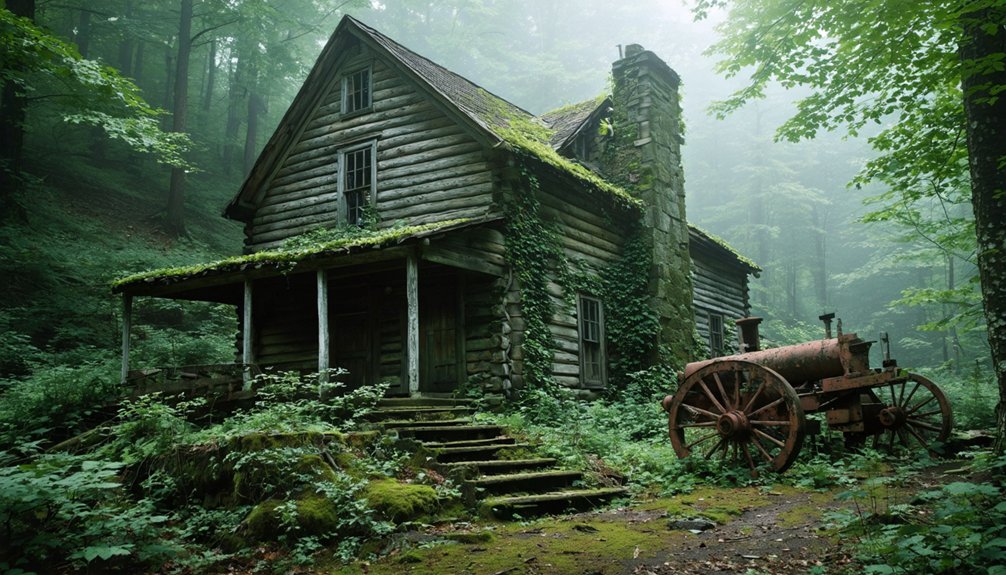
High in the rugged terrain of Yancey County’s Pisgah National Forest, Lost Cove earned its name through sheer isolation—a mountain settlement so remote that even legislators refused to build roads to reach it.
Lost Cove’s extreme isolation proved so daunting that government officials outright rejected constructing any roads to the mountain settlement.
Founded during the Civil War era, this logging and moonshine hub once housed 100 residents across 13-15 homes, sustained by two sawmills and a railroad stop.
When timber dwindled and trains switched to coal in the 1940s, the town’s fate was sealed. The last family departed in 1957.
Today, you’ll find cultural heritage preservation efforts protecting stone chimneys, building remnants, and Swin Miller’s rusted Chevy.
Remote hiking experiences via Lost Cove Trail reward adventurous souls willing to trek into the Nolichucky Gorge, where one of eastern America’s most legendary ghost towns awaits your discovery.
Cape Lookout Village: A Preserved Fishing Community
Unlike most North Carolina ghost towns hidden in mountain hollows, Cape Lookout Village sprawls across nearly 810 acres of windswept barrier island near Core Banks in Carteret County. You’ll discover this preserved fishing community within Cape Lookout National Seashore, where maritime heritage comes alive through 20 historic buildings showcasing Queen Anne and Craftsman architecture.
This seldom-visited destination thrived during the late 1800s before destructive hurricanes drove families to the mainland.
Today, you can explore:
- Cape Lookout Life-Saving Station (1888)
- Historic fishing cottages and vacation homes
- WWII coastal defense remnants
- Keeper’s Quarters and original boathouse
Reach this freedom-seekers’ paradise via passenger ferry or personal watercraft.
The harbor restoration and authentic structures transport you back to when resilient families carved lives from these barrier islands, leaving behind North Carolina’s most accessible coastal ghost town.
Frequently Asked Questions
Are Ghost Town Visits in North Carolina Safe for Children and Families?
You’ll find most North Carolina ghost towns safe for families when you stick to maintained sites like Brunswick Town, where historical preservation guarantees stable pathways. Always check photography restrictions beforehand, avoid structurally compromised buildings, and never enter boarded-up structures marking danger.
In addition to ghost towns, there are many haunted locations in North Carolina that offer unique experiences for those interested in the paranormal. Whether exploring old cemeteries or historic battlefields, always prioritize safety and respect for the sites and their history. With the right approach, these adventures can provide thrilling encounters with the past while ensuring a memorable time for everyone involved.
What’s the Best Time of Year to Visit North Carolina Ghost Towns?
Spring and fall offer you the best ghost town adventures—mild temperatures perfect for hiking remote sites, stunning photography opportunities with vibrant foliage, fewer crowds, and ideal conditions for exploring historical preservation efforts at fragile structures.
Do I Need Special Permits to Explore Abandoned Buildings in These Towns?
You’ll need permits for city-owned buildings and public lands, but many ghost towns offer freedom from public roads. Legal considerations protect preservation efforts—always respect private property boundaries while exploring North Carolina’s hauntingly beautiful abandoned landscapes responsibly.
In addition to ghost towns, there are numerous haunted locations in North Carolina that attract thrill-seekers and history buffs alike. Each location has its own rich tales of spirits and legend, offering insight into the region’s mysterious past. Whether you’re drawn by the stories or the adventure, these sites promise an unforgettable experience.
Exploring ghost towns in North Carolina reveals not just crumbling structures but also the echoes of lives once lived. Each town tells a story through its dilapidated buildings and forgotten streets, inviting visitors to delve into the past. As you wander through these eerie locales, you’ll uncover a sense of nostalgia and intrigue that makes every visit a journey into history.
Can I Camp Overnight Near Any of These Ghost Town Locations?
You can camp overnight at Devil’s Tramping Ground with reservations and at Proctor Ghost Town’s backcountry site. Check camping regulations for each location, and take wildlife precautions in remote areas where nature’s reclaimed these haunting settlements.
Are Guided Tours Available at North Carolina’s Ghost Town Sites?
You’ll discover guided candlelit tours through North Carolina’s ghostly settlements, where historical preservation meets spine-tingling tales. Expert storytellers lead you through abandoned colonial streets and cemeteries, creating unforgettable photography opportunities amid centuries-old mysteries and atmospheric ruins.
References
- https://www.atlasobscura.com/things-to-do/north-carolina/ghost-towns
- https://www.youtube.com/watch?v=iWhjTfCyUpY
- https://www.ghosttowns.com/states/nc/nc.html
- https://takingthekids.com/abandoned-north-carolina-destinations-every-explorer-should-visit/
- https://www.visitnc.com/list/ncs-mysterious-disappearances-and-abandoned-places
- http://www.onlyinyourstate.com/experiences/north-carolina/nc-ghost-towns
- https://en.wikipedia.org/wiki/Henry_River_Mill_Village
- https://roadtrippers.com/magazine/henry-mill-river-hunger-games-district-12/
- https://www.romanticasheville.com/henry-river
- https://henryrivermillvillage.com/history/