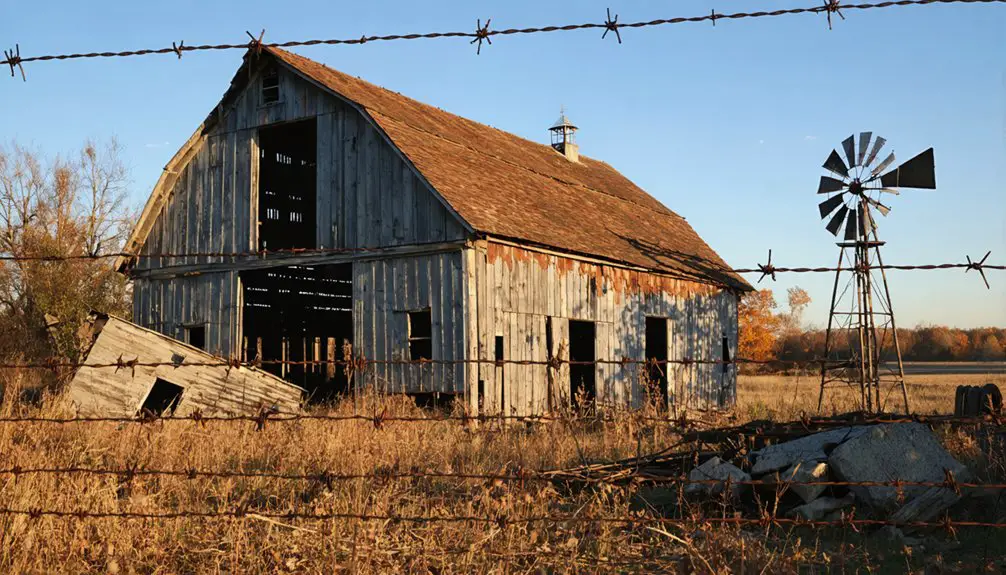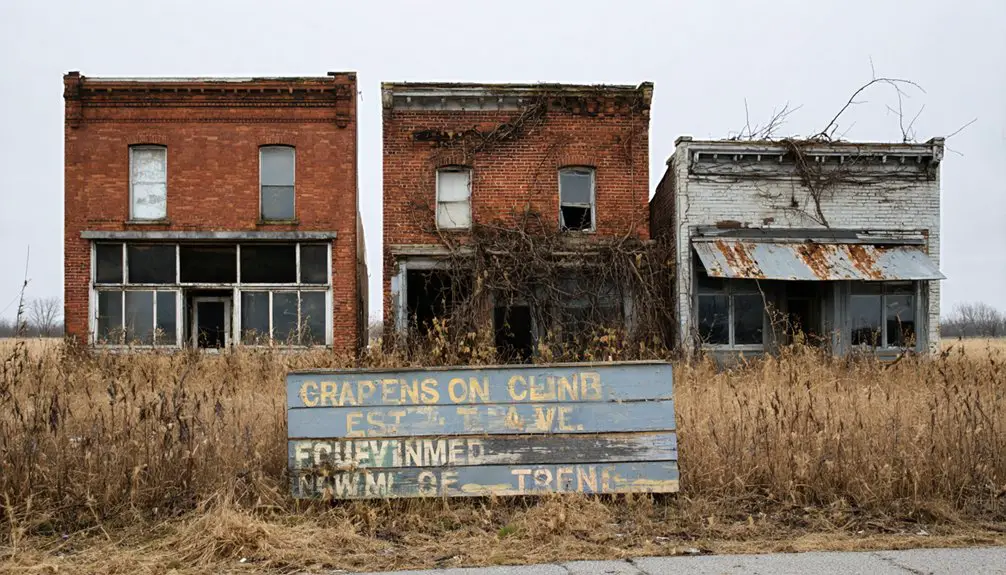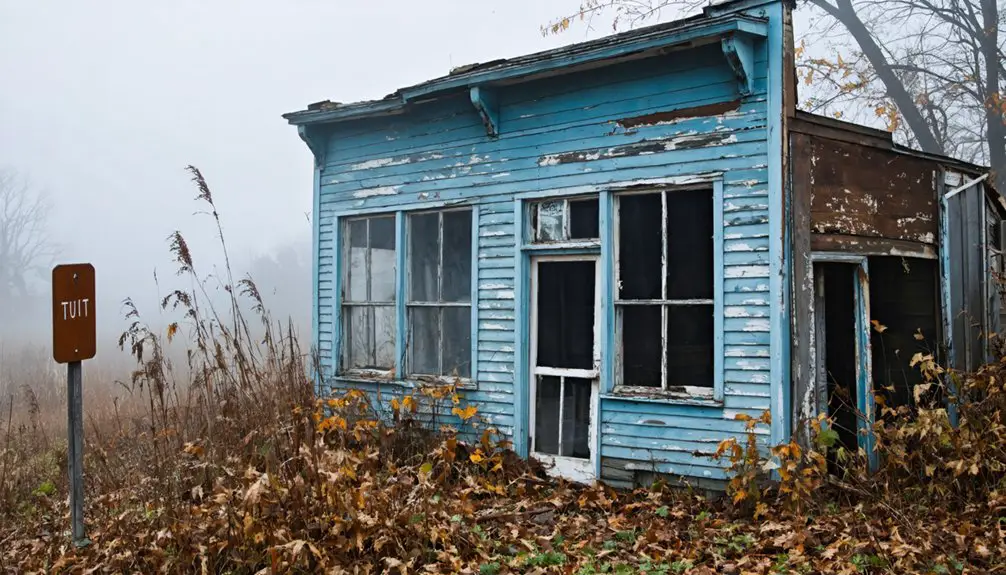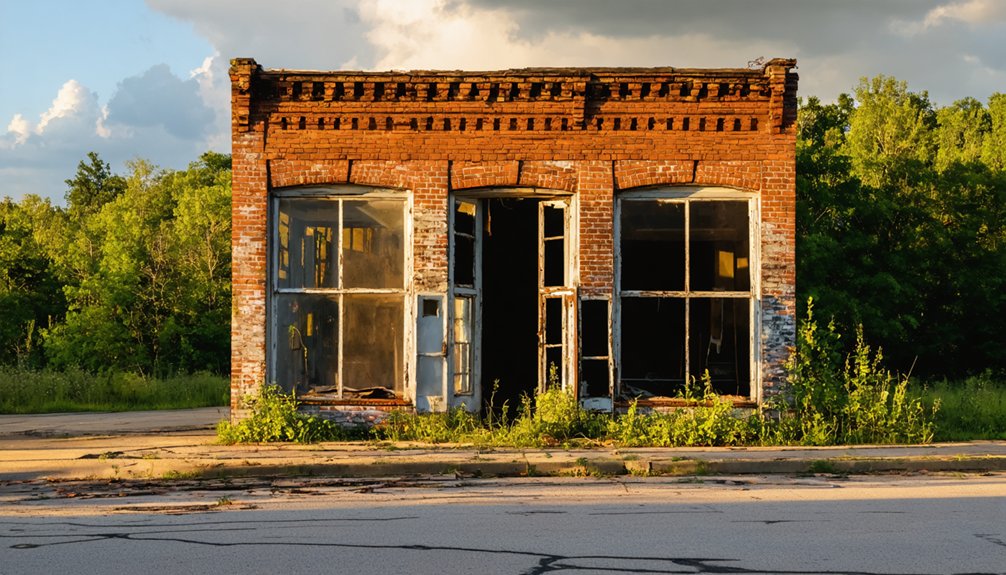
You’ll find Ohio’s most enchanting ghost towns scattered through state parks and forests, where history whispers through abandoned structures. Explore Moonville’s haunted railroad tunnel in Vinton County, Boston Mills’ eerie remnants in Cuyahoga Valley National Park, or Sprucevale’s crumbling canal locks in Beaver Creek State Park. Vinton Furnace showcases 24 Belgian coke ovens from the failed iron industry, while Shaker Village preserves communal architecture from 1824. Each site offers unique photography opportunities, from overgrown foundations to brick industrial ruins, with stories that’ll transport you deeper into Ohio’s forgotten past.
Key Takeaways
- Boston Mills (Helltown) in Summit County features urban legends, Boston Cemetery, and remnants of an 1805 settlement displaced for Cuyahoga Valley National Park.
- Moonville Tunnel in Vinton County offers ghost stories, the 1856 brick archway, cemetery, and accessible hiking via the Moonville Rail Trail.
- Sprucevale in Beaver Creek State Park showcases 1837 canal ruins, Hambleton Mill remains, lock systems, and Gretchen’s Lock crypt with ghost legends.
- Haydenville displays over 120 preserved brick structures from an 1852 company town, illustrating Ohio’s extensive iron industry and corporate industrial culture.
- Vinton Furnace features 24 Belgian coke ovens and iron industry ruins from 1854, representing Ohio’s failed modernization efforts and industrial decline.
Boston Mills: The Helltown Legend
Nestled in the rolling hills of Summit County, Boston Mills began as a promising frontier settlement in 1805, when surveyors Alfred Wolcott and James Stanford mapped out what would become the oldest community in the region.
By 1821, sawmills dotted the landscape, giving the village its name and modest prosperity.
The Ohio and Erie Canal, completed between 1825 and 1827, transformed the local economy by facilitating transportation of lumber and agricultural products.
Everything changed in the 1970s when the government acquired properties for Cuyahoga Valley National Park, displacing residents and boarding up homes.
President Gerald Ford signed legislation in 1974 that authorized land acquisition via eminent domain, forcing property owners to sell at government-set prices with little opportunity for negotiation.
What remained spawned “Helltown”—a collection of urban legends about upside-down crosses, ghostly school buses, and a mutant Peninsula Python.
These historical myths have been debunked: the church’s crosses reflect architectural style, the bus housed a family, and no giant snake exists.
Yet Boston Cemetery still stands, keeping the legend alive.
Moonville: A Haunted Railroad Legacy
Deep in Vinton County’s woods, you’ll find the crumbling Moonville Tunnel standing as a dark portal to Ohio’s most tragic railroad past. Over 21 souls met violent deaths along this isolated eight-mile stretch of track, where heavy timber muffled approaching trains and trapped unsuspecting travelers on trestles and inside the tunnel itself.
Today, you can walk the Moonville Tunnel Rail Trail and search for the lingering spirits—from Engineer Theodore Lawhead swinging his phantom lantern to the Lavender Lady who appears where the tracks once claimed her life. The abandoned railroad line was pulled up in 1988, but the tunnel and old right-of-way remain accessible to those seeking this haunted destination. The name Moonville refers to multiple geographic locations, though this particular site remains the most famous for its supernatural legends.
The Moonville Tunnel Legend
Along the abandoned railway cutting through southeastern Ohio’s Vinton County, the Moonville Tunnel emerges from the hillside like a dark portal into the past. This brick-lined passage through Henry Ferguson’s property earned its name from the full moon’s eerie glow overhead on certain nights.
Between the 1850s and 1978, over 21 deaths occurred on these treacherous tracks, spawning haunted legends that draw seekers to this day.
Four spectral figures dominate the ghost stories: Engineer Theodore Lawhead, who perished in an 1880s head-on collision, now holds his lantern while floating near the tunnel stones.
The Brakeman, crushed while drunk on the rails in 1859, stumbles eternally toward departing trains.
The Lavender Lady—Mary Shea—walks the trail before vanishing in fragrant mist, while mysterious lights dance through the darkness.
The town itself was established around the railroad construction in 1856, when Samuel Coe granted land to the Marietta and Cincinnati Railroad, creating a community that would peak at approximately 100 residents before its eventual abandonment. The railway became part of the Baltimore and Ohio Railway in 1883, continuing operations until the town’s decline in the 1940s.
Exploring the Rail Trail
You can explore the tunnel’s weathered brick archway, discover the schoolhouse foundation, and visit the quiet community cemetery where residents rest.
Community revitalization continues through annual events and planned expansions linking to Lake Alma State Park. The old rail bed has been transformed into a multi-use trail for horseback riding, biking, and hiking. The Moonville Rail Trail Association, formed in 2001, works to preserve the remaining structures and historical significance of the site. These tangible fragments offer something legends can’t—genuine connection to Moonville’s vanished world.
Sprucevale: Canal Town Remnants
You’ll find Sprucevale hidden within Beaver Creek State Park in eastern Ohio’s Columbiana County.
A failed canal venture from the 1830s left behind crumbling locks and forgotten dreams. This ghost town emerged alongside the Sandy & Beaver Canal in 1837, and it thrived briefly around a grist mill on Beaver Creek.
Then, by 1870, it vanished when chronic water shortages doomed the entire waterway system.
Today, you can walk the park trails to discover the stone remnants of Gretchen’s Lock and explore the site where two tragic legends—one of a young girl entombed in masonry, another of a jilted bride—still haunt the August nights. The historic Hambleton Mill stands as one of the town’s most significant remnants. The canal’s construction employed engineer E.H. Gill, whose Dutch heritage and European journey would become central to the area’s most enduring ghost story.
History and Early Settlement
The town’s position on Beaver Creek made it essential for regional trade throughout the 1830s and 1840s. You can still explore remnants of this ambitious venture, where lock systems and mill ruins stand as monuments to pioneers who chased opportunity along Ohio’s waterways.
Exploring the Ghost Town
Nestled within Beaver Creek State Park’s 2,722 wooded acres, Sprucevale’s skeletal remains tell stories of ambition turned to dust. You’ll discover Hambleton’s Mill ruins first—stone arches still directing phantom water flows. One house survives from twelve original homes, while the cotton mill’s graffiti-covered interior beckons urban explorers.
Trails wind past canal lock systems built in 1836, their masonry foundations marked by interpretive signs explaining vanished barn sites.
The abandoned architecture merges seamlessly with haunted legends: Gretchen’s Lock holds the crypt where a canal engineer’s daughter was temporarily entombed. Fireplace remnants and sandstone cliffs punctuate your journey through this wilderness reclaimed.
Access via Sprucevale Road reveals how quickly nature erases human ambition—by 1870, economic collapse had returned these canal dreams to forest silence.
Getting to Sprucevale
From Ohio’s eastern corridor, Sprucevale Road cuts through Beaver Creek State Park like a forgotten artery to the past. You’ll navigate between Pancake-Clarkson Road and Echo Dell Road, where trailheads beckon you toward archaeological evidence of the 1837 settlement.
Park along Sprucevale and venture north into the woods above Little Beaver Creek—coordinates 40.708519, -80.576598 mark your destination.
Historical preservation efforts maintain paths leading to Hambelton Mill’s stone skeleton and crumbling canal locks. You’ll descend through hardwood forest to discover Gretchen’s Lock, cotton mill foundations, and remnants of workers’ cabins.
The bridge spanning Beaver Creek grants easy access, though the real treasures hide beyond pavement’s reach. Follow the waterway upstream where middle and west forks converge, and you’ll find yourself walking through commerce routes that died in 1870.
Vinton Furnace: Iron Industry Relics
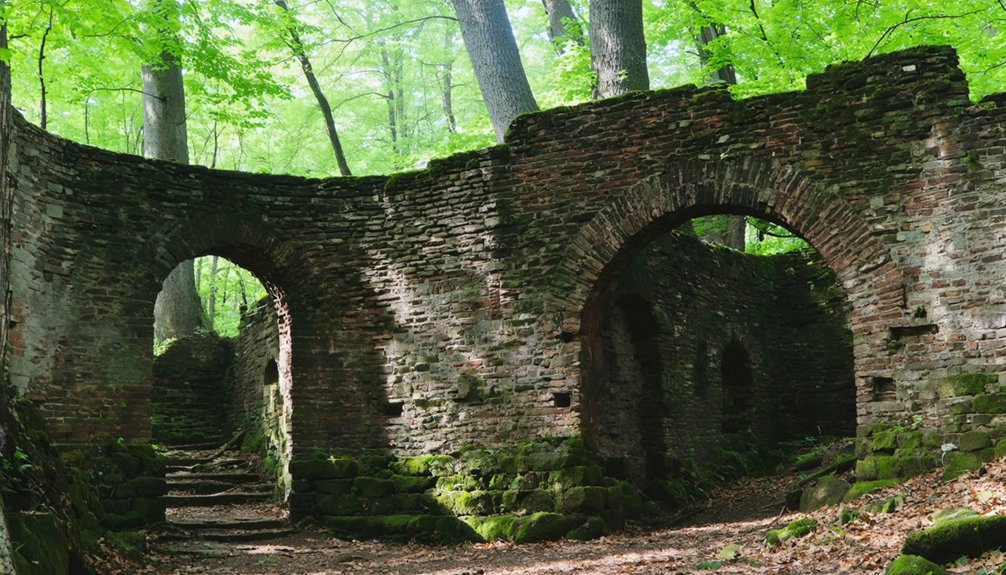
Deep within Vinton Furnace State Forest, southeast of McArthur, stone ruins whisper stories of Ohio’s industrial ambitions. You’ll discover 24 Belgian coke ovens standing as proof of a bold but failed experiment in industrial archaeology.
Twenty-four Belgian coke ovens stand as haunting monuments to industrial ambition that couldn’t overcome Ohio’s sulfur-rich coal.
Founded in 1854, Vinton Furnace once powered Union railroads and armies, producing 6,000 tons yearly from its modernized 50-foot stack.
The 1875 conversion to coke promised prosperity, but local coal’s high sulfur content doomed the operation. By 1883, Lake Superior’s superior ore ended the dream entirely.
Today, these crumbling stone remnants represent essential heritage preservation—rare physical evidence of the Hanging Rock Iron Region‘s struggle to adapt.
Walk among these silent sentinels, and you’re touching the raw ambition of pioneers who refused conventional limits.
Shaker Village: Religious Community Ruins
Along the banks of the Dry Fork of White Water River in Hamilton County, twenty brick and frame structures stand as Ohio’s best-preserved Shaker settlement. You’ll find the country’s only remaining brick Shaker meeting house here, where believers practiced their distinctive spirituality from 1824 to 1916.
The communal architecture tells stories of celibate residents who chose collective living over individual ownership, building workshops, dwellings, and barns across 600 acres of fertile land.
Walk through the 1827 meeting house and 1832 dwelling to witness Shaker spirituality’s physical manifestation—simple lines, functional design, and craftsmanship that supported their thriving broom and seed industries.
Great Parks of Hamilton County now preserves these structures, offering you direct access to authentic nineteenth-century communal life without modern reconstruction.
Haydenville: Ohio’s Last Company Town
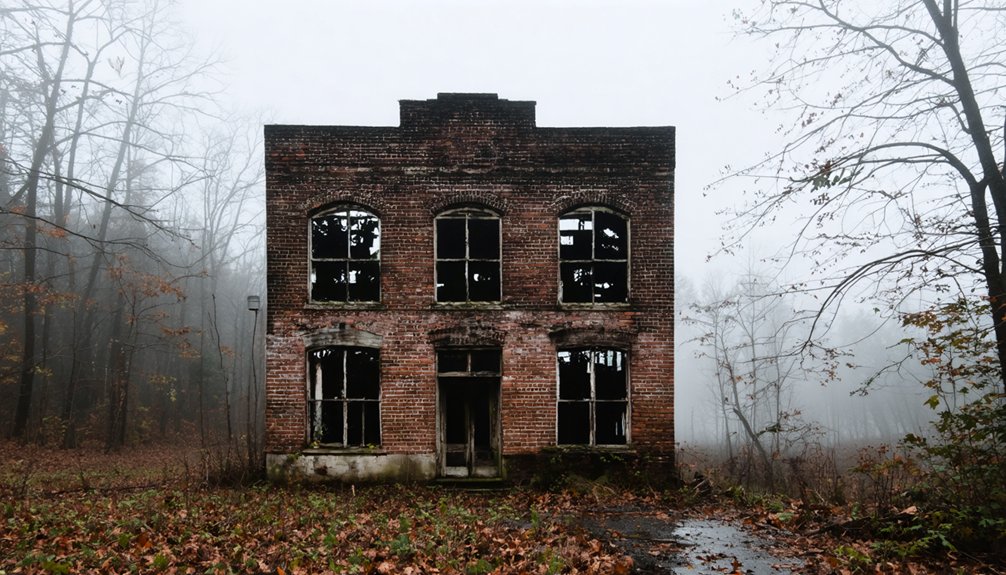
When Peter Hayden surveyed the coal-rich hills of Hocking County in 1852, he envisioned more than a mining operation—he planned a self-contained world where workers would live, shop, and labor entirely within his industrial ecosystem. By 1882, his company controlled everything: houses, stores, even the currency. Employees received scrip usable only at company outlets, and losing your job meant immediate eviction.
Today, you’ll discover America’s industrial history preserved in over 120 brick structures standing as silent monuments to corporate control. Listed on the National Register in 1973, preservation efforts saved these architectural testimonies after the last plant closed in 1962.
Workers finally gained freedom to purchase their homes in the early 1960s—a liberation decades overdue. The atmospheric railroad tunnel adds haunting character to this remarkably intact company town.
Planning Your Ghost Town Adventure
Before you set foot in Ohio’s forgotten settlements, you’ll need more than curiosity—proper preparation separates memorable adventures from dangerous mishaps.
Your gear list should include sturdy hiking boots for traversing overgrown paths, GPS devices for finding unmarked locations like Boston Mills, and cameras to document crumbling structures before they vanish entirely.
Timing matters too, as spring and fall offer ideal conditions when vegetation won’t obscure historical details and daylight hours stretch long enough for thorough exploration.
Essential Gear and Supplies
Exploring Ohio’s crumbling ghost towns demands preparation that goes beyond grabbing a flashlight and heading out the door. You’ll need cut-resistant gloves and sturdy boots to navigate rusty surfaces and uneven terrain where local legends whisper through broken windows.
Pack a headlamp for hands-free navigation through pitch-black structures, plus backup batteries—total blackout isn’t an adventure.
A respirator mask filters decades of asbestos and mold, while long sleeves protect against overgrown vegetation and wildlife encounters lurking in forgotten corners.
Don’t forget your fully charged smartphone, first-aid kit, and multi-tool for unexpected repairs.
A good backpack organizes everything, leaving your hands free to document these haunting relics.
Two-way radios keep your group connected where cell signals fear to tread.
Safety Tips for Exploration
Rust-stained floorboards groan beneath your weight as sunlight filters through collapsed roofing—this is the moment where excitement meets consequence in Ohio’s abandoned settlements.
Before chasing urban legends through decaying doorways, understand the legal considerations: trespassing charges and fines await those who ignore posted warnings.
Always travel in groups of three minimum—if injury strikes, one stays while another seeks help.
Watch for wildlife in overgrown structures; black bears and bobcats increasingly roam southeastern Ohio.
Test every surface before trusting your weight to rotting staircases or mine shafts.
Inform someone of your location and return time.
Carry identification, first-aid supplies, and animal repellents.
Stay sober, respect boundaries, and leave only footprints.
Your freedom depends on smart choices, not reckless abandon.
Best Seasons to Visit
When October’s amber light streams through skeletal window frames and crimson leaves blanket forgotten foundations, Ohio’s ghost towns transform into living postcards of abandonment.
You’ll catch peak foliage during the October 11-12 Fall Foliage Tour, when seasonal flora paints Holden Arboretum’s canopy walk in breathtaking hues.
Spring’s March and May guided tours through Little Egypt offer cooler temperatures and wildflower-dotted trails minus summer’s oppressive heat.
However, wildlife activity peaks during fall turkey season around Vinton Furnace—wear bright colors if you’re exploring backcountry sites.
Midweek visits guarantee solitude at places like Moonville Tunnel, where crunching leaves amplify the eerie atmosphere.
Winter’s stark quiet intensifies Boston Mills‘ haunted reputation, while spring’s emptier paths lead you to forgotten cemeteries and moss-covered foundations without crowds blocking your discovery.
What to Bring on Your Exploration
As abandoned buildings creak in the wind and floorboards threaten to give way beneath your weight, the gear you’ve packed becomes your lifeline between curiosity and catastrophe. Your gear checklist should include cut-resistant gloves, sturdy boots, and long clothing to shield against rusty nails and thorny vegetation.
In crumbling ruins where danger lurks beneath every step, your equipment transforms from simple supplies into essential survival tools.
Pack at least two flashlights per person, plus a headlamp for hands-free exploration—night safety demands redundant lighting when electricity’s been dead for decades. Don’t forget your first-aid kit, multi-tool, and water bottle for extended adventures through Ohio’s forgotten settlements.
A respirator mask protects against asbestos and mold in decaying structures, while communication equipment keeps your group connected when exploring remote corners where cell towers can’t reach.
Document everything with your camera—these ghost towns won’t wait forever.
Safety Tips for Visiting Abandoned Sites

Beneath the collapsed roofline of an 1880s schoolhouse or inside the crumbling walls of a forgotten factory, Ohio’s ghost towns harbor dangers that’ve claimed their share of careless explorers. Hazard awareness starts with testing every surface before trusting your weight—floors give way, staircases crumble, and ceilings collapse without warning.
Watch for snakes coiled in corners and poison ivy threading through doorways. Legal considerations matter too: respect no trespassing signs to avoid fines or arrest, and always seek permission on private property.
Travel with at least two companions, carry your phone and first-aid kit, and tell someone your plans. Navigate with deliberate steps, inspecting hand and foot placement.
The freedom to explore abandoned Ohio demands respect for both structure and law.
Photography Opportunities in Ohio’s Ghost Towns
Once you’ve learned to navigate Ohio’s abandoned sites safely, you’ll want to capture their haunting beauty through your lens. Moonville Tunnel delivers ghostly long exposures along moonlit track beds, while its skeletal settlement structures frame perfect urban decay compositions.
Haydenville’s 1852 brick homes showcase preserved industrial textures—National Register sites that emphasize historical preservation through weathered surfaces and dramatic tunnel lighting.
San Toy’s overgrown foundations tell boomtown stories through atmospheric wilderness blends, while Ash Cave’s winter waterfall freezes into elegant ice formations beneath pale apparition trails.
Tadmor’s Miami Erie Canal relics capture nature-reclaimed infrastructure along Buckeye Trail access points. You’ll find raw, authentic perspectives in these forgotten places—unedited documentation of Ohio’s vanished communities waiting for your creative vision.
Frequently Asked Questions
Are Ghost Town Visits in Ohio Free or Do They Require Entrance Fees?
You’ll find most Ohio ghost towns are completely free to explore, with no entrance fees or ticket costs holding you back. These abandoned sites welcome adventurers ready to roam historic ruins at their own pace.
In the eerie silence of these forgotten places, you might come across ghostly tales from Ohio’s towns that linger in the air. Locals often share stories of spectral sightings and strange happenings that add an extra layer of intrigue to your exploration. Each town has its own unique history, waiting to be uncovered by those brave enough to listen to the whispers of the past.
As you wander through the remnants, you may find hints of the everyday lives once led in these ghost towns in Ohio history, echoed in the decaying buildings and overgrown pathways. Each abandoned structure invites curiosity, prompting reflections on how the towns fell into disrepair and what stories they might tell if walls could speak. With every step, the eerie atmosphere deepens, drawing you closer to the forgotten narratives that shaped these once-thriving communities.
What Is the Best Time of Year to Visit Ohio’s Ghost Towns?
Fall’s your prime window for exploring Ohio’s ghost towns. You’ll capture stunning photography opportunities amid vibrant foliage, enjoy ideal seasonal weather between 30-60°F, and roam freely through haunted remnants without summer’s crowds slowing your adventure.
As you explore fall ghost towns in Ohio, be sure to take a moment to immerse yourself in the local history and eerie legends that surround these abandoned places. Each town tells a unique story, and the fall atmosphere adds a haunting charm that enhances the experience. Bring along a cozy sweater and a camera to capture the beauty of these forgotten sites, making memories that will last long after the leaves have fallen.
Can You Camp Overnight Near Any of Ohio’s Ghost Towns?
You’ll find overnight camping near several Ohio ghost towns, where historical preservation meets adventure. Ruin Ridge offers apocalypse-themed sites by Moonville, while Beaver Creek’s campgrounds let you explore local legends at Sprucevale’s haunting ruins under starlit skies.
Are Guided Tours Available for Any Ohio Ghost Town Locations?
Yes, you’ll discover guided tours throughout Ohio’s historic towns where history preservation meets tourism development. Springboro, Waterville, Dublin, and Marietta offer immersive walking experiences, paranormal investigations, and trolley rides through storied streets where the past comes alive.
Which Ohio Ghost Towns Are Most Accessible for Families With Children?
Ghost Town in Findlay offers your family the most accessible experience, with historical preservation showcased through restored 1880s buildings, clear vehicle access, and family-friendly activities including arts vendors and antique markets—no strenuous hiking required for adventure-seeking kids.
References
- https://ohioghosttowns.org/top-10-ghost-towns/
- https://wrkr.com/ohio-ghost-towns/
- https://www.onlyinyourstate.com/trip-ideas/ohio/road-trip-ghost-towns-oh
- https://hockingvacations.com/blog/exploring-the-ghost-towns-of-ohio-unearthing-forgotten-histories
- https://www.youtube.com/watch?v=ONB5GV9T-GI
- https://ohioghosttowns.org
- https://www.youtube.com/watch?v=MqeHr-inQ08
- https://allthatsinteresting.com/helltown-ohio
- https://www.thewanderingoddball.com/post/the-road-to-hell-dorado-helltown-ohio
- https://thelittlehouseofhorrors.com/helltown/